Chemical Equations That’s what it’s ALL about  Grooooovey baby…yeah!!
What is a chemical equation? It is a symbolic representation of a chemical reaction, that is balanced and represents the states of matter That’s soooo exciting!…yeah ok, not really
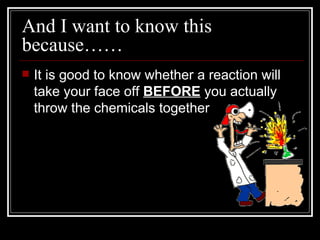
And I want to know this because…… It is good to know whether a reaction will take your face off  BEFORE  you actually throw the chemicals together
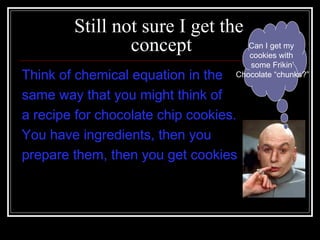
Still not sure I get the  concept Think of chemical equation in the  same way that you might think of  a recipe for chocolate chip cookies. You have ingredients, then you  prepare them, then you get cookies Can I get my  cookies with  some Frikin’ Chocolate “chunks?”
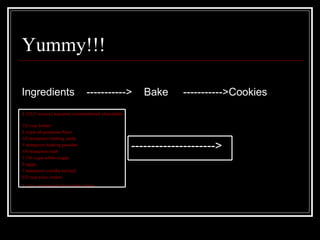
Yummy!!! Ingredients  ----------->  Bake  ----------->Cookies 2 1/2 (1 ounce) squares unsweetened chocolate 
 1/2 cup butter 
 2 cups all-purpose flour 
 1/2 teaspoon baking soda 
 1 teaspoon baking powder 
 1/4 teaspoon salt 
 1 1/4 cups white sugar 
 2 eggs 
 1 teaspoon vanilla extract 
 2/3 cup sour cream 
 2 cups semisweet chocolate chips   --------------------->
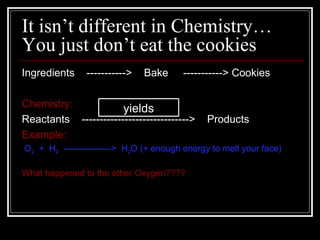
It isn’t different in Chemistry… You just don’t eat the cookies Ingredients  ----------->  Bake  -----------> Cookies Chemistry: Reactants  ------------------------------>  Products Example: O 2   +  H 2   ---------------->  H 2 O (+ enough energy to melt your face) What happened to the other Oxygen???? yields
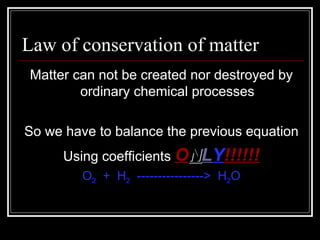
Law of conservation of matter  Matter can not be created nor destroyed by ordinary chemical processes So we have to balance the previous equation Using coefficients  O N L Y !!!!!! O 2   +  H 2   ---------------->  H 2 O
ONCE AGAIN…. COEFFICIENTS ONLY!!!!!!!!!
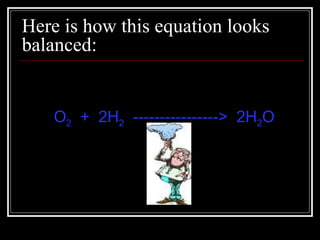
Here is how this equation looks balanced: O 2   +  2H 2   ---------------->  2H 2 O
How do I balance an equation? The basic concept is to use coefficients ONLY to be sure that there are the same number of moles of stuff on the left side as there are on the right. This can be done by counting single elements on both sides and look for lowest common factors
This could get a bit tedious…are there some shortcuts? Yes: Look for polyatomic ions common on both sides and treat them as one element Look for lowest common factors to determine the correct coefficients ALWAYS double check when you are done!!!! Anything else I need to know about equations??
Oh YEEEES! States of matter of each reactant and product Reaction types and other CRAPO(N) Metal activity Nonmetal activity Solubility Endo/Exothermic
STATES OF MATTER OF REACTANTS AND PRODUCTS Since some chemicals react differently (or are more dangerous) when they are liquids, solids, or gasses, it is useful to determine this ahead of time Greenhouse solids would  be a lot better than  greenhouse gasses
HERE ARE THE MOST COMMON WAYS TO EXPRESS STATES OF MATTER SOLID (s) LIQUID (l) GAS (g) AQUEOUS  (DISSOLVED IN WATER)  (aq) CRYSTALLINE (cr) There are one or two other obscure ones but these are the real important ones
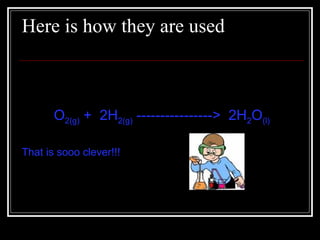
Here is how they are used   O 2(g)  +  2H 2(g)  ---------------->  2H 2 O (l) That is sooo clever!!!
THIS IS A BUNCH OF…. CRAP!!!!
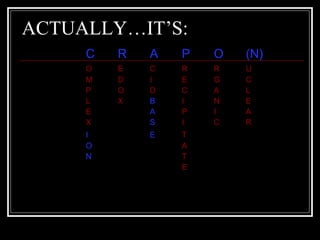
ACTUALLY…IT’S: C R A P O (N) O E C R R U M D I E G C P O D C A L L X B I N E E A P I A X S I C R I E T O A N T E
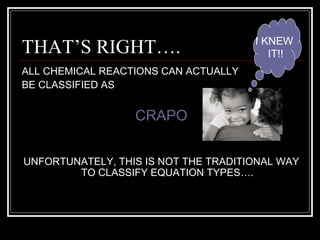
THAT’S RIGHT…. ALL CHEMICAL REACTIONS CAN ACTUALLY  BE CLASSIFIED AS CRAPO (NUCLEAR IS NOT CLASSIFIED AS CHEMICAL) UNFORTUNATELY, THIS IS NOT THE TRADITIONAL WAY TO CLASSIFY EQUATION TYPES…. I KNEW  IT!!
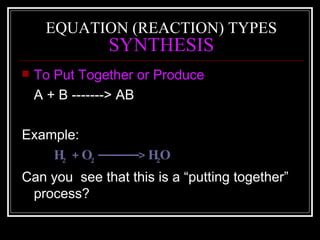
EQUATION (REACTION) TYPES   SYNTHESIS  To Put Together or Produce A + B -------> AB Example: H 2   + O 2  -----------> H 2 O Can you  see that this is a “putting together” process?
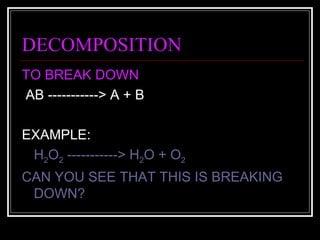
DECOMPOSITION TO BREAK DOWN AB -----------> A + B EXAMPLE: H 2 O 2  -----------> H 2 O + O 2 CAN YOU SEE THAT THIS IS BREAKING DOWN?
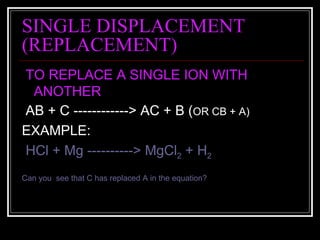
SINGLE DISPLACEMENT (REPLACEMENT) TO REPLACE A SINGLE ION WITH ANOTHER AB + C ------------> AC + B ( OR CB + A) EXAMPLE: HCl + Mg ----------> MgCl 2  + H 2 Can you  see that C has replaced A in the equation?
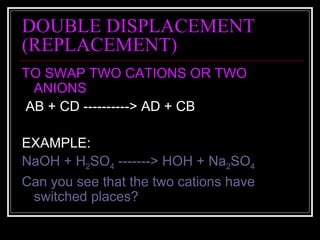
DOUBLE DISPLACEMENT (REPLACEMENT) TO SWAP TWO CATIONS OR TWO ANIONS AB + CD ----------> AD + CB EXAMPLE: NaOH + H 2 SO 4  -------> HOH + Na 2 SO 4 Can you see that the two cations have switched places?
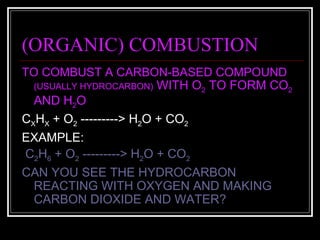
(ORGANIC) COMBUSTION TO COMBUST A CARBON-BASED COMPOUND  (USUALLY HYDROCARBON)  WITH O 2  TO FORM CO 2  AND H 2 O C X H X  + O 2  ---------> H 2 O + CO 2 EXAMPLE: C 2 H 6  + O 2  ---------> H 2 O + CO 2 CAN YOU SEE THE HYDROCARBON REACTING WITH OXYGEN AND MAKING CARBON DIOXIDE AND WATER?
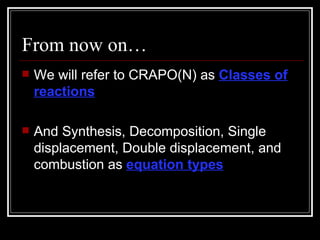
From now on… We will refer to CRAPO(N) as  Classes of reactions And Synthesis, Decomposition, Single displacement, Double displacement, and combustion as  equation types
ACTIVITY SERIES!!!!! Do reactions occur every time chemicals are put together?  Of course not…if they did we would change every time we came in contact with another chemical Help me!! I’m melting
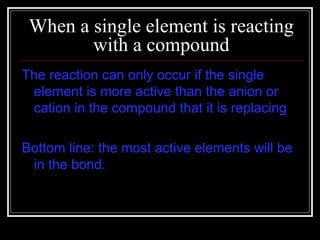
When a single element is reacting with a compound The reaction can only occur if the single element is more active than the anion or cation in the compound that it is replacing Bottom line: the most active elements will be in the bond.
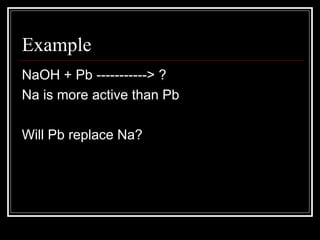
Example NaOH + Pb -----------> ? Na is more active than Pb Will Pb replace Na?
NO!!!!!!!! Remember the most active elements will be in the bond
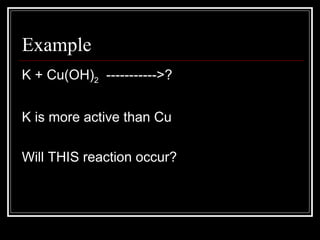
Example K + Cu(OH) 2   ----------->? K is more active than Cu Will THIS reaction occur?
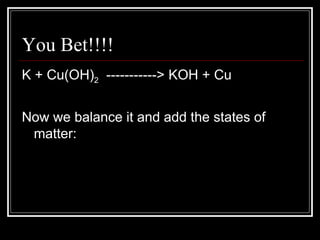
You Bet!!!! K + Cu(OH) 2   -----------> KOH + Cu Now we balance it and add the states of matter:
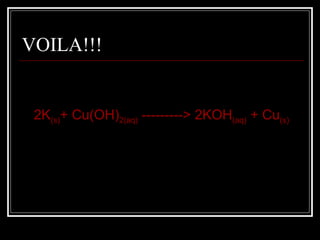
VOILA!!!  2K (s) + Cu(OH) 2(aq)  ---------> 2KOH (aq)  + Cu (s)
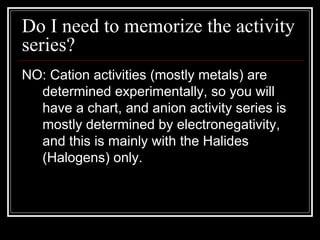
Do I need to memorize the activity series? NO: Cation activities (mostly metals) are determined experimentally, so you will have a chart, and anion activity series is mostly determined by electronegativity, and this is mainly with the Halides (Halogens) only.
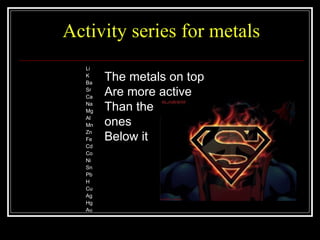
Activity series for metals Li K Ba Sr Ca Na Mg Al Mn Zn Fe Cd Co Ni Sn Pb H Cu Ag Hg Au The metals on top  Are more active  Than the  ones Below it
Activity series for nonmetals Simple: Since halides are involved in most replacement type reactions, just remember that the halide higher up on the periodic table will replace the one below it, or in other words the higher, the more active
SOLUBILITY Have you noticed, in some reactions, that solids form when you mix 2 aqueous chemicals? How is this possible? Easy: Sometimes chemicals form in a reaction that don’t dissolve in water…they are insoluble-solid
Solubility Definitions Soluble:  Will or is dissolved in a solvent (usually water) Insoluble:  Will not or isn’t dissolve in a solvent  Precipitate:  A solid formed from the mixing of two aqueous liquids
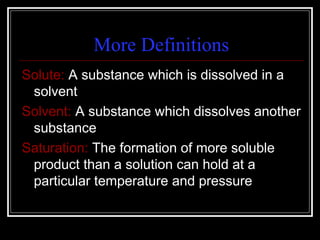
More Definitions Solute:  A substance which is dissolved in a solvent Solvent:  A substance which dissolves another substance Saturation:  The formation of more soluble product than a solution can hold at a particular temperature and pressure
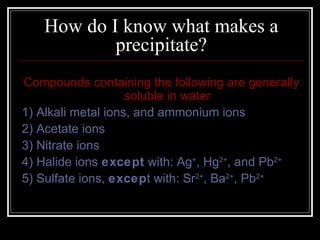
How do I know what makes a precipitate? Compounds containing the following are generally soluble in water 1) Alkali metal ions, and ammonium ions 2) Acetate ions 3) Nitrate ions 4) Halide ions  except  with: Ag + , Hg 2+ , and Pb 2+ 5) Sulfate ions,  excep t with: Sr 2+ , Ba 2+ , Pb 2+
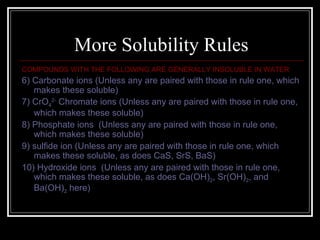
More Solubility Rules COMPOUNDS WITH THE FOLLOWING ARE GENERALLY INSOLUBLE IN WATER 6) Carbonate ions (Unless any are paired with those in rule one, which makes these soluble) 7) CrO 4 2-  Chromate ions (Unless any are paired with those in rule one, which makes these soluble) 8) Phosphate ions  (Unless any are paired with those in rule one, which makes these soluble) 9) sulfide ion (Unless any are paired with those in rule one, which makes these soluble, as does CaS, SrS, BaS) 10) Hydroxide ions  (Unless any are paired with those in rule one, which makes these soluble, as does Ca(OH) 2 , Sr(OH) 2 , and Ba(OH) 2  here)
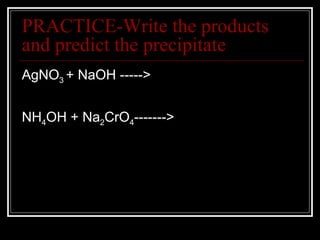
PRACTICE-Write the products and predict the precipitate AgNO 3  + NaOH ----->  NH 4 OH + Na 2 CrO 4 ------->
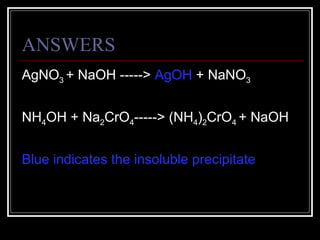
ANSWERS AgNO 3  + NaOH ----->  AgOH  + NaNO 3 NH 4 OH + Na 2 CrO 4 -----> (NH 4 ) 2 CrO 4  + NaOH Blue indicates the insoluble precipitate
CONGRATULATIONS YOU ARE NOW EXPERTS IN CHEMICAL EQUATIONS!!!
You can use this information for Evil… Release the “CO 2 ” to start  the “global Warming”
Or For Good…. Green is Groovey  Baby…Yeah!!!!

Chem Equations

  • 1.
    Chemical Equations That’swhat it’s ALL about Grooooovey baby…yeah!!
  • 2.
    What is achemical equation? It is a symbolic representation of a chemical reaction, that is balanced and represents the states of matter That’s soooo exciting!…yeah ok, not really
  • 3.
    And I wantto know this because…… It is good to know whether a reaction will take your face off BEFORE you actually throw the chemicals together
  • 4.
    Still not sureI get the concept Think of chemical equation in the same way that you might think of a recipe for chocolate chip cookies. You have ingredients, then you prepare them, then you get cookies Can I get my cookies with some Frikin’ Chocolate “chunks?”
  • 5.
    Yummy!!! Ingredients -----------> Bake ----------->Cookies 2 1/2 (1 ounce) squares unsweetened chocolate 
 1/2 cup butter 
 2 cups all-purpose flour 
 1/2 teaspoon baking soda 
 1 teaspoon baking powder 
 1/4 teaspoon salt 
 1 1/4 cups white sugar 
 2 eggs 
 1 teaspoon vanilla extract 
 2/3 cup sour cream 
 2 cups semisweet chocolate chips --------------------->
  • 6.
    It isn’t differentin Chemistry… You just don’t eat the cookies Ingredients -----------> Bake -----------> Cookies Chemistry: Reactants ------------------------------> Products Example: O 2 + H 2 ----------------> H 2 O (+ enough energy to melt your face) What happened to the other Oxygen???? yields
  • 7.
    Law of conservationof matter Matter can not be created nor destroyed by ordinary chemical processes So we have to balance the previous equation Using coefficients O N L Y !!!!!! O 2 + H 2 ----------------> H 2 O
  • 8.
  • 9.
    Here is howthis equation looks balanced: O 2 + 2H 2 ----------------> 2H 2 O
  • 10.
    How do Ibalance an equation? The basic concept is to use coefficients ONLY to be sure that there are the same number of moles of stuff on the left side as there are on the right. This can be done by counting single elements on both sides and look for lowest common factors
  • 11.
    This could geta bit tedious…are there some shortcuts? Yes: Look for polyatomic ions common on both sides and treat them as one element Look for lowest common factors to determine the correct coefficients ALWAYS double check when you are done!!!! Anything else I need to know about equations??
  • 12.
    Oh YEEEES! Statesof matter of each reactant and product Reaction types and other CRAPO(N) Metal activity Nonmetal activity Solubility Endo/Exothermic
  • 13.
    STATES OF MATTEROF REACTANTS AND PRODUCTS Since some chemicals react differently (or are more dangerous) when they are liquids, solids, or gasses, it is useful to determine this ahead of time Greenhouse solids would be a lot better than greenhouse gasses
  • 14.
    HERE ARE THEMOST COMMON WAYS TO EXPRESS STATES OF MATTER SOLID (s) LIQUID (l) GAS (g) AQUEOUS (DISSOLVED IN WATER) (aq) CRYSTALLINE (cr) There are one or two other obscure ones but these are the real important ones
  • 15.
    Here is howthey are used O 2(g) + 2H 2(g) ----------------> 2H 2 O (l) That is sooo clever!!!
  • 16.
    THIS IS ABUNCH OF…. CRAP!!!!
  • 17.
    ACTUALLY…IT’S: C RA P O (N) O E C R R U M D I E G C P O D C A L L X B I N E E A P I A X S I C R I E T O A N T E
  • 18.
    THAT’S RIGHT…. ALLCHEMICAL REACTIONS CAN ACTUALLY BE CLASSIFIED AS CRAPO (NUCLEAR IS NOT CLASSIFIED AS CHEMICAL) UNFORTUNATELY, THIS IS NOT THE TRADITIONAL WAY TO CLASSIFY EQUATION TYPES…. I KNEW IT!!
  • 19.
    EQUATION (REACTION) TYPES SYNTHESIS To Put Together or Produce A + B -------> AB Example: H 2 + O 2 -----------> H 2 O Can you see that this is a “putting together” process?
  • 20.
    DECOMPOSITION TO BREAKDOWN AB -----------> A + B EXAMPLE: H 2 O 2 -----------> H 2 O + O 2 CAN YOU SEE THAT THIS IS BREAKING DOWN?
  • 21.
    SINGLE DISPLACEMENT (REPLACEMENT)TO REPLACE A SINGLE ION WITH ANOTHER AB + C ------------> AC + B ( OR CB + A) EXAMPLE: HCl + Mg ----------> MgCl 2 + H 2 Can you see that C has replaced A in the equation?
  • 22.
    DOUBLE DISPLACEMENT (REPLACEMENT)TO SWAP TWO CATIONS OR TWO ANIONS AB + CD ----------> AD + CB EXAMPLE: NaOH + H 2 SO 4 -------> HOH + Na 2 SO 4 Can you see that the two cations have switched places?
  • 23.
    (ORGANIC) COMBUSTION TOCOMBUST A CARBON-BASED COMPOUND (USUALLY HYDROCARBON) WITH O 2 TO FORM CO 2 AND H 2 O C X H X + O 2 ---------> H 2 O + CO 2 EXAMPLE: C 2 H 6 + O 2 ---------> H 2 O + CO 2 CAN YOU SEE THE HYDROCARBON REACTING WITH OXYGEN AND MAKING CARBON DIOXIDE AND WATER?
  • 24.
    From now on…We will refer to CRAPO(N) as Classes of reactions And Synthesis, Decomposition, Single displacement, Double displacement, and combustion as equation types
  • 25.
    ACTIVITY SERIES!!!!! Doreactions occur every time chemicals are put together? Of course not…if they did we would change every time we came in contact with another chemical Help me!! I’m melting
  • 26.
    When a singleelement is reacting with a compound The reaction can only occur if the single element is more active than the anion or cation in the compound that it is replacing Bottom line: the most active elements will be in the bond.
  • 27.
    Example NaOH +Pb -----------> ? Na is more active than Pb Will Pb replace Na?
  • 28.
    NO!!!!!!!! Remember themost active elements will be in the bond
  • 29.
    Example K +Cu(OH) 2 ----------->? K is more active than Cu Will THIS reaction occur?
  • 30.
    You Bet!!!! K+ Cu(OH) 2 -----------> KOH + Cu Now we balance it and add the states of matter:
  • 31.
    VOILA!!! 2K(s) + Cu(OH) 2(aq) ---------> 2KOH (aq) + Cu (s)
  • 32.
    Do I needto memorize the activity series? NO: Cation activities (mostly metals) are determined experimentally, so you will have a chart, and anion activity series is mostly determined by electronegativity, and this is mainly with the Halides (Halogens) only.
  • 33.
    Activity series formetals Li K Ba Sr Ca Na Mg Al Mn Zn Fe Cd Co Ni Sn Pb H Cu Ag Hg Au The metals on top Are more active Than the ones Below it
  • 34.
    Activity series fornonmetals Simple: Since halides are involved in most replacement type reactions, just remember that the halide higher up on the periodic table will replace the one below it, or in other words the higher, the more active
  • 35.
    SOLUBILITY Have younoticed, in some reactions, that solids form when you mix 2 aqueous chemicals? How is this possible? Easy: Sometimes chemicals form in a reaction that don’t dissolve in water…they are insoluble-solid
  • 36.
    Solubility Definitions Soluble: Will or is dissolved in a solvent (usually water) Insoluble: Will not or isn’t dissolve in a solvent Precipitate: A solid formed from the mixing of two aqueous liquids
  • 37.
    More Definitions Solute: A substance which is dissolved in a solvent Solvent: A substance which dissolves another substance Saturation: The formation of more soluble product than a solution can hold at a particular temperature and pressure
  • 38.
    How do Iknow what makes a precipitate? Compounds containing the following are generally soluble in water 1) Alkali metal ions, and ammonium ions 2) Acetate ions 3) Nitrate ions 4) Halide ions except with: Ag + , Hg 2+ , and Pb 2+ 5) Sulfate ions, excep t with: Sr 2+ , Ba 2+ , Pb 2+
  • 39.
    More Solubility RulesCOMPOUNDS WITH THE FOLLOWING ARE GENERALLY INSOLUBLE IN WATER 6) Carbonate ions (Unless any are paired with those in rule one, which makes these soluble) 7) CrO 4 2- Chromate ions (Unless any are paired with those in rule one, which makes these soluble) 8) Phosphate ions (Unless any are paired with those in rule one, which makes these soluble) 9) sulfide ion (Unless any are paired with those in rule one, which makes these soluble, as does CaS, SrS, BaS) 10) Hydroxide ions (Unless any are paired with those in rule one, which makes these soluble, as does Ca(OH) 2 , Sr(OH) 2 , and Ba(OH) 2 here)
  • 40.
    PRACTICE-Write the productsand predict the precipitate AgNO 3 + NaOH -----> NH 4 OH + Na 2 CrO 4 ------->
  • 41.
    ANSWERS AgNO 3 + NaOH -----> AgOH + NaNO 3 NH 4 OH + Na 2 CrO 4 -----> (NH 4 ) 2 CrO 4 + NaOH Blue indicates the insoluble precipitate
  • 42.
    CONGRATULATIONS YOU ARENOW EXPERTS IN CHEMICAL EQUATIONS!!!
  • 43.
    You can usethis information for Evil… Release the “CO 2 ” to start the “global Warming”
  • 44.
    Or For Good….Green is Groovey Baby…Yeah!!!!