Basic Chemistry: Chapter 2 and 3 Unit 1 Notes
Matter Matter-  is anything that takes up space. Each kind of matter has specific properties, or characteristics, that distinguish it from every other kind of matter.
Physical Properties of Matter Physical properties-  are characteristics that can be determined without changing the basic makeup of the substance.
Chemical Properties of Matter Chemical properties-  describe how a substance acts when it combines with other substances to form an entirely different substance, with new properties.
Atoms Atoms-  are the basic building blocks of matter. Atomic structure  of an atom consists of a nucleus and electron cloud.
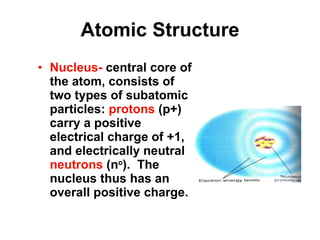
Atomic Structure Nucleus-  central core of the atom, consists of two types of subatomic particles:  protons  (p+) carry a positive electrical charge of +1, and electrically neutral  neutrons  (n o ).  The nucleus thus has an overall positive charge.
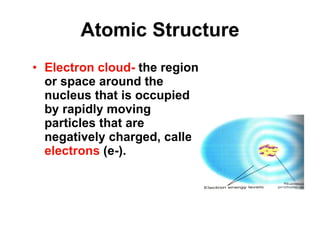
Atomic Structure Electron cloud-  the region or space around the nucleus that is occupied by rapidly moving particles that are negatively charged, called  electrons  (e-).
Ions Ion-  atom that has gained or lost one or more electrons.   Anion-  atoms that have gained  electron(s) and are now negative ions (Cl - , F - ) Cation-  atoms that have lost electron(s) and are now positive ions (H + , Na + )
Elements Elements-  substance composed of one type of atom, that can not be changed into a simpler substance by chemical means. The number of protons in the nucleus determines the type of atom/element, and the  number of protons in a given element is always constant.
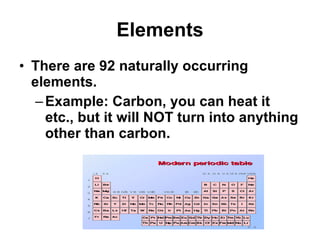
Elements There are 92 naturally occurring elements. Example: Carbon, you can heat it etc., but it will NOT turn into anything other than carbon.
Elements (cont.) Symbols-  a simple, standard, abbreviated way of referring to elements.  Usually one letter, sometimes two letters, but the second letter is not capitalized. Ex.  H = hydrogen, Na = sodium
Elements (cont.) Isotopes-  are atoms of the same element with different numbers of neutrons.  Isotopes do have the same chemical properties.
Elements (cont.) Radioactive Isotopes-  isotopes with unstable nuclei that break down at a constant rate over time.  As a result, they give off radiation which can be harmful.  But they can also be used as “labels” or “tracers.”
Chemical Formulas Chemical Formula-  a group of symbols that show what type and how many atoms are present in a compound .
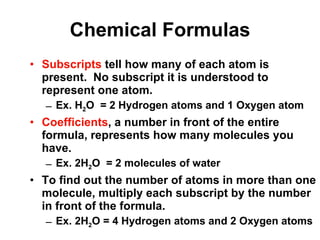
Chemical Formulas Subscripts  tell how many of each atom is present.  No subscript it is understood to represent one atom. Ex. H 2 O  = 2 Hydrogen atoms and 1 Oxygen atom Coefficients , a number in front of the entire formula, represents how many molecules you have.  Ex. 2H 2 O  = 2 molecules of water To find out the number of atoms in more than one molecule, multiply each subscript by the number in front of the formula. Ex. 2H 2 O = 4 Hydrogen atoms and 2 Oxygen atoms
Compounds Compounds -  are two or more elements that are chemically combined.  Each compound has its own special properties, which differ from the properties of the individual elements within that compound. Ex. Chlorine (poisonous gas) combined with sodium = sodium chloride (table salt).
Molecules Molecules-  The smallest particle of a compound or element that can have stable, independent existence.
Molecules A molecule of a compound contains two or more different atoms. When atoms combine to form molecules a molecule of an element may consist of one, two or more atoms of that element. their outer energy levels become more stable. One way of filling their energy levels is by sharing electrons.  The electrons then move in the region between and around the nucleus.
Chemical Bonds Chemical bonds-  forces holding atoms in any molecule or compound together.  Chemical bonds result from the interaction of electrons in the outer energy levels of atoms.
Ionic Bonds Ionic Bonds-  electrical attraction between positively and negatively charged  ions  (atom that has gained or lost one or more electrons).  The resulting charge of an  Ionic Compound  will be zero or neutral .
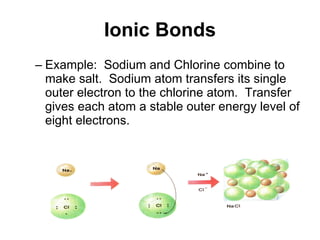
Ionic Bonds Example:  Sodium and Chlorine combine to make salt.  Sodium atom transfers its single outer electron to the chlorine atom.  Transfer gives each atom a stable outer energy level of eight electrons.
Covalent Bonds Covalent Bonds-  when atoms combine to form a molecule by sharing electrons.  Non-polar covalent bonds-  all atoms have similar electronegativities and share the electrons equally (carbon and hydrogen) Polar covalent bonds-  atoms have different electronegativities and one holds the electrons more strongly (oxygen and hydrogen)
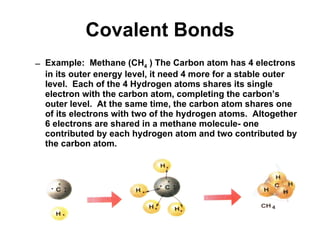
Covalent Bonds Example:  Methane (CH 4  ) The Carbon atom has 4 electrons in its outer energy level, it need 4 more for a stable outer level.  Each of the 4 Hydrogen atoms shares its single electron with the carbon atom, completing the carbon’s outer level.  At the same time, the carbon atom shares one of its electrons with two of the hydrogen atoms.  Altogether 6 electrons are shared in a methane molecule- one contributed by each hydrogen atom and two contributed by the carbon atom.
Hydrogen Bonds Hydrogen Bonds :  slight attractions that develop between the oppositely charged regions of nearby molecules.  Although these forces are not as strong as ionic or covalent bonds, they can hold molecules together, especially when the molecules are large.  Individual these bonds are weak and short lived, but collectively they are very strong.
Chemical Equations Chemical Equations  – are mathematical ways to represent chemical reactions. Ex.  C + 4H    CH 4
Mixtures Mixture-  is the molecules of different substances mingling together (physically) with out chemically combining.  Each substance retains all its chemical properties and its physical properties, which makes it possible to separate them physically. Mixtures can contain solids, liquids and gases.
Solutions Solutions-  are mixtures that are the same throughout, but have variable compositions, depending on how much of one substance is dissolved in the other.
Solutions Two Parts of a Solution: Solvent-  the substance that can dissolve other substances.  Water is often called the “Universal Solvent.” Solute-  the substance that dissolves in the solvent. Examples:  Salt Water: Water is the solvent and Salt is the solute. Kool Aid: Water is the solvent and Sugar is the solute.
Solutions Concentration-  the amount of solute dissolved in a given amount of solvent. Molarity-  the moles of solute per liter of solution.  A 1.0 molar solution of sucrose will contain 1 mole (6.02 x 10 23  molecules) of sugar in each liter of solution.
Suspensions Mixtures of water and non-dissolved materials that are in pieces so small that the movement of water molecules does not allow them to settle out but keeps them “suspended.” Blood is an example of a  suspension .
Water and The Fitness of the Environment Overview: The Molecule That Supports All of Life Water is the biological medium here on Earth All living organisms require water more than any other substance
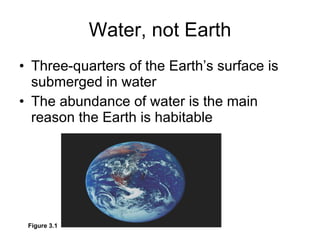
Water, not Earth Three-quarters of the Earth’s surface is submerged in water The abundance of water is the main reason the Earth is habitable Figure 3.1
Water is Polar Concept 3.1: The polarity of water molecules results in hydrogen bonding. The water molecule is a polar molecule: Oxygen is significantly more electronegative than hydrogen. Although oxygen and hydrogen share electrons, oxygen does not share fairly…it keeps the electrons more of the time. Water can form four hydrogen bonds with neighboring molecules.
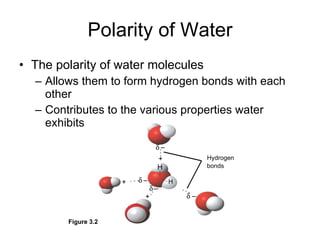
Polarity of Water The polarity of water molecules Allows them to form hydrogen bonds with each other Contributes to the various properties water exhibits Hydrogen bonds + + H H + +    –    –   –    – Figure 3.2
Water and Life Concept 3.2:  Emergent properties of water  due to its polarity contribute to Earth’s fitness for life
Cohesion Water molecules exhibit cohesion Cohesion Is the bonding of a high percentage of the molecules to neighboring molecules Is due to hydrogen bonding
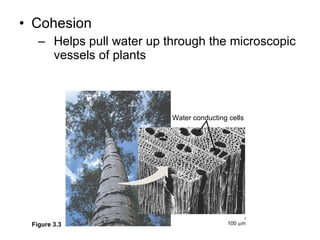
Cohesion Helps pull water up through the microscopic vessels of plants Water conducting cells 100  µ m Figure 3.3
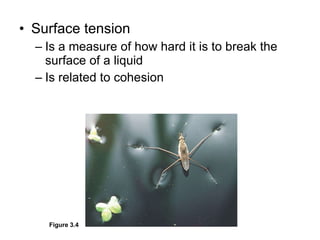
Surface tension Is a measure of how hard it is to break the surface of a liquid Is related to cohesion Figure 3.4
Moderation of Temperature Water moderates air temperature By absorbing heat from air that is warmer and releasing the stored heat to air that is cooler
Heat and Temperature Kinetic energy Is the energy of motion, the average molecular kinetic energy is temperature.  Temperature is measured in degrees Celcius or  in Kelvins Heat Is a measure of the total amount of kinetic energy due to molecular motion that is transferred from one object to another.  Heat is measured in calories or joules
Water’s High Specific Heat The specific heat of a substance Is the amount of heat that must be absorbed or lost for 1 gram of that substance to change its temperature by 1ºC Water has a high specific heat, which allows it to minimize temperature fluctuations to within limits that permit life Heat is absorbed when hydrogen bonds break Heat is released when hydrogen bonds form
Evaporative Cooling Evaporation Is the transformation of a substance from a liquid to a gas Hydrogen bonds are broken and heat is absorbed Many animals rid their bodies of excess heat by allowing water is evaporate in the form of sweat, or by panting.
Heat of Vaporization Heat of vaporization Is the quantity of heat a liquid must absorb for 1 gram of it to be converted from a liquid to a gas Water has a relatively high heat of vaporization due to hydrogen bonding
Insulation of Bodies of Water by Floating Ice Solid water, or ice Is less dense than liquid water Floats in liquid water
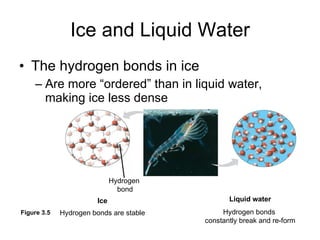
Ice and Liquid Water The hydrogen bonds in ice Are more “ordered” than in liquid water, making ice less dense Liquid water Hydrogen bonds  constantly break and re-form Ice Hydrogen bonds are stable Hydrogen  bond Figure 3.5
Ice and Life Since ice floats in water Life can exist under the frozen surfaces of lakes and polar seas. Ice formed in the winter in temperate zones does not sink and can be melted by the sun in the spring. Water is most dense at 38 o F or 4 o C.
The Solvent of Life Water is a versatile solvent due to its polarity It can form aqueous solutions with polar molecules
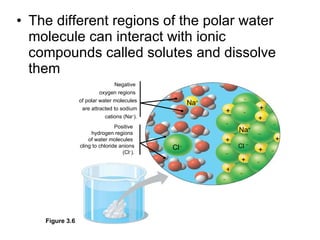
The different regions of the polar water molecule can interact with ionic compounds called solutes and dissolve them Negative  oxygen regions  of polar water molecules are attracted to sodium cations (Na + ). + + + + Cl  – – – – – Na + Positive  hydrogen regions  of water molecules  cling to chloride anions (Cl – ). + + + + – – – – – – Na + Cl – Figure 3.6
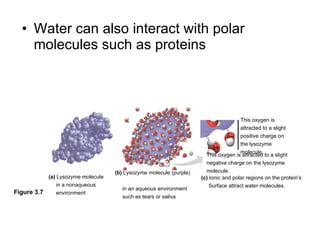
Water can also interact with polar molecules such as proteins This oxygen is attracted to a slight positive charge on the lysozyme molecule. This oxygen is attracted to a slight  negative charge on the lysozyme molecule. (a)  Lysozyme molecule    in a nonaqueous    environment (b)  Lysozyme molecule (purple)    in an aqueous environment    such as tears or saliva (c)  Ionic and polar regions on the protein’s    Surface attract water molecules.   +  – Figure 3.7
Hydrophilic and Hydrophobic Substances A hydrophilic substance Has an affinity for water “Loves” water Is polar A hydrophobic substance Does not have an affinity for water “Hates” water Is non-polar
Solute Concentration in Aqueous Solutions Since most biochemical reactions occur in water It is important to learn to calculate the concentration of solutes in an aqueous solution
Molarity A mole Represents an exact number of molecules of a substance in a given mass Molarity Is the number of moles of solute per liter of solution (See the “Molarity in Action” document).
Acids and Bases Concept 3.3: Dissociation of water molecules leads to acidic and basic conditions that affect living organisms
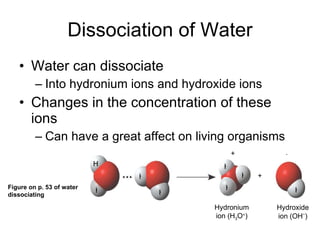
Dissociation of Water Water can dissociate Into hydronium ions and hydroxide ions Changes in the concentration of these ions Can have a great affect on living organisms H Hydronium ion (H 3 O + ) H Hydroxide ion (OH – ) H H H H H H + – + Figure on p. 53 of water  dissociating
Acids and Bases An acid Is any substance that increases the hydrogen ion concentration of a solution A base Is any substance that reduces the hydrogen ion concentration of a solution
The pH Scale The pH of a solution Is determined by the relative concentration of hydrogen ions Is low in an acid Is high in a base In pure water 1 out of 10 7  water molecules is dissociated pH is the negative log 10  of the hydrogen ion concentration, thus in pure water the pH is 7
The pH scale and pH values of various aqueous solutions Increasingly  Acidic [H + ] > [OH – ] Increasingly  Basic [H + ] < [OH – ] Neutral [H + ] = [OH – ] Oven cleaner 0 1 2 3 4 5 6 7 8 9 10 11 12 13 14 pH Scale Battery acid Digestive (stomach)  juice, lemon juice Vinegar, beer, wine, cola Tomato juice Black coffee  Rainwater Urine Pure water Human blood Seawater Milk of magnesia Household ammonia Household bleach Figure 3.8
Buffers The internal pH of most living cells Must remain close to pH 7 Buffers Are substances that minimize changes in the concentrations of hydrogen and hydroxide ions in a solution Consist of an acid-base pair that reversibly combines with hydrogen ions
The Threat of Acid Precipitation Acid precipitation Refers to rain, snow, or fog with a pH lower than pH 5.6 Is caused primarily by the mixing of different pollutants with water in the air
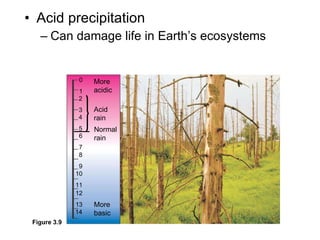
Acid precipitation Can damage life in Earth’s ecosystems 0 1 2 3 4 5 6 7 8 9 10 11 12 13 14 More acidic Acid rain Normal rain More basic Figure 3.9

Chapters 2&3

  • 1.
    Basic Chemistry: Chapter2 and 3 Unit 1 Notes
  • 2.
    Matter Matter- is anything that takes up space. Each kind of matter has specific properties, or characteristics, that distinguish it from every other kind of matter.
  • 3.
    Physical Properties ofMatter Physical properties- are characteristics that can be determined without changing the basic makeup of the substance.
  • 4.
    Chemical Properties ofMatter Chemical properties- describe how a substance acts when it combines with other substances to form an entirely different substance, with new properties.
  • 5.
    Atoms Atoms- are the basic building blocks of matter. Atomic structure of an atom consists of a nucleus and electron cloud.
  • 6.
    Atomic Structure Nucleus- central core of the atom, consists of two types of subatomic particles: protons (p+) carry a positive electrical charge of +1, and electrically neutral neutrons (n o ). The nucleus thus has an overall positive charge.
  • 7.
    Atomic Structure Electroncloud- the region or space around the nucleus that is occupied by rapidly moving particles that are negatively charged, called electrons (e-).
  • 8.
    Ions Ion- atom that has gained or lost one or more electrons. Anion- atoms that have gained electron(s) and are now negative ions (Cl - , F - ) Cation- atoms that have lost electron(s) and are now positive ions (H + , Na + )
  • 9.
    Elements Elements- substance composed of one type of atom, that can not be changed into a simpler substance by chemical means. The number of protons in the nucleus determines the type of atom/element, and the number of protons in a given element is always constant.
  • 10.
    Elements There are92 naturally occurring elements. Example: Carbon, you can heat it etc., but it will NOT turn into anything other than carbon.
  • 11.
    Elements (cont.) Symbols- a simple, standard, abbreviated way of referring to elements. Usually one letter, sometimes two letters, but the second letter is not capitalized. Ex. H = hydrogen, Na = sodium
  • 12.
    Elements (cont.) Isotopes- are atoms of the same element with different numbers of neutrons. Isotopes do have the same chemical properties.
  • 13.
    Elements (cont.) RadioactiveIsotopes- isotopes with unstable nuclei that break down at a constant rate over time. As a result, they give off radiation which can be harmful. But they can also be used as “labels” or “tracers.”
  • 14.
    Chemical Formulas ChemicalFormula- a group of symbols that show what type and how many atoms are present in a compound .
  • 15.
    Chemical Formulas Subscripts tell how many of each atom is present. No subscript it is understood to represent one atom. Ex. H 2 O = 2 Hydrogen atoms and 1 Oxygen atom Coefficients , a number in front of the entire formula, represents how many molecules you have. Ex. 2H 2 O = 2 molecules of water To find out the number of atoms in more than one molecule, multiply each subscript by the number in front of the formula. Ex. 2H 2 O = 4 Hydrogen atoms and 2 Oxygen atoms
  • 16.
    Compounds Compounds - are two or more elements that are chemically combined. Each compound has its own special properties, which differ from the properties of the individual elements within that compound. Ex. Chlorine (poisonous gas) combined with sodium = sodium chloride (table salt).
  • 17.
    Molecules Molecules- The smallest particle of a compound or element that can have stable, independent existence.
  • 18.
    Molecules A moleculeof a compound contains two or more different atoms. When atoms combine to form molecules a molecule of an element may consist of one, two or more atoms of that element. their outer energy levels become more stable. One way of filling their energy levels is by sharing electrons. The electrons then move in the region between and around the nucleus.
  • 19.
    Chemical Bonds Chemicalbonds- forces holding atoms in any molecule or compound together. Chemical bonds result from the interaction of electrons in the outer energy levels of atoms.
  • 20.
    Ionic Bonds IonicBonds- electrical attraction between positively and negatively charged ions (atom that has gained or lost one or more electrons). The resulting charge of an Ionic Compound will be zero or neutral .
  • 21.
    Ionic Bonds Example: Sodium and Chlorine combine to make salt. Sodium atom transfers its single outer electron to the chlorine atom. Transfer gives each atom a stable outer energy level of eight electrons.
  • 22.
    Covalent Bonds CovalentBonds- when atoms combine to form a molecule by sharing electrons. Non-polar covalent bonds- all atoms have similar electronegativities and share the electrons equally (carbon and hydrogen) Polar covalent bonds- atoms have different electronegativities and one holds the electrons more strongly (oxygen and hydrogen)
  • 23.
    Covalent Bonds Example: Methane (CH 4 ) The Carbon atom has 4 electrons in its outer energy level, it need 4 more for a stable outer level. Each of the 4 Hydrogen atoms shares its single electron with the carbon atom, completing the carbon’s outer level. At the same time, the carbon atom shares one of its electrons with two of the hydrogen atoms. Altogether 6 electrons are shared in a methane molecule- one contributed by each hydrogen atom and two contributed by the carbon atom.
  • 24.
    Hydrogen Bonds HydrogenBonds : slight attractions that develop between the oppositely charged regions of nearby molecules. Although these forces are not as strong as ionic or covalent bonds, they can hold molecules together, especially when the molecules are large. Individual these bonds are weak and short lived, but collectively they are very strong.
  • 25.
    Chemical Equations ChemicalEquations – are mathematical ways to represent chemical reactions. Ex. C + 4H  CH 4
  • 26.
    Mixtures Mixture- is the molecules of different substances mingling together (physically) with out chemically combining. Each substance retains all its chemical properties and its physical properties, which makes it possible to separate them physically. Mixtures can contain solids, liquids and gases.
  • 27.
    Solutions Solutions- are mixtures that are the same throughout, but have variable compositions, depending on how much of one substance is dissolved in the other.
  • 28.
    Solutions Two Partsof a Solution: Solvent- the substance that can dissolve other substances. Water is often called the “Universal Solvent.” Solute- the substance that dissolves in the solvent. Examples: Salt Water: Water is the solvent and Salt is the solute. Kool Aid: Water is the solvent and Sugar is the solute.
  • 29.
    Solutions Concentration- the amount of solute dissolved in a given amount of solvent. Molarity- the moles of solute per liter of solution. A 1.0 molar solution of sucrose will contain 1 mole (6.02 x 10 23 molecules) of sugar in each liter of solution.
  • 30.
    Suspensions Mixtures ofwater and non-dissolved materials that are in pieces so small that the movement of water molecules does not allow them to settle out but keeps them “suspended.” Blood is an example of a suspension .
  • 31.
    Water and TheFitness of the Environment Overview: The Molecule That Supports All of Life Water is the biological medium here on Earth All living organisms require water more than any other substance
  • 32.
    Water, not EarthThree-quarters of the Earth’s surface is submerged in water The abundance of water is the main reason the Earth is habitable Figure 3.1
  • 33.
    Water is PolarConcept 3.1: The polarity of water molecules results in hydrogen bonding. The water molecule is a polar molecule: Oxygen is significantly more electronegative than hydrogen. Although oxygen and hydrogen share electrons, oxygen does not share fairly…it keeps the electrons more of the time. Water can form four hydrogen bonds with neighboring molecules.
  • 34.
    Polarity of WaterThe polarity of water molecules Allows them to form hydrogen bonds with each other Contributes to the various properties water exhibits Hydrogen bonds + + H H + +  –  –  –  – Figure 3.2
  • 35.
    Water and LifeConcept 3.2: Emergent properties of water due to its polarity contribute to Earth’s fitness for life
  • 36.
    Cohesion Water moleculesexhibit cohesion Cohesion Is the bonding of a high percentage of the molecules to neighboring molecules Is due to hydrogen bonding
  • 37.
    Cohesion Helps pullwater up through the microscopic vessels of plants Water conducting cells 100 µ m Figure 3.3
  • 38.
    Surface tension Isa measure of how hard it is to break the surface of a liquid Is related to cohesion Figure 3.4
  • 39.
    Moderation of TemperatureWater moderates air temperature By absorbing heat from air that is warmer and releasing the stored heat to air that is cooler
  • 40.
    Heat and TemperatureKinetic energy Is the energy of motion, the average molecular kinetic energy is temperature. Temperature is measured in degrees Celcius or in Kelvins Heat Is a measure of the total amount of kinetic energy due to molecular motion that is transferred from one object to another. Heat is measured in calories or joules
  • 41.
    Water’s High SpecificHeat The specific heat of a substance Is the amount of heat that must be absorbed or lost for 1 gram of that substance to change its temperature by 1ºC Water has a high specific heat, which allows it to minimize temperature fluctuations to within limits that permit life Heat is absorbed when hydrogen bonds break Heat is released when hydrogen bonds form
  • 42.
    Evaporative Cooling EvaporationIs the transformation of a substance from a liquid to a gas Hydrogen bonds are broken and heat is absorbed Many animals rid their bodies of excess heat by allowing water is evaporate in the form of sweat, or by panting.
  • 43.
    Heat of VaporizationHeat of vaporization Is the quantity of heat a liquid must absorb for 1 gram of it to be converted from a liquid to a gas Water has a relatively high heat of vaporization due to hydrogen bonding
  • 44.
    Insulation of Bodiesof Water by Floating Ice Solid water, or ice Is less dense than liquid water Floats in liquid water
  • 45.
    Ice and LiquidWater The hydrogen bonds in ice Are more “ordered” than in liquid water, making ice less dense Liquid water Hydrogen bonds constantly break and re-form Ice Hydrogen bonds are stable Hydrogen bond Figure 3.5
  • 46.
    Ice and LifeSince ice floats in water Life can exist under the frozen surfaces of lakes and polar seas. Ice formed in the winter in temperate zones does not sink and can be melted by the sun in the spring. Water is most dense at 38 o F or 4 o C.
  • 47.
    The Solvent ofLife Water is a versatile solvent due to its polarity It can form aqueous solutions with polar molecules
  • 48.
    The different regionsof the polar water molecule can interact with ionic compounds called solutes and dissolve them Negative oxygen regions of polar water molecules are attracted to sodium cations (Na + ). + + + + Cl – – – – – Na + Positive hydrogen regions of water molecules cling to chloride anions (Cl – ). + + + + – – – – – – Na + Cl – Figure 3.6
  • 49.
    Water can alsointeract with polar molecules such as proteins This oxygen is attracted to a slight positive charge on the lysozyme molecule. This oxygen is attracted to a slight negative charge on the lysozyme molecule. (a) Lysozyme molecule in a nonaqueous environment (b) Lysozyme molecule (purple) in an aqueous environment such as tears or saliva (c) Ionic and polar regions on the protein’s Surface attract water molecules.  +  – Figure 3.7
  • 50.
    Hydrophilic and HydrophobicSubstances A hydrophilic substance Has an affinity for water “Loves” water Is polar A hydrophobic substance Does not have an affinity for water “Hates” water Is non-polar
  • 51.
    Solute Concentration inAqueous Solutions Since most biochemical reactions occur in water It is important to learn to calculate the concentration of solutes in an aqueous solution
  • 52.
    Molarity A moleRepresents an exact number of molecules of a substance in a given mass Molarity Is the number of moles of solute per liter of solution (See the “Molarity in Action” document).
  • 53.
    Acids and BasesConcept 3.3: Dissociation of water molecules leads to acidic and basic conditions that affect living organisms
  • 54.
    Dissociation of WaterWater can dissociate Into hydronium ions and hydroxide ions Changes in the concentration of these ions Can have a great affect on living organisms H Hydronium ion (H 3 O + ) H Hydroxide ion (OH – ) H H H H H H + – + Figure on p. 53 of water dissociating
  • 55.
    Acids and BasesAn acid Is any substance that increases the hydrogen ion concentration of a solution A base Is any substance that reduces the hydrogen ion concentration of a solution
  • 56.
    The pH ScaleThe pH of a solution Is determined by the relative concentration of hydrogen ions Is low in an acid Is high in a base In pure water 1 out of 10 7 water molecules is dissociated pH is the negative log 10 of the hydrogen ion concentration, thus in pure water the pH is 7
  • 57.
    The pH scaleand pH values of various aqueous solutions Increasingly Acidic [H + ] > [OH – ] Increasingly Basic [H + ] < [OH – ] Neutral [H + ] = [OH – ] Oven cleaner 0 1 2 3 4 5 6 7 8 9 10 11 12 13 14 pH Scale Battery acid Digestive (stomach) juice, lemon juice Vinegar, beer, wine, cola Tomato juice Black coffee Rainwater Urine Pure water Human blood Seawater Milk of magnesia Household ammonia Household bleach Figure 3.8
  • 58.
    Buffers The internalpH of most living cells Must remain close to pH 7 Buffers Are substances that minimize changes in the concentrations of hydrogen and hydroxide ions in a solution Consist of an acid-base pair that reversibly combines with hydrogen ions
  • 59.
    The Threat ofAcid Precipitation Acid precipitation Refers to rain, snow, or fog with a pH lower than pH 5.6 Is caused primarily by the mixing of different pollutants with water in the air
  • 60.
    Acid precipitation Candamage life in Earth’s ecosystems 0 1 2 3 4 5 6 7 8 9 10 11 12 13 14 More acidic Acid rain Normal rain More basic Figure 3.9