ProbabilityMathematics Chapter 12
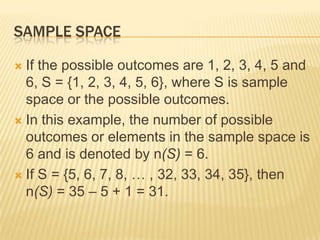
Sample spaceIf the possible outcomes are 1, 2, 3, 4, 5 and 6, S = {1, 2, 3, 4, 5, 6}, where S is sample space or the possible outcomes.In this example, the number of possible outcomes or elements in the sample space is 6 and is denoted by n(S) = 6.If S = {5, 6, 7, 8, … , 32, 33, 34, 35}, then n(S) = 35 – 5 + 1 = 31.
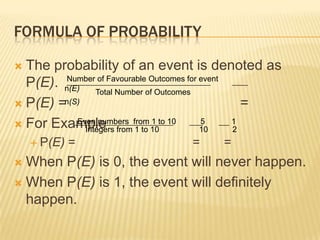
Formula of ProbabilityThe probability of an event is denoted as P(E).P(E) =                                            =         For ExampleP(E) =                                  =       =When P(E) is 0, the event will never happen.When P(E) is 1, the event will definitely happen. Number of Favourable Outcomes for event             n(E)              Total Number of Outcomes                          n(S)Even numbers  from 1 to 10           5            1Integers from 1 to 10                  10           2
ENd

Probability

  • 1.
  • 2.
    Sample spaceIf thepossible outcomes are 1, 2, 3, 4, 5 and 6, S = {1, 2, 3, 4, 5, 6}, where S is sample space or the possible outcomes.In this example, the number of possible outcomes or elements in the sample space is 6 and is denoted by n(S) = 6.If S = {5, 6, 7, 8, … , 32, 33, 34, 35}, then n(S) = 35 – 5 + 1 = 31.
  • 3.
    Formula of ProbabilityTheprobability of an event is denoted as P(E).P(E) = = For ExampleP(E) = = =When P(E) is 0, the event will never happen.When P(E) is 1, the event will definitely happen. Number of Favourable Outcomes for event n(E) Total Number of Outcomes n(S)Even numbers from 1 to 10 5 1Integers from 1 to 10 10 2
  • 4.