SOLID, LIQUID & GAS
INTRODUCTION

An understanding of fundamental properties of
different states of mater is important in all science,
engineering, and in a medicine. Force put stresses on
solids, stress can strain, deform, and break those
solids, whether they are steel beams or bones. Fluids
under pressure can perform work, or they carry
nutrient and essentials solutes, like the blood flowing
through our arteries and veins. Flowing gases cause
pressure differences that can lift a massive cargo plane
or the roof off a house in hurricane.
Matter?
▪ solid
▪ liquid
▪ gas

What are their characteristics?
SOLID

General types of solids :
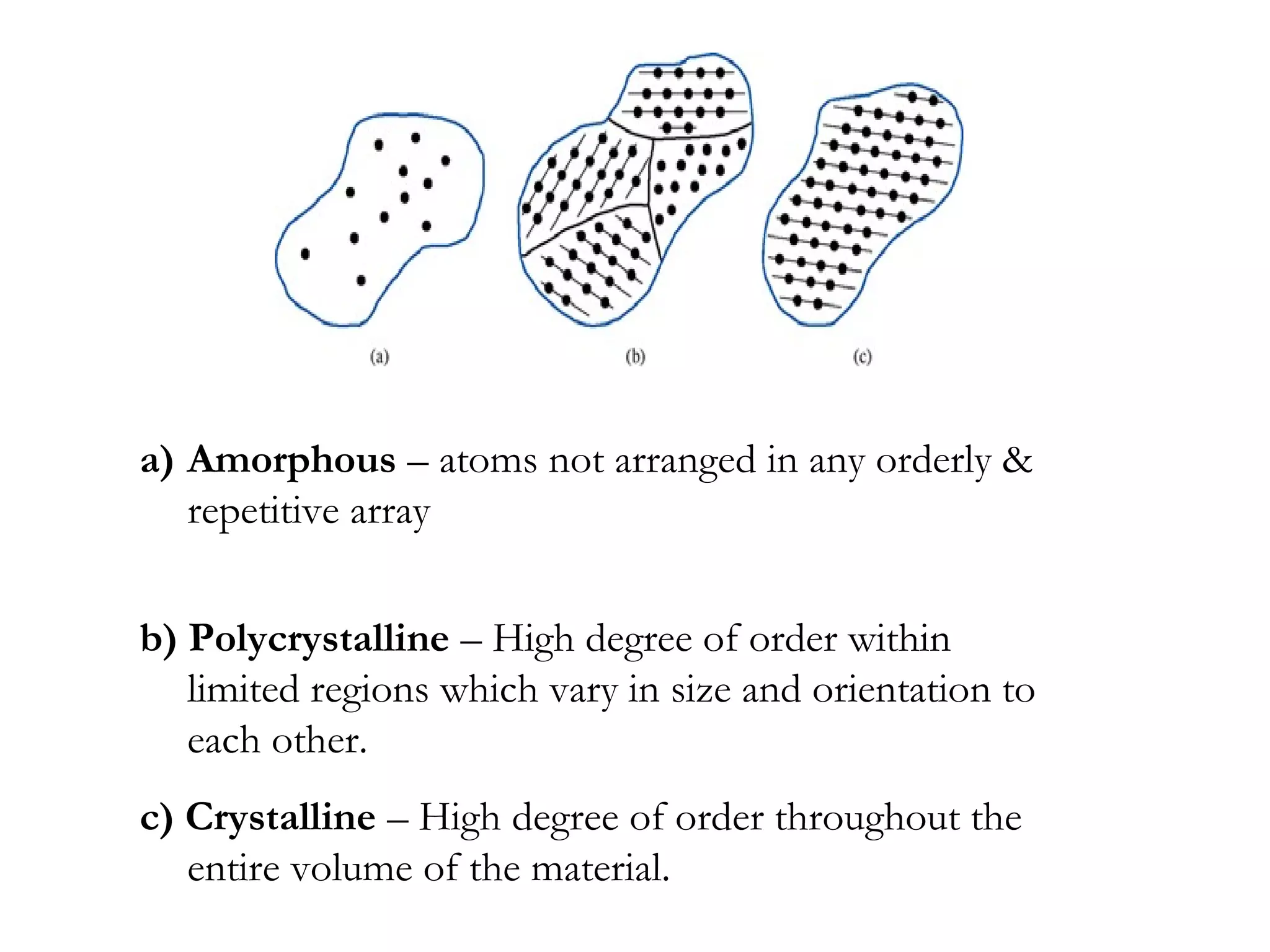
▪ amorphous
▪ polycrystalline
▪ crystalline
Each type is characteristic by the size of an
order region within the material
a) Amorphous – atoms not arranged in any orderly &
   repetitive array


b) Polycrystalline – High degree of order within
   limited regions which vary in size and orientation to
   each other.
c) Crystalline – High degree of order throughout the
   entire volume of the material.
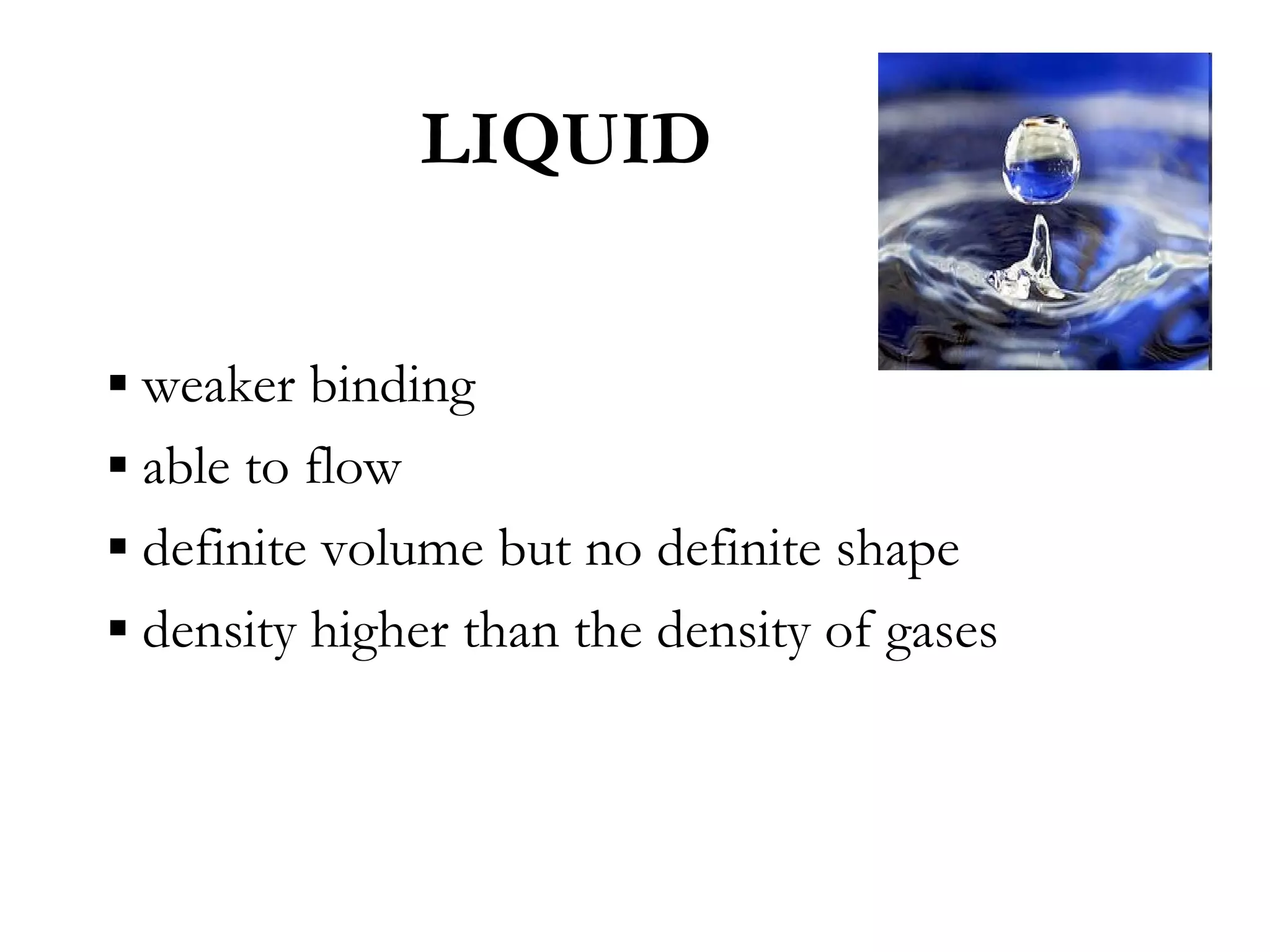
LIQUID


▪ weaker binding
▪ able to flow
▪ definite volume but no definite shape
▪ density higher than the density of gases
GAS
▪ fills container
▪ compressible
▪ flows easily
▪ very low density – each particles are well
   separated
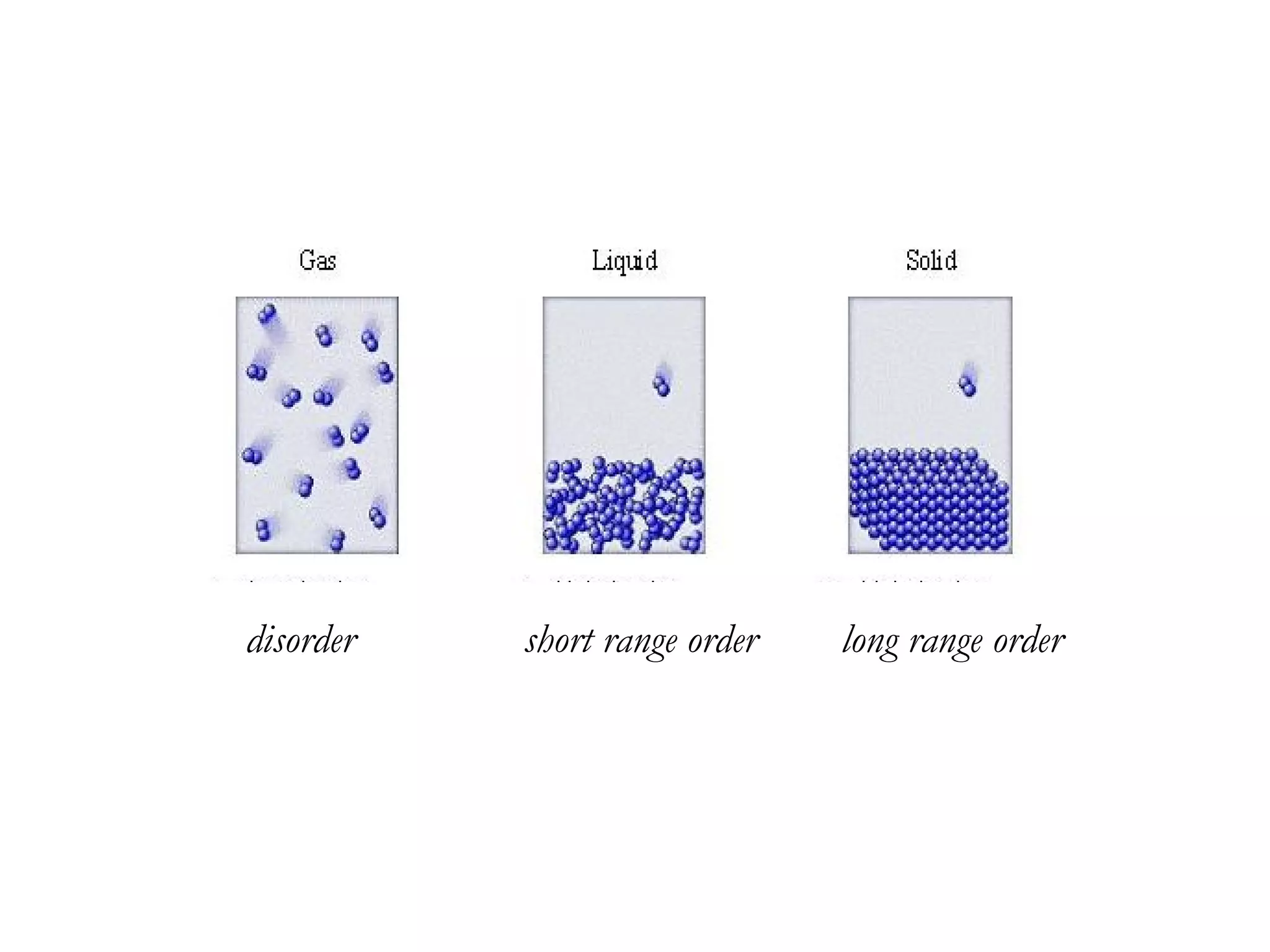
disorder   short range order   long range order
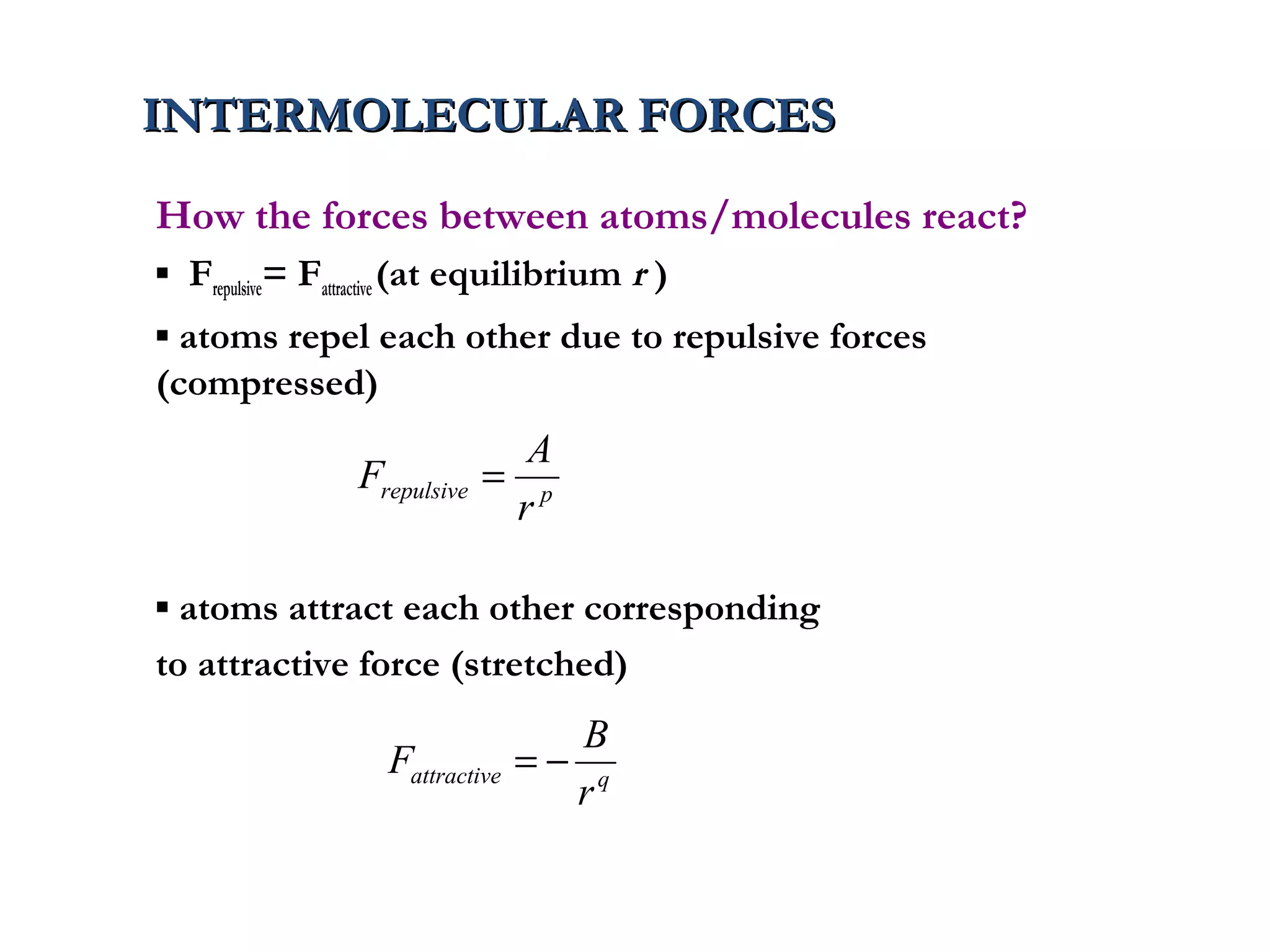
INTERMOLECULAR FORCES
How the forces between atoms/molecules react?
▪ Frepulsive= Fattractive (at equilibrium r )
▪ atoms repel each other due to repulsive forces
(compressed)
                                A
                 Frepulsive   = p
                               r

▪ atoms attract each other corresponding
to attractive force (stretched)
                                     B
                    Fattractive   =− q
                                    r
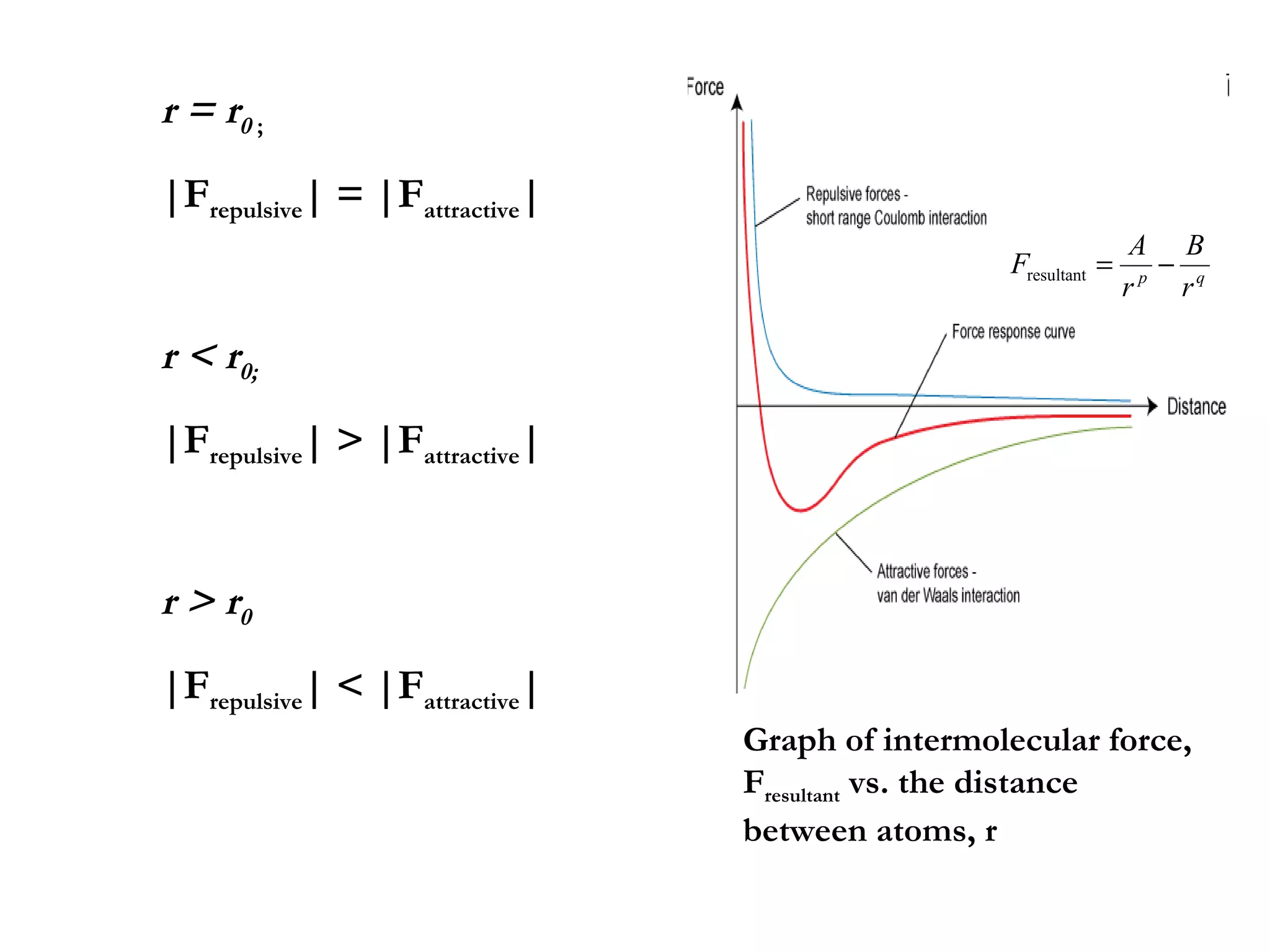
r = r0 ;
|Frepulsive| = |Fattractive|
                                                                A B
                                                Fresultant =     p
                                                                   − q
                                                               r    r

r < r0;
                               r0
|Frepulsive| > |Fattractive|


r > r0
|Frepulsive| < |Fattractive|
                               Graph of intermolecular force,
                               Fresultant vs. the distance
                               between atoms, r
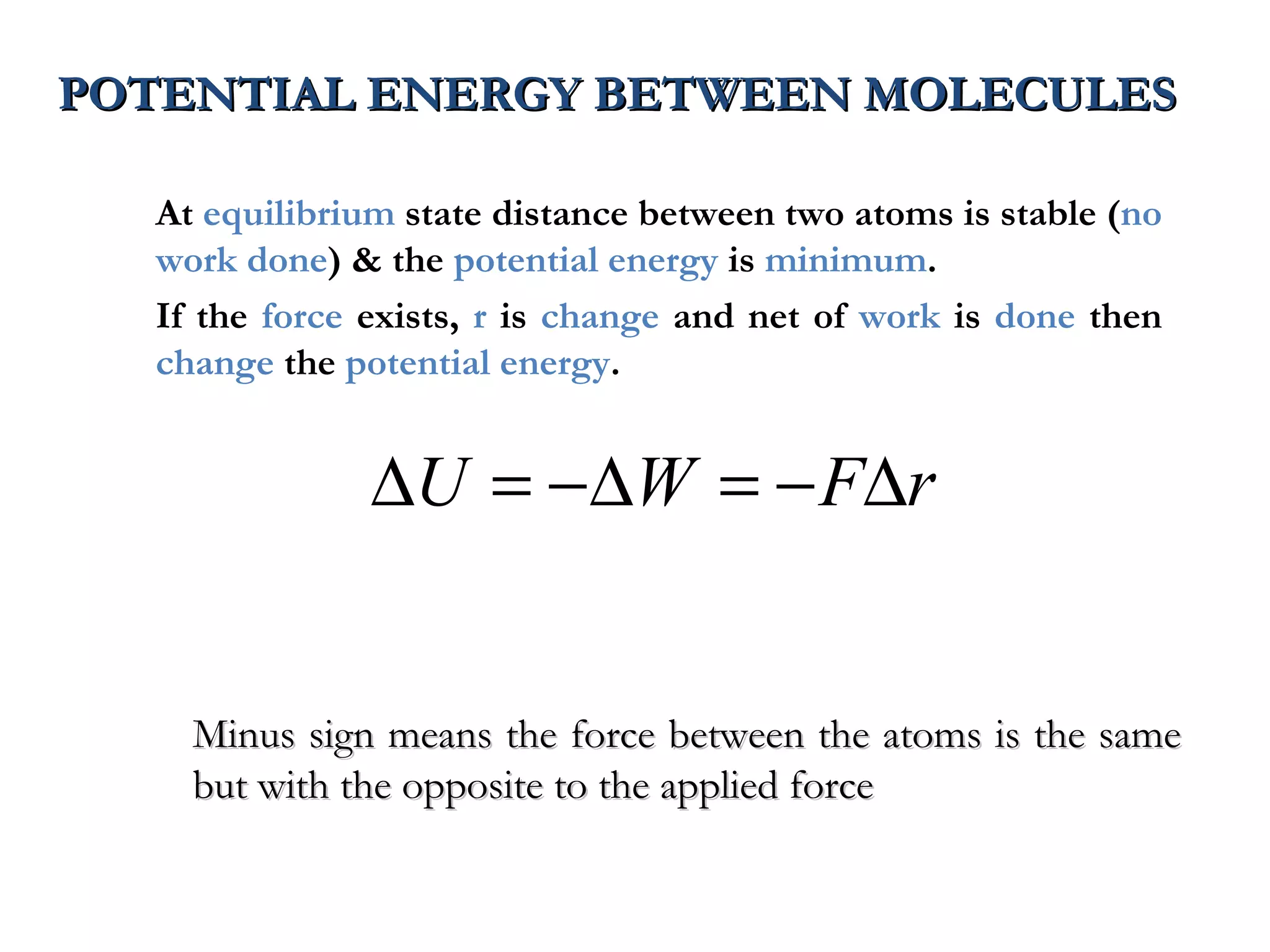
POTENTIAL ENERGY BETWEEN MOLECULES

  At equilibrium state distance between two atoms is stable (no
  work done) & the potential energy is minimum.
  If the force exists, r is change and net of work is done then
  change the potential energy.


               ∆U = −∆W = − F∆r


    Minus sign means the force between the atoms is the same
    but with the opposite to the applied force
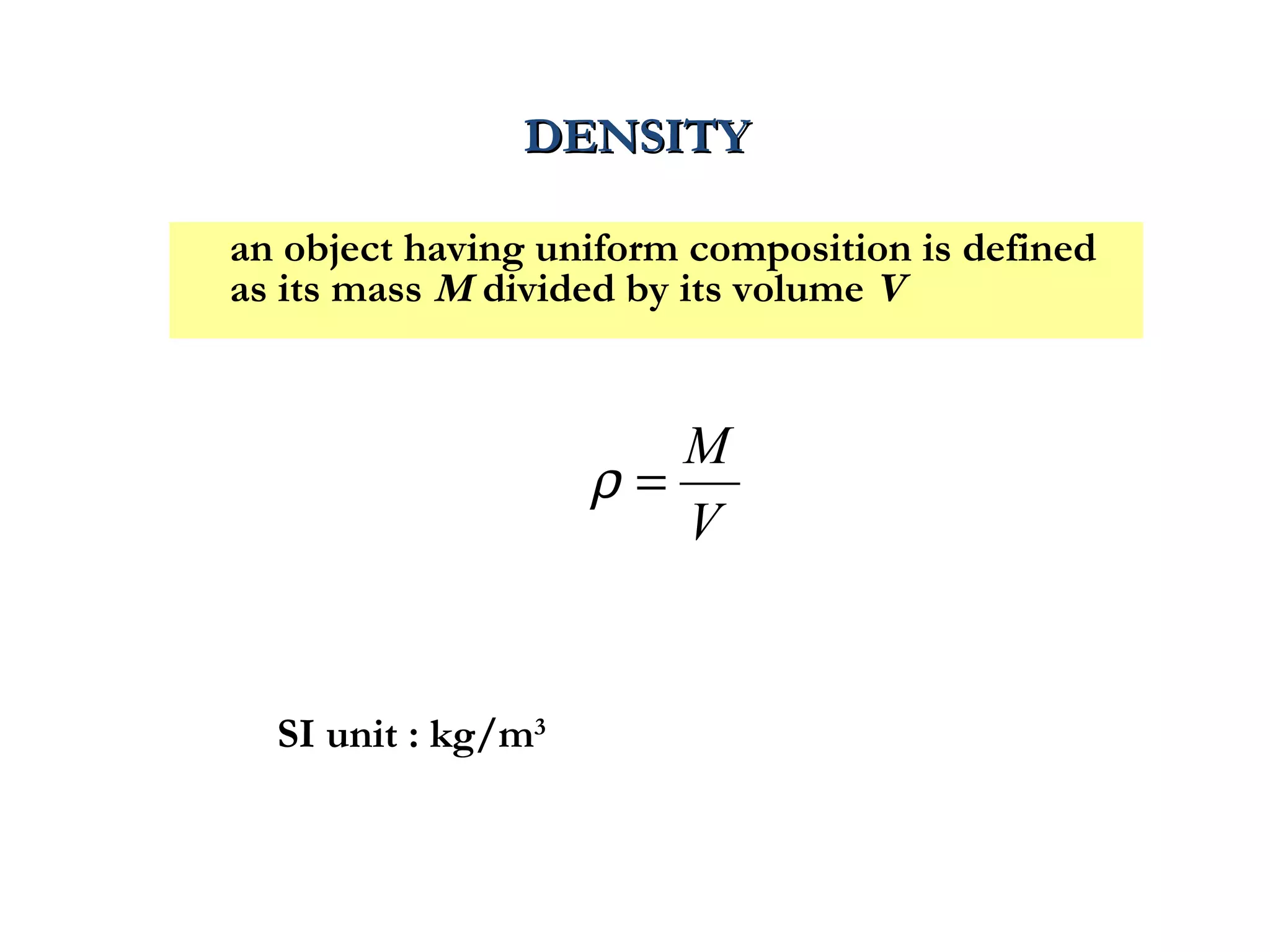
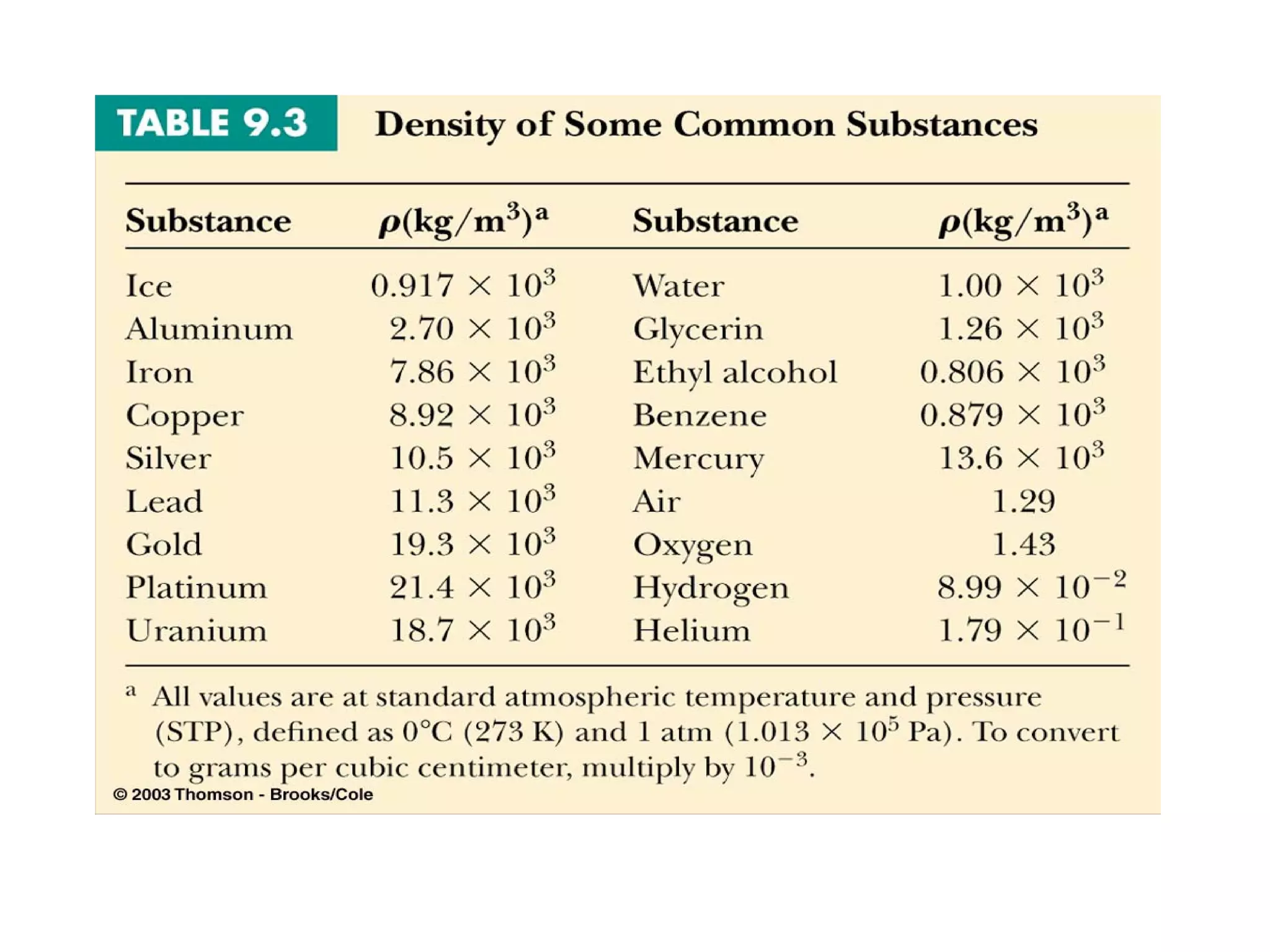
DENSITY

an object having uniform composition is defined
as its mass M divided by its volume V


                       M
                    ρ=
                       V


  SI unit : kg/m3
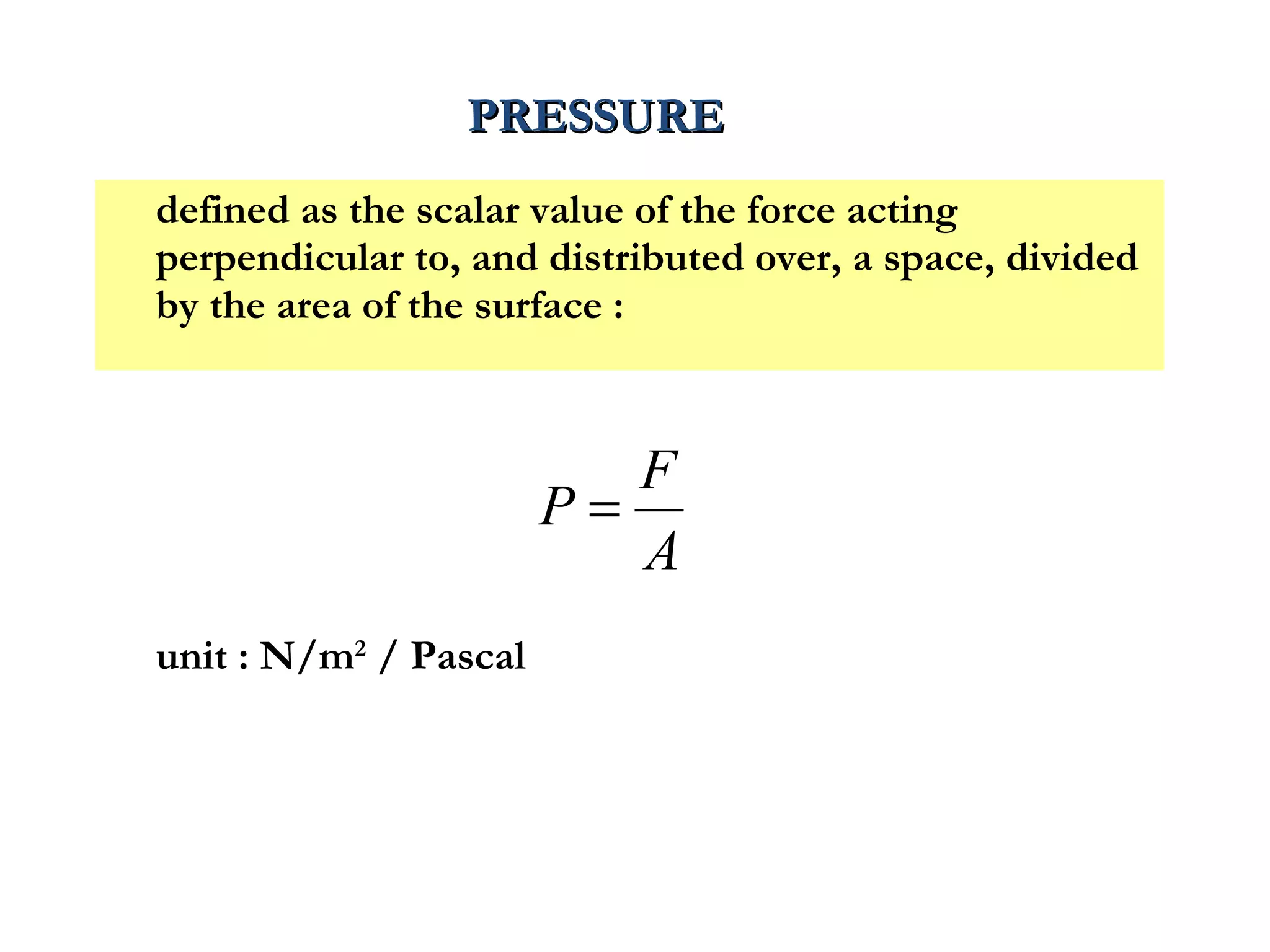
PRESSURE
defined as the scalar value of the force acting
perpendicular to, and distributed over, a space, divided
by the area of the surface :


                          F
                       P=
                          A
unit : N/m2 / Pascal
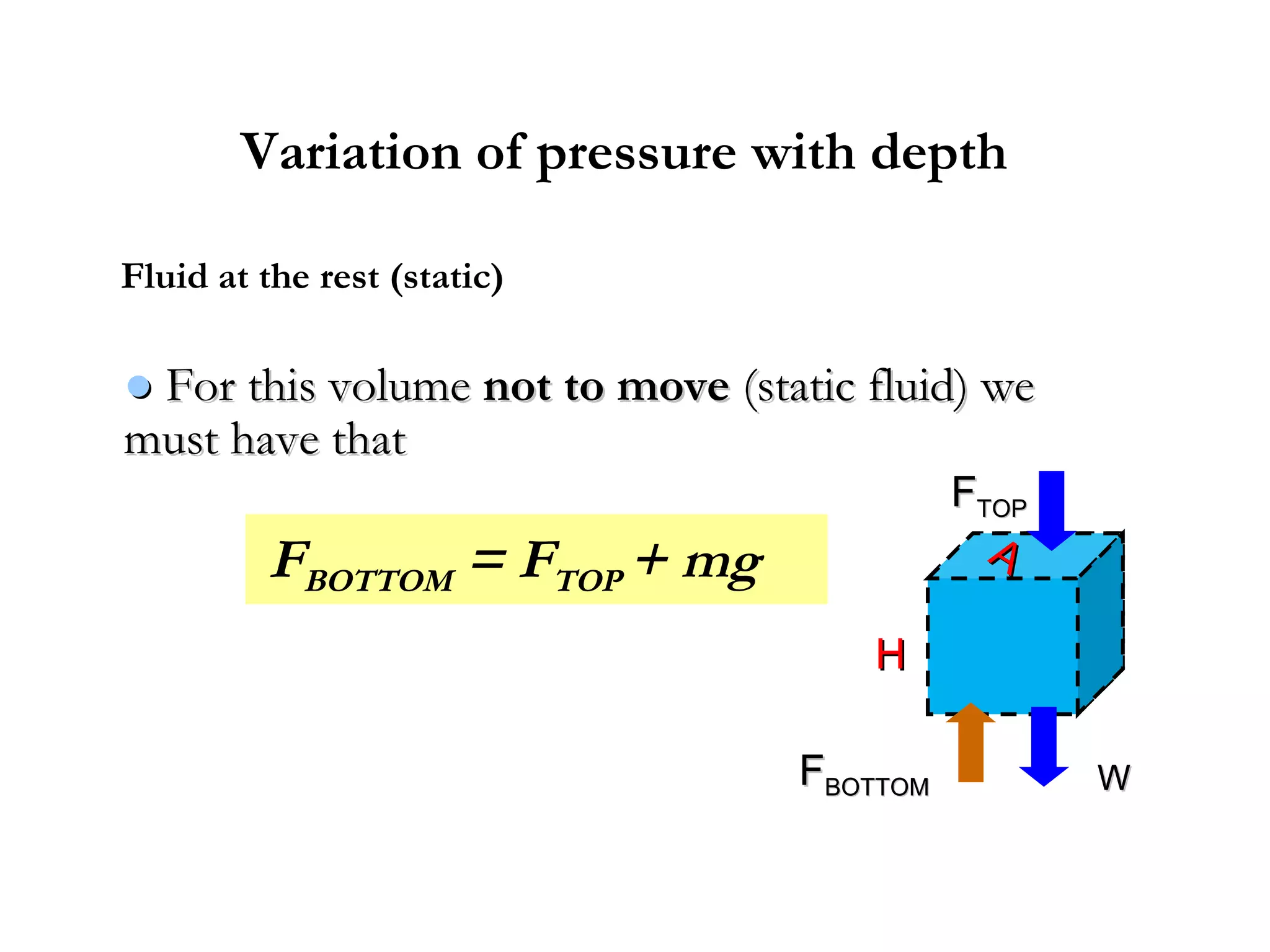
Variation of pressure with depth

Fluid at the rest (static)

● For this volume not to move (static fluid) we
must have that
                                            FTOP
          FBOTTOM = FTOP + mg                 A

                                      H

                                  FBOTTOM          W
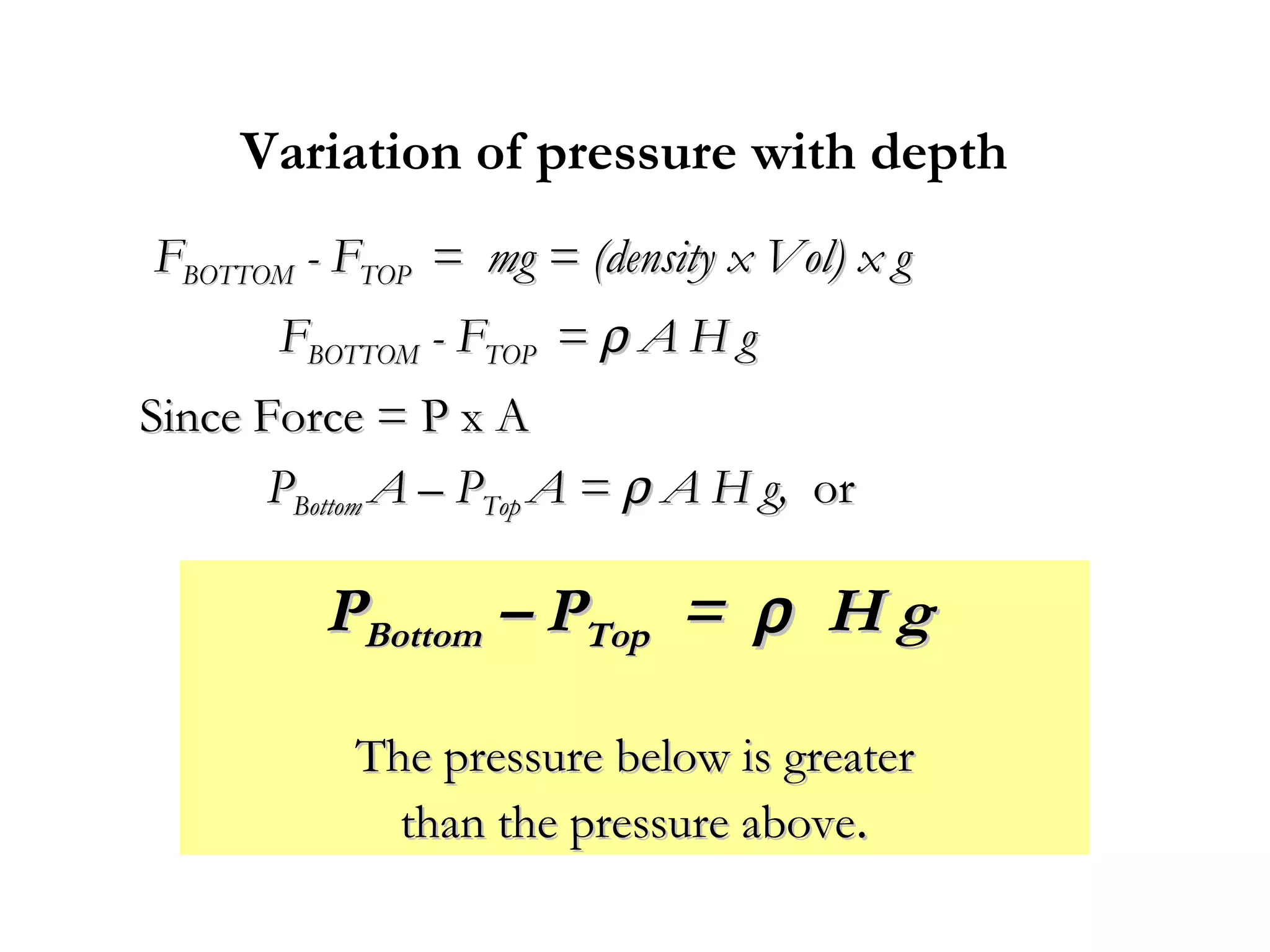
Variation of pressure with depth
FBOTTOM - FTOP = mg = (density x Vol) x g
       FBOTTOM - FTOP = ρ A H g
Since Force = P x A
      PBottom A – PTop A = ρ A H g, or

         PBottom – PTop = ρ H g

           The pressure below is greater
             than the pressure above.
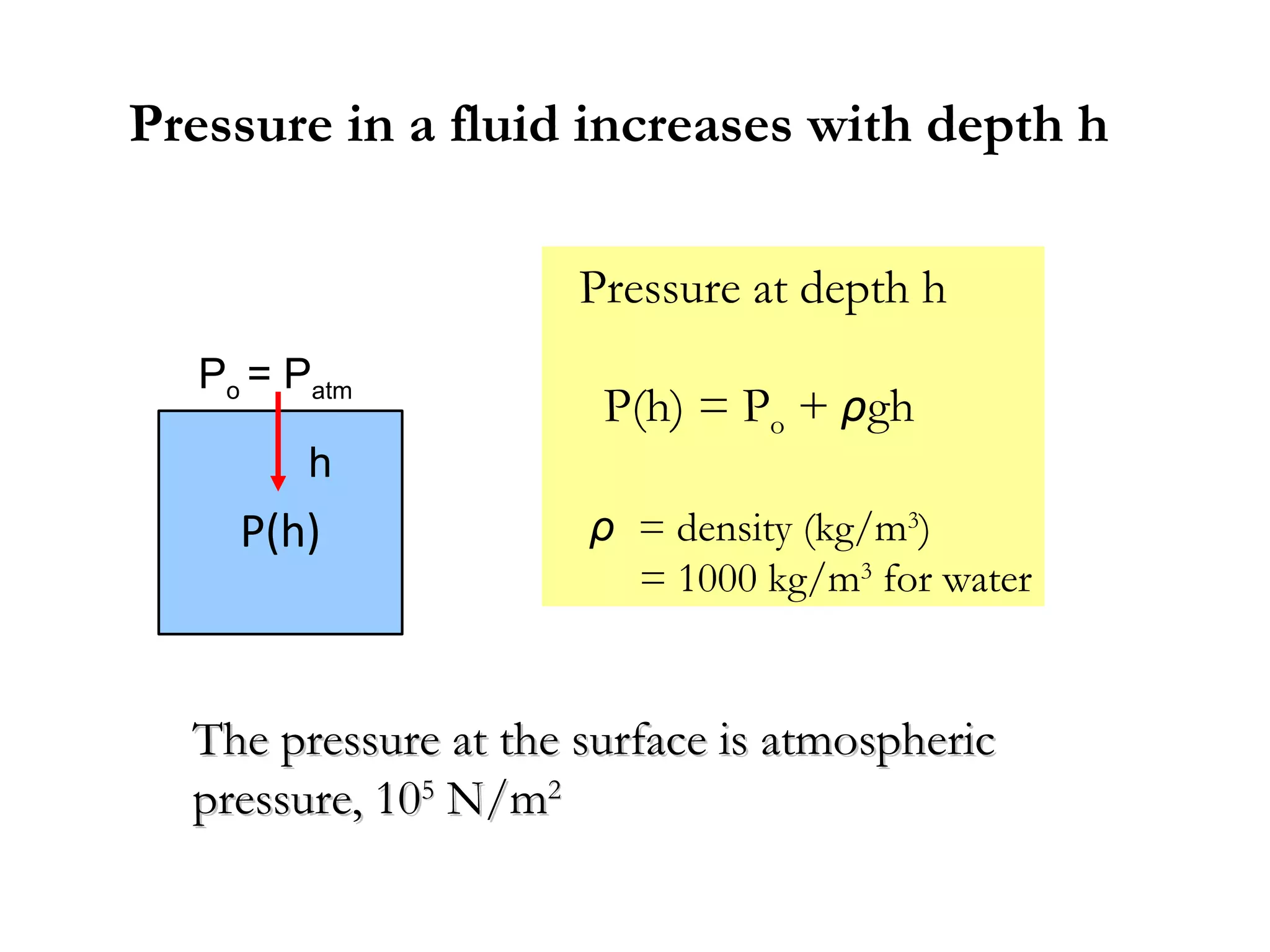
Pressure in a fluid increases with depth h

                      Pressure at depth h
  Po = Patm
                       P(h) = Po + ρgh
        h
    P(h)              ρ = density (kg/m3)
                        = 1000 kg/m3 for water


  The pressure at the surface is atmospheric
  pressure, 105 N/m2
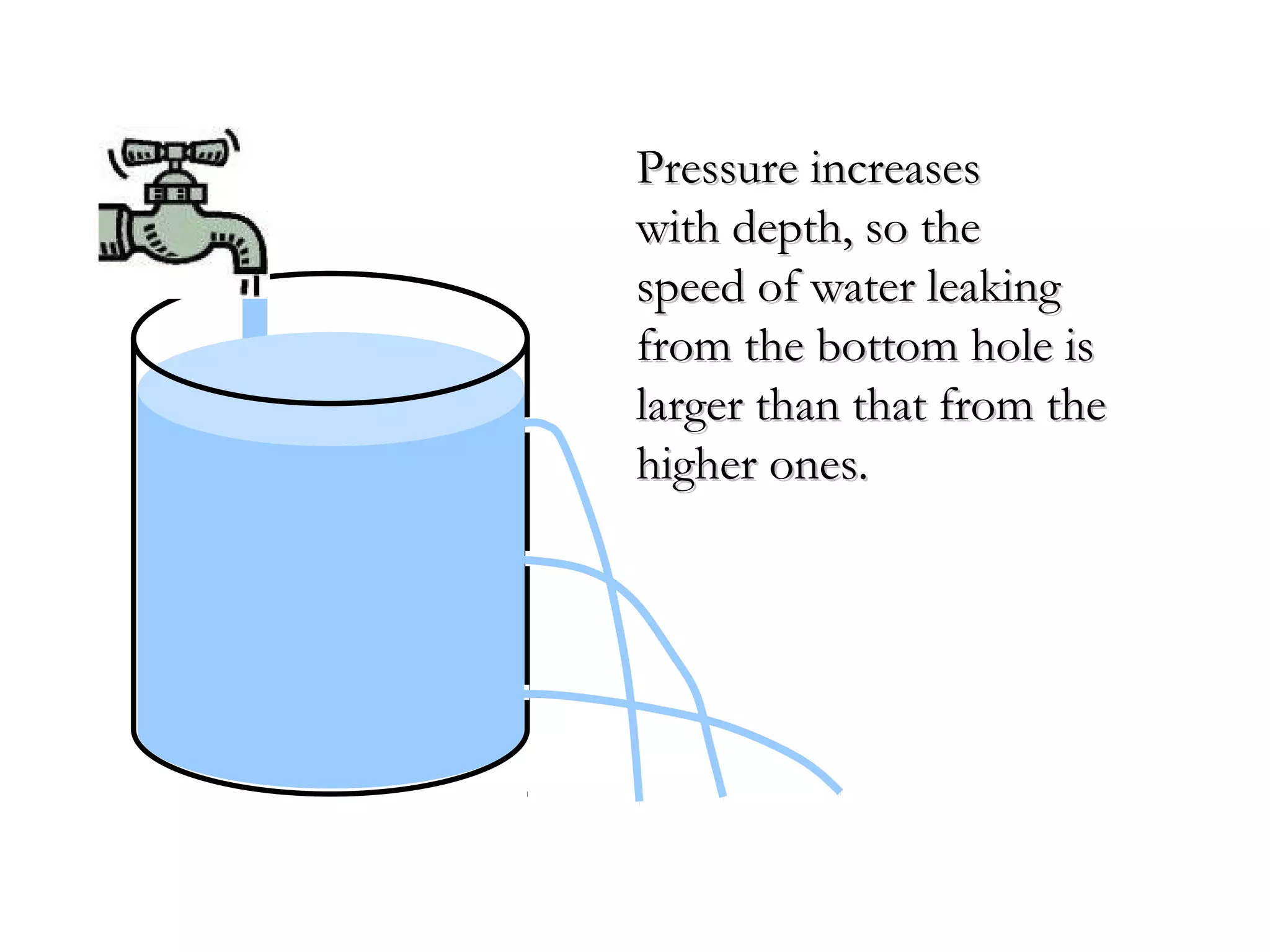
Pressure increases
with depth, so the
speed of water leaking
from the bottom hole is
larger than that from the
higher ones.
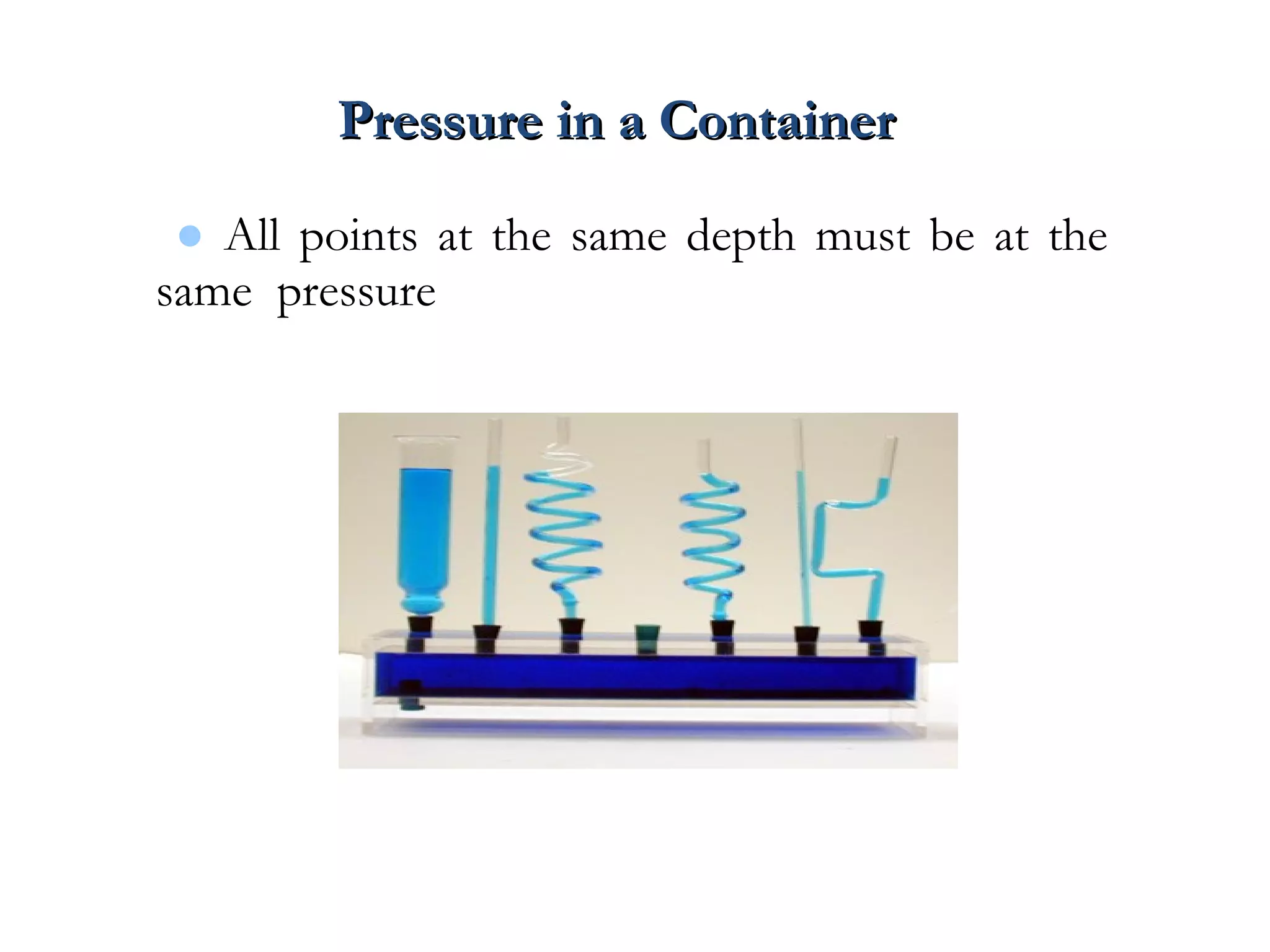
Pressure in a Container

 ● All points at the same depth must be at the
same pressure
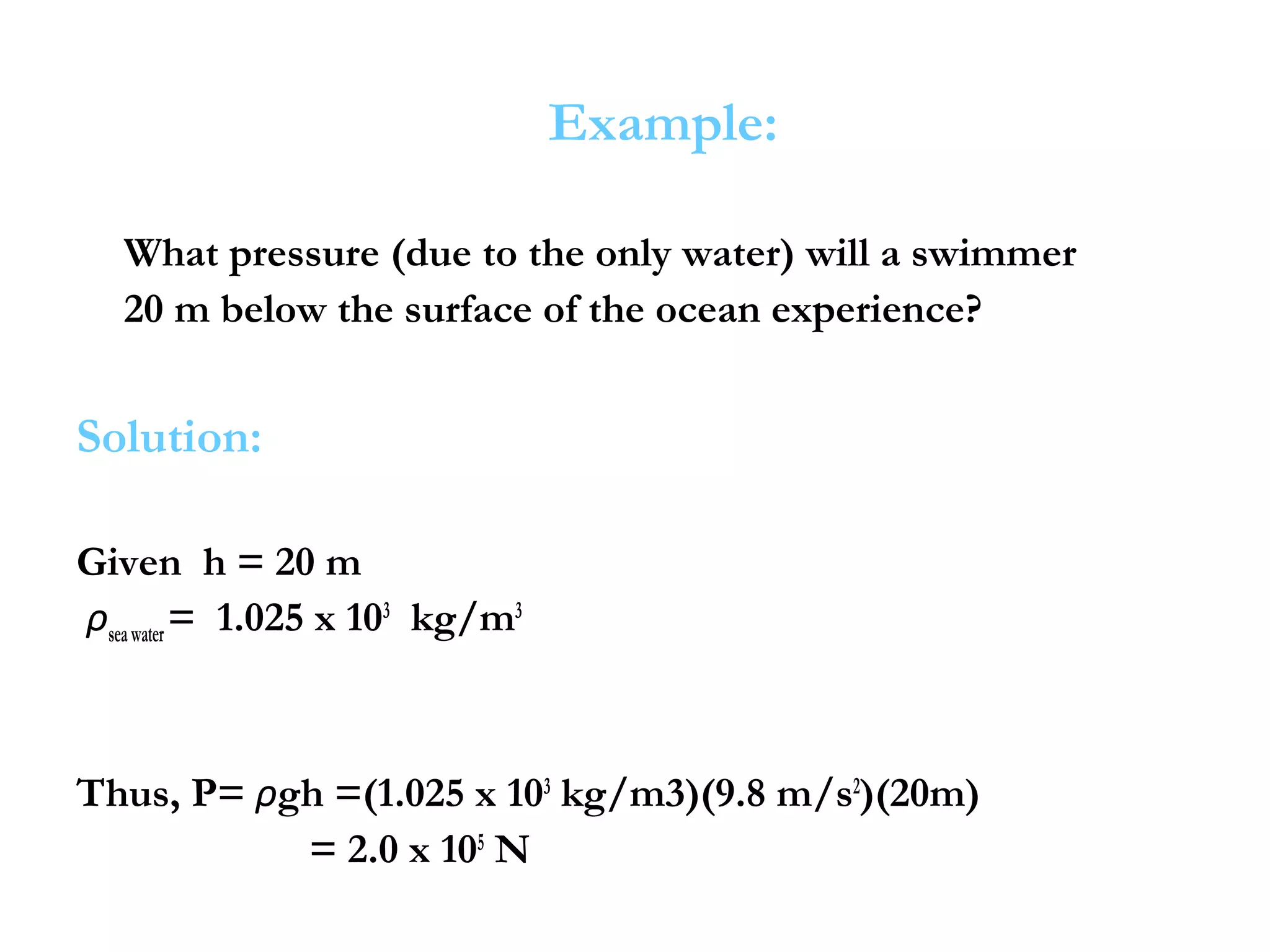
Example:

   What pressure (due to the only water) will a swimmer
   20 m below the surface of the ocean experience?


Solution:

Given h = 20 m
ρsea water = 1.025 x 10³ kg/m3


Thus, P= ρgh =(1.025 x 10³ kg/m3)(9.8 m/s2)(20m)
           = 2.0 x 10⁵ N
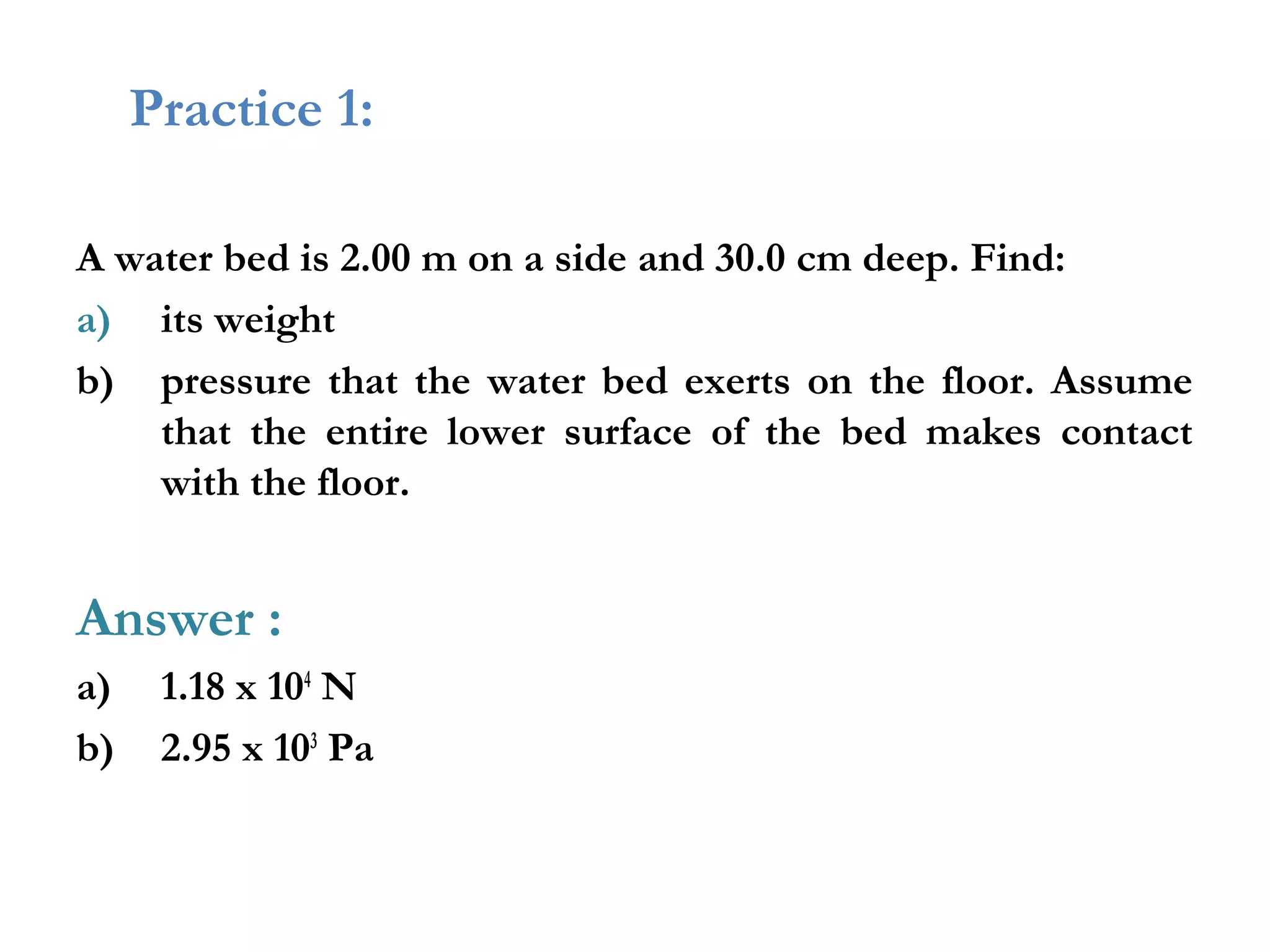
Practice 1:

A water bed is 2.00 m on a side and 30.0 cm deep. Find:
a) its weight
b) pressure that the water bed exerts on the floor. Assume
    that the entire lower surface of the bed makes contact
    with the floor.


Answer :
a)    1.18 x 10⁴ N
b)    2.95 x 10³ Pa
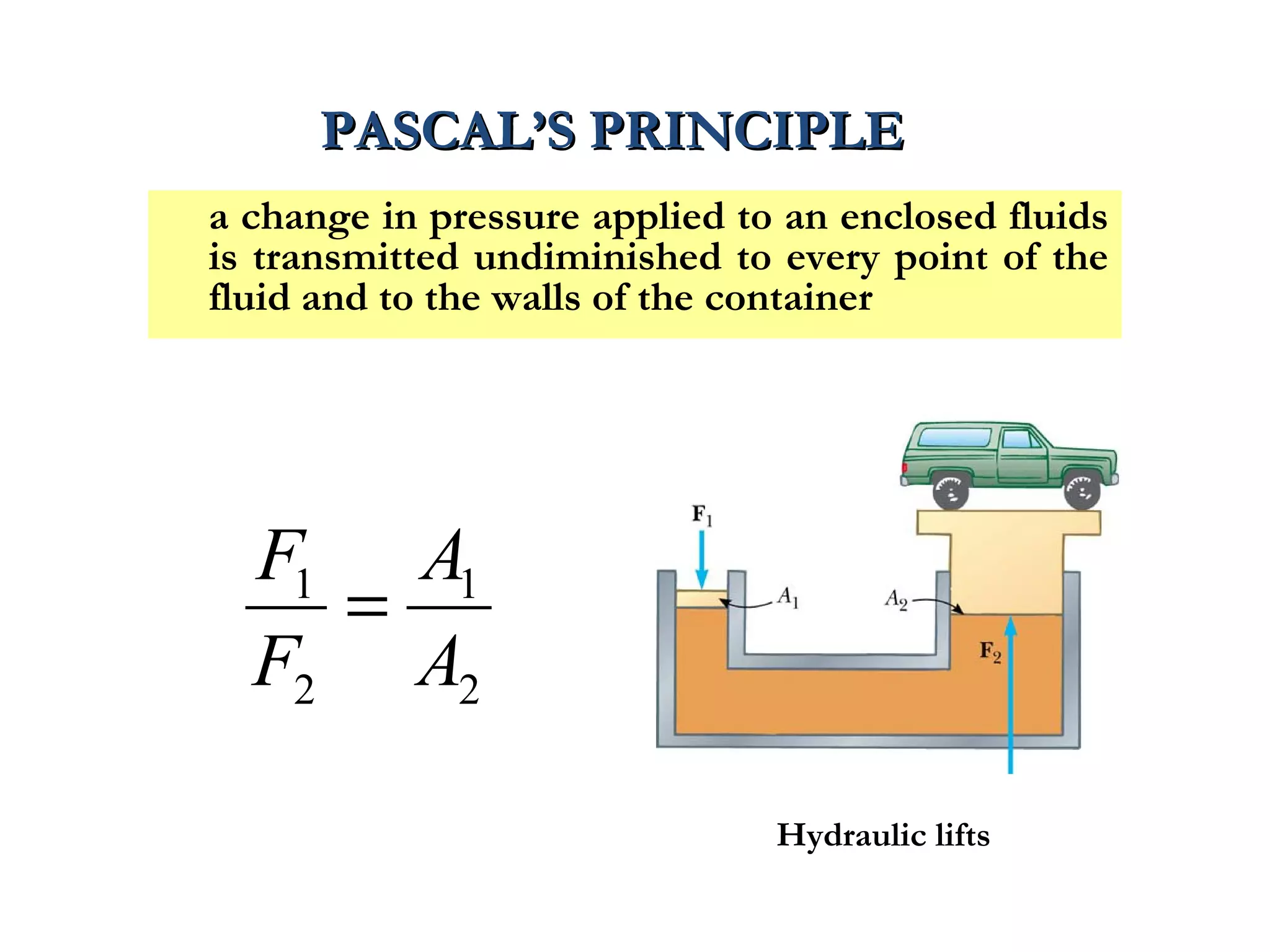
PASCAL’S PRINCIPLE
a change in pressure applied to an enclosed fluids
is transmitted undiminished to every point of the
fluid and to the walls of the container


  F1 A1
    =
  F2 A2

                               Hydraulic lifts
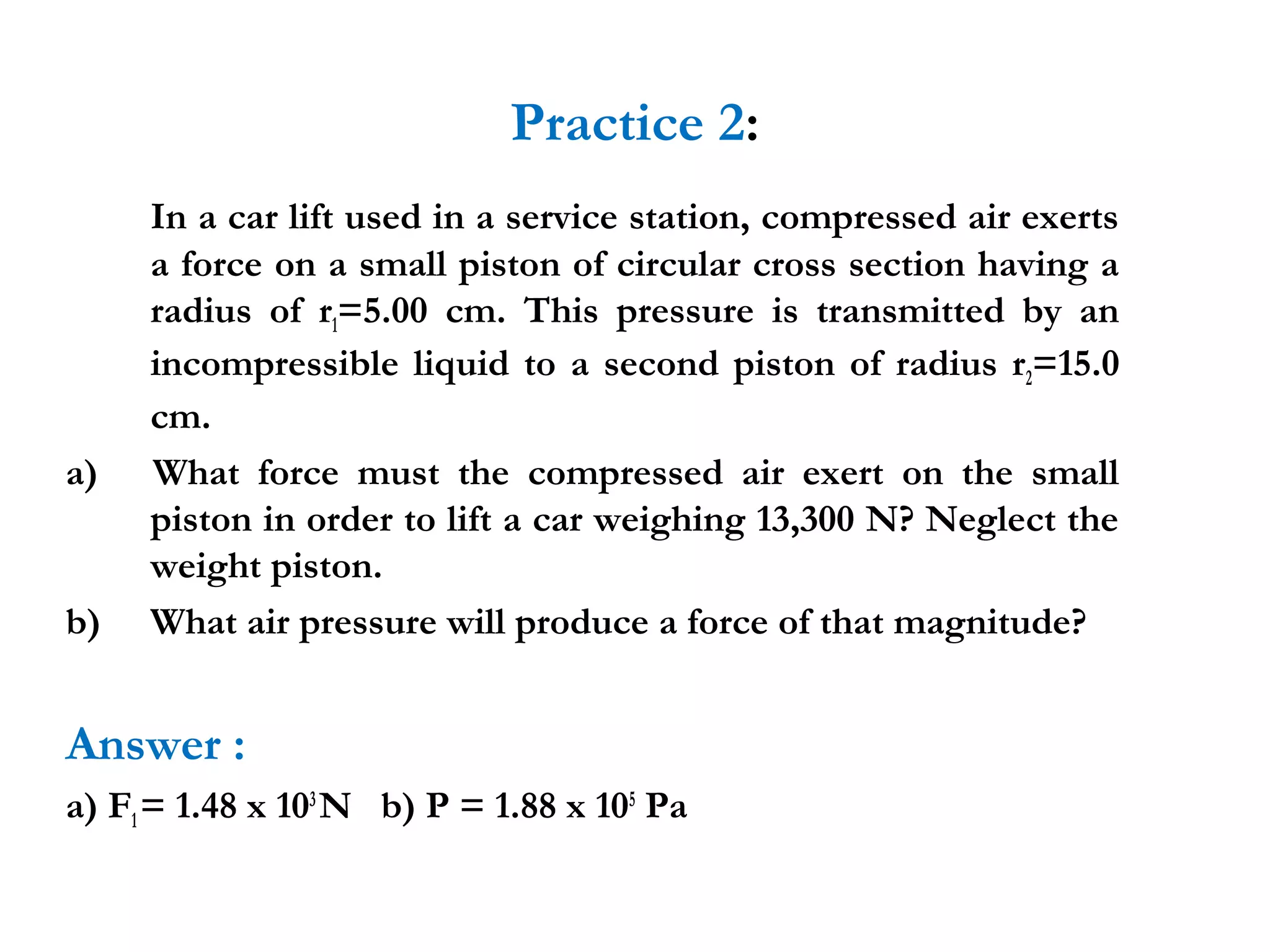
Practice 2:
     In a car lift used in a service station, compressed air exerts
     a force on a small piston of circular cross section having a
     radius of r1=5.00 cm. This pressure is transmitted by an
     incompressible liquid to a second piston of radius r2=15.0
     cm.
a)   What force must the compressed air exert on the small
     piston in order to lift a car weighing 13,300 N? Neglect the
     weight piston.
b)   What air pressure will produce a force of that magnitude?


Answer :
a) F1 = 1.48 x 10³ N b) P = 1.88 x 10⁵ Pa
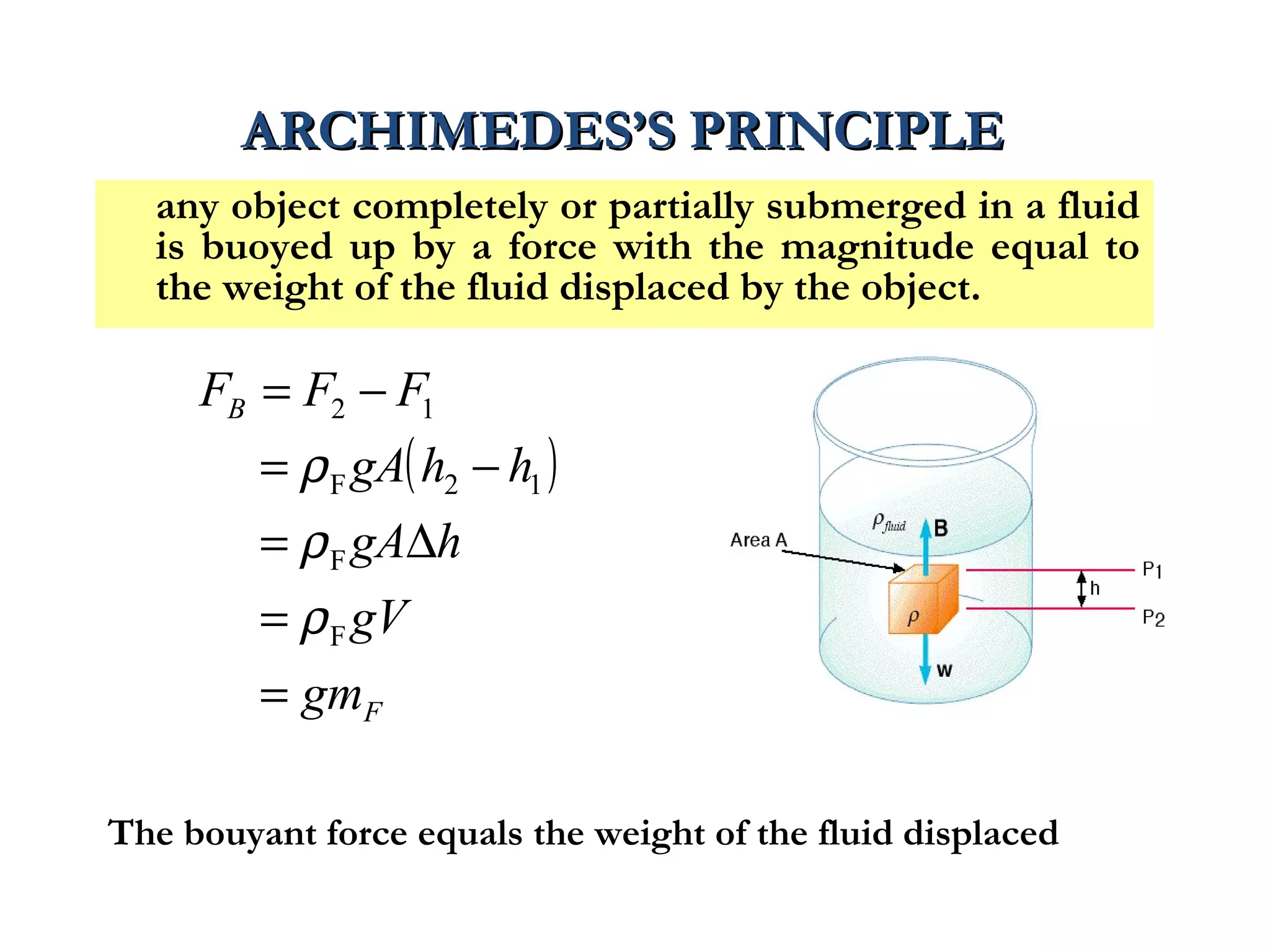
ARCHIMEDES’S PRINCIPLE
  any object completely or partially submerged in a fluid
  is buoyed up by a force with the magnitude equal to
  the weight of the fluid displaced by the object.

     FB = F2 − F1
         = ρ F gA( h2 − h1 )
         = ρ F gA∆h
         = ρ F gV
         = gmF

The bouyant force equals the weight of the fluid displaced
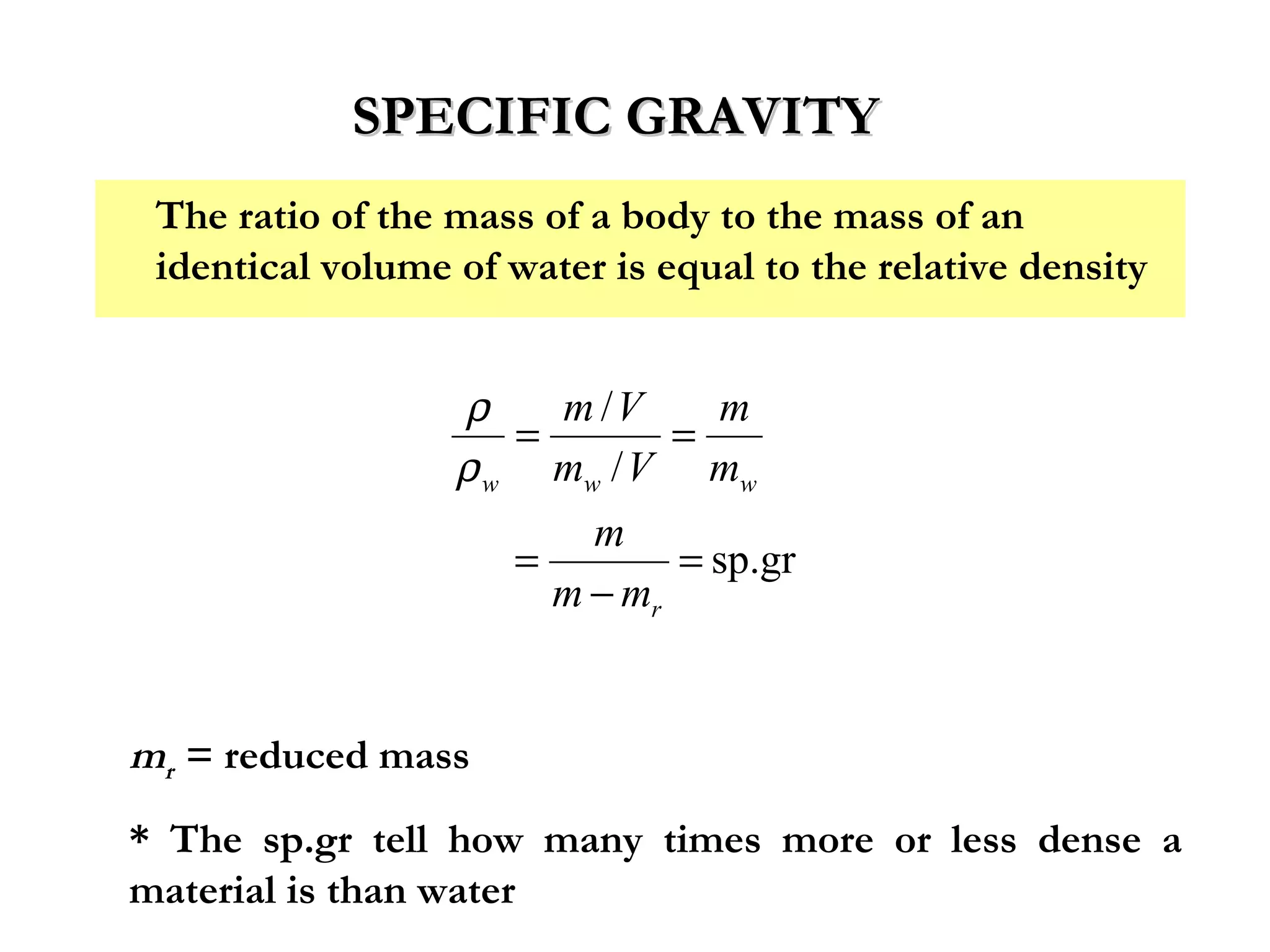
SPECIFIC GRAVITY
 The ratio of the mass of a body to the mass of an
 identical volume of water is equal to the relative density


                  ρ    m /V     m
                     =        =
                  ρ w mw / V mw
                         m
                     =        = sp.gr
                       m − mr


mr = reduced mass
* The sp.gr tell how many times more or less dense a
material is than water
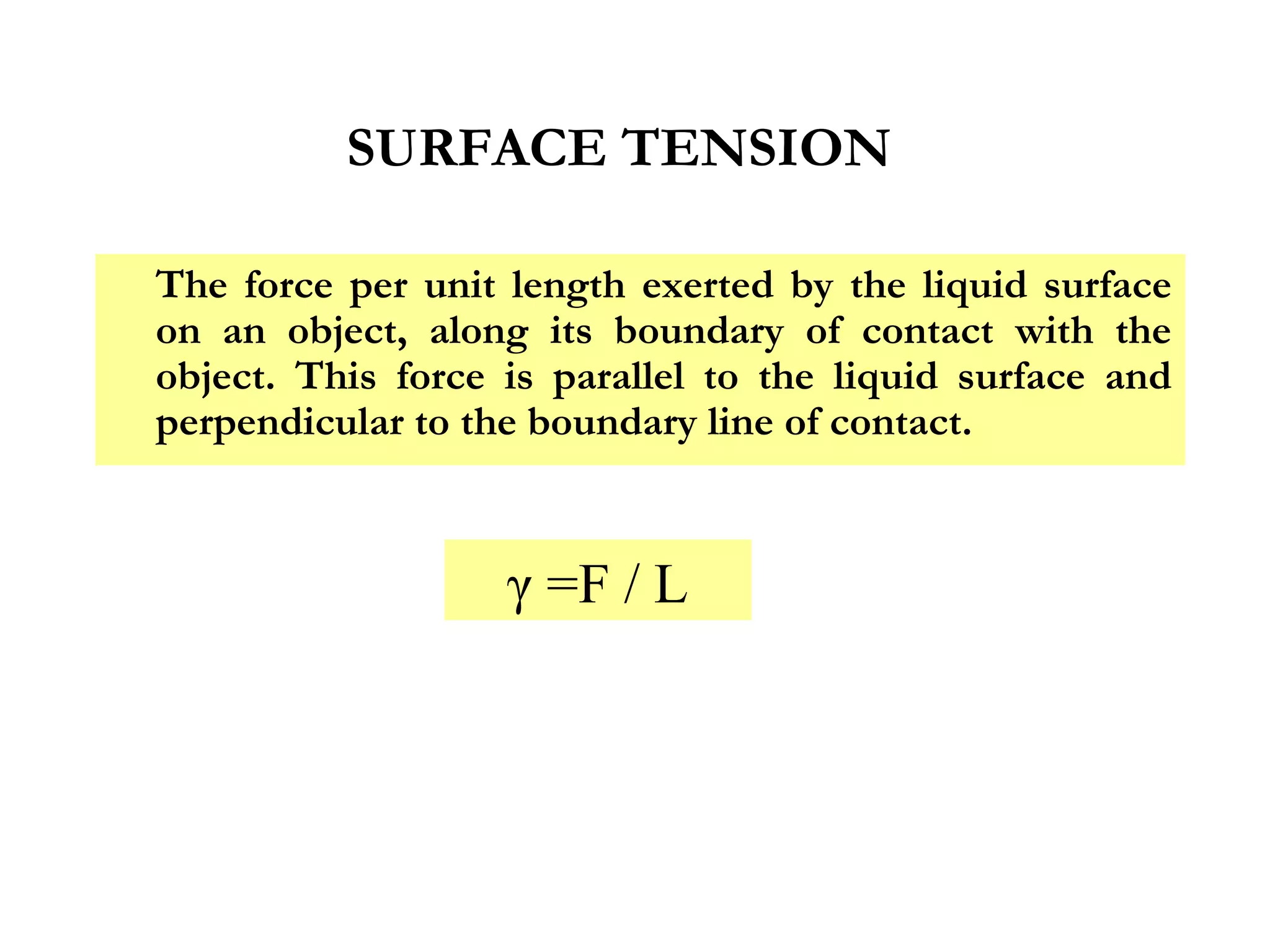
SURFACE TENSION

The force per unit length exerted by the liquid surface
on an object, along its boundary of contact with the
object. This force is parallel to the liquid surface and
perpendicular to the boundary line of contact.


                   γ =F / L
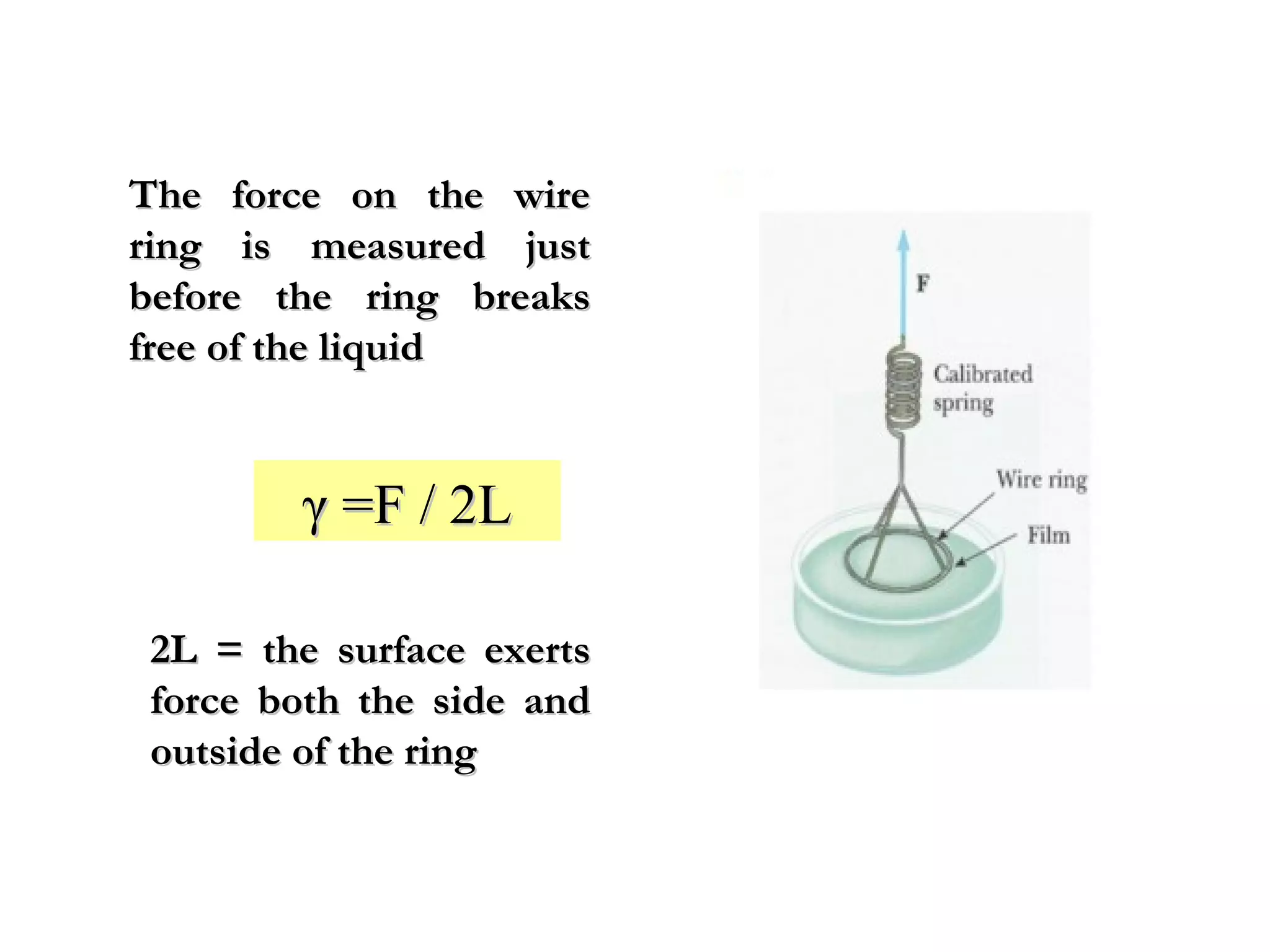
The force on the wire
ring is measured just
before the ring breaks
free of the liquid


        γ =F / 2L

 2L = the surface exerts
 force both the side and
 outside of the ring
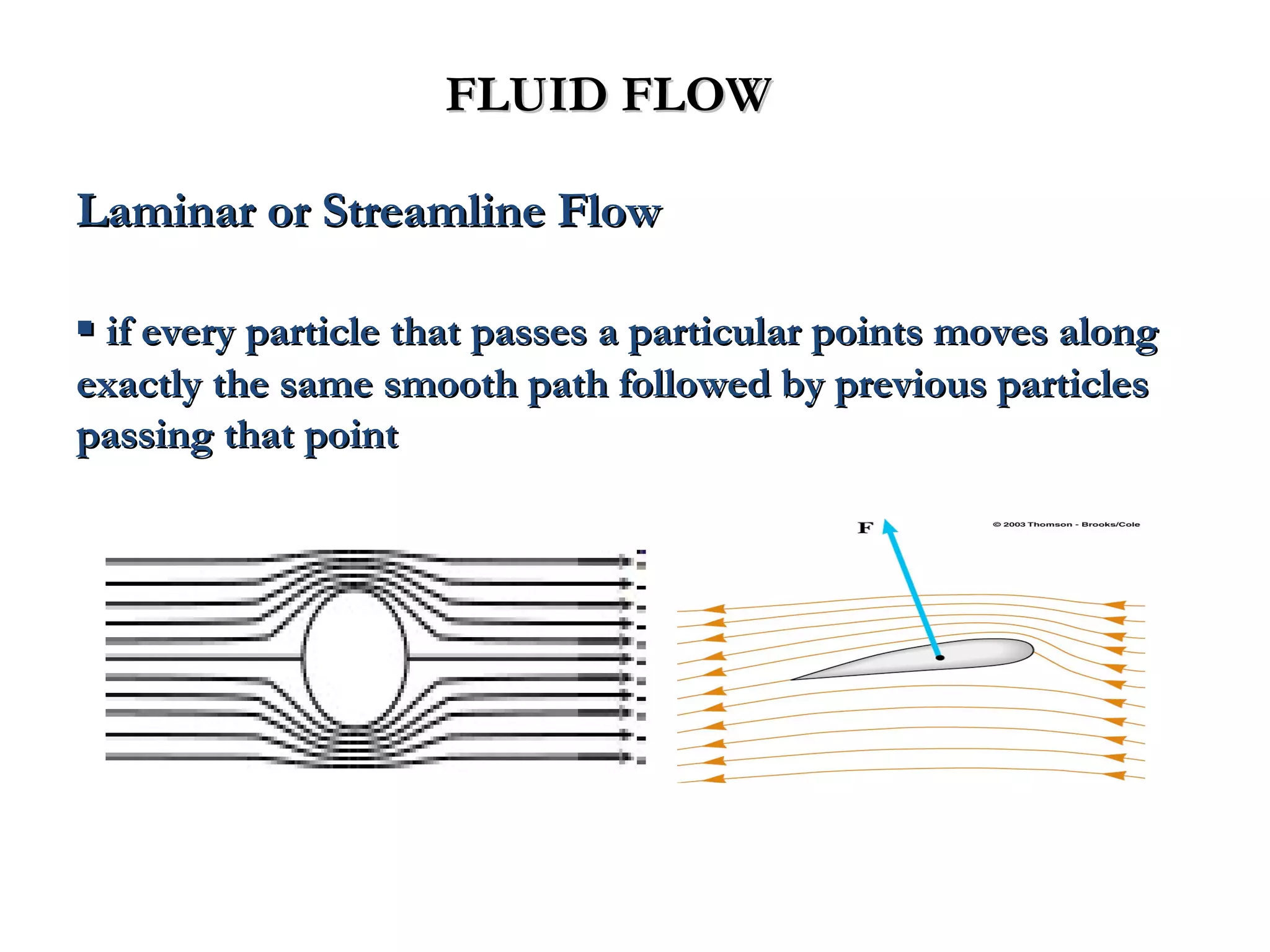
FLUID FLOW

Laminar or Streamline Flow

▪ if every particle that passes a particular points moves along
exactly the same smooth path followed by previous particles
passing that point
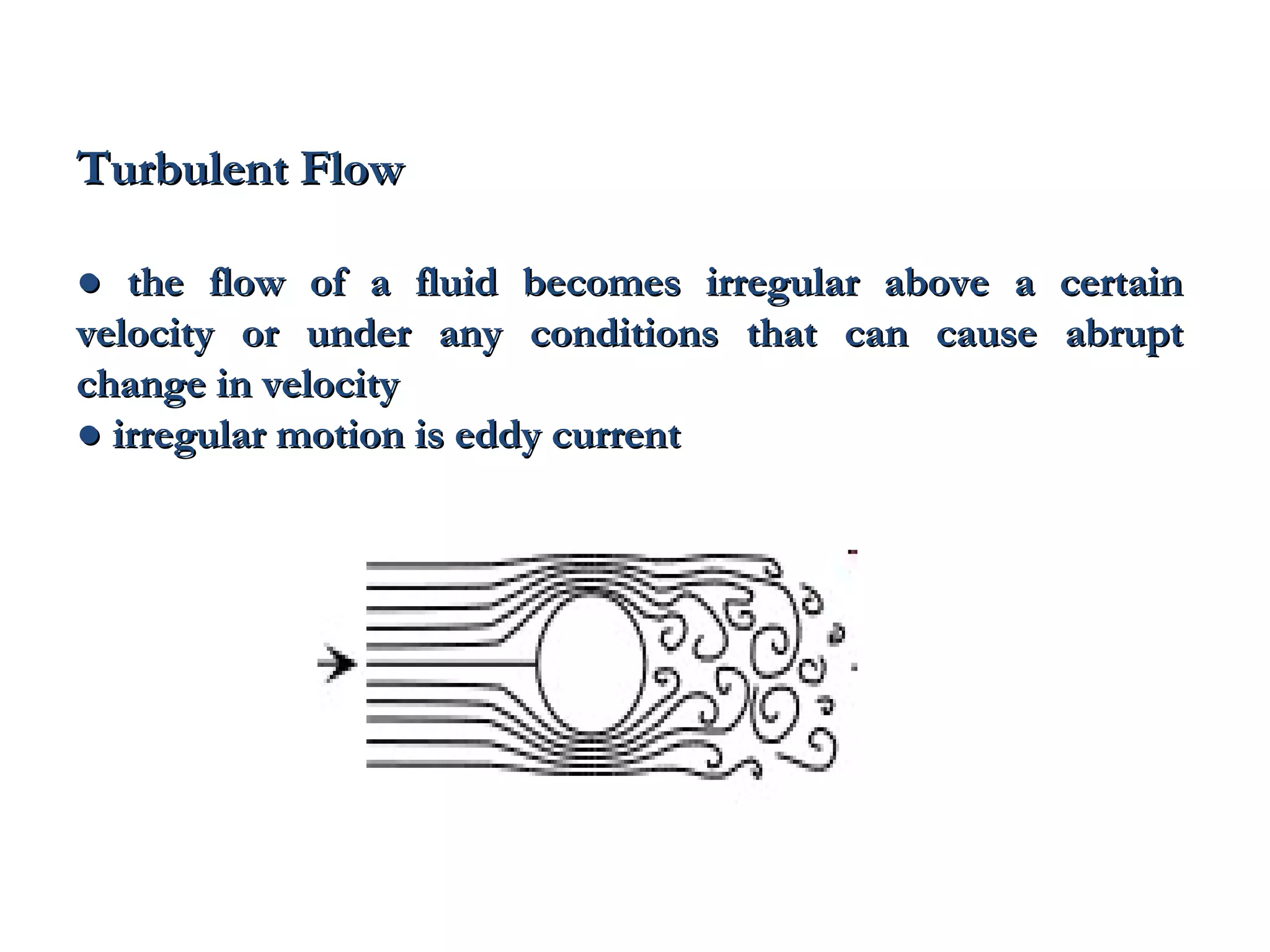
Turbulent Flow

● the flow of a fluid becomes irregular above a   certain
velocity or under any conditions that can cause   abrupt
change in velocity
● irregular motion is eddy current
▪ The laminar or turbulent behavior of fluids is dependent
   by:

a) size of the object moving through the fluid, or the size
   of the vessel in which the fluid is moving.
b) velocity of the object, or the fluid relative to the vessel.
c) viscosity of the fluid.

▪ The relationship between these variables is described by
   a scaling number, which is dimentionless, called the
   Reynolds number, Re.
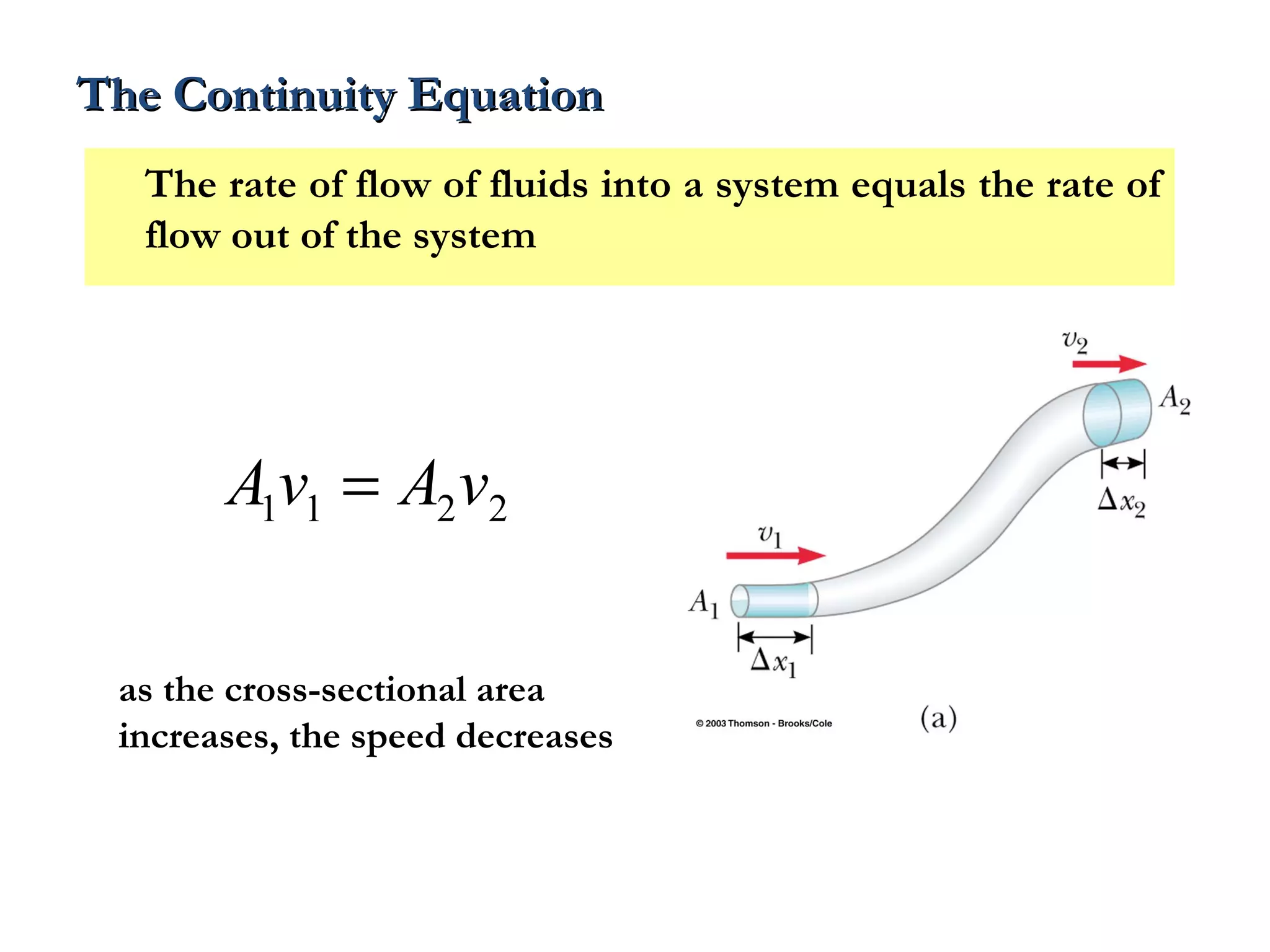
The Continuity Equation
  The rate of flow of fluids into a system equals the rate of
  flow out of the system


       A1v1 = A2 v2

 as the cross-sectional area
 increases, the speed decreases
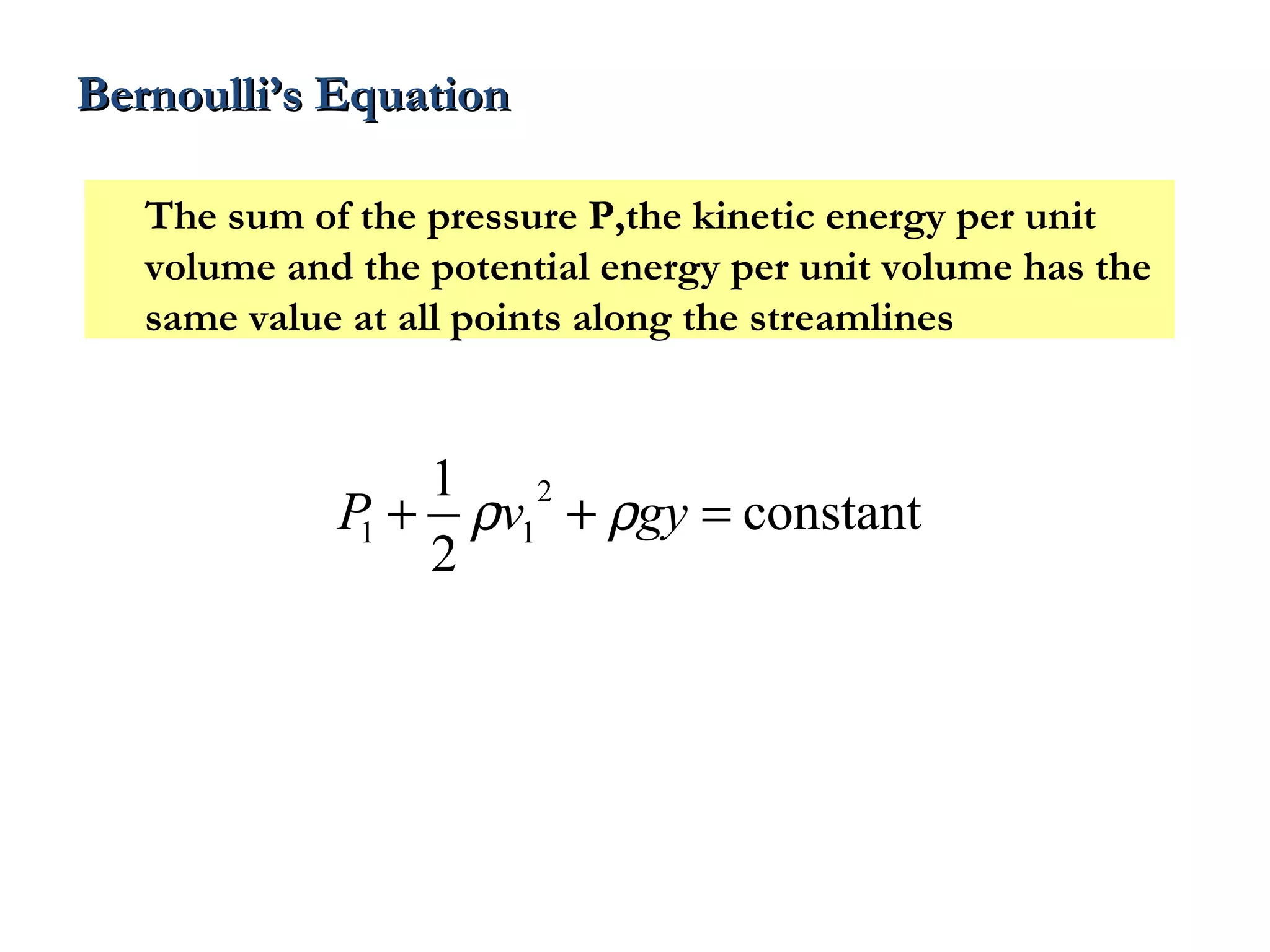
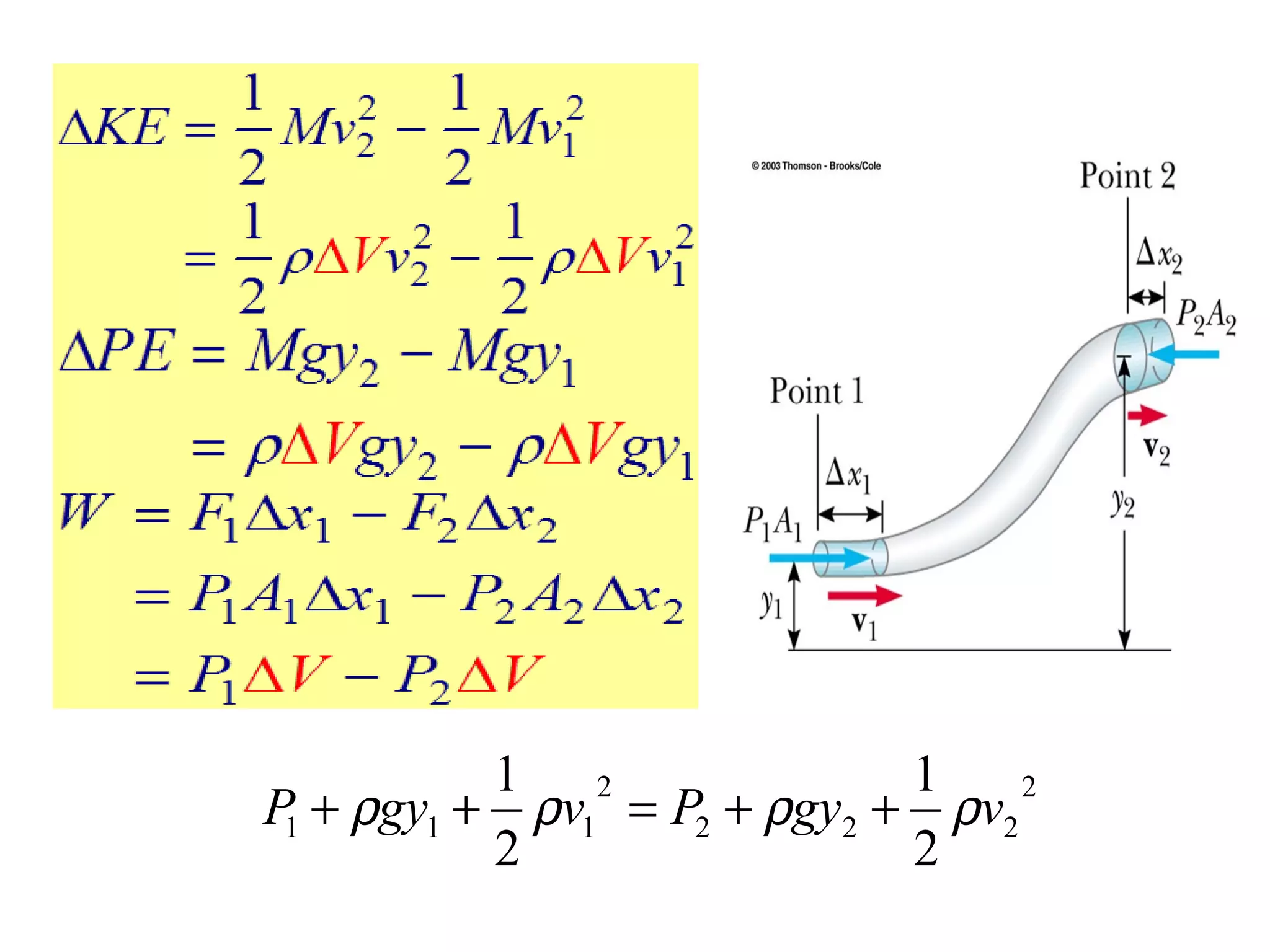
Bernoulli’s Equation

   The sum of the pressure P,the kinetic energy per unit
   volume and the potential energy per unit volume has the
   same value at all points along the streamlines


                1 2
             P + ρv1 + ρgy = constant
              1
                2
1 2               1
P + ρgy1 + ρv1 = P2 + ρgy2 + ρv2
                                 2
 1
          2                 2
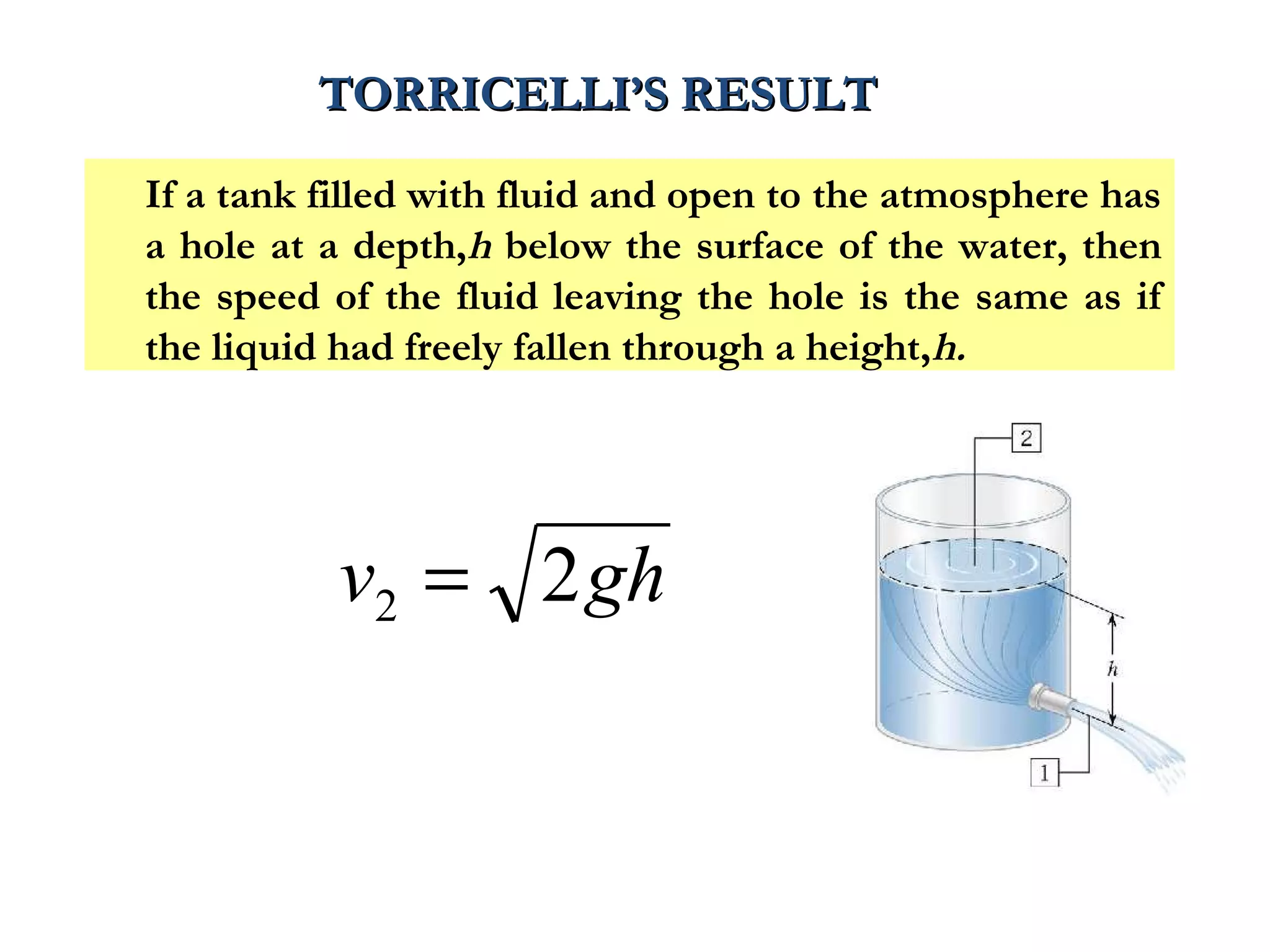
TORRICELLI’S RESULT

If a tank filled with fluid and open to the atmosphere has
a hole at a depth,h below the surface of the water, then
the speed of the fluid leaving the hole is the same as if
the liquid had freely fallen through a height,h.


           v2 = 2 gh
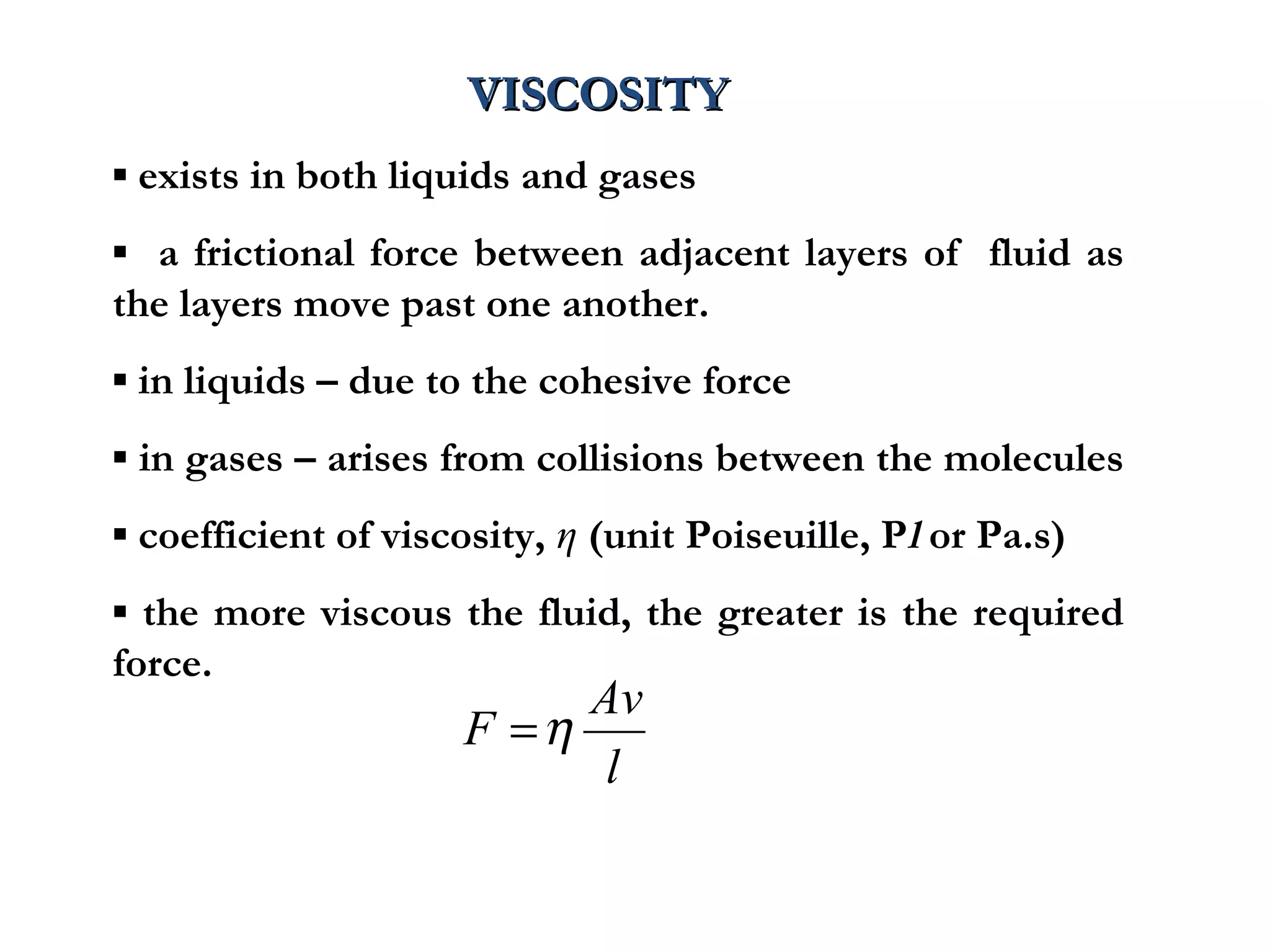
VISCOSITY
▪ exists in both liquids and gases
▪ a frictional force between adjacent layers of fluid as
the layers move past one another.
▪ in liquids – due to the cohesive force
▪ in gases – arises from collisions between the molecules
▪ coefficient of viscosity, η (unit Poiseuille, Pl or Pa.s)
▪ the more viscous the fluid, the greater is the required
force.
                          Av
                     F =η
                           l
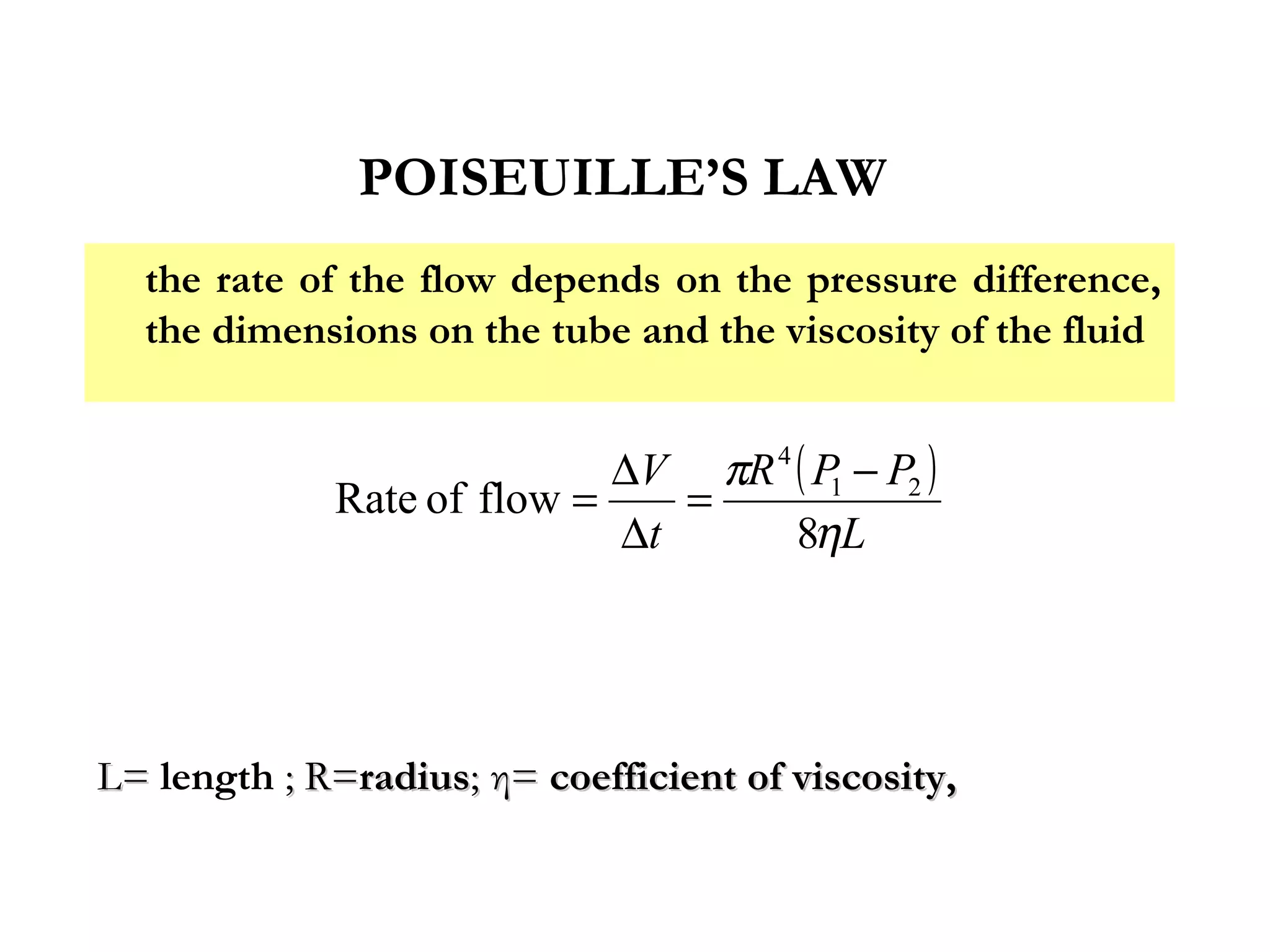
POISEUILLE’S LAW
  the rate of the flow depends on the pressure difference,
  the dimensions on the tube and the viscosity of the fluid


                            ∆V πR 4 ( P − P2 )
             Rate of flow =    =       1
                            ∆t      8ηL


L= length ; R=radius; η= coefficient of viscosity,
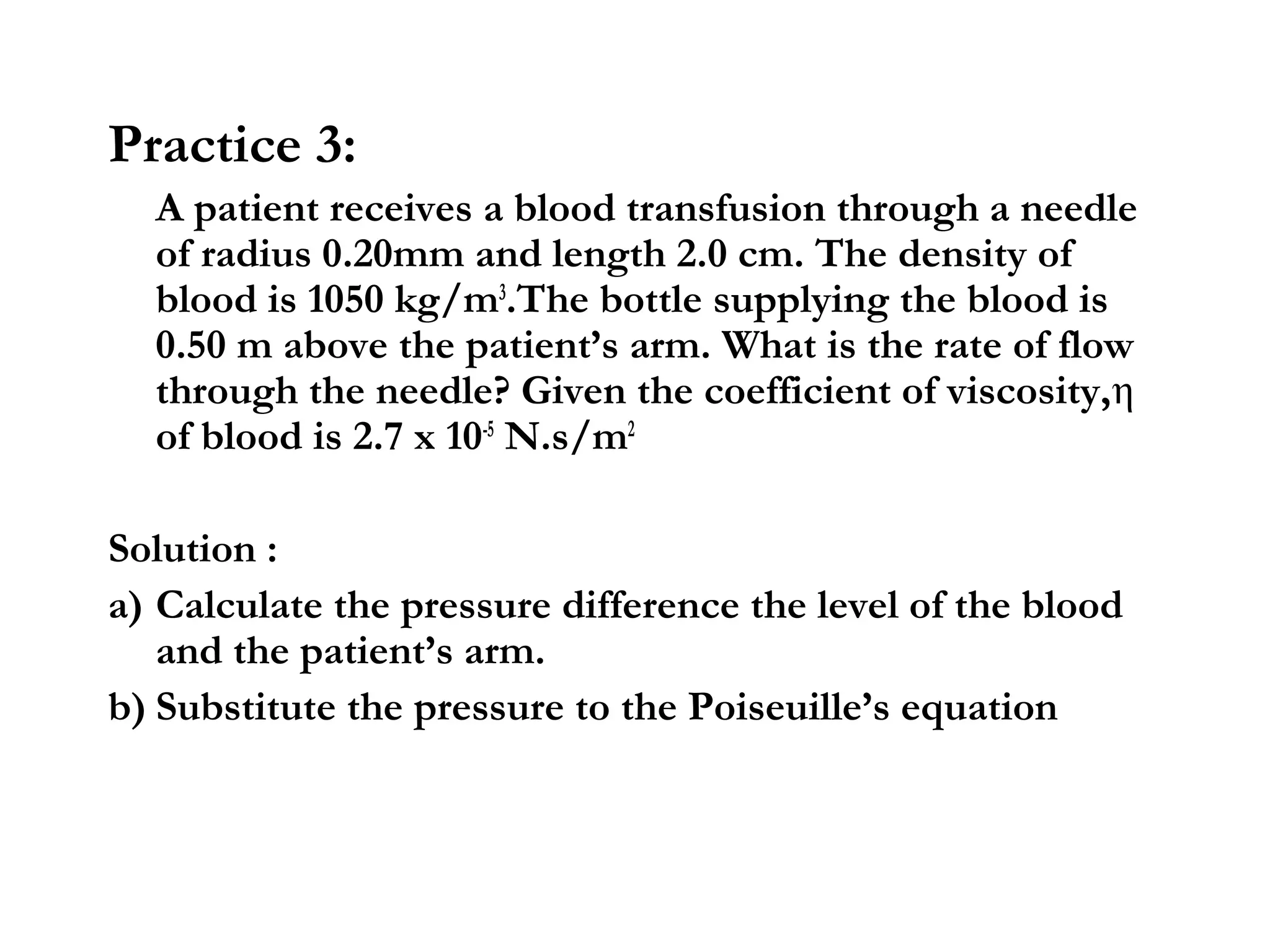
Practice 3:
  A patient receives a blood transfusion through a needle
  of radius 0.20mm and length 2.0 cm. The density of
  blood is 1050 kg/m3.The bottle supplying the blood is
  0.50 m above the patient’s arm. What is the rate of flow
  through the needle? Given the coefficient of viscosity,η
  of blood is 2.7 x 10⁻⁵ N.s/m2

Solution :
a) Calculate the pressure difference the level of the blood
   and the patient’s arm.
b) Substitute the pressure to the Poiseuille’s equation
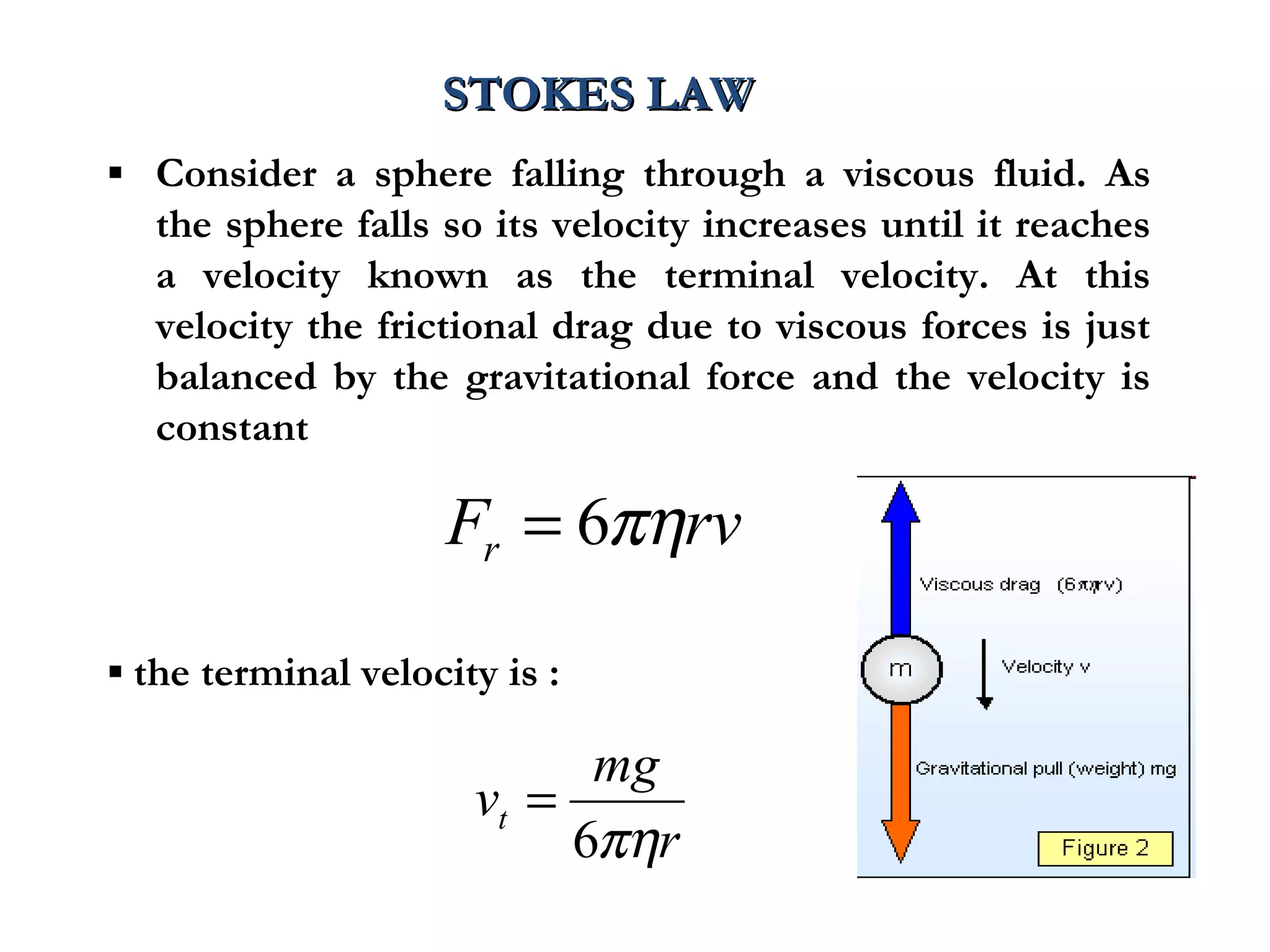
STOKES LAW
▪ Consider a sphere falling through a viscous fluid. As
  the sphere falls so its velocity increases until it reaches
  a velocity known as the terminal velocity. At this
  velocity the frictional drag due to viscous forces is just
  balanced by the gravitational force and the velocity is
  constant

                    Fr = 6πηrv

▪ the terminal velocity is :

                            mg
                      vt =
                           6πηr

Solids, liquids & gases

  • 1.
  • 2.
    INTRODUCTION An understanding offundamental properties of different states of mater is important in all science, engineering, and in a medicine. Force put stresses on solids, stress can strain, deform, and break those solids, whether they are steel beams or bones. Fluids under pressure can perform work, or they carry nutrient and essentials solutes, like the blood flowing through our arteries and veins. Flowing gases cause pressure differences that can lift a massive cargo plane or the roof off a house in hurricane.
  • 3.
    Matter? ▪ solid ▪ liquid ▪gas What are their characteristics?
  • 4.
    SOLID General types ofsolids : ▪ amorphous ▪ polycrystalline ▪ crystalline Each type is characteristic by the size of an order region within the material
  • 5.
    a) Amorphous –atoms not arranged in any orderly & repetitive array b) Polycrystalline – High degree of order within limited regions which vary in size and orientation to each other. c) Crystalline – High degree of order throughout the entire volume of the material.
  • 6.
    LIQUID ▪ weaker binding ▪able to flow ▪ definite volume but no definite shape ▪ density higher than the density of gases
  • 7.
    GAS ▪ fills container ▪compressible ▪ flows easily ▪ very low density – each particles are well separated
  • 8.
    disorder short range order long range order
  • 9.
    INTERMOLECULAR FORCES How theforces between atoms/molecules react? ▪ Frepulsive= Fattractive (at equilibrium r ) ▪ atoms repel each other due to repulsive forces (compressed) A Frepulsive = p r ▪ atoms attract each other corresponding to attractive force (stretched) B Fattractive =− q r
  • 10.
    r = r0; |Frepulsive| = |Fattractive| A B Fresultant = p − q r r r < r0; r0 |Frepulsive| > |Fattractive| r > r0 |Frepulsive| < |Fattractive| Graph of intermolecular force, Fresultant vs. the distance between atoms, r
  • 11.
    POTENTIAL ENERGY BETWEENMOLECULES At equilibrium state distance between two atoms is stable (no work done) & the potential energy is minimum. If the force exists, r is change and net of work is done then change the potential energy. ∆U = −∆W = − F∆r Minus sign means the force between the atoms is the same but with the opposite to the applied force
  • 12.
    DENSITY an object havinguniform composition is defined as its mass M divided by its volume V M ρ= V SI unit : kg/m3
  • 14.
    PRESSURE defined as thescalar value of the force acting perpendicular to, and distributed over, a space, divided by the area of the surface : F P= A unit : N/m2 / Pascal
  • 15.
    Variation of pressurewith depth Fluid at the rest (static) ● For this volume not to move (static fluid) we must have that FTOP FBOTTOM = FTOP + mg A H FBOTTOM W
  • 16.
    Variation of pressurewith depth FBOTTOM - FTOP = mg = (density x Vol) x g FBOTTOM - FTOP = ρ A H g Since Force = P x A PBottom A – PTop A = ρ A H g, or PBottom – PTop = ρ H g The pressure below is greater than the pressure above.
  • 17.
    Pressure in afluid increases with depth h Pressure at depth h Po = Patm P(h) = Po + ρgh h P(h) ρ = density (kg/m3) = 1000 kg/m3 for water The pressure at the surface is atmospheric pressure, 105 N/m2
  • 18.
    Pressure increases with depth,so the speed of water leaking from the bottom hole is larger than that from the higher ones.
  • 19.
    Pressure in aContainer ● All points at the same depth must be at the same pressure
  • 20.
    Example: What pressure (due to the only water) will a swimmer 20 m below the surface of the ocean experience? Solution: Given h = 20 m ρsea water = 1.025 x 10³ kg/m3 Thus, P= ρgh =(1.025 x 10³ kg/m3)(9.8 m/s2)(20m) = 2.0 x 10⁵ N
  • 21.
    Practice 1: A waterbed is 2.00 m on a side and 30.0 cm deep. Find: a) its weight b) pressure that the water bed exerts on the floor. Assume that the entire lower surface of the bed makes contact with the floor. Answer : a) 1.18 x 10⁴ N b) 2.95 x 10³ Pa
  • 22.
    PASCAL’S PRINCIPLE a changein pressure applied to an enclosed fluids is transmitted undiminished to every point of the fluid and to the walls of the container F1 A1 = F2 A2 Hydraulic lifts
  • 23.
    Practice 2: In a car lift used in a service station, compressed air exerts a force on a small piston of circular cross section having a radius of r1=5.00 cm. This pressure is transmitted by an incompressible liquid to a second piston of radius r2=15.0 cm. a) What force must the compressed air exert on the small piston in order to lift a car weighing 13,300 N? Neglect the weight piston. b) What air pressure will produce a force of that magnitude? Answer : a) F1 = 1.48 x 10³ N b) P = 1.88 x 10⁵ Pa
  • 24.
    ARCHIMEDES’S PRINCIPLE any object completely or partially submerged in a fluid is buoyed up by a force with the magnitude equal to the weight of the fluid displaced by the object. FB = F2 − F1 = ρ F gA( h2 − h1 ) = ρ F gA∆h = ρ F gV = gmF The bouyant force equals the weight of the fluid displaced
  • 25.
    SPECIFIC GRAVITY Theratio of the mass of a body to the mass of an identical volume of water is equal to the relative density ρ m /V m = = ρ w mw / V mw m = = sp.gr m − mr mr = reduced mass * The sp.gr tell how many times more or less dense a material is than water
  • 26.
    SURFACE TENSION The forceper unit length exerted by the liquid surface on an object, along its boundary of contact with the object. This force is parallel to the liquid surface and perpendicular to the boundary line of contact. γ =F / L
  • 27.
    The force onthe wire ring is measured just before the ring breaks free of the liquid γ =F / 2L 2L = the surface exerts force both the side and outside of the ring
  • 28.
    FLUID FLOW Laminar orStreamline Flow ▪ if every particle that passes a particular points moves along exactly the same smooth path followed by previous particles passing that point
  • 29.
    Turbulent Flow ● theflow of a fluid becomes irregular above a certain velocity or under any conditions that can cause abrupt change in velocity ● irregular motion is eddy current
  • 30.
    ▪ The laminaror turbulent behavior of fluids is dependent by: a) size of the object moving through the fluid, or the size of the vessel in which the fluid is moving. b) velocity of the object, or the fluid relative to the vessel. c) viscosity of the fluid. ▪ The relationship between these variables is described by a scaling number, which is dimentionless, called the Reynolds number, Re.
  • 31.
    The Continuity Equation The rate of flow of fluids into a system equals the rate of flow out of the system A1v1 = A2 v2 as the cross-sectional area increases, the speed decreases
  • 32.
    Bernoulli’s Equation The sum of the pressure P,the kinetic energy per unit volume and the potential energy per unit volume has the same value at all points along the streamlines 1 2 P + ρv1 + ρgy = constant 1 2
  • 33.
    1 2 1 P + ρgy1 + ρv1 = P2 + ρgy2 + ρv2 2 1 2 2
  • 34.
    TORRICELLI’S RESULT If atank filled with fluid and open to the atmosphere has a hole at a depth,h below the surface of the water, then the speed of the fluid leaving the hole is the same as if the liquid had freely fallen through a height,h. v2 = 2 gh
  • 35.
    VISCOSITY ▪ exists inboth liquids and gases ▪ a frictional force between adjacent layers of fluid as the layers move past one another. ▪ in liquids – due to the cohesive force ▪ in gases – arises from collisions between the molecules ▪ coefficient of viscosity, η (unit Poiseuille, Pl or Pa.s) ▪ the more viscous the fluid, the greater is the required force. Av F =η l
  • 36.
    POISEUILLE’S LAW the rate of the flow depends on the pressure difference, the dimensions on the tube and the viscosity of the fluid ∆V πR 4 ( P − P2 ) Rate of flow = = 1 ∆t 8ηL L= length ; R=radius; η= coefficient of viscosity,
  • 37.
    Practice 3: A patient receives a blood transfusion through a needle of radius 0.20mm and length 2.0 cm. The density of blood is 1050 kg/m3.The bottle supplying the blood is 0.50 m above the patient’s arm. What is the rate of flow through the needle? Given the coefficient of viscosity,η of blood is 2.7 x 10⁻⁵ N.s/m2 Solution : a) Calculate the pressure difference the level of the blood and the patient’s arm. b) Substitute the pressure to the Poiseuille’s equation
  • 38.
    STOKES LAW ▪ Considera sphere falling through a viscous fluid. As the sphere falls so its velocity increases until it reaches a velocity known as the terminal velocity. At this velocity the frictional drag due to viscous forces is just balanced by the gravitational force and the velocity is constant Fr = 6πηrv ▪ the terminal velocity is : mg vt = 6πηr