Hello!
• I’m Chris Blake, your lecturer for the rest of
semester
• We’ll cover: fluid motion, thermal physics,
electricity, revision
• MASH centre in AMDC 503 - 09.30-16.30 daily
• My consultation hours: Tues 10.30-12.30
• Wayne’s consultation hours: Thurs 2.30-4.30
• cblake@swin.edu.au
• 03 9214 8624
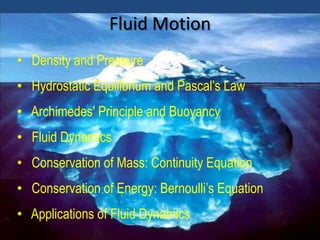
Fluid Motion
• Density and Pressure
• Hydrostatic Equilibrium and Pascal’s Law
• Archimedes' Principle and Buoyancy
• Fluid Dynamics
• Conservation of Mass: Continuity Equation
• Conservation of Energy: Bernoulli’s Equation
• Applications of Fluid Dynamics
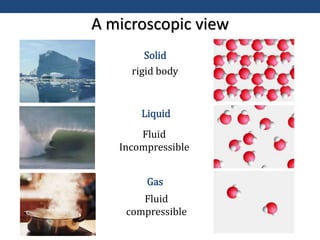
A microscopic view
Gas
Fluid
compressible
Liquid
Fluid
Incompressible
Solid
rigid body
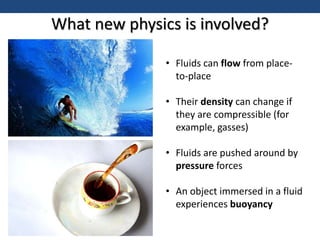
What new physics is involved?
• Fluids can flow from place-
to-place
• Their density can change if
they are compressible (for
example, gasses)
• Fluids are pushed around by
pressure forces
• An object immersed in a fluid
experiences buoyancy
Density
𝑑𝑒𝑛𝑠𝑖𝑡𝑦 =
𝑚𝑎𝑠𝑠
𝑣𝑜𝑙𝑢𝑚𝑒
𝜌 =
𝑚
𝑉
𝑈𝑛𝑖𝑡𝑠 𝑎𝑟𝑒
𝑘𝑔
𝑚3
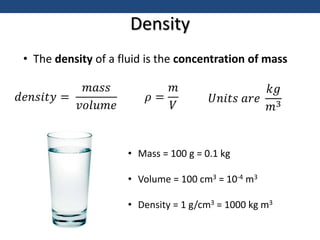
• The density of a fluid is the concentration of mass
• Mass = 100 g = 0.1 kg
• Volume = 100 cm3 = 10-4 m3
• Density = 1 g/cm3 = 1000 kg m3
0%
0%
0%
0%
0%
1 2 3 4 5
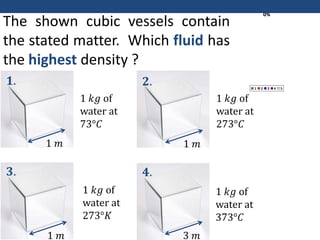
The shown cubic vessels contain
the stated matter. Which fluid has
the highest density ?
1 𝑘𝑔 of
water at
73°𝐶
1 𝑘𝑔 of
water at
273°𝐾
1 𝑘𝑔 of
water at
273°𝐶
1 𝑘𝑔 of
water at
373°𝐶
1 𝑚
1 𝑚
1 𝑚
3 𝑚
𝟏.
𝟑.
𝟐.
𝟒.
Pressure
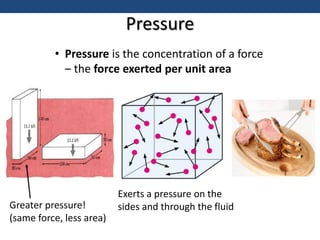
• Pressure is the concentration of a force
– the force exerted per unit area
Greater pressure!
(same force, less area)
Exerts a pressure on the
sides and through the fluid
Pressure
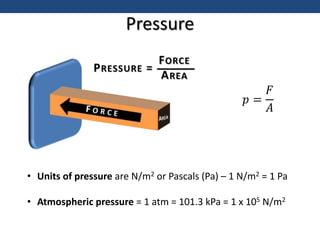
𝑝 =
𝐹
𝐴
• Units of pressure are N/m2 or Pascals (Pa) – 1 N/m2 = 1 Pa
• Atmospheric pressure = 1 atm = 101.3 kPa = 1 x 10⁵ N/m2
0%
0%
0%
0%
1. 2. 3. 4.
𝑣𝑎𝑐𝑢𝑢𝑚
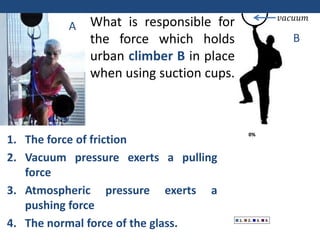
What is responsible for
the force which holds
urban climber B in place
when using suction cups.
A
B
1. The force of friction
2. Vacuum pressure exerts a pulling
force
3. Atmospheric pressure exerts a
pushing force
4. The normal force of the glass.
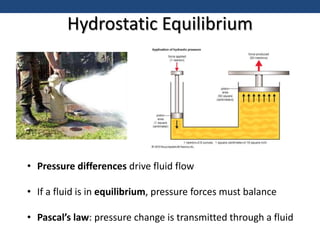
Hydrostatic Equilibrium
• Pressure differences drive fluid flow
• If a fluid is in equilibrium, pressure forces must balance
• Pascal’s law: pressure change is transmitted through a fluid
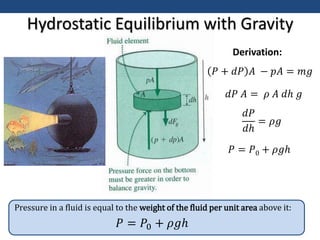
Hydrostatic Equilibrium with Gravity
Pressure in a fluid is equal to the weight of the fluid per unit area above it:
𝑃 = 𝑃0 + 𝜌𝑔ℎ
𝑃 + 𝑑𝑃 𝐴 − 𝑝𝐴 = 𝑚𝑔
𝑑𝑃 𝐴 = 𝜌 𝐴 𝑑ℎ 𝑔
𝑑𝑃
𝑑ℎ
= 𝜌𝑔
Derivation:
𝑃 = 𝑃0 + 𝜌𝑔ℎ
0%
0%
0%
0%
0%
1. 2. 3. 4. 5.
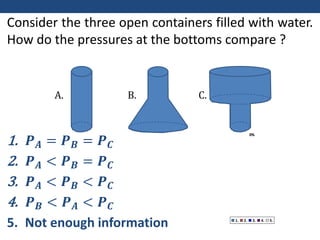
Consider the three open containers filled with water.
How do the pressures at the bottoms compare ?
1. 𝑷𝑨 = 𝑷𝑩 = 𝑷𝑪
2. 𝑷𝑨 < 𝑷𝑩 = 𝑷𝑪
3. 𝑷𝑨 < 𝑷𝑩 < 𝑷𝑪
4. 𝑷𝑩 < 𝑷𝑨 < 𝑷𝑪
5. Not enough information
A. B. C.
0%
0%
0%
0%
0%
1 2 3 4 5
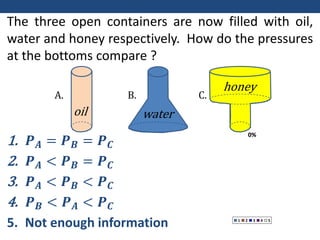
The three open containers are now filled with oil,
water and honey respectively. How do the pressures
at the bottoms compare ?
1. 𝑷𝑨 = 𝑷𝑩 = 𝑷𝑪
2. 𝑷𝑨 < 𝑷𝑩 = 𝑷𝑪
3. 𝑷𝑨 < 𝑷𝑩 < 𝑷𝑪
4. 𝑷𝑩 < 𝑷𝑨 < 𝑷𝑪
5. Not enough information
A. B. C.
oil water
honey
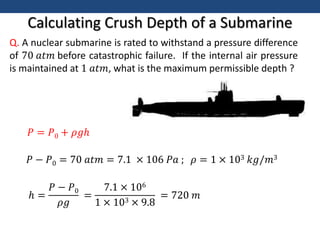
Calculating Crush Depth of a Submarine
Q. A nuclear submarine is rated to withstand a pressure difference
of 70 𝑎𝑡𝑚 before catastrophic failure. If the internal air pressure
is maintained at 1 𝑎𝑡𝑚, what is the maximum permissible depth ?
𝑃 = 𝑃0 + 𝜌𝑔ℎ
𝑃 − 𝑃0 = 70 𝑎𝑡𝑚 = 7.1 × 10⁶ 𝑃𝑎 ; 𝜌 = 1 × 10³ 𝑘𝑔/𝑚3
ℎ =
𝑃 − 𝑃0
𝜌𝑔
=
7.1 × 10⁶
1 × 103 × 9.8
= 720 𝑚
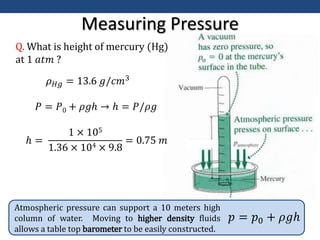
Measuring Pressure
Atmospheric pressure can support a 10 meters high
column of water. Moving to higher density fluids
allows a table top barometer to be easily constructed.
𝑝 = 𝑝0 + 𝜌𝑔ℎ
Q. What is height of mercury (Hg)
at 1 𝑎𝑡𝑚 ?
𝜌𝐻𝑔 = 13.6 𝑔/𝑐𝑚3
𝑃 = 𝑃0 + 𝜌𝑔ℎ → ℎ = 𝑃/𝜌𝑔
ℎ =
1 × 10⁵
1.36 × 104 × 9.8
= 0.75 𝑚
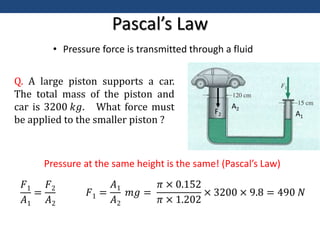
Pascal’s Law
Q. A large piston supports a car.
The total mass of the piston and
car is 3200 𝑘𝑔. What force must
be applied to the smaller piston ?
Pressure at the same height is the same! (Pascal’s Law)
𝐹1
𝐴1
=
𝐹2
𝐴2
𝐹1 =
𝐴1
𝐴2
𝑚𝑔 =
𝜋 × 0.152
𝜋 × 1.202
× 3200 × 9.8 = 490 𝑁
A1
A2
F2
• Pressure force is transmitted through a fluid
Gauge Pressure
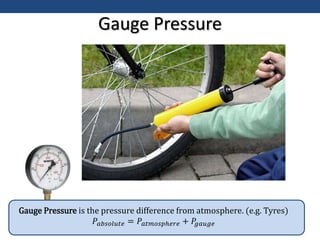
Gauge Pressure is the pressure difference from atmosphere. (e.g. Tyres)
𝑃𝑎𝑏𝑠𝑜𝑙𝑢𝑡𝑒 = 𝑃𝑎𝑡𝑚𝑜𝑠𝑝ℎ𝑒𝑟𝑒 + 𝑃
𝑔𝑎𝑢𝑔𝑒
Archimedes’ Principle and Buoyancy
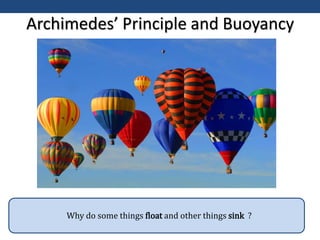
Why do some things float and other things sink ?
Archimedes’ Principle and Buoyancy
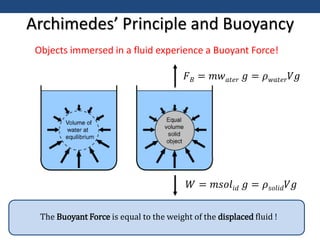
The Buoyant Force is equal to the weight of the displaced fluid !
𝐹𝐵 = 𝑚𝑤𝑎𝑡𝑒𝑟 𝑔 = 𝜌𝑤𝑎𝑡𝑒𝑟𝑉𝑔
𝑊 = 𝑚𝑠𝑜𝑙𝑖𝑑 𝑔 = 𝜌𝑠𝑜𝑙𝑖𝑑𝑉𝑔
Objects immersed in a fluid experience a Buoyant Force!
Archimedes’ Principle and Buoyancy
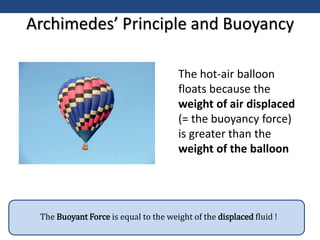
The hot-air balloon
floats because the
weight of air displaced
(= the buoyancy force)
is greater than the
weight of the balloon
The Buoyant Force is equal to the weight of the displaced fluid !
0%
0%
0%
0%
0%
1 2 3 4 5
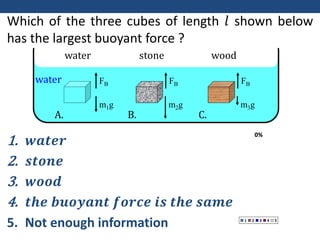
Which of the three cubes of length 𝑙 shown below
has the largest buoyant force ?
A. B. C.
water stone wood
water FB FB FB
m1g m2g m3g
1. 𝒘𝒂𝒕𝒆𝒓
2. 𝒔𝒕𝒐𝒏𝒆
3. 𝒘𝒐𝒐𝒅
4. 𝒕𝒉𝒆 𝒃𝒖𝒐𝒚𝒂𝒏𝒕 𝒇𝒐𝒓𝒄𝒆 𝒊𝒔 𝒕𝒉𝒆 𝒔𝒂𝒎𝒆
5. Not enough information
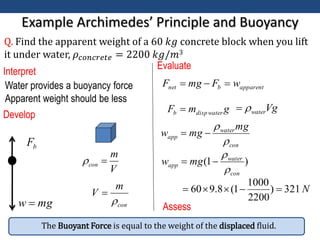
Example Archimedes’ Principle and Buoyancy
The Buoyant Force is equal to the weight of the displaced fluid.
Q. Find the apparent weight of a 60 𝑘𝑔 concrete block when you lift
it under water, 𝜌𝑐𝑜𝑛𝑐𝑟𝑒𝑡𝑒 = 2200 𝑘𝑔/𝑚3
mg
w 
b
F
Develop
Assess
Interpret
Water provides a buoyancy force
Evaluate
Apparent weight should be less
apparent
b
net w
F
mg
F 


g
m
F water
disp
b  Vg
water


V
m
con 

con
water
app
mg
mg
w




con
m
V


)
1
(
con
water
app mg
w




N
321
)
2200
1000
1
(
8
.
9
60 




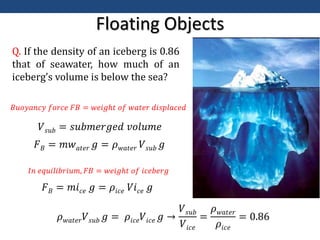
Floating Objects
Q. If the density of an iceberg is 0.86
that of seawater, how much of an
iceberg’s volume is below the sea?
𝐵𝑢𝑜𝑦𝑎𝑛𝑐𝑦 𝑓𝑜𝑟𝑐𝑒 𝐹𝐵 = 𝑤𝑒𝑖𝑔ℎ𝑡 𝑜𝑓 𝑤𝑎𝑡𝑒𝑟 𝑑𝑖𝑠𝑝𝑙𝑎𝑐𝑒𝑑
𝑉𝑠𝑢𝑏 = 𝑠𝑢𝑏𝑚𝑒𝑟𝑔𝑒𝑑 𝑣𝑜𝑙𝑢𝑚𝑒
𝐹𝐵 = 𝑚𝑤𝑎𝑡𝑒𝑟 𝑔 = 𝜌𝑤𝑎𝑡𝑒𝑟 𝑉𝑠𝑢𝑏 𝑔
𝐼𝑛 𝑒𝑞𝑢𝑖𝑙𝑖𝑏𝑟𝑖𝑢𝑚, 𝐹𝐵 = 𝑤𝑒𝑖𝑔ℎ𝑡 𝑜𝑓 𝑖𝑐𝑒𝑏𝑒𝑟𝑔
𝐹𝐵 = 𝑚𝑖𝑐𝑒 𝑔 = 𝜌𝑖𝑐𝑒 𝑉𝑖𝑐𝑒 𝑔
𝜌𝑤𝑎𝑡𝑒𝑟𝑉𝑠𝑢𝑏 𝑔 = 𝜌𝑖𝑐𝑒𝑉𝑖𝑐𝑒 𝑔 →
𝑉𝑠𝑢𝑏
𝑉𝑖𝑐𝑒
=
𝜌𝑤𝑎𝑡𝑒𝑟
𝜌𝑖𝑐𝑒
= 0.86
0%
0%
0%
0%
0%
1 2 3 4 5
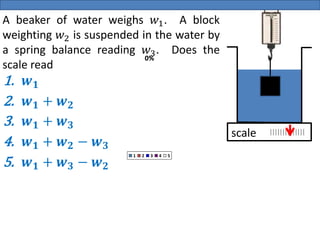
A beaker of water weighs 𝑤1. A block
weighting 𝑤2 is suspended in the water by
a spring balance reading 𝑤3. Does the
scale read
scale
1. 𝒘𝟏
2. 𝒘𝟏 + 𝒘𝟐
3. 𝒘𝟏 + 𝒘𝟑
4. 𝒘𝟏 + 𝒘𝟐 − 𝒘𝟑
5. 𝒘𝟏 + 𝒘𝟑 − 𝒘𝟐
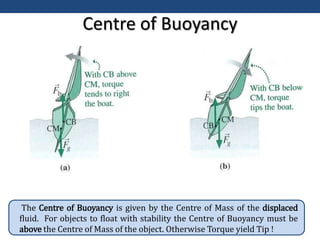
Centre of Buoyancy
The Centre of Buoyancy is given by the Centre of Mass of the displaced
fluid. For objects to float with stability the Centre of Buoyancy must be
above the Centre of Mass of the object. Otherwise Torque yield Tip !
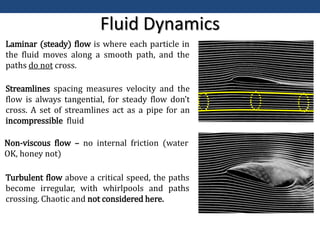
Fluid Dynamics
Laminar (steady) flow is where each particle in
the fluid moves along a smooth path, and the
paths do not cross.
Turbulent flow above a critical speed, the paths
become irregular, with whirlpools and paths
crossing. Chaotic and not considered here.
Streamlines spacing measures velocity and the
flow is always tangential, for steady flow don’t
cross. A set of streamlines act as a pipe for an
incompressible fluid
Non-viscous flow – no internal friction (water
OK, honey not)
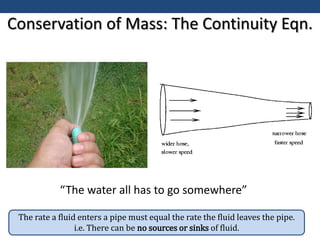
Conservation of Mass: The Continuity Eqn.
The rate a fluid enters a pipe must equal the rate the fluid leaves the pipe.
i.e. There can be no sources or sinks of fluid.
“The water all has to go somewhere”
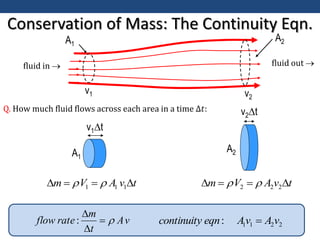
Conservation of Mass: The Continuity Eqn.
v1 v2
A1
A2
Q. How much fluid flows across each area in a time ∆𝑡:
v
A
t
m
rate
flow 



:
fluid in  fluid out 
t
v
A
V
m 


 1
1
1 

v1t
A1
v2t
A2
t
v
A
V
m 


 2
2
2 

2
2
1
1
: v
A
v
A
eqn
continuity 
Conservation of Mass: The Continuity Eqn.
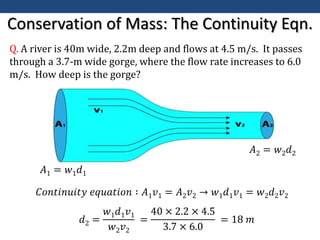
Q. A river is 40m wide, 2.2m deep and flows at 4.5 m/s. It passes
through a 3.7-m wide gorge, where the flow rate increases to 6.0
m/s. How deep is the gorge?
𝐴1 = 𝑤1𝑑1
𝐴2 = 𝑤2𝑑2
𝐶𝑜𝑛𝑡𝑖𝑛𝑢𝑖𝑡𝑦 𝑒𝑞𝑢𝑎𝑡𝑖𝑜𝑛 ∶ 𝐴1𝑣1 = 𝐴2𝑣2 → 𝑤1𝑑1𝑣1 = 𝑤2𝑑2𝑣2
𝑑2 =
𝑤1𝑑1𝑣1
𝑤2𝑣2
=
40 × 2.2 × 4.5
3.7 × 6.0
= 18 𝑚
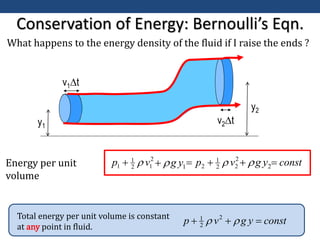
Conservation of Energy: Bernoulli’s Eqn.
v2t
v1t
What happens to the energy density of the fluid if I raise the ends ?
const
v
p
v
p 


 2
2
2
1
2
2
1
2
1
1 

Energy per unit
volume
y1
y2
1
y
g

 2
y
g


Total energy per unit volume is constant
at any point in fluid.
const
y
g
v
p 

 
 2
2
1
Conservation of Energy: Bernoulli’s Eqn.
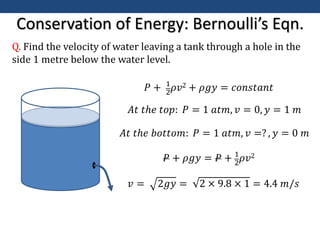
Q. Find the velocity of water leaving a tank through a hole in the
side 1 metre below the water level.
𝑃 + 1
2
𝜌𝑣2 + 𝜌𝑔𝑦 = 𝑐𝑜𝑛𝑠𝑡𝑎𝑛𝑡
𝐴𝑡 𝑡ℎ𝑒 𝑡𝑜𝑝: 𝑃 = 1 𝑎𝑡𝑚, 𝑣 = 0, 𝑦 = 1 𝑚
𝐴𝑡 𝑡ℎ𝑒 𝑏𝑜𝑡𝑡𝑜𝑚: 𝑃 = 1 𝑎𝑡𝑚, 𝑣 =? , 𝑦 = 0 𝑚
𝑃 + 𝜌𝑔𝑦 = 𝑃 + 1
2𝜌𝑣2
𝑣 = 2𝑔𝑦 = 2 × 9.8 × 1 = 4.4 𝑚/𝑠
0%
0%
0%
0%
0%
1 2 3 4 5
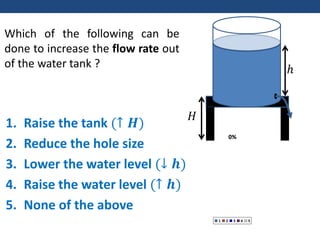
Which of the following can be
done to increase the flow rate out
of the water tank ? ℎ
𝐻
1. Raise the tank (↑ 𝑯)
2. Reduce the hole size
3. Lower the water level (↓ 𝒉)
4. Raise the water level (↑ 𝒉)
5. None of the above
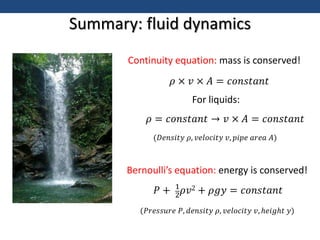
Summary: fluid dynamics
Continuity equation: mass is conserved!
𝜌 × 𝑣 × 𝐴 = 𝑐𝑜𝑛𝑠𝑡𝑎𝑛𝑡
For liquids:
𝜌 = 𝑐𝑜𝑛𝑠𝑡𝑎𝑛𝑡 → 𝑣 × 𝐴 = 𝑐𝑜𝑛𝑠𝑡𝑎𝑛𝑡
Bernoulli’s equation: energy is conserved!
𝑃 + 1
2𝜌𝑣2 + 𝜌𝑔𝑦 = 𝑐𝑜𝑛𝑠𝑡𝑎𝑛𝑡
(𝐷𝑒𝑛𝑠𝑖𝑡𝑦 𝜌, 𝑣𝑒𝑙𝑜𝑐𝑖𝑡𝑦 𝑣, 𝑝𝑖𝑝𝑒 𝑎𝑟𝑒𝑎 𝐴)
(𝑃𝑟𝑒𝑠𝑠𝑢𝑟𝑒 𝑃, 𝑑𝑒𝑛𝑠𝑖𝑡𝑦 𝜌, 𝑣𝑒𝑙𝑜𝑐𝑖𝑡𝑦 𝑣, ℎ𝑒𝑖𝑔ℎ𝑡 𝑦)
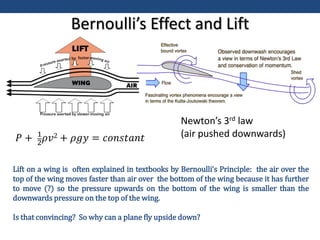
Lift on a wing is often explained in textbooks by Bernoulli’s Principle: the air over the
top of the wing moves faster than air over the bottom of the wing because it has further
to move (?) so the pressure upwards on the bottom of the wing is smaller than the
downwards pressure on the top of the wing.
Is that convincing? So why can a plane fly upside down?
Bernoulli’s Effect and Lift
Newton’s 3rd law
(air pushed downwards)
𝑃 + 1
2𝜌𝑣2 + 𝜌𝑔𝑦 = 𝑐𝑜𝑛𝑠𝑡𝑎𝑛𝑡
Chapter 15 Fluid Motion Summary
Examples 15.6, 15.7 Bernoulli's Equation – Draining a Tank and Venturi Flow
Examples 15.5 Continuity Equation: Ausable Chasm
Examples 15.3 , 15.4 Buoyancy Forces: Working Underwater + Tip of Iceberg
• Density and Pressure describe bulk fluid behaviour
• In hydrostatic equilibrium, pressure increases with depth due to gravity
• Fluid flow conserves mass (continuity eq.) and energy (Bernoulli’s equation)
• Reread, Review and Reinforce concepts and techniques of Chapter 15
• A constriction in flow is accompanied by a velocity and pressure change.
• The buoyant force is the weight of the displaced fluid
• Pressure in a fluid is the same for points at the same height
Examples 15.1 , 15.2 Calculating Pressure and Pascals Law

Topic3_FluidMotion.pptx

  • 1.
    Hello! • I’m ChrisBlake, your lecturer for the rest of semester • We’ll cover: fluid motion, thermal physics, electricity, revision • MASH centre in AMDC 503 - 09.30-16.30 daily • My consultation hours: Tues 10.30-12.30 • Wayne’s consultation hours: Thurs 2.30-4.30 • cblake@swin.edu.au • 03 9214 8624
  • 2.
    Fluid Motion • Densityand Pressure • Hydrostatic Equilibrium and Pascal’s Law • Archimedes' Principle and Buoyancy • Fluid Dynamics • Conservation of Mass: Continuity Equation • Conservation of Energy: Bernoulli’s Equation • Applications of Fluid Dynamics
  • 3.
  • 4.
    What new physicsis involved? • Fluids can flow from place- to-place • Their density can change if they are compressible (for example, gasses) • Fluids are pushed around by pressure forces • An object immersed in a fluid experiences buoyancy
  • 5.
    Density 𝑑𝑒𝑛𝑠𝑖𝑡𝑦 = 𝑚𝑎𝑠𝑠 𝑣𝑜𝑙𝑢𝑚𝑒 𝜌 = 𝑚 𝑉 𝑈𝑛𝑖𝑡𝑠𝑎𝑟𝑒 𝑘𝑔 𝑚3 • The density of a fluid is the concentration of mass • Mass = 100 g = 0.1 kg • Volume = 100 cm3 = 10-4 m3 • Density = 1 g/cm3 = 1000 kg m3
  • 6.
    0% 0% 0% 0% 0% 1 2 34 5 The shown cubic vessels contain the stated matter. Which fluid has the highest density ? 1 𝑘𝑔 of water at 73°𝐶 1 𝑘𝑔 of water at 273°𝐾 1 𝑘𝑔 of water at 273°𝐶 1 𝑘𝑔 of water at 373°𝐶 1 𝑚 1 𝑚 1 𝑚 3 𝑚 𝟏. 𝟑. 𝟐. 𝟒.
  • 7.
    Pressure • Pressure isthe concentration of a force – the force exerted per unit area Greater pressure! (same force, less area) Exerts a pressure on the sides and through the fluid
  • 8.
    Pressure 𝑝 = 𝐹 𝐴 • Unitsof pressure are N/m2 or Pascals (Pa) – 1 N/m2 = 1 Pa • Atmospheric pressure = 1 atm = 101.3 kPa = 1 x 10⁵ N/m2
  • 9.
    0% 0% 0% 0% 1. 2. 3.4. 𝑣𝑎𝑐𝑢𝑢𝑚 What is responsible for the force which holds urban climber B in place when using suction cups. A B 1. The force of friction 2. Vacuum pressure exerts a pulling force 3. Atmospheric pressure exerts a pushing force 4. The normal force of the glass.
  • 10.
    Hydrostatic Equilibrium • Pressuredifferences drive fluid flow • If a fluid is in equilibrium, pressure forces must balance • Pascal’s law: pressure change is transmitted through a fluid
  • 11.
    Hydrostatic Equilibrium withGravity Pressure in a fluid is equal to the weight of the fluid per unit area above it: 𝑃 = 𝑃0 + 𝜌𝑔ℎ 𝑃 + 𝑑𝑃 𝐴 − 𝑝𝐴 = 𝑚𝑔 𝑑𝑃 𝐴 = 𝜌 𝐴 𝑑ℎ 𝑔 𝑑𝑃 𝑑ℎ = 𝜌𝑔 Derivation: 𝑃 = 𝑃0 + 𝜌𝑔ℎ
  • 12.
    0% 0% 0% 0% 0% 1. 2. 3.4. 5. Consider the three open containers filled with water. How do the pressures at the bottoms compare ? 1. 𝑷𝑨 = 𝑷𝑩 = 𝑷𝑪 2. 𝑷𝑨 < 𝑷𝑩 = 𝑷𝑪 3. 𝑷𝑨 < 𝑷𝑩 < 𝑷𝑪 4. 𝑷𝑩 < 𝑷𝑨 < 𝑷𝑪 5. Not enough information A. B. C.
  • 13.
    0% 0% 0% 0% 0% 1 2 34 5 The three open containers are now filled with oil, water and honey respectively. How do the pressures at the bottoms compare ? 1. 𝑷𝑨 = 𝑷𝑩 = 𝑷𝑪 2. 𝑷𝑨 < 𝑷𝑩 = 𝑷𝑪 3. 𝑷𝑨 < 𝑷𝑩 < 𝑷𝑪 4. 𝑷𝑩 < 𝑷𝑨 < 𝑷𝑪 5. Not enough information A. B. C. oil water honey
  • 14.
    Calculating Crush Depthof a Submarine Q. A nuclear submarine is rated to withstand a pressure difference of 70 𝑎𝑡𝑚 before catastrophic failure. If the internal air pressure is maintained at 1 𝑎𝑡𝑚, what is the maximum permissible depth ? 𝑃 = 𝑃0 + 𝜌𝑔ℎ 𝑃 − 𝑃0 = 70 𝑎𝑡𝑚 = 7.1 × 10⁶ 𝑃𝑎 ; 𝜌 = 1 × 10³ 𝑘𝑔/𝑚3 ℎ = 𝑃 − 𝑃0 𝜌𝑔 = 7.1 × 10⁶ 1 × 103 × 9.8 = 720 𝑚
  • 15.
    Measuring Pressure Atmospheric pressurecan support a 10 meters high column of water. Moving to higher density fluids allows a table top barometer to be easily constructed. 𝑝 = 𝑝0 + 𝜌𝑔ℎ Q. What is height of mercury (Hg) at 1 𝑎𝑡𝑚 ? 𝜌𝐻𝑔 = 13.6 𝑔/𝑐𝑚3 𝑃 = 𝑃0 + 𝜌𝑔ℎ → ℎ = 𝑃/𝜌𝑔 ℎ = 1 × 10⁵ 1.36 × 104 × 9.8 = 0.75 𝑚
  • 16.
    Pascal’s Law Q. Alarge piston supports a car. The total mass of the piston and car is 3200 𝑘𝑔. What force must be applied to the smaller piston ? Pressure at the same height is the same! (Pascal’s Law) 𝐹1 𝐴1 = 𝐹2 𝐴2 𝐹1 = 𝐴1 𝐴2 𝑚𝑔 = 𝜋 × 0.152 𝜋 × 1.202 × 3200 × 9.8 = 490 𝑁 A1 A2 F2 • Pressure force is transmitted through a fluid
  • 17.
    Gauge Pressure Gauge Pressureis the pressure difference from atmosphere. (e.g. Tyres) 𝑃𝑎𝑏𝑠𝑜𝑙𝑢𝑡𝑒 = 𝑃𝑎𝑡𝑚𝑜𝑠𝑝ℎ𝑒𝑟𝑒 + 𝑃 𝑔𝑎𝑢𝑔𝑒
  • 18.
    Archimedes’ Principle andBuoyancy Why do some things float and other things sink ?
  • 19.
    Archimedes’ Principle andBuoyancy The Buoyant Force is equal to the weight of the displaced fluid ! 𝐹𝐵 = 𝑚𝑤𝑎𝑡𝑒𝑟 𝑔 = 𝜌𝑤𝑎𝑡𝑒𝑟𝑉𝑔 𝑊 = 𝑚𝑠𝑜𝑙𝑖𝑑 𝑔 = 𝜌𝑠𝑜𝑙𝑖𝑑𝑉𝑔 Objects immersed in a fluid experience a Buoyant Force!
  • 20.
    Archimedes’ Principle andBuoyancy The hot-air balloon floats because the weight of air displaced (= the buoyancy force) is greater than the weight of the balloon The Buoyant Force is equal to the weight of the displaced fluid !
  • 21.
    0% 0% 0% 0% 0% 1 2 34 5 Which of the three cubes of length 𝑙 shown below has the largest buoyant force ? A. B. C. water stone wood water FB FB FB m1g m2g m3g 1. 𝒘𝒂𝒕𝒆𝒓 2. 𝒔𝒕𝒐𝒏𝒆 3. 𝒘𝒐𝒐𝒅 4. 𝒕𝒉𝒆 𝒃𝒖𝒐𝒚𝒂𝒏𝒕 𝒇𝒐𝒓𝒄𝒆 𝒊𝒔 𝒕𝒉𝒆 𝒔𝒂𝒎𝒆 5. Not enough information
  • 22.
    Example Archimedes’ Principleand Buoyancy The Buoyant Force is equal to the weight of the displaced fluid. Q. Find the apparent weight of a 60 𝑘𝑔 concrete block when you lift it under water, 𝜌𝑐𝑜𝑛𝑐𝑟𝑒𝑡𝑒 = 2200 𝑘𝑔/𝑚3 mg w  b F Develop Assess Interpret Water provides a buoyancy force Evaluate Apparent weight should be less apparent b net w F mg F    g m F water disp b  Vg water   V m con   con water app mg mg w     con m V   ) 1 ( con water app mg w     N 321 ) 2200 1000 1 ( 8 . 9 60     
  • 23.
    Floating Objects Q. Ifthe density of an iceberg is 0.86 that of seawater, how much of an iceberg’s volume is below the sea? 𝐵𝑢𝑜𝑦𝑎𝑛𝑐𝑦 𝑓𝑜𝑟𝑐𝑒 𝐹𝐵 = 𝑤𝑒𝑖𝑔ℎ𝑡 𝑜𝑓 𝑤𝑎𝑡𝑒𝑟 𝑑𝑖𝑠𝑝𝑙𝑎𝑐𝑒𝑑 𝑉𝑠𝑢𝑏 = 𝑠𝑢𝑏𝑚𝑒𝑟𝑔𝑒𝑑 𝑣𝑜𝑙𝑢𝑚𝑒 𝐹𝐵 = 𝑚𝑤𝑎𝑡𝑒𝑟 𝑔 = 𝜌𝑤𝑎𝑡𝑒𝑟 𝑉𝑠𝑢𝑏 𝑔 𝐼𝑛 𝑒𝑞𝑢𝑖𝑙𝑖𝑏𝑟𝑖𝑢𝑚, 𝐹𝐵 = 𝑤𝑒𝑖𝑔ℎ𝑡 𝑜𝑓 𝑖𝑐𝑒𝑏𝑒𝑟𝑔 𝐹𝐵 = 𝑚𝑖𝑐𝑒 𝑔 = 𝜌𝑖𝑐𝑒 𝑉𝑖𝑐𝑒 𝑔 𝜌𝑤𝑎𝑡𝑒𝑟𝑉𝑠𝑢𝑏 𝑔 = 𝜌𝑖𝑐𝑒𝑉𝑖𝑐𝑒 𝑔 → 𝑉𝑠𝑢𝑏 𝑉𝑖𝑐𝑒 = 𝜌𝑤𝑎𝑡𝑒𝑟 𝜌𝑖𝑐𝑒 = 0.86
  • 24.
    0% 0% 0% 0% 0% 1 2 34 5 A beaker of water weighs 𝑤1. A block weighting 𝑤2 is suspended in the water by a spring balance reading 𝑤3. Does the scale read scale 1. 𝒘𝟏 2. 𝒘𝟏 + 𝒘𝟐 3. 𝒘𝟏 + 𝒘𝟑 4. 𝒘𝟏 + 𝒘𝟐 − 𝒘𝟑 5. 𝒘𝟏 + 𝒘𝟑 − 𝒘𝟐
  • 25.
    Centre of Buoyancy TheCentre of Buoyancy is given by the Centre of Mass of the displaced fluid. For objects to float with stability the Centre of Buoyancy must be above the Centre of Mass of the object. Otherwise Torque yield Tip !
  • 26.
    Fluid Dynamics Laminar (steady)flow is where each particle in the fluid moves along a smooth path, and the paths do not cross. Turbulent flow above a critical speed, the paths become irregular, with whirlpools and paths crossing. Chaotic and not considered here. Streamlines spacing measures velocity and the flow is always tangential, for steady flow don’t cross. A set of streamlines act as a pipe for an incompressible fluid Non-viscous flow – no internal friction (water OK, honey not)
  • 27.
    Conservation of Mass:The Continuity Eqn. The rate a fluid enters a pipe must equal the rate the fluid leaves the pipe. i.e. There can be no sources or sinks of fluid. “The water all has to go somewhere”
  • 28.
    Conservation of Mass:The Continuity Eqn. v1 v2 A1 A2 Q. How much fluid flows across each area in a time ∆𝑡: v A t m rate flow     : fluid in  fluid out  t v A V m     1 1 1   v1t A1 v2t A2 t v A V m     2 2 2   2 2 1 1 : v A v A eqn continuity 
  • 29.
    Conservation of Mass:The Continuity Eqn. Q. A river is 40m wide, 2.2m deep and flows at 4.5 m/s. It passes through a 3.7-m wide gorge, where the flow rate increases to 6.0 m/s. How deep is the gorge? 𝐴1 = 𝑤1𝑑1 𝐴2 = 𝑤2𝑑2 𝐶𝑜𝑛𝑡𝑖𝑛𝑢𝑖𝑡𝑦 𝑒𝑞𝑢𝑎𝑡𝑖𝑜𝑛 ∶ 𝐴1𝑣1 = 𝐴2𝑣2 → 𝑤1𝑑1𝑣1 = 𝑤2𝑑2𝑣2 𝑑2 = 𝑤1𝑑1𝑣1 𝑤2𝑣2 = 40 × 2.2 × 4.5 3.7 × 6.0 = 18 𝑚
  • 30.
    Conservation of Energy:Bernoulli’s Eqn. v2t v1t What happens to the energy density of the fluid if I raise the ends ? const v p v p     2 2 2 1 2 2 1 2 1 1   Energy per unit volume y1 y2 1 y g   2 y g   Total energy per unit volume is constant at any point in fluid. const y g v p      2 2 1
  • 31.
    Conservation of Energy:Bernoulli’s Eqn. Q. Find the velocity of water leaving a tank through a hole in the side 1 metre below the water level. 𝑃 + 1 2 𝜌𝑣2 + 𝜌𝑔𝑦 = 𝑐𝑜𝑛𝑠𝑡𝑎𝑛𝑡 𝐴𝑡 𝑡ℎ𝑒 𝑡𝑜𝑝: 𝑃 = 1 𝑎𝑡𝑚, 𝑣 = 0, 𝑦 = 1 𝑚 𝐴𝑡 𝑡ℎ𝑒 𝑏𝑜𝑡𝑡𝑜𝑚: 𝑃 = 1 𝑎𝑡𝑚, 𝑣 =? , 𝑦 = 0 𝑚 𝑃 + 𝜌𝑔𝑦 = 𝑃 + 1 2𝜌𝑣2 𝑣 = 2𝑔𝑦 = 2 × 9.8 × 1 = 4.4 𝑚/𝑠
  • 32.
    0% 0% 0% 0% 0% 1 2 34 5 Which of the following can be done to increase the flow rate out of the water tank ? ℎ 𝐻 1. Raise the tank (↑ 𝑯) 2. Reduce the hole size 3. Lower the water level (↓ 𝒉) 4. Raise the water level (↑ 𝒉) 5. None of the above
  • 33.
    Summary: fluid dynamics Continuityequation: mass is conserved! 𝜌 × 𝑣 × 𝐴 = 𝑐𝑜𝑛𝑠𝑡𝑎𝑛𝑡 For liquids: 𝜌 = 𝑐𝑜𝑛𝑠𝑡𝑎𝑛𝑡 → 𝑣 × 𝐴 = 𝑐𝑜𝑛𝑠𝑡𝑎𝑛𝑡 Bernoulli’s equation: energy is conserved! 𝑃 + 1 2𝜌𝑣2 + 𝜌𝑔𝑦 = 𝑐𝑜𝑛𝑠𝑡𝑎𝑛𝑡 (𝐷𝑒𝑛𝑠𝑖𝑡𝑦 𝜌, 𝑣𝑒𝑙𝑜𝑐𝑖𝑡𝑦 𝑣, 𝑝𝑖𝑝𝑒 𝑎𝑟𝑒𝑎 𝐴) (𝑃𝑟𝑒𝑠𝑠𝑢𝑟𝑒 𝑃, 𝑑𝑒𝑛𝑠𝑖𝑡𝑦 𝜌, 𝑣𝑒𝑙𝑜𝑐𝑖𝑡𝑦 𝑣, ℎ𝑒𝑖𝑔ℎ𝑡 𝑦)
  • 34.
    Lift on awing is often explained in textbooks by Bernoulli’s Principle: the air over the top of the wing moves faster than air over the bottom of the wing because it has further to move (?) so the pressure upwards on the bottom of the wing is smaller than the downwards pressure on the top of the wing. Is that convincing? So why can a plane fly upside down? Bernoulli’s Effect and Lift Newton’s 3rd law (air pushed downwards) 𝑃 + 1 2𝜌𝑣2 + 𝜌𝑔𝑦 = 𝑐𝑜𝑛𝑠𝑡𝑎𝑛𝑡
  • 35.
    Chapter 15 FluidMotion Summary Examples 15.6, 15.7 Bernoulli's Equation – Draining a Tank and Venturi Flow Examples 15.5 Continuity Equation: Ausable Chasm Examples 15.3 , 15.4 Buoyancy Forces: Working Underwater + Tip of Iceberg • Density and Pressure describe bulk fluid behaviour • In hydrostatic equilibrium, pressure increases with depth due to gravity • Fluid flow conserves mass (continuity eq.) and energy (Bernoulli’s equation) • Reread, Review and Reinforce concepts and techniques of Chapter 15 • A constriction in flow is accompanied by a velocity and pressure change. • The buoyant force is the weight of the displaced fluid • Pressure in a fluid is the same for points at the same height Examples 15.1 , 15.2 Calculating Pressure and Pascals Law