NUCLEAR
CHEMISTRY
RADIOACTIVIT Y

RECAP:
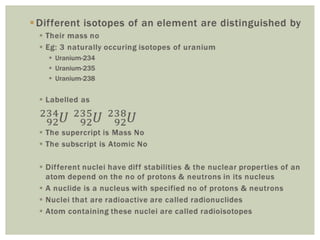
  Two types of subatomic particles in nucleus
   Proton & Neutron – refer as nucleons
  All atoms of a given element have the same no of
   protons
   Atomic No
  Atoms of a given element can have diff no of
   neutrons
   Can have different Mass No
   Mass No = The total no of nucleons in the nucleus
  Atoms with the same atomic no but diff in mass no
   Known as Isotopes
NUCLEAR EQUATIONS

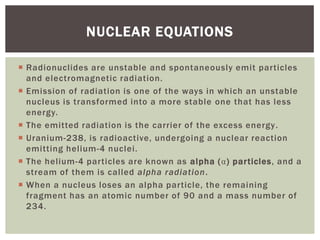
 Radionuclides are unstable and spontaneously emit particles
  and electromagnetic radiation.
 Emission of radiation is one of the ways in which an unstable
  nucleus is transformed into a more stable one that has less
  energy.
 The emitted radiation is the carrier of the excess energy .
 Uranium-238, is radioactive, undergoing a nuclear reaction
  emitting helium-4 nuclei.
 The helium-4 particles are known as alpha (α) particles, and a
  stream of them is called alpha radiation.
 When a nucleus loses an alpha particle, the remaining
  fragment has an atomic number of 90 and a mass number of
  234.
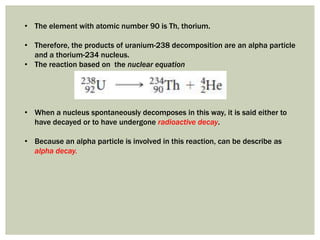
• The element with atomic number 90 is Th, thorium.

• Therefore, the products of uranium-238 decomposition are an alpha particle
  and a thorium-234 nucleus.
• The reaction based on the nuclear equation


• When a nucleus spontaneously decomposes in this way, it is said either to
  have decayed or to have undergone radioactive decay.

• Because an alpha particle is involved in this reaction, can be describe as
  alpha decay.
PREDICTING THE PRODUCT OF A
         NUCLEAR REACTION

• Again, from the periodic table, the element with Z = 86 is radon (Rn).
T YPES OF RADIOACTIVE DECAY


WRITING NUCLEAR EQUATIONS

 Write nuclear equations     for   thorium-231   decaying   to
  protactinium-231.


 From 231 = 231 + A and 90 = 91 + Z , we deduce A = 0 and Z
  = -1
 The particle with these characteristics is the beta particle
  (electron).
NUCLEAR POWER: FISSION

 Commercial nuclear power plants and most forms of nuclear
  weaponry depend on nuclear fission for their operation.
 The first nuclear fission reaction to be discovered was that of
  uranium-235.
 This nucleus, as well as those of uranium -233 and plutonium-
  239, undergoes fission when struck by a slow -moving neutron


   Uranium-235 fission.
   This is just one of many fission patterns. In this reaction, 3.5 x 10⁻¹¹ of
   energy is produced per U-235 nucleus.
• A heavy nucleus can split in many ways.
• Two ways that the uranium-235 nucleus splits, for instance, are:


• More than 200 isotopes of 35 elements have been found among the
  fission products of uranium-235.
• Most of them are radioactive.
• Slow-moving neutrons are required in fission because the process involves
  initial absorption of the neutron by the nucleus.
• The resulting more massive nucleus is often unstable and spontaneously
  undergoes fission.
• Fast neutrons tend to bounce off the nucleus, and little fission occurs.
• On average, 2.4 neutrons are produced by every fission of a uranium-235
  nucleus.
• If one fission produces two neutrons, the two neutrons can cause two
  additional fissions, each producing two neutrons. The four neutrons
  thereby released can produce four fissions, and so forth,
• The number of fissions and the energy released quickly escalate, and if
  the process is unchecked, the result is a violent explosion.
• Reactions that multiply in this fashion are called chain reactions.
NUCLEAR POWER: FUSION

 Fusion is appealing as an energy source because of the
  availability of light isotopes on Earth and because fusion
  products are generally not radioactive.
 Despite this fact, fusion is not presently used to generate
  energy.
 The problem is that, in order for two nuclei to fuse, high
  temperatures and pressures are needed to overcome the
  electrostatic repulsion between them.
 Fusion reactions are therefore also known as thermonuclear
 reactions.
 The lowest temperature required for any fusion is about
  40,000,000 K, the temperature needed to fuse deuterium and
  tritium
• Such high temperatures have been achieved by using an atomic bomb to
  initiate fusion.
• This is the operating principle behind a thermonuclear, or hydrogen bomb.
• This approach is obviously unacceptable, however, for a power generation
  plant.
• Historically a nuclear weapon that relies solely on a fission process to
  release energy is called an atomic bomb, whereas one that also releases
  energy via a fusion reaction is called a hydrogen bomb.
• Numerous problems must be overcome before fusion becomes a practical
  energy source.
• In addition to the high temperatures necessary to initiate the reaction,
  there is the problem of confining the reaction. No known structural material
  is able to withstand the enormous temperatures necessary for fusion
NUCLEAR TRANSMUTATION

 Fewer than 300 of the more than 3600 known isotopes occur
  naturally.
 The remainder have been made by nuclear transmutation , the
  change of one element into another.
 Such transmutation is often brought about by bombardment
  of an atom with a high energy particle such as a
  proton, neutron, or particle.
 In the ensuing collision between particle and atom, an
  unstable nucleus is momentarily created, a nuclear change
  occurs, and a dif ferent element is produced.
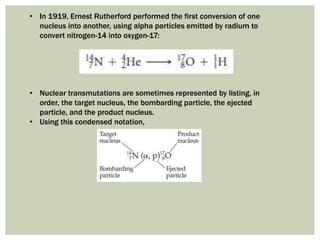
• In 1919, Ernest Rutherford performed the first conversion of one
  nucleus into another, using alpha particles emitted by radium to
  convert nitrogen-14 into oxygen-17:


• Nuclear transmutations are sometimes represented by listing, in
  order, the target nucleus, the bombarding particle, the ejected
  particle, and the product nucleus.
• Using this condensed notation,
• Alpha particles and other positively charged particles must move very fast
  to overcome the electrostatic repulsion between them and the target
  nucleus.

• The higher the nuclear charge on either the bombarding particle or the
  target nucleus, the faster the bombarding particle must move to bring
  about a nuclear reaction.

• Many methods have been devised to accelerate charged particles, using
  strong magnetic and electrostatic fields.

• These particle accelerators, popularly called “atom smashers,” bear such
  names as cyclotron and synchrotron.

• All particle accelerators is the need to create charged particles so that
  they can be manipulated by electrical and magnetic fields.
• The tubes through which the particles move must be kept at high
  vacuum so that the particles do not inadvertently collide with any gas-
  phase molecules.
• Relativistic Heavy Ion Collider (RHIC) located at Brookhaven National
  Laboratory. This facility and the Large Hadron Collider (LHC) at CERN (Conseil
  Europeen pour la Recherche Nucleaire) near Geneva are two of the largest
  particle accelerators in the world.

• Both LHC and RHIC are capable of accelerating protons, as well as heavy ions
  such as gold and lead, to speeds approaching the speed of light.

• Scientists study the outcomes of collisions involving these ultra-high-energy
  particles
• Most synthetic isotopes used in medicine and scientific research are made
  using neutrons as the bombarding particles.

• Because neutrons are neutral, they are not repelled by the nucleus.

• Consequently, they do not need to be accelerated to cause nuclear reactions.

• The neutrons are produced in nuclear reactors.

• For example, cobalt-60, which is used in cancer radiation therapy, is produced
  by neutron capture.

• Iron-58 is placed in a nuclear reactor and bombarded by neutrons to trigger the
  reactions sequence

Nuclear chem

  • 1.
  • 2.
    RADIOACTIVIT Y RECAP: Two types of subatomic particles in nucleus  Proton & Neutron – refer as nucleons  All atoms of a given element have the same no of protons  Atomic No  Atoms of a given element can have diff no of neutrons  Can have different Mass No  Mass No = The total no of nucleons in the nucleus  Atoms with the same atomic no but diff in mass no  Known as Isotopes
  • 4.
    NUCLEAR EQUATIONS  Radionuclidesare unstable and spontaneously emit particles and electromagnetic radiation.  Emission of radiation is one of the ways in which an unstable nucleus is transformed into a more stable one that has less energy.  The emitted radiation is the carrier of the excess energy .  Uranium-238, is radioactive, undergoing a nuclear reaction emitting helium-4 nuclei.  The helium-4 particles are known as alpha (α) particles, and a stream of them is called alpha radiation.  When a nucleus loses an alpha particle, the remaining fragment has an atomic number of 90 and a mass number of 234.
  • 5.
    • The elementwith atomic number 90 is Th, thorium. • Therefore, the products of uranium-238 decomposition are an alpha particle and a thorium-234 nucleus. • The reaction based on the nuclear equation • When a nucleus spontaneously decomposes in this way, it is said either to have decayed or to have undergone radioactive decay. • Because an alpha particle is involved in this reaction, can be describe as alpha decay.
  • 6.
    PREDICTING THE PRODUCTOF A NUCLEAR REACTION 
  • 7.
    • Again, fromthe periodic table, the element with Z = 86 is radon (Rn).
  • 9.
    T YPES OFRADIOACTIVE DECAY 
  • 12.
    WRITING NUCLEAR EQUATIONS Write nuclear equations for thorium-231 decaying to protactinium-231.  From 231 = 231 + A and 90 = 91 + Z , we deduce A = 0 and Z = -1  The particle with these characteristics is the beta particle (electron).
  • 13.
    NUCLEAR POWER: FISSION Commercial nuclear power plants and most forms of nuclear weaponry depend on nuclear fission for their operation.  The first nuclear fission reaction to be discovered was that of uranium-235.  This nucleus, as well as those of uranium -233 and plutonium- 239, undergoes fission when struck by a slow -moving neutron Uranium-235 fission. This is just one of many fission patterns. In this reaction, 3.5 x 10⁻¹¹ of energy is produced per U-235 nucleus.
  • 14.
    • A heavynucleus can split in many ways. • Two ways that the uranium-235 nucleus splits, for instance, are: • More than 200 isotopes of 35 elements have been found among the fission products of uranium-235. • Most of them are radioactive. • Slow-moving neutrons are required in fission because the process involves initial absorption of the neutron by the nucleus. • The resulting more massive nucleus is often unstable and spontaneously undergoes fission. • Fast neutrons tend to bounce off the nucleus, and little fission occurs. • On average, 2.4 neutrons are produced by every fission of a uranium-235 nucleus. • If one fission produces two neutrons, the two neutrons can cause two additional fissions, each producing two neutrons. The four neutrons thereby released can produce four fissions, and so forth,
  • 15.
    • The numberof fissions and the energy released quickly escalate, and if the process is unchecked, the result is a violent explosion. • Reactions that multiply in this fashion are called chain reactions.
  • 16.
    NUCLEAR POWER: FUSION Fusion is appealing as an energy source because of the availability of light isotopes on Earth and because fusion products are generally not radioactive.  Despite this fact, fusion is not presently used to generate energy.  The problem is that, in order for two nuclei to fuse, high temperatures and pressures are needed to overcome the electrostatic repulsion between them.  Fusion reactions are therefore also known as thermonuclear reactions.  The lowest temperature required for any fusion is about 40,000,000 K, the temperature needed to fuse deuterium and tritium
  • 17.
    • Such hightemperatures have been achieved by using an atomic bomb to initiate fusion. • This is the operating principle behind a thermonuclear, or hydrogen bomb. • This approach is obviously unacceptable, however, for a power generation plant. • Historically a nuclear weapon that relies solely on a fission process to release energy is called an atomic bomb, whereas one that also releases energy via a fusion reaction is called a hydrogen bomb. • Numerous problems must be overcome before fusion becomes a practical energy source. • In addition to the high temperatures necessary to initiate the reaction, there is the problem of confining the reaction. No known structural material is able to withstand the enormous temperatures necessary for fusion
  • 18.
    NUCLEAR TRANSMUTATION  Fewerthan 300 of the more than 3600 known isotopes occur naturally.  The remainder have been made by nuclear transmutation , the change of one element into another.  Such transmutation is often brought about by bombardment of an atom with a high energy particle such as a proton, neutron, or particle.  In the ensuing collision between particle and atom, an unstable nucleus is momentarily created, a nuclear change occurs, and a dif ferent element is produced.
  • 19.
    • In 1919,Ernest Rutherford performed the first conversion of one nucleus into another, using alpha particles emitted by radium to convert nitrogen-14 into oxygen-17: • Nuclear transmutations are sometimes represented by listing, in order, the target nucleus, the bombarding particle, the ejected particle, and the product nucleus. • Using this condensed notation,
  • 20.
    • Alpha particlesand other positively charged particles must move very fast to overcome the electrostatic repulsion between them and the target nucleus. • The higher the nuclear charge on either the bombarding particle or the target nucleus, the faster the bombarding particle must move to bring about a nuclear reaction. • Many methods have been devised to accelerate charged particles, using strong magnetic and electrostatic fields. • These particle accelerators, popularly called “atom smashers,” bear such names as cyclotron and synchrotron. • All particle accelerators is the need to create charged particles so that they can be manipulated by electrical and magnetic fields. • The tubes through which the particles move must be kept at high vacuum so that the particles do not inadvertently collide with any gas- phase molecules.
  • 21.
    • Relativistic HeavyIon Collider (RHIC) located at Brookhaven National Laboratory. This facility and the Large Hadron Collider (LHC) at CERN (Conseil Europeen pour la Recherche Nucleaire) near Geneva are two of the largest particle accelerators in the world. • Both LHC and RHIC are capable of accelerating protons, as well as heavy ions such as gold and lead, to speeds approaching the speed of light. • Scientists study the outcomes of collisions involving these ultra-high-energy particles
  • 23.
    • Most syntheticisotopes used in medicine and scientific research are made using neutrons as the bombarding particles. • Because neutrons are neutral, they are not repelled by the nucleus. • Consequently, they do not need to be accelerated to cause nuclear reactions. • The neutrons are produced in nuclear reactors. • For example, cobalt-60, which is used in cancer radiation therapy, is produced by neutron capture. • Iron-58 is placed in a nuclear reactor and bombarded by neutrons to trigger the reactions sequence