Solid Models
R.B.Chadge
Evolution of Geometric Modeling
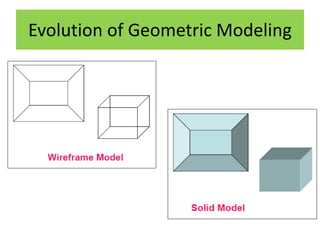
• A wireframe representation of an object is done using
edges (lines curves) and vertices.
• Surface representation is the logical evolution using faces
(surfaces), edges and vertices.
• In this sequence of developments, the solid modeling uses
topological information in addition to the geometrical
information to represent the object completely.
Evolution of Geometric Modeling
Advantages of Solid Models
• Unlike wireframes and surface representations which
contain only geometrical data,
• The solid model uses topological information in
addition to the geometrical information to represent
the object completely.
• Solid model results in accurate design, helps to
further the goal of CAD/ CAM like CIM, Flexible
manufacturing leading to better automation of the
manufacturing process.
Advantages of Solid Models
• Geometry: The graphical information of dimension,
length, angle, area and transformations
• Topology: The invisible information about the
connectivity, neighbourhood, associatively etc.
Definition of Solid Model
• A solid model of an object is a more complete
representation than its surface (wireframe) model.
• It provides more topological information in addition
to the geometrical information which helps to
represent the solid completely.
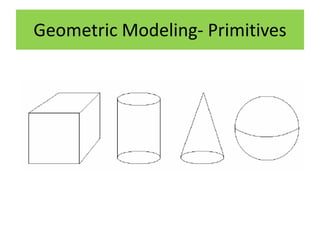
Geometric Modeling- Primitives
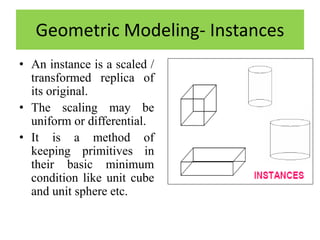
Geometric Modeling- Instances
• An instance is a scaled /
transformed replica of
its original.
• The scaling may be
uniform or differential.
• It is a method of
keeping primitives in
their basic minimum
condition like unit cube
and unit sphere etc.
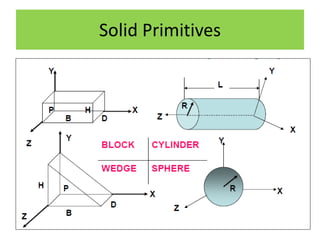
Solid Primitives
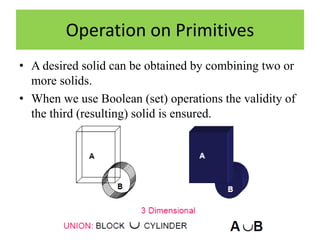
Operation on Primitives
• A desired solid can be obtained by combining two or
more solids.
• When we use Boolean (set) operations the validity of
the third (resulting) solid is ensured.
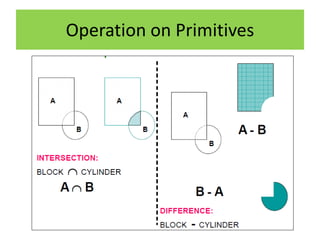
Operation on Primitives
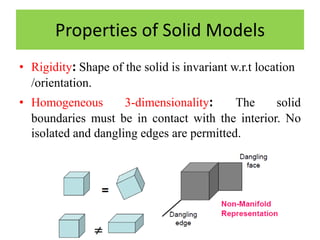
• Rigidity: Shape of the solid is invariant w.r.t location
/orientation.
• Homogeneous 3-dimensionality: The solid
boundaries must be in contact with the interior. No
isolated and dangling edges are permitted.
Properties of Solid Models
• Finiteness and finite describability: Size is finite and a
finite amount of information can describe the solid
model.
• Closure under rigid motion and regularised Boolean
operations: Movement and Boolean operations
should produce other valid solids.
• Boundary determinism: The boundary must contain
the solid and hence determine the solid distinctly.
Properties of Solid Models
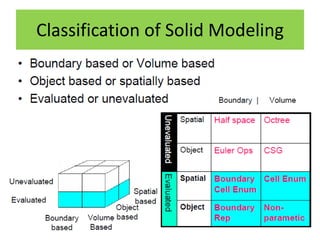
Classification of Solid Modeling
1. Half Spaces.
2. Boundary Representation (B-Rep)
3. Constructive Solid Geometry (CSG)
4. Sweeping
5. Analytical Solid Modeling (ASM)
6. Cell decomposition
7. Spatial Ennumeration
8. Octree encoding
9. Primitive Instancing
The 3 most popular schemes: B-rep, CSG, Sweeping
Major Modeling Schemes
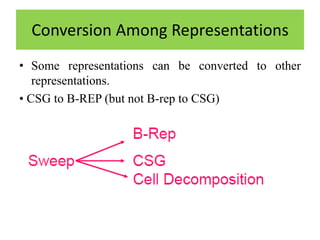
Conversion Among Representations
• Some representations can be converted to other
representations.
• CSG to B-REP (but not B-rep to CSG)
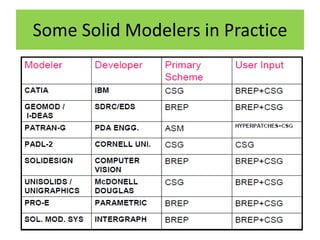
Some Solid Modelers in Practice

Solid Modelling in computer aided Design

  • 1.
  • 2.
    Evolution of GeometricModeling • A wireframe representation of an object is done using edges (lines curves) and vertices. • Surface representation is the logical evolution using faces (surfaces), edges and vertices. • In this sequence of developments, the solid modeling uses topological information in addition to the geometrical information to represent the object completely.
  • 3.
  • 4.
    Advantages of SolidModels • Unlike wireframes and surface representations which contain only geometrical data, • The solid model uses topological information in addition to the geometrical information to represent the object completely. • Solid model results in accurate design, helps to further the goal of CAD/ CAM like CIM, Flexible manufacturing leading to better automation of the manufacturing process.
  • 5.
    Advantages of SolidModels • Geometry: The graphical information of dimension, length, angle, area and transformations • Topology: The invisible information about the connectivity, neighbourhood, associatively etc.
  • 6.
    Definition of SolidModel • A solid model of an object is a more complete representation than its surface (wireframe) model. • It provides more topological information in addition to the geometrical information which helps to represent the solid completely.
  • 7.
  • 8.
    Geometric Modeling- Instances •An instance is a scaled / transformed replica of its original. • The scaling may be uniform or differential. • It is a method of keeping primitives in their basic minimum condition like unit cube and unit sphere etc.
  • 9.
  • 10.
    Operation on Primitives •A desired solid can be obtained by combining two or more solids. • When we use Boolean (set) operations the validity of the third (resulting) solid is ensured.
  • 11.
  • 12.
    • Rigidity: Shapeof the solid is invariant w.r.t location /orientation. • Homogeneous 3-dimensionality: The solid boundaries must be in contact with the interior. No isolated and dangling edges are permitted. Properties of Solid Models
  • 13.
    • Finiteness andfinite describability: Size is finite and a finite amount of information can describe the solid model. • Closure under rigid motion and regularised Boolean operations: Movement and Boolean operations should produce other valid solids. • Boundary determinism: The boundary must contain the solid and hence determine the solid distinctly. Properties of Solid Models
  • 14.
  • 15.
    1. Half Spaces. 2.Boundary Representation (B-Rep) 3. Constructive Solid Geometry (CSG) 4. Sweeping 5. Analytical Solid Modeling (ASM) 6. Cell decomposition 7. Spatial Ennumeration 8. Octree encoding 9. Primitive Instancing The 3 most popular schemes: B-rep, CSG, Sweeping Major Modeling Schemes
  • 16.
    Conversion Among Representations •Some representations can be converted to other representations. • CSG to B-REP (but not B-rep to CSG)
  • 17.