SOLAR CELL
Presenter: Damion Lawrence, M.Sc., B.Ed.
1
The Solar Cell
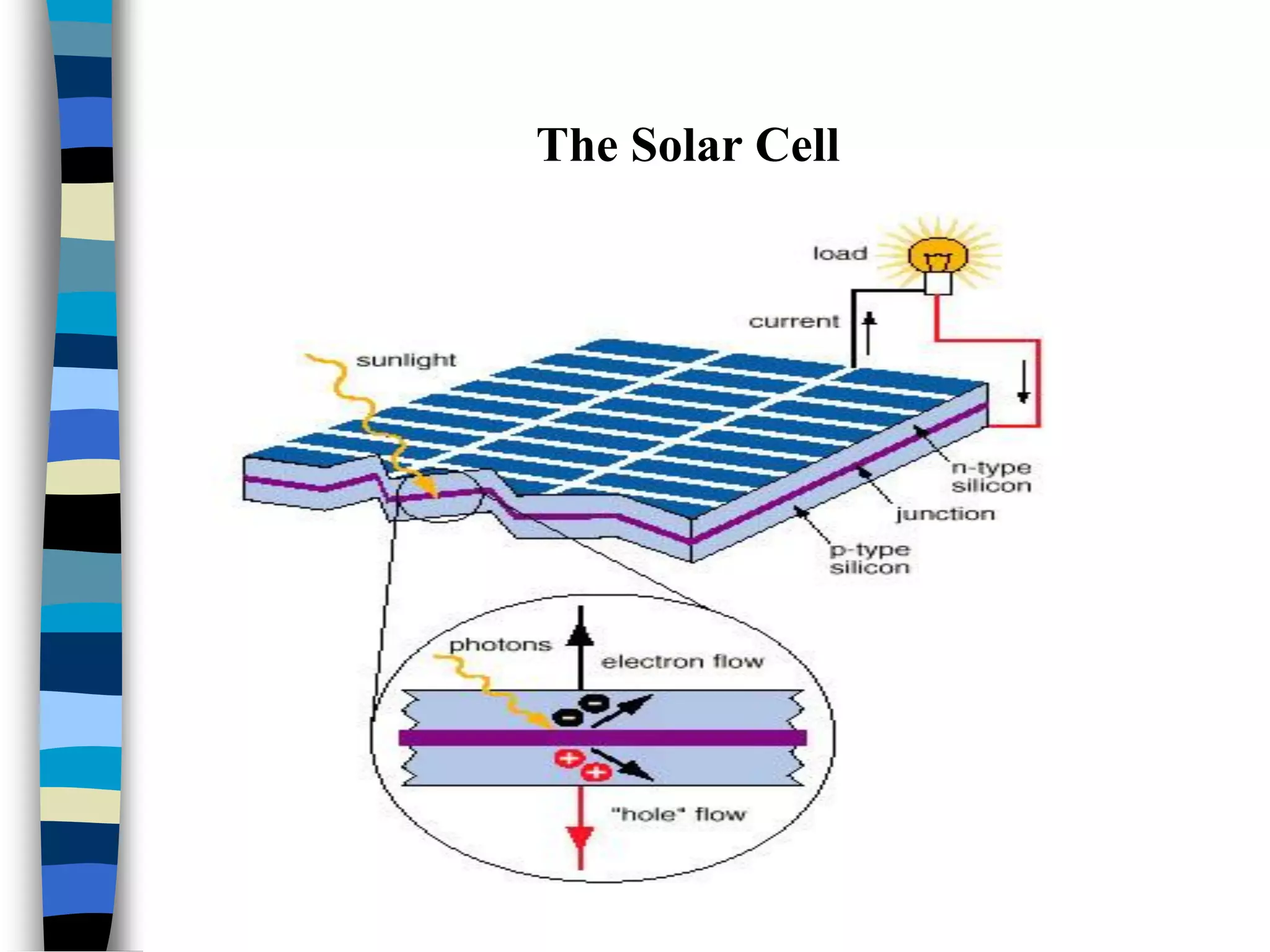
• The most common type of solar cells are Photovoltaic
Cells (PV cells)
• Converts sunlight directly into electricity
• Cells are made of a semiconductor material (eg. silicon)
• Light strikes the PV cell, and a certain portion is absorbed
• The light energy (in the form of photons) knocks electrons
loose, allowing them to flow freely, forming a current
• Metal contacts on the top and bottom of PV cell draws off
the current to use externally as power
Why Use Solar Cells?
• Low maintenance, long lasting sources of energy
• Provides cost-effective power supplies for people remote
from the main electricity grid
• Non-polluting and silent sources of electricity
• Convenient and flexible source of small amounts of power
• Renewable and sustainable power, as a means to reduce
global warming
• In 2002, the global market for photovoltaic panels and
equipment was valued at 3.5 billion dollars
The Single Crystalline Silicon Solar Cell
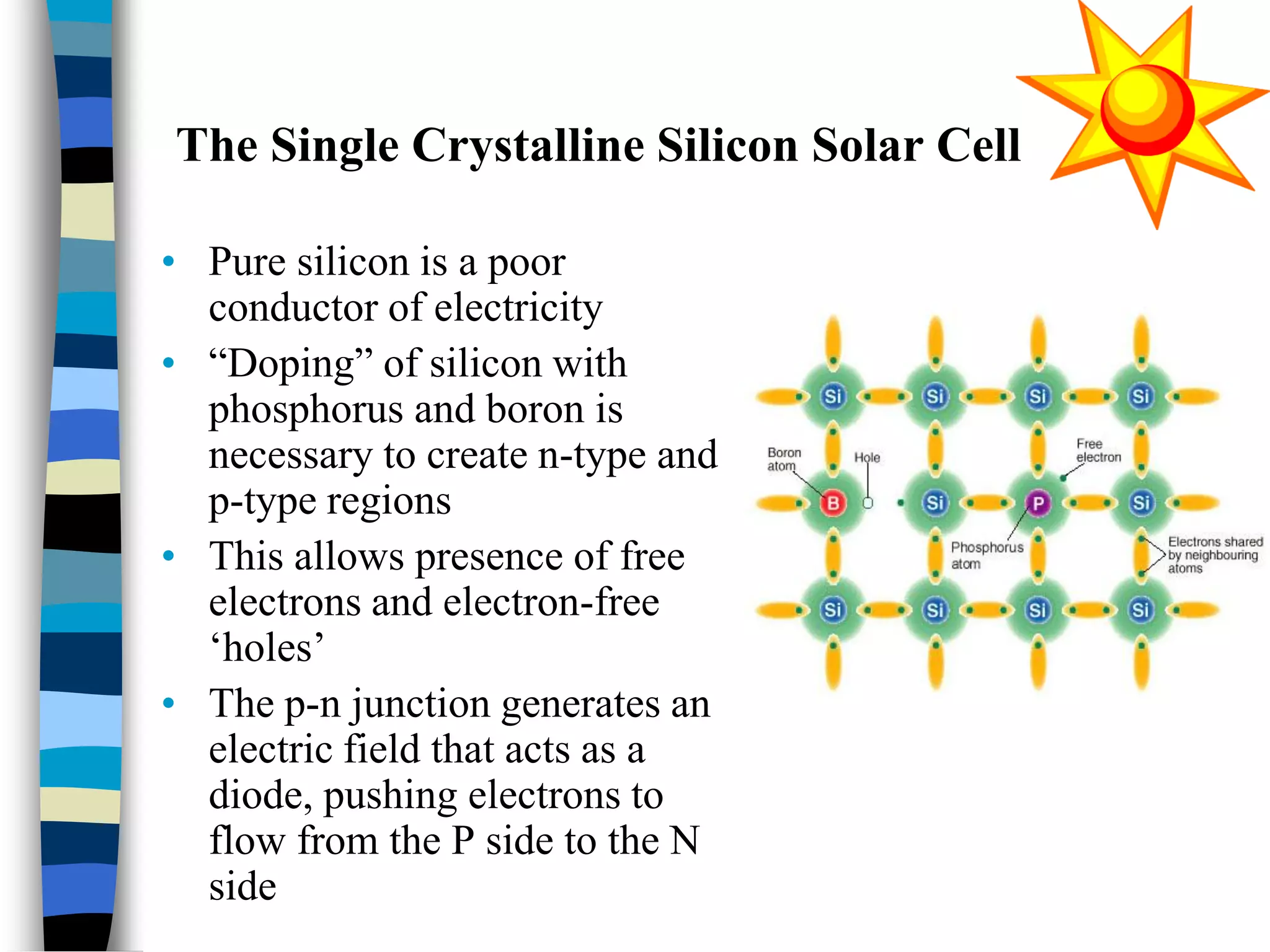
• Pure silicon is a poor
conductor of electricity
• “Doping” of silicon with
phosphorus and boron is
necessary to create n-type and
p-type regions
• This allows presence of free
electrons and electron-free
‘holes’
• The p-n junction generates an
electric field that acts as a
diode, pushing electrons to
flow from the P side to the N
side
The Solar Cell
When Light Hits the Cell
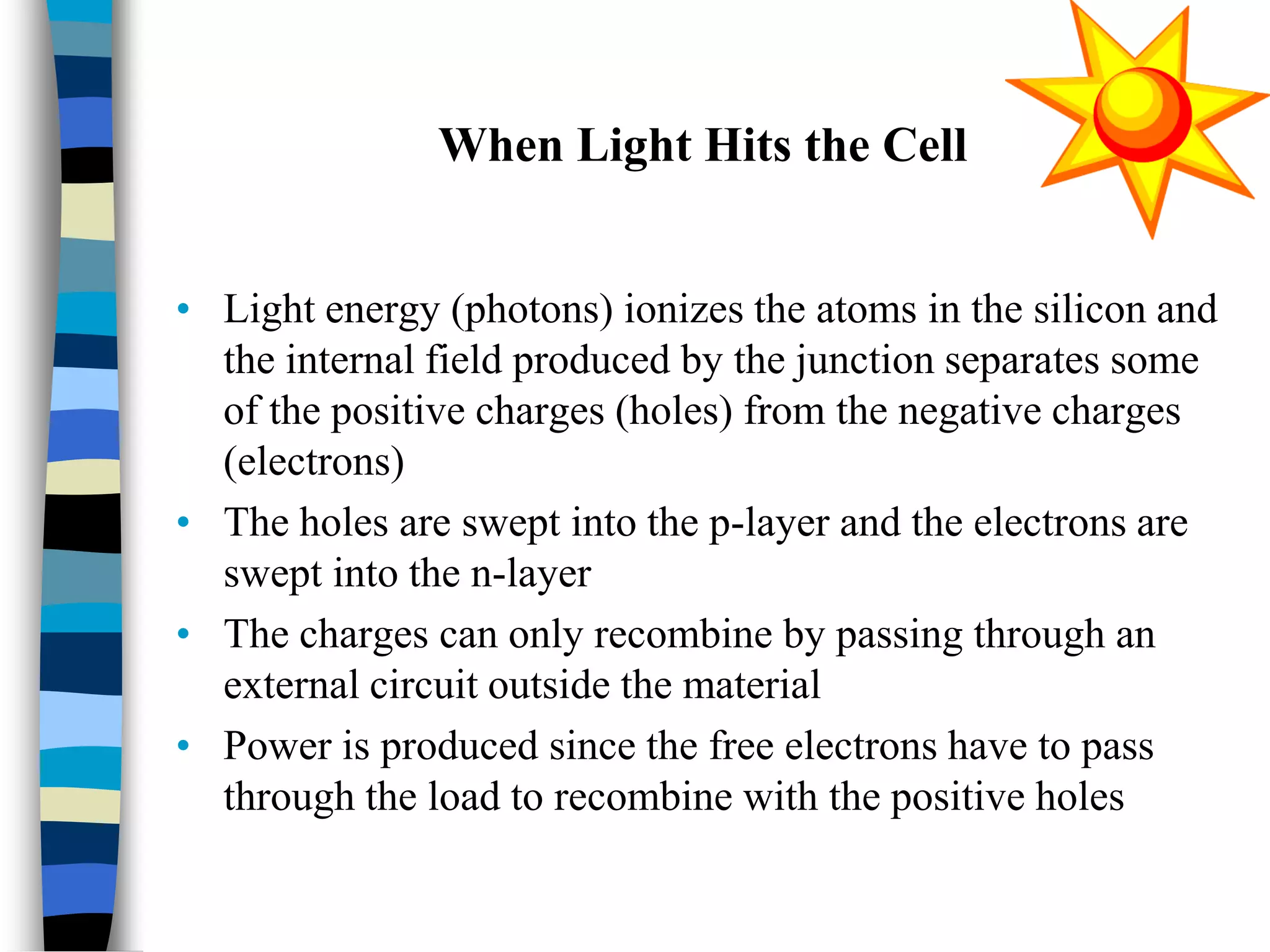
• Light energy (photons) ionizes the atoms in the silicon and
the internal field produced by the junction separates some
of the positive charges (holes) from the negative charges
(electrons)
• The holes are swept into the p-layer and the electrons are
swept into the n-layer
• The charges can only recombine by passing through an
external circuit outside the material
• Power is produced since the free electrons have to pass
through the load to recombine with the positive holes
Efficiency of Solar Cells
• The amount of power available from a PV device is
determined by
• Type and area of the material
• The intensity of the sunlight
• The wavelength of the sunlight
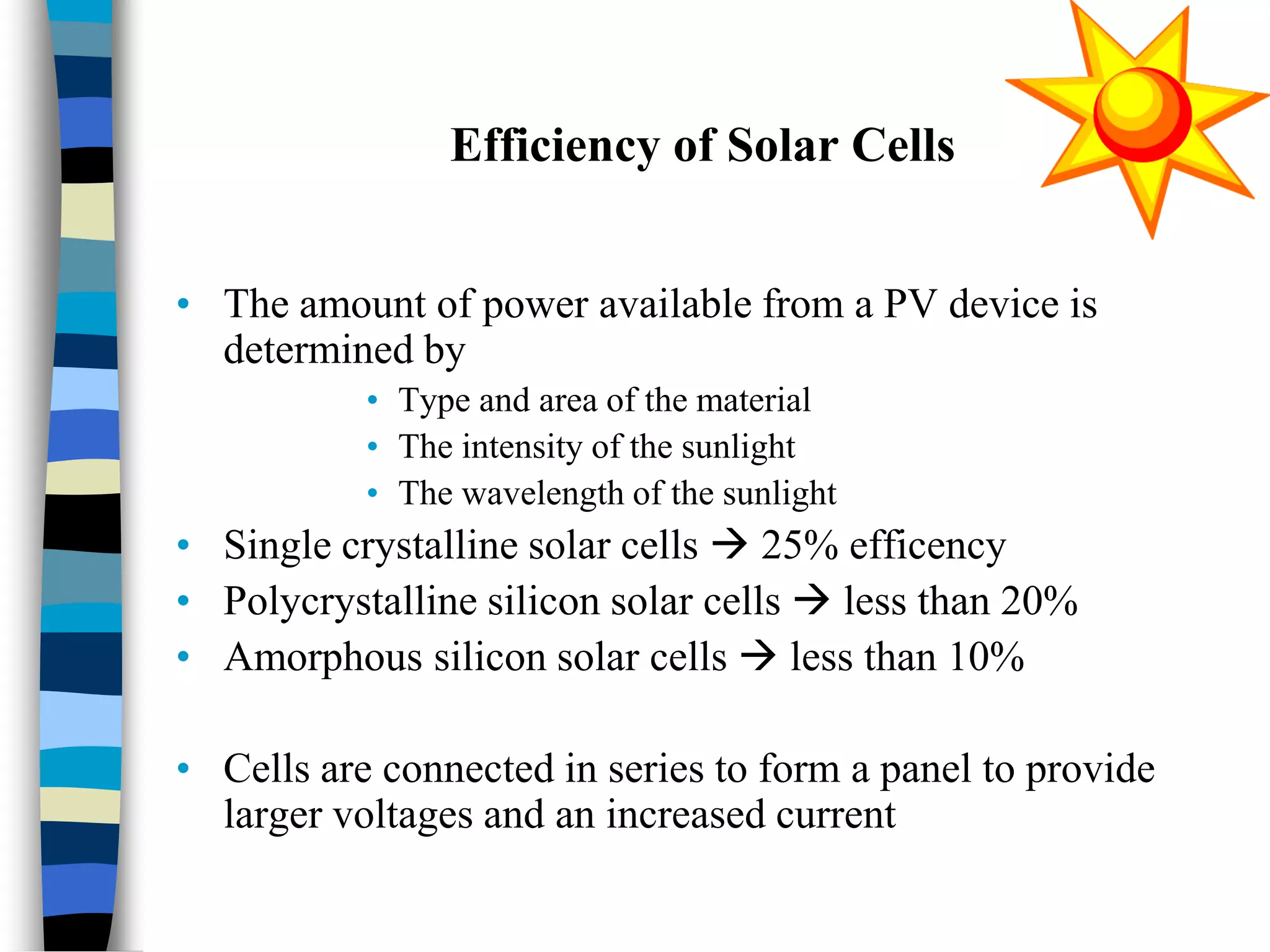
• Single crystalline solar cells  25% efficency
• Polycrystalline silicon solar cells  less than 20%
• Amorphous silicon solar cells  less than 10%
• Cells are connected in series to form a panel to provide
larger voltages and an increased current
Arrays and Systems
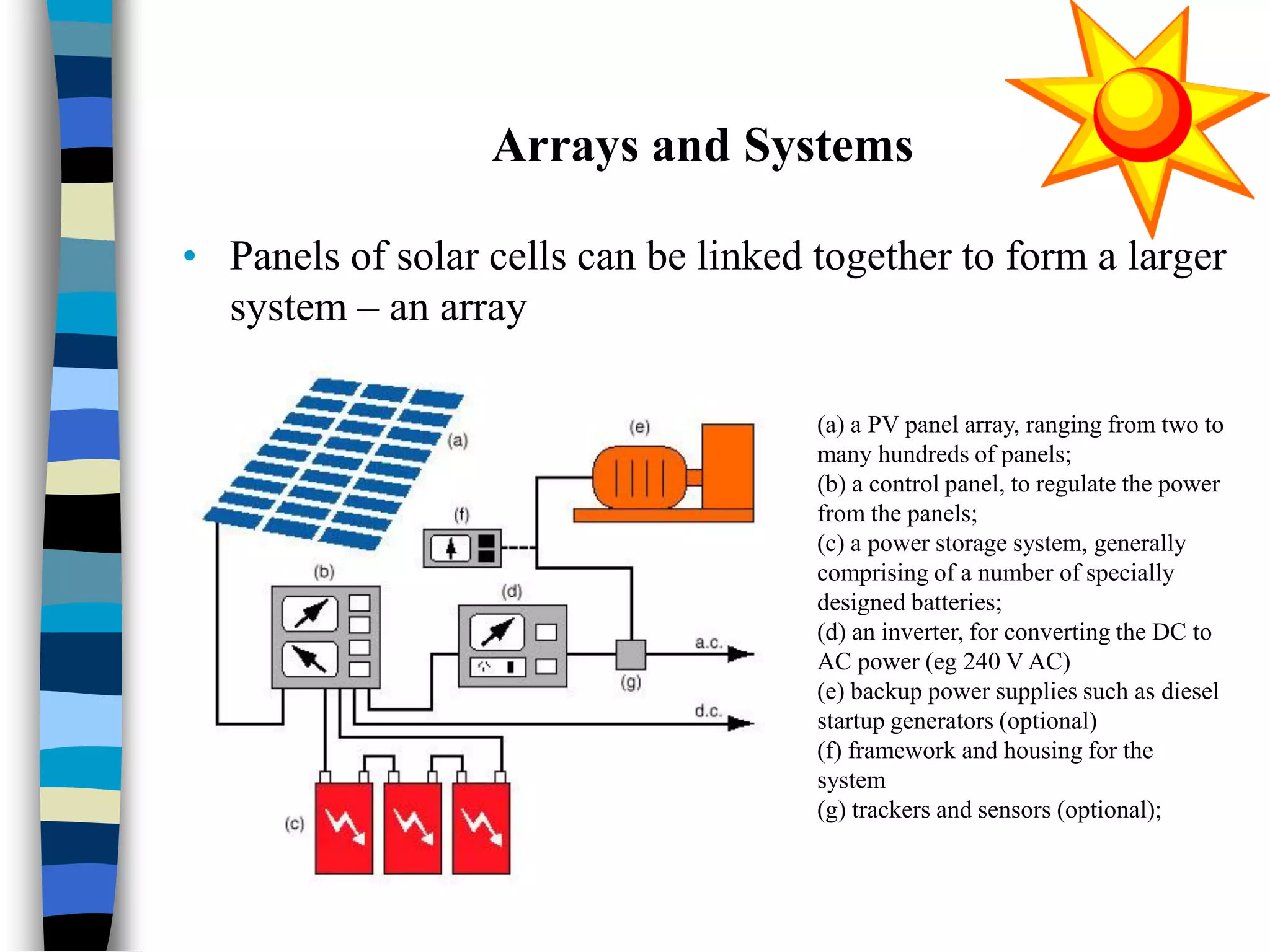
• Panels of solar cells can be linked together to form a larger
system – an array
(a) a PV panel array, ranging from two to
many hundreds of panels;
(b) a control panel, to regulate the power
from the panels;
(c) a power storage system, generally
comprising of a number of specially
designed batteries;
(d) an inverter, for converting the DC to
AC power (eg 240 V AC)
(e) backup power supplies such as diesel
startup generators (optional)
(f) framework and housing for the
system
(g) trackers and sensors (optional);
Solar Cells are used in a wide variety of
applications
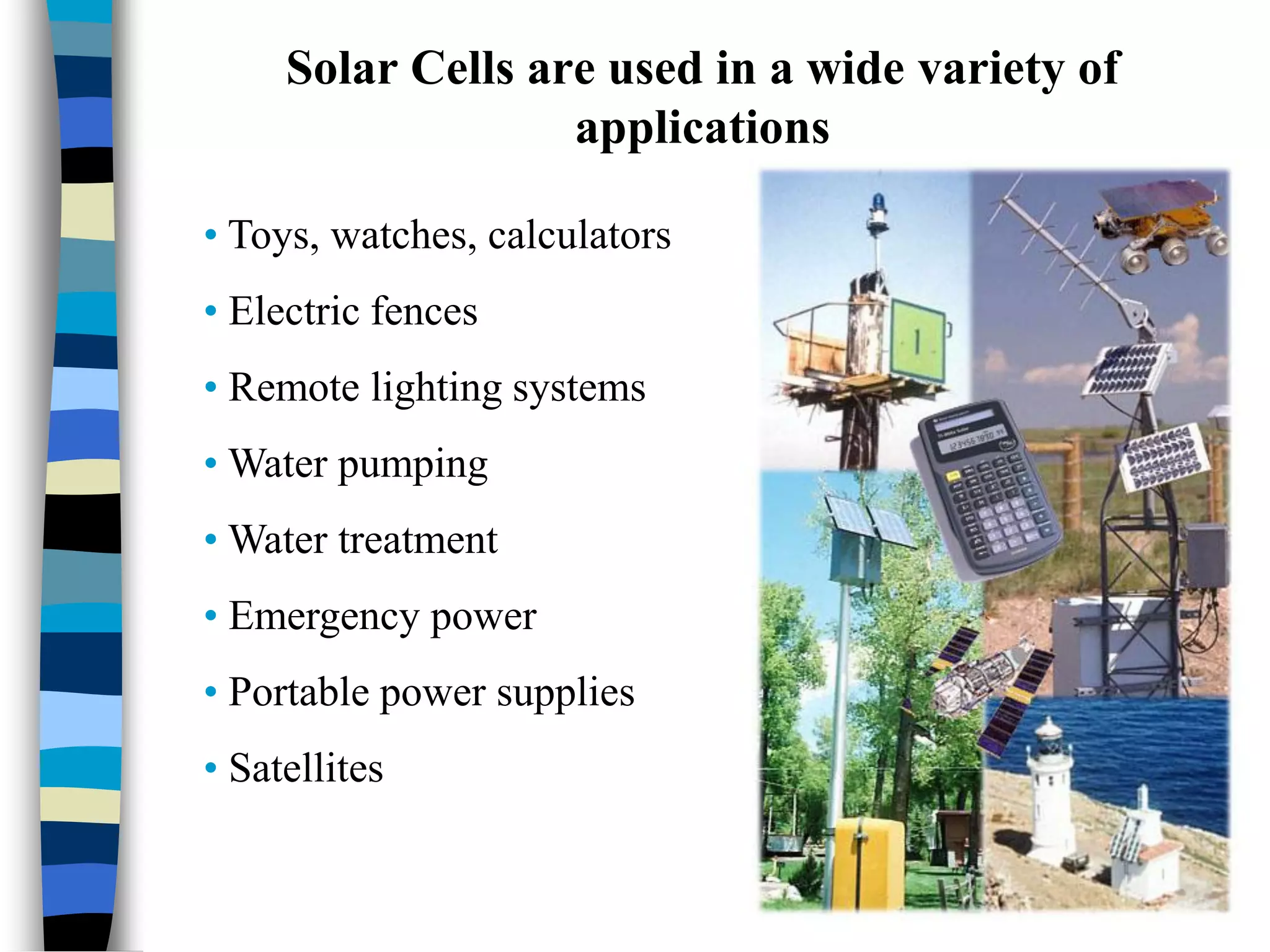
• Toys, watches, calculators
• Electric fences
• Remote lighting systems
• Water pumping
• Water treatment
• Emergency power
• Portable power supplies
• Satellites
Future Applications
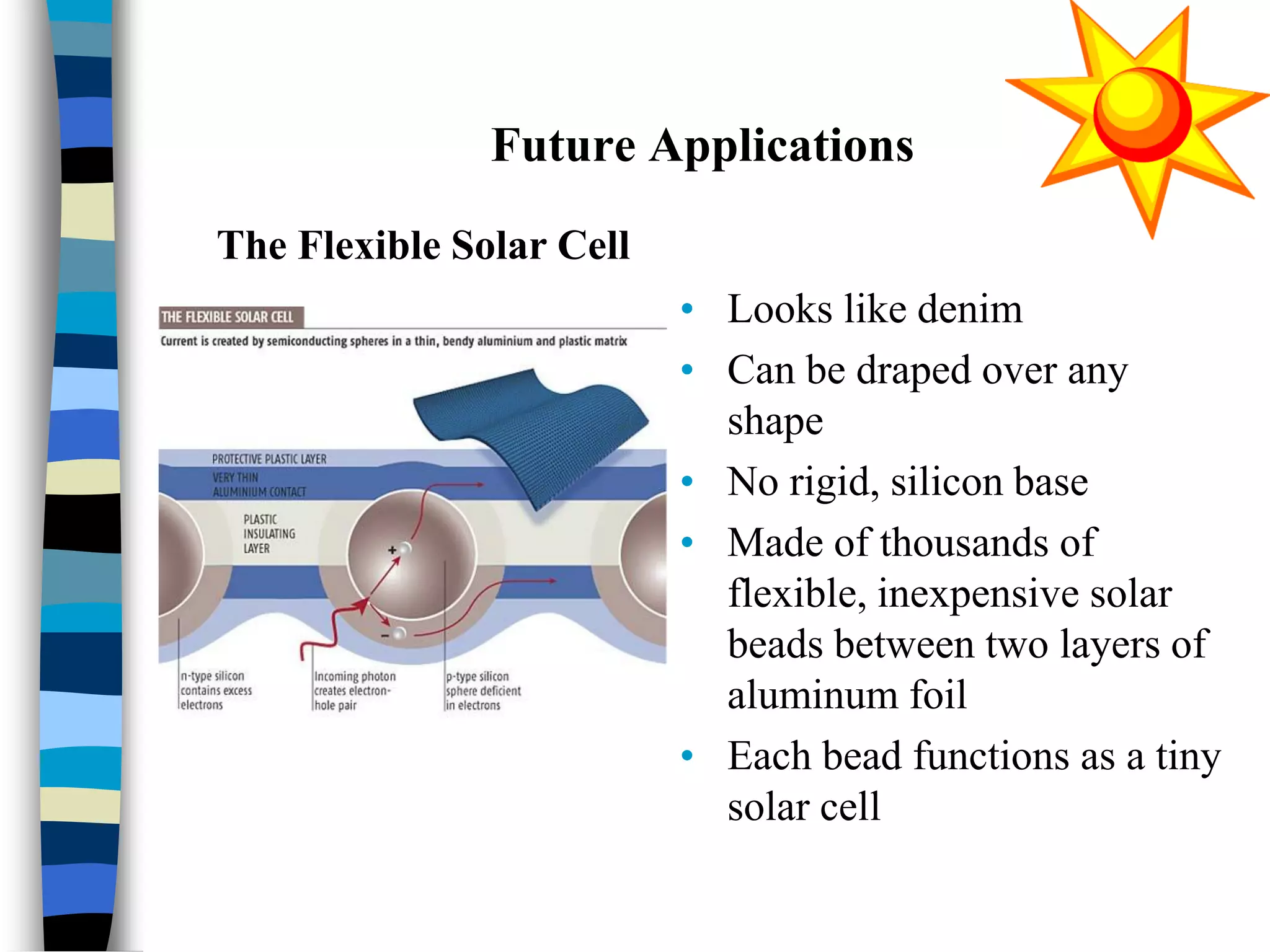
• Looks like denim
• Can be draped over any
shape
• No rigid, silicon base
• Made of thousands of
flexible, inexpensive solar
beads between two layers of
aluminum foil
• Each bead functions as a tiny
solar cell
The Flexible Solar Cell
Future Applications
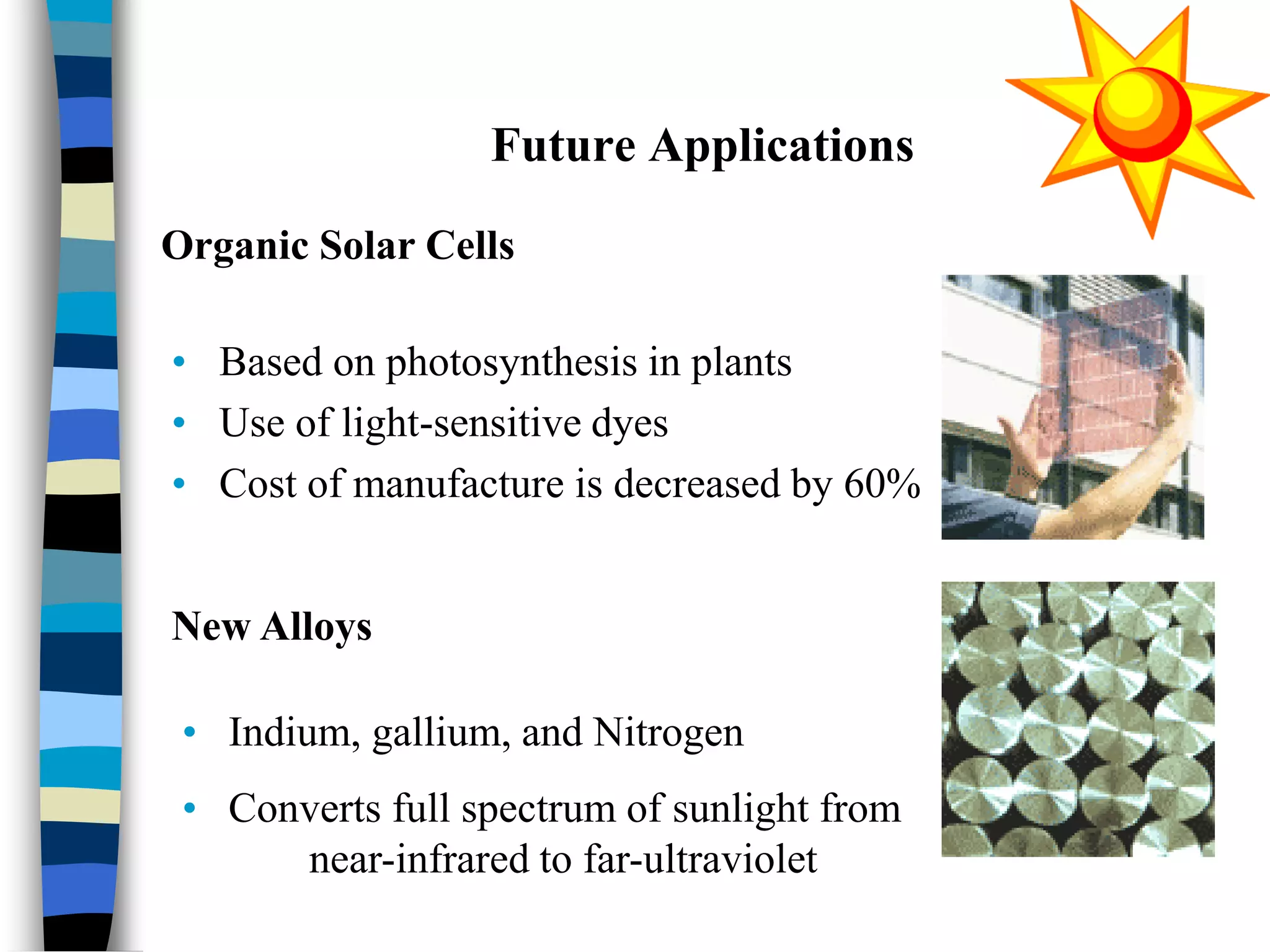
• Based on photosynthesis in plants
• Use of light-sensitive dyes
• Cost of manufacture is decreased by 60%
Organic Solar Cells
New Alloys
• Indium, gallium, and Nitrogen
• Converts full spectrum of sunlight from
near-infrared to far-ultraviolet
Future Applications
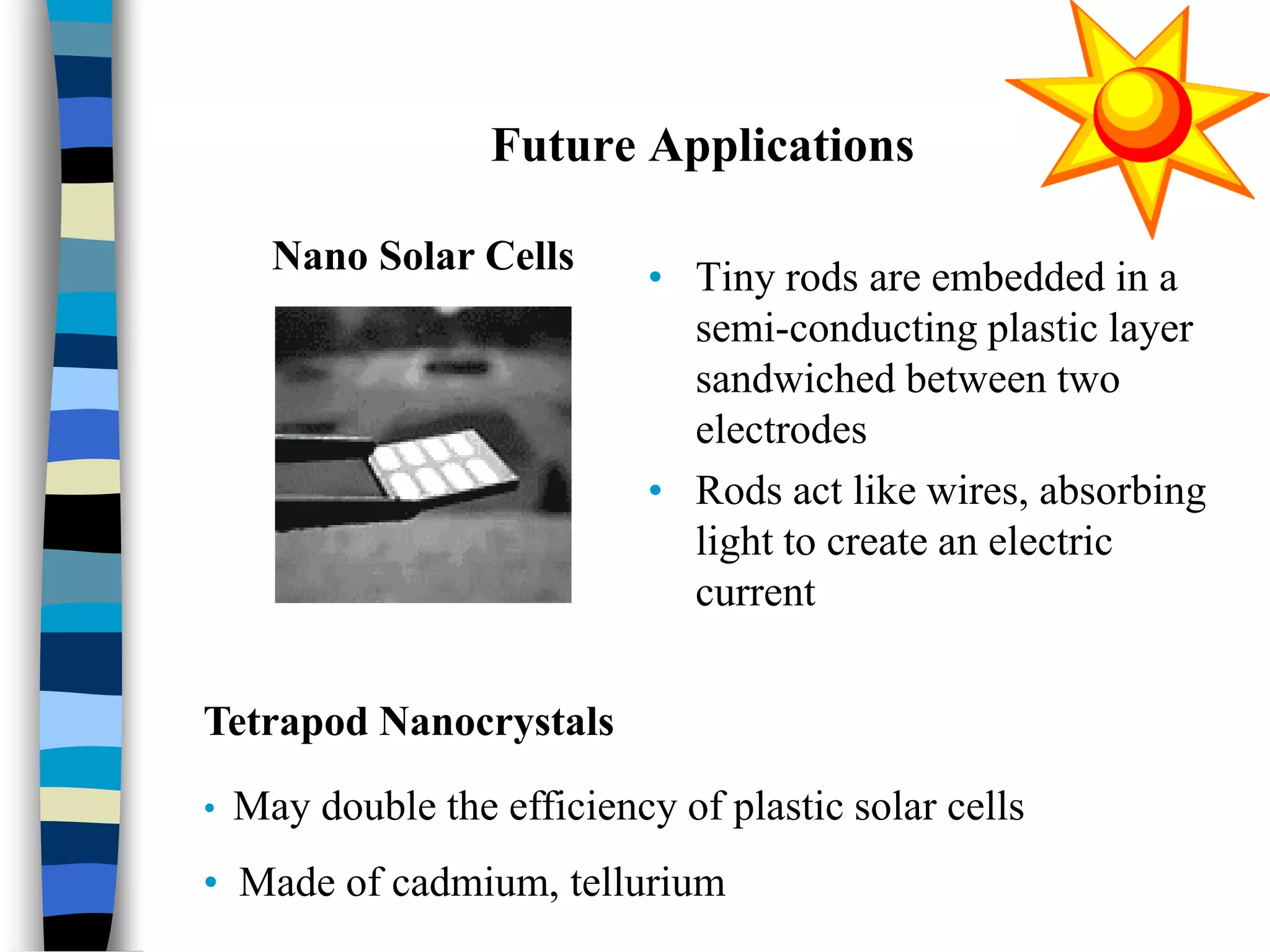
• Tiny rods are embedded in a
semi-conducting plastic layer
sandwiched between two
electrodes
• Rods act like wires, absorbing
light to create an electric
current
Nano Solar Cells
Tetrapod Nanocrystals
• May double the efficiency of plastic solar cells
• Made of cadmium, tellurium

Solar cells for slideshare

  • 1.
    SOLAR CELL Presenter: DamionLawrence, M.Sc., B.Ed. 1
  • 2.
    The Solar Cell •The most common type of solar cells are Photovoltaic Cells (PV cells) • Converts sunlight directly into electricity • Cells are made of a semiconductor material (eg. silicon) • Light strikes the PV cell, and a certain portion is absorbed • The light energy (in the form of photons) knocks electrons loose, allowing them to flow freely, forming a current • Metal contacts on the top and bottom of PV cell draws off the current to use externally as power
  • 3.
    Why Use SolarCells? • Low maintenance, long lasting sources of energy • Provides cost-effective power supplies for people remote from the main electricity grid • Non-polluting and silent sources of electricity • Convenient and flexible source of small amounts of power • Renewable and sustainable power, as a means to reduce global warming • In 2002, the global market for photovoltaic panels and equipment was valued at 3.5 billion dollars
  • 4.
    The Single CrystallineSilicon Solar Cell • Pure silicon is a poor conductor of electricity • “Doping” of silicon with phosphorus and boron is necessary to create n-type and p-type regions • This allows presence of free electrons and electron-free ‘holes’ • The p-n junction generates an electric field that acts as a diode, pushing electrons to flow from the P side to the N side
  • 5.
  • 6.
    When Light Hitsthe Cell • Light energy (photons) ionizes the atoms in the silicon and the internal field produced by the junction separates some of the positive charges (holes) from the negative charges (electrons) • The holes are swept into the p-layer and the electrons are swept into the n-layer • The charges can only recombine by passing through an external circuit outside the material • Power is produced since the free electrons have to pass through the load to recombine with the positive holes
  • 7.
    Efficiency of SolarCells • The amount of power available from a PV device is determined by • Type and area of the material • The intensity of the sunlight • The wavelength of the sunlight • Single crystalline solar cells  25% efficency • Polycrystalline silicon solar cells  less than 20% • Amorphous silicon solar cells  less than 10% • Cells are connected in series to form a panel to provide larger voltages and an increased current
  • 8.
    Arrays and Systems •Panels of solar cells can be linked together to form a larger system – an array (a) a PV panel array, ranging from two to many hundreds of panels; (b) a control panel, to regulate the power from the panels; (c) a power storage system, generally comprising of a number of specially designed batteries; (d) an inverter, for converting the DC to AC power (eg 240 V AC) (e) backup power supplies such as diesel startup generators (optional) (f) framework and housing for the system (g) trackers and sensors (optional);
  • 9.
    Solar Cells areused in a wide variety of applications • Toys, watches, calculators • Electric fences • Remote lighting systems • Water pumping • Water treatment • Emergency power • Portable power supplies • Satellites
  • 10.
    Future Applications • Lookslike denim • Can be draped over any shape • No rigid, silicon base • Made of thousands of flexible, inexpensive solar beads between two layers of aluminum foil • Each bead functions as a tiny solar cell The Flexible Solar Cell
  • 11.
    Future Applications • Basedon photosynthesis in plants • Use of light-sensitive dyes • Cost of manufacture is decreased by 60% Organic Solar Cells New Alloys • Indium, gallium, and Nitrogen • Converts full spectrum of sunlight from near-infrared to far-ultraviolet
  • 12.
    Future Applications • Tinyrods are embedded in a semi-conducting plastic layer sandwiched between two electrodes • Rods act like wires, absorbing light to create an electric current Nano Solar Cells Tetrapod Nanocrystals • May double the efficiency of plastic solar cells • Made of cadmium, tellurium