The energy crisis and oil embargos of the 1970’s made
many nations aware of their dependency on controlled
non-renewable energy sources .

This formulated the scientists to search for new
alternative sources of energy.

Further researches into renewable sources made a
path through solar power, wind power and geothermal
power.

Solar power generation has emerged as one of the
most rapidly growing renewable sources of energy.
 Solar  power is the conversion of
  sunlight into electricity .
 The methods used for generating
  electricity through solar power are:
1. Concentrated solar power(CSP)
2. Photovoltaic method .
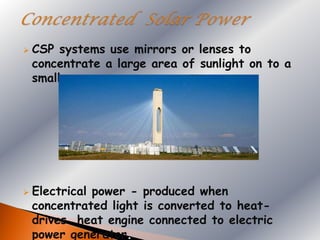
   CSP systems use mirrors or lenses to
    concentrate a large area of sunlight on to a
    small area.


   Electrical power - produced when
    concentrated light is converted to heat-
    drives heat engine connected to electric
    power generator.
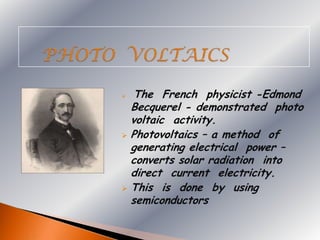
  The French physicist -Edmond
  Becquerel - demonstrated photo
  voltaic activity.
 Photovoltaics – a method of
  generating electrical power –
  converts solar radiation into
  direct current electricity.
 This is done by using
  semiconductors
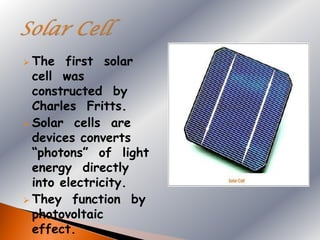
 The   first solar
  cell was
  constructed by
  Charles Fritts.
 Solar cells are
  devices converts
  “photons” of light
  energy directly
  into electricity.
 They function by
  photovoltaic
  effect.
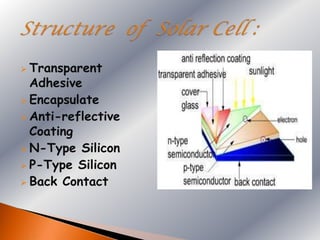
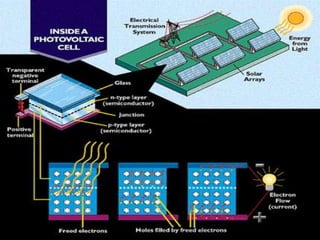
 Transparent
  Adhesive
 Encapsulate
 Anti-reflective
  Coating
 N-Type Silicon
 P-Type Silicon
 Back Contact
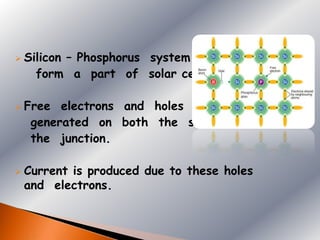
   Silicon – Phosphorus system
      form a part of solar cell.

   Free electrons and holes are
     generated on both the sides of
     the junction.

   Current is produced due to these holes
    and electrons.
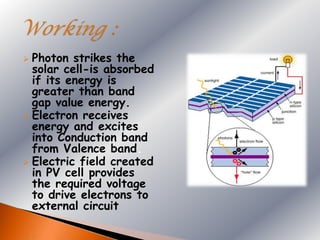
 Photon strikes the
  solar cell-is absorbed
  if its energy is
  greater than band
  gap value energy.
 Electron receives
  energy and excites
  into Conduction band
  from Valence band.
 Electric field created
  in PV cell provides
  the required voltage
  to drive electrons to
  external circuit
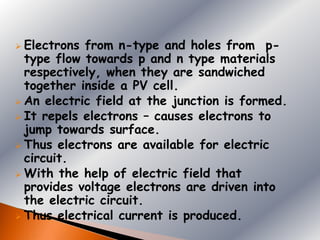
 Electrons from n-type and holes from p-
  type flow towards p and n type materials
  respectively, when they are sandwiched
  together inside a PV cell.
 An electric field at the junction is formed.
 It repels electrons – causes electrons to
  jump towards surface.
 Thus electrons are available for electric
  circuit.
 With the help of electric field that
  provides voltage electrons are driven into
  the electric circuit.
 Thus electrical current is produced.
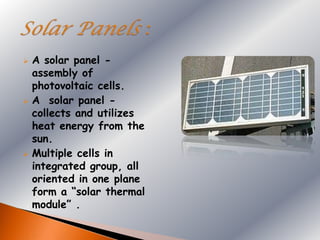
   A solar panel -
    assembly of
    photovoltaic cells.
   A solar panel -
    collects and utilizes
    heat energy from the
    sun.
   Multiple cells in
    integrated group, all
    oriented in one plane
    form a “solar thermal
    module” .
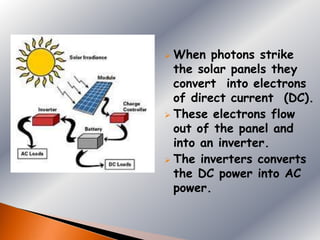
 When photons strike
  the solar panels they
  convert into electrons
  of direct current (DC).
 These electrons flow
  out of the panel and
  into an inverter.
 The inverters converts
  the DC power into AC
  power.
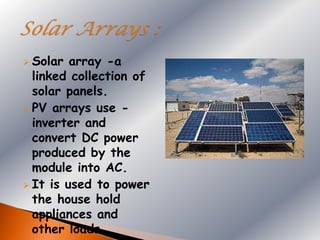
 Solar  array -a
  linked collection of
  solar panels.
 PV arrays use -
  inverter and
  convert DC power
  produced by the
  module into AC.
 It is used to power
  the house hold
  appliances and
  other loads.
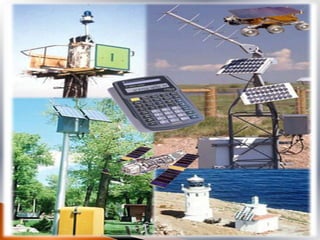
PV can be used in variety of
  applications:
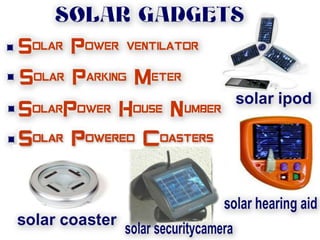
 Consumer products
 Emergency power systems
 Vaccine and blood storage
  refrigerators
 Aeration system for ponds
 Power supply for satellites and space
  vehicles
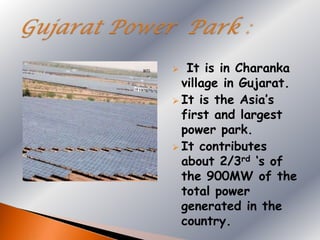
  It is in Charanka
  village in Gujarat.
 It is the Asia‟s
  first and largest
  power park.
 It contributes
  about 2/3rd „s of
  the 900MW of the
  total power
  generated in the
  country.
 Avoids  green-house gases
 Infinite free energy
 Decentralisation of power
 Saving eco-systems and livelihood
 Their life span is more
 Easy installation
It  is    extremely “expensive”
Solar    power is inefficient
Solar     panels are bulky
Need      for a large amount of
 area.
solar cells
solar cells

solar cells

  • 2.
    The energy crisisand oil embargos of the 1970’s made many nations aware of their dependency on controlled non-renewable energy sources . This formulated the scientists to search for new alternative sources of energy. Further researches into renewable sources made a path through solar power, wind power and geothermal power. Solar power generation has emerged as one of the most rapidly growing renewable sources of energy.
  • 3.
     Solar power is the conversion of sunlight into electricity .  The methods used for generating electricity through solar power are: 1. Concentrated solar power(CSP) 2. Photovoltaic method .
  • 4.
    CSP systems use mirrors or lenses to concentrate a large area of sunlight on to a small area.  Electrical power - produced when concentrated light is converted to heat- drives heat engine connected to electric power generator.
  • 5.
     TheFrench physicist -Edmond Becquerel - demonstrated photo voltaic activity.  Photovoltaics – a method of generating electrical power – converts solar radiation into direct current electricity.  This is done by using semiconductors
  • 6.
     The first solar cell was constructed by Charles Fritts.  Solar cells are devices converts “photons” of light energy directly into electricity.  They function by photovoltaic effect.
  • 7.
     Transparent Adhesive  Encapsulate  Anti-reflective Coating  N-Type Silicon  P-Type Silicon  Back Contact
  • 8.
    Silicon – Phosphorus system form a part of solar cell.  Free electrons and holes are generated on both the sides of the junction.  Current is produced due to these holes and electrons.
  • 9.
     Photon strikesthe solar cell-is absorbed if its energy is greater than band gap value energy.  Electron receives energy and excites into Conduction band from Valence band.  Electric field created in PV cell provides the required voltage to drive electrons to external circuit
  • 10.
     Electrons fromn-type and holes from p- type flow towards p and n type materials respectively, when they are sandwiched together inside a PV cell.  An electric field at the junction is formed.  It repels electrons – causes electrons to jump towards surface.  Thus electrons are available for electric circuit.  With the help of electric field that provides voltage electrons are driven into the electric circuit.  Thus electrical current is produced.
  • 12.
    A solar panel - assembly of photovoltaic cells.  A solar panel - collects and utilizes heat energy from the sun.  Multiple cells in integrated group, all oriented in one plane form a “solar thermal module” .
  • 13.
     When photonsstrike the solar panels they convert into electrons of direct current (DC).  These electrons flow out of the panel and into an inverter.  The inverters converts the DC power into AC power.
  • 14.
     Solar array -a linked collection of solar panels.  PV arrays use - inverter and convert DC power produced by the module into AC.  It is used to power the house hold appliances and other loads.
  • 15.
    PV can beused in variety of applications:  Consumer products  Emergency power systems  Vaccine and blood storage refrigerators  Aeration system for ponds  Power supply for satellites and space vehicles
  • 17.
     Itis in Charanka village in Gujarat.  It is the Asia‟s first and largest power park.  It contributes about 2/3rd „s of the 900MW of the total power generated in the country.
  • 19.
     Avoids green-house gases  Infinite free energy  Decentralisation of power  Saving eco-systems and livelihood  Their life span is more  Easy installation
  • 20.
    It is extremely “expensive” Solar power is inefficient Solar panels are bulky Need for a large amount of area.