Introduction
 An exposed ground surface that stands at an angle (b)
with the horizontal is called slope. Slopes are required in
the construction of highway and railway embankments,
earth dams, levees and canals.
 These are constructed by sloping the lateral faces of the
soil because slopes are generally less expensive than
constructing walls.
 Two Types:
 Natural slopes: Due too natural causes
 Man made slopes: Cutting and embankments
 Made slopes are used in
 Highways
 Railways
 Earth dams
 River Training works
 The slopes whether natural or artificial may be
◦ Infinite slopes
◦ Finite slopes
 Infinite slopes:
They have dimensions that extend over great distances and the soil
mass is inclined to the horizontal.
 Finite slopes:
A finite slope is one with a base and top surface, the height being
limited. The inclined faces of earth dams, embankments and
excavation and the like are all finite slopes.
Factor of safety
 Factor of safety of a slope is defined as the ratio of average
shear strength (tf ) of a soil to the average shear stress (td)
developed along the potential failure surface.
 FS = Factor of safety
 tf = average shear strength of the soil
 td = average shear stress developed along the potential surface.
Infinite Slopes
 3 cases of stability analysis of infinite slopes are considered
◦ Case (i) Cohesionless soil
◦ Case (ii) Cohesive soil
◦ Case (iii) Cohesive-frictional soil.
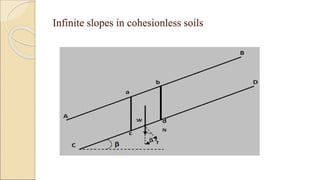
Infinite slopes in cohesionless soils
 Consider an infinite slope in a cohesionless soil inclined at an
angle to the horizontal as shown. Consider an element ‘abcd’
of the soil mass.
 Let the weight of the element be W.
 The component of W parallel to slope = T = W Sinß
 The component of W perpendicular to slope = N = W Cos ß
 The force that causes slope to slide = T = W Sin ß
 The force that restrains the sliding of the slope = s tanø= N tanø
= W Cos tanø
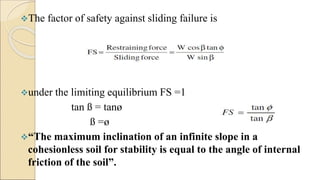
The factor of safety against sliding failure is
under the limiting equilibrium FS =1
tan ß = tanø
ß =ø
“The maximum inclination of an infinite slope in a
cohesionless soil for stability is equal to the angle of internal
friction of the soil”.
 Normal stress Vs Shear stress indicating the limiting
condition of a slope.
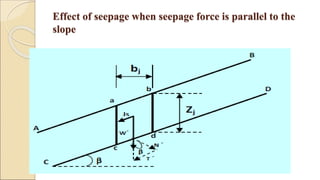
Effect of seepage when seepage force is parallel to the
slope
tan ß =1/2 tanø
“The seepage parallel to the slope reduces the limiting slope angle in
coarse grained soil by one-half of the friction angle”.
Infinite slope in pure cohesive soil
Infinite slope in cohesive frictional soil
Finite Slopes
A finite slope is one with a base and top surface, the height
being limited. The inclined faces of earth dams,
embankments, excavation and the like are all finite slopes.
Investigation of the stability of finite slopes involves the
following steps
a) assuming a possible slip surface,
b) studying the equilibrium of the forces acting on this surface,
and
c) Repeating the process until the worst slip surface, that is, the
one with minimum margin of safety is found.
Methods:-
I. Total stress analysis for purely cohesive soil.
II. Total stress analysis for cohesive –frictional (c-f) soil –
(Swedish method of slices or Method of slices)
III. Effective stress analysis for conditions of steady
seepage, rapid drawdown and immediately after
construction.
IV. Friction circle method
V. Taylor’s method.
Solutions to Slope Stability Problems
 Change alignment
 Lower grade
 Counterweight berm
 Excavate and replace weak soil
Ground Improvement
o Grouting
o Vertical Wick Drains
o Stone Columns
o Vibro Compaction
o Dynamic Compaction
o Soil Mixing
o Soil Nailing
o Reinforced Soil Slopes
o Micropiles
Ground Improvement Stone Columns
Reinforced Soil Slopes
Thank U

unit-ii-das.ppt

  • 3.
    Introduction  An exposedground surface that stands at an angle (b) with the horizontal is called slope. Slopes are required in the construction of highway and railway embankments, earth dams, levees and canals.  These are constructed by sloping the lateral faces of the soil because slopes are generally less expensive than constructing walls.
  • 4.
     Two Types: Natural slopes: Due too natural causes  Man made slopes: Cutting and embankments  Made slopes are used in  Highways  Railways  Earth dams  River Training works  The slopes whether natural or artificial may be ◦ Infinite slopes ◦ Finite slopes
  • 5.
     Infinite slopes: Theyhave dimensions that extend over great distances and the soil mass is inclined to the horizontal.  Finite slopes: A finite slope is one with a base and top surface, the height being limited. The inclined faces of earth dams, embankments and excavation and the like are all finite slopes.
  • 6.
    Factor of safety Factor of safety of a slope is defined as the ratio of average shear strength (tf ) of a soil to the average shear stress (td) developed along the potential failure surface.  FS = Factor of safety  tf = average shear strength of the soil  td = average shear stress developed along the potential surface.
  • 7.
    Infinite Slopes  3cases of stability analysis of infinite slopes are considered ◦ Case (i) Cohesionless soil ◦ Case (ii) Cohesive soil ◦ Case (iii) Cohesive-frictional soil.
  • 8.
    Infinite slopes incohesionless soils
  • 9.
     Consider aninfinite slope in a cohesionless soil inclined at an angle to the horizontal as shown. Consider an element ‘abcd’ of the soil mass.  Let the weight of the element be W.  The component of W parallel to slope = T = W Sinß  The component of W perpendicular to slope = N = W Cos ß  The force that causes slope to slide = T = W Sin ß  The force that restrains the sliding of the slope = s tanø= N tanø = W Cos tanø
  • 10.
    The factor ofsafety against sliding failure is under the limiting equilibrium FS =1 tan ß = tanø ß =ø “The maximum inclination of an infinite slope in a cohesionless soil for stability is equal to the angle of internal friction of the soil”.
  • 11.
     Normal stressVs Shear stress indicating the limiting condition of a slope.
  • 12.
    Effect of seepagewhen seepage force is parallel to the slope
  • 13.
    tan ß =1/2tanø “The seepage parallel to the slope reduces the limiting slope angle in coarse grained soil by one-half of the friction angle”.
  • 14.
    Infinite slope inpure cohesive soil
  • 16.
    Infinite slope incohesive frictional soil
  • 17.
    Finite Slopes A finiteslope is one with a base and top surface, the height being limited. The inclined faces of earth dams, embankments, excavation and the like are all finite slopes. Investigation of the stability of finite slopes involves the following steps a) assuming a possible slip surface, b) studying the equilibrium of the forces acting on this surface, and c) Repeating the process until the worst slip surface, that is, the one with minimum margin of safety is found.
  • 18.
    Methods:- I. Total stressanalysis for purely cohesive soil. II. Total stress analysis for cohesive –frictional (c-f) soil – (Swedish method of slices or Method of slices) III. Effective stress analysis for conditions of steady seepage, rapid drawdown and immediately after construction. IV. Friction circle method V. Taylor’s method.
  • 19.
    Solutions to SlopeStability Problems  Change alignment  Lower grade  Counterweight berm  Excavate and replace weak soil
  • 20.
    Ground Improvement o Grouting oVertical Wick Drains o Stone Columns o Vibro Compaction o Dynamic Compaction o Soil Mixing o Soil Nailing o Reinforced Soil Slopes o Micropiles
  • 21.
  • 22.
  • 23.