SAC 101 Fundamentals of Soil Science (2 + 1) 2006
LECTURE 24 and 25 SOIL AIR and TEMPERATURE
SOIL AIR
1. Soil air is a continuation of the atmospheric air. It is in constant motion from the soil pores
into the atmosphere and from the atmosphere into the pore space. The circulation of air in
the soil and renewal of component gases like oxygen and carbon dioxide is known as soil
aeration. Soil aeration is essential for the respiration and survival of soil organisms and
plant roots.
2. Composition of Soil Air
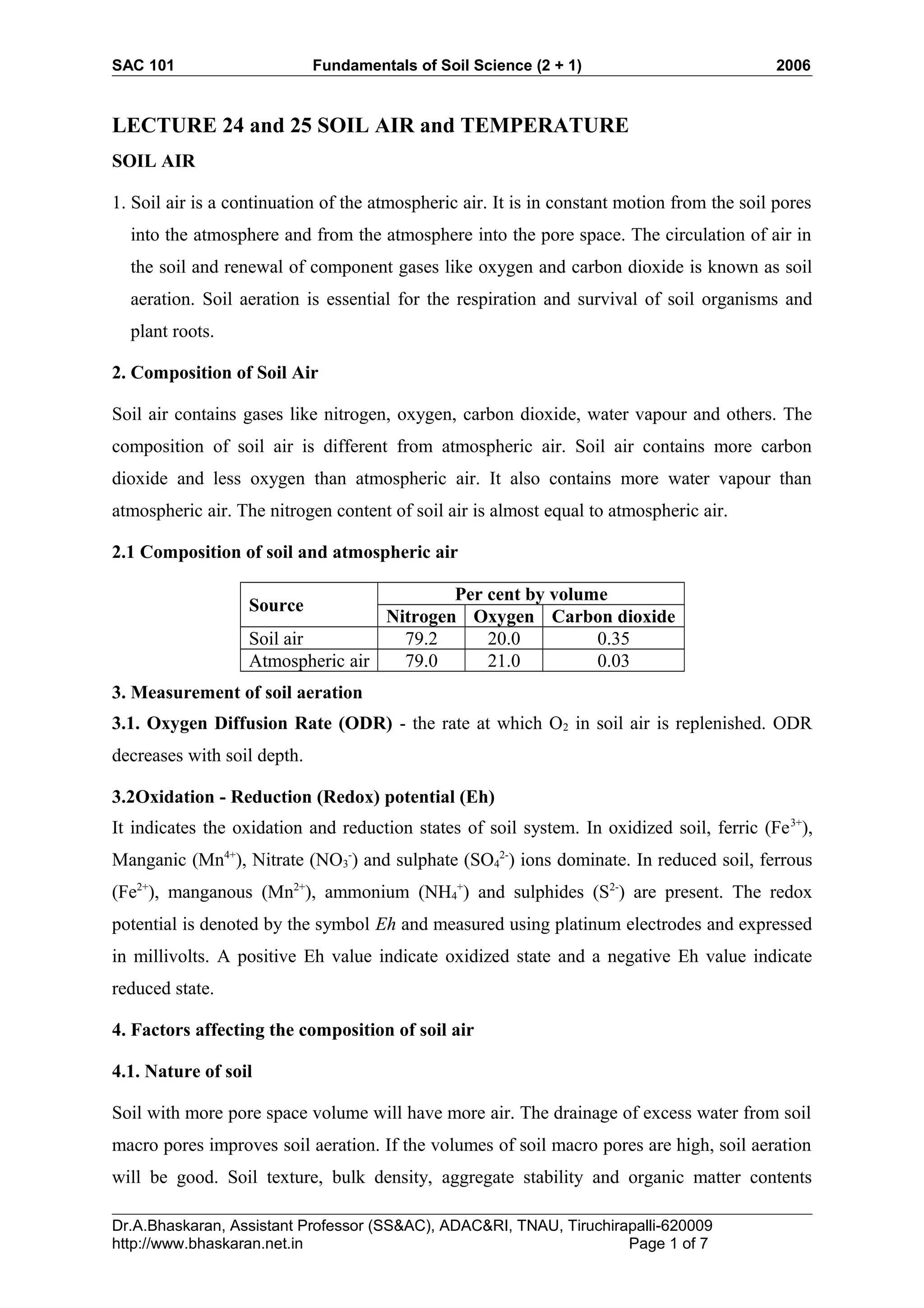
Soil air contains gases like nitrogen, oxygen, carbon dioxide, water vapour and others. The
composition of soil air is different from atmospheric air. Soil air contains more carbon
dioxide and less oxygen than atmospheric air. It also contains more water vapour than
atmospheric air. The nitrogen content of soil air is almost equal to atmospheric air.
2.1 Composition of soil and atmospheric air
Source
Per cent by volume
Nitrogen Oxygen Carbon dioxide
Soil air 79.2 20.0 0.35
Atmospheric air 79.0 21.0 0.03
3. Measurement of soil aeration
3.1. Oxygen Diffusion Rate (ODR) - the rate at which O2 in soil air is replenished. ODR
decreases with soil depth.
3.2Oxidation - Reduction (Redox) potential (Eh)
It indicates the oxidation and reduction states of soil system. In oxidized soil, ferric (Fe3+
),
Manganic (Mn4+
), Nitrate (NO3
-
) and sulphate (SO4
2-
) ions dominate. In reduced soil, ferrous
(Fe2+
), manganous (Mn2+
), ammonium (NH4
+
) and sulphides (S2-
) are present. The redox
potential is denoted by the symbol Eh and measured using platinum electrodes and expressed
in millivolts. A positive Eh value indicate oxidized state and a negative Eh value indicate
reduced state.
4. Factors affecting the composition of soil air
4.1. Nature of soil
Soil with more pore space volume will have more air. The drainage of excess water from soil
macro pores improves soil aeration. If the volumes of soil macro pores are high, soil aeration
will be good. Soil texture, bulk density, aggregate stability and organic matter contents
Dr.A.Bhaskaran, Assistant Professor (SS&AC), ADAC&RI, TNAU, Tiruchirapalli-620009
http://www.bhaskaran.net.in Page 1 of 7
SAC 101 Fundamentals of Soil Science (2 + 1) 2006
influence the soil macro pores. The quantity of oxygen in soil air is less than that in
atmospheric air. The oxygen content of the air reduces with increasing depth of soil. Surface
soil will have more oxygen than sub soil because of quick replenishment from the
atmospheric air through diffusion. Light textured soil or sandy soil contain more air than
heavy soil. The concentration of CO2 is more in subsoil due to slow rate of replenishment and
low aeration in lower layer than in the surface soil. High clay containing soils will have high
soil moisture potential - which reduces the oxygen diffusion rate and increases the CO2
accumulation.
4.2. Type of crop
Plants roots require oxygen, which they take from the soil air and deplete the concentration of
oxygen in the soil air and release CO2. Soils on which crops are grown contain more CO2
than fallow lands. The amount of CO2 is more near the plant than further away due to
respiration by roots.
4.3. Microbial activity
The microorganisms in soil require oxygen for respiration and they take it from the soil air
deplete its concentration. Decomposition of organic matter produces CO2 because of
increased microbial activity. Hence, soils rich in organic matter contain higher CO2.
4.4. Seasonal variations
The oxygen content of soil air is higher in dry season than during the monsoon. During dry
season, most of the soil pores are and the exchange of gases between soil air and atmosphere
is more. During monsoon seasons, most of the soil pores are filled with water.
Temperature also influences the gaseous composition of soil air. High temperature enhances
the gaseous exchange between soil air and atmosphere. High temperature also increases the
microbial respiration and releases more CO2 in the soil air.
5. Soil aeration problems in the field
Under field conditions, poor soil aeration occurs due to two conditions: a) when the moisture
content is too high occupying most of the pore space b) when the exchange of gases with the
atmosphere is slow. When the field is completely submerged with water, all the plants except
some plants like rice, die for want of oxygen.
Dr.A.Bhaskaran, Assistant Professor (SS&AC), ADAC&RI, TNAU, Tiruchirapalli-620009
http://www.bhaskaran.net.in Page 2 of 7
SAC 101 Fundamentals of Soil Science (2 + 1) 2006
6. Exchange of Gases between Soil and Atmosphere
The exchange of gases between soil air and atmosphere is facilitated by two mechanisms.
6.1. Mass flow
During rain fall or during irrigation, a part of the soil air is replaced by water and the replaced
air moves out into the atmosphere. When soil moisture is lost due to evaporation, plant
absorption, internal drainage etc., atmospheric air re-enters into the soil pore space. The
variations in soil temperature cause changes in the temperature of soil air. Also, when soil air
gets heated during the day, it expands and the expanded air moves out into the atmosphere.
When the soil cools during night, the soil air contracts and the atmospheric air is drawn in.
6.2. Diffusion
Most of the gaseous interchange in soils occurs by diffusion. Atmospheric and soil air
contains gases such as nitrogen, oxygen, carbon dioxide etc., each of which exerts its own
partial pressure in proportion to its concentration. These gases move from higher
concentration (higher partial pressure) to lower concentration (lower partial pressure).
Oxygen moves from the atmosphere into soil sir and CO2 moves out of soil air into the
atmosphere through diffusion without the movement of entire air mass because of the
difference in their concentration or partial pressure. This movement is called diffusion and
this will continue till equilibrium is established.
7. Importance of Soil Aeration
7.1. Soil reactions and properties
Microbial breakdown of soil organic residues is reduced under poor aeration and hence
organic matter is accumulated. In well aerated soil, aerobic microorganisms are active and
they convert simple sugars to CO2 and water using oxygen. In submerged or reduced soil,
anaerobic microorganisms are active and they convert sugars to less CO2 and more CH4
(methane) which is an atmospheric pollutant. This process also gives out some organic acid;
ethylene gas etc., which are toxic to plant roots and some microbes. The aerobic
decomposition will be faster than anaerobic decomposition.
7.2. Oxidation and reduction of inorganic elements
The oxidized state of nitrogen and sulphur are easily utilized by plants. Reduced forms of
some of the elements are toxic. Though solubility of iron and manganese increases, they
become toxic to plants.
Dr.A.Bhaskaran, Assistant Professor (SS&AC), ADAC&RI, TNAU, Tiruchirapalli-620009
http://www.bhaskaran.net.in Page 3 of 7
SAC 101 Fundamentals of Soil Science (2 + 1) 2006
Soil colour is also altered by aeration. Well aerated soils have red, yellow and reddish brown
colours. Reduced soils have grey and blue colours. The dis-colouration of soil in patches is
called mottling.
7.3. Plant and root growth
Soil aeration is important factor for normal growth of plants. Roots absorb oxygen for their
respiration and release CO2. The supply of oxygen to roots in adequate quantities and the
removal of CO2 from the soil atmosphere are very essential for healthy plant growth. When
the supply of oxygen is inadequate, the plant growth either retards or ceases completely as the
accumulated CO2 hampers the growth of plant roots. The abnormal effect of insufficient
aeration on root development is most noticeable on the root crops. Abnormally shaped roots
of these plants are common on the compact and poorly aerated soils. The penetration and
development of root are poor. Such undeveloped root system cannot absorb sufficient
moisture and nutrients from the soil.
7.4. Microorganism population and activity
The microorganisms living in the soil also require oxygen for respiration and metabolism.
Some of the important microbial activities such as the decomposition of organic matter,
nitrification, sulphur oxidation etc., depend upon oxygen present in the soil air. The
deficiency of oxygen in soil air slows down the rate of microbial activity. The decomposition
of organic matter is retarded and nitrification arrested. The microorganism population is also
drastically affected by poor aeration.
7.5. Formation of toxic material
Poor aeration results in the development of toxins and other injurious substances such as
ferrous oxide, H2S gas, CO2 gas, ethylene, organic acids, etc., in the soil.
7.6. Water and nutrient absorption
A deficiency of oxygen has been found to check the nutrient and water absorption by plants.
The energy of respiration is utilized in absorption of water and nutrients. Under poor aeration
in water logged soils, plants exhibit water and nutrient deficiency
7.7. Development of plant diseases
Insufficient aeration of soil leads to the development of some diseases like, wilt of gram and
dieback of citrus and peach.
Dr.A.Bhaskaran, Assistant Professor (SS&AC), ADAC&RI, TNAU, Tiruchirapalli-620009
http://www.bhaskaran.net.in Page 4 of 7
SAC 101 Fundamentals of Soil Science (2 + 1) 2006
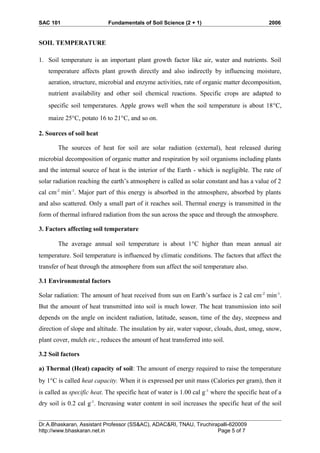
SOIL TEMPERATURE
1. Soil temperature is an important plant growth factor like air, water and nutrients. Soil
temperature affects plant growth directly and also indirectly by influencing moisture,
aeration, structure, microbial and enzyme activities, rate of organic matter decomposition,
nutrient availability and other soil chemical reactions. Specific crops are adapted to
specific soil temperatures. Apple grows well when the soil temperature is about 18°C,
maize 25°C, potato 16 to 21°C, and so on.
2. Sources of soil heat
The sources of heat for soil are solar radiation (external), heat released during
microbial decomposition of organic matter and respiration by soil organisms including plants
and the internal source of heat is the interior of the Earth - which is negligible. The rate of
solar radiation reaching the earth’s atmosphere is called as solar constant and has a value of 2
cal cm-2
min-1
. Major part of this energy is absorbed in the atmosphere, absorbed by plants
and also scattered. Only a small part of it reaches soil. Thermal energy is transmitted in the
form of thermal infrared radiation from the sun across the space and through the atmosphere.
3. Factors affecting soil temperature
The average annual soil temperature is about 1°C higher than mean annual air
temperature. Soil temperature is influenced by climatic conditions. The factors that affect the
transfer of heat through the atmosphere from sun affect the soil temperature also.
3.1 Environmental factors
Solar radiation: The amount of heat received from sun on Earth’s surface is 2 cal cm-2
min-1
.
But the amount of heat transmitted into soil is much lower. The heat transmission into soil
depends on the angle on incident radiation, latitude, season, time of the day, steepness and
direction of slope and altitude. The insulation by air, water vapour, clouds, dust, smog, snow,
plant cover, mulch etc., reduces the amount of heat transferred into soil.
3.2 Soil factors
a) Thermal (Heat) capacity of soil: The amount of energy required to raise the temperature
by 1°C is called heat capacity. When it is expressed per unit mass (Calories per gram), then it
is called as specific heat. The specific heat of water is 1.00 cal g-1
where the specific heat of a
dry soil is 0.2 cal g-1
. Increasing water content in soil increases the specific heat of the soil
Dr.A.Bhaskaran, Assistant Professor (SS&AC), ADAC&RI, TNAU, Tiruchirapalli-620009
http://www.bhaskaran.net.in Page 5 of 7
SAC 101 Fundamentals of Soil Science (2 + 1) 2006
and hence a dry soil heats up quickly than a moist soil.
b) Heat of vaporization: The evaporation of water from soil requires a large amount of
energy, 540 kilocalories kg-1
soil. Soil water utilizes the energy from solar radiation to
evaporate and thereby rendering it unavailable for heating up of soil. Also the thermal energy
from soil is utilized for the evaporation of water, thereby reducing the soil temperature. This
is the reason that surface soil temperatures will be sometimes 1 to 6°C lower than the sub-
surface soil temperature. That is why the specific heat of a wet soil is higher than dry soil.
c) Thermal conductivity and diffusivity: This refers to the movement of heat in soils. In
soil, heat is transmitted through conduction. Heat passes from soil to water about 150 times
faster than soil to air. So the movement of heat will be more in wet soil than in dry soil where
the pores will be occupied with air. Thermal conductivity of soil forming materials is 0.005
thermal conductivity units, and that of air is 0.00005 units, water 0.001 units. A dry and
loosely packed soil will conduct heat slower than a compact soil and wet soil.
d) Biological activity: Respiration by soil animals, microbes and plant roots evolve heat.
More the biological activity more will be the soil temperature.
e) Radiation from soil: Radiation from high temperature bodies (Sun) is in short waves (0.3
to 2.2 µ) and that from low temperature bodies (soil) is in long waves (6.8 to 100 µ) Longer
wavelengths have little ability to penetrate water vapour, air and glass and hence soil remains
warm during night hours, cloudy days and in glass houses.
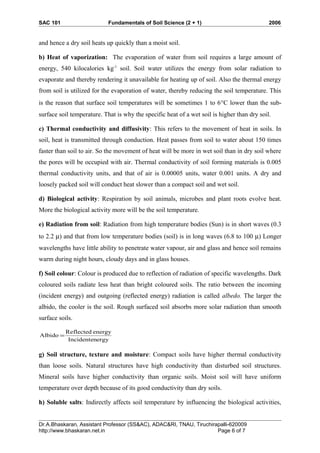
f) Soil colour: Colour is produced due to reflection of radiation of specific wavelengths. Dark
coloured soils radiate less heat than bright coloured soils. The ratio between the incoming
(incident energy) and outgoing (reflected energy) radiation is called albedo. The larger the
albido, the cooler is the soil. Rough surfaced soil absorbs more solar radiation than smooth
surface soils.
ergyIncidenten
energyReflected
Albido =
g) Soil structure, texture and moisture: Compact soils have higher thermal conductivity
than loose soils. Natural structures have high conductivity than disturbed soil structures.
Mineral soils have higher conductivity than organic soils. Moist soil will have uniform
temperature over depth because of its good conductivity than dry soils.
h) Soluble salts: Indirectly affects soil temperature by influencing the biological activities,
Dr.A.Bhaskaran, Assistant Professor (SS&AC), ADAC&RI, TNAU, Tiruchirapalli-620009
http://www.bhaskaran.net.in Page 6 of 7
SAC 101 Fundamentals of Soil Science (2 + 1) 2006
evaporation etc.
4. Effect of soil temperature on plant growth
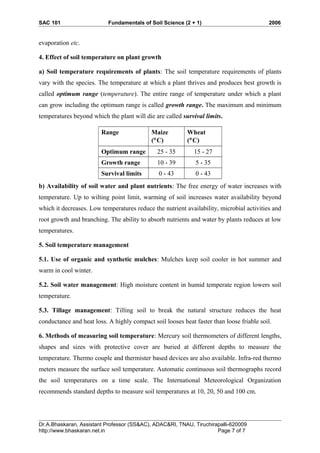
a) Soil temperature requirements of plants: The soil temperature requirements of plants
vary with the species. The temperature at which a plant thrives and produces best growth is
called optimum range (temperature). The entire range of temperature under which a plant
can grow including the optimum range is called growth range. The maximum and minimum
temperatures beyond which the plant will die are called survival limits.
Range Maize
(°C)
Wheat
(°C)
Optimum range 25 - 35 15 - 27
Growth range 10 - 39 5 - 35
Survival limits 0 - 43 0 - 43
b) Availability of soil water and plant nutrients: The free energy of water increases with
temperature. Up to wilting point limit, warming of soil increases water availability beyond
which it decreases. Low temperatures reduce the nutrient availability, microbial activities and
root growth and branching. The ability to absorb nutrients and water by plants reduces at low
temperatures.
5. Soil temperature management
5.1. Use of organic and synthetic mulches: Mulches keep soil cooler in hot summer and
warm in cool winter.
5.2. Soil water management: High moisture content in humid temperate region lowers soil
temperature.
5.3. Tillage management: Tilling soil to break the natural structure reduces the heat
conductance and heat loss. A highly compact soil looses heat faster than loose friable soil.
6. Methods of measuring soil temperature: Mercury soil thermometers of different lengths,
shapes and sizes with protective cover are buried at different depths to measure the
temperature. Thermo couple and thermister based devices are also available. Infra-red thermo
meters measure the surface soil temperature. Automatic continuous soil thermographs record
the soil temperatures on a time scale. The International Meteorological Organization
recommends standard depths to measure soil temperatures at 10, 20, 50 and 100 cm.
Dr.A.Bhaskaran, Assistant Professor (SS&AC), ADAC&RI, TNAU, Tiruchirapalli-620009
http://www.bhaskaran.net.in Page 7 of 7

Soil air and temperature

  • 1.
    SAC 101 Fundamentalsof Soil Science (2 + 1) 2006 LECTURE 24 and 25 SOIL AIR and TEMPERATURE SOIL AIR 1. Soil air is a continuation of the atmospheric air. It is in constant motion from the soil pores into the atmosphere and from the atmosphere into the pore space. The circulation of air in the soil and renewal of component gases like oxygen and carbon dioxide is known as soil aeration. Soil aeration is essential for the respiration and survival of soil organisms and plant roots. 2. Composition of Soil Air Soil air contains gases like nitrogen, oxygen, carbon dioxide, water vapour and others. The composition of soil air is different from atmospheric air. Soil air contains more carbon dioxide and less oxygen than atmospheric air. It also contains more water vapour than atmospheric air. The nitrogen content of soil air is almost equal to atmospheric air. 2.1 Composition of soil and atmospheric air Source Per cent by volume Nitrogen Oxygen Carbon dioxide Soil air 79.2 20.0 0.35 Atmospheric air 79.0 21.0 0.03 3. Measurement of soil aeration 3.1. Oxygen Diffusion Rate (ODR) - the rate at which O2 in soil air is replenished. ODR decreases with soil depth. 3.2Oxidation - Reduction (Redox) potential (Eh) It indicates the oxidation and reduction states of soil system. In oxidized soil, ferric (Fe3+ ), Manganic (Mn4+ ), Nitrate (NO3 - ) and sulphate (SO4 2- ) ions dominate. In reduced soil, ferrous (Fe2+ ), manganous (Mn2+ ), ammonium (NH4 + ) and sulphides (S2- ) are present. The redox potential is denoted by the symbol Eh and measured using platinum electrodes and expressed in millivolts. A positive Eh value indicate oxidized state and a negative Eh value indicate reduced state. 4. Factors affecting the composition of soil air 4.1. Nature of soil Soil with more pore space volume will have more air. The drainage of excess water from soil macro pores improves soil aeration. If the volumes of soil macro pores are high, soil aeration will be good. Soil texture, bulk density, aggregate stability and organic matter contents Dr.A.Bhaskaran, Assistant Professor (SS&AC), ADAC&RI, TNAU, Tiruchirapalli-620009 http://www.bhaskaran.net.in Page 1 of 7
  • 2.
    SAC 101 Fundamentalsof Soil Science (2 + 1) 2006 influence the soil macro pores. The quantity of oxygen in soil air is less than that in atmospheric air. The oxygen content of the air reduces with increasing depth of soil. Surface soil will have more oxygen than sub soil because of quick replenishment from the atmospheric air through diffusion. Light textured soil or sandy soil contain more air than heavy soil. The concentration of CO2 is more in subsoil due to slow rate of replenishment and low aeration in lower layer than in the surface soil. High clay containing soils will have high soil moisture potential - which reduces the oxygen diffusion rate and increases the CO2 accumulation. 4.2. Type of crop Plants roots require oxygen, which they take from the soil air and deplete the concentration of oxygen in the soil air and release CO2. Soils on which crops are grown contain more CO2 than fallow lands. The amount of CO2 is more near the plant than further away due to respiration by roots. 4.3. Microbial activity The microorganisms in soil require oxygen for respiration and they take it from the soil air deplete its concentration. Decomposition of organic matter produces CO2 because of increased microbial activity. Hence, soils rich in organic matter contain higher CO2. 4.4. Seasonal variations The oxygen content of soil air is higher in dry season than during the monsoon. During dry season, most of the soil pores are and the exchange of gases between soil air and atmosphere is more. During monsoon seasons, most of the soil pores are filled with water. Temperature also influences the gaseous composition of soil air. High temperature enhances the gaseous exchange between soil air and atmosphere. High temperature also increases the microbial respiration and releases more CO2 in the soil air. 5. Soil aeration problems in the field Under field conditions, poor soil aeration occurs due to two conditions: a) when the moisture content is too high occupying most of the pore space b) when the exchange of gases with the atmosphere is slow. When the field is completely submerged with water, all the plants except some plants like rice, die for want of oxygen. Dr.A.Bhaskaran, Assistant Professor (SS&AC), ADAC&RI, TNAU, Tiruchirapalli-620009 http://www.bhaskaran.net.in Page 2 of 7
  • 3.
    SAC 101 Fundamentalsof Soil Science (2 + 1) 2006 6. Exchange of Gases between Soil and Atmosphere The exchange of gases between soil air and atmosphere is facilitated by two mechanisms. 6.1. Mass flow During rain fall or during irrigation, a part of the soil air is replaced by water and the replaced air moves out into the atmosphere. When soil moisture is lost due to evaporation, plant absorption, internal drainage etc., atmospheric air re-enters into the soil pore space. The variations in soil temperature cause changes in the temperature of soil air. Also, when soil air gets heated during the day, it expands and the expanded air moves out into the atmosphere. When the soil cools during night, the soil air contracts and the atmospheric air is drawn in. 6.2. Diffusion Most of the gaseous interchange in soils occurs by diffusion. Atmospheric and soil air contains gases such as nitrogen, oxygen, carbon dioxide etc., each of which exerts its own partial pressure in proportion to its concentration. These gases move from higher concentration (higher partial pressure) to lower concentration (lower partial pressure). Oxygen moves from the atmosphere into soil sir and CO2 moves out of soil air into the atmosphere through diffusion without the movement of entire air mass because of the difference in their concentration or partial pressure. This movement is called diffusion and this will continue till equilibrium is established. 7. Importance of Soil Aeration 7.1. Soil reactions and properties Microbial breakdown of soil organic residues is reduced under poor aeration and hence organic matter is accumulated. In well aerated soil, aerobic microorganisms are active and they convert simple sugars to CO2 and water using oxygen. In submerged or reduced soil, anaerobic microorganisms are active and they convert sugars to less CO2 and more CH4 (methane) which is an atmospheric pollutant. This process also gives out some organic acid; ethylene gas etc., which are toxic to plant roots and some microbes. The aerobic decomposition will be faster than anaerobic decomposition. 7.2. Oxidation and reduction of inorganic elements The oxidized state of nitrogen and sulphur are easily utilized by plants. Reduced forms of some of the elements are toxic. Though solubility of iron and manganese increases, they become toxic to plants. Dr.A.Bhaskaran, Assistant Professor (SS&AC), ADAC&RI, TNAU, Tiruchirapalli-620009 http://www.bhaskaran.net.in Page 3 of 7
  • 4.
    SAC 101 Fundamentalsof Soil Science (2 + 1) 2006 Soil colour is also altered by aeration. Well aerated soils have red, yellow and reddish brown colours. Reduced soils have grey and blue colours. The dis-colouration of soil in patches is called mottling. 7.3. Plant and root growth Soil aeration is important factor for normal growth of plants. Roots absorb oxygen for their respiration and release CO2. The supply of oxygen to roots in adequate quantities and the removal of CO2 from the soil atmosphere are very essential for healthy plant growth. When the supply of oxygen is inadequate, the plant growth either retards or ceases completely as the accumulated CO2 hampers the growth of plant roots. The abnormal effect of insufficient aeration on root development is most noticeable on the root crops. Abnormally shaped roots of these plants are common on the compact and poorly aerated soils. The penetration and development of root are poor. Such undeveloped root system cannot absorb sufficient moisture and nutrients from the soil. 7.4. Microorganism population and activity The microorganisms living in the soil also require oxygen for respiration and metabolism. Some of the important microbial activities such as the decomposition of organic matter, nitrification, sulphur oxidation etc., depend upon oxygen present in the soil air. The deficiency of oxygen in soil air slows down the rate of microbial activity. The decomposition of organic matter is retarded and nitrification arrested. The microorganism population is also drastically affected by poor aeration. 7.5. Formation of toxic material Poor aeration results in the development of toxins and other injurious substances such as ferrous oxide, H2S gas, CO2 gas, ethylene, organic acids, etc., in the soil. 7.6. Water and nutrient absorption A deficiency of oxygen has been found to check the nutrient and water absorption by plants. The energy of respiration is utilized in absorption of water and nutrients. Under poor aeration in water logged soils, plants exhibit water and nutrient deficiency 7.7. Development of plant diseases Insufficient aeration of soil leads to the development of some diseases like, wilt of gram and dieback of citrus and peach. Dr.A.Bhaskaran, Assistant Professor (SS&AC), ADAC&RI, TNAU, Tiruchirapalli-620009 http://www.bhaskaran.net.in Page 4 of 7
  • 5.
    SAC 101 Fundamentalsof Soil Science (2 + 1) 2006 SOIL TEMPERATURE 1. Soil temperature is an important plant growth factor like air, water and nutrients. Soil temperature affects plant growth directly and also indirectly by influencing moisture, aeration, structure, microbial and enzyme activities, rate of organic matter decomposition, nutrient availability and other soil chemical reactions. Specific crops are adapted to specific soil temperatures. Apple grows well when the soil temperature is about 18°C, maize 25°C, potato 16 to 21°C, and so on. 2. Sources of soil heat The sources of heat for soil are solar radiation (external), heat released during microbial decomposition of organic matter and respiration by soil organisms including plants and the internal source of heat is the interior of the Earth - which is negligible. The rate of solar radiation reaching the earth’s atmosphere is called as solar constant and has a value of 2 cal cm-2 min-1 . Major part of this energy is absorbed in the atmosphere, absorbed by plants and also scattered. Only a small part of it reaches soil. Thermal energy is transmitted in the form of thermal infrared radiation from the sun across the space and through the atmosphere. 3. Factors affecting soil temperature The average annual soil temperature is about 1°C higher than mean annual air temperature. Soil temperature is influenced by climatic conditions. The factors that affect the transfer of heat through the atmosphere from sun affect the soil temperature also. 3.1 Environmental factors Solar radiation: The amount of heat received from sun on Earth’s surface is 2 cal cm-2 min-1 . But the amount of heat transmitted into soil is much lower. The heat transmission into soil depends on the angle on incident radiation, latitude, season, time of the day, steepness and direction of slope and altitude. The insulation by air, water vapour, clouds, dust, smog, snow, plant cover, mulch etc., reduces the amount of heat transferred into soil. 3.2 Soil factors a) Thermal (Heat) capacity of soil: The amount of energy required to raise the temperature by 1°C is called heat capacity. When it is expressed per unit mass (Calories per gram), then it is called as specific heat. The specific heat of water is 1.00 cal g-1 where the specific heat of a dry soil is 0.2 cal g-1 . Increasing water content in soil increases the specific heat of the soil Dr.A.Bhaskaran, Assistant Professor (SS&AC), ADAC&RI, TNAU, Tiruchirapalli-620009 http://www.bhaskaran.net.in Page 5 of 7
  • 6.
    SAC 101 Fundamentalsof Soil Science (2 + 1) 2006 and hence a dry soil heats up quickly than a moist soil. b) Heat of vaporization: The evaporation of water from soil requires a large amount of energy, 540 kilocalories kg-1 soil. Soil water utilizes the energy from solar radiation to evaporate and thereby rendering it unavailable for heating up of soil. Also the thermal energy from soil is utilized for the evaporation of water, thereby reducing the soil temperature. This is the reason that surface soil temperatures will be sometimes 1 to 6°C lower than the sub- surface soil temperature. That is why the specific heat of a wet soil is higher than dry soil. c) Thermal conductivity and diffusivity: This refers to the movement of heat in soils. In soil, heat is transmitted through conduction. Heat passes from soil to water about 150 times faster than soil to air. So the movement of heat will be more in wet soil than in dry soil where the pores will be occupied with air. Thermal conductivity of soil forming materials is 0.005 thermal conductivity units, and that of air is 0.00005 units, water 0.001 units. A dry and loosely packed soil will conduct heat slower than a compact soil and wet soil. d) Biological activity: Respiration by soil animals, microbes and plant roots evolve heat. More the biological activity more will be the soil temperature. e) Radiation from soil: Radiation from high temperature bodies (Sun) is in short waves (0.3 to 2.2 µ) and that from low temperature bodies (soil) is in long waves (6.8 to 100 µ) Longer wavelengths have little ability to penetrate water vapour, air and glass and hence soil remains warm during night hours, cloudy days and in glass houses. f) Soil colour: Colour is produced due to reflection of radiation of specific wavelengths. Dark coloured soils radiate less heat than bright coloured soils. The ratio between the incoming (incident energy) and outgoing (reflected energy) radiation is called albedo. The larger the albido, the cooler is the soil. Rough surfaced soil absorbs more solar radiation than smooth surface soils. ergyIncidenten energyReflected Albido = g) Soil structure, texture and moisture: Compact soils have higher thermal conductivity than loose soils. Natural structures have high conductivity than disturbed soil structures. Mineral soils have higher conductivity than organic soils. Moist soil will have uniform temperature over depth because of its good conductivity than dry soils. h) Soluble salts: Indirectly affects soil temperature by influencing the biological activities, Dr.A.Bhaskaran, Assistant Professor (SS&AC), ADAC&RI, TNAU, Tiruchirapalli-620009 http://www.bhaskaran.net.in Page 6 of 7
  • 7.
    SAC 101 Fundamentalsof Soil Science (2 + 1) 2006 evaporation etc. 4. Effect of soil temperature on plant growth a) Soil temperature requirements of plants: The soil temperature requirements of plants vary with the species. The temperature at which a plant thrives and produces best growth is called optimum range (temperature). The entire range of temperature under which a plant can grow including the optimum range is called growth range. The maximum and minimum temperatures beyond which the plant will die are called survival limits. Range Maize (°C) Wheat (°C) Optimum range 25 - 35 15 - 27 Growth range 10 - 39 5 - 35 Survival limits 0 - 43 0 - 43 b) Availability of soil water and plant nutrients: The free energy of water increases with temperature. Up to wilting point limit, warming of soil increases water availability beyond which it decreases. Low temperatures reduce the nutrient availability, microbial activities and root growth and branching. The ability to absorb nutrients and water by plants reduces at low temperatures. 5. Soil temperature management 5.1. Use of organic and synthetic mulches: Mulches keep soil cooler in hot summer and warm in cool winter. 5.2. Soil water management: High moisture content in humid temperate region lowers soil temperature. 5.3. Tillage management: Tilling soil to break the natural structure reduces the heat conductance and heat loss. A highly compact soil looses heat faster than loose friable soil. 6. Methods of measuring soil temperature: Mercury soil thermometers of different lengths, shapes and sizes with protective cover are buried at different depths to measure the temperature. Thermo couple and thermister based devices are also available. Infra-red thermo meters measure the surface soil temperature. Automatic continuous soil thermographs record the soil temperatures on a time scale. The International Meteorological Organization recommends standard depths to measure soil temperatures at 10, 20, 50 and 100 cm. Dr.A.Bhaskaran, Assistant Professor (SS&AC), ADAC&RI, TNAU, Tiruchirapalli-620009 http://www.bhaskaran.net.in Page 7 of 7