Rain Water Harvesting
Prepared by: Dr. Pooja Goswami
Assistant Professor (Agronomy)
College of Agriculture, Balaghat
Rain Water Harvesting
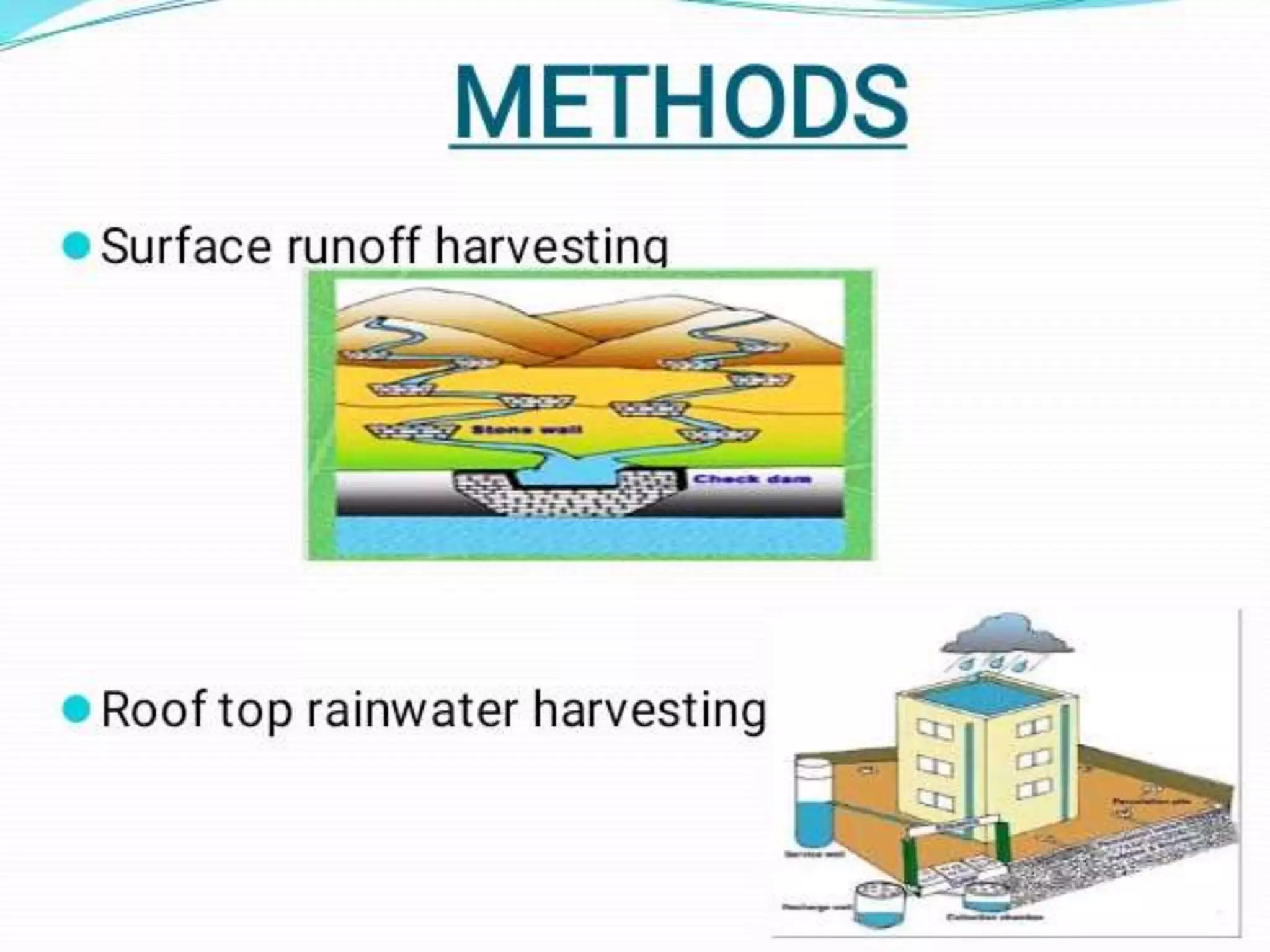
There are two main techniques of rain water harvestings.
1. Storage of rainwater on surface for future use.
2 Recharge to ground water.
The storage of rain water on surface is a traditional
techniques and structures used were underground
a. Tanks
b. Ponds
c. Check
d. dams,
e. Weirs
Advantages of groundwater recharge
There is more ground water than surface
water. Ground water is less expensive and
economic resource.
Ground water is sustainable and reliable
source of water supply. It is relatively less
vulnerable to pollution
Ground water is usually of high
bacteriological purity. It is free of pathogenic
organisms.
Continued..
Ground water is usually universally available.
It has no turbidity and colour.
Ground water has distinct health advantage as
art alternative for lower sanitary quality surface
water.
Ground water resource can be instantly
developed and used. There is no conveyance
losses in ground water based supplies.
Ground water has low vulnerability to drought.
It is key to life in arid and semi-arid regions..
Recharge to ground water is a
new concept of rain water
harvesting and the structures
generally used are :-
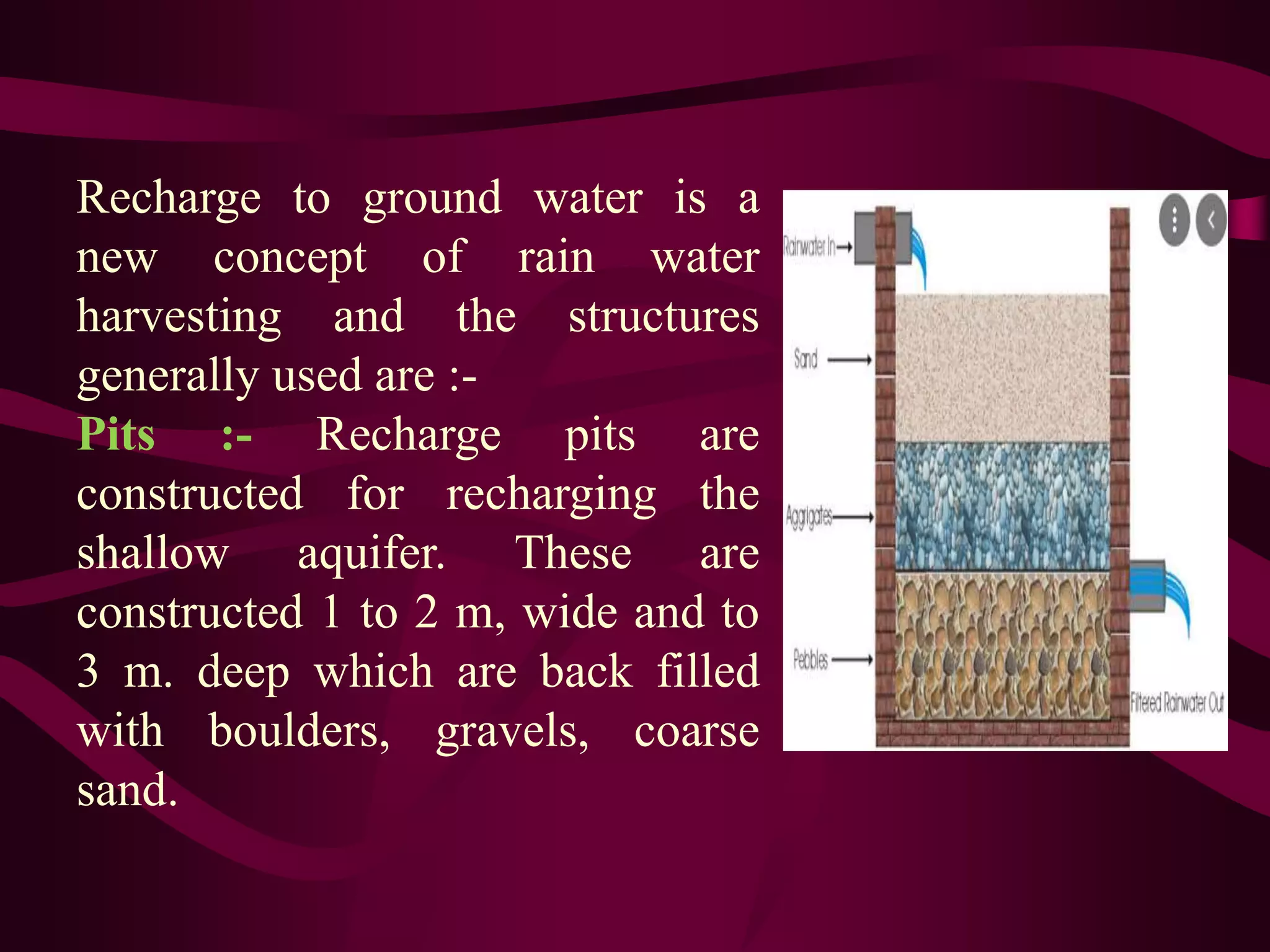
Pits :- Recharge pits are
constructed for recharging the
shallow aquifer. These are
constructed 1 to 2 m, wide and to
3 m. deep which are back filled
with boulders, gravels, coarse
sand.
Important Points
1). Width of pit: 1.2 to 1.5 m.
Depth: 2.5 to 3.0 m.
2). Material: 40-60 mm coarse
gravel followed by 20 mm
aggregates and 2 mm sand. Pits are
conveniently made at suitable low-
level micro-watershed locations as
collection centers of surface runoff.
3). A splash pad is provided on top
of the sand layer to cut off the
velocity of entry of water to the pit.
4). The number of such pits is
based on the park area and the
small rivulets dissecting the
landscapes into micro-watersheds.
Trenches:- These are constructed when the permeable stram is
available at shallow depth. Trench may be 0.5 to 1 m. wide, 1 to
1.5m. deep and 10 to 20 m. long depending up availability of
water. These are back filled with filter materials.
Dug wells:- Existing dug wells may be utilised as recharge
structure and water should pass through filter media before
putting into dug well.
Hand pumps :- The existing hand pumps may be
used for recharging the shallow/deep aquifers, if
the availability of water is limited. Water should
pass through filter media before diverting it into
hand pumps.
Recharge wells :- Recharge wells of 100 to 300
mm. diameter are generally constructed for
recharging the deeper aquifers and water is passed
through filter media to avoid choking of recharge
wells.
Recharge Shafts :- For recharging the shallow aquifer
which are located below clayey surface, recharge
shafts of 0.5 to 3 m. diameter and 10 to 15 m. deep are
constructed and back filled with boulders, gravels &
coarse sand.
Lateral shafts with bore wells :- For recharging the
upper as well as deeper aquifers lateral shafts of 1.5 to
2 m. wide & 10 to 30 m. long depending upon
availability of water with one or two bore wells are
constructed. The lateral shafts is back filled with
boulders, gravels & coarse sand.
When permeable strata starts from top then
this technique is used. Spread the water in
streams by making check dams, bunds,
cement plugs, gabion structures or a
percolation pond may be constructed.
Spreading techniques:-
Rain water harvesting system-
The typical roof top rain water harvesting system
comprises of :
Roof catchment
Gutters
Down pipe & first flushing pipe
Filter Unit
Storage Tank
Roof Water Harvesting
Roof Catchment
The roof of the house is used as the catchment
for collecting rain water.
The style construction and material of the roof
effect its suitability as a catchment, Roofs made
of corrugated iron sheet , asbestos sheet,Tiles or
Concrete can be utilized for harvesting the rain
water.
Gutters
Gutters are channels fixed to the edges of
roof all around to collect & transport the
rainwater from the roof.
Gutters can be made in semi-circular and
rectangular shape with cement pipe, plain
galvanized iron sheet, PVC pipes, bamboos
etc.
Use of locally available material reduce the
overall cost of the system.
Down Pipe
It is the pipe which carries the rainwater
from the gutters to the filter & storage
tank. Down pipe is joined with the gutters
at one end & the other end is connected to
the filter unit of the storage tank. PVC or
GI pipe of 50mm to 75mm (2 to”) are
commonly used for down pipe. Bamboo
can be also used wherever available and
possible
First Flush Pipe
Debris, dust & dirt collect on the roof during
non rainy periods when the first rain arrive.
A first flush system arrangement is made to
avoid the entering unwanted material into the
Filter media & storage tank.
This is a simple manually operated
arrangement or semi-automatic system with a
valve below the ‘T’ junction
Filter Unit
The filter unit is a container or chamber
filled with filter media such as coarse sand,
charcoal, coconut fiber, pebbles & gravels to
remove the debris & dirt from water that
enters the tank.
The filter unit is placed over the storage
tank or separately. It may be of Ferro cement
filter unit, Aluminum, Cement rings or
Plastic bucket etc
Storage Tank
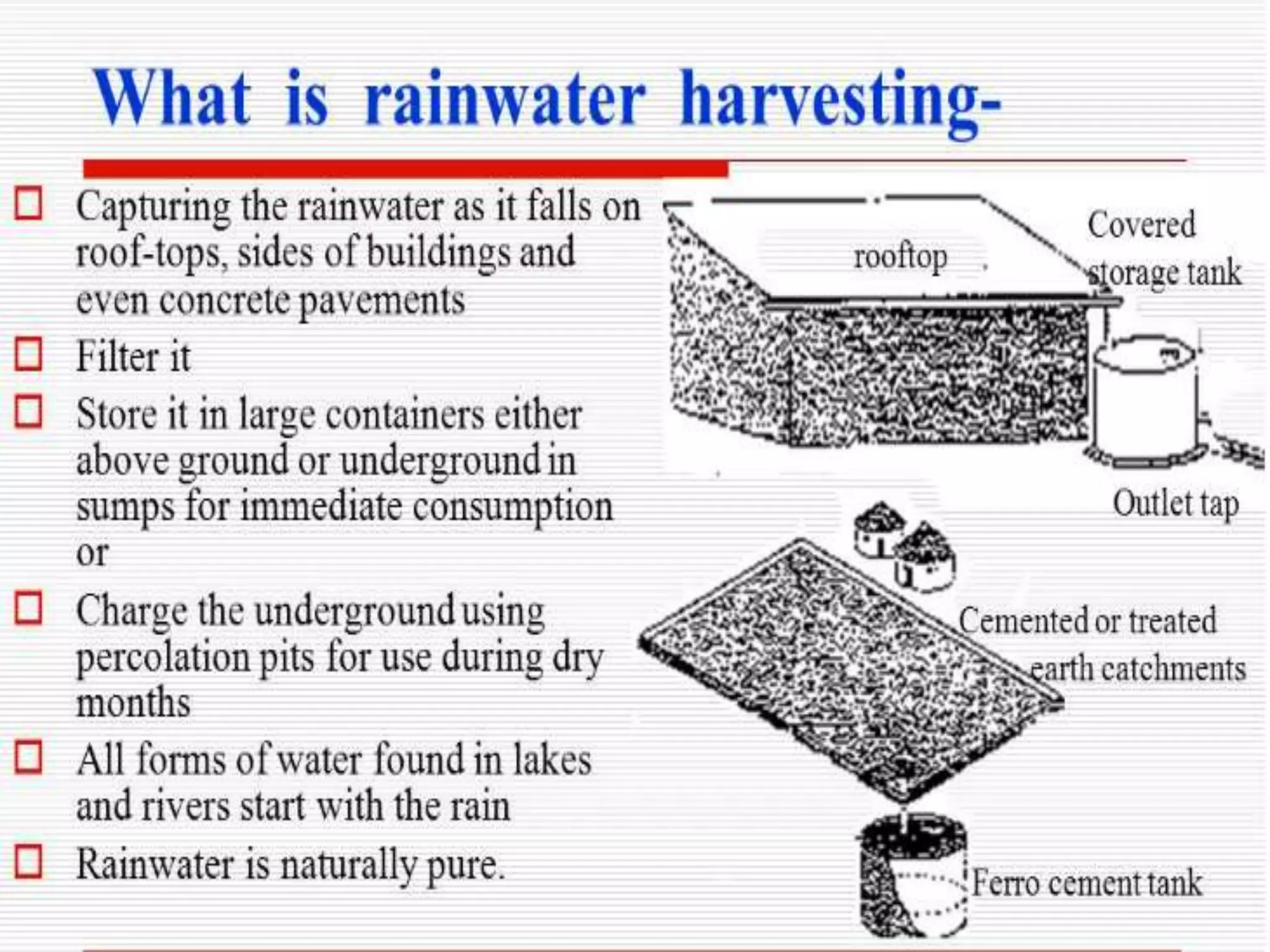
It is used to store the water that is collected from the roof
through filter. For small scale water storage plastic buckets, jerry
cans, clay or cement jars, ceramic jars, drums may be used. For
larger quantities of water, the system will require a bigger tank
with cylindrical or rectangular or square in shape constructed
with Ferro cement or cement rings or plain cement concrete or
reinforced cement concrete or brick or stone etc.
The storage tank is provided with a cover on the top to avoid
the contamination of water from external sources. The storage
tank is provided with pipe fixtures at appropriate places to draw
the water to clean the tank & to dispose of extra water. A
provision for keeping the vessel to collect. the water is to be
made.
Size of Storage Tank Based on:
No. of person in the House hold
Per capita water requirement
No. of days for which water is required
Water available from Roof
Annual rainfall (in mm) x roof area (in sq.
m) x co-efficient of run off for roof
co-efficient of run off
Rain water is the ultimate source of fresh
water.
Potential of rain to meet water demand is
tremendous.
Rain water harvesting helps to overcome
water scarcity
To conserve ground water the aquifers must
be recharged with rain water
Rain water harvesting is the ultimate
answer
Advantages of Rainwater harvesting

Rain water harvesting

  • 1.
    Rain Water Harvesting Preparedby: Dr. Pooja Goswami Assistant Professor (Agronomy) College of Agriculture, Balaghat
  • 7.
  • 8.
    There are twomain techniques of rain water harvestings. 1. Storage of rainwater on surface for future use. 2 Recharge to ground water. The storage of rain water on surface is a traditional techniques and structures used were underground a. Tanks b. Ponds c. Check d. dams, e. Weirs
  • 9.
    Advantages of groundwaterrecharge There is more ground water than surface water. Ground water is less expensive and economic resource. Ground water is sustainable and reliable source of water supply. It is relatively less vulnerable to pollution Ground water is usually of high bacteriological purity. It is free of pathogenic organisms.
  • 10.
    Continued.. Ground water isusually universally available. It has no turbidity and colour. Ground water has distinct health advantage as art alternative for lower sanitary quality surface water. Ground water resource can be instantly developed and used. There is no conveyance losses in ground water based supplies. Ground water has low vulnerability to drought. It is key to life in arid and semi-arid regions..
  • 11.
    Recharge to groundwater is a new concept of rain water harvesting and the structures generally used are :- Pits :- Recharge pits are constructed for recharging the shallow aquifer. These are constructed 1 to 2 m, wide and to 3 m. deep which are back filled with boulders, gravels, coarse sand.
  • 13.
    Important Points 1). Widthof pit: 1.2 to 1.5 m. Depth: 2.5 to 3.0 m. 2). Material: 40-60 mm coarse gravel followed by 20 mm aggregates and 2 mm sand. Pits are conveniently made at suitable low- level micro-watershed locations as collection centers of surface runoff. 3). A splash pad is provided on top of the sand layer to cut off the velocity of entry of water to the pit. 4). The number of such pits is based on the park area and the small rivulets dissecting the landscapes into micro-watersheds.
  • 14.
    Trenches:- These areconstructed when the permeable stram is available at shallow depth. Trench may be 0.5 to 1 m. wide, 1 to 1.5m. deep and 10 to 20 m. long depending up availability of water. These are back filled with filter materials. Dug wells:- Existing dug wells may be utilised as recharge structure and water should pass through filter media before putting into dug well.
  • 15.
    Hand pumps :-The existing hand pumps may be used for recharging the shallow/deep aquifers, if the availability of water is limited. Water should pass through filter media before diverting it into hand pumps. Recharge wells :- Recharge wells of 100 to 300 mm. diameter are generally constructed for recharging the deeper aquifers and water is passed through filter media to avoid choking of recharge wells.
  • 16.
    Recharge Shafts :-For recharging the shallow aquifer which are located below clayey surface, recharge shafts of 0.5 to 3 m. diameter and 10 to 15 m. deep are constructed and back filled with boulders, gravels & coarse sand. Lateral shafts with bore wells :- For recharging the upper as well as deeper aquifers lateral shafts of 1.5 to 2 m. wide & 10 to 30 m. long depending upon availability of water with one or two bore wells are constructed. The lateral shafts is back filled with boulders, gravels & coarse sand.
  • 17.
    When permeable stratastarts from top then this technique is used. Spread the water in streams by making check dams, bunds, cement plugs, gabion structures or a percolation pond may be constructed. Spreading techniques:-
  • 18.
    Rain water harvestingsystem- The typical roof top rain water harvesting system comprises of : Roof catchment Gutters Down pipe & first flushing pipe Filter Unit Storage Tank Roof Water Harvesting
  • 19.
    Roof Catchment The roofof the house is used as the catchment for collecting rain water. The style construction and material of the roof effect its suitability as a catchment, Roofs made of corrugated iron sheet , asbestos sheet,Tiles or Concrete can be utilized for harvesting the rain water.
  • 20.
    Gutters Gutters are channelsfixed to the edges of roof all around to collect & transport the rainwater from the roof. Gutters can be made in semi-circular and rectangular shape with cement pipe, plain galvanized iron sheet, PVC pipes, bamboos etc. Use of locally available material reduce the overall cost of the system.
  • 21.
    Down Pipe It isthe pipe which carries the rainwater from the gutters to the filter & storage tank. Down pipe is joined with the gutters at one end & the other end is connected to the filter unit of the storage tank. PVC or GI pipe of 50mm to 75mm (2 to”) are commonly used for down pipe. Bamboo can be also used wherever available and possible
  • 22.
    First Flush Pipe Debris,dust & dirt collect on the roof during non rainy periods when the first rain arrive. A first flush system arrangement is made to avoid the entering unwanted material into the Filter media & storage tank. This is a simple manually operated arrangement or semi-automatic system with a valve below the ‘T’ junction
  • 23.
    Filter Unit The filterunit is a container or chamber filled with filter media such as coarse sand, charcoal, coconut fiber, pebbles & gravels to remove the debris & dirt from water that enters the tank. The filter unit is placed over the storage tank or separately. It may be of Ferro cement filter unit, Aluminum, Cement rings or Plastic bucket etc
  • 24.
    Storage Tank It isused to store the water that is collected from the roof through filter. For small scale water storage plastic buckets, jerry cans, clay or cement jars, ceramic jars, drums may be used. For larger quantities of water, the system will require a bigger tank with cylindrical or rectangular or square in shape constructed with Ferro cement or cement rings or plain cement concrete or reinforced cement concrete or brick or stone etc. The storage tank is provided with a cover on the top to avoid the contamination of water from external sources. The storage tank is provided with pipe fixtures at appropriate places to draw the water to clean the tank & to dispose of extra water. A provision for keeping the vessel to collect. the water is to be made.
  • 25.
    Size of StorageTank Based on: No. of person in the House hold Per capita water requirement No. of days for which water is required
  • 26.
    Water available fromRoof Annual rainfall (in mm) x roof area (in sq. m) x co-efficient of run off for roof co-efficient of run off
  • 27.
    Rain water isthe ultimate source of fresh water. Potential of rain to meet water demand is tremendous. Rain water harvesting helps to overcome water scarcity To conserve ground water the aquifers must be recharged with rain water Rain water harvesting is the ultimate answer Advantages of Rainwater harvesting