
Soft Tissue
Calcification in the
Neck
Judy H. Oh, D.D.S.
UCLA School of Dentistry, 1992
Preceptorship in Oral & Maxillofacial Radiology, Rutgers School of Dental Medicine, 2016
3D Oral & Maxillofacial Imaging Center, North Bethesda, MD
3DOMI.net
Types of Calcification in the Neck
1. Carotid Artery Calcification CAC 0.1 ~ 37%
2. Calcified Stylohyoid Chain CSC 1.4 ~ 30%
3. Calcified Triticeous Cartilage CTC 5 ~ 29%
4. Calcified Tonsils CT 16%
5. Calcified Superior Cornu of Thyroid Cartilage CSCT
6. Sialolith
7. Calcification of Lymph Nodes
8. Phlebolith(calcified vascular thrombus)
9. Intradermal Calcifications
10. Cutaneous Ossifications
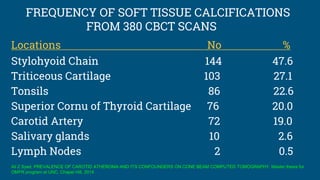
FREQUENCY OF SOFT TISSUE CALCIFICATIONS
FROM 380 CBCT SCANS
Locations No %
Stylohyoid Chain 144 47.6
Triticeous Cartilage 103 27.1
Tonsils 86 22.6
Superior Cornu of Thyroid Cartilage 76 20.0
Carotid Artery 72 19.0
Salivary glands 10 2.6
Lymph Nodes 2 0.5
Ali Z Syed, PREVALENCE OF CAROTID ATHEROMA AND ITS CONFOUNDERS ON CONE BEAM COMPUTED TOMOGRAPHY, Master thesis for
OMFR program at UNC, Chapel Hill, 2014
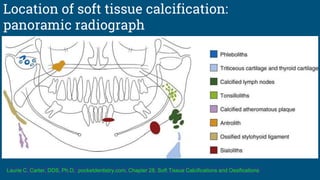
Location of soft tissue calcification:
panoramic radiograph
Laurie C. Carter, DDS, Ph.D, pocketdentistry.com, Chapter 28, Soft Tissue Calcifications and Ossifications
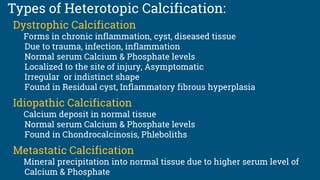
Types of Heterotopic Calcification:
Dystrophic Calcification
Forms in chronic inflammation, cyst, diseased tissue
Due to trauma, infection, inflammation
Normal serum Calcium & Phosphate levels
Localized to the site of injury, Asymptomatic
Irregular or indistinct shape
Found in Residual cyst, Inflammatory fibrous hyperplasia
Idiopathic Calcification
Calcium deposit in normal tissue
Normal serum Calcium & Phosphate levels
Found in Chondrocalcinosis, Phleboliths
Metastatic Calcification
Mineral precipitation into normal tissue due to higher serum level of
Calcium & Phosphate
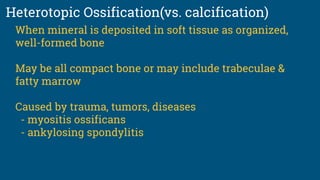
Heterotopic Ossification(vs. calcification)
When mineral is deposited in soft tissue as organized,
well-formed bone
May be all compact bone or may include trabeculae &
fatty marrow
Caused by trauma, tumors, diseases
- myositis ossificans
- ankylosing spondylitis
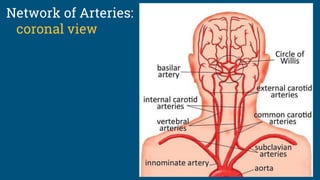
Network of Arteries:
coronal view
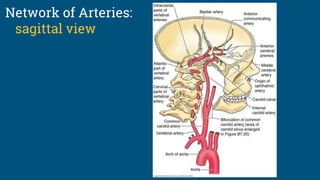
Network of Arteries:
sagittal view
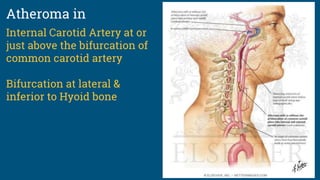
Atheroma in
Internal Carotid Artery at or
just above the bifurcation of
common carotid artery
Bifurcation at lateral &
inferior to Hyoid bone
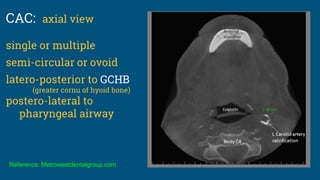
Reference: Metrowestdentalgroup.com
CAC: axial view
single or multiple
semi-circular or ovoid
latero-posterior to GCHB
(greater cornu of hyoid bone)
postero-lateral to
pharyngeal airway
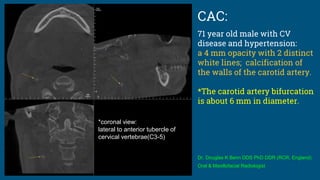
Dr. Douglas K Benn DDS PhD DDR (RCR, England)
Oral & Maxillofacial Radiologist
CAC:
71 year old male with CV
disease and hypertension:
a 4 mm opacity with 2 distinct
white lines; calcification of
the walls of the carotid artery.
*The carotid artery bifurcation
is about 6 mm in diameter.
*coronal view:
lateral to anterior tubercle of
cervical vertebrae(C3-5)
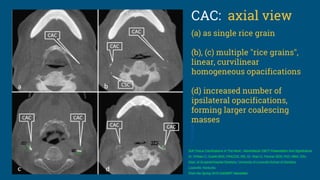
CAC: axial view
(a) as single rice grain
(b), (c) multiple "rice grains",
linear, curvilinear
homogeneous opacifications
(d) increased number of
ipsilateral opacifications,
forming larger coalescing
masses
Soft Tissue Calcifications In The Neck: Maxillofacial CBCT Presentation And Significance
Dr. William C. Scarfe BDS, FRACDS, MS, Dr. Allan G. Farman BDS, PhD, MBA, DSc
Dept. of Surgical/Hospital Dentistry, University of Louisville School of Dentistry
Louisville, Kentucky
From the Spring 2010 AADMRT Newsletter
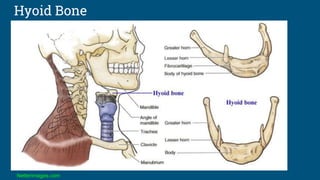
Hyoid Bone
Netterimages.com
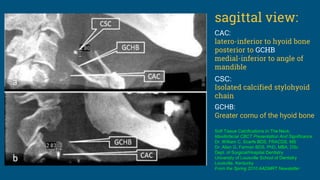
sagittal view:
CAC:
latero-inferior to hyoid bone
posterior to GCHB
medial-inferior to angle of
mandible
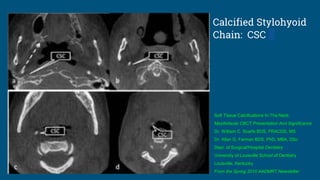
CSC:
Isolated calcified stylohyoid
chain
GCHB:
Greater cornu of the hyoid bone
Soft Tissue Calcifications In The Neck:
Maxillofacial CBCT Presentation And Significance
Dr. William C. Scarfe BDS, FRACDS, MS
Dr. Allan G. Farman BDS, PhD, MBA, DSc
Dept. of Surgical/Hospital Dentistry
University of Louisville School of Dentistry
Louisville, Kentucky
From the Spring 2010 AADMRT Newsletter
Soft Tissue Calcifications In The Neck:
Maxillofacial CBCT Presentation And Significance
Dr. William C. Scarfe BDS, FRACDS, MS
Dr. Allan G. Farman BDS, PhD, MBA, DSc
Dept. of Surgical/Hospital Dentistry
University of Louisville School of Dentistry
Louisville, Kentucky
From the Spring 2010 AADMRT Newsletter
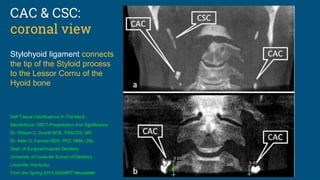
CAC & CSC:
coronal view
Stylohyoid ligament connects
the tip of the Styloid process
to the Lessor Cornu of the
Hyoid bone
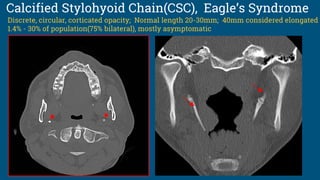
Calcified Stylohyoid Chain(CSC), Eagle’s Syndrome
Discrete, circular, corticated opacity; Normal length 20-30mm; 40mm considered elongated
1.4% - 30% of population(75% bilateral), mostly asymptomatic
Soft Tissue Calcifications In The Neck:
Maxillofacial CBCT Presentation And Significance
Dr. William C. Scarfe BDS, FRACDS, MS
Dr. Allan G. Farman BDS, PhD, MBA, DSc
Dept. of Surgical/Hospital Dentistry
University of Louisville School of Dentistry
Louisville, Kentucky
From the Spring 2010 AADMRT Newsletter
Calcified Stylohyoid
Chain: CSC
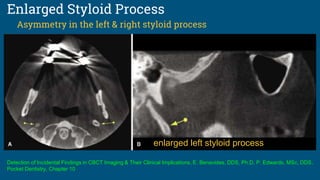
Enlarged Styloid Process
Detection of Incidental Findings in CBCT Imaging & Their Clinical Implications, E. Benavides, DDS, Ph.D, P. Edwards, MSc, DDS,
Pocket Dentistry, Chapter 10
Asymmetry in the left & right styloid process
enlarged left styloid process
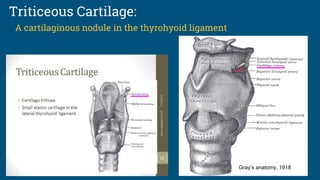
Triticeous Cartilage:
A cartilaginous nodule in the thyrohyoid ligament
Gray’s anatomy, 1918
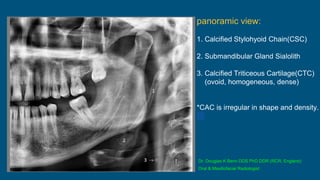
Dr. Douglas K Benn DDS PhD DDR (RCR, England)
Oral & Maxillofacial Radiologist
panoramic view:
1. Calcified Stylohyoid Chain(CSC)
2. Submandibular Gland Sialolith
3. Calcified Triticeous Cartilage(CTC)
(ovoid, homogeneous, dense)
*CAC is irregular in shape and density.
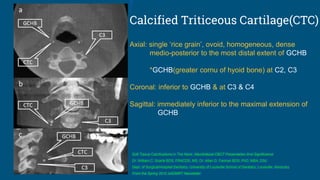
Calcified Triticeous Cartilage(CTC)
Axial: single ‘rice grain’, ovoid, homogeneous, dense
medio-posterior to the most distal extent of GCHB
*GCHB(greater cornu of hyoid bone) at C2, C3
Coronal: inferior to GCHB & at C3 & C4
Sagittal: immediately inferior to the maximal extension of
GCHB
Soft Tissue Calcifications In The Neck: Maxillofacial CBCT Presentation And Significance
Dr. William C. Scarfe BDS, FRACDS, MS, Dr. Allan G. Farman BDS, PhD, MBA, DSc
Dept. of Surgical/Hospital Dentistry, University of Louisville School of Dentistry, Louisville, Kentucky
From the Spring 2010 AADMRT Newsletter
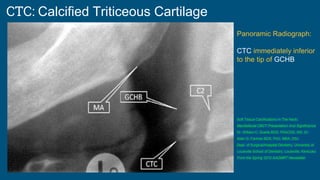
CTC: Calcified Triticeous Cartilage
Soft Tissue Calcifications In The Neck:
Maxillofacial CBCT Presentation And Significance
Dr. William C. Scarfe BDS, FRACDS, MS, Dr.
Allan G. Farman BDS, PhD, MBA, DSc
Dept. of Surgical/Hospital Dentistry, University of
Louisville School of Dentistry, Louisville, Kentucky
From the Spring 2010 AADMRT Newsletter
Panoramic Radiograph:
CTC immediately inferior
to the tip of GCHB
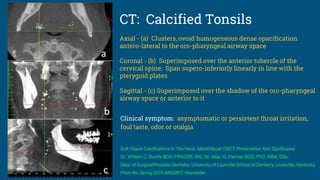
CT: Calcified Tonsils
Axial - (a) Clusters, ovoid homogeneous dense opacification
antero-lateral to the oro-pharyngeal airway space
Coronal - (b) Superimposed over the anterior tubercle of the
cervical spine; Span supero-inferiorly linearly in line with the
pterygoid plates
Sagittal - (c) Superimposed over the shadow of the oro-pharyngeal
airway space or anterior to it
Clinical symptom: asymptomatic or persistent throat irritation,
foul taste, odor or otalgia
Soft Tissue Calcifications In The Neck: Maxillofacial CBCT Presentation And Significance
Dr. William C. Scarfe BDS, FRACDS, MS, Dr. Allan G. Farman BDS, PhD, MBA, DSc
Dept. of Surgical/Hospital Dentistry, University of Louisville School of Dentistry, Louisville, Kentucky
From the Spring 2010 AADMRT Newsletter
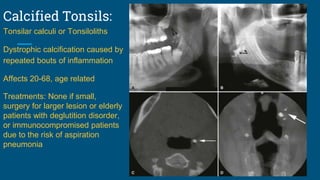
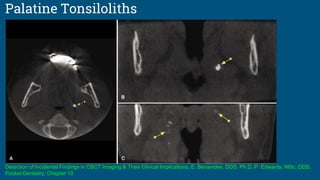
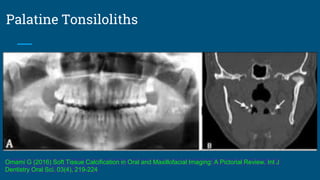
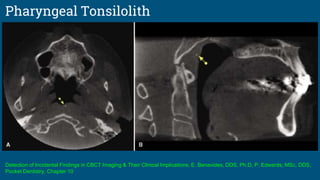
Calcified Tonsils:
Tonsilar calculi or Tonsiloliths
Dystrophic calcification caused by
repeated bouts of inflammation
Affects 20-68, age related
Treatments: None if small,
surgery for larger lesion or elderly
patients with deglutition disorder,
or immunocompromised patients
due to the risk of aspiration
pneumonia
Palatine Tonsiloliths
Detection of Incidental Findings in CBCT Imaging & Their Clinical Implications, E. Benavides, DDS, Ph.D, P. Edwards, MSc, DDS,
Pocket Dentistry, Chapter 10
Palatine Tonsiloliths
Omami G (2016) Soft Tissue Calcification in Oral and Maxillofacial Imaging: A Pictorial Review. Int J
Dentistry Oral Sci. 03(4), 219-224
Pharyngeal Tonsilolith
Detection of Incidental Findings in CBCT Imaging & Their Clinical Implications, E. Benavides, DDS, Ph.D, P. Edwards, MSc, DDS,
Pocket Dentistry, Chapter 10
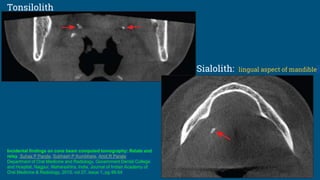
Tonsilolith
Sialolith: lingual aspect of mandible
Incidental findings on cone beam computed tomography: Relate and
relay, Suhas P Pande, Subhash P Kumbhare, Amit R Parate
Department of Oral Medicine and Radiology, Government Dental College
and Hospital, Nagpur, Maharashtra, India, Journal of Indian Academy of
Oral Medicine & Radiology, 2015, vol 27, issue 1, pg 48-54
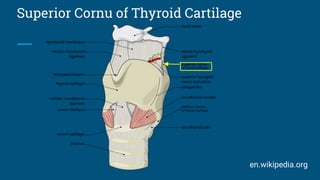
Superior Cornu of Thyroid Cartilage
en.wikipedia.org
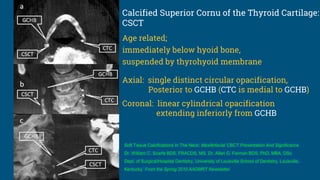
Calcified Superior Cornu of the Thyroid Cartilage:
CSCT
Soft Tissue Calcifications In The Neck: Maxillofacial CBCT Presentation And Significance
Dr. William C. Scarfe BDS, FRACDS, MS, Dr. Allan G. Farman BDS, PhD, MBA, DSc
Dept. of Surgical/Hospital Dentistry, University of Louisville School of Dentistry, Louisville,
Kentucky From the Spring 2010 AADMRT Newsletter
Age related;
immediately below hyoid bone,
suspended by thyrohyoid membrane
Axial: single distinct circular opacification,
Posterior to GCHB (CTC is medial to GCHB)
Coronal: linear cylindrical opacification
extending inferiorly from GCHB
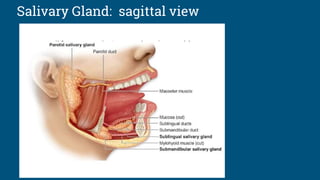
Salivary Gland: sagittal view
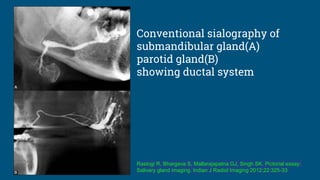
Conventional sialography of
submandibular gland(A)
parotid gland(B)
showing ductal system
Rastogi R, Bhargava S, Mallarajapatna GJ, Singh SK. Pictorial essay:
Salivary gland imaging. Indian J Radiol Imaging 2012;22:325-33
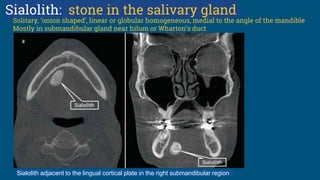
Sialolith: stone in the salivary gland
Sialolith adjacent to the lingual cortical plate in the right submandibular region
Solitary, ‘onion shaped’, linear or globular homogeneous, medial to the angle of the mandible
Mostly in submandibular gland near hilum or Wharton’s duct
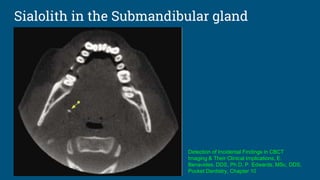
Sialolith in the Submandibular gland
Detection of Incidental Findings in CBCT
Imaging & Their Clinical Implications, E.
Benavides, DDS, Ph.D, P. Edwards, MSc, DDS,
Pocket Dentistry, Chapter 10
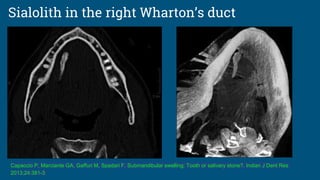
Sialolith in the right Wharton’s duct
Capaccio P, Marciante GA, Gaffuri M, Spadari F. Submandibular swelling: Tooth or salivary stone?. Indian J Dent Res
2013;24:381-3
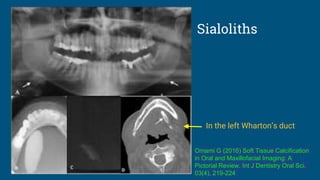
Sialoliths
In the left Wharton’s duct
Omami G (2016) Soft Tissue Calcification
in Oral and Maxillofacial Imaging: A
Pictorial Review. Int J Dentistry Oral Sci.
03(4), 219-224
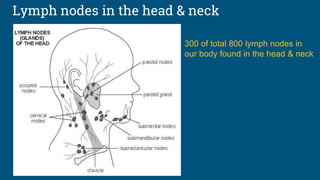
Lymph nodes in the head & neck
300 of total 800 lymph nodes in
our body found in the head & neck
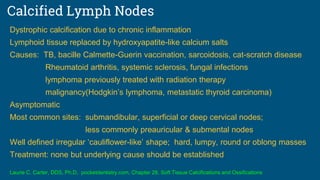
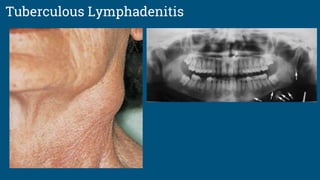
Calcified Lymph Nodes
Dystrophic calcification due to chronic inflammation
Lymphoid tissue replaced by hydroxyapatite-like calcium salts
Causes: TB, bacille Calmette-Guerin vaccination, sarcoidosis, cat-scratch disease
Rheumatoid arthritis, systemic sclerosis, fungal infections
lymphoma previously treated with radiation therapy
malignancy(Hodgkin’s lymphoma, metastatic thyroid carcinoma)
Asymptomatic
Most common sites: submandibular, superficial or deep cervical nodes;
less commonly preauricular & submental nodes
Well defined irregular ‘cauliflower-like’ shape; hard, lumpy, round or oblong masses
Treatment: none but underlying cause should be established
Laurie C. Carter, DDS, Ph.D, pocketdentistry.com, Chapter 28, Soft Tissue Calcifications and Ossifications
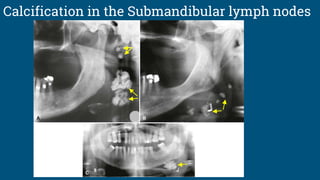
Calcification in the Submandibular lymph nodes
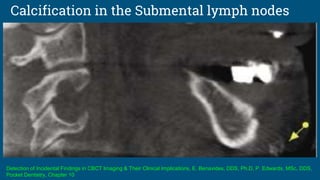
Calcification in the Submental lymph nodes
Detection of Incidental Findings in CBCT Imaging & Their Clinical Implications, E. Benavides, DDS, Ph.D, P. Edwards, MSc, DDS,
Pocket Dentistry, Chapter 10
Tuberculous Lymphadenitis
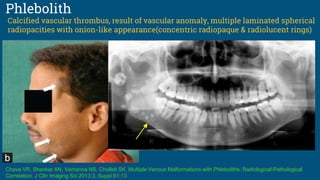
Phlebolith
Calcified vascular thrombus, result of vascular anomaly, multiple laminated spherical
radiopacities with onion-like appearance(concentric radiopaque & radiolucent rings)
Chava VR, Shankar AN, Vemanna NS, Cholleti SK. Multiple Venous Malformations with Phleboliths: Radiological-Pathological
Correlation. J Clin Imaging Sci 2013;3, Suppl S1:13
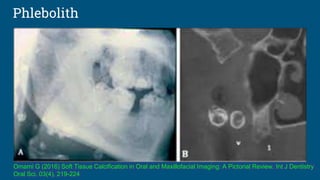
Phlebolith
Omami G (2016) Soft Tissue Calcification in Oral and Maxillofacial Imaging: A Pictorial Review. Int J Dentistry
Oral Sci. 03(4), 219-224
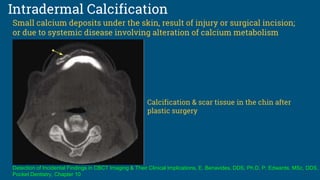
Intradermal Calcification
Small calcium deposits under the skin, result of injury or surgical incision;
or due to systemic disease involving alteration of calcium metabolism
Calcification & scar tissue in the chin after
plastic surgery
Detection of Incidental Findings in CBCT Imaging & Their Clinical Implications, E. Benavides, DDS, Ph.D, P. Edwards, MSc, DDS,
Pocket Dentistry, Chapter 10
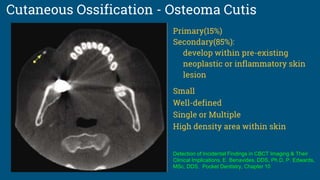
Cutaneous Ossification - Osteoma Cutis
Primary(15%)
Secondary(85%):
develop within pre-existing
neoplastic or inflammatory skin
lesion
Small
Well-defined
Single or Multiple
High density area within skin
Detection of Incidental Findings in CBCT Imaging & Their
Clinical Implications, E. Benavides, DDS, Ph.D, P. Edwards,
MSc, DDS, Pocket Dentistry, Chapter 10
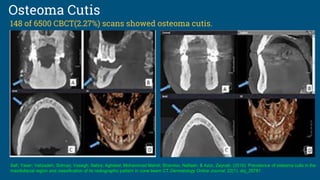
Osteoma Cutis
Safi, Yaser; Valizadeh, Solmaz; Vasegh, Sahra; Aghdasi, Mohammad Mahdi; Shamloo, Nafiseh; & Azizi, Zeynab. (2016). Prevalence of osteoma cutis in the
maxillofacial region and classification of its radiographic pattern in cone beam CT.Dermatology Online Journal, 22(1). doj_29781
148 of 6500 CBCT(2.27%) scans showed osteoma cutis.
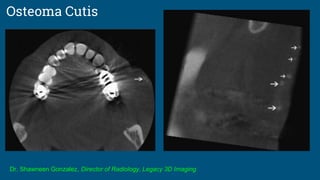
Osteoma Cutis
Dr. Shawneen Gonzalez, Director of Radiology, Legacy 3D Imaging
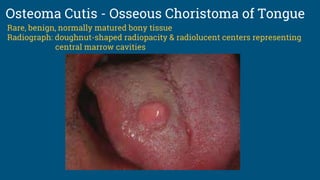
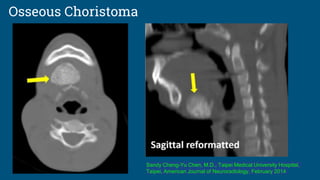
Osteoma Cutis - Osseous Choristoma of Tongue
Rare, benign, normally matured bony tissue
Radiograph: doughnut-shaped radiopacity & radiolucent centers representing
central marrow cavities
Osseous Choristoma
Sandy Cheng-Yu Chen, M.D., Taipei Medical University Hospital,
Taipei, American Journal of Neuroradiology, February 2014
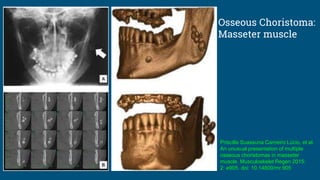
Osseous Choristoma:
Masseter muscle
Priscilla Suassuna Carneiro Lúcio, et al.
An unusual presentation of multiple
osseous choristomas in masseter
muscle. Musculoskelet Regen 2015;
2: e905. doi: 10.14800/mr.905
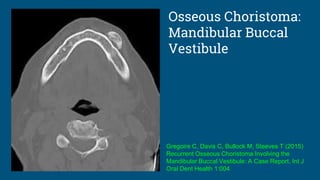
Osseous Choristoma:
Mandibular Buccal
Vestibule
Gregoire C, Davis C, Bullock M, Steeves T (2015)
Recurrent Osseous Choristoma Involving the
Mandibular Buccal Vestibule: A Case Report. Int J
Oral Dent Health 1:004
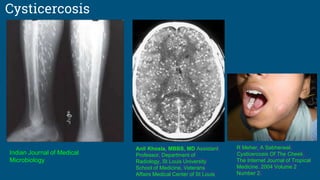
Cysticercosis
Caused by Parasite, Taenia Solium(pork tapeworm)
Larval form penetrate mucosa, blood vessels, lymphatics
Dead larvae causes granuloma, scarring, calcification
Calcification seen years after the infection
Intraorally:
palpable, well-circumscribed, soft fluctuant swelling
multiple, small nodules in tongue, buccal mucosa, lip,
masseter & suprahyoid muscles
Radiograph:
homogeneous, ‘grain of rice’ radiopacity
smaller, widespread dissemination in brain, muscles
Laurie C. Carter, DDS, Ph.D, Soft Tissue Calcifications and Ossifications, pocketdentistry.com, Chapter 28
Cysticercosis
Indian Journal of Medical
Microbiology
Anil Khosla, MBBS, MD Assistant
Professor, Department of
Radiology, St Louis University
School of Medicine, Veterans
Affairs Medical Center of St Louis
R Meher, A Sabherwal.
Cysticercosis Of The Cheek.
The Internet Journal of Tropical
Medicine. 2004 Volume 2
Number 2.
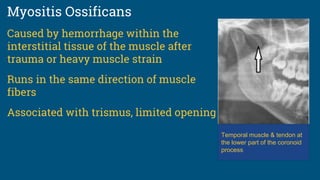
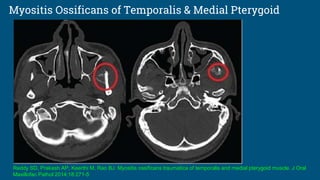
Myositis Ossificans
Temporal muscle & tendon at
the lower part of the coronoid
process
Caused by hemorrhage within the
interstitial tissue of the muscle after
trauma or heavy muscle strain
Runs in the same direction of muscle
fibers
Associated with trismus, limited opening
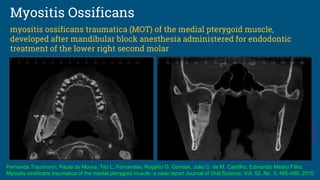
Myositis Ossificans
Fernanda Trautmann, Paula de Moura, Tito L. Fernandes, Rogério O. Gondak, Julio C. de M. Castilho, Edmundo Medici Filho,
Myositis ossificans traumatica of the medial pterygoid muscle: a case report Journal of Oral Science, Vol. 52, No. 3, 485-489, 2010
myositis ossificans traumatica (MOT) of the medial pterygoid muscle,
developed after mandibular block anesthesia administered for endodontic
treatment of the lower right second molar
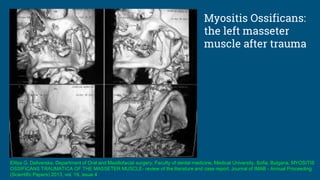
Myositis Ossificans:
the left masseter
muscle after trauma
Elitsa G. Deliverska, Department of Oral and Maxillofacial surgery, Faculty of dental medicine, Medical University, Sofia, Bulgaria, MYOSITIS
OSSIFICANS TRAUMATICA OF THE MASSETER MUSCLE- review of the literature and case report, Journal of IMAB - Annual Proceeding
(Scientific Papers) 2013, vol. 19, issue 4
Myositis Ossificans of Temporalis & Medial Pterygoid
Reddy SD, Prakash AP, Keerthi M, Rao BJ. Myositis ossificans traumatica of temporalis and medial pterygoid muscle. J Oral
Maxillofac Pathol 2014;18:271-5
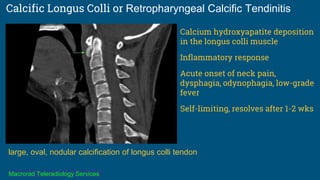
Calcific Longus Colli or Retropharyngeal Calcific Tendinitis
Calcium hydroxyapatite deposition
in the longus colli muscle
Inflammatory response
Acute onset of neck pain,
dysphagia, odynophagia, low-grade
fever
Self-limiting, resolves after 1-2 wks
large, oval, nodular calcification of longus colli tendon
Macrorad Teleradiology Services
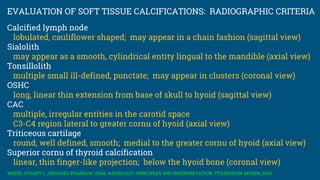
EVALUATION OF SOFT TISSUE CALCIFICATIONS: RADIOGRAPHIC CRITERIA
Calcified lymph node
lobulated, cauliflower shaped; may appear in a chain fashion (sagittal view)
Sialolith
may appear as a smooth, cylindrical entity lingual to the mandible (axial view)
Tonsillolith
multiple small ill-defined, punctate; may appear in clusters (coronal view)
OSHC
long, linear thin extension from base of skull to hyoid (sagittal view)
CAC
multiple, irregular entities in the carotid space
C3-C4 region lateral to greater cornu of hyoid (axial view)
Triticeous cartilage
round, well defined, smooth; medial to the greater cornu of hyoid (axial view)
Superior cornu of thyroid calcification
linear, thin finger-like projection; below the hyoid bone (coronal view)
WHITE, STUART C., MICHAEL PHARAOH. ORAL RADIOLOGY: PRINCIPLES AND INTERPRETATION, 7TH EDITION. MOSBY, 2014
References:
1. Dr. William C. Scarfe BDS, FRACDS, MS, Dr. Allan G. Farman BDS, PhD, MBA, DSc, Soft Tissue Calcifications In The Neck:
Maxillofacial CBCT Presentation And Significance, Dept. of Surgical/Hospital Dentistry, University of Louisville School of
Dentistry, Louisville, Kentucky, From the Spring 2010 AADMRT Newsletter
2. Khan et ai, Soft tissue calcifications in CBCT,
3. Suhas P Pande, Subhash P Kumbhare, Amit R Parate, Incidental findings on cone beam computed tomography:
Relate and relay, Department of Oral Medicine and Radiology, Government Dental College and Hospital, Nagpur, Maharashtra,
India, Journal of Indian Academy of Oral Medicine & Radiology, 2015, vol 27, issue 1, pg 48-54
4. Laurie C. Carter, DDS, Ph.D, Soft Tissue Calcifications and Ossifications, pocketdentistry.com, Chapter 28
5. E. Benavides, DDS, Ph.D, P. Edwards, MSc, DDS, Detection of Incidental Findings in CBCT Imaging & Their Clinical
Implications, Pocket Dentistry, Chapter 10
6. Omami G (2016) Soft Tissue Calcification in Oral and Maxillofacial Imaging: A Pictorial Review. Int J Dentistry Oral Sci. 03(4),
219-224
7. Rastogi R, Bhargava S, Mallarajapatna GJ, Singh SK. Pictorial essay: Salivary gland imaging. Indian J Radiol Imaging
2012;22:325-33
8. Safi, Yaser; Valizadeh, Solmaz; Vasegh, Sahra; Aghdasi, Mohammad Mahdi; Shamloo, Nafiseh; & Azizi, Zeynab. (2016).
Prevalence of osteoma cutis in the maxillofacial region and classification of its radiographic pattern in cone beam CT.
Dermatology Online Journal, 22(1). Doj_29781
9. WHITE, STUART C., MICHAEL PHARAOH. ORAL RADIOLOGY: PRINCIPLES AND INTERPRETATION, 7TH EDITION. MOSBY, 2014
10. Shawneen Gonzalez, DDS, MS, Interpretation Basics of CBCT
11. Gregoire C, Davis C, Bullock M, Steeves T (2015) Recurrent Osseous Choristoma Involving the Mandibular Buccal
Vestibule: A Case Report. Int J Oral Dent Health 1:004
12. Priscilla Suassuna Carneiro Lúcio, et al. An unusual presentation of multiple osseous choristomas in masseter muscle.
Musculoskelet Regen 2015; 2: e905. doi: 10.14800/mr.905
References:
13. Sandy Cheng-Yu Chen, M.D., Taipei Medical University Hospital, Taipei, American Journal of Neuroradiology, February 2014
14. Fernanda Trautmann, Paula de Moura, Tito L. Fernandes, Rogério O. Gondak, Julio C. de M. Castilho, Edmundo Medici Filho,
Myositis ossificans traumatica of the medial pterygoid muscle: a case report Journal of Oral Science, Vol. 52, No. 3, 485-489, 2010
15. Elitsa G. Deliverska, Department of Oral and Maxillofacial surgery, Faculty of dental medicine, Medical University, Sofia,
Bulgaria, MYOSITIS OSSIFICANS TRAUMATICA OF THE MASSETER MUSCLE- review of the literature and case report, Journal
of IMAB - Annual Proceeding (Scientific Papers) 2013, vol. 19, issue 4
16. Reddy SD, Prakash AP, Keerthi M, Rao BJ. Myositis ossificans traumatica of temporalis and medial pterygoid muscle. J Oral
Maxillofac Pathol 2014;18:271-5

Soft tissue calcification in the neck

  • 1.
    Soft Tissue Calcification inthe Neck Judy H. Oh, D.D.S. UCLA School of Dentistry, 1992 Preceptorship in Oral & Maxillofacial Radiology, Rutgers School of Dental Medicine, 2016 3D Oral & Maxillofacial Imaging Center, North Bethesda, MD 3DOMI.net
  • 2.
    Types of Calcificationin the Neck 1. Carotid Artery Calcification CAC 0.1 ~ 37% 2. Calcified Stylohyoid Chain CSC 1.4 ~ 30% 3. Calcified Triticeous Cartilage CTC 5 ~ 29% 4. Calcified Tonsils CT 16% 5. Calcified Superior Cornu of Thyroid Cartilage CSCT 6. Sialolith 7. Calcification of Lymph Nodes 8. Phlebolith(calcified vascular thrombus) 9. Intradermal Calcifications 10. Cutaneous Ossifications
  • 3.
    FREQUENCY OF SOFTTISSUE CALCIFICATIONS FROM 380 CBCT SCANS Locations No % Stylohyoid Chain 144 47.6 Triticeous Cartilage 103 27.1 Tonsils 86 22.6 Superior Cornu of Thyroid Cartilage 76 20.0 Carotid Artery 72 19.0 Salivary glands 10 2.6 Lymph Nodes 2 0.5 Ali Z Syed, PREVALENCE OF CAROTID ATHEROMA AND ITS CONFOUNDERS ON CONE BEAM COMPUTED TOMOGRAPHY, Master thesis for OMFR program at UNC, Chapel Hill, 2014
  • 4.
    Location of softtissue calcification: panoramic radiograph Laurie C. Carter, DDS, Ph.D, pocketdentistry.com, Chapter 28, Soft Tissue Calcifications and Ossifications
  • 5.
    Types of HeterotopicCalcification: Dystrophic Calcification Forms in chronic inflammation, cyst, diseased tissue Due to trauma, infection, inflammation Normal serum Calcium & Phosphate levels Localized to the site of injury, Asymptomatic Irregular or indistinct shape Found in Residual cyst, Inflammatory fibrous hyperplasia Idiopathic Calcification Calcium deposit in normal tissue Normal serum Calcium & Phosphate levels Found in Chondrocalcinosis, Phleboliths Metastatic Calcification Mineral precipitation into normal tissue due to higher serum level of Calcium & Phosphate
  • 6.
    Heterotopic Ossification(vs. calcification) Whenmineral is deposited in soft tissue as organized, well-formed bone May be all compact bone or may include trabeculae & fatty marrow Caused by trauma, tumors, diseases - myositis ossificans - ankylosing spondylitis
  • 7.
  • 8.
  • 9.
    Atheroma in Internal CarotidArtery at or just above the bifurcation of common carotid artery Bifurcation at lateral & inferior to Hyoid bone
  • 10.
    Reference: Metrowestdentalgroup.com CAC: axialview single or multiple semi-circular or ovoid latero-posterior to GCHB (greater cornu of hyoid bone) postero-lateral to pharyngeal airway
  • 11.
    Dr. Douglas KBenn DDS PhD DDR (RCR, England) Oral & Maxillofacial Radiologist CAC: 71 year old male with CV disease and hypertension: a 4 mm opacity with 2 distinct white lines; calcification of the walls of the carotid artery. *The carotid artery bifurcation is about 6 mm in diameter. *coronal view: lateral to anterior tubercle of cervical vertebrae(C3-5)
  • 12.
    CAC: axial view (a)as single rice grain (b), (c) multiple "rice grains", linear, curvilinear homogeneous opacifications (d) increased number of ipsilateral opacifications, forming larger coalescing masses Soft Tissue Calcifications In The Neck: Maxillofacial CBCT Presentation And Significance Dr. William C. Scarfe BDS, FRACDS, MS, Dr. Allan G. Farman BDS, PhD, MBA, DSc Dept. of Surgical/Hospital Dentistry, University of Louisville School of Dentistry Louisville, Kentucky From the Spring 2010 AADMRT Newsletter
  • 13.
  • 14.
    sagittal view: CAC: latero-inferior tohyoid bone posterior to GCHB medial-inferior to angle of mandible CSC: Isolated calcified stylohyoid chain GCHB: Greater cornu of the hyoid bone Soft Tissue Calcifications In The Neck: Maxillofacial CBCT Presentation And Significance Dr. William C. Scarfe BDS, FRACDS, MS Dr. Allan G. Farman BDS, PhD, MBA, DSc Dept. of Surgical/Hospital Dentistry University of Louisville School of Dentistry Louisville, Kentucky From the Spring 2010 AADMRT Newsletter
  • 15.
    Soft Tissue CalcificationsIn The Neck: Maxillofacial CBCT Presentation And Significance Dr. William C. Scarfe BDS, FRACDS, MS Dr. Allan G. Farman BDS, PhD, MBA, DSc Dept. of Surgical/Hospital Dentistry University of Louisville School of Dentistry Louisville, Kentucky From the Spring 2010 AADMRT Newsletter CAC & CSC: coronal view Stylohyoid ligament connects the tip of the Styloid process to the Lessor Cornu of the Hyoid bone
  • 16.
    Calcified Stylohyoid Chain(CSC),Eagle’s Syndrome Discrete, circular, corticated opacity; Normal length 20-30mm; 40mm considered elongated 1.4% - 30% of population(75% bilateral), mostly asymptomatic
  • 17.
    Soft Tissue CalcificationsIn The Neck: Maxillofacial CBCT Presentation And Significance Dr. William C. Scarfe BDS, FRACDS, MS Dr. Allan G. Farman BDS, PhD, MBA, DSc Dept. of Surgical/Hospital Dentistry University of Louisville School of Dentistry Louisville, Kentucky From the Spring 2010 AADMRT Newsletter Calcified Stylohyoid Chain: CSC
  • 18.
    Enlarged Styloid Process Detectionof Incidental Findings in CBCT Imaging & Their Clinical Implications, E. Benavides, DDS, Ph.D, P. Edwards, MSc, DDS, Pocket Dentistry, Chapter 10 Asymmetry in the left & right styloid process enlarged left styloid process
  • 19.
    Triticeous Cartilage: A cartilaginousnodule in the thyrohyoid ligament Gray’s anatomy, 1918
  • 20.
    Dr. Douglas KBenn DDS PhD DDR (RCR, England) Oral & Maxillofacial Radiologist panoramic view: 1. Calcified Stylohyoid Chain(CSC) 2. Submandibular Gland Sialolith 3. Calcified Triticeous Cartilage(CTC) (ovoid, homogeneous, dense) *CAC is irregular in shape and density.
  • 21.
    Calcified Triticeous Cartilage(CTC) Axial:single ‘rice grain’, ovoid, homogeneous, dense medio-posterior to the most distal extent of GCHB *GCHB(greater cornu of hyoid bone) at C2, C3 Coronal: inferior to GCHB & at C3 & C4 Sagittal: immediately inferior to the maximal extension of GCHB Soft Tissue Calcifications In The Neck: Maxillofacial CBCT Presentation And Significance Dr. William C. Scarfe BDS, FRACDS, MS, Dr. Allan G. Farman BDS, PhD, MBA, DSc Dept. of Surgical/Hospital Dentistry, University of Louisville School of Dentistry, Louisville, Kentucky From the Spring 2010 AADMRT Newsletter
  • 22.
    CTC: Calcified TriticeousCartilage Soft Tissue Calcifications In The Neck: Maxillofacial CBCT Presentation And Significance Dr. William C. Scarfe BDS, FRACDS, MS, Dr. Allan G. Farman BDS, PhD, MBA, DSc Dept. of Surgical/Hospital Dentistry, University of Louisville School of Dentistry, Louisville, Kentucky From the Spring 2010 AADMRT Newsletter Panoramic Radiograph: CTC immediately inferior to the tip of GCHB
  • 23.
    CT: Calcified Tonsils Axial- (a) Clusters, ovoid homogeneous dense opacification antero-lateral to the oro-pharyngeal airway space Coronal - (b) Superimposed over the anterior tubercle of the cervical spine; Span supero-inferiorly linearly in line with the pterygoid plates Sagittal - (c) Superimposed over the shadow of the oro-pharyngeal airway space or anterior to it Clinical symptom: asymptomatic or persistent throat irritation, foul taste, odor or otalgia Soft Tissue Calcifications In The Neck: Maxillofacial CBCT Presentation And Significance Dr. William C. Scarfe BDS, FRACDS, MS, Dr. Allan G. Farman BDS, PhD, MBA, DSc Dept. of Surgical/Hospital Dentistry, University of Louisville School of Dentistry, Louisville, Kentucky From the Spring 2010 AADMRT Newsletter
  • 24.
    Calcified Tonsils: Tonsilar calculior Tonsiloliths Dystrophic calcification caused by repeated bouts of inflammation Affects 20-68, age related Treatments: None if small, surgery for larger lesion or elderly patients with deglutition disorder, or immunocompromised patients due to the risk of aspiration pneumonia
  • 25.
    Palatine Tonsiloliths Detection ofIncidental Findings in CBCT Imaging & Their Clinical Implications, E. Benavides, DDS, Ph.D, P. Edwards, MSc, DDS, Pocket Dentistry, Chapter 10
  • 26.
    Palatine Tonsiloliths Omami G(2016) Soft Tissue Calcification in Oral and Maxillofacial Imaging: A Pictorial Review. Int J Dentistry Oral Sci. 03(4), 219-224
  • 27.
    Pharyngeal Tonsilolith Detection ofIncidental Findings in CBCT Imaging & Their Clinical Implications, E. Benavides, DDS, Ph.D, P. Edwards, MSc, DDS, Pocket Dentistry, Chapter 10
  • 28.
    Tonsilolith Sialolith: lingual aspectof mandible Incidental findings on cone beam computed tomography: Relate and relay, Suhas P Pande, Subhash P Kumbhare, Amit R Parate Department of Oral Medicine and Radiology, Government Dental College and Hospital, Nagpur, Maharashtra, India, Journal of Indian Academy of Oral Medicine & Radiology, 2015, vol 27, issue 1, pg 48-54
  • 29.
    Superior Cornu ofThyroid Cartilage en.wikipedia.org
  • 30.
    Calcified Superior Cornuof the Thyroid Cartilage: CSCT Soft Tissue Calcifications In The Neck: Maxillofacial CBCT Presentation And Significance Dr. William C. Scarfe BDS, FRACDS, MS, Dr. Allan G. Farman BDS, PhD, MBA, DSc Dept. of Surgical/Hospital Dentistry, University of Louisville School of Dentistry, Louisville, Kentucky From the Spring 2010 AADMRT Newsletter Age related; immediately below hyoid bone, suspended by thyrohyoid membrane Axial: single distinct circular opacification, Posterior to GCHB (CTC is medial to GCHB) Coronal: linear cylindrical opacification extending inferiorly from GCHB
  • 31.
  • 32.
    Conventional sialography of submandibulargland(A) parotid gland(B) showing ductal system Rastogi R, Bhargava S, Mallarajapatna GJ, Singh SK. Pictorial essay: Salivary gland imaging. Indian J Radiol Imaging 2012;22:325-33
  • 33.
    Sialolith: stone inthe salivary gland Sialolith adjacent to the lingual cortical plate in the right submandibular region Solitary, ‘onion shaped’, linear or globular homogeneous, medial to the angle of the mandible Mostly in submandibular gland near hilum or Wharton’s duct
  • 34.
    Sialolith in theSubmandibular gland Detection of Incidental Findings in CBCT Imaging & Their Clinical Implications, E. Benavides, DDS, Ph.D, P. Edwards, MSc, DDS, Pocket Dentistry, Chapter 10
  • 35.
    Sialolith in theright Wharton’s duct Capaccio P, Marciante GA, Gaffuri M, Spadari F. Submandibular swelling: Tooth or salivary stone?. Indian J Dent Res 2013;24:381-3
  • 36.
    Sialoliths In the leftWharton’s duct Omami G (2016) Soft Tissue Calcification in Oral and Maxillofacial Imaging: A Pictorial Review. Int J Dentistry Oral Sci. 03(4), 219-224
  • 37.
    Lymph nodes inthe head & neck 300 of total 800 lymph nodes in our body found in the head & neck
  • 38.
    Calcified Lymph Nodes Dystrophiccalcification due to chronic inflammation Lymphoid tissue replaced by hydroxyapatite-like calcium salts Causes: TB, bacille Calmette-Guerin vaccination, sarcoidosis, cat-scratch disease Rheumatoid arthritis, systemic sclerosis, fungal infections lymphoma previously treated with radiation therapy malignancy(Hodgkin’s lymphoma, metastatic thyroid carcinoma) Asymptomatic Most common sites: submandibular, superficial or deep cervical nodes; less commonly preauricular & submental nodes Well defined irregular ‘cauliflower-like’ shape; hard, lumpy, round or oblong masses Treatment: none but underlying cause should be established Laurie C. Carter, DDS, Ph.D, pocketdentistry.com, Chapter 28, Soft Tissue Calcifications and Ossifications
  • 39.
    Calcification in theSubmandibular lymph nodes
  • 40.
    Calcification in theSubmental lymph nodes Detection of Incidental Findings in CBCT Imaging & Their Clinical Implications, E. Benavides, DDS, Ph.D, P. Edwards, MSc, DDS, Pocket Dentistry, Chapter 10
  • 41.
  • 42.
    Phlebolith Calcified vascular thrombus,result of vascular anomaly, multiple laminated spherical radiopacities with onion-like appearance(concentric radiopaque & radiolucent rings) Chava VR, Shankar AN, Vemanna NS, Cholleti SK. Multiple Venous Malformations with Phleboliths: Radiological-Pathological Correlation. J Clin Imaging Sci 2013;3, Suppl S1:13
  • 43.
    Phlebolith Omami G (2016)Soft Tissue Calcification in Oral and Maxillofacial Imaging: A Pictorial Review. Int J Dentistry Oral Sci. 03(4), 219-224
  • 44.
    Intradermal Calcification Small calciumdeposits under the skin, result of injury or surgical incision; or due to systemic disease involving alteration of calcium metabolism Calcification & scar tissue in the chin after plastic surgery Detection of Incidental Findings in CBCT Imaging & Their Clinical Implications, E. Benavides, DDS, Ph.D, P. Edwards, MSc, DDS, Pocket Dentistry, Chapter 10
  • 45.
    Cutaneous Ossification -Osteoma Cutis Primary(15%) Secondary(85%): develop within pre-existing neoplastic or inflammatory skin lesion Small Well-defined Single or Multiple High density area within skin Detection of Incidental Findings in CBCT Imaging & Their Clinical Implications, E. Benavides, DDS, Ph.D, P. Edwards, MSc, DDS, Pocket Dentistry, Chapter 10
  • 46.
    Osteoma Cutis Safi, Yaser;Valizadeh, Solmaz; Vasegh, Sahra; Aghdasi, Mohammad Mahdi; Shamloo, Nafiseh; & Azizi, Zeynab. (2016). Prevalence of osteoma cutis in the maxillofacial region and classification of its radiographic pattern in cone beam CT.Dermatology Online Journal, 22(1). doj_29781 148 of 6500 CBCT(2.27%) scans showed osteoma cutis.
  • 47.
    Osteoma Cutis Dr. ShawneenGonzalez, Director of Radiology, Legacy 3D Imaging
  • 48.
    Osteoma Cutis -Osseous Choristoma of Tongue Rare, benign, normally matured bony tissue Radiograph: doughnut-shaped radiopacity & radiolucent centers representing central marrow cavities
  • 49.
    Osseous Choristoma Sandy Cheng-YuChen, M.D., Taipei Medical University Hospital, Taipei, American Journal of Neuroradiology, February 2014
  • 50.
    Osseous Choristoma: Masseter muscle PriscillaSuassuna Carneiro Lúcio, et al. An unusual presentation of multiple osseous choristomas in masseter muscle. Musculoskelet Regen 2015; 2: e905. doi: 10.14800/mr.905
  • 51.
    Osseous Choristoma: Mandibular Buccal Vestibule GregoireC, Davis C, Bullock M, Steeves T (2015) Recurrent Osseous Choristoma Involving the Mandibular Buccal Vestibule: A Case Report. Int J Oral Dent Health 1:004
  • 52.
    Cysticercosis Caused by Parasite,Taenia Solium(pork tapeworm) Larval form penetrate mucosa, blood vessels, lymphatics Dead larvae causes granuloma, scarring, calcification Calcification seen years after the infection Intraorally: palpable, well-circumscribed, soft fluctuant swelling multiple, small nodules in tongue, buccal mucosa, lip, masseter & suprahyoid muscles Radiograph: homogeneous, ‘grain of rice’ radiopacity smaller, widespread dissemination in brain, muscles Laurie C. Carter, DDS, Ph.D, Soft Tissue Calcifications and Ossifications, pocketdentistry.com, Chapter 28
  • 53.
    Cysticercosis Indian Journal ofMedical Microbiology Anil Khosla, MBBS, MD Assistant Professor, Department of Radiology, St Louis University School of Medicine, Veterans Affairs Medical Center of St Louis R Meher, A Sabherwal. Cysticercosis Of The Cheek. The Internet Journal of Tropical Medicine. 2004 Volume 2 Number 2.
  • 54.
    Myositis Ossificans Temporal muscle& tendon at the lower part of the coronoid process Caused by hemorrhage within the interstitial tissue of the muscle after trauma or heavy muscle strain Runs in the same direction of muscle fibers Associated with trismus, limited opening
  • 55.
    Myositis Ossificans Fernanda Trautmann,Paula de Moura, Tito L. Fernandes, Rogério O. Gondak, Julio C. de M. Castilho, Edmundo Medici Filho, Myositis ossificans traumatica of the medial pterygoid muscle: a case report Journal of Oral Science, Vol. 52, No. 3, 485-489, 2010 myositis ossificans traumatica (MOT) of the medial pterygoid muscle, developed after mandibular block anesthesia administered for endodontic treatment of the lower right second molar
  • 56.
    Myositis Ossificans: the leftmasseter muscle after trauma Elitsa G. Deliverska, Department of Oral and Maxillofacial surgery, Faculty of dental medicine, Medical University, Sofia, Bulgaria, MYOSITIS OSSIFICANS TRAUMATICA OF THE MASSETER MUSCLE- review of the literature and case report, Journal of IMAB - Annual Proceeding (Scientific Papers) 2013, vol. 19, issue 4
  • 57.
    Myositis Ossificans ofTemporalis & Medial Pterygoid Reddy SD, Prakash AP, Keerthi M, Rao BJ. Myositis ossificans traumatica of temporalis and medial pterygoid muscle. J Oral Maxillofac Pathol 2014;18:271-5
  • 58.
    Calcific Longus Collior Retropharyngeal Calcific Tendinitis Calcium hydroxyapatite deposition in the longus colli muscle Inflammatory response Acute onset of neck pain, dysphagia, odynophagia, low-grade fever Self-limiting, resolves after 1-2 wks large, oval, nodular calcification of longus colli tendon Macrorad Teleradiology Services
  • 60.
    EVALUATION OF SOFTTISSUE CALCIFICATIONS: RADIOGRAPHIC CRITERIA Calcified lymph node lobulated, cauliflower shaped; may appear in a chain fashion (sagittal view) Sialolith may appear as a smooth, cylindrical entity lingual to the mandible (axial view) Tonsillolith multiple small ill-defined, punctate; may appear in clusters (coronal view) OSHC long, linear thin extension from base of skull to hyoid (sagittal view) CAC multiple, irregular entities in the carotid space C3-C4 region lateral to greater cornu of hyoid (axial view) Triticeous cartilage round, well defined, smooth; medial to the greater cornu of hyoid (axial view) Superior cornu of thyroid calcification linear, thin finger-like projection; below the hyoid bone (coronal view) WHITE, STUART C., MICHAEL PHARAOH. ORAL RADIOLOGY: PRINCIPLES AND INTERPRETATION, 7TH EDITION. MOSBY, 2014
  • 61.
    References: 1. Dr. WilliamC. Scarfe BDS, FRACDS, MS, Dr. Allan G. Farman BDS, PhD, MBA, DSc, Soft Tissue Calcifications In The Neck: Maxillofacial CBCT Presentation And Significance, Dept. of Surgical/Hospital Dentistry, University of Louisville School of Dentistry, Louisville, Kentucky, From the Spring 2010 AADMRT Newsletter 2. Khan et ai, Soft tissue calcifications in CBCT, 3. Suhas P Pande, Subhash P Kumbhare, Amit R Parate, Incidental findings on cone beam computed tomography: Relate and relay, Department of Oral Medicine and Radiology, Government Dental College and Hospital, Nagpur, Maharashtra, India, Journal of Indian Academy of Oral Medicine & Radiology, 2015, vol 27, issue 1, pg 48-54 4. Laurie C. Carter, DDS, Ph.D, Soft Tissue Calcifications and Ossifications, pocketdentistry.com, Chapter 28 5. E. Benavides, DDS, Ph.D, P. Edwards, MSc, DDS, Detection of Incidental Findings in CBCT Imaging & Their Clinical Implications, Pocket Dentistry, Chapter 10 6. Omami G (2016) Soft Tissue Calcification in Oral and Maxillofacial Imaging: A Pictorial Review. Int J Dentistry Oral Sci. 03(4), 219-224 7. Rastogi R, Bhargava S, Mallarajapatna GJ, Singh SK. Pictorial essay: Salivary gland imaging. Indian J Radiol Imaging 2012;22:325-33 8. Safi, Yaser; Valizadeh, Solmaz; Vasegh, Sahra; Aghdasi, Mohammad Mahdi; Shamloo, Nafiseh; & Azizi, Zeynab. (2016). Prevalence of osteoma cutis in the maxillofacial region and classification of its radiographic pattern in cone beam CT. Dermatology Online Journal, 22(1). Doj_29781 9. WHITE, STUART C., MICHAEL PHARAOH. ORAL RADIOLOGY: PRINCIPLES AND INTERPRETATION, 7TH EDITION. MOSBY, 2014 10. Shawneen Gonzalez, DDS, MS, Interpretation Basics of CBCT 11. Gregoire C, Davis C, Bullock M, Steeves T (2015) Recurrent Osseous Choristoma Involving the Mandibular Buccal Vestibule: A Case Report. Int J Oral Dent Health 1:004 12. Priscilla Suassuna Carneiro Lúcio, et al. An unusual presentation of multiple osseous choristomas in masseter muscle. Musculoskelet Regen 2015; 2: e905. doi: 10.14800/mr.905
  • 62.
    References: 13. Sandy Cheng-YuChen, M.D., Taipei Medical University Hospital, Taipei, American Journal of Neuroradiology, February 2014 14. Fernanda Trautmann, Paula de Moura, Tito L. Fernandes, Rogério O. Gondak, Julio C. de M. Castilho, Edmundo Medici Filho, Myositis ossificans traumatica of the medial pterygoid muscle: a case report Journal of Oral Science, Vol. 52, No. 3, 485-489, 2010 15. Elitsa G. Deliverska, Department of Oral and Maxillofacial surgery, Faculty of dental medicine, Medical University, Sofia, Bulgaria, MYOSITIS OSSIFICANS TRAUMATICA OF THE MASSETER MUSCLE- review of the literature and case report, Journal of IMAB - Annual Proceeding (Scientific Papers) 2013, vol. 19, issue 4 16. Reddy SD, Prakash AP, Keerthi M, Rao BJ. Myositis ossificans traumatica of temporalis and medial pterygoid muscle. J Oral Maxillofac Pathol 2014;18:271-5

Editor's Notes

  • #3 CAC: 0.1~3.2% in population over 50 y.o. 22~37% in those with hx of hypertension, cardiovascular disease, past stroke/CVA, Diabetes, high cholesterol, obesity, physical inactivity, smoking, sleep apnea, head/neck radiation therapy, higher incidence in male population
  • #4 Of the 380 study scans reviewed, the most prevalent finding was ossified stylohyoid ligament (OSHC) (N= 144, 47.6%), followed by triticeal calcification (n=103, 27.1%), tonsillolith (n=86, 22.6%), Superior cornu of thyroid (n= 76, 20 %) CAC (n=72, 19.0%), Sialolith (n=10, 2.6 %) calcified lymph node (n=2, 0.5%)
  • #10 Atherosclerosis causes formation of thrombi or emboli which can induce stroke.
  • #12 0.1~3.2% of >50 yrs of age but 22~37% in population with hypertension, CV disease, past stroke/CVA, Diabetes, high cholesterol, obesity, physical inactivity, smoking, sleep apnea, head/neck radiation therapy, male gender
  • #17 Posterolateral to pharyngeal air space, anterior to petrous temporal bone, posterior & medial to distal border of ramus, anterior to airway at the level of lower border of mandible
  • #18 Location of CSC on axial images. At the level of the sigmoid notch (a), discrete circular opacities are present posterior and lateral to the pharyngeal airspace, anterior to the petrous temporal bone and posterior and medial to the distal border of the ramus. At the level of the mid ramus/ C1 (b) and mid mandible/C2 (c) the location of the opacity changes along a medial anterior path (arrow in (a)) such that at the level of the lower border of the mandible (d) the opacities are anterior to the airway.
  • #20 TC may help reinforce the lateral thyrohyoid ligament.
  • #21 A long narrow well defined opacity running inferiorly from the styloid process anteriorly to just below the lower border of the left angle of the mandible. This is most likely a calcified stylo-hyoid ligament. There is a small lucent line crossing the superior portion of the opacity which is where the ligament flexes. The lower portion of the opacity does not extend all the way to the hyoid bone. A large well defined rectangular opacity just below the left angle of the mandible. This is probably a submandibular gland sialolith just below the posterior border of the mylohyoid muscle where the gland duct curves around the muscle. A small round well defined uniformly dense opacity just inferior to the long horn of the hyoid bone. This is at the level of C4 and close to the carotid artery bifurcation. The opacity is a good example of a Triticeous cartilage and should not be confused with calcification of the carotid artery which is irregular in shape and density.
  • #24 Calcified Tonsils (CT). The tonsils are paired bilateral lymphoid tissue located in the lateral wall of the oropharynx adjacent lateral to the terminal sulcus of the tongue. Tonsilloliths are small areas of calcareous matter that form in the tonsillar crypts which may grow or coalesce to a large size.19 Patients may be asymptomatic or complain of persistent throat irritation, foul taste and odor or otalgia. Tonsilloliths are a common incidental imaging finding on up to 16% of patients.20 On panoramic images they appear as multiple small opaque masses superimposed on the anterior border of the oropharyngeal airway space and may extend over the mandible. On CBCT imaging CT appear as multiple clustered "rice grain" like ovoid homogeneous dense opacifications immediately superficial to the lateral oro-pharyngeal airway space which differentiates them from CAC or CTC
  • #49 Hamartoma is different from choristoma in that it is composed of tissue elements normally found in the same location but growing in a disorganized mass.
  • #53 The eggs of parasite, Taenia Solium(pork tapeworm) is hatched & the larval form penetrate mucosa, blood vessels, lymphatics. Inflammatory reaction induced by the dead larvae causes granuloma, scarring, calcification.