
Under the guidence of :
DEPT. OF ORTHODONTIA AND DENTOFACIAL
ORTHOPEDICS
NORTH BENGAL DENTAL COLLEGE AND HOSPITAL
WHY SPACE NEEDED????????????
IN SOME MALOCCLUSIONS AND IN THOSE CASES
WHERE TOOTH MATERIAL AND ARCH LENGHT
DISCREPANCY PRESENT, SPACE IS NEEDED TO CORRECT
THOSE MALOCCLUSIONS.
SUCH SITUATION WHICH REQUIRE SPACE FOR
CORRECTION ARE:
1) CROWDING,
2) ANTERIOR PROCLINATION,
3) IMPACTED CANINE,
4) CURVE OF SPEE LEVELING,
5) CONSTRICTED ARCH,
VARIOUSMETHODS FOR GAINING SPACE
 PROXIMAL STIPPING
 ARCH EXPANSION
 EXTRACTION
 DISTALIZATION OF MOLAR
 UPRIGHTING OF TILTED MOLAR
 DEROTATION OF POSTERIOR TEETH
 PROCLINATION/FLARING OF ANTERIORS.
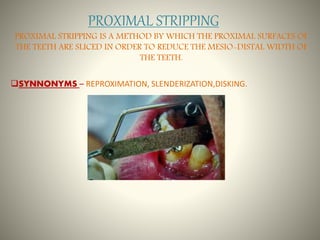
PROXIMAL STRIPPING
PROXIMAL STRIPPING IS A METHOD BY WHICH THE PROXIMAL SURFACES OF
THE TEETH ARE SLICED IN ORDER TO REDUCE THE MESIO-DISTAL WIDTH OF
THE TEETH.
SYNNONYMS – REPROXIMATION, SLENDERIZATION,DISKING.
PROXIMAL STRIPPING
INDICATION OF PROXIMAL STRIPPING:
1) IF BOLTON ANALSIS SHOWS MILD TOOTH MATERIAL EXCESS IN EITHER ARCH.
2) IF CAREY’S ANALYSIS SHOWS TOTAL TOOTH MATERIAL EXCESS 0-2.5 mm.
3) IN LOWER ANTERIOR REGION AS AN AID TO RETENTION.
4) IN CASES WHERE INDIVIDUAL TOOTH SIZES PREVENTS A CLASS I MOLAR AND
CANINE RELATIONSHIP.
5) TO OBTAIN MORE FAVOURABLE OVERJET AND OVERBITE.
CONTRAINDICATION OF PROXIMAL STRIPING:
1) YOUNG PATIENT AS THEY POSSESS LARGE PULP CHAMBER,WHICH INCREASE
RISK OF PULP EXPOSURE.
2) CARIES RISK PATIENT.
3) TEETH WITH ENAMEL HYPOPLASIA.
4) PATIENT WITH POOR ORAL HYGINE.
PROXIMAL STRIPPING
ADVANTAGES OF PROXIMAL STRIPPING:
1) POSSIBLE TO AVOID EXTRACTION IN BORDERLINE CASES WHERE SPACE
REQUIRMENT IDS MINIMUM.
2) MORE FAVOURABLE OVERJET AND OVERBITE CAN BE ESTABLISHED.
3) MINIMIZE THE POTENTIAL CONSEQUENCES OF EXTRACTION:
• DIFFICULTY IN COMPLICATING SPACE CLOSURE.
• DIFFICULTY IN PARALLELING THE ROOT AFTER EXTRACTION.
• NEED FOR GREATER ANCHORAGE REINFORCEMENT.
• POSSIBILITY OF SPACE RE-OPENING.
DISADVANTAGES OF PROXIMAL STRIPPING:
1) CARIES SUSCEPTIBILITY IS INCREASED.
2) PATIENT MAY EXPERIENCES SENSITIVITY.
3) LOSS OF CANTACT BETWEEN TEETH MAY LEAD TO FOOD IMPACTION.
4) IMPROPER PROCEDURE MAY LEAD TO CHANGE IN MORPHOLOGY OF TOOTH.
5) ROUGH PROXIMAL SURFACE ATTRACT PLAQUE.
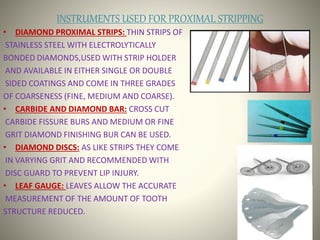
INSTRUMENTS USED FOR PROXIMAL STRIPPING
• DIAMOND PROXIMAL STRIPS: THIN STRIPS OF
STAINLESS STEEL WITH ELECTROLYTICALLY
BONDED DIAMONDS,USED WITH STRIP HOLDER
AND AVAILABLE IN EITHER SINGLE OR DOUBLE
SIDED COATINGS AND COME IN THREE GRADES
OF COARSENESS (FINE, MEDIUM AND COARSE).
• CARBIDE AND DIAMOND BAR: CROSS CUT
CARBIDE FISSURE BURS AND MEDIUM OR FINE
GRIT DIAMOND FINISHING BUR CAN BE USED.
• DIAMOND DISCS: AS LIKE STRIPS THEY COME
IN VARYING GRIT AND RECOMMENDED WITH
DISC GUARD TO PREVENT LIP INJURY.
• LEAF GAUGE: LEAVES ALLOW THE ACCURATE
MEASUREMENT OF THE AMOUNT OF TOOTH
STRUCTURE REDUCED.
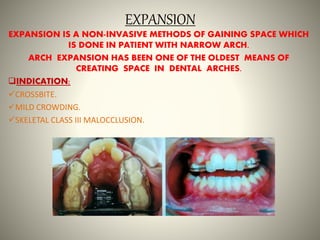
EXPANSION
EXPANSION IS A NON-INVASIVE METHODS OF GAINING SPACE WHICH
IS DONE IN PATIENT WITH NARROW ARCH.
ARCH EXPANSION HAS BEEN ONE OF THE OLDEST MEANS OF
CREATING SPACE IN DENTAL ARCHES.
INDICATION:
CROSSBITE.
MILD CROWDING.
SKELETAL CLASS III MALOCCLUSION.
EXPANSION
 WHEN WE CAN DO ARCH EXPANSION????
 ACCORDING TO ASHLEY HOWE’S ANALYSIS:
 IF PREMOLAR DIAMETER(PMD) IS LESS THAN PREMOLAR BASAL
ARCH WIDTH(PMBAW) THEN ONLY ARCH EXPANSION IS
INDICATED.
 ACCORDING TO PONT’S ANALYSIS:
 IF MEASURED VALUE IS LESS THAN CALCULATED VALUE THEN
EXPANSION IS POSSIBLE.
EXPANSION
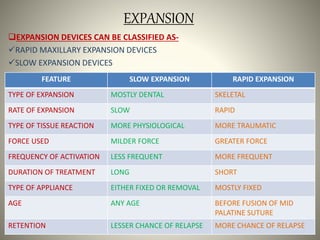
EXPANSION DEVICES CAN BE CLASSIFIED AS-
RAPID MAXILLARY EXPANSION DEVICES
SLOW EXPANSION DEVICES
FEATURE SLOW EXPANSION RAPID EXPANSION
TYPE OF EXPANSION MOSTLY DENTAL SKELETAL
RATE OF EXPANSION SLOW RAPID
TYPE OF TISSUE REACTION MORE PHYSIOLOGICAL MORE TRAUMATIC
FORCE USED MILDER FORCE GREATER FORCE
FREQUENCY OF ACTIVATION LESS FREQUENT MORE FREQUENT
DURATION OF TREATMENT LONG SHORT
TYPE OF APPLIANCE EITHER FIXED OR REMOVAL MOSTLY FIXED
AGE ANY AGE BEFORE FUSION OF MID
PALATINE SUTURE
RETENTION LESSER CHANCE OF RELAPSE MORE CHANCE OF RELAPSE
EXPANSION
RAPID EXPANSION DEVICES:
 FIXED APPLIANCES-
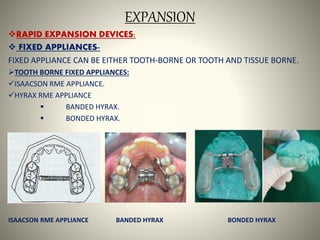
FIXED APPLIANCE CAN BE EITHER TOOTH-BORNE OR TOOTH AND TISSUE BORNE.
TOOTH BORNE FIXED APPLIANCES:
ISAACSON RME APPLIANCE.
HYRAX RME APPLIANCE
 BANDED HYRAX.
 BONDED HYRAX.
ISAACSON RME APPLIANCE BANDED HYRAX BONDED HYRAX
EXPANSION
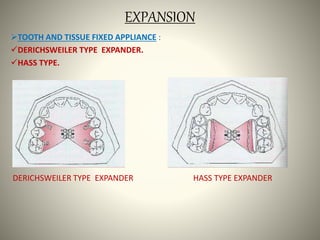
TOOTH AND TISSUE FIXED APPLIANCE :
DERICHSWEILER TYPE EXPANDER.
HASS TYPE.
DERICHSWEILER TYPE EXPANDER HASS TYPE EXPANDER
EXPANSION
 SLOW EXPANSION DEVICES:
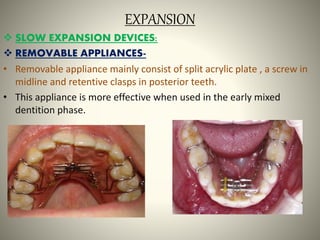
 REMOVABLE APPLIANCES-
• Removable appliance mainly consist of split acrylic plate , a screw in
midline and retentive clasps in posterior teeth.
• This appliance is more effective when used in the early mixed
dentition phase.
EXPANSION
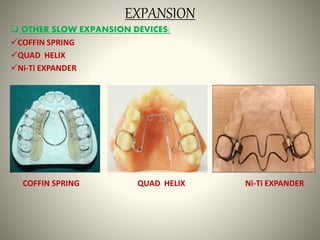
 OTHER SLOW EXPANSION DEVICES:
COFFIN SPRING
QUAD HELIX
Ni-Ti EXPANDER
COFFIN SPRING QUAD HELIX Ni-Ti EXPANDER
EXTRACTION
THERE ARE NUMBER OF CIMCUMSTANCES THAT NECESSITATE
EXTRACTION OF TEETH AS A PART OF ROUTINE ORTHODONTIC
TREATMENT.
THEY ARE LISTED AS FOLLOWS:
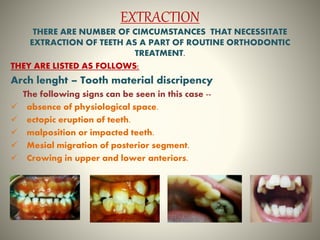
Arch lenght – Tooth material discripency
The following signs can be seen in this case --
 absence of physiological space.
 ectopic eruption of teeth.
 malposition or impacted teeth.
 Mesial migration of posterior segment.
 Crowing in upper and lower anteriors.
EXTRACTION
 WHEN WE CAN DO EXTRACTION??????
 According to carey’s analysis(applicable for lower arch):
If Arch lenght and tooth material discrepancy—
2.5mm-5mm ---- Extraction of second premolar .
> 5 mm ------ Extraction of first premolar.
 According to howe’s analysis:
If premolar basal arch width % (PMBAW%) is 37% or less it is
indicated for extraction.
PMBAW % =PMBAW 100/TTM
EXTRACTION
Why 1st premolar is the choice of tooth for
extraction in most cases (for upper arch):
1) 1st premolar is very near to anterior segment.
2) Their location in the arch is such that the space gained by their
extraction can be utilize for correction both anterior and
posterior segment.
3) when 1st premolar is extracted anchorage given by 2nd premolar
and 2 molars, which is satisfactory for retraction of anterior
segment.
4) Contact that result between canine and second premolar is well.
5) 1st premolar is less esthetically important.
6) 1st premolar not so much useful in chewing.
DISTALIZATION OF MOLARS
Distalization procedures are aimed at moving the molars in a distal direction so as
to gain space. This approach became popular due to the fact that extraction can
be avoided.The ideal timing for distalization is during the mixed dentition period
prior to eruption of second permanent molar.
Objectives:
1) To distalize(normalized) mesially migrated maxillary molars due to their
premature mesial shift.such as a situation may exist unilaterally or bilaterally.
2) To correct mild maxillary dentoalveolar protrusion.
3) The profile of such patient is normal or slightly protrusive at the upper lip due
to dental protrusion.
4) In class I occlusion patient,distalization may indicated to gain space to resolve
minor anterior crowding.
DISTALIZATION OF MOLARS
 Distalization can be done by following methods:
1) Extra oral approach.
2) Intra oral approach.
 EXTRA ORAL APPROACH:
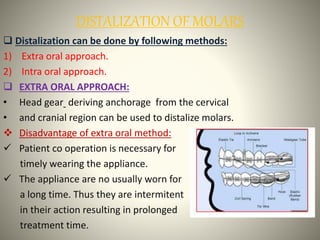
• Head gear deriving anchorage from the cervical
• and cranial region can be used to distalize molars.
 Disadvantage of extra oral method:
 Patient co operation is necessary for
timely wearing the appliance.
 The appliance are no usually worn for
a long time. Thus they are intermitent
in their action resulting in prolonged
treatment time.
DISTALIZATION OF MOLARS
INTRA ORAL APPROACH:
This appliance were introduce to overcome the various drawbacks of extra oral
methods.this appliances are fixed with tooth and therefore produce a continuous effect.
The devices are following:
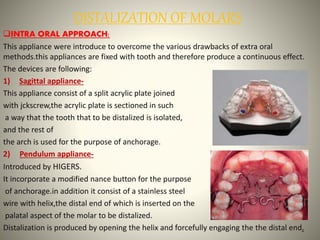
1) Sagittal appliance-
This appliance consist of a split acrylic plate joined
with jckscrew,the acrylic plate is sectioned in such
a way that the tooth that to be distalized is isolated,
and the rest of
the arch is used for the purpose of anchorage.
2) Pendulum appliance-
Introduced by HIGERS.
It incorporate a modified nance button for the purpose
of anchorage.in addition it consist of a stainless steel
wire with helix,the distal end of which is inserted on the
palatal aspect of the molar to be distalized.
Distalization is produced by opening the helix and forcefully engaging the the distal end.
DISTALIZATION OF MOLARS
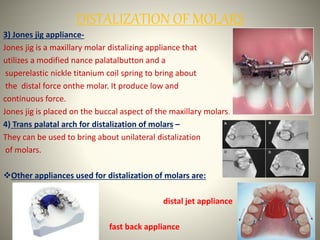
3) Jones jig appliance-
Jones jig is a maxillary molar distalizing appliance that
utilizes a modified nance palatalbutton and a
superelastic nickle titanium coil spring to bring about
the distal force onthe molar. It produce low and
continuous force.
Jones jig is placed on the buccal aspect of the maxillary molars.
4) Trans palatal arch for distalization of molars –
They can be used to bring about unilateral distalization
of molars.
Other appliances used for distalization of molars are:
distal jet appliance
fast back appliance
UPRIGHTING OF TILTED MOLAR
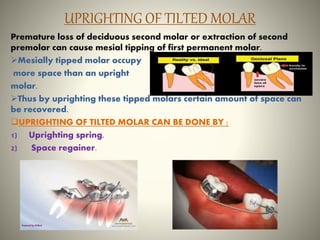
Premature loss of deciduous second molar or extraction of second
premolar can cause mesial tipping of first permanent molar.
Mesially tipped molar occupy
more space than an upright
molar.
Thus by uprighting these tipped molars certain amount of space can
be recovered.
UPRIGHTING OF TILTED MOLAR CAN BE DONE BY :
1) Uprighting spring.
2) Space regainer.
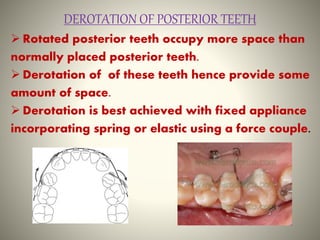
DEROTATION OF POSTERIOR TEETH
 Rotated posterior teeth occupy more space than
normally placed posterior teeth.
 Derotation of of these teeth hence provide some
amount of space.
 Derotation is best achieved with fixed appliance
incorporating spring or elastic using a force couple.
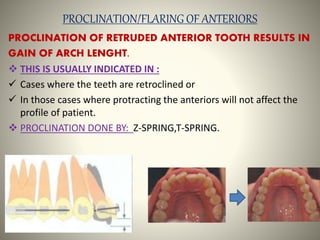
PROCLINATION/FLARING OF ANTERIORS
PROCLINATION OF RETRUDED ANTERIOR TOOTH RESULTS IN
GAIN OF ARCH LENGHT.
 THIS IS USUALLY INDICATED IN :
 Cases where the teeth are retroclined or
 In those cases where protracting the anteriors will not affect the
profile of patient.
 PROCLINATION DONE BY: Z-SPRING,T-SPRING.
REFERENCE:
 CONTEMPORARY ORTHODONTICS-
WILLIAM R.PROFFIT (4TH EDITION)
 TEXTBOOK OF ORTHODONTICS-
GURKEERAT SINGH
 ORTHODONTICS ,THE ART AND
SCIENCE-S.I.BHALAJHI (6TH EDITION)
Space gaining methods  -ORTHODONTICS

Space gaining methods -ORTHODONTICS

  • 1.
    Under the guidenceof : DEPT. OF ORTHODONTIA AND DENTOFACIAL ORTHOPEDICS NORTH BENGAL DENTAL COLLEGE AND HOSPITAL
  • 2.
    WHY SPACE NEEDED???????????? INSOME MALOCCLUSIONS AND IN THOSE CASES WHERE TOOTH MATERIAL AND ARCH LENGHT DISCREPANCY PRESENT, SPACE IS NEEDED TO CORRECT THOSE MALOCCLUSIONS. SUCH SITUATION WHICH REQUIRE SPACE FOR CORRECTION ARE: 1) CROWDING, 2) ANTERIOR PROCLINATION, 3) IMPACTED CANINE, 4) CURVE OF SPEE LEVELING, 5) CONSTRICTED ARCH,
  • 3.
    VARIOUSMETHODS FOR GAININGSPACE  PROXIMAL STIPPING  ARCH EXPANSION  EXTRACTION  DISTALIZATION OF MOLAR  UPRIGHTING OF TILTED MOLAR  DEROTATION OF POSTERIOR TEETH  PROCLINATION/FLARING OF ANTERIORS.
  • 4.
    PROXIMAL STRIPPING PROXIMAL STRIPPINGIS A METHOD BY WHICH THE PROXIMAL SURFACES OF THE TEETH ARE SLICED IN ORDER TO REDUCE THE MESIO-DISTAL WIDTH OF THE TEETH. SYNNONYMS – REPROXIMATION, SLENDERIZATION,DISKING.
  • 5.
    PROXIMAL STRIPPING INDICATION OFPROXIMAL STRIPPING: 1) IF BOLTON ANALSIS SHOWS MILD TOOTH MATERIAL EXCESS IN EITHER ARCH. 2) IF CAREY’S ANALYSIS SHOWS TOTAL TOOTH MATERIAL EXCESS 0-2.5 mm. 3) IN LOWER ANTERIOR REGION AS AN AID TO RETENTION. 4) IN CASES WHERE INDIVIDUAL TOOTH SIZES PREVENTS A CLASS I MOLAR AND CANINE RELATIONSHIP. 5) TO OBTAIN MORE FAVOURABLE OVERJET AND OVERBITE. CONTRAINDICATION OF PROXIMAL STRIPING: 1) YOUNG PATIENT AS THEY POSSESS LARGE PULP CHAMBER,WHICH INCREASE RISK OF PULP EXPOSURE. 2) CARIES RISK PATIENT. 3) TEETH WITH ENAMEL HYPOPLASIA. 4) PATIENT WITH POOR ORAL HYGINE.
  • 6.
    PROXIMAL STRIPPING ADVANTAGES OFPROXIMAL STRIPPING: 1) POSSIBLE TO AVOID EXTRACTION IN BORDERLINE CASES WHERE SPACE REQUIRMENT IDS MINIMUM. 2) MORE FAVOURABLE OVERJET AND OVERBITE CAN BE ESTABLISHED. 3) MINIMIZE THE POTENTIAL CONSEQUENCES OF EXTRACTION: • DIFFICULTY IN COMPLICATING SPACE CLOSURE. • DIFFICULTY IN PARALLELING THE ROOT AFTER EXTRACTION. • NEED FOR GREATER ANCHORAGE REINFORCEMENT. • POSSIBILITY OF SPACE RE-OPENING. DISADVANTAGES OF PROXIMAL STRIPPING: 1) CARIES SUSCEPTIBILITY IS INCREASED. 2) PATIENT MAY EXPERIENCES SENSITIVITY. 3) LOSS OF CANTACT BETWEEN TEETH MAY LEAD TO FOOD IMPACTION. 4) IMPROPER PROCEDURE MAY LEAD TO CHANGE IN MORPHOLOGY OF TOOTH. 5) ROUGH PROXIMAL SURFACE ATTRACT PLAQUE.
  • 7.
    INSTRUMENTS USED FORPROXIMAL STRIPPING • DIAMOND PROXIMAL STRIPS: THIN STRIPS OF STAINLESS STEEL WITH ELECTROLYTICALLY BONDED DIAMONDS,USED WITH STRIP HOLDER AND AVAILABLE IN EITHER SINGLE OR DOUBLE SIDED COATINGS AND COME IN THREE GRADES OF COARSENESS (FINE, MEDIUM AND COARSE). • CARBIDE AND DIAMOND BAR: CROSS CUT CARBIDE FISSURE BURS AND MEDIUM OR FINE GRIT DIAMOND FINISHING BUR CAN BE USED. • DIAMOND DISCS: AS LIKE STRIPS THEY COME IN VARYING GRIT AND RECOMMENDED WITH DISC GUARD TO PREVENT LIP INJURY. • LEAF GAUGE: LEAVES ALLOW THE ACCURATE MEASUREMENT OF THE AMOUNT OF TOOTH STRUCTURE REDUCED.
  • 8.
    EXPANSION EXPANSION IS ANON-INVASIVE METHODS OF GAINING SPACE WHICH IS DONE IN PATIENT WITH NARROW ARCH. ARCH EXPANSION HAS BEEN ONE OF THE OLDEST MEANS OF CREATING SPACE IN DENTAL ARCHES. INDICATION: CROSSBITE. MILD CROWDING. SKELETAL CLASS III MALOCCLUSION.
  • 9.
    EXPANSION  WHEN WECAN DO ARCH EXPANSION????  ACCORDING TO ASHLEY HOWE’S ANALYSIS:  IF PREMOLAR DIAMETER(PMD) IS LESS THAN PREMOLAR BASAL ARCH WIDTH(PMBAW) THEN ONLY ARCH EXPANSION IS INDICATED.  ACCORDING TO PONT’S ANALYSIS:  IF MEASURED VALUE IS LESS THAN CALCULATED VALUE THEN EXPANSION IS POSSIBLE.
  • 10.
    EXPANSION EXPANSION DEVICES CANBE CLASSIFIED AS- RAPID MAXILLARY EXPANSION DEVICES SLOW EXPANSION DEVICES FEATURE SLOW EXPANSION RAPID EXPANSION TYPE OF EXPANSION MOSTLY DENTAL SKELETAL RATE OF EXPANSION SLOW RAPID TYPE OF TISSUE REACTION MORE PHYSIOLOGICAL MORE TRAUMATIC FORCE USED MILDER FORCE GREATER FORCE FREQUENCY OF ACTIVATION LESS FREQUENT MORE FREQUENT DURATION OF TREATMENT LONG SHORT TYPE OF APPLIANCE EITHER FIXED OR REMOVAL MOSTLY FIXED AGE ANY AGE BEFORE FUSION OF MID PALATINE SUTURE RETENTION LESSER CHANCE OF RELAPSE MORE CHANCE OF RELAPSE
  • 11.
    EXPANSION RAPID EXPANSION DEVICES: FIXED APPLIANCES- FIXED APPLIANCE CAN BE EITHER TOOTH-BORNE OR TOOTH AND TISSUE BORNE. TOOTH BORNE FIXED APPLIANCES: ISAACSON RME APPLIANCE. HYRAX RME APPLIANCE  BANDED HYRAX.  BONDED HYRAX. ISAACSON RME APPLIANCE BANDED HYRAX BONDED HYRAX
  • 12.
    EXPANSION TOOTH AND TISSUEFIXED APPLIANCE : DERICHSWEILER TYPE EXPANDER. HASS TYPE. DERICHSWEILER TYPE EXPANDER HASS TYPE EXPANDER
  • 13.
    EXPANSION  SLOW EXPANSIONDEVICES:  REMOVABLE APPLIANCES- • Removable appliance mainly consist of split acrylic plate , a screw in midline and retentive clasps in posterior teeth. • This appliance is more effective when used in the early mixed dentition phase.
  • 14.
    EXPANSION  OTHER SLOWEXPANSION DEVICES: COFFIN SPRING QUAD HELIX Ni-Ti EXPANDER COFFIN SPRING QUAD HELIX Ni-Ti EXPANDER
  • 15.
    EXTRACTION THERE ARE NUMBEROF CIMCUMSTANCES THAT NECESSITATE EXTRACTION OF TEETH AS A PART OF ROUTINE ORTHODONTIC TREATMENT. THEY ARE LISTED AS FOLLOWS: Arch lenght – Tooth material discripency The following signs can be seen in this case --  absence of physiological space.  ectopic eruption of teeth.  malposition or impacted teeth.  Mesial migration of posterior segment.  Crowing in upper and lower anteriors.
  • 16.
    EXTRACTION  WHEN WECAN DO EXTRACTION??????  According to carey’s analysis(applicable for lower arch): If Arch lenght and tooth material discrepancy— 2.5mm-5mm ---- Extraction of second premolar . > 5 mm ------ Extraction of first premolar.  According to howe’s analysis: If premolar basal arch width % (PMBAW%) is 37% or less it is indicated for extraction. PMBAW % =PMBAW 100/TTM
  • 17.
    EXTRACTION Why 1st premolaris the choice of tooth for extraction in most cases (for upper arch): 1) 1st premolar is very near to anterior segment. 2) Their location in the arch is such that the space gained by their extraction can be utilize for correction both anterior and posterior segment. 3) when 1st premolar is extracted anchorage given by 2nd premolar and 2 molars, which is satisfactory for retraction of anterior segment. 4) Contact that result between canine and second premolar is well. 5) 1st premolar is less esthetically important. 6) 1st premolar not so much useful in chewing.
  • 19.
    DISTALIZATION OF MOLARS Distalizationprocedures are aimed at moving the molars in a distal direction so as to gain space. This approach became popular due to the fact that extraction can be avoided.The ideal timing for distalization is during the mixed dentition period prior to eruption of second permanent molar. Objectives: 1) To distalize(normalized) mesially migrated maxillary molars due to their premature mesial shift.such as a situation may exist unilaterally or bilaterally. 2) To correct mild maxillary dentoalveolar protrusion. 3) The profile of such patient is normal or slightly protrusive at the upper lip due to dental protrusion. 4) In class I occlusion patient,distalization may indicated to gain space to resolve minor anterior crowding.
  • 20.
    DISTALIZATION OF MOLARS Distalization can be done by following methods: 1) Extra oral approach. 2) Intra oral approach.  EXTRA ORAL APPROACH: • Head gear deriving anchorage from the cervical • and cranial region can be used to distalize molars.  Disadvantage of extra oral method:  Patient co operation is necessary for timely wearing the appliance.  The appliance are no usually worn for a long time. Thus they are intermitent in their action resulting in prolonged treatment time.
  • 21.
    DISTALIZATION OF MOLARS INTRAORAL APPROACH: This appliance were introduce to overcome the various drawbacks of extra oral methods.this appliances are fixed with tooth and therefore produce a continuous effect. The devices are following: 1) Sagittal appliance- This appliance consist of a split acrylic plate joined with jckscrew,the acrylic plate is sectioned in such a way that the tooth that to be distalized is isolated, and the rest of the arch is used for the purpose of anchorage. 2) Pendulum appliance- Introduced by HIGERS. It incorporate a modified nance button for the purpose of anchorage.in addition it consist of a stainless steel wire with helix,the distal end of which is inserted on the palatal aspect of the molar to be distalized. Distalization is produced by opening the helix and forcefully engaging the the distal end.
  • 22.
    DISTALIZATION OF MOLARS 3)Jones jig appliance- Jones jig is a maxillary molar distalizing appliance that utilizes a modified nance palatalbutton and a superelastic nickle titanium coil spring to bring about the distal force onthe molar. It produce low and continuous force. Jones jig is placed on the buccal aspect of the maxillary molars. 4) Trans palatal arch for distalization of molars – They can be used to bring about unilateral distalization of molars. Other appliances used for distalization of molars are: distal jet appliance fast back appliance
  • 23.
    UPRIGHTING OF TILTEDMOLAR Premature loss of deciduous second molar or extraction of second premolar can cause mesial tipping of first permanent molar. Mesially tipped molar occupy more space than an upright molar. Thus by uprighting these tipped molars certain amount of space can be recovered. UPRIGHTING OF TILTED MOLAR CAN BE DONE BY : 1) Uprighting spring. 2) Space regainer.
  • 24.
    DEROTATION OF POSTERIORTEETH  Rotated posterior teeth occupy more space than normally placed posterior teeth.  Derotation of of these teeth hence provide some amount of space.  Derotation is best achieved with fixed appliance incorporating spring or elastic using a force couple.
  • 25.
    PROCLINATION/FLARING OF ANTERIORS PROCLINATIONOF RETRUDED ANTERIOR TOOTH RESULTS IN GAIN OF ARCH LENGHT.  THIS IS USUALLY INDICATED IN :  Cases where the teeth are retroclined or  In those cases where protracting the anteriors will not affect the profile of patient.  PROCLINATION DONE BY: Z-SPRING,T-SPRING.
  • 26.
    REFERENCE:  CONTEMPORARY ORTHODONTICS- WILLIAMR.PROFFIT (4TH EDITION)  TEXTBOOK OF ORTHODONTICS- GURKEERAT SINGH  ORTHODONTICS ,THE ART AND SCIENCE-S.I.BHALAJHI (6TH EDITION)