ASSERTIVE COMMUNICATION AND 6
TIPS FOR ITS EFFECTIVE USE
An Initiative of
Shivnandani Industries Pvt Ltd
&
Jagdamb Janaki Nawal Janaki Society
By
Col Mukteshwar Prasad(Retd),
MTech,FIE(I),FIETE,FISLE,FInstOD,AMCSI
Style of communication or
behavioural choice
 DirectAggression-bossy , arrogant ,
bulldozing , intolerant ,opionated
,overbearing
 Indirect Aggression-sarcastic , deceiving ,
ambiguous ,insinuating ,manipulative ,guilt
inducing
 Submissive- Wailing , moaning , helpless ,
passive ,indecisive , apologetic
 Assertive-direct ,honest, accepting ,
responsible ,spontaneous
Definition of Assertive
Communication
 Ability to express positive and negative ideas
and feelings in open , honest and direct way .
It recognises our rights
 Respect right of others
 Responsibility for ourselves and our action
without judging or blaming other people
 Constructively confront and find mutually
satisfying solution if conflict exist
Characteristics of Assertive
comn
 Eye contact-demonstrates interest, shows sincerity
 Body posture-congruent body language will improve
the significance of message
 Gesture-appropriate gesture help to add emphasis
 Voice-a level , well modulated tone is more
convincing and acceptable and is not intimidating
 Timing-use your judgment to maximise receiptivity
and impact
 Content-how, where and when you choose to
comment is probably more important than what you
say
Importance of I statement
 Part of being assertive and involves ability to
appropriately express your needs and feelings
 It indicates
 Ownership
 Donot attribute blame
 Focuses on behavour
 Identifies effect of behaviour
 Honest
 Contributes in growth of relationship with each other
 Strong I statement has 3 elements
 Behaviour
 Feeling
 Tangible effect
Example of I statement
 I am frustrated when you are late in the
meeting. I do not like to having repeat
information
Techniques of Assertive
communication
 Behavioural Rehearsal
 Practising what you want to look and sound
 Useful if I statement is to be used
 Helps dissipate emotions associated with experience
 Allows you to identify behaviour you wish to confront.
 Repeated assertion
 Allows you to be comfortable
 By ignoring verbal side traps while sticking to
the point
 Argumentative baiting
 Irrelevant logic
Techniques of Assertive
communication …
 To use technique most effectively
 Use calm repetition
 Say what you want to say
 Stay focused on the issue
 No need to
 rehearse
 Hype your self to deal with others
Techniques of Assertive
communication …
 Example
 Would like to show some of our product
 No thank you. I am not interested
 I really have great range to offer you
 That may be true but I am not interested at present
 Would any one else be interested
 I told you I do not want any one of these products
 Fine .Would you take brochure and think about it later.
 Yes I will
 Thank you.
 You are welcome
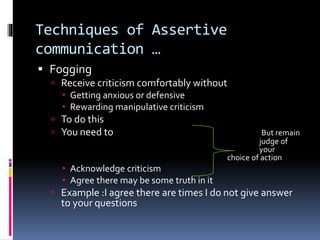
Techniques of Assertive
communication …
 Fogging
 Receive criticism comfortably without
 Getting anxious or defensive
 Rewarding manipulative criticism
 To do this
 You need to But remain
judge of
your
choice of action
 Acknowledge criticism
 Agree there may be some truth in it
 Example :I agree there are times I do not give answer
to your questions
Techniques of Assertive
communication …
 Negative assertion
 Makes you more comfortable
 at negative of your behaviour or personality
 without feeling defensive or anxious
 Reduces your critic’s hostility
 You should accept your error or fault but don’t
apologise
 Instead tentatively and sympathetically agree
with hostile criticism of your negative qualities
 Example:Yes you are right I do not always listen to
close to what you say
Techniques of Assertive
communication ..
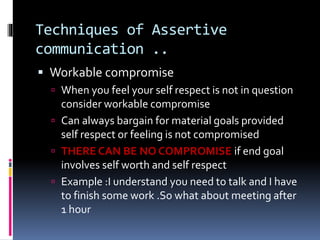
 Workable compromise
 When you feel your self respect is not in question
consider workable compromise
 Can always bargain for material goals provided
self respect or feeling is not compromised
 THERE CAN BE NO COMPROMISE if end goal
involves self worth and self respect
 Example :I understand you need to talk and I have
to finish some work .So what about meeting after
1 hour
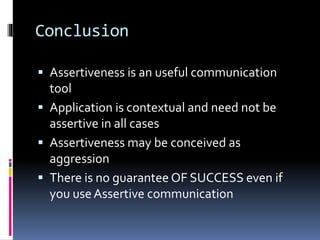
Conclusion
 Assertiveness is an useful communication
tool
 Application is contextual and need not be
assertive in all cases
 Assertiveness may be conceived as
aggression
 There is no guarantee OF SUCCESS even if
you use Assertive communication

SOFT SKILL-6 (ASSERTIVE COMMUNICATION)

  • 1.
    ASSERTIVE COMMUNICATION AND6 TIPS FOR ITS EFFECTIVE USE An Initiative of Shivnandani Industries Pvt Ltd & Jagdamb Janaki Nawal Janaki Society By Col Mukteshwar Prasad(Retd), MTech,FIE(I),FIETE,FISLE,FInstOD,AMCSI
  • 2.
    Style of communicationor behavioural choice  DirectAggression-bossy , arrogant , bulldozing , intolerant ,opionated ,overbearing  Indirect Aggression-sarcastic , deceiving , ambiguous ,insinuating ,manipulative ,guilt inducing  Submissive- Wailing , moaning , helpless , passive ,indecisive , apologetic  Assertive-direct ,honest, accepting , responsible ,spontaneous
  • 3.
    Definition of Assertive Communication Ability to express positive and negative ideas and feelings in open , honest and direct way . It recognises our rights  Respect right of others  Responsibility for ourselves and our action without judging or blaming other people  Constructively confront and find mutually satisfying solution if conflict exist
  • 4.
    Characteristics of Assertive comn Eye contact-demonstrates interest, shows sincerity  Body posture-congruent body language will improve the significance of message  Gesture-appropriate gesture help to add emphasis  Voice-a level , well modulated tone is more convincing and acceptable and is not intimidating  Timing-use your judgment to maximise receiptivity and impact  Content-how, where and when you choose to comment is probably more important than what you say
  • 5.
    Importance of Istatement  Part of being assertive and involves ability to appropriately express your needs and feelings  It indicates  Ownership  Donot attribute blame  Focuses on behavour  Identifies effect of behaviour  Honest  Contributes in growth of relationship with each other  Strong I statement has 3 elements  Behaviour  Feeling  Tangible effect
  • 6.
    Example of Istatement  I am frustrated when you are late in the meeting. I do not like to having repeat information
  • 7.
    Techniques of Assertive communication Behavioural Rehearsal  Practising what you want to look and sound  Useful if I statement is to be used  Helps dissipate emotions associated with experience  Allows you to identify behaviour you wish to confront.  Repeated assertion  Allows you to be comfortable  By ignoring verbal side traps while sticking to the point  Argumentative baiting  Irrelevant logic
  • 8.
    Techniques of Assertive communication…  To use technique most effectively  Use calm repetition  Say what you want to say  Stay focused on the issue  No need to  rehearse  Hype your self to deal with others
  • 9.
    Techniques of Assertive communication…  Example  Would like to show some of our product  No thank you. I am not interested  I really have great range to offer you  That may be true but I am not interested at present  Would any one else be interested  I told you I do not want any one of these products  Fine .Would you take brochure and think about it later.  Yes I will  Thank you.  You are welcome
  • 10.
    Techniques of Assertive communication…  Fogging  Receive criticism comfortably without  Getting anxious or defensive  Rewarding manipulative criticism  To do this  You need to But remain judge of your choice of action  Acknowledge criticism  Agree there may be some truth in it  Example :I agree there are times I do not give answer to your questions
  • 11.
    Techniques of Assertive communication…  Negative assertion  Makes you more comfortable  at negative of your behaviour or personality  without feeling defensive or anxious  Reduces your critic’s hostility  You should accept your error or fault but don’t apologise  Instead tentatively and sympathetically agree with hostile criticism of your negative qualities  Example:Yes you are right I do not always listen to close to what you say
  • 12.
    Techniques of Assertive communication..  Workable compromise  When you feel your self respect is not in question consider workable compromise  Can always bargain for material goals provided self respect or feeling is not compromised  THERE CAN BE NO COMPROMISE if end goal involves self worth and self respect  Example :I understand you need to talk and I have to finish some work .So what about meeting after 1 hour
  • 13.
    Conclusion  Assertiveness isan useful communication tool  Application is contextual and need not be assertive in all cases  Assertiveness may be conceived as aggression  There is no guarantee OF SUCCESS even if you use Assertive communication