ASSERTIVE
COMMUNICATION
ARCHANA JAYAKUMAR
Definition
a) Assertive communication is the ability to express positive and negative
ideas and feelings in an open , honest and direct way. It recognizes our
rights whilst still respecting the rights of others. It allows us to take
responsibility for ourselves and our actions without judging or blaming other
people. And it allows us to constructively confront and find a mutually
satisfying solution were conflict exists.
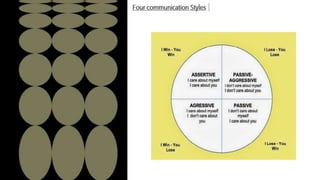
As indicated above, style of communication can vary in significant ways. Four typical
communication styles are:
Aggressive: Is intimidating, forceful, and does not consider the needs, rights or feelings of others. It
can involve yelling or saying rude, cutting or abusive Communicating aggressively can feel powerful
and can seem effective as others may fear you and do what you want as a result, however, this sort
of communication tends towards bullying behaviour that is potentially quite harmful to others and
ultimately ineffective as it does not engender like or respect from others.
Passive: Is submissive and deferent, avoids conflict at all costs, puts your own needs last, means
giving in to unreasonable demands from others and holding back your opinion. Passive
communication tends to avoid negative criticism and strives to avoid the notice of others. Passive
communication tends to focus overly on pleasing others at the cost of ones own needs and rights.
Passive-Aggressive: Has an overtone of aggression disguised in a benign or even pleasant tone of
voice. It is a way of not complying with the needs and wishes of others but without being upfront
about it. For example, claiming a headache when you are about to go out with a friend so that you
don’t have to go instead of being upfront about not wanting to go in the first place. Passive
aggressive communication can involve undermining others or “accidentally” taking an action that is
harmful to another.
Assertive: As described above, assertive communication is clear in its intent, involves standing up
for your own rights and wishes but respecting others at the same time. This is the most effective of
the four communication styles.
Characteristics of Assertive
Communication
There are six main characteristics of assertive communication
 Eye cotact – demonstrates interest, shows sincerity
 Body posture – congruent body language will improve the
significance of the message.
 Gestures -- appropriate gestures help to add emphasis.
 Voice --a level , well modulated tone is more convincing and
acceptable, and is not intimidating
 Timing – use your judgement to maximize receptivity and
impact.
 Content –how, where and when you choose to comment is
probably more important than WHAT you say.
The advantages of assertive communication
There are many advantages of assertive communication :
 It helps us feel good about ourselves and others.
 It leads to the development of mutual respect with others.
 It helps us achieve our goals
 It increases our self esteem.
 It minimizes hurting and alienating other people.
 It reduces anxiety
 It protects us from being taken advantage of by others.
 It enables us to make decisions and free choives inlife.
 It enables us to express , both verbally and non-verbally a wide range of feelings and
thoughts , both positive and negative.
Disadvantages of assertive communication
 Others may not approve of this style of communication , or may not approve of the views
you express
 Also, having a healthy regard for another person’s rights means that you won’t always
get what YOU want.
 You may also find out that you were wrong about a viewpoint that you held.
 But most importantly, it involves the risk that others may not understand and therefore
not accept this style of communication.
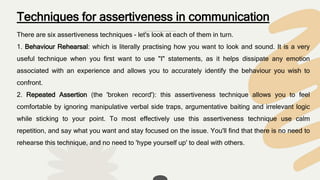
Techniques for assertiveness in communication
There are six assertiveness techniques - let's look at each of them in turn.
1. Behaviour Rehearsal: which is literally practising how you want to look and sound. It is a very
useful technique when you first want to use "I" statements, as it helps dissipate any emotion
associated with an experience and allows you to accurately identify the behaviour you wish to
confront.
2. Repeated Assertion (the 'broken record'): this assertiveness technique allows you to feel
comfortable by ignoring manipulative verbal side traps, argumentative baiting and irrelevant logic
while sticking to your point. To most effectively use this assertiveness technique use calm
repetition, and say what you want and stay focused on the issue. You'll find that there is no need to
rehearse this technique, and no need to 'hype yourself up' to deal with others.
Example:
"I would like to show you some of our products"
"No thank you, I'm not interested"
"I really have a great range to offer you"
"That may be true, but I'm not interested at the moment"
"Is there someone else here who would be interested?"
"I don't want any of these products"
"Ok, would you take this brochure and think about it?"
"Yes, I will take a brochure"
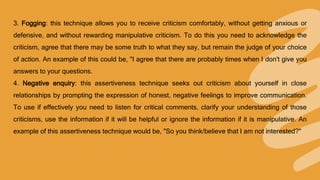
3. Fogging: this technique allows you to receive criticism comfortably, without getting anxious or
defensive, and without rewarding manipulative criticism. To do this you need to acknowledge the
criticism, agree that there may be some truth to what they say, but remain the judge of your choice
of action. An example of this could be, "I agree that there are probably times when I don't give you
answers to your questions.
4. Negative enquiry: this assertiveness technique seeks out criticism about yourself in close
relationships by prompting the expression of honest, negative feelings to improve communication.
To use if effectively you need to listen for critical comments, clarify your understanding of those
criticisms, use the information if it will be helpful or ignore the information if it is manipulative. An
example of this assertiveness technique would be, "So you think/believe that I am not interested?"
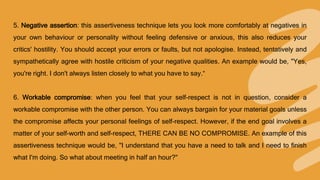
5. Negative assertion: this assertiveness technique lets you look more comfortably at negatives in
your own behaviour or personality without feeling defensive or anxious, this also reduces your
critics' hostility. You should accept your errors or faults, but not apologise. Instead, tentatively and
sympathetically agree with hostile criticism of your negative qualities. An example would be, "Yes,
you're right. I don't always listen closely to what you have to say.“
6. Workable compromise: when you feel that your self-respect is not in question, consider a
workable compromise with the other person. You can always bargain for your material goals unless
the compromise affects your personal feelings of self-respect. However, if the end goal involves a
matter of your self-worth and self-respect, THERE CAN BE NO COMPROMISE. An example of this
assertiveness technique would be, "I understand that you have a need to talk and I need to finish
what I'm doing. So what about meeting in half an hour?"
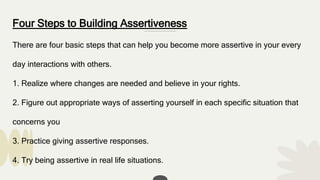
Four Steps to Building Assertiveness
There are four basic steps that can help you become more assertive in your every
day interactions with others.
1. Realize where changes are needed and believe in your rights.
2. Figure out appropriate ways of asserting yourself in each specific situation that
concerns you
3. Practice giving assertive responses.
4. Try being assertive in real life situations.
THANK
YOU

ASSERTIVE COMMUNICATION ,MSC NURSING PPT

  • 1.
  • 2.
    Definition a) Assertive communicationis the ability to express positive and negative ideas and feelings in an open , honest and direct way. It recognizes our rights whilst still respecting the rights of others. It allows us to take responsibility for ourselves and our actions without judging or blaming other people. And it allows us to constructively confront and find a mutually satisfying solution were conflict exists.
  • 4.
    As indicated above,style of communication can vary in significant ways. Four typical communication styles are: Aggressive: Is intimidating, forceful, and does not consider the needs, rights or feelings of others. It can involve yelling or saying rude, cutting or abusive Communicating aggressively can feel powerful and can seem effective as others may fear you and do what you want as a result, however, this sort of communication tends towards bullying behaviour that is potentially quite harmful to others and ultimately ineffective as it does not engender like or respect from others. Passive: Is submissive and deferent, avoids conflict at all costs, puts your own needs last, means giving in to unreasonable demands from others and holding back your opinion. Passive communication tends to avoid negative criticism and strives to avoid the notice of others. Passive communication tends to focus overly on pleasing others at the cost of ones own needs and rights.
  • 5.
    Passive-Aggressive: Has anovertone of aggression disguised in a benign or even pleasant tone of voice. It is a way of not complying with the needs and wishes of others but without being upfront about it. For example, claiming a headache when you are about to go out with a friend so that you don’t have to go instead of being upfront about not wanting to go in the first place. Passive aggressive communication can involve undermining others or “accidentally” taking an action that is harmful to another. Assertive: As described above, assertive communication is clear in its intent, involves standing up for your own rights and wishes but respecting others at the same time. This is the most effective of the four communication styles.
  • 6.
    Characteristics of Assertive Communication Thereare six main characteristics of assertive communication  Eye cotact – demonstrates interest, shows sincerity  Body posture – congruent body language will improve the significance of the message.  Gestures -- appropriate gestures help to add emphasis.  Voice --a level , well modulated tone is more convincing and acceptable, and is not intimidating  Timing – use your judgement to maximize receptivity and impact.  Content –how, where and when you choose to comment is probably more important than WHAT you say.
  • 7.
    The advantages ofassertive communication There are many advantages of assertive communication :  It helps us feel good about ourselves and others.  It leads to the development of mutual respect with others.  It helps us achieve our goals  It increases our self esteem.  It minimizes hurting and alienating other people.  It reduces anxiety  It protects us from being taken advantage of by others.  It enables us to make decisions and free choives inlife.  It enables us to express , both verbally and non-verbally a wide range of feelings and thoughts , both positive and negative.
  • 8.
    Disadvantages of assertivecommunication  Others may not approve of this style of communication , or may not approve of the views you express  Also, having a healthy regard for another person’s rights means that you won’t always get what YOU want.  You may also find out that you were wrong about a viewpoint that you held.  But most importantly, it involves the risk that others may not understand and therefore not accept this style of communication.
  • 9.
    Techniques for assertivenessin communication There are six assertiveness techniques - let's look at each of them in turn. 1. Behaviour Rehearsal: which is literally practising how you want to look and sound. It is a very useful technique when you first want to use "I" statements, as it helps dissipate any emotion associated with an experience and allows you to accurately identify the behaviour you wish to confront. 2. Repeated Assertion (the 'broken record'): this assertiveness technique allows you to feel comfortable by ignoring manipulative verbal side traps, argumentative baiting and irrelevant logic while sticking to your point. To most effectively use this assertiveness technique use calm repetition, and say what you want and stay focused on the issue. You'll find that there is no need to rehearse this technique, and no need to 'hype yourself up' to deal with others.
  • 10.
    Example: "I would liketo show you some of our products" "No thank you, I'm not interested" "I really have a great range to offer you" "That may be true, but I'm not interested at the moment" "Is there someone else here who would be interested?" "I don't want any of these products" "Ok, would you take this brochure and think about it?" "Yes, I will take a brochure"
  • 11.
    3. Fogging: thistechnique allows you to receive criticism comfortably, without getting anxious or defensive, and without rewarding manipulative criticism. To do this you need to acknowledge the criticism, agree that there may be some truth to what they say, but remain the judge of your choice of action. An example of this could be, "I agree that there are probably times when I don't give you answers to your questions. 4. Negative enquiry: this assertiveness technique seeks out criticism about yourself in close relationships by prompting the expression of honest, negative feelings to improve communication. To use if effectively you need to listen for critical comments, clarify your understanding of those criticisms, use the information if it will be helpful or ignore the information if it is manipulative. An example of this assertiveness technique would be, "So you think/believe that I am not interested?"
  • 12.
    5. Negative assertion:this assertiveness technique lets you look more comfortably at negatives in your own behaviour or personality without feeling defensive or anxious, this also reduces your critics' hostility. You should accept your errors or faults, but not apologise. Instead, tentatively and sympathetically agree with hostile criticism of your negative qualities. An example would be, "Yes, you're right. I don't always listen closely to what you have to say.“ 6. Workable compromise: when you feel that your self-respect is not in question, consider a workable compromise with the other person. You can always bargain for your material goals unless the compromise affects your personal feelings of self-respect. However, if the end goal involves a matter of your self-worth and self-respect, THERE CAN BE NO COMPROMISE. An example of this assertiveness technique would be, "I understand that you have a need to talk and I need to finish what I'm doing. So what about meeting in half an hour?"
  • 13.
    Four Steps toBuilding Assertiveness There are four basic steps that can help you become more assertive in your every day interactions with others. 1. Realize where changes are needed and believe in your rights. 2. Figure out appropriate ways of asserting yourself in each specific situation that concerns you 3. Practice giving assertive responses. 4. Try being assertive in real life situations.
  • 14.