UNIT 2
(Artificial Intelligence &
Machine Learning)
What is Machine Learning?
▪ “Learning is any process by which a system improves performance from
experience.” - Herbert Simon
▪ Definition by Tom Mitchell (1998):
▪ Machine Learning is the study of algorithms that
▪ improve their performance P
▪ at some task T
▪ with experience E.
▪ A well-defined learning task is given by <P,T,E>
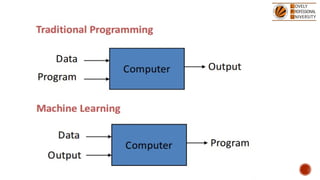
It is the field of the study that gives computers the capability to learn without being explicitly
programmed.
e.g. e-commerce website (online shopping)
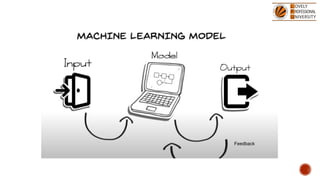
Feedback
Introduction to Machine Learning
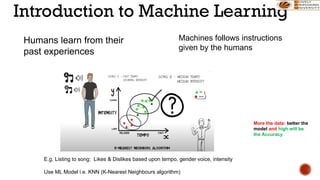
Humans learn from their
past experiences
Machines follows instructions
given by the humans
E.g. Listing to song: Likes & Dislikes based upon tempo, gender voice, intensity
Use ML Model i.e. KNN (K-Nearest Neighbours algorithm)
More the data: better the
model and high will be
the Accuracy
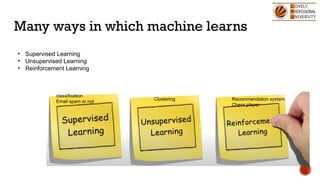
Many ways in which machine learns
• Supervised Learning
• Unsupervised Learning
• Reinforcement Learning
classification
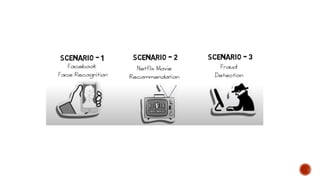
Email spam or not Clustering Recommendation system
Chess player
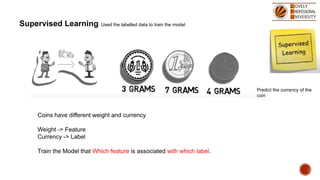
Supervised Learning: Used the labelled data to train the model
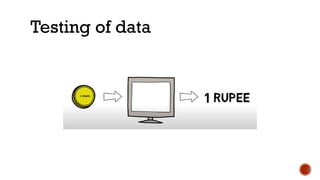
Coins have different weight and currency
Weight -> Feature
Currency -> Label
Train the Model that Which feature is associated with which label.
Predict the currency of the
coin
Testing of data
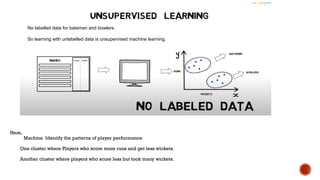
Here,
Machine Identify the patterns of player performance
One cluster where Players who score more runs and get less wickets.
Another cluster where players who score less but took many wickets.
No labelled data for batsman and bowlers.
So learning with unlabelled data is unsupervised machine learning.
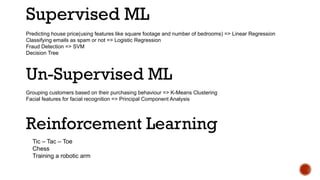
Supervised ML
Predicting house price(using features like square footage and number of bedrooms) => Linear Regression
Classifying emails as spam or not => Logistic Regression
Fraud Detection => SVM
Decision Tree
Un-Supervised ML
Grouping customers based on their purchasing behaviour => K-Means Clustering
Facial features for facial recognition => Principal Component Analysis
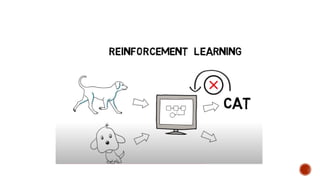
Reinforcement Learning
Tic – Tac – Toe
Chess
Training a robotic arm
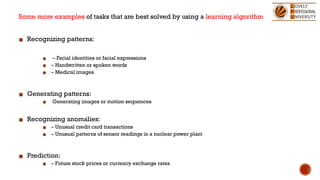
Some more examples of tasks that are best solved by using a learning algorithm
▪ Recognizing patterns:
▪ – Facial identities or facial expressions
▪ – Handwritten or spoken words
▪ – Medical images
▪ Generating patterns:
▪ Generating images or motion sequences
▪ Recognizing anomalies:
▪ – Unusual credit card transactions
▪ – Unusual patterns of sensor readings in a nuclear power plant
▪ Prediction:
▪ – Future stock prices or currency exchange rates
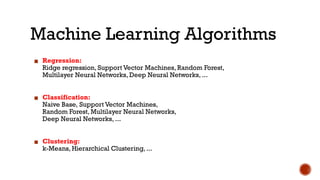
Machine Learning Algorithms
▪ Regression:
Ridge regression, Support Vector Machines, Random Forest,
Multilayer Neural Networks, Deep Neural Networks, ...
▪ Classification:
Naive Base, Support Vector Machines,
Random Forest, Multilayer Neural Networks,
Deep Neural Networks, ...
▪ Clustering:
k-Means, Hierarchical Clustering, ...
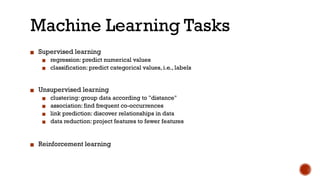
Machine Learning Tasks
▪ Supervised learning
▪ regression: predict numerical values
▪ classification: predict categorical values, i.e., labels
▪ Unsupervised learning
▪ clustering: group data according to "distance"
▪ association: find frequent co-occurrences
▪ link prediction: discover relationships in data
▪ data reduction: project features to fewer features
▪ Reinforcement learning
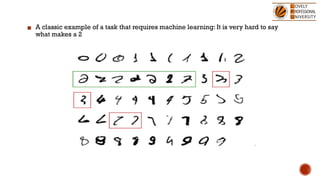
▪ A classic example of a task that requires machine learning: It is very hard to say
what makes a 2
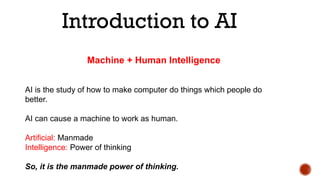
Introduction to AI
AI is the study of how to make computer do things which people do
better.
AI can cause a machine to work as human.
Artificial: Manmade
Intelligence: Power of thinking
So, it is the manmade power of thinking.
Machine + Human Intelligence
Reasons of Boost in AI
S/w or device can be made to solve real time problem.
Creation of virtual assistant. E.g. SIRI, CORTANA, ALEXA
Robots development [Helps in different dangerous environment
condition]
New Job opportunity
Goals of AI
• Replication of human intelligence.
• Solving problems that requires knowledge.
• Building a machine that can do human
intelligence task.
• -e.g. Chess , Automatic car driver,
proving theorems.
▪ Artificial Intelligence (AI) is a branch of computer science that
focuses on creating machines or systems capable of performing
tasks that typically require human intelligence.
▪ These tasks include learning, reasoning, problem-solving,
perception, language understanding, and decision-making.
▪ The ultimate goal of AI is to develop machines that can exhibit
intelligence similar to or even surpassing human intelligence.
Types of AI
AI can be broadly categorized into two types:
▪ Narrow AI (or Weak AI)
Narrow AI is designed to perform a specific task or a set of tasks, such
as speech recognition, image recognition, or playing chess
▪ General AI (or Strong AI)
▪ General AI, on the other hand, refers to machines with the ability to
understand, learn, and apply knowledge across various domains, similar
to human intelligence.
Components of AI includes
1. Machine Learning (ML): It is a subset of AI that involves the development of algorithms
and statistical models that enable computers to improve their performance on a task
through experience.
2. Deep Learning: This is a subfield of machine learning that involves neural networks with
multiple layers (deep neural networks). Deep learning has proven to be highly effective in
tasks such as image and speech recognition, natural language processing, and more.
3. Natural Language Processing (NLP): NLP enables computers to understand, interpret,
and generate human language. It is crucial for applications like chatbots, language
translation, and sentiment analysis.
4. Computer Vision: This field focuses on enabling machines to interpret and understand
visual information from the world, such as images and videos. Applications include facial
recognition, object detection, and autonomous vehicles.
5. Robotics: Integrating AI with robotics allows machines to interact with the physical world,
perform tasks, and make decisions based on sensory input.
6. Expert Systems: These are computer systems designed to mimic the decision-making abilities
of a human expert in a specific domain. They use rule-based systems and knowledge
representation to solve complex problems.
Reasons for failure
▪ Asking the wrong question
▪ Trying to solve the wrong problem
▪ Not having enough data
▪ Not having the right data
▪ Having too much data
▪ Hiring the wrong people
▪ Using the wrong tools
▪ Not having the right model
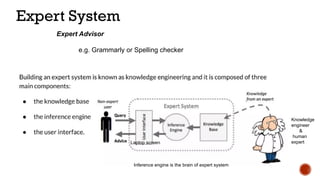
Expert System
Expert Advisor
e.g. Grammarly or Spelling checker
Inference engine is the brain of expert system
Laptop screen
Knowledge
engineer
&
human
expert
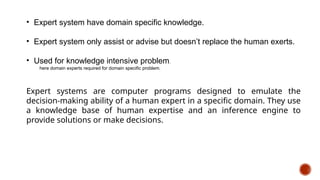
• Expert system have domain specific knowledge.
• Expert system only assist or advise but doesn’t replace the human exerts.
• Used for knowledge intensive problem.
here domain experts required for domain specific problem.
Expert systems are computer programs designed to emulate the
decision-making ability of a human expert in a specific domain. They use
a knowledge base of human expertise and an inference engine to
provide solutions or make decisions.
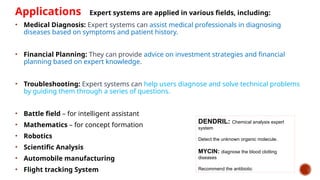
Applications Expert systems are applied in various fields, including:
• Medical Diagnosis: Expert systems can assist medical professionals in diagnosing
diseases based on symptoms and patient history.
• Financial Planning: They can provide advice on investment strategies and financial
planning based on expert knowledge.
• Troubleshooting: Expert systems can help users diagnose and solve technical problems
by guiding them through a series of questions.
• Battle field – for intelligent assistant
• Mathematics – for concept formation
• Robotics
• Scientific Analysis
• Automobile manufacturing
• Flight tracking System
DENDRIL: Chemical analysis expert
system
Detect the unknown organic molecule.
MYCIN: diagnose the blood clotting
diseases
Recommend the antibiotic
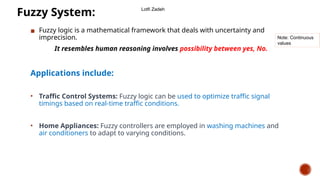
▪ Fuzzy logic is a mathematical framework that deals with uncertainty and
imprecision.
It resembles human reasoning involves possibility between yes, No.
Applications include:
• Traffic Control Systems: Fuzzy logic can be used to optimize traffic signal
timings based on real-time traffic conditions.
• Home Appliances: Fuzzy controllers are employed in washing machines and
air conditioners to adapt to varying conditions.
Fuzzy System:
Note: Continuous
values
Lotfi Zadeh
Augmented Reality
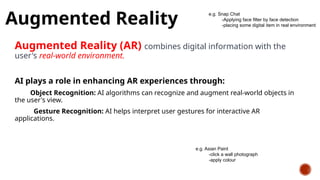
Augmented Reality (AR) combines digital information with the
user's real-world environment.
AI plays a role in enhancing AR experiences through:
Object Recognition: AI algorithms can recognize and augment real-world objects in
the user's view.
Gesture Recognition: AI helps interpret user gestures for interactive AR
applications.
e.g. Snap Chat
-Applying face filter by face detection
-placing some digital item in real environment
e.g. Asian Paint
-click a wall photograph
-apply colour
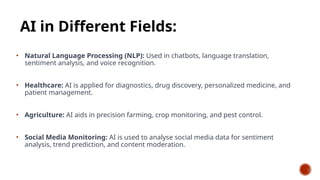
AI in Different Fields:
• Natural Language Processing (NLP): Used in chatbots, language translation,
sentiment analysis, and voice recognition.
• Healthcare: AI is applied for diagnostics, drug discovery, personalized medicine, and
patient management.
• Agriculture: AI aids in precision farming, crop monitoring, and pest control.
• Social Media Monitoring: AI is used to analyse social media data for sentiment
analysis, trend prediction, and content moderation.
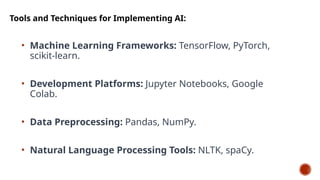
Tools and Techniques for Implementing AI:
• Machine Learning Frameworks: TensorFlow, PyTorch,
scikit-learn.
• Development Platforms: Jupyter Notebooks, Google
Colab.
• Data Preprocessing: Pandas, NumPy.
• Natural Language Processing Tools: NLTK, spaCy.
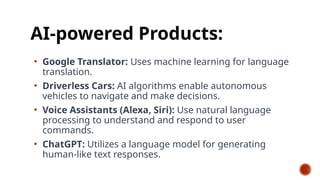
AI-powered Products:
• Google Translator: Uses machine learning for language
translation.
• Driverless Cars: AI algorithms enable autonomous
vehicles to navigate and make decisions.
• Voice Assistants (Alexa, Siri): Use natural language
processing to understand and respond to user
commands.
• ChatGPT: Utilizes a language model for generating
human-like text responses.
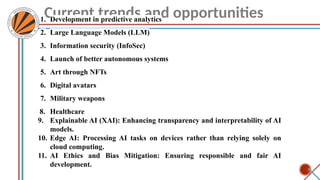
Current trends and opportunities
1. Development in predictive analytics
2. Large Language Models (LLM)
3. Information security (InfoSec)
4. Launch of better autonomous systems
5. Art through NFTs
6. Digital avatars
7. Military weapons
8. Healthcare
9. Explainable AI (XAI): Enhancing transparency and interpretability of AI
models.
10. Edge AI: Processing AI tasks on devices rather than relying solely on
cloud computing.
11. AI Ethics and Bias Mitigation: Ensuring responsible and fair AI
development.
Job roles and skill set
SKill Set
● Programming languages (Python, R, Java are the most necessary)
● Linear algebra and statistics
● Signal processing techniques
● Neural network architectures
● Machine Learning algorithms
Job Roles
● Machine Learning Engineer
● Data scientist
● Robotics scientist
● Research
● NLP Engineer
● Computer Vision Engineer.

Unit 2 artificial intelligence and machine learning

  • 1.
  • 2.
    What is MachineLearning? ▪ “Learning is any process by which a system improves performance from experience.” - Herbert Simon ▪ Definition by Tom Mitchell (1998): ▪ Machine Learning is the study of algorithms that ▪ improve their performance P ▪ at some task T ▪ with experience E. ▪ A well-defined learning task is given by <P,T,E> It is the field of the study that gives computers the capability to learn without being explicitly programmed. e.g. e-commerce website (online shopping)
  • 4.
  • 5.
    Introduction to MachineLearning Humans learn from their past experiences Machines follows instructions given by the humans E.g. Listing to song: Likes & Dislikes based upon tempo, gender voice, intensity Use ML Model i.e. KNN (K-Nearest Neighbours algorithm) More the data: better the model and high will be the Accuracy
  • 6.
    Many ways inwhich machine learns • Supervised Learning • Unsupervised Learning • Reinforcement Learning classification Email spam or not Clustering Recommendation system Chess player
  • 7.
    Supervised Learning: Usedthe labelled data to train the model Coins have different weight and currency Weight -> Feature Currency -> Label Train the Model that Which feature is associated with which label. Predict the currency of the coin
  • 8.
  • 9.
    Here, Machine Identify thepatterns of player performance One cluster where Players who score more runs and get less wickets. Another cluster where players who score less but took many wickets. No labelled data for batsman and bowlers. So learning with unlabelled data is unsupervised machine learning.
  • 12.
    Supervised ML Predicting houseprice(using features like square footage and number of bedrooms) => Linear Regression Classifying emails as spam or not => Logistic Regression Fraud Detection => SVM Decision Tree Un-Supervised ML Grouping customers based on their purchasing behaviour => K-Means Clustering Facial features for facial recognition => Principal Component Analysis Reinforcement Learning Tic – Tac – Toe Chess Training a robotic arm
  • 13.
    Some more examplesof tasks that are best solved by using a learning algorithm ▪ Recognizing patterns: ▪ – Facial identities or facial expressions ▪ – Handwritten or spoken words ▪ – Medical images ▪ Generating patterns: ▪ Generating images or motion sequences ▪ Recognizing anomalies: ▪ – Unusual credit card transactions ▪ – Unusual patterns of sensor readings in a nuclear power plant ▪ Prediction: ▪ – Future stock prices or currency exchange rates
  • 14.
    Machine Learning Algorithms ▪Regression: Ridge regression, Support Vector Machines, Random Forest, Multilayer Neural Networks, Deep Neural Networks, ... ▪ Classification: Naive Base, Support Vector Machines, Random Forest, Multilayer Neural Networks, Deep Neural Networks, ... ▪ Clustering: k-Means, Hierarchical Clustering, ...
  • 15.
    Machine Learning Tasks ▪Supervised learning ▪ regression: predict numerical values ▪ classification: predict categorical values, i.e., labels ▪ Unsupervised learning ▪ clustering: group data according to "distance" ▪ association: find frequent co-occurrences ▪ link prediction: discover relationships in data ▪ data reduction: project features to fewer features ▪ Reinforcement learning
  • 16.
    ▪ A classicexample of a task that requires machine learning: It is very hard to say what makes a 2
  • 17.
    Introduction to AI AIis the study of how to make computer do things which people do better. AI can cause a machine to work as human. Artificial: Manmade Intelligence: Power of thinking So, it is the manmade power of thinking. Machine + Human Intelligence
  • 18.
    Reasons of Boostin AI S/w or device can be made to solve real time problem. Creation of virtual assistant. E.g. SIRI, CORTANA, ALEXA Robots development [Helps in different dangerous environment condition] New Job opportunity
  • 19.
    Goals of AI •Replication of human intelligence. • Solving problems that requires knowledge. • Building a machine that can do human intelligence task. • -e.g. Chess , Automatic car driver, proving theorems.
  • 20.
    ▪ Artificial Intelligence(AI) is a branch of computer science that focuses on creating machines or systems capable of performing tasks that typically require human intelligence. ▪ These tasks include learning, reasoning, problem-solving, perception, language understanding, and decision-making. ▪ The ultimate goal of AI is to develop machines that can exhibit intelligence similar to or even surpassing human intelligence.
  • 21.
    Types of AI AIcan be broadly categorized into two types: ▪ Narrow AI (or Weak AI) Narrow AI is designed to perform a specific task or a set of tasks, such as speech recognition, image recognition, or playing chess ▪ General AI (or Strong AI) ▪ General AI, on the other hand, refers to machines with the ability to understand, learn, and apply knowledge across various domains, similar to human intelligence.
  • 22.
    Components of AIincludes 1. Machine Learning (ML): It is a subset of AI that involves the development of algorithms and statistical models that enable computers to improve their performance on a task through experience. 2. Deep Learning: This is a subfield of machine learning that involves neural networks with multiple layers (deep neural networks). Deep learning has proven to be highly effective in tasks such as image and speech recognition, natural language processing, and more. 3. Natural Language Processing (NLP): NLP enables computers to understand, interpret, and generate human language. It is crucial for applications like chatbots, language translation, and sentiment analysis. 4. Computer Vision: This field focuses on enabling machines to interpret and understand visual information from the world, such as images and videos. Applications include facial recognition, object detection, and autonomous vehicles. 5. Robotics: Integrating AI with robotics allows machines to interact with the physical world, perform tasks, and make decisions based on sensory input. 6. Expert Systems: These are computer systems designed to mimic the decision-making abilities of a human expert in a specific domain. They use rule-based systems and knowledge representation to solve complex problems.
  • 23.
    Reasons for failure ▪Asking the wrong question ▪ Trying to solve the wrong problem ▪ Not having enough data ▪ Not having the right data ▪ Having too much data ▪ Hiring the wrong people ▪ Using the wrong tools ▪ Not having the right model
  • 24.
    Expert System Expert Advisor e.g.Grammarly or Spelling checker Inference engine is the brain of expert system Laptop screen Knowledge engineer & human expert
  • 25.
    • Expert systemhave domain specific knowledge. • Expert system only assist or advise but doesn’t replace the human exerts. • Used for knowledge intensive problem. here domain experts required for domain specific problem. Expert systems are computer programs designed to emulate the decision-making ability of a human expert in a specific domain. They use a knowledge base of human expertise and an inference engine to provide solutions or make decisions.
  • 26.
    Applications Expert systemsare applied in various fields, including: • Medical Diagnosis: Expert systems can assist medical professionals in diagnosing diseases based on symptoms and patient history. • Financial Planning: They can provide advice on investment strategies and financial planning based on expert knowledge. • Troubleshooting: Expert systems can help users diagnose and solve technical problems by guiding them through a series of questions. • Battle field – for intelligent assistant • Mathematics – for concept formation • Robotics • Scientific Analysis • Automobile manufacturing • Flight tracking System DENDRIL: Chemical analysis expert system Detect the unknown organic molecule. MYCIN: diagnose the blood clotting diseases Recommend the antibiotic
  • 27.
    ▪ Fuzzy logicis a mathematical framework that deals with uncertainty and imprecision. It resembles human reasoning involves possibility between yes, No. Applications include: • Traffic Control Systems: Fuzzy logic can be used to optimize traffic signal timings based on real-time traffic conditions. • Home Appliances: Fuzzy controllers are employed in washing machines and air conditioners to adapt to varying conditions. Fuzzy System: Note: Continuous values Lotfi Zadeh
  • 28.
    Augmented Reality Augmented Reality(AR) combines digital information with the user's real-world environment. AI plays a role in enhancing AR experiences through: Object Recognition: AI algorithms can recognize and augment real-world objects in the user's view. Gesture Recognition: AI helps interpret user gestures for interactive AR applications. e.g. Snap Chat -Applying face filter by face detection -placing some digital item in real environment e.g. Asian Paint -click a wall photograph -apply colour
  • 29.
    AI in DifferentFields: • Natural Language Processing (NLP): Used in chatbots, language translation, sentiment analysis, and voice recognition. • Healthcare: AI is applied for diagnostics, drug discovery, personalized medicine, and patient management. • Agriculture: AI aids in precision farming, crop monitoring, and pest control. • Social Media Monitoring: AI is used to analyse social media data for sentiment analysis, trend prediction, and content moderation.
  • 30.
    Tools and Techniquesfor Implementing AI: • Machine Learning Frameworks: TensorFlow, PyTorch, scikit-learn. • Development Platforms: Jupyter Notebooks, Google Colab. • Data Preprocessing: Pandas, NumPy. • Natural Language Processing Tools: NLTK, spaCy.
  • 31.
    AI-powered Products: • GoogleTranslator: Uses machine learning for language translation. • Driverless Cars: AI algorithms enable autonomous vehicles to navigate and make decisions. • Voice Assistants (Alexa, Siri): Use natural language processing to understand and respond to user commands. • ChatGPT: Utilizes a language model for generating human-like text responses.
  • 32.
    Current trends andopportunities 1. Development in predictive analytics 2. Large Language Models (LLM) 3. Information security (InfoSec) 4. Launch of better autonomous systems 5. Art through NFTs 6. Digital avatars 7. Military weapons 8. Healthcare 9. Explainable AI (XAI): Enhancing transparency and interpretability of AI models. 10. Edge AI: Processing AI tasks on devices rather than relying solely on cloud computing. 11. AI Ethics and Bias Mitigation: Ensuring responsible and fair AI development.
  • 33.
    Job roles andskill set SKill Set ● Programming languages (Python, R, Java are the most necessary) ● Linear algebra and statistics ● Signal processing techniques ● Neural network architectures ● Machine Learning algorithms Job Roles ● Machine Learning Engineer ● Data scientist ● Robotics scientist ● Research ● NLP Engineer ● Computer Vision Engineer.