MODULE - I
Introduction to Multimedia
WHAT IS MULTIMEDIA?
• Multimedia consists of applications that use multiple
modalities to their advantage, including text, images,
drawings (graphics), animation, video, sound (including
speech), and, most likely, interactivity of some kind.
• Multimedia is content that uses a combination of different
content forms such as text, audio, images, animation, video
and interactive content.
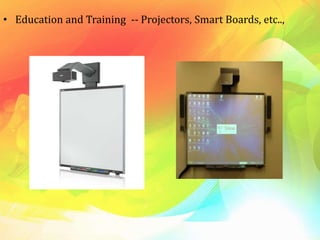
• Education and Training -- Projectors, Smart Boards, etc..,
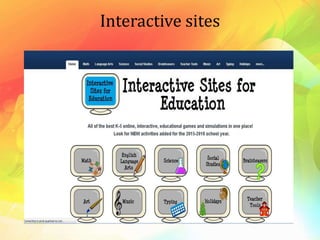
Interactive sites
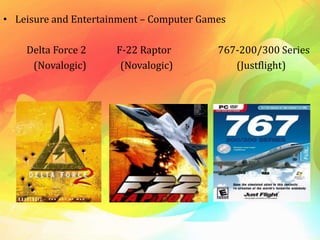
• Leisure and Entertainment – Computer Games
Delta Force 2 F-22 Raptor 767-200/300 Series
(Novalogic) (Novalogic) (Justflight)
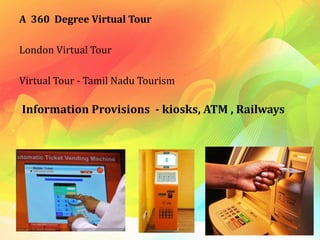
A 360 Degree Virtual Tour
London Virtual Tour
Virtual Tour - Tamil Nadu Tourism
Information Provisions - kiosks, ATM , Railways
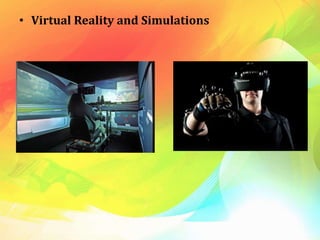
• Virtual Reality and Simulations
Advances in Technology
Google Maps
The developments in satellite technology in space has
allowed for the creation of highly interactive maps on the
internet, accessible via Google maps making it easier for the
audience to locate places and gather directions
Connectivity, the Key to Multimedia
The capacity of a program or device to connect with other
programs or devices; internet networks and wireless phones
bring it to mind. Essentially, connectivity allows us to
connect with each other.
Connectivity in Public Spaces
To develop an interaction between the individual and their
surroundings. The goal then becomes to make space an
interface where content that adapts to the activity taking
place in that space can be projected.
Generating Content in Real Time
Tom Bradley International Terminal project at the Los
Angeles Airport, where the ambient imagery changes
according to passengers’ destinations.
The digital artwork on the pillars is connected to the
airport data system and regularly changes to reflect
outbound flights.
Wearable Technology
One very obvious trend in wearable technologies will be
the “smartwatch,” the intelligent watch that, in addition to
telling time, allows us to remain connected and keep our
hands free.
3D Printing, Smart Keyboard, etc..,
Components of Multimedia
The multiple modalities of text, audio, images, drawings,
animation, and video in multimedia are put to use in ways as
diverse as
• Video teleconferencing – [Discussion]
• Distributed lectures for higher education - [Distance Learning]
• Telemedicine - [Telehealth]
• Cooperative work environments that allow business people to
edit a shared document or schoolchildren to share a single
game using two mice that pass control back and forth -
[Goolge Docs, Online Chess]
• Searching (very) large video and image databases for target
visual objects .
• "Augmented" reality:
Placing real-appearing computer graphics and video objects
into scenes so as to take the physics of objects and lights (e.g.,
shadows) into account.
Augmented reality (AR) is a live, direct or indirect, view of a
physical, real-World environment whose elements are
augmented by computer-generated sensory input such as
sound, video, graphics or GPS data.
• Audio cues for where video-conference participants are
seated, as well as taking into account gaze direction and
attention of participants
• Building searchable features into new video and enabling
very high to very low bit rate use of new, scalable
multimedia products
• Making multimedia components editable allowing the user
side to decide what components, video, graphics, and so on
are actually viewed and allowing the client to move
components around or delete them making components
distributed
• Building "inverse-Hollywood" applications that can re-
create the process by which a video was made, allowing
story board pruning and concise video summarization
• Using voice recognition to build an interactive environment
say a kitchen-wall web browser .
Multimedia Research Topics & Projects
 Multimedia Processing and coding
Multimedia content analysis
Content-based multimedia retrieval
Multimedia security
Audio/image/video processing
Compression
Data Mining
 Multimedia system support and networking
Network protocols
Internet
Operating Systems
Servers and Clients
QoS
Databases
 Multimedia tools, end systems, and applications
Hypermedia systems
User Interfaces
Authoring systems
Multimodal Interaction and integration
Multimedia Education
Applications of virtual environment
 Current Multimedia Projects
Camera based object tracking technology Gaming, Industry……
3D motion capture Multiple camera’s
Applications for handicapped persons
Digital fashion
Health Care Monitoring
Natural Interaction by virtual characters
Multimedia
• History of Multimedia
1. Newspapers: perhaps the first mass communication medium
2. Motion Pictures (1830’s)
3. Wireless radio transmission (1895)
4. Television (20th century)
5. Computer (21 st century)
History of Multimedia
• A brief history of the use of multimedia to communicate ideas might
begin with newspapers, which were perhaps the first mass
communication medium, using text, graphics, and images.
• Motion pictures were originally conceived of in the 1830s to observe
motion too rapid for perception by the human eye. [persistence of
vision and the phi phenomenon]
• Thomas Alva Edison commissioned the invention of a motion picture
camera in 1887.
[Kinetograph] [Phonograph][Gramophone]
• Silent feature films appeared from 1910 to 1927; the silent era
effectively ended with the release of The Jazz Singer in 1927. [The first
feature-length motion picture with synchronized dialogue sequences,
with its Vitaphone sound-on-disc system]
• In 1895, Guglielmo Marconi sent his first wireless radio transmission at
Pontecchio, Italy.
• A few years later (1901), he detected radio waves beamed across the
Atlantic. [sending signals across The English channel (1899), from shore
to ship (1899) and finally across the Atlantic (1901)]
• Initially invented for telegraph, radio is now a major medium for audio
broadcasting. In 1909, Marconi shared the Nobel Prize for physics.
[The Titanic Makes "Radio“ A Household Word, David Sarnoff was
involved in monitoring oceanic radio transmissions that night. ]
• Television was the new medium for the twentieth century. It
established video as a commonly available medium and has since
changed the world of mass communication.
• Of course, the telegraph was just the first of a string of inventions
throughout history that threatened the existing order of things.
newspapers were threatened by radio, and films were threatened by
both radio and television.
What is Multimedia?
• Multimedia means that computer information can be represented
through audio, video, and animation in addition to traditional media (i.e.,
text, graphics drawings, images).
• Multimedia is the field concerned with the computer-controlled
integration of text, graphics, drawings, still and moving images (Video),
animation, audio, and any other media where every type of information
can be represented, stored, transmitted and processed digitally.
• Hypermedia can be considered as one of the multimedia applications.
HyperText
• Hypertext is a text which contains links to other texts. The term was
invented by Ted Nelson around 1965. Hypertext is therefore usually non-
linear.
• HyperMedia is not constrained to be text-based. It can include other
media, e.g., graphics, images, and especially the continuous media -
sound and video. Ted Nelson was also the first to use this term.
• The World Wide Web (WWW) is the best example of hypermedia
applications.
Multimedia Systems
• A Multimedia System is a system capable of processing
multimedia data and applications.
• A Multimedia System is characterised by the processing, storage,
generation, manipulation and rendition of Multimedia
information.
A Multimedia system has four basic characteristics
• Multimedia systems must be computer controlled.
• Multimedia systems are integrated.
• The information they handle must be represented digitally.
• The interface to the final presentation of media is usually
interactive.
Components of a Multimedia System
(Hardware and Software)
• Capture devices -- Video Camera, Video Recorder, Audio Microphone,
Keyboards, mice, graphics tablets, 3D input devices, tactile sensors, VR
devices. Digitising/Sampling Hardware
• Storage Devices -- Hard disks, CD-ROMs, Jaz/Zip drives, DVD, etc
• Communication Networks -- Ethernet, Token Ring, FDDI, ATM,
Intranets, Internets.
• Computer Systems -- Multimedia Desktop machines, Workstations,
MPEG/VIDEO/DSP Hardware
• Display Devices -- CD-quality speakers, HDTV,SVGA, Hi-Res monitors,
Colour printers etc.
The connection between computers and ideas about multimedia
covers what is actually only a short period:
• 1945 As part of MIT's postwar deliberations on what to do with
all those scientists employed on the war effort, Vannevar Bush
(1890-1974) wrote a landmark article [2] describing what
amounts to a hypermedia system, called "Memex." Memex was
meant to be a universally useful and personalized memory
device that even included the concept of associative links — it
really is the forerunner of the World Wide Web.
• 1960s Ted Nelson started the Xanadu project and coined the
term "hypertext." Xanadu was the first attempt at a hypertext
system — Nelson called it a "magic place of literary memory.“
• 1967sNicholas Negroponte formed the Architecture Machine
Group at MIT.
• Douglas Engelbart, greatly influenced by Vannevar Bush's
"As We May Think," demonstrated the "On-Line System"
(NLS), another early hypertext program.
• En-gelbart's group at Stanford Research Institute aimed at
"augmentation, not automation," to enhance human
abilities through computer technology.
• Nelson and van Dam at Brown University created an early
hypertext editor called FRESS'.
• The present-day Intermedia project by the Institute for
Research in Information and Scholarship (IRIS) at Brown is
the descendant of that early system.
• 1976 The MIT Architecture Machine Group proposed
aproject entitled "Multiple Media." This resulted in the
Aspen Movie Map, the first hypermedia videodisc, in 1978.
• 1985Negroponte and Wiesner cofounded the MIT Media
Lab, a leading research institution investigating digital
video and multimedia.
• Tim Berners-Lee proposed the World Wide Web to the
European Council for Nuclear Research (CERN).
• Kristina Hooper Woolsey headed the Apple Multimedia
Lab, with a staff of 100. Education was a chief goal.
• MPEG-1 was approved as an international standard for
digital video. Its further development led to newer
standards, MPEG-2, MPEG-4, and further MPEGs, in the
1990s.
• The introduction of PDAs in 1991 began a new period in
the use of computers in general and multimedia in
particular. This development continued in 1996 with the
marketing of the first PDA with no keyboard.
• JPEG was accepted as the international standard for digital
image compression. Its further development has now led to
the new JPEG2000 standard.
• The first MBone audio multicast on the Net was made.
• The University of Illinois National Center for Supercomputing
Applications produced NCSA Mosaic, the first full-fledged
browser, launching a new era in Internet information access.
• Jim Clark and Marc Andreessen created the Netscape
program.
• The JAVA language was created for platform-independent
application development.
• DVD video was introduced; high-quality, full-length movies
were distributed on a single disk. The DVD format promised
to transform the music, gaming and computer industries.
• 1998 XML 1.0 was announced as a W3C Recommendation.
• 1998 Handheld MP3 devices first made inroads into
consumer tastes in the fall, with the introduction of devices
holding 32 MB of flash memory.
• 2000 World Wide Web (WWW) size was estimated at over
1 billion pages. The W3C has listed the following three
goals for the WWW: universal access of web resources (by
everyone everywhere), effectiveness of navigating available
information, and responsible use of posted material.
Referances
Text Books
• Ze-Nian Li and M. S. Drew, .Fundamental of Multimedia., Pearson Education,2004
• V. S. Subrahmanian, .Principles of Multimedia Database Systems., Morgan Kaufmann
Publication.
Web
• http://interactivesites.weebly.com/
• http://www.cs.cf.ac.uk/Dave/ISE_Multimedia/BSC_MM_CALLER.html
• http://www.cybercollege.com/frtv/frtv015.htm
• http://interactivesites.weebly.com/
• http://www.visitlondon.com/discover-london/london-virtual-tour
• http://tamilnadutourism.org/virtualtour/
Any Comments and suggestions are welcome
• manish.cs@adishankara.ac.in

Introduction to Multimedia

  • 1.
  • 2.
    WHAT IS MULTIMEDIA? •Multimedia consists of applications that use multiple modalities to their advantage, including text, images, drawings (graphics), animation, video, sound (including speech), and, most likely, interactivity of some kind. • Multimedia is content that uses a combination of different content forms such as text, audio, images, animation, video and interactive content.
  • 3.
    • Education andTraining -- Projectors, Smart Boards, etc..,
  • 4.
  • 5.
    • Leisure andEntertainment – Computer Games Delta Force 2 F-22 Raptor 767-200/300 Series (Novalogic) (Novalogic) (Justflight)
  • 6.
    A 360 DegreeVirtual Tour London Virtual Tour Virtual Tour - Tamil Nadu Tourism Information Provisions - kiosks, ATM , Railways
  • 7.
    • Virtual Realityand Simulations
  • 8.
    Advances in Technology GoogleMaps The developments in satellite technology in space has allowed for the creation of highly interactive maps on the internet, accessible via Google maps making it easier for the audience to locate places and gather directions Connectivity, the Key to Multimedia The capacity of a program or device to connect with other programs or devices; internet networks and wireless phones bring it to mind. Essentially, connectivity allows us to connect with each other.
  • 9.
    Connectivity in PublicSpaces To develop an interaction between the individual and their surroundings. The goal then becomes to make space an interface where content that adapts to the activity taking place in that space can be projected. Generating Content in Real Time Tom Bradley International Terminal project at the Los Angeles Airport, where the ambient imagery changes according to passengers’ destinations. The digital artwork on the pillars is connected to the airport data system and regularly changes to reflect outbound flights.
  • 10.
    Wearable Technology One veryobvious trend in wearable technologies will be the “smartwatch,” the intelligent watch that, in addition to telling time, allows us to remain connected and keep our hands free. 3D Printing, Smart Keyboard, etc..,
  • 11.
    Components of Multimedia Themultiple modalities of text, audio, images, drawings, animation, and video in multimedia are put to use in ways as diverse as • Video teleconferencing – [Discussion] • Distributed lectures for higher education - [Distance Learning] • Telemedicine - [Telehealth] • Cooperative work environments that allow business people to edit a shared document or schoolchildren to share a single game using two mice that pass control back and forth - [Goolge Docs, Online Chess]
  • 12.
    • Searching (very)large video and image databases for target visual objects . • "Augmented" reality: Placing real-appearing computer graphics and video objects into scenes so as to take the physics of objects and lights (e.g., shadows) into account. Augmented reality (AR) is a live, direct or indirect, view of a physical, real-World environment whose elements are augmented by computer-generated sensory input such as sound, video, graphics or GPS data. • Audio cues for where video-conference participants are seated, as well as taking into account gaze direction and attention of participants
  • 13.
    • Building searchablefeatures into new video and enabling very high to very low bit rate use of new, scalable multimedia products • Making multimedia components editable allowing the user side to decide what components, video, graphics, and so on are actually viewed and allowing the client to move components around or delete them making components distributed • Building "inverse-Hollywood" applications that can re- create the process by which a video was made, allowing story board pruning and concise video summarization • Using voice recognition to build an interactive environment say a kitchen-wall web browser .
  • 14.
    Multimedia Research Topics& Projects  Multimedia Processing and coding Multimedia content analysis Content-based multimedia retrieval Multimedia security Audio/image/video processing Compression Data Mining  Multimedia system support and networking Network protocols Internet Operating Systems Servers and Clients QoS Databases
  • 15.
     Multimedia tools,end systems, and applications Hypermedia systems User Interfaces Authoring systems Multimodal Interaction and integration Multimedia Education Applications of virtual environment  Current Multimedia Projects Camera based object tracking technology Gaming, Industry…… 3D motion capture Multiple camera’s Applications for handicapped persons Digital fashion Health Care Monitoring Natural Interaction by virtual characters
  • 16.
    Multimedia • History ofMultimedia 1. Newspapers: perhaps the first mass communication medium 2. Motion Pictures (1830’s) 3. Wireless radio transmission (1895) 4. Television (20th century) 5. Computer (21 st century)
  • 17.
    History of Multimedia •A brief history of the use of multimedia to communicate ideas might begin with newspapers, which were perhaps the first mass communication medium, using text, graphics, and images. • Motion pictures were originally conceived of in the 1830s to observe motion too rapid for perception by the human eye. [persistence of vision and the phi phenomenon] • Thomas Alva Edison commissioned the invention of a motion picture camera in 1887. [Kinetograph] [Phonograph][Gramophone]
  • 18.
    • Silent featurefilms appeared from 1910 to 1927; the silent era effectively ended with the release of The Jazz Singer in 1927. [The first feature-length motion picture with synchronized dialogue sequences, with its Vitaphone sound-on-disc system] • In 1895, Guglielmo Marconi sent his first wireless radio transmission at Pontecchio, Italy. • A few years later (1901), he detected radio waves beamed across the Atlantic. [sending signals across The English channel (1899), from shore to ship (1899) and finally across the Atlantic (1901)] • Initially invented for telegraph, radio is now a major medium for audio broadcasting. In 1909, Marconi shared the Nobel Prize for physics. [The Titanic Makes "Radio“ A Household Word, David Sarnoff was involved in monitoring oceanic radio transmissions that night. ]
  • 19.
    • Television wasthe new medium for the twentieth century. It established video as a commonly available medium and has since changed the world of mass communication. • Of course, the telegraph was just the first of a string of inventions throughout history that threatened the existing order of things. newspapers were threatened by radio, and films were threatened by both radio and television.
  • 20.
    What is Multimedia? •Multimedia means that computer information can be represented through audio, video, and animation in addition to traditional media (i.e., text, graphics drawings, images). • Multimedia is the field concerned with the computer-controlled integration of text, graphics, drawings, still and moving images (Video), animation, audio, and any other media where every type of information can be represented, stored, transmitted and processed digitally. • Hypermedia can be considered as one of the multimedia applications. HyperText • Hypertext is a text which contains links to other texts. The term was invented by Ted Nelson around 1965. Hypertext is therefore usually non- linear.
  • 21.
    • HyperMedia isnot constrained to be text-based. It can include other media, e.g., graphics, images, and especially the continuous media - sound and video. Ted Nelson was also the first to use this term. • The World Wide Web (WWW) is the best example of hypermedia applications. Multimedia Systems • A Multimedia System is a system capable of processing multimedia data and applications. • A Multimedia System is characterised by the processing, storage, generation, manipulation and rendition of Multimedia information.
  • 22.
    A Multimedia systemhas four basic characteristics • Multimedia systems must be computer controlled. • Multimedia systems are integrated. • The information they handle must be represented digitally. • The interface to the final presentation of media is usually interactive.
  • 23.
    Components of aMultimedia System (Hardware and Software) • Capture devices -- Video Camera, Video Recorder, Audio Microphone, Keyboards, mice, graphics tablets, 3D input devices, tactile sensors, VR devices. Digitising/Sampling Hardware • Storage Devices -- Hard disks, CD-ROMs, Jaz/Zip drives, DVD, etc • Communication Networks -- Ethernet, Token Ring, FDDI, ATM, Intranets, Internets. • Computer Systems -- Multimedia Desktop machines, Workstations, MPEG/VIDEO/DSP Hardware • Display Devices -- CD-quality speakers, HDTV,SVGA, Hi-Res monitors, Colour printers etc.
  • 24.
    The connection betweencomputers and ideas about multimedia covers what is actually only a short period: • 1945 As part of MIT's postwar deliberations on what to do with all those scientists employed on the war effort, Vannevar Bush (1890-1974) wrote a landmark article [2] describing what amounts to a hypermedia system, called "Memex." Memex was meant to be a universally useful and personalized memory device that even included the concept of associative links — it really is the forerunner of the World Wide Web. • 1960s Ted Nelson started the Xanadu project and coined the term "hypertext." Xanadu was the first attempt at a hypertext system — Nelson called it a "magic place of literary memory.“ • 1967sNicholas Negroponte formed the Architecture Machine Group at MIT.
  • 25.
    • Douglas Engelbart,greatly influenced by Vannevar Bush's "As We May Think," demonstrated the "On-Line System" (NLS), another early hypertext program. • En-gelbart's group at Stanford Research Institute aimed at "augmentation, not automation," to enhance human abilities through computer technology. • Nelson and van Dam at Brown University created an early hypertext editor called FRESS'. • The present-day Intermedia project by the Institute for Research in Information and Scholarship (IRIS) at Brown is the descendant of that early system.
  • 26.
    • 1976 TheMIT Architecture Machine Group proposed aproject entitled "Multiple Media." This resulted in the Aspen Movie Map, the first hypermedia videodisc, in 1978. • 1985Negroponte and Wiesner cofounded the MIT Media Lab, a leading research institution investigating digital video and multimedia. • Tim Berners-Lee proposed the World Wide Web to the European Council for Nuclear Research (CERN).
  • 27.
    • Kristina HooperWoolsey headed the Apple Multimedia Lab, with a staff of 100. Education was a chief goal. • MPEG-1 was approved as an international standard for digital video. Its further development led to newer standards, MPEG-2, MPEG-4, and further MPEGs, in the 1990s. • The introduction of PDAs in 1991 began a new period in the use of computers in general and multimedia in particular. This development continued in 1996 with the marketing of the first PDA with no keyboard. • JPEG was accepted as the international standard for digital image compression. Its further development has now led to the new JPEG2000 standard.
  • 28.
    • The firstMBone audio multicast on the Net was made. • The University of Illinois National Center for Supercomputing Applications produced NCSA Mosaic, the first full-fledged browser, launching a new era in Internet information access. • Jim Clark and Marc Andreessen created the Netscape program. • The JAVA language was created for platform-independent application development. • DVD video was introduced; high-quality, full-length movies were distributed on a single disk. The DVD format promised to transform the music, gaming and computer industries.
  • 29.
    • 1998 XML1.0 was announced as a W3C Recommendation. • 1998 Handheld MP3 devices first made inroads into consumer tastes in the fall, with the introduction of devices holding 32 MB of flash memory. • 2000 World Wide Web (WWW) size was estimated at over 1 billion pages. The W3C has listed the following three goals for the WWW: universal access of web resources (by everyone everywhere), effectiveness of navigating available information, and responsible use of posted material.
  • 30.
    Referances Text Books • Ze-NianLi and M. S. Drew, .Fundamental of Multimedia., Pearson Education,2004 • V. S. Subrahmanian, .Principles of Multimedia Database Systems., Morgan Kaufmann Publication. Web • http://interactivesites.weebly.com/ • http://www.cs.cf.ac.uk/Dave/ISE_Multimedia/BSC_MM_CALLER.html • http://www.cybercollege.com/frtv/frtv015.htm • http://interactivesites.weebly.com/ • http://www.visitlondon.com/discover-london/london-virtual-tour • http://tamilnadutourism.org/virtualtour/
  • 31.
    Any Comments andsuggestions are welcome • manish.cs@adishankara.ac.in

Editor's Notes