Neuro Fuzzy
Soft Computing
An Introduction
http://www.free-powerpoint-templates-design.com
Agenda
Combination of Artificial Intelligence with Fuzzy Logic
Neuro Fuzzy Computing
02
Neural Network, Fuzzy set, Genetic Algorithm, Simulated annealing
Soft Computing Constituents
03
Goal Driven Characteristics
Characteristics
04
Constructing Intelligent System
Soft Computing
01
Soft Computing
Emerging approach to incorporate learning.
Resembles the remarkable ability of humans.
Innovative approach to construct Intelligent System.
Promotes learning in environment of uncertainty and imprecision.
Intelligent machine that generates Intelligent Behavior.
Soft Computing algorithms are adaptive.
Soft Computing relies on formal logic and probabilistic reasoning.
Soft computing is stochastic in nature.
Soft computing works on ambiguous and noisy data.
Soft computing can perform parallel computations.
It can deal with issues consisting of non-statistical data.
It can form equations based on a range of overlapping values instead of
those with hard boundaries.
Soft Computing
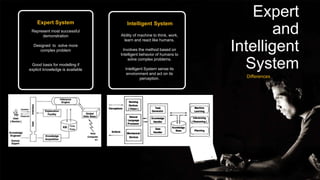
Expert System
Represent most successful
demonstration
Designed to solve more
complex problem
Good basis for modelling if
explicit knowledge is available
Intelligent System
Ability of machine to think, work,
learn and react like humans.
Involves the method based on
Intelligent behavior of humans to
solve complex problems.
Intelligent System sense its
environment and act on its
perception.
Expert
and
Intelligent
System
Differences
Neuro Fuzzy
A neuro-fuzzy system is based on a fuzzy system which is trained by a
learning algorithm derived from neural network theory.
They are a synergistic fusion of fuzzy logic and neural networks with the
ability to automate adaptation to training data and knowledge interpretability.
A neuro-fuzzy system can be viewed as a 3-layer feed forward neural
network.
The first layer represents input variables, the middle (hidden) layer
represents fuzzy rules and the third layer represents output variables.
Helps to create the system out of training data from scratch, as it is possible
to initialize it by prior knowledge in form of fuzzy rules.
NeuroFuzzy
A neuro-fuzzy system based on an underlying fuzzy system is trained by
means of a data-driven learning method derived from neural network theory.
represented as a set of fuzzy rules at any time of the learning process
The learning procedure is constrained to ensure the semantic properties of
the underlying fuzzy system.
A neuro-fuzzy system approximates a n-dimensional unknown function
which is partly represented by training examples
CharacteristicsofNeuroFuzzy
Constituents
Soft Computing
Neural Network
Fuzzy Set
Approximate Reasoning
Derivative free Optimization – Genetic Algorithm and Simulated annealing.
Constituents
NN helps to recognize underlying relationships in a set of data through a
process that mimics the way the human brain operates
Neural networks help us cluster and classify data.
Novel non algorithmic approach to information processing.
Uses distributed representation in the form of weights between
interconnected neurons.
NeuralNetwork
In real world we could encounter vague, inexact and uncertain information
that is called as Fuzzy Knowledge.
Fuzzy Set contracts to Classical set that has crisp boundary.
Fuzziness helps us to answer to many questions even the information is
unreliable and incomplete.
Fuzzy set is defined by unsharp and ambiguous boundaries.
Operations that could be performed on Fuzzy Sets Union, Intersection and
Complement.
Fuzzy rules could be generated to model human thinking, perception and
judgment.
Fuzzy Set
 Genetic Algorithm reflects the process of natural selection where the
individual fittest is selected.
This algorithm works iteratively.
It works in five phases Initial Population, Fitness function, Selection, Cross
Over and Mutation.
Algorithm terminates when convergence takes place.
GeneticAlgorithm
Characteristics
Human Expertise – fuzzy if-then rules.
Biologically inspired Computing Models – Neural networks and Artifical NN.
 New Optimization Techniques – Genetic algorithm, simulated annealing,
random search method, downhill simplex method.
Numerical computation – Soft computing relies on numerical computation.
New application domain – applications are computation intensive.
Model free learning – construct model only using target system sample data.
Intensive Computation – rely on high speed number crunching computation
Fault Tolerance – deletion of neuron does not destroy the system.
Goal Driven characteristics – current state to the solution progress towards
the goal in the long run.
Real world application – utilize specific techniques to construct satisfactory
solutions.
Neuro Fuzzy and Soft ComputingCharacteristics
THANK YOU

Soft Computing

  • 1.
    Neuro Fuzzy Soft Computing AnIntroduction http://www.free-powerpoint-templates-design.com
  • 2.
    Agenda Combination of ArtificialIntelligence with Fuzzy Logic Neuro Fuzzy Computing 02 Neural Network, Fuzzy set, Genetic Algorithm, Simulated annealing Soft Computing Constituents 03 Goal Driven Characteristics Characteristics 04 Constructing Intelligent System Soft Computing 01
  • 3.
  • 4.
    Emerging approach toincorporate learning. Resembles the remarkable ability of humans. Innovative approach to construct Intelligent System. Promotes learning in environment of uncertainty and imprecision. Intelligent machine that generates Intelligent Behavior. Soft Computing algorithms are adaptive. Soft Computing relies on formal logic and probabilistic reasoning. Soft computing is stochastic in nature. Soft computing works on ambiguous and noisy data. Soft computing can perform parallel computations. It can deal with issues consisting of non-statistical data. It can form equations based on a range of overlapping values instead of those with hard boundaries. Soft Computing
  • 5.
    Expert System Represent mostsuccessful demonstration Designed to solve more complex problem Good basis for modelling if explicit knowledge is available Intelligent System Ability of machine to think, work, learn and react like humans. Involves the method based on Intelligent behavior of humans to solve complex problems. Intelligent System sense its environment and act on its perception. Expert and Intelligent System Differences
  • 6.
  • 7.
    A neuro-fuzzy systemis based on a fuzzy system which is trained by a learning algorithm derived from neural network theory. They are a synergistic fusion of fuzzy logic and neural networks with the ability to automate adaptation to training data and knowledge interpretability. A neuro-fuzzy system can be viewed as a 3-layer feed forward neural network. The first layer represents input variables, the middle (hidden) layer represents fuzzy rules and the third layer represents output variables. Helps to create the system out of training data from scratch, as it is possible to initialize it by prior knowledge in form of fuzzy rules. NeuroFuzzy
  • 8.
    A neuro-fuzzy systembased on an underlying fuzzy system is trained by means of a data-driven learning method derived from neural network theory. represented as a set of fuzzy rules at any time of the learning process The learning procedure is constrained to ensure the semantic properties of the underlying fuzzy system. A neuro-fuzzy system approximates a n-dimensional unknown function which is partly represented by training examples CharacteristicsofNeuroFuzzy
  • 9.
  • 10.
    Neural Network Fuzzy Set ApproximateReasoning Derivative free Optimization – Genetic Algorithm and Simulated annealing. Constituents
  • 11.
    NN helps torecognize underlying relationships in a set of data through a process that mimics the way the human brain operates Neural networks help us cluster and classify data. Novel non algorithmic approach to information processing. Uses distributed representation in the form of weights between interconnected neurons. NeuralNetwork
  • 12.
    In real worldwe could encounter vague, inexact and uncertain information that is called as Fuzzy Knowledge. Fuzzy Set contracts to Classical set that has crisp boundary. Fuzziness helps us to answer to many questions even the information is unreliable and incomplete. Fuzzy set is defined by unsharp and ambiguous boundaries. Operations that could be performed on Fuzzy Sets Union, Intersection and Complement. Fuzzy rules could be generated to model human thinking, perception and judgment. Fuzzy Set
  • 13.
     Genetic Algorithmreflects the process of natural selection where the individual fittest is selected. This algorithm works iteratively. It works in five phases Initial Population, Fitness function, Selection, Cross Over and Mutation. Algorithm terminates when convergence takes place. GeneticAlgorithm
  • 14.
  • 15.
    Human Expertise –fuzzy if-then rules. Biologically inspired Computing Models – Neural networks and Artifical NN.  New Optimization Techniques – Genetic algorithm, simulated annealing, random search method, downhill simplex method. Numerical computation – Soft computing relies on numerical computation. New application domain – applications are computation intensive. Model free learning – construct model only using target system sample data. Intensive Computation – rely on high speed number crunching computation Fault Tolerance – deletion of neuron does not destroy the system. Goal Driven characteristics – current state to the solution progress towards the goal in the long run. Real world application – utilize specific techniques to construct satisfactory solutions. Neuro Fuzzy and Soft ComputingCharacteristics
  • 16.