Introduction to Soft Computing
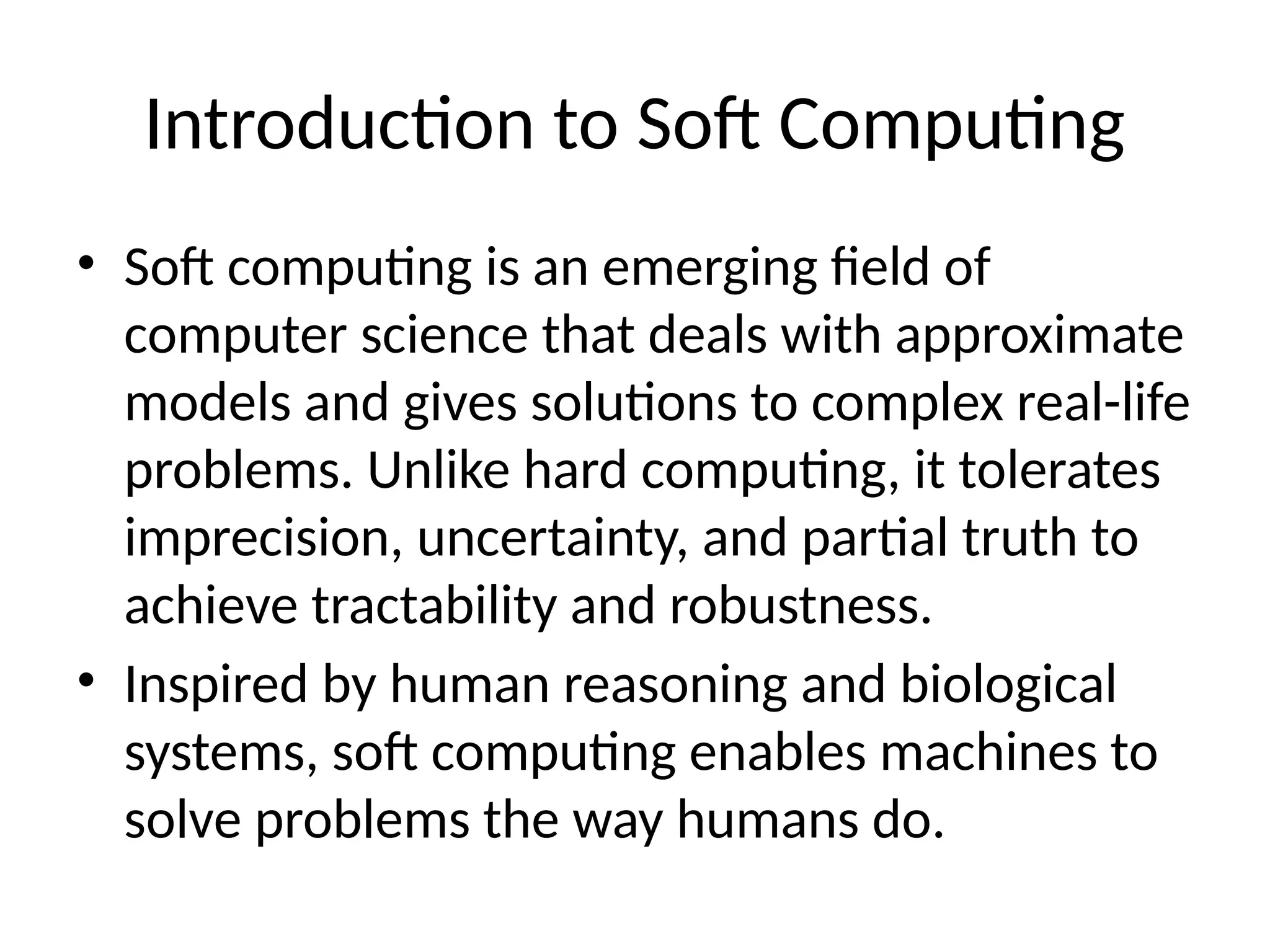
• Soft computing is an emerging field of
computer science that deals with approximate
models and gives solutions to complex real-life
problems. Unlike hard computing, it tolerates
imprecision, uncertainty, and partial truth to
achieve tractability and robustness.
• Inspired by human reasoning and biological
systems, soft computing enables machines to
solve problems the way humans do.
Historical Background
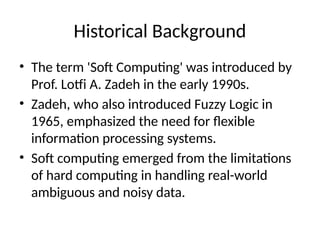
• The term 'Soft Computing' was introduced by
Prof. Lotfi A. Zadeh in the early 1990s.
• Zadeh, who also introduced Fuzzy Logic in
1965, emphasized the need for flexible
information processing systems.
• Soft computing emerged from the limitations
of hard computing in handling real-world
ambiguous and noisy data.
Importance of Soft Computing
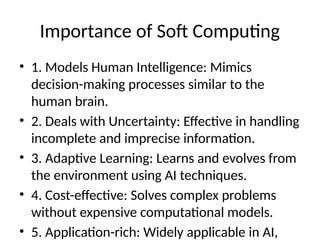
• 1. Models Human Intelligence: Mimics
decision-making processes similar to the
human brain.
• 2. Deals with Uncertainty: Effective in handling
incomplete and imprecise information.
• 3. Adaptive Learning: Learns and evolves from
the environment using AI techniques.
• 4. Cost-effective: Solves complex problems
without expensive computational models.
• 5. Application-rich: Widely applicable in AI,
What is Hard Computing?
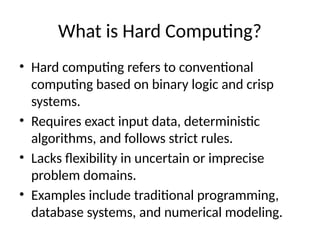
• Hard computing refers to conventional
computing based on binary logic and crisp
systems.
• Requires exact input data, deterministic
algorithms, and follows strict rules.
• Lacks flexibility in uncertain or imprecise
problem domains.
• Examples include traditional programming,
database systems, and numerical modeling.
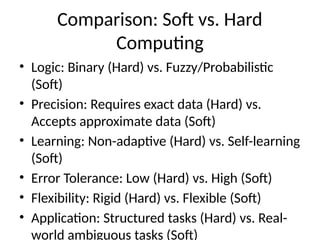
Comparison: Soft vs. Hard
Computing
• Logic: Binary (Hard) vs. Fuzzy/Probabilistic
(Soft)
• Precision: Requires exact data (Hard) vs.
Accepts approximate data (Soft)
• Learning: Non-adaptive (Hard) vs. Self-learning
(Soft)
• Error Tolerance: Low (Hard) vs. High (Soft)
• Flexibility: Rigid (Hard) vs. Flexible (Soft)
• Application: Structured tasks (Hard) vs. Real-
world ambiguous tasks (Soft)
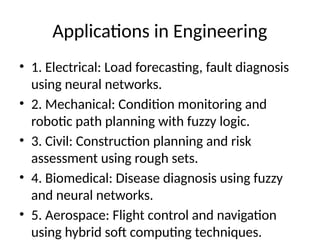
Applications in Engineering
• 1. Electrical: Load forecasting, fault diagnosis
using neural networks.
• 2. Mechanical: Condition monitoring and
robotic path planning with fuzzy logic.
• 3. Civil: Construction planning and risk
assessment using rough sets.
• 4. Biomedical: Disease diagnosis using fuzzy
and neural networks.
• 5. Aerospace: Flight control and navigation
using hybrid soft computing techniques.
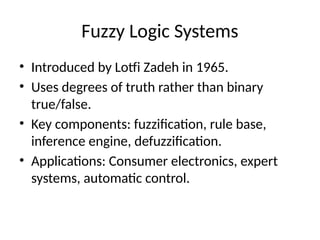
Fuzzy Logic Systems
• Introduced by Lotfi Zadeh in 1965.
• Uses degrees of truth rather than binary
true/false.
• Key components: fuzzification, rule base,
inference engine, defuzzification.
• Applications: Consumer electronics, expert
systems, automatic control.
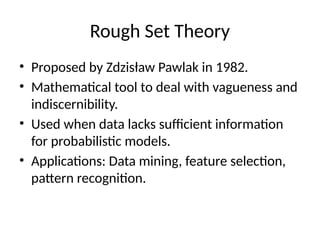
Rough Set Theory
• Proposed by Zdzisław Pawlak in 1982.
• Mathematical tool to deal with vagueness and
indiscernibility.
• Used when data lacks sufficient information
for probabilistic models.
• Applications: Data mining, feature selection,
pattern recognition.
Optimization in Soft Computing
• Optimization involves finding the best solution
from all feasible solutions.
• Common techniques in soft computing:
• - Genetic Algorithms (GA): Evolutionary
optimization inspired by natural selection.
• - Particle Swarm Optimization (PSO): Based on
social behavior of birds/fish.
• - Ant Colony Optimization (ACO): Based on the
behavior of ant colonies.
• Used in engineering design, scheduling, and
Artificial Neural Networks (ANN)
• Inspired by biological neural systems.
• Composed of layers of interconnected
'neurons'.
• Learn by adjusting weights using algorithms
like backpropagation.
• Types: Feedforward, Convolutional (CNN),
Recurrent (RNN).
• Applications: Image recognition, speech
processing, predictive analytics.
Hybrid Soft Computing Techniques
• Combines two or more soft computing
techniques for improved performance.
• Examples:
• - Neuro-Fuzzy Systems: Fuzzy logic with
learning ability of neural networks.
• - Genetic-Fuzzy Systems: Optimization of fuzzy
rules using genetic algorithms.
• - Fuzzy-PSO: Tuning fuzzy systems using swarm
intelligence.
• Benefits: Robustness, adaptability, higher
Summary & Conclusion
• Soft computing is essential for solving
complex, imprecise, and real-world problems.
• It complements hard computing by providing
human-like decision-making abilities.
• Applications are vast and growing in
engineering, medicine, business, and beyond.
• Future trends involve deeper integration with
AI, big data, and quantum computing.
Q&A
• Thank you for your attention.
• Any questions or clarifications?

Detailed_Soft_Computing_Presentation.pptx

  • 1.
    Introduction to SoftComputing • Soft computing is an emerging field of computer science that deals with approximate models and gives solutions to complex real-life problems. Unlike hard computing, it tolerates imprecision, uncertainty, and partial truth to achieve tractability and robustness. • Inspired by human reasoning and biological systems, soft computing enables machines to solve problems the way humans do.
  • 2.
    Historical Background • Theterm 'Soft Computing' was introduced by Prof. Lotfi A. Zadeh in the early 1990s. • Zadeh, who also introduced Fuzzy Logic in 1965, emphasized the need for flexible information processing systems. • Soft computing emerged from the limitations of hard computing in handling real-world ambiguous and noisy data.
  • 3.
    Importance of SoftComputing • 1. Models Human Intelligence: Mimics decision-making processes similar to the human brain. • 2. Deals with Uncertainty: Effective in handling incomplete and imprecise information. • 3. Adaptive Learning: Learns and evolves from the environment using AI techniques. • 4. Cost-effective: Solves complex problems without expensive computational models. • 5. Application-rich: Widely applicable in AI,
  • 4.
    What is HardComputing? • Hard computing refers to conventional computing based on binary logic and crisp systems. • Requires exact input data, deterministic algorithms, and follows strict rules. • Lacks flexibility in uncertain or imprecise problem domains. • Examples include traditional programming, database systems, and numerical modeling.
  • 5.
    Comparison: Soft vs.Hard Computing • Logic: Binary (Hard) vs. Fuzzy/Probabilistic (Soft) • Precision: Requires exact data (Hard) vs. Accepts approximate data (Soft) • Learning: Non-adaptive (Hard) vs. Self-learning (Soft) • Error Tolerance: Low (Hard) vs. High (Soft) • Flexibility: Rigid (Hard) vs. Flexible (Soft) • Application: Structured tasks (Hard) vs. Real- world ambiguous tasks (Soft)
  • 6.
    Applications in Engineering •1. Electrical: Load forecasting, fault diagnosis using neural networks. • 2. Mechanical: Condition monitoring and robotic path planning with fuzzy logic. • 3. Civil: Construction planning and risk assessment using rough sets. • 4. Biomedical: Disease diagnosis using fuzzy and neural networks. • 5. Aerospace: Flight control and navigation using hybrid soft computing techniques.
  • 7.
    Fuzzy Logic Systems •Introduced by Lotfi Zadeh in 1965. • Uses degrees of truth rather than binary true/false. • Key components: fuzzification, rule base, inference engine, defuzzification. • Applications: Consumer electronics, expert systems, automatic control.
  • 8.
    Rough Set Theory •Proposed by Zdzisław Pawlak in 1982. • Mathematical tool to deal with vagueness and indiscernibility. • Used when data lacks sufficient information for probabilistic models. • Applications: Data mining, feature selection, pattern recognition.
  • 9.
    Optimization in SoftComputing • Optimization involves finding the best solution from all feasible solutions. • Common techniques in soft computing: • - Genetic Algorithms (GA): Evolutionary optimization inspired by natural selection. • - Particle Swarm Optimization (PSO): Based on social behavior of birds/fish. • - Ant Colony Optimization (ACO): Based on the behavior of ant colonies. • Used in engineering design, scheduling, and
  • 10.
    Artificial Neural Networks(ANN) • Inspired by biological neural systems. • Composed of layers of interconnected 'neurons'. • Learn by adjusting weights using algorithms like backpropagation. • Types: Feedforward, Convolutional (CNN), Recurrent (RNN). • Applications: Image recognition, speech processing, predictive analytics.
  • 11.
    Hybrid Soft ComputingTechniques • Combines two or more soft computing techniques for improved performance. • Examples: • - Neuro-Fuzzy Systems: Fuzzy logic with learning ability of neural networks. • - Genetic-Fuzzy Systems: Optimization of fuzzy rules using genetic algorithms. • - Fuzzy-PSO: Tuning fuzzy systems using swarm intelligence. • Benefits: Robustness, adaptability, higher
  • 12.
    Summary & Conclusion •Soft computing is essential for solving complex, imprecise, and real-world problems. • It complements hard computing by providing human-like decision-making abilities. • Applications are vast and growing in engineering, medicine, business, and beyond. • Future trends involve deeper integration with AI, big data, and quantum computing.
  • 13.
    Q&A • Thank youfor your attention. • Any questions or clarifications?