SOFT COMPUTING
Under the guidance of:
Santhosh
Introduction
 Soft computing is an emerging approach to computing which
parallel the remarkable ability of the human mind to
reason and learn in a environment of uncertainty and
imprecision.
Some of it’s principle components includes:
 Neural Network(NN)
 Fuzzy Logic(FL)
 Genetic Algorithm(GA)
These methodologies form the core of soft computing.
Goals of Soft Computing
 The main goal of soft computing is to develop intelligent
machines to provide solutions to real world problems,
which are not modeled, or where ideal solutions are not there
or too difficult to model mathematically.
 It’s aim is to exploit the tolerance for Approximation,
Uncertainty, Imprecision, and Partial Truth in order to
achieve close resemblance with human like decision making.
 To achieve Practicability, Robustness and low solution
cost.
 Well suited for real world problems
• Approximation : here the model features are similar to the
real ones, but not the same.
• Uncertainty : here we are not sure that the features of the
model are the same as that of the entity (belief).
• Imprecision : here the model features (quantities) are not the
same as that of the real ones, but close to them.
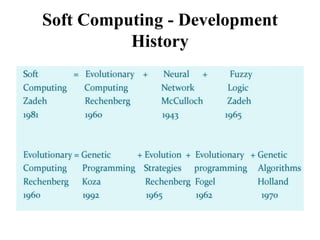
Soft Computing - Development
History
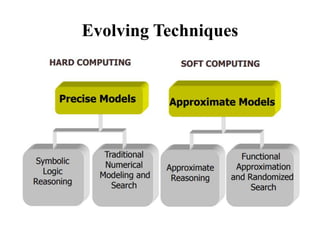
Evolving Techniques
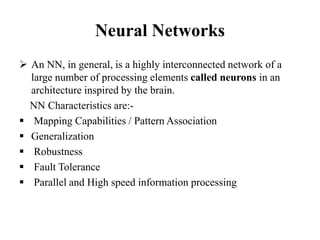
Neural Networks
 An NN, in general, is a highly interconnected network of a
large number of processing elements called neurons in an
architecture inspired by the brain.
NN Characteristics are:-
 Mapping Capabilities / Pattern Association
 Generalization
 Robustness
 Fault Tolerance
 Parallel and High speed information processing
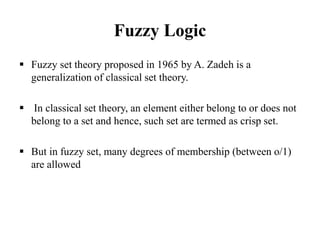
Fuzzy Logic
 Fuzzy set theory proposed in 1965 by A. Zadeh is a
generalization of classical set theory.
 In classical set theory, an element either belong to or does not
belong to a set and hence, such set are termed as crisp set.
 But in fuzzy set, many degrees of membership (between o/1)
are allowed
Genetic Algorithm
• Genetic Algorithms initiated and developed in the early 1970’s
by John Holland are unorthodox search and optimization
algorithms, which mimic some of the process of natural
evolution.
• Gas perform directed random search through a given set of
alternative with the aim of finding the best alternative with
respect to the given criteria of goodness.
• These criteria are required to be expressed in terms of an
object function which is usually referred to as a fitness
function.
Why Soft Computing is Important
 Soft computing provides an approach to problem-solving
using means other than computers.
 With the human mind as a role model, soft computing is
tolerant of partial truths, uncertainty, imprecision and
approximation, unlike traditional computing models.
 The tolerance of soft computing allows researchers to
approach some problems that traditional computing can't
process.
Soft Computing uses Component
Fields of Study in:
• Fuzzy logic
• Machine learning
• Probabilistic reasoning
• Evolutionary computation
• Perceptron
• Genetic algorithms
• Differential algorithms
• Support vector machines
• Metaheuristics
• Swarm intelligence
• Ant colony optimization
• Particle optimization
• Bayesian networks
• Artificial neural networks
• Expert systems

Soft computing

  • 1.
    SOFT COMPUTING Under theguidance of: Santhosh
  • 2.
    Introduction  Soft computingis an emerging approach to computing which parallel the remarkable ability of the human mind to reason and learn in a environment of uncertainty and imprecision. Some of it’s principle components includes:  Neural Network(NN)  Fuzzy Logic(FL)  Genetic Algorithm(GA) These methodologies form the core of soft computing.
  • 3.
    Goals of SoftComputing  The main goal of soft computing is to develop intelligent machines to provide solutions to real world problems, which are not modeled, or where ideal solutions are not there or too difficult to model mathematically.  It’s aim is to exploit the tolerance for Approximation, Uncertainty, Imprecision, and Partial Truth in order to achieve close resemblance with human like decision making.  To achieve Practicability, Robustness and low solution cost.  Well suited for real world problems
  • 4.
    • Approximation :here the model features are similar to the real ones, but not the same. • Uncertainty : here we are not sure that the features of the model are the same as that of the entity (belief). • Imprecision : here the model features (quantities) are not the same as that of the real ones, but close to them.
  • 5.
    Soft Computing -Development History
  • 6.
  • 7.
    Neural Networks  AnNN, in general, is a highly interconnected network of a large number of processing elements called neurons in an architecture inspired by the brain. NN Characteristics are:-  Mapping Capabilities / Pattern Association  Generalization  Robustness  Fault Tolerance  Parallel and High speed information processing
  • 8.
    Fuzzy Logic  Fuzzyset theory proposed in 1965 by A. Zadeh is a generalization of classical set theory.  In classical set theory, an element either belong to or does not belong to a set and hence, such set are termed as crisp set.  But in fuzzy set, many degrees of membership (between o/1) are allowed
  • 9.
    Genetic Algorithm • GeneticAlgorithms initiated and developed in the early 1970’s by John Holland are unorthodox search and optimization algorithms, which mimic some of the process of natural evolution. • Gas perform directed random search through a given set of alternative with the aim of finding the best alternative with respect to the given criteria of goodness. • These criteria are required to be expressed in terms of an object function which is usually referred to as a fitness function.
  • 10.
    Why Soft Computingis Important  Soft computing provides an approach to problem-solving using means other than computers.  With the human mind as a role model, soft computing is tolerant of partial truths, uncertainty, imprecision and approximation, unlike traditional computing models.  The tolerance of soft computing allows researchers to approach some problems that traditional computing can't process.
  • 11.
    Soft Computing usesComponent Fields of Study in: • Fuzzy logic • Machine learning • Probabilistic reasoning • Evolutionary computation • Perceptron • Genetic algorithms • Differential algorithms • Support vector machines • Metaheuristics • Swarm intelligence • Ant colony optimization • Particle optimization • Bayesian networks • Artificial neural networks • Expert systems