Solar Image Processing
A Multiscale View
Atheism is so senseless. When I look at the solar
system, I see the earth at the right distance from
the sun to receive the proper amounts of heat and
light. This did not happen by chance.
Isaac Newton
PROFILE
❏ As our life giving star it provides a vital ingredient for most of
the life on Earth.
❏ Existing for about 4 and a half billion years, it has burnt up
about half of the hydrogen in its core.
❏ This leaves the Sun's life expectancy to 5 billion more years,
at which time, the Sun's elements will "swell" up, swallow
Earth.
Heliophysics
› Every culture and every continent observed the sun from
” The Origin of the Earth and Life” .
› Heliology is the science of Helios, Sol, otherwise known as the
Sun and the term heliophysics means "physics of the Sun“.
› It influences environment around the earth and other planets,
and it also generates changes in space for the entire solar
system, which is known as space weather.
Sun-Earth Connection
› When we leave our protective atmosphere it affects our
satellites, robotic missions and human explorers.
› The sun’s reach or impact goes to the edge of the solar system,
and we need to understand the events going to affects different
entity.
› By taking high resolution images of the sun, modeling solar
events by using multiple methods we can predict the future
activities and how they will affect our daily lives.
Solar Events
› Sunspots form on the surface of the Sun due to strong
magnetic field lines coming up from within the Sun trough
the solar surface and appear visibly as dark spots compared
to their surroundings.
› A Solar flare occurs when magnetic energy that has built
up in the solar atmosphere is suddenly released. Radiation
is emitted across virtually the entire electromagnetic
spectrum.
Solar Events
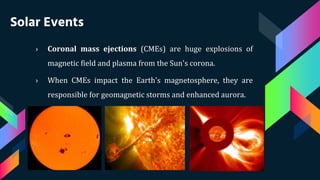
› Coronal mass ejections (CMEs) are huge explosions of
magnetic field and plasma from the Sun's corona.
› When CMEs impact the Earth's magnetosphere, they are
responsible for geomagnetic storms and enhanced aurora.
IMPACT
› The Maunder minimum in the 1600s and 1700s, when there
was almost no sunspot activity, coincided with a period of cold
temperatures and severe winters in Europe and North America.
› There is a well-known 11-year cycle in which the Sun's
ultraviolet radiation peaks and declines as a result of sunspot
activity.
› The energetic ultraviolet radiation, they heat the Earth’s outer
atmosphere, causing it to expand. This increases the drag on
Earth-orbiting satellites, reducing their lifetime in orbit.
IMPACT
› The geomagnetic storms induces by coronal mass ejections
(CMEs). CME is also induced by solar flare.
› During geomagnetic storms, high currents in the
magnetosphere induce high currents in power lines, blowing
out electric transformers and power stations at high latitudes.
› A CME typically takes 3 to 5 days to reach the Earth after it
leaves the Sun.
IMPACT
› The intense radio emission from flares and these changes in the
atmosphere can degrade the precision of Global Positioning
System (GPS) measurements.
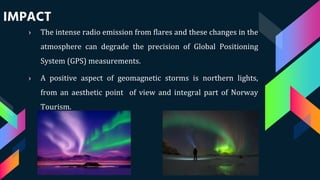
› A positive aspect of geomagnetic storms is northern lights,
from an aesthetic point of view and integral part of Norway
Tourism.
IMPACT
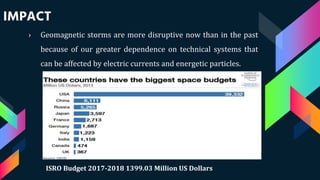
› Geomagnetic storms are more disruptive now than in the past
because of our greater dependence on technical systems that
can be affected by electric currents and energetic particles.
ISRO Budget 2017-2018 1399.03 Million US Dollars
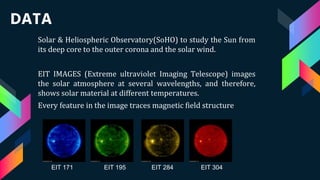
Solar & Heliospheric Observatory(SoHO) to study the Sun from
its deep core to the outer corona and the solar wind.
EIT IMAGES (Extreme ultraviolet Imaging Telescope) images
the solar atmosphere at several wavelengths, and therefore,
shows solar material at different temperatures.
Every feature in the image traces magnetic field structure
DATA
EIT 171 EIT 195 EIT 284 EIT 304
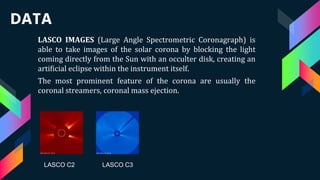
LASCO IMAGES (Large Angle Spectrometric Coronagraph) is
able to take images of the solar corona by blocking the light
coming directly from the Sun with an occulter disk, creating an
artificial eclipse within the instrument itself.
The most prominent feature of the corona are usually the
coronal streamers, coronal mass ejection.
DATA
LASCO C2 LASCO C3
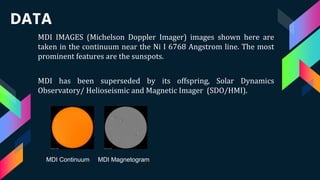
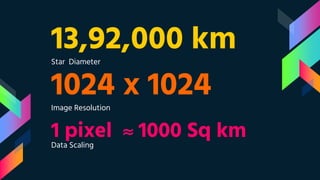
MDI IMAGES (Michelson Doppler Imager) images shown here are
taken in the continuum near the Ni I 6768 Angstrom line. The most
prominent features are the sunspots.
MDI has been superseded by its offspring, Solar Dynamics
Observatory/ Helioseismic and Magnetic Imager (SDO/HMI).
DATA
MDI Continuum MDI Magnetogram
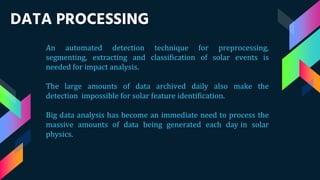
13,92,000 kmStar Diameter
1 pixel ≈ 1000 Sq kmData Scaling
1024 x 1024Image Resolution
An automated detection technique for preprocessing,
segmenting, extracting and classification of solar events is
needed for impact analysis.
The large amounts of data archived daily also make the
detection impossible for solar feature identification.
Big data analysis has become an immediate need to process the
massive amounts of data being generated each day in solar
physics.
DATA PROCESSING
With over one terabyte of solar data being generated each day,
heliophysics provide exciting opportunities for the use of Big
data processing techniques & Hadoop Image Processing
Interface.
More missions on the horizon that expect to generate petabytes
of data each year to build a content-based image retrieval
system (CBIR) with recent technologies for future Solar mission.
DATA PROCESSING
ISRO
Aditya-L1 is a spacecraft whose mission is to study the Sun.
Proposed launch on 2019 or 2020
Science Daily
The Sun might emit less radiation by mid-century, giving planet
Earth a chance to warm a bit more slowly but not halt the trend
of human-induced climate change.
Weather.com
The Sun is in a Cooling Cycle, But It Won't Fix Global Warming.
Space.com
Magnetic 'Cages' on the Sun Could Limit the Strength of
Dangerous Solar Flares.
News
We can apply this knowledge to our
journeys in space, and most importantly, to
our lives here on Earth.
References
 Solar & Heliospheric Observatory (SoHO)
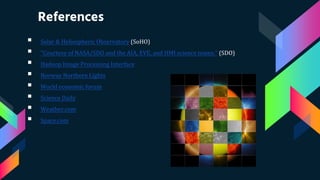
 "Courtesy of NASA/SDO and the AIA, EVE, and HMI science teams.“ (SDO)
 Hadoop Image Processing Interface
 Norway Northern Lights
 World economic forum
 Science Daily
 Weather.com
 Space.com

Solar Image Processing

  • 1.
    Solar Image Processing AMultiscale View
  • 2.
    Atheism is sosenseless. When I look at the solar system, I see the earth at the right distance from the sun to receive the proper amounts of heat and light. This did not happen by chance. Isaac Newton
  • 3.
    PROFILE ❏ As ourlife giving star it provides a vital ingredient for most of the life on Earth. ❏ Existing for about 4 and a half billion years, it has burnt up about half of the hydrogen in its core. ❏ This leaves the Sun's life expectancy to 5 billion more years, at which time, the Sun's elements will "swell" up, swallow Earth.
  • 4.
    Heliophysics › Every cultureand every continent observed the sun from ” The Origin of the Earth and Life” . › Heliology is the science of Helios, Sol, otherwise known as the Sun and the term heliophysics means "physics of the Sun“. › It influences environment around the earth and other planets, and it also generates changes in space for the entire solar system, which is known as space weather.
  • 5.
    Sun-Earth Connection › Whenwe leave our protective atmosphere it affects our satellites, robotic missions and human explorers. › The sun’s reach or impact goes to the edge of the solar system, and we need to understand the events going to affects different entity. › By taking high resolution images of the sun, modeling solar events by using multiple methods we can predict the future activities and how they will affect our daily lives.
  • 6.
    Solar Events › Sunspotsform on the surface of the Sun due to strong magnetic field lines coming up from within the Sun trough the solar surface and appear visibly as dark spots compared to their surroundings. › A Solar flare occurs when magnetic energy that has built up in the solar atmosphere is suddenly released. Radiation is emitted across virtually the entire electromagnetic spectrum.
  • 7.
    Solar Events › Coronalmass ejections (CMEs) are huge explosions of magnetic field and plasma from the Sun's corona. › When CMEs impact the Earth's magnetosphere, they are responsible for geomagnetic storms and enhanced aurora.
  • 8.
    IMPACT › The Maunderminimum in the 1600s and 1700s, when there was almost no sunspot activity, coincided with a period of cold temperatures and severe winters in Europe and North America. › There is a well-known 11-year cycle in which the Sun's ultraviolet radiation peaks and declines as a result of sunspot activity. › The energetic ultraviolet radiation, they heat the Earth’s outer atmosphere, causing it to expand. This increases the drag on Earth-orbiting satellites, reducing their lifetime in orbit.
  • 9.
    IMPACT › The geomagneticstorms induces by coronal mass ejections (CMEs). CME is also induced by solar flare. › During geomagnetic storms, high currents in the magnetosphere induce high currents in power lines, blowing out electric transformers and power stations at high latitudes. › A CME typically takes 3 to 5 days to reach the Earth after it leaves the Sun.
  • 10.
    IMPACT › The intenseradio emission from flares and these changes in the atmosphere can degrade the precision of Global Positioning System (GPS) measurements. › A positive aspect of geomagnetic storms is northern lights, from an aesthetic point of view and integral part of Norway Tourism.
  • 11.
    IMPACT › Geomagnetic stormsare more disruptive now than in the past because of our greater dependence on technical systems that can be affected by electric currents and energetic particles. ISRO Budget 2017-2018 1399.03 Million US Dollars
  • 12.
    Solar & HeliosphericObservatory(SoHO) to study the Sun from its deep core to the outer corona and the solar wind. EIT IMAGES (Extreme ultraviolet Imaging Telescope) images the solar atmosphere at several wavelengths, and therefore, shows solar material at different temperatures. Every feature in the image traces magnetic field structure DATA EIT 171 EIT 195 EIT 284 EIT 304
  • 13.
    LASCO IMAGES (LargeAngle Spectrometric Coronagraph) is able to take images of the solar corona by blocking the light coming directly from the Sun with an occulter disk, creating an artificial eclipse within the instrument itself. The most prominent feature of the corona are usually the coronal streamers, coronal mass ejection. DATA LASCO C2 LASCO C3
  • 14.
    MDI IMAGES (MichelsonDoppler Imager) images shown here are taken in the continuum near the Ni I 6768 Angstrom line. The most prominent features are the sunspots. MDI has been superseded by its offspring, Solar Dynamics Observatory/ Helioseismic and Magnetic Imager (SDO/HMI). DATA MDI Continuum MDI Magnetogram
  • 15.
    13,92,000 kmStar Diameter 1pixel ≈ 1000 Sq kmData Scaling 1024 x 1024Image Resolution
  • 16.
    An automated detectiontechnique for preprocessing, segmenting, extracting and classification of solar events is needed for impact analysis. The large amounts of data archived daily also make the detection impossible for solar feature identification. Big data analysis has become an immediate need to process the massive amounts of data being generated each day in solar physics. DATA PROCESSING
  • 17.
    With over oneterabyte of solar data being generated each day, heliophysics provide exciting opportunities for the use of Big data processing techniques & Hadoop Image Processing Interface. More missions on the horizon that expect to generate petabytes of data each year to build a content-based image retrieval system (CBIR) with recent technologies for future Solar mission. DATA PROCESSING
  • 18.
    ISRO Aditya-L1 is aspacecraft whose mission is to study the Sun. Proposed launch on 2019 or 2020 Science Daily The Sun might emit less radiation by mid-century, giving planet Earth a chance to warm a bit more slowly but not halt the trend of human-induced climate change. Weather.com The Sun is in a Cooling Cycle, But It Won't Fix Global Warming. Space.com Magnetic 'Cages' on the Sun Could Limit the Strength of Dangerous Solar Flares. News
  • 19.
    We can applythis knowledge to our journeys in space, and most importantly, to our lives here on Earth.
  • 20.
    References  Solar &Heliospheric Observatory (SoHO)  "Courtesy of NASA/SDO and the AIA, EVE, and HMI science teams.“ (SDO)  Hadoop Image Processing Interface  Norway Northern Lights  World economic forum  Science Daily  Weather.com  Space.com