Hyponatremia and Hypernatremia
Introduction
• Most common electrolyte disorder in clinical practice
• Sodium and water disorders occur simultaneously
• Most commonly affect the neurologic system and
can potentially lead to devastating outcomes
Sterns RH. Disorders of Plasma Sodium - Causes, Consequences, and Correction. N Engl J Med 2015
Relationship of fluid compartments to total
body weight
Harring TR, et al. Disorders of Sodium and Water Balance. Emerg Med Clin N Am 2014
• Serum sodium is closely related with S. osmolality
• S. osmolality = 2 Na+ + BUN (mg/dl)/2.8 + Glu (mg/dl)/18
• By controlling water intake and excretion, the
osmoregulatory system normally prevents the S. Na from
staying outside its normal range (135 -145 mEq/l)
• Failure of the system to regulate within this range
exposes cells to hypotonic or hypertonic stress
Sodium & osmolarity
Sterns RH. Disorders of Plasma Sodium - Causes, Consequences, and Correction. N Engl J Med 2015
• Serum sodium is closely related with S. osmolality
• S. osmolality = 2 Na+ + BUN (mg/dl)/2.8 + Glu (mg/dl)/18
• By controlling water intake and excretion, the
osmoregulatory system normally prevents the S. Na from
staying outside its normal range (135 -145 mEq/l)
• Failure of the system to regulate within this range
exposes cells to hypotonic or hypertonic stress
Sodium & osmolarity
Sterns RH. Disorders of Plasma Sodium - Causes, Consequences, and Correction. N Engl J Med 2015
S. Na regulation
• Regulation of H2O intake (Thirst)
• Regulation of H2O excretion (Vasopressin)
• Regulation of Na intake (Not regulated)
• Regulation of Na excretion (Tubular Na reabsorption)
Harring TR, et al. Disorders of Sodium and Water Balance. Emerg Med Clin N Am 2014
HYPONATREMIA
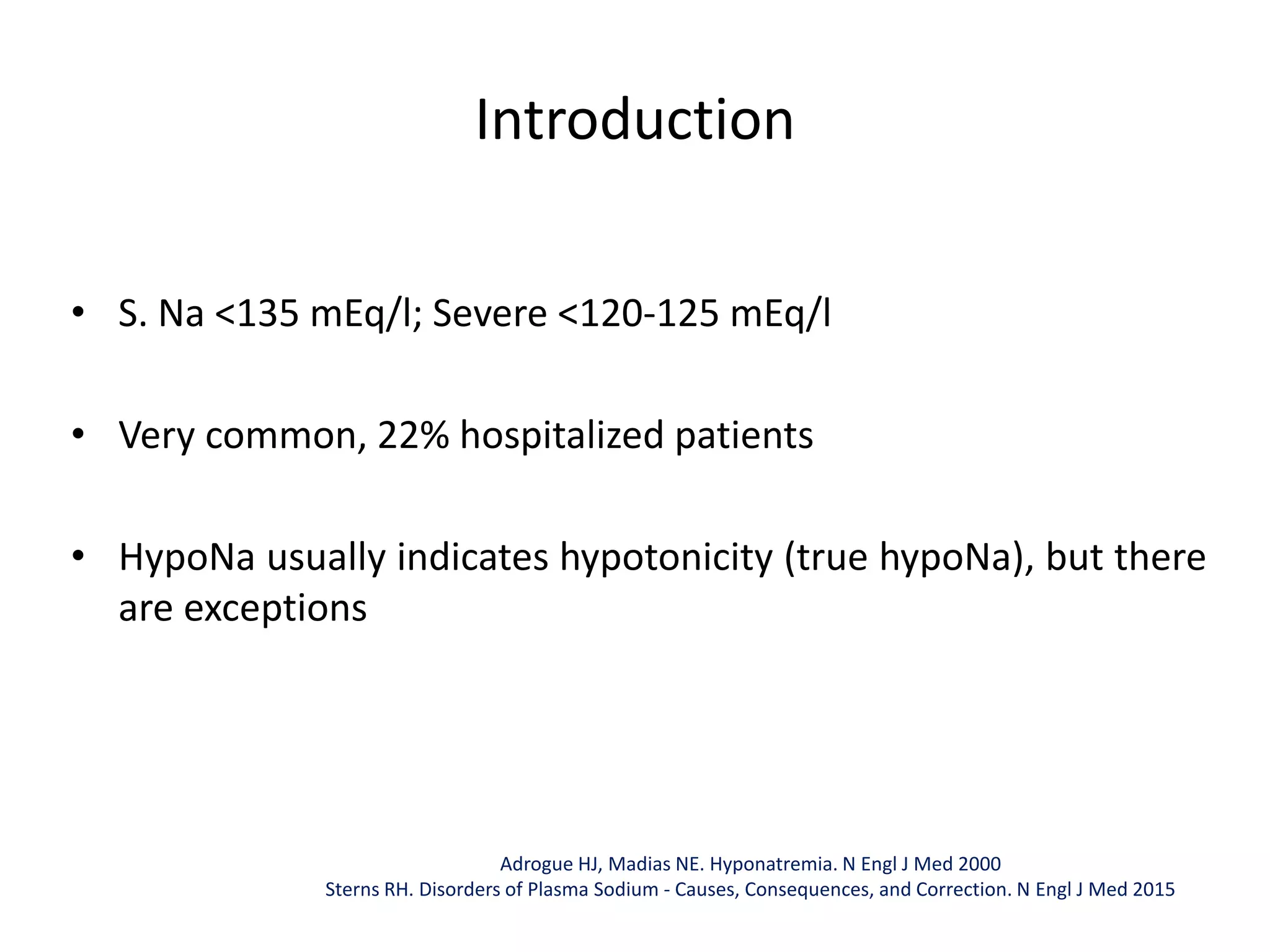
Introduction
• S. Na <135 mEq/l; Severe <120-125 mEq/l
• Very common, 22% hospitalized patients
• HypoNa usually indicates hypotonicity (true hypoNa), but there
are exceptions
Adrogue HJ, Madias NE. Hyponatremia. N Engl J Med 2000
Sterns RH. Disorders of Plasma Sodium - Causes, Consequences, and Correction. N Engl J Med 2015
Non-hypotonic hyponatremia
• Hypertonic (or translocational) hyponatremia
When hyperglycemia +, the underlying S. Na (corrected S. Na)
can be estimated by adding 1.6 - 2.4 mEq/l (≃2 mEq/l) to the
reported S. Na for every 100 mg/dl ↑ in BS >100 mg/dl
• Isotonic hyponatremia
Isotonic irrigation solutions during hysteroscopy, laparoscopy,
or TURP
• Pseudohyponatremia
Severe hyperproteinemia (myeloma) or severe hyperlipid
Hypovolemic Hyponatremia
• HypoNa with ↓ POSM and ↑UOSM
• Clinical hypovolemia triggering AVP release
• Can be due to renal volume losses (UNa >20 mmol/L), or
extrarenal losses (UNa <20 mmol/L)
• Renal - diuretic use and mineralocorticoid deficiency
• Extrarenal - GI (vomiting, diarrhea), third spacing (burns,
pancreatitis)
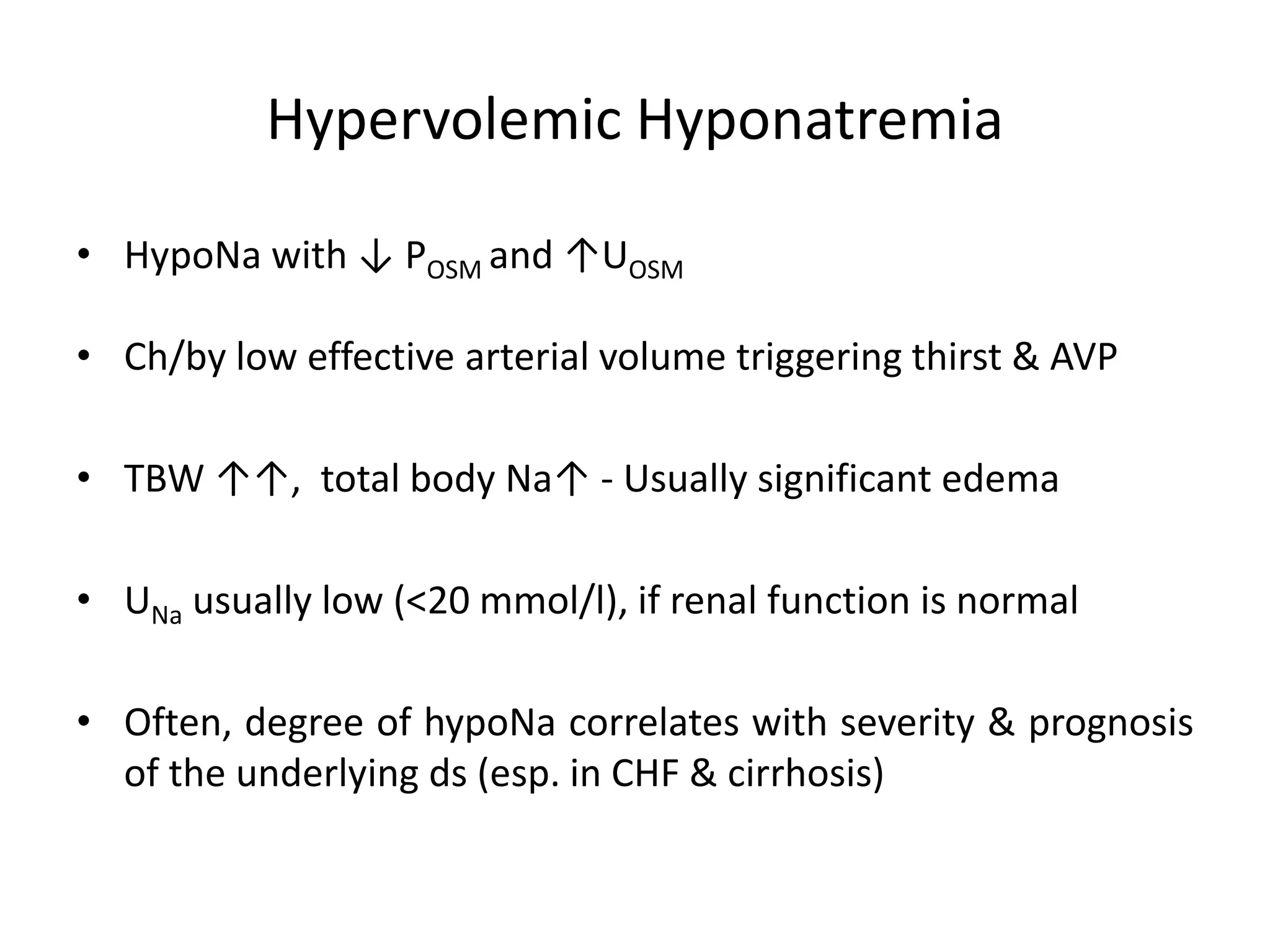
Hypervolemic Hyponatremia
• HypoNa with ↓ POSM and ↑UOSM
• Ch/by low effective arterial volume triggering thirst & AVP
• TBW ↑↑, total body Na↑ - Usually significant edema
• UNa usually low (<20 mmol/l), if renal function is normal
• Often, degree of hypoNa correlates with severity & prognosis
of the underlying ds (esp. in CHF & cirrhosis)
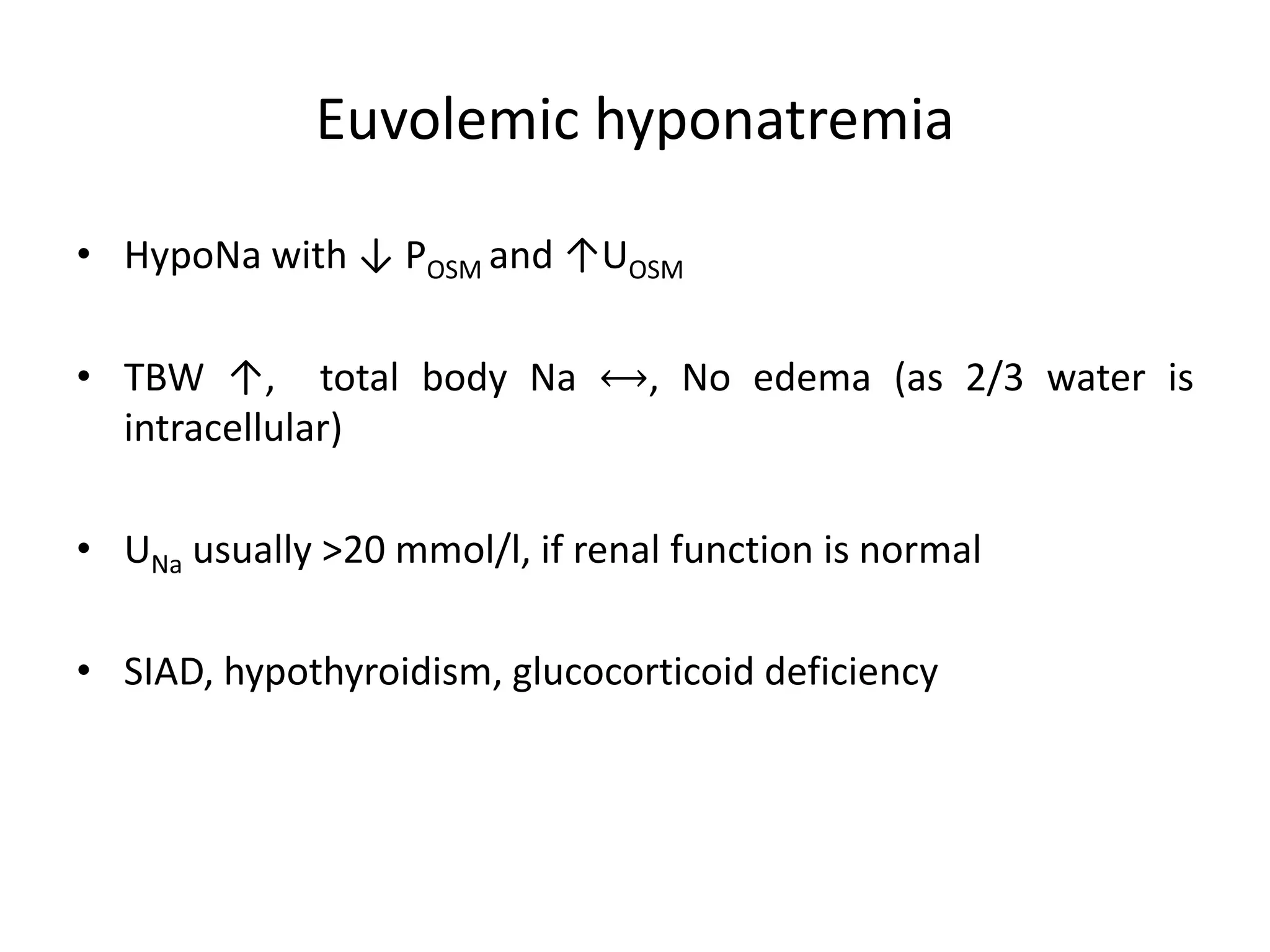
Euvolemic hyponatremia
• HypoNa with ↓ POSM and ↑UOSM
• TBW ↑, total body Na ⟷, No edema (as 2/3 water is
intracellular)
• UNa usually >20 mmol/l, if renal function is normal
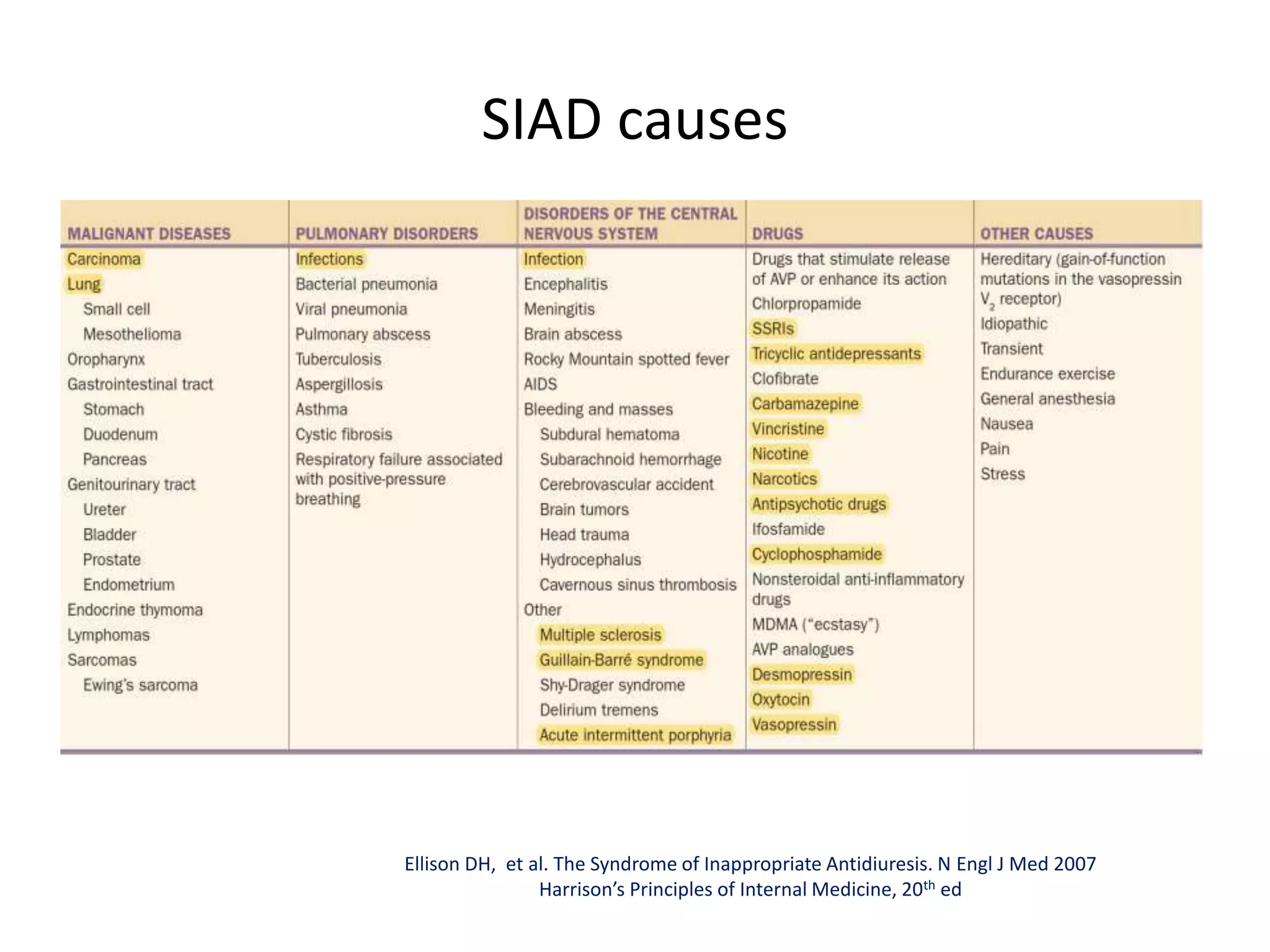
• SIAD, hypothyroidism, glucocorticoid deficiency
SIAD causes
Ellison DH, et al. The Syndrome of Inappropriate Antidiuresis. N Engl J Med 2007
Harrison’s Principles of Internal Medicine, 20th ed
Hyponatremia with ↓POsm & ↓UOsm
• HypoNa with ↓POsm despite a max dilute urine and
suppressed AVP
• ↓Uosm <100 mOsm/kg
• ↑↑fluid ingestion (primary polydipsia) can overwhelm the
max renal diluting capacity
• ↓solute intake (malnourished states like excessive beer
drinkers) limits the renal ability to excrete water independent
of AVP
Diagnostic approach
The Washington Manual of Medical Therapeutics, 35th ed
Spasovski G, et al. Clinical practice guideline on diagnosis and treatment of hyponatraemia. Eur J Endo 2014
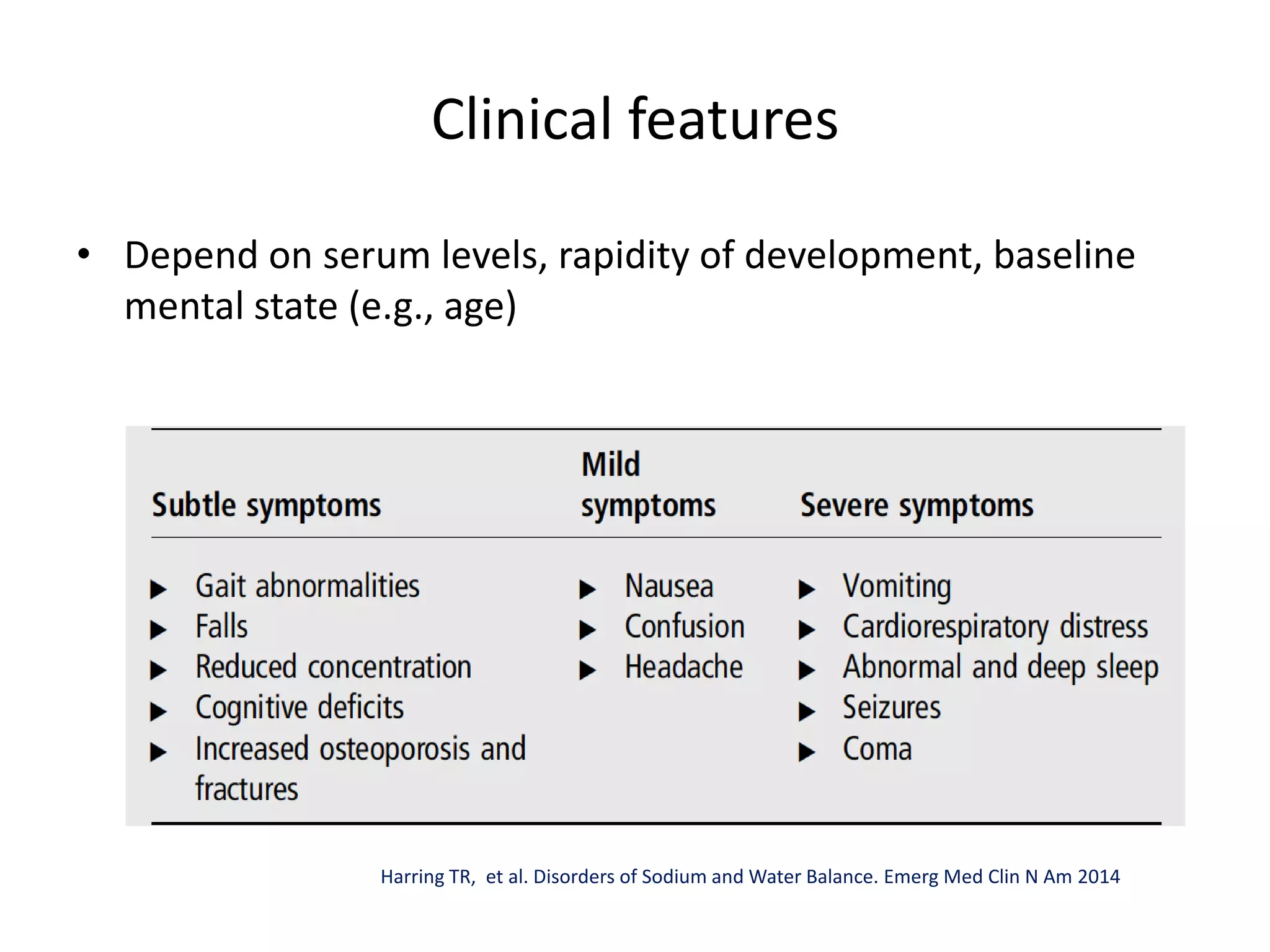
Clinical features
• Depend on serum levels, rapidity of development, baseline
mental state (e.g., age)
Harring TR, et al. Disorders of Sodium and Water Balance. Emerg Med Clin N Am 2014
Clinical features
• Depend on serum levels, rapidity of development, baseline
mental state (e.g., age)
Harring TR, et al. Disorders of Sodium and Water Balance. Emerg Med Clin N Am 2014
Treatment
• Type of hypoNa, serum level, C/F, rapidity of development
• Nonhypotonic hypoNa usually requires management of
underlying condition
• Hypovol. hypoNa - careful volume expansion with isotonic
fluids
• Hypervol. & euvol. hypoNa usually require fluid restriction,
loop diuretics, oral or IV (3% NaCl), vaptans
Treatment: Vaptans
• Vasopressin antagonists
• Blocks the binding of AVP to V2 receptors at basolateral
membrane of principal cells of collecting duct
• Electrolyte free water excretion
• Not the mainstay of treatment in hypoNa
Treatment: Vaptans
Berl T. Vasopressin Antagonists. N Engl J Med 2015
Treatment: IV correction
• Acute severe hyponatremia: cerebral edema
• Main risk of rapid correction: osmotic demyelination synd
• Adrogue-Madias formula to guide rate of infusion
Change in S. Na per liter infusion = (Infusate Na – S. Na) ÷ (TBW* + 1)
*TBW: Body wt X % of body water (0.6 - pediatric age & adult male, 0.5 -
adult female & elderly male, and 0.45 - elderly female)
Adrogue HJ, Madias NE. Hyponatremia. N Engl J Med 2000
Sterns RH. Disorders of Plasma Sodium - Causes, Consequences, and Correction. N Engl J Med 2015
Treatment: IV correction
1 ml of 3% saline/kg body wt will ↑ S. Na by ≃ 1 mEq/l
(In the absence of urinary loss of water)
Treatment: Algorithm
Spasovski G, et al. Clinical practice guideline. Eur J Endo 2014
Williams DM, et al. The clinical management of hyponatraemia. Postgrad Med J 2016
Treatment: Algorithm
Sterns RH. Disorders of Plasma Sodium - Causes, Consequences, and Correction. N Engl J Med 2015
HYPERNATREMIA
• S. Na >145 mmol/l
• Invariably a/w hyperosmolality and always causes cellular
dehydration
• Sustained hyperNa occurs only when thirst or access to water
is impaired, i.e., usually in very old, very young, critically ill, or
neurologically impaired
• First step is to assess the volume status
Introduction
Adrogue HJ, Madias NE. Hypernatremia. N Engl J Med 2000
Diagnostic approach
Uvol ↓ (<800 ml)
Uosm ↑ (>800 mOsm/l)
Uvol in 24 hr X Uosm
Harrison’s, 20th ed
Washington MMT, 35th ed
Clinical features
• Depend on serum levels, rapidity of onset, baseline mental
state (e.g., age)
• Similar to hypoNa – neurological symptoms (AMS, seizures)
• During hypernatremia water moves into the extracellular
space → brain cells shrink substantially → can cause ICH as a
result of tearing of cerebral blood vessels
Adrogue HJ, Madias NE. Hypernatremia. N Engl J Med 2000
Harring TR, et al. Disorders of Sodium and Water Balance. Emerg Med Clin N Am 2014
• Type of hyperNa, serum level, C/F, rapidity of development
• Acute severe hypernatremia (in hours) → rapid correction @ 1
mEq/l/hr
• Chronic hypernatremia (over days) → @ 0.5 meq/l/hr
• T/t goals: replacement of FWD and ↓ ongoing water loss
Treatment: objectives
• Calculate FWD (in liter)= TBW* x ([Serum Na+ / 140] – 1)
• Administer the FWD over 48-72 hrs with a goal ≯10 mEq/l/d
• As this formula can underestimate the amount of FWD,
Adrogue-Madias formula remains standard
• *TBW: Because hypernatremia suggests a contraction in water
content (estimated to ↓ by ≃10%), the correction factor is 0.5
in male (rather than 0.6) and 0.4 in female
Treatment: PO/IV correction
Adrogue HJ, Madias NE. Hypernatremia. N Engl J Med 2000
Harring TR, et al. Disorders of Sodium and Water Balance. Emerg Med Clin N Am 2014
• HyperNa with ⟷ ECF: Only water repletion may be sufficient,
either by water PO/RT or by IV D5W
• HyperNa with ↓ECF: Both water & Na replacement is required,
by hypotonic saline (0.45%)
• HyperNa with ↑ECF: Cessation of iatrogenic Na, use of
diuretics along with replacement of FWD
• Central DI: Desmopressin
• Nephrogenic DI: Thiazides (paradoxical antidiuretic effect)
Treatment: underlying cause
Take Home Message
THANK YOU

sodium disorders Md class dr ashok.pptx

  • 1.
  • 2.
    Introduction • Most commonelectrolyte disorder in clinical practice • Sodium and water disorders occur simultaneously • Most commonly affect the neurologic system and can potentially lead to devastating outcomes Sterns RH. Disorders of Plasma Sodium - Causes, Consequences, and Correction. N Engl J Med 2015
  • 3.
    Relationship of fluidcompartments to total body weight Harring TR, et al. Disorders of Sodium and Water Balance. Emerg Med Clin N Am 2014
  • 4.
    • Serum sodiumis closely related with S. osmolality • S. osmolality = 2 Na+ + BUN (mg/dl)/2.8 + Glu (mg/dl)/18 • By controlling water intake and excretion, the osmoregulatory system normally prevents the S. Na from staying outside its normal range (135 -145 mEq/l) • Failure of the system to regulate within this range exposes cells to hypotonic or hypertonic stress Sodium & osmolarity Sterns RH. Disorders of Plasma Sodium - Causes, Consequences, and Correction. N Engl J Med 2015
  • 5.
    • Serum sodiumis closely related with S. osmolality • S. osmolality = 2 Na+ + BUN (mg/dl)/2.8 + Glu (mg/dl)/18 • By controlling water intake and excretion, the osmoregulatory system normally prevents the S. Na from staying outside its normal range (135 -145 mEq/l) • Failure of the system to regulate within this range exposes cells to hypotonic or hypertonic stress Sodium & osmolarity Sterns RH. Disorders of Plasma Sodium - Causes, Consequences, and Correction. N Engl J Med 2015
  • 6.
    S. Na regulation •Regulation of H2O intake (Thirst) • Regulation of H2O excretion (Vasopressin) • Regulation of Na intake (Not regulated) • Regulation of Na excretion (Tubular Na reabsorption) Harring TR, et al. Disorders of Sodium and Water Balance. Emerg Med Clin N Am 2014
  • 7.
  • 8.
    Introduction • S. Na<135 mEq/l; Severe <120-125 mEq/l • Very common, 22% hospitalized patients • HypoNa usually indicates hypotonicity (true hypoNa), but there are exceptions Adrogue HJ, Madias NE. Hyponatremia. N Engl J Med 2000 Sterns RH. Disorders of Plasma Sodium - Causes, Consequences, and Correction. N Engl J Med 2015
  • 9.
    Non-hypotonic hyponatremia • Hypertonic(or translocational) hyponatremia When hyperglycemia +, the underlying S. Na (corrected S. Na) can be estimated by adding 1.6 - 2.4 mEq/l (≃2 mEq/l) to the reported S. Na for every 100 mg/dl ↑ in BS >100 mg/dl • Isotonic hyponatremia Isotonic irrigation solutions during hysteroscopy, laparoscopy, or TURP • Pseudohyponatremia Severe hyperproteinemia (myeloma) or severe hyperlipid
  • 10.
    Hypovolemic Hyponatremia • HypoNawith ↓ POSM and ↑UOSM • Clinical hypovolemia triggering AVP release • Can be due to renal volume losses (UNa >20 mmol/L), or extrarenal losses (UNa <20 mmol/L) • Renal - diuretic use and mineralocorticoid deficiency • Extrarenal - GI (vomiting, diarrhea), third spacing (burns, pancreatitis)
  • 11.
    Hypervolemic Hyponatremia • HypoNawith ↓ POSM and ↑UOSM • Ch/by low effective arterial volume triggering thirst & AVP • TBW ↑↑, total body Na↑ - Usually significant edema • UNa usually low (<20 mmol/l), if renal function is normal • Often, degree of hypoNa correlates with severity & prognosis of the underlying ds (esp. in CHF & cirrhosis)
  • 12.
    Euvolemic hyponatremia • HypoNawith ↓ POSM and ↑UOSM • TBW ↑, total body Na ⟷, No edema (as 2/3 water is intracellular) • UNa usually >20 mmol/l, if renal function is normal • SIAD, hypothyroidism, glucocorticoid deficiency
  • 13.
    SIAD causes Ellison DH,et al. The Syndrome of Inappropriate Antidiuresis. N Engl J Med 2007 Harrison’s Principles of Internal Medicine, 20th ed
  • 14.
    Hyponatremia with ↓POsm& ↓UOsm • HypoNa with ↓POsm despite a max dilute urine and suppressed AVP • ↓Uosm <100 mOsm/kg • ↑↑fluid ingestion (primary polydipsia) can overwhelm the max renal diluting capacity • ↓solute intake (malnourished states like excessive beer drinkers) limits the renal ability to excrete water independent of AVP
  • 15.
    Diagnostic approach The WashingtonManual of Medical Therapeutics, 35th ed Spasovski G, et al. Clinical practice guideline on diagnosis and treatment of hyponatraemia. Eur J Endo 2014
  • 17.
    Clinical features • Dependon serum levels, rapidity of development, baseline mental state (e.g., age) Harring TR, et al. Disorders of Sodium and Water Balance. Emerg Med Clin N Am 2014
  • 18.
    Clinical features • Dependon serum levels, rapidity of development, baseline mental state (e.g., age) Harring TR, et al. Disorders of Sodium and Water Balance. Emerg Med Clin N Am 2014
  • 19.
    Treatment • Type ofhypoNa, serum level, C/F, rapidity of development • Nonhypotonic hypoNa usually requires management of underlying condition • Hypovol. hypoNa - careful volume expansion with isotonic fluids • Hypervol. & euvol. hypoNa usually require fluid restriction, loop diuretics, oral or IV (3% NaCl), vaptans
  • 20.
    Treatment: Vaptans • Vasopressinantagonists • Blocks the binding of AVP to V2 receptors at basolateral membrane of principal cells of collecting duct • Electrolyte free water excretion • Not the mainstay of treatment in hypoNa
  • 21.
    Treatment: Vaptans Berl T.Vasopressin Antagonists. N Engl J Med 2015
  • 22.
    Treatment: IV correction •Acute severe hyponatremia: cerebral edema • Main risk of rapid correction: osmotic demyelination synd • Adrogue-Madias formula to guide rate of infusion Change in S. Na per liter infusion = (Infusate Na – S. Na) ÷ (TBW* + 1) *TBW: Body wt X % of body water (0.6 - pediatric age & adult male, 0.5 - adult female & elderly male, and 0.45 - elderly female) Adrogue HJ, Madias NE. Hyponatremia. N Engl J Med 2000 Sterns RH. Disorders of Plasma Sodium - Causes, Consequences, and Correction. N Engl J Med 2015
  • 23.
    Treatment: IV correction 1ml of 3% saline/kg body wt will ↑ S. Na by ≃ 1 mEq/l (In the absence of urinary loss of water)
  • 24.
    Treatment: Algorithm Spasovski G,et al. Clinical practice guideline. Eur J Endo 2014 Williams DM, et al. The clinical management of hyponatraemia. Postgrad Med J 2016
  • 25.
    Treatment: Algorithm Sterns RH.Disorders of Plasma Sodium - Causes, Consequences, and Correction. N Engl J Med 2015
  • 27.
  • 28.
    • S. Na>145 mmol/l • Invariably a/w hyperosmolality and always causes cellular dehydration • Sustained hyperNa occurs only when thirst or access to water is impaired, i.e., usually in very old, very young, critically ill, or neurologically impaired • First step is to assess the volume status Introduction Adrogue HJ, Madias NE. Hypernatremia. N Engl J Med 2000
  • 29.
    Diagnostic approach Uvol ↓(<800 ml) Uosm ↑ (>800 mOsm/l) Uvol in 24 hr X Uosm Harrison’s, 20th ed Washington MMT, 35th ed
  • 30.
    Clinical features • Dependon serum levels, rapidity of onset, baseline mental state (e.g., age) • Similar to hypoNa – neurological symptoms (AMS, seizures) • During hypernatremia water moves into the extracellular space → brain cells shrink substantially → can cause ICH as a result of tearing of cerebral blood vessels Adrogue HJ, Madias NE. Hypernatremia. N Engl J Med 2000 Harring TR, et al. Disorders of Sodium and Water Balance. Emerg Med Clin N Am 2014
  • 31.
    • Type ofhyperNa, serum level, C/F, rapidity of development • Acute severe hypernatremia (in hours) → rapid correction @ 1 mEq/l/hr • Chronic hypernatremia (over days) → @ 0.5 meq/l/hr • T/t goals: replacement of FWD and ↓ ongoing water loss Treatment: objectives
  • 32.
    • Calculate FWD(in liter)= TBW* x ([Serum Na+ / 140] – 1) • Administer the FWD over 48-72 hrs with a goal ≯10 mEq/l/d • As this formula can underestimate the amount of FWD, Adrogue-Madias formula remains standard • *TBW: Because hypernatremia suggests a contraction in water content (estimated to ↓ by ≃10%), the correction factor is 0.5 in male (rather than 0.6) and 0.4 in female Treatment: PO/IV correction Adrogue HJ, Madias NE. Hypernatremia. N Engl J Med 2000 Harring TR, et al. Disorders of Sodium and Water Balance. Emerg Med Clin N Am 2014
  • 33.
    • HyperNa with⟷ ECF: Only water repletion may be sufficient, either by water PO/RT or by IV D5W • HyperNa with ↓ECF: Both water & Na replacement is required, by hypotonic saline (0.45%) • HyperNa with ↑ECF: Cessation of iatrogenic Na, use of diuretics along with replacement of FWD • Central DI: Desmopressin • Nephrogenic DI: Thiazides (paradoxical antidiuretic effect) Treatment: underlying cause
  • 34.
  • 35.