CKD - MBD
SPEAKER : DR. MOHAMMED DAANISH
MODERATOR : DR. SUBHASH GIRI
KDIGO CLASSIFICATION OF CKD-
MBD
 DEFINTION OF CKD- MBD :
A systemic disorder of mineral and bone metabolism due to CKD manifested by either one or a
combination of the following :
1. Abnormalities of calcium, phosphorus, PTH or Vitamin D metabolism
2. Abnormalities in bone turnover, mineralization, volume, linear growth, strength.
3. Vascular or other soft tissue calcification
PATHOGENESIS
PATHOGENESIS
 EXPLAINED UNDER 4 HEADINGS :
1. Elevated PTH
2. Hyperphosphatemia
3. Decreased calcitriol activity
4. Hypocalcemia and calcium sensing receptor functions
ELEVATED PTH LEVELS
 Secondary hyperparathyroidism begins early in the course of CKD and prevalence increases as the
kidney function declines ( eGFR < 60ml/min/1.73m2
 Almost all elements of MBD are present below a eGFR of <40
 Abnormalities that contribute to secondary hyperparathyroidism are:
1. PO4 retention
2. Decreased calcitriol
3. Decreased ionized calcium
4. Increased FGF-23
5. Reduced expression of Vitamin D receptors(VDRs), Calcium sensing receptors(CaSRs), Fibroblast
growth factor receptors and Klotho receptors
 High circulating levels of PTH downregulate the PTH receptors hence, skeletal resistance to the
calcemic action of PTH is seen
 Both Calcitriol deficiency and hyperphosphatemia contribute
 Can lead to tertiary hyperparathyroidism – reflects severe parathyroid hyperplasia with autonomous
secretion of PTH which no longer is responsive to plasma calcium concentration
 In Patients with tertiary hyperparathyroidism , decreased expression of CaSR and VDR result in a
lack of suppression of PTH.
 Nodular hyperplasia of parathyroid gland does not resolve even with resolution of some triggering
mechanism
 Therefore, CKD patients with post renal transplant status still show persisting high PTH and
hypercalcemia
HYPERPHOSPHATEMIA
 3 MAJOR THEORIES PROPOSED EXPLAINING HYPERPHOSPHATEMIA CAUSING
INCREASED PTH RELEASE:
1. By Inducing hypocalcemia
2. Decreased formation / activity of calcitriol
3. Increased PTH gene expression
 Bone changes occurs as early as stage 2
 The initial increase in PTH levels is appropriate since it results in phosphate excretion and lowers
the plasma phosphate concentration towards normal.
 <30 eGFR the phosphaturic action of FGF 23 and PTH fails
 In ESRD patients, PTH inhibits proximal tubular phosphate reabsorption from the normal 80 to 95 %
to as low as 15% of the total filtered phosphate
 PTH induces phosphate release from bone resulting in hyperphosphatemia
 Increased PTH levels tends to correct both the hypocalcemia (by bone resorption) and calcitriol
deficiency (by stimulating 1 alpha hydroxylase in proximal tubule)
DECREASED CALCITRIOL ACTIVITY
 Plasma calcitriol levels fall below normal levels when eGFR< 60ml/min/1.73m2
 Mechanism of decrease in calcitriol levels :
1. Early CKD : increase FGF -23 levels(inhibits 1 alpha hydroxylase activity)
2. Advanced CKD : hyperphosphatemia and loss of renal mass
 Low calcitriol levels increase PTH release by;
1. Indirectly : low calcitriol --- low intestinal absorption of calcium and calcium release from bone ---
hypocalcemia----CaSR stimulated on parathyroid gland------ PTH release
2. Directly : calcitriol normally acts on VDR in parathyroid gland to suppress PTH transcription but not
on PTH secretion
HYPOCALCEMIA AND CALCIUM SENSING
RECEPTOR (CaSR)
 Calcium is a major regulator of PTH secretion
 Minute changes in serum ionized calcium are sensed by the specific membrane receptor CaSR,
expressed on the chief cell of parathyroid glands, tightly regulating PTH secretion
 Total serum calcium concentration decreases during the course of CKD due to :
1. Phosphate retention
2. Decreased calcitriol concentration
3. Resistance to calcemic actions of PTH on bone
 In CKD, number of CaSR are reduced in hypertrophied parathyroid gland, in areas of nodular
hypertrophy
 The decrease in receptor levels can lead to inadequate suppression of PTH secretion by calcium ,
therefore the inappropriately high PTH levels in the setting of normal or high calcium levels
When do we call it ‘RENAL
OSTEODYSTROPHY’?
 Renal osteodystrophy is alteration bone morphology in patients with CKD based upon bone biopsy.
 KDIGO recommends 3 parameters be used to assess bone pathology : (TMV system)
1. Bone turnover
2. Bone Mineralisation
3. Bone Volume
TMV CHARACTERISTICS OF MAJOR CKD
RELATED BONE DISEASES :
1. OSTEITIS FIBROSA CYSTICA
2. ADYNAMIC BONE DISEASE
3. OSTEOMALACIA
4. MIXED UREMIC OSTEODYSTROPHY
5. UREMIC BONE DISEASE TYPE
OSTEITIS FIBROSA CYSTICA
 High bone turnover due to secondary hyperparathyroidism
ADYNAMIC BONE DISEASE
 Low bone turnover
 Results from excessive suppression of the parathyroid gland induced by the relatively high doses of
vitamin D analogs, calcium based phosphate binders, and/or calcimimetic agents or resistance to
PTH actions on bone.
 Major bone lesion found in females, Caucasians, diabetics, peritoneal dialysis and hemodialysis
patients.
OSTEOMALACIA
 Low bone turnover + abnormal mineralization
 Normal mineralization lag time is <35days , this is prolonged to >100days in osteomalacia.
 Earlier increased prevalence was due to aluminium deposition in bone when aluminium containing
antacids were used as phosphate binders.
 Now aluminium containing phosphate binders have been banned from use, hence decreased cases
MIXED UREMIC OSTEODYSTROPHY
 High or low bone turnover + abnormal mineralisation
UREMIC BONE DISEASE TYPE
 Unique pathogenesis
 Occurs in patients on long term dialysis and presents as bone cysts which results from beta 2
macroglobulin associated deposits -----dialysis related amyloidosis
CLINICAL FEATURES – SKELETAL
MANIFESTATIONS
 BONE DISEASE
 Can be asymptomatic
 Can result in weakness, fractures, bone and muscle pain, avascular necrosis (dialysis)
 Bone pain predominant in adynamic bone disease ---- low bone turnover leads to an impaired ability
to repair microdamage
EXTRASKELETAL MANIFESTATIONS
 VASCULAR CALCIFICATIONS
 Intimal and medial calcification are associated with increased mortality
 Intimal calcification is marker for advanced atherosclerotic plaque and has been used for screening
for coronary disease
 Medial calcification results in arterial distensibility loss ----- systolic hypertension, left ventricular
hypertrophy and impaired coronary artery perfusion
EXTRASKELETAL MANIFESTATION
 CALCIPHYLAXIS ( CALCIFIC UREMIC ARTERIOLOPATHY)
 Rare and serious disorder
 Systemic medial calcification of arterioles ---- ischemia and subcutaneous necrosis
 Occurs in ESRD who are on hemodialysis or who have received a renal transplant or also in non
ESRD patients
TREATMENT
TREATMENT OF HYPERPHOSPHATEMIA
NONDIALYSABLE
 Target <4.5mg/dl
 Requires dietary modification
 Use phosphate binders when levels >5.5mg/dl despite diet modification
 When phosphate > 6mg/dl start diet modification with binders (diet alone not effective)
 Phosphate intake restriction upto 900mg/day
 DIALYSIS PATIENTS:
 In dialysis patients maintain phosphate between 3.5 to 5.5 mg/dl
 >5.5 mg/dl requires treatment
 Hyperphosphatemia has increased risk for mortality – hence treatment is necessary
 Start with phosphate restriction and binder
 Limiting phosphate intake is difficult to achieve unless protein intake is limited which can contribute to protein
malnutrition, therefore high biologic value food should be used (meat and eggs)
 Phosphate restriction to 900mg/day (avoid nutritional compromise)
 Ensure protein intake in malnourished patients but restrict phosphate intake
 Adequate dialysis (one average session removes 900mg of phosphate
 Pt education regarding diet
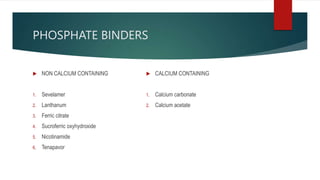
PHOSPHATE BINDERS
 NON CALCIUM CONTAINING
1. Sevelamer
2. Lanthanum
3. Ferric citrate
4. Sucroferric oxyhydroxide
5. Nicotinamide
6. Tenapavor
 CALCIUM CONTAINING
1. Calcium carbonate
2. Calcium acetate
 Sevelamer – phosphate levels – 5.5 – 7.5 mg/dl – 800mg TDS
> 7.5 mg/dl – 1600mg TDS
 Hypocalcemia – use calcium containing phosphate binders ( less likely to become hypercalcemic
with their use )
 Normocalcemic – use calcium containing phosphate binders ( patients with no evidence of vascular
calcification or adynamic bone disease )
 Hypercalcemia / adynamic bone disease / vascular calcification – use non calcium containing
phosphate binders
 Start with lowest effective dose
 If using calcium containing buffers total elemental calcium should not exceed 2000 mg/day
(including dietary sources)
 The amount of elemental calcium contained in the phosphate binder should not exceed
1500mg/day
 Phosphate binders effective only when taken with meals
REFRACTORY HYPERPHOSPHATEMIA
 Not controlled by diet, phosphate binders and patient unwilling for hemodialysis --- reduce PTH
levels (CINACALCET)
MAINTAIN NORMOCALCEMIA
 Corrected Ca >7.5(Asymptomatic and mild hypocal)-no rx as there is increased risk of
hypercalcemia
 Maintain <9.5
VITAMIN D REPLENISHMENT
 Vitamin D replacement in deficient pts (Sr. Calcium <10.2 and P<5.5)
 Vitamin D levels : <12 ng/ml – 50000 IU ( vitamin D2 or D3 )weekly for 6 to 8 weeks followed by 800
IU (vitamin D2 or D3 ) daily
 12 to 20-800 to 1000IU daily(repeat levels after 3 months)
 20 to 30-600 to 800IU daily
INCREASED PTH Rx
 Treatment initiation-pth>2.3 to 3 times ULN assay range
 Calcimimetics-Widely available calcimimetics include cinacalcet (oral)
and etelcalcetide (intravenous)
 Calcitriol /Synthetic Vitamin D analogues – should be avoided , given at a low dose or stopped if
P>5.5 or Ca >10.2
 Any out of the two can be used as a monotherapy or in combination
 Treat patients with phosphate <5.5 mg/dL (<1.78 mmol/L) and calcium <9.5 mg/dL (<2.37 mmol/L)
with calcitriol monotherapy
 Among patients with serum phosphate ≥5.5 mg/dL (≥1.78 mmol/L) or serum calcium level ≥9.5 mg/dL (≥2.37
mmol/L) and persistently elevated PTH, despite maximal therapies to reduce phosphate, we initiate therapy
with a calcimimetic(used only in dialysis pts) rather than calcitriol or a synthetic vitamin D analog.
 Among patients who do not sufficiently reduce PTH with cinacalcet alone, we add calcitriol or a synthetic
vitamin D analog, providing the phosphate <5.5 mg/dL (<1.78 mmol/L) and calcium <9.5 mg/dL (<2.37
mmol/L).
 Calcitriol-0.25 microgram thrice per week(preferred dose)-titrate maintain pth <150
 In general, the starting dose of calcitriol, whether oral or IV, or of the vitamin D analog
should be low (eg, 0.25 mcg thrice weekly). Dose adjustments may be made at four-
to eight-week intervals. Patients who are responsive to therapy typically show
significant reductions in PTH levels within the first three to six months of therapy
 REFRACTORY HYPERPARATHYROIDISM-We define refractory hyperparathyroidism as persistent
and progressive elevations of serum parathyroid hormone (PTH) that cannot be lowered to levels
<600 pg/mL despite treatment with vitamin D derivatives and cinacalcet and without causing
significant hyperphosphatemia or hypercalcemia. Patients with severe disease may require
parathyroidectomy
 Reference-
 Uptodate
 Kdigo guidelines
THANKYOU

CKD - MBD MODIFIED.pptx

  • 1.
    CKD - MBD SPEAKER: DR. MOHAMMED DAANISH MODERATOR : DR. SUBHASH GIRI
  • 2.
    KDIGO CLASSIFICATION OFCKD- MBD  DEFINTION OF CKD- MBD : A systemic disorder of mineral and bone metabolism due to CKD manifested by either one or a combination of the following : 1. Abnormalities of calcium, phosphorus, PTH or Vitamin D metabolism 2. Abnormalities in bone turnover, mineralization, volume, linear growth, strength. 3. Vascular or other soft tissue calcification
  • 4.
  • 7.
    PATHOGENESIS  EXPLAINED UNDER4 HEADINGS : 1. Elevated PTH 2. Hyperphosphatemia 3. Decreased calcitriol activity 4. Hypocalcemia and calcium sensing receptor functions
  • 8.
    ELEVATED PTH LEVELS Secondary hyperparathyroidism begins early in the course of CKD and prevalence increases as the kidney function declines ( eGFR < 60ml/min/1.73m2  Almost all elements of MBD are present below a eGFR of <40
  • 9.
     Abnormalities thatcontribute to secondary hyperparathyroidism are: 1. PO4 retention 2. Decreased calcitriol 3. Decreased ionized calcium 4. Increased FGF-23 5. Reduced expression of Vitamin D receptors(VDRs), Calcium sensing receptors(CaSRs), Fibroblast growth factor receptors and Klotho receptors
  • 10.
     High circulatinglevels of PTH downregulate the PTH receptors hence, skeletal resistance to the calcemic action of PTH is seen  Both Calcitriol deficiency and hyperphosphatemia contribute  Can lead to tertiary hyperparathyroidism – reflects severe parathyroid hyperplasia with autonomous secretion of PTH which no longer is responsive to plasma calcium concentration
  • 11.
     In Patientswith tertiary hyperparathyroidism , decreased expression of CaSR and VDR result in a lack of suppression of PTH.  Nodular hyperplasia of parathyroid gland does not resolve even with resolution of some triggering mechanism  Therefore, CKD patients with post renal transplant status still show persisting high PTH and hypercalcemia
  • 12.
    HYPERPHOSPHATEMIA  3 MAJORTHEORIES PROPOSED EXPLAINING HYPERPHOSPHATEMIA CAUSING INCREASED PTH RELEASE: 1. By Inducing hypocalcemia 2. Decreased formation / activity of calcitriol 3. Increased PTH gene expression
  • 13.
     Bone changesoccurs as early as stage 2  The initial increase in PTH levels is appropriate since it results in phosphate excretion and lowers the plasma phosphate concentration towards normal.  <30 eGFR the phosphaturic action of FGF 23 and PTH fails
  • 14.
     In ESRDpatients, PTH inhibits proximal tubular phosphate reabsorption from the normal 80 to 95 % to as low as 15% of the total filtered phosphate  PTH induces phosphate release from bone resulting in hyperphosphatemia  Increased PTH levels tends to correct both the hypocalcemia (by bone resorption) and calcitriol deficiency (by stimulating 1 alpha hydroxylase in proximal tubule)
  • 15.
    DECREASED CALCITRIOL ACTIVITY Plasma calcitriol levels fall below normal levels when eGFR< 60ml/min/1.73m2  Mechanism of decrease in calcitriol levels : 1. Early CKD : increase FGF -23 levels(inhibits 1 alpha hydroxylase activity) 2. Advanced CKD : hyperphosphatemia and loss of renal mass
  • 16.
     Low calcitriollevels increase PTH release by; 1. Indirectly : low calcitriol --- low intestinal absorption of calcium and calcium release from bone --- hypocalcemia----CaSR stimulated on parathyroid gland------ PTH release 2. Directly : calcitriol normally acts on VDR in parathyroid gland to suppress PTH transcription but not on PTH secretion
  • 17.
    HYPOCALCEMIA AND CALCIUMSENSING RECEPTOR (CaSR)  Calcium is a major regulator of PTH secretion  Minute changes in serum ionized calcium are sensed by the specific membrane receptor CaSR, expressed on the chief cell of parathyroid glands, tightly regulating PTH secretion
  • 18.
     Total serumcalcium concentration decreases during the course of CKD due to : 1. Phosphate retention 2. Decreased calcitriol concentration 3. Resistance to calcemic actions of PTH on bone
  • 19.
     In CKD,number of CaSR are reduced in hypertrophied parathyroid gland, in areas of nodular hypertrophy  The decrease in receptor levels can lead to inadequate suppression of PTH secretion by calcium , therefore the inappropriately high PTH levels in the setting of normal or high calcium levels
  • 21.
    When do wecall it ‘RENAL OSTEODYSTROPHY’?  Renal osteodystrophy is alteration bone morphology in patients with CKD based upon bone biopsy.  KDIGO recommends 3 parameters be used to assess bone pathology : (TMV system) 1. Bone turnover 2. Bone Mineralisation 3. Bone Volume
  • 22.
    TMV CHARACTERISTICS OFMAJOR CKD RELATED BONE DISEASES : 1. OSTEITIS FIBROSA CYSTICA 2. ADYNAMIC BONE DISEASE 3. OSTEOMALACIA 4. MIXED UREMIC OSTEODYSTROPHY 5. UREMIC BONE DISEASE TYPE
  • 23.
    OSTEITIS FIBROSA CYSTICA High bone turnover due to secondary hyperparathyroidism
  • 24.
    ADYNAMIC BONE DISEASE Low bone turnover  Results from excessive suppression of the parathyroid gland induced by the relatively high doses of vitamin D analogs, calcium based phosphate binders, and/or calcimimetic agents or resistance to PTH actions on bone.  Major bone lesion found in females, Caucasians, diabetics, peritoneal dialysis and hemodialysis patients.
  • 25.
    OSTEOMALACIA  Low boneturnover + abnormal mineralization  Normal mineralization lag time is <35days , this is prolonged to >100days in osteomalacia.  Earlier increased prevalence was due to aluminium deposition in bone when aluminium containing antacids were used as phosphate binders.  Now aluminium containing phosphate binders have been banned from use, hence decreased cases
  • 26.
    MIXED UREMIC OSTEODYSTROPHY High or low bone turnover + abnormal mineralisation
  • 27.
    UREMIC BONE DISEASETYPE  Unique pathogenesis  Occurs in patients on long term dialysis and presents as bone cysts which results from beta 2 macroglobulin associated deposits -----dialysis related amyloidosis
  • 29.
    CLINICAL FEATURES –SKELETAL MANIFESTATIONS  BONE DISEASE  Can be asymptomatic  Can result in weakness, fractures, bone and muscle pain, avascular necrosis (dialysis)  Bone pain predominant in adynamic bone disease ---- low bone turnover leads to an impaired ability to repair microdamage
  • 30.
    EXTRASKELETAL MANIFESTATIONS  VASCULARCALCIFICATIONS  Intimal and medial calcification are associated with increased mortality  Intimal calcification is marker for advanced atherosclerotic plaque and has been used for screening for coronary disease  Medial calcification results in arterial distensibility loss ----- systolic hypertension, left ventricular hypertrophy and impaired coronary artery perfusion
  • 31.
    EXTRASKELETAL MANIFESTATION  CALCIPHYLAXIS( CALCIFIC UREMIC ARTERIOLOPATHY)  Rare and serious disorder  Systemic medial calcification of arterioles ---- ischemia and subcutaneous necrosis  Occurs in ESRD who are on hemodialysis or who have received a renal transplant or also in non ESRD patients
  • 40.
  • 42.
    TREATMENT OF HYPERPHOSPHATEMIA NONDIALYSABLE Target <4.5mg/dl  Requires dietary modification  Use phosphate binders when levels >5.5mg/dl despite diet modification  When phosphate > 6mg/dl start diet modification with binders (diet alone not effective)  Phosphate intake restriction upto 900mg/day
  • 43.
     DIALYSIS PATIENTS: In dialysis patients maintain phosphate between 3.5 to 5.5 mg/dl  >5.5 mg/dl requires treatment  Hyperphosphatemia has increased risk for mortality – hence treatment is necessary  Start with phosphate restriction and binder
  • 44.
     Limiting phosphateintake is difficult to achieve unless protein intake is limited which can contribute to protein malnutrition, therefore high biologic value food should be used (meat and eggs)  Phosphate restriction to 900mg/day (avoid nutritional compromise)  Ensure protein intake in malnourished patients but restrict phosphate intake  Adequate dialysis (one average session removes 900mg of phosphate  Pt education regarding diet
  • 47.
    PHOSPHATE BINDERS  NONCALCIUM CONTAINING 1. Sevelamer 2. Lanthanum 3. Ferric citrate 4. Sucroferric oxyhydroxide 5. Nicotinamide 6. Tenapavor  CALCIUM CONTAINING 1. Calcium carbonate 2. Calcium acetate
  • 48.
     Sevelamer –phosphate levels – 5.5 – 7.5 mg/dl – 800mg TDS > 7.5 mg/dl – 1600mg TDS
  • 49.
     Hypocalcemia –use calcium containing phosphate binders ( less likely to become hypercalcemic with their use )  Normocalcemic – use calcium containing phosphate binders ( patients with no evidence of vascular calcification or adynamic bone disease )  Hypercalcemia / adynamic bone disease / vascular calcification – use non calcium containing phosphate binders
  • 50.
     Start withlowest effective dose  If using calcium containing buffers total elemental calcium should not exceed 2000 mg/day (including dietary sources)  The amount of elemental calcium contained in the phosphate binder should not exceed 1500mg/day  Phosphate binders effective only when taken with meals
  • 51.
    REFRACTORY HYPERPHOSPHATEMIA  Notcontrolled by diet, phosphate binders and patient unwilling for hemodialysis --- reduce PTH levels (CINACALCET)
  • 52.
    MAINTAIN NORMOCALCEMIA  CorrectedCa >7.5(Asymptomatic and mild hypocal)-no rx as there is increased risk of hypercalcemia  Maintain <9.5
  • 53.
    VITAMIN D REPLENISHMENT Vitamin D replacement in deficient pts (Sr. Calcium <10.2 and P<5.5)  Vitamin D levels : <12 ng/ml – 50000 IU ( vitamin D2 or D3 )weekly for 6 to 8 weeks followed by 800 IU (vitamin D2 or D3 ) daily  12 to 20-800 to 1000IU daily(repeat levels after 3 months)  20 to 30-600 to 800IU daily
  • 56.
    INCREASED PTH Rx Treatment initiation-pth>2.3 to 3 times ULN assay range  Calcimimetics-Widely available calcimimetics include cinacalcet (oral) and etelcalcetide (intravenous)  Calcitriol /Synthetic Vitamin D analogues – should be avoided , given at a low dose or stopped if P>5.5 or Ca >10.2  Any out of the two can be used as a monotherapy or in combination
  • 57.
     Treat patientswith phosphate <5.5 mg/dL (<1.78 mmol/L) and calcium <9.5 mg/dL (<2.37 mmol/L) with calcitriol monotherapy  Among patients with serum phosphate ≥5.5 mg/dL (≥1.78 mmol/L) or serum calcium level ≥9.5 mg/dL (≥2.37 mmol/L) and persistently elevated PTH, despite maximal therapies to reduce phosphate, we initiate therapy with a calcimimetic(used only in dialysis pts) rather than calcitriol or a synthetic vitamin D analog.  Among patients who do not sufficiently reduce PTH with cinacalcet alone, we add calcitriol or a synthetic vitamin D analog, providing the phosphate <5.5 mg/dL (<1.78 mmol/L) and calcium <9.5 mg/dL (<2.37 mmol/L).  Calcitriol-0.25 microgram thrice per week(preferred dose)-titrate maintain pth <150
  • 58.
     In general,the starting dose of calcitriol, whether oral or IV, or of the vitamin D analog should be low (eg, 0.25 mcg thrice weekly). Dose adjustments may be made at four- to eight-week intervals. Patients who are responsive to therapy typically show significant reductions in PTH levels within the first three to six months of therapy
  • 61.
     REFRACTORY HYPERPARATHYROIDISM-Wedefine refractory hyperparathyroidism as persistent and progressive elevations of serum parathyroid hormone (PTH) that cannot be lowered to levels <600 pg/mL despite treatment with vitamin D derivatives and cinacalcet and without causing significant hyperphosphatemia or hypercalcemia. Patients with severe disease may require parathyroidectomy
  • 63.
  • 64.