Sodium Alginate Beads
• Sodium Alginate is a salt of alginic acid, which is a linear polymer
composed of two monosaccharides: D-mannuronic acid and guluronic
acid.
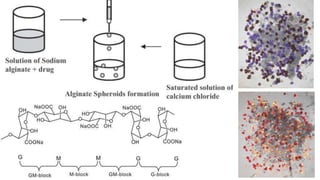
• In the experiment, sodium alginate solution is mixed with a calcium
chloride solution to form microencapsulated beads.
• This is achieved by a process known as ionotropic gelation, where the
calcium ions from the calcium chloride solution cross-link the alginate
chains, forming a gel-like structure.
• The resulting beads are then washed with distilled water to remove
any excess calcium ions.
Procedure
• Prepare 2% w/v and 5% w/v sodium alginate solution by dissolving 2gm
and 5gm of sodium alginate in 100 mL of distilled water respectively.
• Prepare a 2% w/v calcium chloride solution by dissolving 2 g of calcium
chloride in 100 mL of distilled water.
• Fill a syringe with the sodium alginate solution and use a dropper to drop
small droplets of the solution into the calcium chloride solution.
• Stir the mixture gently using a stirring rod.
• Observe the formation of the microencapsulated beads and collect them
using a dropper.
• Wash the beads with distilled water to remove any excess calcium ions.
• Transfer the beads to a glass petri dish for further observation.
Observation
1. Formation of spherical beads of smooth surface and uniform size observed.
2. When concentration of Sodium Alginate increases :
• Hardness Increases
• Cross-linking increases
• Rigidity increases
• Size decreases
• Lightness and yellowness decreases
• Slower rate of diffusion(drug delivery)
• Vice-versa
3. pH
• Decrease in pH cause protonation of carboxyl group and reduced bonding with divalent ions i.e.
Calcium ions.
• Vice-versa
• Mechanical Properties and Biocompatiblity : Presence of surfactants, protein, polymer,
phosphate or chloride ions.
Applications
• Pharmaceuticals
• Effective and controlled, targetted drug delivery.
• Protection of drug in stomach from degradation.
• Cosmetics
• Controlled release of active ingredients such as fragrances, vitamins, and skin-care agents.
• Biotechnology
• For the immobilization of enzymes and cells(Increases life span).
• Food Industry
• Encapsulating flavors, other sensitive ingredients.
Learning Outcomes:
Upon completion of this topic, there must be a clear understanding of-
• Method to formulate Microencapsulated sodium alginate beads.
• Factors influencing beads formation and Applications.

Sodium alginate beads

  • 1.
    Sodium Alginate Beads •Sodium Alginate is a salt of alginic acid, which is a linear polymer composed of two monosaccharides: D-mannuronic acid and guluronic acid. • In the experiment, sodium alginate solution is mixed with a calcium chloride solution to form microencapsulated beads. • This is achieved by a process known as ionotropic gelation, where the calcium ions from the calcium chloride solution cross-link the alginate chains, forming a gel-like structure. • The resulting beads are then washed with distilled water to remove any excess calcium ions.
  • 3.
    Procedure • Prepare 2%w/v and 5% w/v sodium alginate solution by dissolving 2gm and 5gm of sodium alginate in 100 mL of distilled water respectively. • Prepare a 2% w/v calcium chloride solution by dissolving 2 g of calcium chloride in 100 mL of distilled water. • Fill a syringe with the sodium alginate solution and use a dropper to drop small droplets of the solution into the calcium chloride solution. • Stir the mixture gently using a stirring rod. • Observe the formation of the microencapsulated beads and collect them using a dropper. • Wash the beads with distilled water to remove any excess calcium ions. • Transfer the beads to a glass petri dish for further observation.
  • 4.
    Observation 1. Formation ofspherical beads of smooth surface and uniform size observed. 2. When concentration of Sodium Alginate increases : • Hardness Increases • Cross-linking increases • Rigidity increases • Size decreases • Lightness and yellowness decreases • Slower rate of diffusion(drug delivery) • Vice-versa 3. pH • Decrease in pH cause protonation of carboxyl group and reduced bonding with divalent ions i.e. Calcium ions. • Vice-versa • Mechanical Properties and Biocompatiblity : Presence of surfactants, protein, polymer, phosphate or chloride ions.
  • 5.
    Applications • Pharmaceuticals • Effectiveand controlled, targetted drug delivery. • Protection of drug in stomach from degradation. • Cosmetics • Controlled release of active ingredients such as fragrances, vitamins, and skin-care agents. • Biotechnology • For the immobilization of enzymes and cells(Increases life span). • Food Industry • Encapsulating flavors, other sensitive ingredients. Learning Outcomes: Upon completion of this topic, there must be a clear understanding of- • Method to formulate Microencapsulated sodium alginate beads. • Factors influencing beads formation and Applications.