Avoiding Social Media
Landmines:
Get the RIGHT Bang for
your buck
Joel Campbell
and
Susan Balcom Walton
Brigham Young University
Let’s practice! How many
of you…
a. Publish blogs.
b. Tweet.
c. Participate in or moderate message
boards.
d. Maintain or contribute to a web site.
e. More than one of the above.
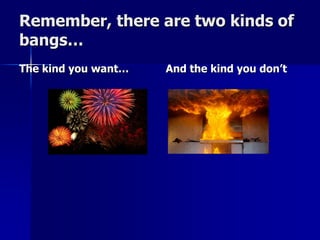
Remember, there are two kinds of
bangs…
The kind you want… And the kind you don’t
First, a disclaimer…
The information appearing in this
presentation is for general informational and
educational purposes only and is not
intended to provide legal advice to any
individual or entity. We urge you to consult
with your own legal advisor before taking
any action based on information appearing
in this presentation.
Same pitch, new ballgame—
the “new rules” of Social Media
1. The old rules still apply
--Know your journalists and their
contact preferences.
--Know what they are writing about
(and don’t pitch something they wrote
about last week).
--Don’t wait till you need them to build
a relationship.
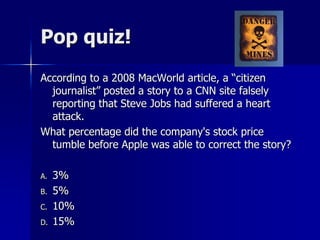
Pop quiz!
According to a 2008 MacWorld article, a “citizen
journalist” posted a story to a CNN site falsely
reporting that Steve Jobs had suffered a heart
attack.
What percentage did the company's stock price
tumble before Apple was able to correct the story?
A. 3%
B. 5%
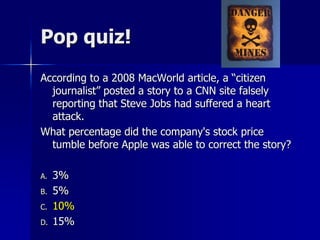
C. 10%
D. 15%
Pop quiz!
According to a 2008 MacWorld article, a “citizen
journalist” posted a story to a CNN site falsely
reporting that Steve Jobs had suffered a heart
attack.
What percentage did the company's stock price
tumble before Apple was able to correct the story?
A. 3%
B. 5%
C. 10%
D. 15%
 Casualization
 Content
 Comments
 Copyright
Social media landmines—
the four “C’s”
How journalists use
Twitter and Facebook
 Follow officials.
 Follow companies.
 Background on stories.
 Make connections with sources.
 Many have professional accounts vs.
private accounts.
 Most consider social media fair game
for quotes without permission.
How journalists use
Twitter and Facebook
 Build a personal brand.
 Invite sources to speak about story.
 Create buzz about a story they’re
covering.
 Real time coverage of events through
Twitter.
 Creating networks among sources.
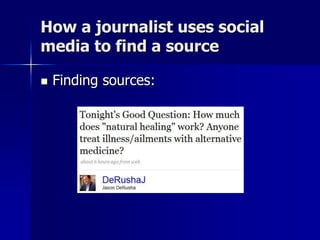
How a journalist uses social
media to find a source
 Finding sources:
Social media creates new
access to journalists
 New points of access.
 New journalists (such as bloggers).
How PR people use Social Media to
pitch to and connect with
journalists
 Use it to “watch” journalists’ interests, writing and
activities.
 Use it as a listening tool.
 As a supplement to more traditional forms of
pitching such as email.
 Use it to provide sources.
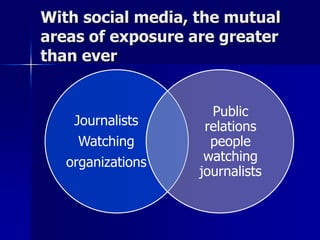
With social media, the mutual
areas of exposure are greater
than ever
Journalists
Watching
organizations
Public
relations
people
watching
journalists
Social media landmines can occur
when professional interactions
become casual or personal
 Journalists friending sources on
Facebook (or vice-versa).
 Too wide a view into personal, political
or social beliefs.
 Too wide a lens for comments.
When comments go bad…
 Make a strategic decision about
whether to address them broadly or
one-on-one.
 Use social media to enhance customer
service.
Pop Quiz!
 According to the “Voice of a Customer Community
site ,” companies using monitoring , AT&T can
now use Twitter data to pinpoint customer
problems ______ faster than through traditional call
center resolution.
1. 5 minutes
2. 10 minutes
3. 20 minutes
Source: http://voice-of-the-customer.tmcnet.com/topics/voice-of-the-
customer/articles/113781-att-listening-subscriber-complaints-
twitter.htm#elying on calls to the service center.
Pop Quiz!
 According to the “Voice of a Customer Community
site ,” companies using monitoring , AT&T can
now use Twitter data to pinpoint customer
problems ______ faster than through traditional call
center resolution.
1. 5 minutes
2. 10 minutes
3. 20 minutes
Source: http://voice-of-the-customer.tmcnet.com/topics/voice-of-the-
customer/articles/113781-att-listening-subscriber-complaints-
twitter.htm#elying on calls to the service center.
 Casual relationships
 Content
 Comment
 Copyright
Social media landmines—
the four “C’s”
The 24-Hour Spokesperson—What
to Do when the Mic is Always On
Good manners, good sense and some
good things to avoid…
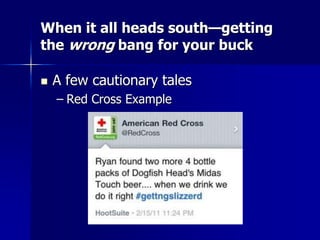
When it all heads south—getting
the wrong bang for your buck
 A few cautionary tales
– Red Cross Example
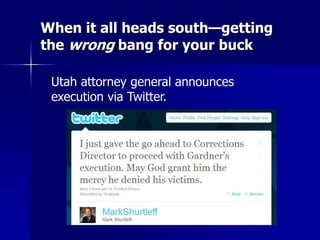
When it all heads south—getting
the wrong bang for your buck
Utah attorney general announces
execution via Twitter.
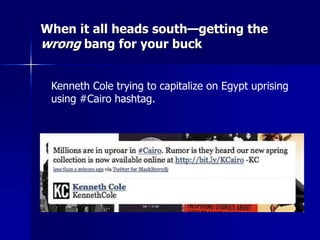
When it all heads south—getting the
wrong bang for your buck
Kenneth Cole trying to capitalize on Egypt uprising
using #Cairo hashtag.
What’s a journalist
to do?
 Control your emotions! Counsel your
clients/managers to do the same.
 Choose words carefully.
 Be accurate and truthful—truth is your best
defense.
 Facts vs. opinion.
The “24-Hour Rule”…strategies
to avoid saying something you’ll
regret later
• Physically leave the computer area.
• Before sending, call someone you trust and talk it
through with them.
• Save the draft (or send it to yourself).
Reread the next day.
• Ask yourself: Would you say this face to face?
Would you be comfortable seeing it in print or in
court?
The ghost of social
networks past, or…
How to lose a job or a reputation in 140
characters or less:
 Watch conversations held in online spaces—
even “private” ones. They could come back
to haunt you!
 When it involves customers or company
reputation, the stakes are even higher.
The ghost of social
networks past, or…
 If you must have a sensitive conversation in
a written format, send a direct message
instead of a tweet or Facebook posting.
 Don’t use your name as your Twitter handle.
Consider the ethics.
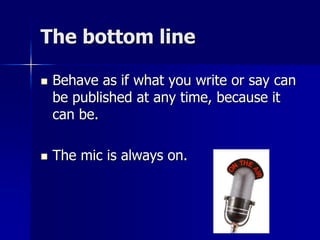
The bottom line
 Behave as if what you write or say can
be published at any time, because it
can be.
 The mic is always on.
 Casual relationships
 Content
 Comments
 Copyright
Social media landmines—
the four “C’s”
What if other people
say it on my site?
 Remain calm (see the 24-hour rule).
 Have a blog moderation policy.
 ISPs (but not those who post)
protected by Section 230 of the 1996
Communications Decency Act.
Pop Quiz: Online libel
 Am I protected from libel if someone
posts something defamatory on my
Web site?
a. There is no protection.
b. There is limited protection if I edit the
libel.
c. There is more protection if I don’t
edit the content of posts.
Pop Quiz: Online libel
 Am I protected from libel if someone
posts something defamatory on my
Web site?
a. There is no protection.
b. There is limited protection if I edit the
libel
c. There is more protection if I don’t
edit the content of posts.
Blog moderation policies
The best blog disclaimers are—
 clear,
 noticed,
 read, and
 reflect what’s actually occurring on the blog.
(From “Balance in the Blogosphere,” November 2008
Tactics, used with permission of PRSA.)
Use other peoples’ comments or not—but
don’t change or edit them.
 Casual relationships
 Content
 Comment
 Copyright
Social media landmines—
the four “C’s”
Pop quiz: Copyright
 Which of the following could you use
without violating copyright?
a. A photo from any public website.
b. A photo from any news website.
c. A photo with Creative Commons
license.
d. None of the above.
Pop quiz: Copyright
 Which of the following could use
without violating copyright?
a. A photo from any public website.
b. A photo from any news website.
c. A photo with Creative Commons
license.
d. None of the above.
Can you use copyrighted
materials?
Answer: It depends.
How much can you use?
Answer: It depends.
A general rule of thumb is that there is
no rule of thumb!
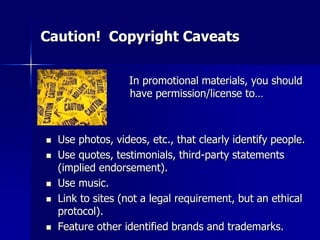
What kinds of works does
copyright apply to?
 Plays
 Movies
 Music
 Mime
 Books
 Poetry
 Etc.
Caution! Copyright Caveats
In promotional materials, you should
have permission/license to…
 Use photos, videos, etc., that clearly identify people.
 Use quotes, testimonials, third-party statements
(implied endorsement).
 Use music.
 Link to sites (not a legal requirement, but an ethical
protocol).
 Feature other identified brands and trademarks.
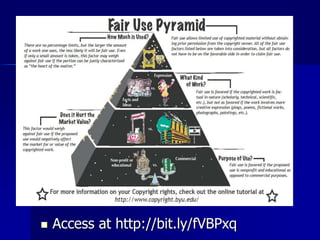
 Access at http://bit.ly/fVBPxq
In conclusion…
 The opportunities for
the meaningful
exchange of
information have
never been greater,
but they come at a
cost.
In conclusion…
 As with any financial
uncertainty you need
a reserve. At the end
of the day the reserve
you build with your
reputation,
professionalism and
that will tide you
through when
mistakes are made.
In conclusion…
 Not one of the companies
we’ve seen was
destroyed over a social
media land. A
fundamentally sound
company is not sunk by a
social media landmine,
but on the other hand a
fundamentally unsound
one is not saved by a
social media success.

Socialmedialandmines

  • 1.
    Avoiding Social Media Landmines: Getthe RIGHT Bang for your buck Joel Campbell and Susan Balcom Walton Brigham Young University
  • 2.
    Let’s practice! Howmany of you… a. Publish blogs. b. Tweet. c. Participate in or moderate message boards. d. Maintain or contribute to a web site. e. More than one of the above.
  • 3.
    Remember, there aretwo kinds of bangs… The kind you want… And the kind you don’t
  • 4.
    First, a disclaimer… Theinformation appearing in this presentation is for general informational and educational purposes only and is not intended to provide legal advice to any individual or entity. We urge you to consult with your own legal advisor before taking any action based on information appearing in this presentation.
  • 5.
    Same pitch, newballgame— the “new rules” of Social Media 1. The old rules still apply --Know your journalists and their contact preferences. --Know what they are writing about (and don’t pitch something they wrote about last week). --Don’t wait till you need them to build a relationship.
  • 6.
    Pop quiz! According toa 2008 MacWorld article, a “citizen journalist” posted a story to a CNN site falsely reporting that Steve Jobs had suffered a heart attack. What percentage did the company's stock price tumble before Apple was able to correct the story? A. 3% B. 5% C. 10% D. 15%
  • 7.
    Pop quiz! According toa 2008 MacWorld article, a “citizen journalist” posted a story to a CNN site falsely reporting that Steve Jobs had suffered a heart attack. What percentage did the company's stock price tumble before Apple was able to correct the story? A. 3% B. 5% C. 10% D. 15%
  • 8.
     Casualization  Content Comments  Copyright Social media landmines— the four “C’s”
  • 9.
    How journalists use Twitterand Facebook  Follow officials.  Follow companies.  Background on stories.  Make connections with sources.  Many have professional accounts vs. private accounts.  Most consider social media fair game for quotes without permission.
  • 10.
    How journalists use Twitterand Facebook  Build a personal brand.  Invite sources to speak about story.  Create buzz about a story they’re covering.  Real time coverage of events through Twitter.  Creating networks among sources.
  • 11.
    How a journalistuses social media to find a source  Finding sources:
  • 12.
    Social media createsnew access to journalists  New points of access.  New journalists (such as bloggers).
  • 13.
    How PR peopleuse Social Media to pitch to and connect with journalists  Use it to “watch” journalists’ interests, writing and activities.  Use it as a listening tool.  As a supplement to more traditional forms of pitching such as email.  Use it to provide sources.
  • 14.
    With social media,the mutual areas of exposure are greater than ever Journalists Watching organizations Public relations people watching journalists
  • 15.
    Social media landminescan occur when professional interactions become casual or personal  Journalists friending sources on Facebook (or vice-versa).  Too wide a view into personal, political or social beliefs.  Too wide a lens for comments.
  • 16.
    When comments gobad…  Make a strategic decision about whether to address them broadly or one-on-one.  Use social media to enhance customer service.
  • 17.
    Pop Quiz!  Accordingto the “Voice of a Customer Community site ,” companies using monitoring , AT&T can now use Twitter data to pinpoint customer problems ______ faster than through traditional call center resolution. 1. 5 minutes 2. 10 minutes 3. 20 minutes Source: http://voice-of-the-customer.tmcnet.com/topics/voice-of-the- customer/articles/113781-att-listening-subscriber-complaints- twitter.htm#elying on calls to the service center.
  • 18.
    Pop Quiz!  Accordingto the “Voice of a Customer Community site ,” companies using monitoring , AT&T can now use Twitter data to pinpoint customer problems ______ faster than through traditional call center resolution. 1. 5 minutes 2. 10 minutes 3. 20 minutes Source: http://voice-of-the-customer.tmcnet.com/topics/voice-of-the- customer/articles/113781-att-listening-subscriber-complaints- twitter.htm#elying on calls to the service center.
  • 19.
     Casual relationships Content  Comment  Copyright Social media landmines— the four “C’s”
  • 20.
    The 24-Hour Spokesperson—What toDo when the Mic is Always On Good manners, good sense and some good things to avoid…
  • 21.
    When it allheads south—getting the wrong bang for your buck  A few cautionary tales – Red Cross Example
  • 22.
    When it allheads south—getting the wrong bang for your buck Utah attorney general announces execution via Twitter.
  • 23.
    When it allheads south—getting the wrong bang for your buck Kenneth Cole trying to capitalize on Egypt uprising using #Cairo hashtag.
  • 24.
    What’s a journalist todo?  Control your emotions! Counsel your clients/managers to do the same.  Choose words carefully.  Be accurate and truthful—truth is your best defense.  Facts vs. opinion.
  • 25.
    The “24-Hour Rule”…strategies toavoid saying something you’ll regret later • Physically leave the computer area. • Before sending, call someone you trust and talk it through with them. • Save the draft (or send it to yourself). Reread the next day. • Ask yourself: Would you say this face to face? Would you be comfortable seeing it in print or in court?
  • 26.
    The ghost ofsocial networks past, or… How to lose a job or a reputation in 140 characters or less:  Watch conversations held in online spaces— even “private” ones. They could come back to haunt you!  When it involves customers or company reputation, the stakes are even higher.
  • 27.
    The ghost ofsocial networks past, or…  If you must have a sensitive conversation in a written format, send a direct message instead of a tweet or Facebook posting.  Don’t use your name as your Twitter handle. Consider the ethics.
  • 28.
    The bottom line Behave as if what you write or say can be published at any time, because it can be.  The mic is always on.
  • 29.
     Casual relationships Content  Comments  Copyright Social media landmines— the four “C’s”
  • 30.
    What if otherpeople say it on my site?  Remain calm (see the 24-hour rule).  Have a blog moderation policy.  ISPs (but not those who post) protected by Section 230 of the 1996 Communications Decency Act.
  • 31.
    Pop Quiz: Onlinelibel  Am I protected from libel if someone posts something defamatory on my Web site? a. There is no protection. b. There is limited protection if I edit the libel. c. There is more protection if I don’t edit the content of posts.
  • 32.
    Pop Quiz: Onlinelibel  Am I protected from libel if someone posts something defamatory on my Web site? a. There is no protection. b. There is limited protection if I edit the libel c. There is more protection if I don’t edit the content of posts.
  • 33.
    Blog moderation policies Thebest blog disclaimers are—  clear,  noticed,  read, and  reflect what’s actually occurring on the blog. (From “Balance in the Blogosphere,” November 2008 Tactics, used with permission of PRSA.) Use other peoples’ comments or not—but don’t change or edit them.
  • 34.
     Casual relationships Content  Comment  Copyright Social media landmines— the four “C’s”
  • 35.
    Pop quiz: Copyright Which of the following could you use without violating copyright? a. A photo from any public website. b. A photo from any news website. c. A photo with Creative Commons license. d. None of the above.
  • 36.
    Pop quiz: Copyright Which of the following could use without violating copyright? a. A photo from any public website. b. A photo from any news website. c. A photo with Creative Commons license. d. None of the above.
  • 37.
    Can you usecopyrighted materials? Answer: It depends. How much can you use? Answer: It depends. A general rule of thumb is that there is no rule of thumb!
  • 38.
    What kinds ofworks does copyright apply to?  Plays  Movies  Music  Mime  Books  Poetry  Etc.
  • 39.
    Caution! Copyright Caveats Inpromotional materials, you should have permission/license to…  Use photos, videos, etc., that clearly identify people.  Use quotes, testimonials, third-party statements (implied endorsement).  Use music.  Link to sites (not a legal requirement, but an ethical protocol).  Feature other identified brands and trademarks.
  • 40.
     Access athttp://bit.ly/fVBPxq
  • 41.
    In conclusion…  Theopportunities for the meaningful exchange of information have never been greater, but they come at a cost.
  • 42.
    In conclusion…  Aswith any financial uncertainty you need a reserve. At the end of the day the reserve you build with your reputation, professionalism and that will tide you through when mistakes are made.
  • 43.
    In conclusion…  Notone of the companies we’ve seen was destroyed over a social media land. A fundamentally sound company is not sunk by a social media landmine, but on the other hand a fundamentally unsound one is not saved by a social media success.