A JOURNALIST’S
GUIDE TO
WORKING WITH
SOCIAL SOURCES
SEPTEMBER 2016
BY CLAIRE WARDLE
Co-founder of Eyewitness Media Hub and
Research Director at Tow Center for Digital Journalism
CONTENTS
1.	 How should I contact a social source?
2.	 How should I word call-outs to eyewitnesses?
3.	 Do I have to get permission before I can use eyewitness media?
4.	 How should I contact eyewitnesses when I need to gain permission to
use their media?
5.	 What happens if people take down their content?
6.	 What do I need to worry about if I’m embedding content?
7.	 Do I need to pay for eyewitness media?
8.	 Do I need to worry about the people visible in the eyewitness media?
9.	 Should I add a credit to the content?
10.	 How can I protect myself when viewing graphic imagery
Increasingly, the most powerful images from
a news event are captured by eyewitnesses.
The proliferation of smartphones and the
popularity of social networks means that
before a professional camera crew can
arrive at the scene, there will almost always
be footage of events already uploaded to
the likes of Twitter, Instagram, YouTube,
Vine and Whatsapp, or streams appearing
via Periscope or Facebook Live. Other
bystanders might also have footage on their
phones, which they have not posted online.
If you work for a news organisation, it is
likely you are interested in using some of
these images. But how do you navigate
the legal and ethical hurdles? This guide
answers ten key questions you will face
working with status updates on social
networks and other online platforms as well
as eyewitness media – photographs or
videos captured by unofficial sources.
INTRODUCTION
While much of this guide will focus
on eyewitness media, many times as
a journalist you will want to contact
someone via the social web who
can help you with your reporting.
The main consideration is that
some users will be shocked that a
journalist is interested in talking to
them, and might be uneasy about
talking with you.
In many cases they will have
probably just witnessed something
traumatic, may still be in danger, or
find themselves in an unexpectedly
difficult and worrying situation. You
will inevitably be under pressure
during a breaking news event, but
always consider the feelings and
circumstances of the person you
are trying to reach. Journalists can
often cause eyewitnesses to shut
down and stop all contact by tactless
approaches.
HOW SHOULD
I CONTACT A
SOCIAL
SOURCE?
1
2
3
4
5
Ask about their wellbeing.
Remember their emotional
health is as important as
their physical safety.
Explain how you found
them and how you were
able to contact them (don’t
take for granted that they
know how privacy works
on different social sites).
Make it clear which news
organisation you work for.
Explain how you hope the
information they are able
to share with you will make
the story stronger.
Give them your
organisational email
address or newsroom
phone number so they can
ensure they’re talking to
who you say you are.
ONE
Building trust is incredibly
important when talking to
sources via the social web.
People communicating online
tend to be more apprehensive;
you will often need to take more
time than you would during a
face-to-face interview or phone
call. Jumping straight in and
asking for a quote is much less
likely to be successful.
1
James M Hudson and Amy Bruckman, (2004) “Go Away”: Participant Objections to
Being Studied and the Ethics of Chatroom Research, The Information Society, (20)
pp.127-139 http://www.cc.gatech.edu/~asb/papers/journal/hudson-bruckman-tis04.pdf
Jumping straight
in and asking for
a quote is much
less likely to be
successful.
It is also important to consider the ethical implications
of using information or quotes from someone who has
been posting on the social web. While certain spaces on
some platforms are public, research shows1
that users,
while knowing the comments are public, think of these
spaces as private zones where they can interact with
other people about the same subject. This is especially
true of chatrooms and message boards. For this reason,
it is more appropriate to contact someone you find in one
of these spaces to get a new quote rather than simply
lifting text from the online source. Jumping into chatroom
conversations will rarely end in success; chatroom users
are not always welcoming of new members. The best
approach is to contact the chatroom administrator to see
if they can post on your behalf.
Previous friendships or university affiliations can
sometimes give a journalist access to information that
isn’t fully public. Every newsroom should have ethical
policies about using information gleaned through these
types of social relationships.
‘Private’ messaging spaces like closed Facebook
or Whatsapp groups can cause other ethical
dilemmas. In these spaces, it is not appropriate
to lift material or quote conversations, even when
being careful not to name names. It can be easy
to forget that these spaces are private and groups
can have thousands of members. If a Facebook
group is ‘closed’, the information cannot be lifted.
There are no hard and fast rules when it comes
to newsgathering on social platforms. Each
news event is different. Do you want to use
photographs from the Facebook page of a victim
of a crime, or someone who perpetrated a crime?
Do you want to publish the final message posted
before an adult died in a plane crash, or before
their child did? If a teenager commits suicide and
her best friend provides you with screenshots of
their last Snapchat messages, is it appropriate to
use these?
Each case will be different, and will require
editorial judgment. We would recommend that
newsrooms create times to work through different
ethical scenarios as a team, so that all staff
members understand the main legal and ethical
issues involved.
KEY POINTS
It takes time to earn trust when contacting
sources via the social web. Where possible, try
to move the conversation on to an organisational
email address. Although online spaces can
technically be public, not all users think that way.
Be respectful of the information you get from
these spaces, and where possible contact the
source directly to ask them for a specific quote.
There are no hard and fast rules about using
information and materials sourced from the
social web. Each case is different. It is therefore
important that newsrooms have team discussions
using different scenarios to test ethical guidance
and policy.
Eyewitnesses who happen to be on the scene are not freelancers
and should not be treated as such. It’s important that the language
you use on your social media channels, whether organisational
accounts, personal accounts, or at the bottom of a news story,
does not suggest you are actively encouraging people to
capture footage for you. There have been examples of people
endangering themselves by crossing police lines, moving to
the front of protests to get better shots, or going outside during
dangerous storms .
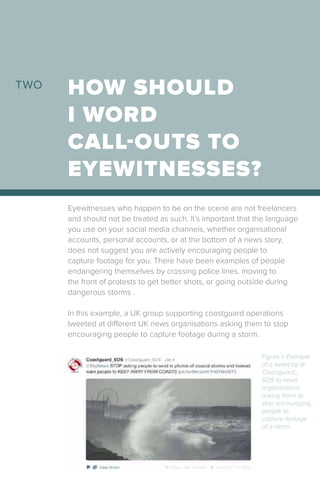
In this example, a UK group supporting coastguard operations
tweeted at different UK news organisations asking them to stop
encouraging people to capture footage during a storm.
HOW SHOULD
I WORD
CALL-OUTS TO
EYEWITNESSES?
TWO
Figure 1: Example
of a tweet by @
Coastguard_
SOS to news
organisations
asking them to
stop encouraging
people to
capture footage
of a storm.
In research2
we conducted in 2014, Fran Unsworth,
Deputy Director of News at the BBC, shared the
organisation’s experience during the Buncefield blaze
of 2005, when a huge fire broke out at a fuel depot
just outside London. Local teenagers got very close
to the fire to film it. Told by BBC producers on the
ground that their pictures were ‘too wobbly’ they then
leapt up and announced they would go and get better
ones. They were told not to do so, as they were
putting themselves in danger. The incident forced
the BBC to rethink its processes around eyewitness
media. It rolled out a specific training course on
working with uploaders and with this type of footage.
Caroline Bannock, who works
on the GuardianWitness
project, also explained how her
organisation has changed the
phrasing of its calls to action,
discarding ‘send us your pictures’
in favour of ‘share your pictures
with us.’ She went on to say:
‘I’m actually quite careful in a
protest, so if someone is sending
in photographs of someone
doing something that they could
be picked up for by security
services, I won’t publish that.
These people aren’t journalists;
they’re sending us snapshots
and they’re sending us stories.
They don’t have that sort of
journalistic sensibility. So we’re
particularly careful.’
Send us your
pictures
vs.
Share your
pictures with us
2
Claire Wardle, Sam Dubberley and Pete Brown (2014), Amateur Footage: A Global
Study of User-Generated Content in TV and Online News Output, Tow Center for
Digital Journalism
http://towcenter.org/wp-content/uploads/2014/05/Tow-Center-Amateur-Footage-A-
Global-Study-of-User-Generated-Content-in-TV-and-Online-News-Output.pdf
Be aware of trying to contact
people who are caught up in an
ongoing situation. There have
been examples of journalists
tweeting people during
active shootings, for example
the Westgate Mall hostage
situation in Nairobi in 2013, or
the shootings at the Umpqua
Community College campus
in Oregon in October 2015.
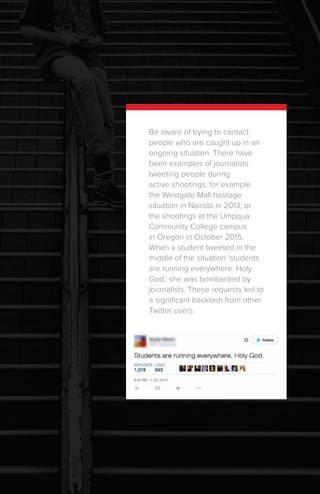
When a student tweeted in the
middle of the situation ‘students
are running everywhere. Holy
God,’ she was bombarded by
journalists. These requests led to
a significant backlash from other
Twitter users
Journalists have to do their job, and have always had to
approach eyewitnesses during difficult times. However
the messaging technology built into social networks
means they can now contact eyewitnesses when it is
not safe to do so. The reputational risk involved in doing
this type of newsgathering publicly is significant, and
the potential benefits are small, as eyewitnesses can
often be too traumatised to speak at that point, or may
shut down potential lines of communication entirely.
In the example from the Umpqua Community College
shooting, the person who tweeted did not reply to any of
the reporters. In other cases, the eyewitness has closed
down their account because of the number of requests.
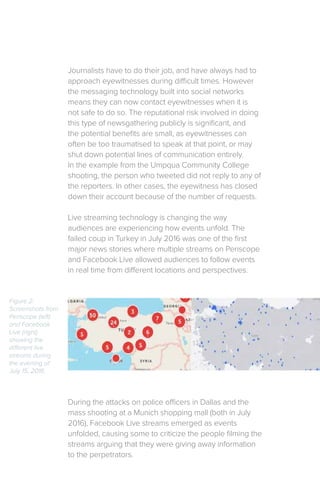
Live streaming technology is changing the way
audiences are experiencing how events unfold. The
failed coup in Turkey in July 2016 was one of the first
major news stories where multiple streams on Periscope
and Facebook Live allowed audiences to follow events
in real time from different locations and perspectives.
During the attacks on police officers in Dallas and the
mass shooting at a Munich shopping mall (both in July
2016), Facebook Live streams emerged as events
unfolded, causing some to criticize the people filming the
streams arguing that they were giving away information
to the perpetrators.
Figure 2:
Screenshots from
Periscope (left)
and Facebook
Live (right)
showing the
different live
streams during
the evening of
July 15, 2016.
As live streams become more common, newsrooms
need to include guidance on how they should
incorporate them into output. Like any piece of
eyewitness media, the copyright belongs to the
person live streaming, and journalists should
exercise caution when contacting an eyewitness
during an active situation. Embedding or linking to
the streams can multiply audiences significantly and
the implications of doing so should be seriously
considered. Is the stream putting authorities in
danger? Is the stream providing unnecessary media
attention for the perpetrator? Is the person live
streaming putting themselves in danger by doing so?
During breaking news events, eyewitnesses
are often contacted by multiple journalists from
the same organisation. While this seems a basic
mistake, it happens frequently. Not only does it
add unnecessarily to the digital bombardment
eyewitnesses are receiving, it has damaging
repercussions for the newsroom in terms of
reputation, as other users often pick up on and
expose the organisation’s internal miscommunication.
Finally, journalists should take care when putting out
open calls for eyewitnesses. While this is common
practice, it can lead to people providing false reports.
In December 2015, someone calling herself Marie
Christmas falsely suggested she had witnessed the
San Bernardino shootings. She was quoted by a
number of reputable news outlets3
.
3
Steve Buttry (3 December, 2015) ‘Marie Christmas:’ Some journalists fell for San
Bernardino prank; others backed away, The Buttry Diary
https://stevebuttry.wordpress.com/2015/12/03/the-case-of-marie-christmas-verifying-
eyewitnesses-isnt-simple-or-polite/
KEY POINTS
Ensure that any outreach language to eyewitnesses
does not suggest you are commissioning them.
Where possible, try to source a telephone number
so you can contact the person offline.
If you have no choice but to approach eyewitnesses
via social networks, think about their emotional and
physical health and safety. Take into account that
they have just seen something shocking or traumatic
and do not put them under any pressure.
Don’t approach eyewitnesses during ongoing
situations.
Newsrooms should co-ordinate messages to
eyewitnesses so they are not contacted by multiple
journalists from the same newsroom.
DO I HAVE TO
GET PERMISSION
BEFORE I CAN
USE EYEWITNESS
MEDIA?
This is not the place for a deep dive into the legalities
of using eyewitness media in different jurisdictions,
that will be the subject of our next guide. The two
important points to remember are:
1
2
There is no legal issue with using text,
i.e. status updates.
The copyright is held by the person
who created the image or video, not the
person who uploaded the content.
The copyright issue is also relevant when you want
to use a photo of someone who is the subject of a
news story. If it is a wedding or school photo, the
professional photographer who took that photograph
holds the copyright. Therefore, if you want to take a
photo or video from a platform, either by capturing a
screenshot, displaying a video in the player owned by
your news organisation, or ingesting it into your own
broadcasting systems, you must seek permission from
the owner of the copyright.
THREE
If you want to embed a photo or video from a social
network, you can embed it directly on your site by
pasting the embed code provided by the social
network. By doing this you are technically not taking
the content off its platform, and you therefore do
not need to gain permission from the person who
created the content. However, there are ethical
implications that need to be considered, which will
be discussed below.
For breaking news stories where there is genuine
public interest in the footage being seen more
widely, it is possible a judge would rule favourably
in a case of eyewitness media being used without
permission. Many people cite fair dealing or fair
use laws as protection. While there are similarities
between these laws in different countries, there are
also real differences in the way news organisations
apply them and judges rule on them. Photos and
videos are also treated differently. For example,
in the UK, videos can be used under a fair use
defence, while photos cannot. If you want to use
eyewitness media without permission, we would
advise talking to a lawyer first.
It is also worth considering reasonable limits in terms
of the size of the clip. Running a short clip might be
deemed acceptable, while running a much longer
segment might not. The long term implications
of using the material, for example in archives or
other longer pieces of news output like an end of
year documentary, are also relevant. While a judge
might look favourably on a news organisation using
footage in the days immediately after a news event
when it was impossible to gain permission, this is
harder to justify as time passes.
There is currently a case going through the
courts involving a 32 second clip that was
uploaded to YouTube of a storm cloud passing
over Buffalo4
. The clip was used by two news
organisations without permission. The owner of
the video filed a lawsuit in the US District Court.
In another recent case the Vietnamese national
broadcaster was suspended from YouTube
after it broadcast videos by an amateur
photographer and drone operator without his
permission5
.
There is a great deal of confusion and
ignorance about copyright and eyewitness
media. Many users assume the social network
owns the rights to their content. This is not the
case. Though users may not understand their
rights, it is important that journalists do.
5
BBC Trending, (13 March, 2016) What happened when Vietnam’s national
broadcaster was caught pinching YouTube videos,
http://www.bbc.com/news/blogs-trending-35785996
4
Melinda Miller (18 August, 2015) Storm video shooter sues the CBC, CNN for
copyright infringement, Buffalo News
http://www.buffalonews.com/city-region/federal-court/storm-video-shooter-sues-the-
cbc-cnn-for-copyright-infringement-20150818
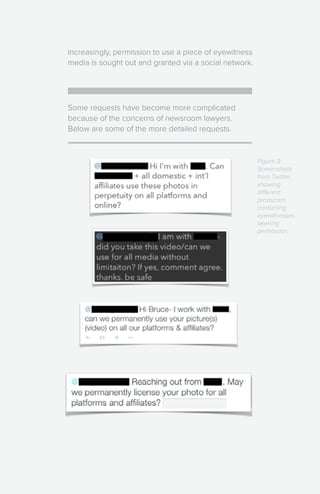
Some requests have become more complicated
because of the concerns of newsroom lawyers.
Below are some of the more detailed requests.
Figure 3:
Screenshots
from Twitter
showing
different
producers
contacting
eyewitnesses
seeking
permission.
Increasingly, permission to use a piece of eyewitness
media is sought out and granted via a social network.
Research with audiences has confirmed how
confusing they find this type of language, with
people admitting that they don’t understand
terms such as exclusivity, syndication, license
and perpetuity. It is important that users are
able to provide informed consent, and that
journalists doing this type of outreach ensure
that eyewitnesses understand everything that
will happen with their content. This might include
distributing content to other news organisations,
whether or not the original newsroom received
a fee. Many users have no idea that if they give
permission to the BBC in London, for example, their
content could appear on ABC Australia due to a
reciprocal arrangement.
Journalists should also explain that footage will
be placed in an archive for potential use at a later
date. This level of permission request should
not happen via Twitter, but via an email or other
form of private communication. It is important to
capture this secondary level of permission as there
is a growing tendency for eyewitnesses to give
permission to a number of news organisations, then
be approached by a licensing company who offers
to pay them a fee. Part of the agreement for this
is that they delete any previous public messages
giving permission for use.
KEY POINTS
Copyright is owned by the person who
captured the footage, not the person
who uploaded it.
Audiences are often confused
by their own rights, as well as by
the terminology used by news
organisations, so it is important to
ensure uploaders understand what
different words mean when seeking
permission.
Where possible, use email so you
have more room to explain terms and
to ensure that you have a copy of the
permission that cannot be deleted by
the user.
As discussed above, eyewitnesses are often bombarded
with requests during a breaking news event. It is easy to
hit reply on Twitter or to leave a comment on an Instagram
post, but you are likely to be competing with many other
journalists. On a story of global relevance, the number of
comments left under a piece of eyewitness media can
reach over 200. It is difficult in 140 characters to explain
that you want the eyewitness to stay safe, and exactly
how you intend to use the footage. It is therefore worth
using online research skills to find other ways to contact an
eyewitness. Encouraging Twitter users to follow you means
you can send them a direct message. This is better than
arranging permission requests via public messages, but
the scrum on Twitter and Instagram in the aftermath of a
breaking news event makes it problematic to rely solely on
these avenues.
HOW SHOULD
I CONTACT
EYEWITNESSES
WHEN I NEED TO
GAIN PERMISSION
TO USE THEIR
MEDIA?
FOUR
It is also worth remembering that many users do not
understand the public nature of Twitter, including
the fact that journalists can find their tweets or
Instagram posts via keywords, or via geo-located
searches if they have added location information to
their posts. They are therefore sometimes shocked
when journalists request permission seemingly out
of the blue. This can occur, in
particular, if a group of friends
are conversing together on
Twitter. There have been
cases of journalists ‘jumping
into’ conversations on Twitter
or in a chatroom, which,
while technically public, felt
private to the participants.
Journalists should consider the
context in which they contact
eyewitnesses. While it is easy
to emulate offline techniques,
there are often specific cultural
norms in online communities.
A simple ‘yes’ via Twitter or Instagram can
sometimes mean a journalist gets permission
quickly and easily. However it is only by talking to an
eyewitness that a journalist can ask the necessary
questions to help with verification, including:
•	 Did you capture this footage yourself?
•	 Can you explain exactly why you were there?
•	 What did you see?
•	 What camera were you using?
•	 Can you send the original image or video?
•	 Did you capture any other footage?
It’s important
journalists consider
the context in
which they contact
eyewitnesses.
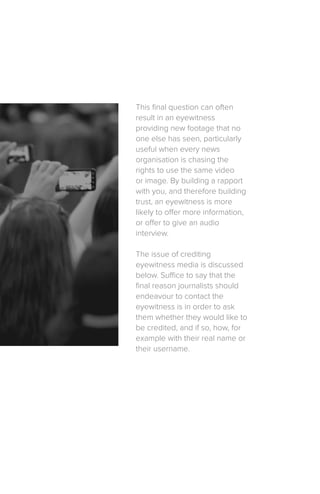
This final question can often
result in an eyewitness
providing new footage that no
one else has seen, particularly
useful when every news
organisation is chasing the
rights to use the same video
or image. By building a rapport
with you, and therefore building
trust, an eyewitness is more
likely to offer more information,
or offer to give an audio
interview.
The issue of crediting
eyewitness media is discussed
below. Suffice to say that the
final reason journalists should
endeavour to contact the
eyewitness is in order to ask
them whether they would like to
be credited, and if so, how, for
example with their real name or
their username.
KEY POINTS
Where possible, use online research
techniques to find email addresses
or telephone numbers to contact
eyewitnesses away from public social
media channels.
Whenever possible, try to talk to an
eyewitness directly, to ask questions
that will help with verification
processes, but also to ask whether
they have other footage on their
phone and are willing to provide an
interview about what they saw.
Where possible, ask the eyewitness
how they would like to be credited.
WHAT HAPPENS
IF PEOPLE TAKE
DOWN THEIR
CONTENT?
Every user has the right to remove their content from
a social network. They will have numerous reasons
for this, but it often happens following the recognition
that the linking of their name to a piece of content
will result in online harassment by other users,
embarrassment, or even danger.
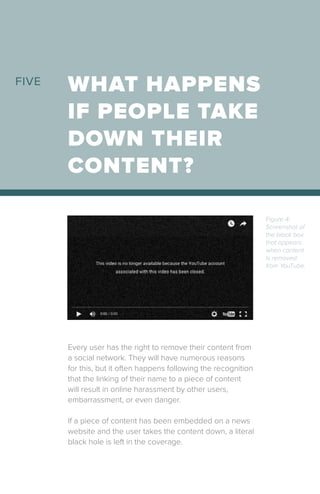
If a piece of content has been embedded on a news
website and the user takes the content down, a literal
black hole is left in the coverage.
FIVE
Figure 4:
Screenshot of
the black box
that appears
when content
is removed
from YouTube.
To prevent this from happening, a newsroom
must seek official permission to use the footage
off-platform. The process of seeking permission
also encourages the user to think about the
implications of having the content publicly
available, something which some users do
not think through when they publish to social
networks, assuming the content will only be seen
by the people who follow them.
Another scenario is when a user removes content
during the newsgathering phase. This was the
case during the Charlie Hebdo attacks, when
Jordi Mir captured the shooting of the police
officer Ahmed Merabet on the street outside his
apartment. He uploaded the film to his Facebook
account, but within fifteen minutes had had a
change of heart and removed the video. Within
that time, one of his Facebook followers had
downloaded the video and re-uploaded it to
YouTube. It was subsequently used by many news
organisations around the world.
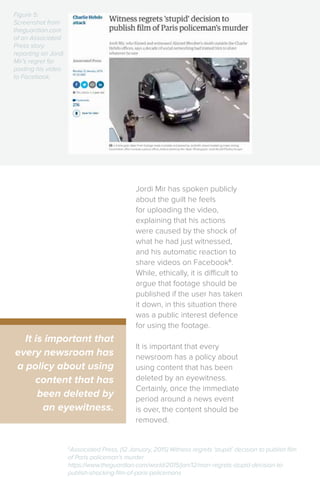
Jordi Mir has spoken publicly
about the guilt he feels
for uploading the video,
explaining that his actions
were caused by the shock of
what he had just witnessed,
and his automatic reaction to
share videos on Facebook6
.
While, ethically, it is difficult to
argue that footage should be
published if the user has taken
it down, in this situation there
was a public interest defence
for using the footage.
It is important that every
newsroom has a policy about
using content that has been
deleted by an eyewitness.
Certainly, once the immediate
period around a news event
is over, the content should be
removed.
It is important that
every newsroom has
a policy about using
content that has
been deleted by
an eyewitness.
6
Associated Press, (12 January, 2015) Witness regrets ‘stupid’ decision to publish film
of Paris policeman’s murder
https://www.theguardian.com/world/2015/jan/12/man-regrets-stupid-decision-to-
publish-shocking-film-of-paris-policemans
Figure 5:
Screenshot from
theguardian.com
of an Associated
Press story
reporting on Jordi
Mir’s regret for
posting his video
to Facebook.
KEY POINTS
If a newsroom embeds eyewitness
media and the user removes the
content, a black hole will appear
where it originally existed.
If a user takes down their video or
image, but you still have a copy, a
wider editorial discussion is necessary
to decide whether public interest
warrants using the content.
If content is used once it has been
removed, it must not be used beyond
the specific time period associated
with interest in the story.
As discussed above, a news organisation does not
have to get permission to embed a status update,
video or image uploaded to a social network.
The terms of service outline that when content is
embedded, it has technically not been moved off the
platform. However journalists still need to think about
the ethical implications of embedding content.
The most important consideration is the fact that
when many users upload content to their social
networks, they are only imagining their own followers
as the audience. Often people have small numbers
of followers, for example 50–100, mostly friends and
family. They rarely consider that a photo or video
might be embedded on a news website and subject to
thousands, if not millions, of views.
While journalists have an instinct for ‘newsworthy’
content, eyewitnesses may be genuinely perplexed
that a news organisation would be interested in their
content. They would not assume a journalist would be
looking for it, or would be able to find it.
WHAT DO I
NEED TO WORRY
ABOUT IF I’M
EMBEDDING
CONTENT?
SIX
When a journalist uses the
code and embeds a post on
a different site, the user does
not receive a notification.
Eyewitnesses therefore often
have no idea that their tweet,
image or video has been
embedded on a news website.
It is only if friends see it and
message them that they realise
what has happened.
Eyewitness Media Hub has five case studies on their
website illustrating how eyewitnesses can feel when
their content is used by news organisations7
. ‘One
of the case studies involves an Instagram image
posted by a woman who was socialising at a hotel
bar in Australia. It was a selfie, but in the background
you could see Stefan Gordy, AKA Redfoo, a
musician, dancer and DJ known for being a judge on
X Factor Australia.
Later that night, events took a dark turn when
Redfoo was struck on the head and wounded by a
bottle deliberately thrown by another patron of the
bar. News of this violent attack on an international
celebrity quickly spread and journalists began
contacting the uploader for an eyewitness account
and permission to use her photo. She turned down
these requests explaining ‘I didn’t grant permission
to any [news outlets]. They took it from my Instagram
page. I did however get asked to send other photos
to several media companies, but declined.’
Despite her refusal, the image was used by various
news outlets around the world. The uploader
explained ‘I was actually considering suing, but
couldn’t be bothered. Apparently because my
Instagram isn’t private they have the right to use it
without permission, which sucks!’
Frequently therefore,
eyewitnesses have
no idea that their
tweet, image or
video has been
embedded on a
news website.
7
Pete Brown (2015) Five Uploader Stories,
http://eyewitnessmediahub.com/research/user-generated-content/uploader-stories
Some would argue that by posting her content
to Instagram, she made it fair game. However, the
implications can last longer than expected. In this
case, the same picture appeared on another new
story about young people and alcohol consumption
six months after the original story about the
Redfoo glassing.
Eyewitness Media Hub spoke to a number of
eyewitnesses who explained their regret about the
fact that their name is now linked to the image or
video they uploaded, and that this now takes priority
on Google over personal or professional information
about them.
While this guide concentrates on eyewitness media,
it is also worth discussing the ethics of embedding
tweets or public Facebook status updates.
Public pages are tricky. If someone posts to a ‘save
our local hospital’ Facebook page, their post is
technically public, but many users don’t understand
that. Lifting a quote from a page like this to use in
reporting, and quoting the name of the person who
wrote it, could be problematic. It is worth contacting
the person to ask whether they stand by the
comment or would like to make another one.
Facebook groups are even more difficult as they
are often ‘closed’, meaning membership has to be
accepted by the administrator of the group. Often
they have rules to ensure comments don’t travel
beyond the group. But some of these groups have
become very large, and there have been instances
of journalists using quotes from people in them. In a
recent example, the journalist blurred out usernames,
but there was anger from users, because anyone
who was a member of the group could do a search to
work out who had made the comment.
In terms of Twitter, there are ethical implications to
embedding tweets. Examples of embedded tweets
have included people live-tweeting overheard
conversations on trains, tweets about a couple
splitting up on a plane including a photograph
of them, and of politicians giving away too much
information in a telephone call. Twitter makes it
very easy to embed tweets like these, allowing a
journalist to make a whole story out of the material.
While there are ethical questions about live-tweeting
conversations in general, amplifying the contents
of these conversations by embedding tweets on
a news website, often before the subjects of the
conversations know, is another issue entirely.
Facebook groups are even more
difficult as they are often ‘closed’
One case study from March 2014 highlighted the
issues that emerge from embedding tweets. Jessica
Testa from Buzzfeed saw a tweet from a woman
asking any of her followers who were survivors of
sexual abuse to share a description of what they
were wearing when they were attacked. Many
replied to the original question, and the result
was a powerful collection of tweets. Jessica Testa
contacted each user to ask permission to include
their tweet in a story she wanted to write for
Buzzfeed. Many journalists praised Jessica for her
ethical practice, although some questioned the need
to ask permission to use information already out in
the open. However Jessica had not asked permission
from the woman who originally posed the questions
and she was particularly upset about the use of her
image alongside the story.8
Twitter is public, but some users do not consider the
repercussions of this. Many have small numbers of
followers and believe that only these people see
what they post. As with Facebook and Instagram,
when a tweet is embedded, the person who wrote
that tweet is not alerted about the potential large
increase in audience. The time pressures under
which journalists operate make it impractical to ask
permission every time a tweet is embedded. For
certain subjects, and certain users who are not high
profile or frequent users, however, the impact of
embedding the tweet should be considered.
A final point involves crediting, discussed in more
detail below. Many eyewitnesses ask not to be
credited, citing a number of reasons. By embedding a
tweet, a journalist is automatically crediting someone,
as their username travels with the tweet. This can
be problematic: any reader who wants to abuse the
eyewitness (for example because they were filming
events rather than helping) can do so by clicking
directly on the username and going to their profile.
8
Kelly McBride (13 March, 2014) Buzzfeed Reporter’s Use of Tweets Stirs Controversy,
http://www.poynter.org/2014/buzzfeed-reporters-use-of-tweets-stirs-controversy/243413/
KEY POINTS
Legally, it is not necessary to receive permission
from a user to embed their status update, video
or image.
Remember the user is not alerted when their
content is embedded on another site.
Ethically, it is important to consider the intent
of the person who created the content. Think
about what the user might reasonably expect to
happen to their content.
Moving content from a social network to a news
site can potentially have a significant impact on
the user.
Remember that when you embed a piece of
content, you are automatically crediting its
creator, meaning that people can click directly
through from the username, potentially to harass
the eyewitness.
This is the 64 million dollar question. Norms and
practices are shifting continually. As mentioned
above, the person who created the content holds
the copyright. They can therefore charge a fee for
use. Whether a newsroom decides to pay this fee
is a different matter.
DO I NEED
TO PAY FOR
EYEWITNESS
MEDIA?
SEVEN
Norms around payment are culturally
specific. In Kenya, for example, many
eyewitnesses will expect to be paid for
their contributions, partly because local
sites have created markets for this type of
content.
A
There are a number of
factors at play here
B
C
D
E
Eyewitnesses often have an inflated sense
of the relative value of their piece of media.
They may not understand that if they have
uploaded it to the social web, its value will
have dropped because exclusivity has been
lost.
Users may not understand what exclusive
means. There have been examples of
eyewitnesses promising exclusive footage
to one news organisation, but also selling it
‘exclusively’ to another.
There are increasing numbers of licensing
companies who swoop in quickly and
offer to manage the rights of a piece of
eyewitness content. Some pay an outright
fee, while others take a share of the
revenue by licensing the piece to other
news organisations.
There is a difference between types of
eyewitness media. Viral content, such as
a cute or funny animal or baby videos, will
almost always be licensed quickly and a fee
attached to them. Breaking news footage is
currently less likely to be licensed, but this
is changing, particularly where high value
footage is concerned.
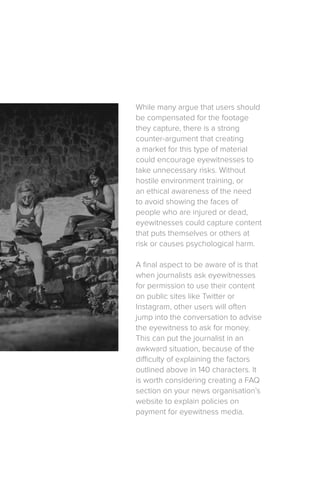
While many argue that users should
be compensated for the footage
they capture, there is a strong
counter-argument that creating
a market for this type of material
could encourage eyewitnesses to
take unnecessary risks. Without
hostile environment training, or
an ethical awareness of the need
to avoid showing the faces of
people who are injured or dead,
eyewitnesses could capture content
that puts themselves or others at
risk or causes psychological harm.
A final aspect to be aware of is that
when journalists ask eyewitnesses
for permission to use their content
on public sites like Twitter or
Instagram, other users will often
jump into the conversation to advise
the eyewitness to ask for money.
This can put the journalist in an
awkward situation, because of the
difficulty of explaining the factors
outlined above in 140 characters. It
is worth considering creating a FAQ
section on your news organisation’s
website to explain policies on
payment for eyewitness media.
KEY POINTS
Eyewitnesses have the right to ask
for payment and it is an individual
newsroom’s decision whether or not to
pay for footage.
Bear in mind that licensing companies
will often secure newsworthy footage
relatively quickly, and a fee will
therefore be required for its use.
Other users will often get involved
in conversations on public platforms
urging eyewitnesses to ask for money.
Be prepared to answer their questions.
If a newsroom relies regularly
on eyewitness media, it is worth
considering writing a FAQ document
about payment. This allows a reporter
in a breaking news situation to point
to the FAQ rather than engaging
individually each time.
Humanitarian organisations require their photographers
and field staff to receive consent from everyone who
features in an image or video. They consider it vital that
people from vulnerable communities understand that an
image might appear on social media and therefore a news
website, and that they agree to it in full understanding of
the implications for themselves and their families.
News organisations are less likely to think about gaining
consent from people captured in a piece of eyewitness
media, but there are certain circumstances in which a
separate conversation is required.
One case study involves the example of Chelsea
football fans chanting racist slurs at a black man on the
platform of the Paris metro9
in February 2015. A freelance
photographer captured the incident, and recognising the
value of the film sent it directly to the Guardian newspaper.
The rights issues around this film are interesting in
DO I NEED TO
WORRY ABOUT
THE PEOPLE
VISIBLE IN THE
EYEWITNESS
MEDIA?
EIGHT
9
BBC 5 Live Interview (11 March, 2015) Souleymane S ‘too traumatised’ to attend
Chelsea vs PSG http://www.bbc.co.uk/programmes/p02ls1dz
KEY POINTS
themselves, and you can read about them here10
, but the
less well-known story involves the subject of the racist
chanting. He has spoken about his discomfort at being
shoved into the media spotlight without his permission, and
in particular about having to explain to his young son why
he had been abused in this way. There are other examples
of similar cases, such as footage of young gay men being
physically bullied in Russia because of their sexuality.
While these stories are important, protecting the victim of
the abuse is just as important. Blurring faces should be
considered in cases like these. In February 2016, YouTube
launched a new version of their blurring tool, following
advice from the human rights organisation WITNESS.11
WITNESS has detailed guidelines on the ethics of curating
eyewitness media.12
Their section on the importance of
gaining the consent of people visible in footage is an
important read.
It is important to consider the implications
for people visible in eyewitness media.
When in doubt, seek permission.
If permission is impossible, blur out faces.
12
Witness (October, 2015) Ethical Guidelines: Using Eyewitness Videos in Human Rights
Reporting and Advocacy, https://library.witness.org/product/video-as-evidence-ethical-
guidelines/
12
Witness (25 February, 2016) Witness Advises YouTube on Video Blurring Tool,
https://witness.org/witness-advises-youtube-on-video-blurring-tool/
10
Jenni Sargent (22 February, 2015) Handing it Over: Case Study of the Chelsea Racism Video,
https://medium.com/@emhub/does-it-pay-to-have-a-right-s-department-on-your-side-
92c37e827016 - .ai6m6bquq
The news industry has a poor record when it
comes to crediting eyewitness media. A 2014 study
demonstrated that only 16% of eyewitness media on
24 news channels had a credit included onscreen.13
Since that research, there is now more evidence that
not everyone wants to be credited. Some people feel
uncomfortable being tied to the event, particularly if
they are still traumatised by what they saw. Others
don’t want to be associated with it for practical
reasons, for example because they should not have
been where they were on that day, or they don’t
want their name connected with the event in Google
searches. Others have seen eyewitnesses harassed
after their footage was used, with commenters
suggesting they should not have been filming and
should have been helping others caught up in events,
or accusing them of collecting payment and profiting
from a tragic situation.
SHOULD I ADD A
CREDIT TO THE
CONTENT?
NINE
13
Claire Wardle, Sam Dubberley and Pete Brown (2014), Amateur Footage: A Global Study of
User-Generated Content in TV and Online News Output, Tow Center for Digital Journalism,
http://towcenter.org/wp-content/uploads/2014/05/Tow-Center-Amateur-Footage-A-Global-
Study-of-User-Generated-Content-in-TV-and-Online-News-Output.pdf
More serious is the case of people uploading
footage from countries where their safety is put at
risk by doing so. For journalists covering stories
from such countries, outreach to eyewitnesses is
extremely important. Public methods of contact,
even using email addresses linked to a newsroom,
should be avoided. Simply being seen to be talking
to certain news organisations can place people in
dangerous situations, and case-by-case decisions
should be taken about ways of verifying footage and
gaining permission. In these situations, a cost/benefit
analysis has to be made about the risks involved
for the person who captured the footage, and usual
norms for working with eyewitness media may have
to be ignored to protect people. Credits should not
be added to this type of footage.
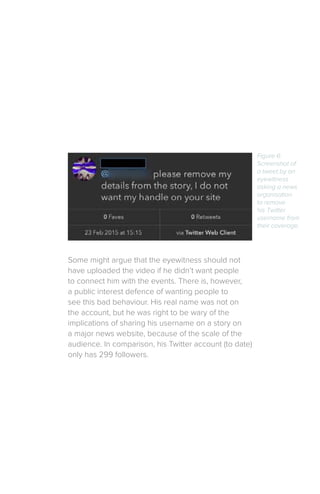
Finally, secret filming is increasing, due to the ease
of pressing record on a smartphone without anyone
seeing. In the example below, a man captured a
group of football fans chanting racist abuse on a
bus. He tweeted the video, but when journalists
contacted him about using it, he said he was happy
for it to be used, but not with his username attached.
When his name was included, he tweeted asking for
it to be removed.
Some might argue that the eyewitness should not
have uploaded the video if he didn’t want people
to connect him with the events. There is, however,
a public interest defence of wanting people to
see this bad behaviour. His real name was not on
the account, but he was right to be wary of the
implications of sharing his username on a story on
a major news website, because of the scale of the
audience. In comparison, his Twitter account (to date)
only has 299 followers.
Figure 6:
Screenshot of
a tweet by an
eyewitness
asking a news
organisation
to remove
his Twitter
username from
their coverage.
KEY POINTS
Don’t assume that the eyewitness wants to have
a credit attached to their footage. If possible,
ask them whether and how they would like to be
credited.
Be aware that eyewitnesses can receive online
abuse for capturing footage or being seen to
potentially receive money for their footage.
Embedding content means credit happens
automatically, allowing other users to click through
to the social account of the eyewitness. This makes
abuse much easier.
Be especially careful when attempting to verify and
gain rights to use eyewitness media captured in
countries where speaking to a journalist could have
serious repercussions for the eyewitness.
Honour requests to keep footage uncredited. If
newsroom policy dictates that a credit is necessary,
explain this to the eyewitness so they have a chance
to refuse permission to use the footage.
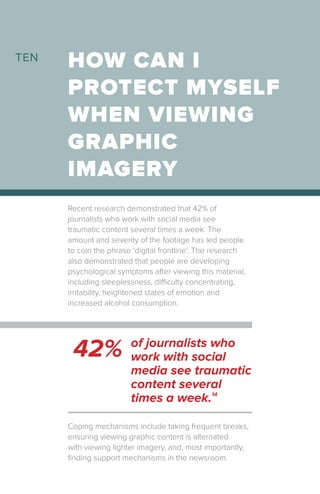
Recent research demonstrated that 42% of
journalists who work with social media see
traumatic content several times a week. The
amount and severity of the footage has led people
to coin the phrase ‘digital frontline’. The research
also demonstrated that people are developing
psychological symptoms after viewing this material,
including sleeplessness, difficulty concentrating,
irritability, heightened states of emotion and
increased alcohol consumption.
HOW CAN I
PROTECT MYSELF
WHEN VIEWING
GRAPHIC
IMAGERY
TEN
42% of journalists who
work with social
media see traumatic
content several
times a week.14
Coping mechanisms include taking frequent breaks,
ensuring viewing graphic content is alternated
with viewing lighter imagery, and, most importantly,
finding support mechanisms in the newsroom.
Audio can prompt strong reactions. It makes
sense to turn off sound unless necessary when
viewing material. It is also good practice to make
the viewing window smaller. There is evidence
that people need to be mentally prepared before
viewing graphic imagery, and that the element
of surprise can amplify the impact. It is therefore
sensible to give colleagues fair warning before
asking them to view something that you think might
cause upset.
The Dart Center for Trauma and Journalism offers
advice for journalists who work with this type of
material.15
One of the most important points to remember is
that if you are experiencing negative emotions or
15
Witness Dart Center (2014) Working with Traumatic Imagery,
http://dartcenter.org/content/working-with-traumatic-imagery
14
Sam Dubberley, Elizabeth Griffin, Haluk Mert Bal (2015) Making Secondary Trauma a
Primary Issue: A Study of Eyewitness Media and Vicarious Trauma on the Digital Frontline
http://eyewitnessmediahub.com/research/vicarious-trauma
feel that you are displaying symptoms of vicarious trauma,
do not feel guilty and/or ashamed. You are not alone in
experiencing such feelings. Research is now demonstrating
that working with distressing eyewitness content in an office
can be as traumatic as working in the field, because you
are likely to be viewing far more graphic and disturbing acts
on a more frequent basis. If you think you are experiencing
symptoms of vicarious trauma or any other mental health
condition, talk to someone you trust.
Here are some practical tips for minimising the likelihood of
experiencing vicarious trauma:
•	Develop healthy coping mechanisms in the office that you
can incorporate into your daily routine, including taking
regular breaks and getting out of the office every so often.
Take time out to view positive images or read light or
inspirational literature.
•	Where possible, limit your exposure to traumatic material
– ask yourself and your colleagues and managers if you
really need to view a particular image that you might find
distressing.
•	When viewing strong material, minimise the sound, pause
the video periodically and move away from your desk
before completing the viewing. If you know that the video
ends with an execution or other act of extreme violence,
ask yourself whether you really need to watch the whole
video to gain the information that you need to do your job.
•	Ensure that you do not share distressing content with
colleagues without warning them. Unexpectedly viewing
upsetting material can cause distress and trauma.
•	Try to identify the specific types of traumatic eyewitness
media that are most disturbing to you. Where possible, let
colleagues and managers know that you find particular
types of content (such as that featuring children, for
example) the most traumatic.
•	Request that your organisation engages professional
mental health experts to provide training and support on
vicarious trauma
KEY POINTS
Be aware that working with distressing
eyewitness content in an office can be as
traumatic as working in the field, because you
are likely to be viewing far more graphic and
disturbing acts on a more frequent basis.
If you think you are experiencing symptoms
of vicarious trauma or any other mental health
condition, talk to someone you trust.
Request that your organisation engages
professional mental health experts to provide
training and support on vicarious trauma.
Working with social sources is likely to
become even more common in the daily
life of journalists, particularly those working
on breaking news reporting. Some argue
that newsgathering online simply mimics
newsgathering offline, but in fact there are
significant differences. The main one is that
eyewitnesses, who often have no previous
experience with working with the news
industry, can become overwhelmed by the
sheer number of journalists contacting them in
real time, often using confusing terminology.
While eyewitnesses offline understand that
talking to a journalist with a recorder pointed
at their mouth or a camera pointed at their face
means being broadcast or published for large
numbers to access, eyewitnesses who upload
to public channels like Twitter and Facebook
may not realise they are in exactly the same
situation. It is not enough simply to argue that
these spaces are public and eyewitnesses
should realise that. Online spaces are
seductive, and many people posting content
in them do not intend for it to travel anywhere
else, and can’t fathom that it could. Finally,
when a journalist asks an offline eyewitness for
a quote, there is an understanding that it might
be used on that outlet. Online users, with little
understanding of their rights or the way the
news business operates, can give consent in a
140 character tweet and find their content sold
to news organisations around the world.
CONCLUSIONS
Any journalist working with social sources,
reaching out to eyewitnesses, and
publishing their media should be aware of
the three key concepts of intent, consent
and impact. While it is perfectly possible
to chase eyewitnesses during breaking
news events, place them in danger, take
content without permission, use names
without consent, and/or sell on content
without explaining this is going to happen,
newsrooms that do these things are not
only exposing themselves to potential legal
action, they are also eroding trust, in their
own brand and in the news industry as
a whole. When journalists act unethically
while newsgathering on social platforms,
other users are quick to point this out. Over
time, this will lead to more eyewitnesses
sharing content only on private spaces
such as Whatsapp and Snapchat, meaning
less content will be available. News
coverage is undeniably improved by
eyewitness media, and it is popular with
audiences. Working responsibly with this
type of content protects eyewitnesses and
supports ethical journalism practices.
3 important considerations when
working with eyewitness media
INTENT
What was the intent of the
eyewitness when they posted their
status update, photo or video?
CONSENT
As a journalist, have you received
informed consent? Does the
eyewitness fully understand what
they are giving permission for?
IMPACT
What will the impact of using
eyewitness media be on the people
involved, both the people visible in
the footage as well as the person
who captured the footage?
Dart Center, Working with Traumatic Imagery
[http://dartcenter.org/content/working-with-traumatic-imagery]
Eyewitness Media Hub, Guiding Principles for Handling Eyewitness Media
[http://eyewitnessmediahub.com/resources/guiding-principles-for-
handling-eyewitness-media]
ONA, Social Newsgathering Ethics Code
[http://toolkit.journalists.org/social-newsgathering/]
WITNESS, Ethical Guidelines: Using Eyewitness Videos in Human Rights
Reporting and Advocacy
[https://library.witness.org/product/video-as-evidence-ethical-guidelines/]
All of the issues and recommendations raised in this Guide feature in
articles and resources published on firstdraftnews.com.
Claire Wardle/@cward1e
Claire Wardle is the Research Director at Columbia
University’s Tow Center for Digital Journalism.
She contributes to First Draft as the co-founder of
Eyewitness Media Hub, a non-profit initiative committed
to providing content creators and publishers with continuing research and
resources. She is one of the world’s experts on user-generated content,
and has led two substantial research projects investigating how it is
handled by news organisations. In 2009, she was asked by BBC News to
develop their Social Newsgathering and Verification training program. She
went on to train over 3000 journalists in newsrooms around the world.
She was also the Director of News Services for Storyful, and Senior Social
Media Officer at the UN Agency for Refugees (UNHCR). Claire holds a PhD
in Communications and an MA in Political Science from the University of
Pennsylvania. She also sits on the World Economic Forum’s Global Agenda
Council on the Future of Information and Entertainment.
ADDITIONAL RESOURCES
ABOUT THE AUTHOR
firstdraftnews.com | @firstdraftnews
© 2016
FOUNDING PARTNERS

A Journalist's guide to working with social sources

  • 1.
    A JOURNALIST’S GUIDE TO WORKINGWITH SOCIAL SOURCES SEPTEMBER 2016 BY CLAIRE WARDLE Co-founder of Eyewitness Media Hub and Research Director at Tow Center for Digital Journalism
  • 3.
    CONTENTS 1. How shouldI contact a social source? 2. How should I word call-outs to eyewitnesses? 3. Do I have to get permission before I can use eyewitness media? 4. How should I contact eyewitnesses when I need to gain permission to use their media? 5. What happens if people take down their content? 6. What do I need to worry about if I’m embedding content? 7. Do I need to pay for eyewitness media? 8. Do I need to worry about the people visible in the eyewitness media? 9. Should I add a credit to the content? 10. How can I protect myself when viewing graphic imagery
  • 5.
    Increasingly, the mostpowerful images from a news event are captured by eyewitnesses. The proliferation of smartphones and the popularity of social networks means that before a professional camera crew can arrive at the scene, there will almost always be footage of events already uploaded to the likes of Twitter, Instagram, YouTube, Vine and Whatsapp, or streams appearing via Periscope or Facebook Live. Other bystanders might also have footage on their phones, which they have not posted online. If you work for a news organisation, it is likely you are interested in using some of these images. But how do you navigate the legal and ethical hurdles? This guide answers ten key questions you will face working with status updates on social networks and other online platforms as well as eyewitness media – photographs or videos captured by unofficial sources. INTRODUCTION
  • 6.
    While much ofthis guide will focus on eyewitness media, many times as a journalist you will want to contact someone via the social web who can help you with your reporting. The main consideration is that some users will be shocked that a journalist is interested in talking to them, and might be uneasy about talking with you. In many cases they will have probably just witnessed something traumatic, may still be in danger, or find themselves in an unexpectedly difficult and worrying situation. You will inevitably be under pressure during a breaking news event, but always consider the feelings and circumstances of the person you are trying to reach. Journalists can often cause eyewitnesses to shut down and stop all contact by tactless approaches. HOW SHOULD I CONTACT A SOCIAL SOURCE? 1 2 3 4 5 Ask about their wellbeing. Remember their emotional health is as important as their physical safety. Explain how you found them and how you were able to contact them (don’t take for granted that they know how privacy works on different social sites). Make it clear which news organisation you work for. Explain how you hope the information they are able to share with you will make the story stronger. Give them your organisational email address or newsroom phone number so they can ensure they’re talking to who you say you are. ONE
  • 7.
    Building trust isincredibly important when talking to sources via the social web. People communicating online tend to be more apprehensive; you will often need to take more time than you would during a face-to-face interview or phone call. Jumping straight in and asking for a quote is much less likely to be successful. 1 James M Hudson and Amy Bruckman, (2004) “Go Away”: Participant Objections to Being Studied and the Ethics of Chatroom Research, The Information Society, (20) pp.127-139 http://www.cc.gatech.edu/~asb/papers/journal/hudson-bruckman-tis04.pdf Jumping straight in and asking for a quote is much less likely to be successful. It is also important to consider the ethical implications of using information or quotes from someone who has been posting on the social web. While certain spaces on some platforms are public, research shows1 that users, while knowing the comments are public, think of these spaces as private zones where they can interact with other people about the same subject. This is especially true of chatrooms and message boards. For this reason, it is more appropriate to contact someone you find in one of these spaces to get a new quote rather than simply lifting text from the online source. Jumping into chatroom conversations will rarely end in success; chatroom users are not always welcoming of new members. The best approach is to contact the chatroom administrator to see if they can post on your behalf. Previous friendships or university affiliations can sometimes give a journalist access to information that isn’t fully public. Every newsroom should have ethical policies about using information gleaned through these types of social relationships.
  • 8.
    ‘Private’ messaging spaceslike closed Facebook or Whatsapp groups can cause other ethical dilemmas. In these spaces, it is not appropriate to lift material or quote conversations, even when being careful not to name names. It can be easy to forget that these spaces are private and groups can have thousands of members. If a Facebook group is ‘closed’, the information cannot be lifted. There are no hard and fast rules when it comes to newsgathering on social platforms. Each news event is different. Do you want to use photographs from the Facebook page of a victim of a crime, or someone who perpetrated a crime? Do you want to publish the final message posted before an adult died in a plane crash, or before their child did? If a teenager commits suicide and her best friend provides you with screenshots of their last Snapchat messages, is it appropriate to use these? Each case will be different, and will require editorial judgment. We would recommend that newsrooms create times to work through different ethical scenarios as a team, so that all staff members understand the main legal and ethical issues involved.
  • 9.
    KEY POINTS It takestime to earn trust when contacting sources via the social web. Where possible, try to move the conversation on to an organisational email address. Although online spaces can technically be public, not all users think that way. Be respectful of the information you get from these spaces, and where possible contact the source directly to ask them for a specific quote. There are no hard and fast rules about using information and materials sourced from the social web. Each case is different. It is therefore important that newsrooms have team discussions using different scenarios to test ethical guidance and policy.
  • 10.
    Eyewitnesses who happento be on the scene are not freelancers and should not be treated as such. It’s important that the language you use on your social media channels, whether organisational accounts, personal accounts, or at the bottom of a news story, does not suggest you are actively encouraging people to capture footage for you. There have been examples of people endangering themselves by crossing police lines, moving to the front of protests to get better shots, or going outside during dangerous storms . In this example, a UK group supporting coastguard operations tweeted at different UK news organisations asking them to stop encouraging people to capture footage during a storm. HOW SHOULD I WORD CALL-OUTS TO EYEWITNESSES? TWO Figure 1: Example of a tweet by @ Coastguard_ SOS to news organisations asking them to stop encouraging people to capture footage of a storm.
  • 11.
    In research2 we conductedin 2014, Fran Unsworth, Deputy Director of News at the BBC, shared the organisation’s experience during the Buncefield blaze of 2005, when a huge fire broke out at a fuel depot just outside London. Local teenagers got very close to the fire to film it. Told by BBC producers on the ground that their pictures were ‘too wobbly’ they then leapt up and announced they would go and get better ones. They were told not to do so, as they were putting themselves in danger. The incident forced the BBC to rethink its processes around eyewitness media. It rolled out a specific training course on working with uploaders and with this type of footage. Caroline Bannock, who works on the GuardianWitness project, also explained how her organisation has changed the phrasing of its calls to action, discarding ‘send us your pictures’ in favour of ‘share your pictures with us.’ She went on to say: ‘I’m actually quite careful in a protest, so if someone is sending in photographs of someone doing something that they could be picked up for by security services, I won’t publish that. These people aren’t journalists; they’re sending us snapshots and they’re sending us stories. They don’t have that sort of journalistic sensibility. So we’re particularly careful.’ Send us your pictures vs. Share your pictures with us 2 Claire Wardle, Sam Dubberley and Pete Brown (2014), Amateur Footage: A Global Study of User-Generated Content in TV and Online News Output, Tow Center for Digital Journalism http://towcenter.org/wp-content/uploads/2014/05/Tow-Center-Amateur-Footage-A- Global-Study-of-User-Generated-Content-in-TV-and-Online-News-Output.pdf
  • 12.
    Be aware oftrying to contact people who are caught up in an ongoing situation. There have been examples of journalists tweeting people during active shootings, for example the Westgate Mall hostage situation in Nairobi in 2013, or the shootings at the Umpqua Community College campus in Oregon in October 2015. When a student tweeted in the middle of the situation ‘students are running everywhere. Holy God,’ she was bombarded by journalists. These requests led to a significant backlash from other Twitter users
  • 13.
    Journalists have todo their job, and have always had to approach eyewitnesses during difficult times. However the messaging technology built into social networks means they can now contact eyewitnesses when it is not safe to do so. The reputational risk involved in doing this type of newsgathering publicly is significant, and the potential benefits are small, as eyewitnesses can often be too traumatised to speak at that point, or may shut down potential lines of communication entirely. In the example from the Umpqua Community College shooting, the person who tweeted did not reply to any of the reporters. In other cases, the eyewitness has closed down their account because of the number of requests. Live streaming technology is changing the way audiences are experiencing how events unfold. The failed coup in Turkey in July 2016 was one of the first major news stories where multiple streams on Periscope and Facebook Live allowed audiences to follow events in real time from different locations and perspectives. During the attacks on police officers in Dallas and the mass shooting at a Munich shopping mall (both in July 2016), Facebook Live streams emerged as events unfolded, causing some to criticize the people filming the streams arguing that they were giving away information to the perpetrators. Figure 2: Screenshots from Periscope (left) and Facebook Live (right) showing the different live streams during the evening of July 15, 2016.
  • 14.
    As live streamsbecome more common, newsrooms need to include guidance on how they should incorporate them into output. Like any piece of eyewitness media, the copyright belongs to the person live streaming, and journalists should exercise caution when contacting an eyewitness during an active situation. Embedding or linking to the streams can multiply audiences significantly and the implications of doing so should be seriously considered. Is the stream putting authorities in danger? Is the stream providing unnecessary media attention for the perpetrator? Is the person live streaming putting themselves in danger by doing so? During breaking news events, eyewitnesses are often contacted by multiple journalists from the same organisation. While this seems a basic mistake, it happens frequently. Not only does it add unnecessarily to the digital bombardment eyewitnesses are receiving, it has damaging repercussions for the newsroom in terms of reputation, as other users often pick up on and expose the organisation’s internal miscommunication. Finally, journalists should take care when putting out open calls for eyewitnesses. While this is common practice, it can lead to people providing false reports. In December 2015, someone calling herself Marie Christmas falsely suggested she had witnessed the San Bernardino shootings. She was quoted by a number of reputable news outlets3 . 3 Steve Buttry (3 December, 2015) ‘Marie Christmas:’ Some journalists fell for San Bernardino prank; others backed away, The Buttry Diary https://stevebuttry.wordpress.com/2015/12/03/the-case-of-marie-christmas-verifying- eyewitnesses-isnt-simple-or-polite/
  • 15.
    KEY POINTS Ensure thatany outreach language to eyewitnesses does not suggest you are commissioning them. Where possible, try to source a telephone number so you can contact the person offline. If you have no choice but to approach eyewitnesses via social networks, think about their emotional and physical health and safety. Take into account that they have just seen something shocking or traumatic and do not put them under any pressure. Don’t approach eyewitnesses during ongoing situations. Newsrooms should co-ordinate messages to eyewitnesses so they are not contacted by multiple journalists from the same newsroom.
  • 16.
    DO I HAVETO GET PERMISSION BEFORE I CAN USE EYEWITNESS MEDIA? This is not the place for a deep dive into the legalities of using eyewitness media in different jurisdictions, that will be the subject of our next guide. The two important points to remember are: 1 2 There is no legal issue with using text, i.e. status updates. The copyright is held by the person who created the image or video, not the person who uploaded the content. The copyright issue is also relevant when you want to use a photo of someone who is the subject of a news story. If it is a wedding or school photo, the professional photographer who took that photograph holds the copyright. Therefore, if you want to take a photo or video from a platform, either by capturing a screenshot, displaying a video in the player owned by your news organisation, or ingesting it into your own broadcasting systems, you must seek permission from the owner of the copyright. THREE
  • 17.
    If you wantto embed a photo or video from a social network, you can embed it directly on your site by pasting the embed code provided by the social network. By doing this you are technically not taking the content off its platform, and you therefore do not need to gain permission from the person who created the content. However, there are ethical implications that need to be considered, which will be discussed below. For breaking news stories where there is genuine public interest in the footage being seen more widely, it is possible a judge would rule favourably in a case of eyewitness media being used without permission. Many people cite fair dealing or fair use laws as protection. While there are similarities between these laws in different countries, there are also real differences in the way news organisations apply them and judges rule on them. Photos and videos are also treated differently. For example, in the UK, videos can be used under a fair use defence, while photos cannot. If you want to use eyewitness media without permission, we would advise talking to a lawyer first. It is also worth considering reasonable limits in terms of the size of the clip. Running a short clip might be deemed acceptable, while running a much longer segment might not. The long term implications of using the material, for example in archives or other longer pieces of news output like an end of year documentary, are also relevant. While a judge might look favourably on a news organisation using footage in the days immediately after a news event when it was impossible to gain permission, this is harder to justify as time passes.
  • 18.
    There is currentlya case going through the courts involving a 32 second clip that was uploaded to YouTube of a storm cloud passing over Buffalo4 . The clip was used by two news organisations without permission. The owner of the video filed a lawsuit in the US District Court. In another recent case the Vietnamese national broadcaster was suspended from YouTube after it broadcast videos by an amateur photographer and drone operator without his permission5 . There is a great deal of confusion and ignorance about copyright and eyewitness media. Many users assume the social network owns the rights to their content. This is not the case. Though users may not understand their rights, it is important that journalists do. 5 BBC Trending, (13 March, 2016) What happened when Vietnam’s national broadcaster was caught pinching YouTube videos, http://www.bbc.com/news/blogs-trending-35785996 4 Melinda Miller (18 August, 2015) Storm video shooter sues the CBC, CNN for copyright infringement, Buffalo News http://www.buffalonews.com/city-region/federal-court/storm-video-shooter-sues-the- cbc-cnn-for-copyright-infringement-20150818
  • 19.
    Some requests havebecome more complicated because of the concerns of newsroom lawyers. Below are some of the more detailed requests. Figure 3: Screenshots from Twitter showing different producers contacting eyewitnesses seeking permission. Increasingly, permission to use a piece of eyewitness media is sought out and granted via a social network.
  • 20.
    Research with audienceshas confirmed how confusing they find this type of language, with people admitting that they don’t understand terms such as exclusivity, syndication, license and perpetuity. It is important that users are able to provide informed consent, and that journalists doing this type of outreach ensure that eyewitnesses understand everything that will happen with their content. This might include distributing content to other news organisations, whether or not the original newsroom received a fee. Many users have no idea that if they give permission to the BBC in London, for example, their content could appear on ABC Australia due to a reciprocal arrangement. Journalists should also explain that footage will be placed in an archive for potential use at a later date. This level of permission request should not happen via Twitter, but via an email or other form of private communication. It is important to capture this secondary level of permission as there is a growing tendency for eyewitnesses to give permission to a number of news organisations, then be approached by a licensing company who offers to pay them a fee. Part of the agreement for this is that they delete any previous public messages giving permission for use.
  • 21.
    KEY POINTS Copyright isowned by the person who captured the footage, not the person who uploaded it. Audiences are often confused by their own rights, as well as by the terminology used by news organisations, so it is important to ensure uploaders understand what different words mean when seeking permission. Where possible, use email so you have more room to explain terms and to ensure that you have a copy of the permission that cannot be deleted by the user.
  • 22.
    As discussed above,eyewitnesses are often bombarded with requests during a breaking news event. It is easy to hit reply on Twitter or to leave a comment on an Instagram post, but you are likely to be competing with many other journalists. On a story of global relevance, the number of comments left under a piece of eyewitness media can reach over 200. It is difficult in 140 characters to explain that you want the eyewitness to stay safe, and exactly how you intend to use the footage. It is therefore worth using online research skills to find other ways to contact an eyewitness. Encouraging Twitter users to follow you means you can send them a direct message. This is better than arranging permission requests via public messages, but the scrum on Twitter and Instagram in the aftermath of a breaking news event makes it problematic to rely solely on these avenues. HOW SHOULD I CONTACT EYEWITNESSES WHEN I NEED TO GAIN PERMISSION TO USE THEIR MEDIA? FOUR
  • 23.
    It is alsoworth remembering that many users do not understand the public nature of Twitter, including the fact that journalists can find their tweets or Instagram posts via keywords, or via geo-located searches if they have added location information to their posts. They are therefore sometimes shocked when journalists request permission seemingly out of the blue. This can occur, in particular, if a group of friends are conversing together on Twitter. There have been cases of journalists ‘jumping into’ conversations on Twitter or in a chatroom, which, while technically public, felt private to the participants. Journalists should consider the context in which they contact eyewitnesses. While it is easy to emulate offline techniques, there are often specific cultural norms in online communities. A simple ‘yes’ via Twitter or Instagram can sometimes mean a journalist gets permission quickly and easily. However it is only by talking to an eyewitness that a journalist can ask the necessary questions to help with verification, including: • Did you capture this footage yourself? • Can you explain exactly why you were there? • What did you see? • What camera were you using? • Can you send the original image or video? • Did you capture any other footage? It’s important journalists consider the context in which they contact eyewitnesses.
  • 24.
    This final questioncan often result in an eyewitness providing new footage that no one else has seen, particularly useful when every news organisation is chasing the rights to use the same video or image. By building a rapport with you, and therefore building trust, an eyewitness is more likely to offer more information, or offer to give an audio interview. The issue of crediting eyewitness media is discussed below. Suffice to say that the final reason journalists should endeavour to contact the eyewitness is in order to ask them whether they would like to be credited, and if so, how, for example with their real name or their username.
  • 25.
    KEY POINTS Where possible,use online research techniques to find email addresses or telephone numbers to contact eyewitnesses away from public social media channels. Whenever possible, try to talk to an eyewitness directly, to ask questions that will help with verification processes, but also to ask whether they have other footage on their phone and are willing to provide an interview about what they saw. Where possible, ask the eyewitness how they would like to be credited.
  • 26.
    WHAT HAPPENS IF PEOPLETAKE DOWN THEIR CONTENT? Every user has the right to remove their content from a social network. They will have numerous reasons for this, but it often happens following the recognition that the linking of their name to a piece of content will result in online harassment by other users, embarrassment, or even danger. If a piece of content has been embedded on a news website and the user takes the content down, a literal black hole is left in the coverage. FIVE Figure 4: Screenshot of the black box that appears when content is removed from YouTube.
  • 27.
    To prevent thisfrom happening, a newsroom must seek official permission to use the footage off-platform. The process of seeking permission also encourages the user to think about the implications of having the content publicly available, something which some users do not think through when they publish to social networks, assuming the content will only be seen by the people who follow them. Another scenario is when a user removes content during the newsgathering phase. This was the case during the Charlie Hebdo attacks, when Jordi Mir captured the shooting of the police officer Ahmed Merabet on the street outside his apartment. He uploaded the film to his Facebook account, but within fifteen minutes had had a change of heart and removed the video. Within that time, one of his Facebook followers had downloaded the video and re-uploaded it to YouTube. It was subsequently used by many news organisations around the world.
  • 28.
    Jordi Mir hasspoken publicly about the guilt he feels for uploading the video, explaining that his actions were caused by the shock of what he had just witnessed, and his automatic reaction to share videos on Facebook6 . While, ethically, it is difficult to argue that footage should be published if the user has taken it down, in this situation there was a public interest defence for using the footage. It is important that every newsroom has a policy about using content that has been deleted by an eyewitness. Certainly, once the immediate period around a news event is over, the content should be removed. It is important that every newsroom has a policy about using content that has been deleted by an eyewitness. 6 Associated Press, (12 January, 2015) Witness regrets ‘stupid’ decision to publish film of Paris policeman’s murder https://www.theguardian.com/world/2015/jan/12/man-regrets-stupid-decision-to- publish-shocking-film-of-paris-policemans Figure 5: Screenshot from theguardian.com of an Associated Press story reporting on Jordi Mir’s regret for posting his video to Facebook.
  • 29.
    KEY POINTS If anewsroom embeds eyewitness media and the user removes the content, a black hole will appear where it originally existed. If a user takes down their video or image, but you still have a copy, a wider editorial discussion is necessary to decide whether public interest warrants using the content. If content is used once it has been removed, it must not be used beyond the specific time period associated with interest in the story.
  • 30.
    As discussed above,a news organisation does not have to get permission to embed a status update, video or image uploaded to a social network. The terms of service outline that when content is embedded, it has technically not been moved off the platform. However journalists still need to think about the ethical implications of embedding content. The most important consideration is the fact that when many users upload content to their social networks, they are only imagining their own followers as the audience. Often people have small numbers of followers, for example 50–100, mostly friends and family. They rarely consider that a photo or video might be embedded on a news website and subject to thousands, if not millions, of views. While journalists have an instinct for ‘newsworthy’ content, eyewitnesses may be genuinely perplexed that a news organisation would be interested in their content. They would not assume a journalist would be looking for it, or would be able to find it. WHAT DO I NEED TO WORRY ABOUT IF I’M EMBEDDING CONTENT? SIX
  • 31.
    When a journalistuses the code and embeds a post on a different site, the user does not receive a notification. Eyewitnesses therefore often have no idea that their tweet, image or video has been embedded on a news website. It is only if friends see it and message them that they realise what has happened. Eyewitness Media Hub has five case studies on their website illustrating how eyewitnesses can feel when their content is used by news organisations7 . ‘One of the case studies involves an Instagram image posted by a woman who was socialising at a hotel bar in Australia. It was a selfie, but in the background you could see Stefan Gordy, AKA Redfoo, a musician, dancer and DJ known for being a judge on X Factor Australia. Later that night, events took a dark turn when Redfoo was struck on the head and wounded by a bottle deliberately thrown by another patron of the bar. News of this violent attack on an international celebrity quickly spread and journalists began contacting the uploader for an eyewitness account and permission to use her photo. She turned down these requests explaining ‘I didn’t grant permission to any [news outlets]. They took it from my Instagram page. I did however get asked to send other photos to several media companies, but declined.’ Despite her refusal, the image was used by various news outlets around the world. The uploader explained ‘I was actually considering suing, but couldn’t be bothered. Apparently because my Instagram isn’t private they have the right to use it without permission, which sucks!’ Frequently therefore, eyewitnesses have no idea that their tweet, image or video has been embedded on a news website. 7 Pete Brown (2015) Five Uploader Stories, http://eyewitnessmediahub.com/research/user-generated-content/uploader-stories
  • 32.
    Some would arguethat by posting her content to Instagram, she made it fair game. However, the implications can last longer than expected. In this case, the same picture appeared on another new story about young people and alcohol consumption six months after the original story about the Redfoo glassing. Eyewitness Media Hub spoke to a number of eyewitnesses who explained their regret about the fact that their name is now linked to the image or video they uploaded, and that this now takes priority on Google over personal or professional information about them. While this guide concentrates on eyewitness media, it is also worth discussing the ethics of embedding tweets or public Facebook status updates. Public pages are tricky. If someone posts to a ‘save our local hospital’ Facebook page, their post is technically public, but many users don’t understand that. Lifting a quote from a page like this to use in reporting, and quoting the name of the person who wrote it, could be problematic. It is worth contacting the person to ask whether they stand by the comment or would like to make another one.
  • 33.
    Facebook groups areeven more difficult as they are often ‘closed’, meaning membership has to be accepted by the administrator of the group. Often they have rules to ensure comments don’t travel beyond the group. But some of these groups have become very large, and there have been instances of journalists using quotes from people in them. In a recent example, the journalist blurred out usernames, but there was anger from users, because anyone who was a member of the group could do a search to work out who had made the comment. In terms of Twitter, there are ethical implications to embedding tweets. Examples of embedded tweets have included people live-tweeting overheard conversations on trains, tweets about a couple splitting up on a plane including a photograph of them, and of politicians giving away too much information in a telephone call. Twitter makes it very easy to embed tweets like these, allowing a journalist to make a whole story out of the material. While there are ethical questions about live-tweeting conversations in general, amplifying the contents of these conversations by embedding tweets on a news website, often before the subjects of the conversations know, is another issue entirely. Facebook groups are even more difficult as they are often ‘closed’
  • 34.
    One case studyfrom March 2014 highlighted the issues that emerge from embedding tweets. Jessica Testa from Buzzfeed saw a tweet from a woman asking any of her followers who were survivors of sexual abuse to share a description of what they were wearing when they were attacked. Many replied to the original question, and the result was a powerful collection of tweets. Jessica Testa contacted each user to ask permission to include their tweet in a story she wanted to write for Buzzfeed. Many journalists praised Jessica for her ethical practice, although some questioned the need to ask permission to use information already out in the open. However Jessica had not asked permission from the woman who originally posed the questions and she was particularly upset about the use of her image alongside the story.8 Twitter is public, but some users do not consider the repercussions of this. Many have small numbers of followers and believe that only these people see what they post. As with Facebook and Instagram, when a tweet is embedded, the person who wrote that tweet is not alerted about the potential large increase in audience. The time pressures under which journalists operate make it impractical to ask permission every time a tweet is embedded. For certain subjects, and certain users who are not high profile or frequent users, however, the impact of embedding the tweet should be considered. A final point involves crediting, discussed in more detail below. Many eyewitnesses ask not to be credited, citing a number of reasons. By embedding a tweet, a journalist is automatically crediting someone, as their username travels with the tweet. This can be problematic: any reader who wants to abuse the eyewitness (for example because they were filming events rather than helping) can do so by clicking directly on the username and going to their profile. 8 Kelly McBride (13 March, 2014) Buzzfeed Reporter’s Use of Tweets Stirs Controversy, http://www.poynter.org/2014/buzzfeed-reporters-use-of-tweets-stirs-controversy/243413/
  • 35.
    KEY POINTS Legally, itis not necessary to receive permission from a user to embed their status update, video or image. Remember the user is not alerted when their content is embedded on another site. Ethically, it is important to consider the intent of the person who created the content. Think about what the user might reasonably expect to happen to their content. Moving content from a social network to a news site can potentially have a significant impact on the user. Remember that when you embed a piece of content, you are automatically crediting its creator, meaning that people can click directly through from the username, potentially to harass the eyewitness.
  • 36.
    This is the64 million dollar question. Norms and practices are shifting continually. As mentioned above, the person who created the content holds the copyright. They can therefore charge a fee for use. Whether a newsroom decides to pay this fee is a different matter. DO I NEED TO PAY FOR EYEWITNESS MEDIA? SEVEN Norms around payment are culturally specific. In Kenya, for example, many eyewitnesses will expect to be paid for their contributions, partly because local sites have created markets for this type of content. A There are a number of factors at play here
  • 37.
    B C D E Eyewitnesses often havean inflated sense of the relative value of their piece of media. They may not understand that if they have uploaded it to the social web, its value will have dropped because exclusivity has been lost. Users may not understand what exclusive means. There have been examples of eyewitnesses promising exclusive footage to one news organisation, but also selling it ‘exclusively’ to another. There are increasing numbers of licensing companies who swoop in quickly and offer to manage the rights of a piece of eyewitness content. Some pay an outright fee, while others take a share of the revenue by licensing the piece to other news organisations. There is a difference between types of eyewitness media. Viral content, such as a cute or funny animal or baby videos, will almost always be licensed quickly and a fee attached to them. Breaking news footage is currently less likely to be licensed, but this is changing, particularly where high value footage is concerned.
  • 38.
    While many arguethat users should be compensated for the footage they capture, there is a strong counter-argument that creating a market for this type of material could encourage eyewitnesses to take unnecessary risks. Without hostile environment training, or an ethical awareness of the need to avoid showing the faces of people who are injured or dead, eyewitnesses could capture content that puts themselves or others at risk or causes psychological harm. A final aspect to be aware of is that when journalists ask eyewitnesses for permission to use their content on public sites like Twitter or Instagram, other users will often jump into the conversation to advise the eyewitness to ask for money. This can put the journalist in an awkward situation, because of the difficulty of explaining the factors outlined above in 140 characters. It is worth considering creating a FAQ section on your news organisation’s website to explain policies on payment for eyewitness media.
  • 39.
    KEY POINTS Eyewitnesses havethe right to ask for payment and it is an individual newsroom’s decision whether or not to pay for footage. Bear in mind that licensing companies will often secure newsworthy footage relatively quickly, and a fee will therefore be required for its use. Other users will often get involved in conversations on public platforms urging eyewitnesses to ask for money. Be prepared to answer their questions. If a newsroom relies regularly on eyewitness media, it is worth considering writing a FAQ document about payment. This allows a reporter in a breaking news situation to point to the FAQ rather than engaging individually each time.
  • 40.
    Humanitarian organisations requiretheir photographers and field staff to receive consent from everyone who features in an image or video. They consider it vital that people from vulnerable communities understand that an image might appear on social media and therefore a news website, and that they agree to it in full understanding of the implications for themselves and their families. News organisations are less likely to think about gaining consent from people captured in a piece of eyewitness media, but there are certain circumstances in which a separate conversation is required. One case study involves the example of Chelsea football fans chanting racist slurs at a black man on the platform of the Paris metro9 in February 2015. A freelance photographer captured the incident, and recognising the value of the film sent it directly to the Guardian newspaper. The rights issues around this film are interesting in DO I NEED TO WORRY ABOUT THE PEOPLE VISIBLE IN THE EYEWITNESS MEDIA? EIGHT 9 BBC 5 Live Interview (11 March, 2015) Souleymane S ‘too traumatised’ to attend Chelsea vs PSG http://www.bbc.co.uk/programmes/p02ls1dz
  • 41.
    KEY POINTS themselves, andyou can read about them here10 , but the less well-known story involves the subject of the racist chanting. He has spoken about his discomfort at being shoved into the media spotlight without his permission, and in particular about having to explain to his young son why he had been abused in this way. There are other examples of similar cases, such as footage of young gay men being physically bullied in Russia because of their sexuality. While these stories are important, protecting the victim of the abuse is just as important. Blurring faces should be considered in cases like these. In February 2016, YouTube launched a new version of their blurring tool, following advice from the human rights organisation WITNESS.11 WITNESS has detailed guidelines on the ethics of curating eyewitness media.12 Their section on the importance of gaining the consent of people visible in footage is an important read. It is important to consider the implications for people visible in eyewitness media. When in doubt, seek permission. If permission is impossible, blur out faces. 12 Witness (October, 2015) Ethical Guidelines: Using Eyewitness Videos in Human Rights Reporting and Advocacy, https://library.witness.org/product/video-as-evidence-ethical- guidelines/ 12 Witness (25 February, 2016) Witness Advises YouTube on Video Blurring Tool, https://witness.org/witness-advises-youtube-on-video-blurring-tool/ 10 Jenni Sargent (22 February, 2015) Handing it Over: Case Study of the Chelsea Racism Video, https://medium.com/@emhub/does-it-pay-to-have-a-right-s-department-on-your-side- 92c37e827016 - .ai6m6bquq
  • 42.
    The news industryhas a poor record when it comes to crediting eyewitness media. A 2014 study demonstrated that only 16% of eyewitness media on 24 news channels had a credit included onscreen.13 Since that research, there is now more evidence that not everyone wants to be credited. Some people feel uncomfortable being tied to the event, particularly if they are still traumatised by what they saw. Others don’t want to be associated with it for practical reasons, for example because they should not have been where they were on that day, or they don’t want their name connected with the event in Google searches. Others have seen eyewitnesses harassed after their footage was used, with commenters suggesting they should not have been filming and should have been helping others caught up in events, or accusing them of collecting payment and profiting from a tragic situation. SHOULD I ADD A CREDIT TO THE CONTENT? NINE 13 Claire Wardle, Sam Dubberley and Pete Brown (2014), Amateur Footage: A Global Study of User-Generated Content in TV and Online News Output, Tow Center for Digital Journalism, http://towcenter.org/wp-content/uploads/2014/05/Tow-Center-Amateur-Footage-A-Global- Study-of-User-Generated-Content-in-TV-and-Online-News-Output.pdf
  • 43.
    More serious isthe case of people uploading footage from countries where their safety is put at risk by doing so. For journalists covering stories from such countries, outreach to eyewitnesses is extremely important. Public methods of contact, even using email addresses linked to a newsroom, should be avoided. Simply being seen to be talking to certain news organisations can place people in dangerous situations, and case-by-case decisions should be taken about ways of verifying footage and gaining permission. In these situations, a cost/benefit analysis has to be made about the risks involved for the person who captured the footage, and usual norms for working with eyewitness media may have to be ignored to protect people. Credits should not be added to this type of footage. Finally, secret filming is increasing, due to the ease of pressing record on a smartphone without anyone seeing. In the example below, a man captured a group of football fans chanting racist abuse on a bus. He tweeted the video, but when journalists contacted him about using it, he said he was happy for it to be used, but not with his username attached. When his name was included, he tweeted asking for it to be removed.
  • 44.
    Some might arguethat the eyewitness should not have uploaded the video if he didn’t want people to connect him with the events. There is, however, a public interest defence of wanting people to see this bad behaviour. His real name was not on the account, but he was right to be wary of the implications of sharing his username on a story on a major news website, because of the scale of the audience. In comparison, his Twitter account (to date) only has 299 followers. Figure 6: Screenshot of a tweet by an eyewitness asking a news organisation to remove his Twitter username from their coverage.
  • 45.
    KEY POINTS Don’t assumethat the eyewitness wants to have a credit attached to their footage. If possible, ask them whether and how they would like to be credited. Be aware that eyewitnesses can receive online abuse for capturing footage or being seen to potentially receive money for their footage. Embedding content means credit happens automatically, allowing other users to click through to the social account of the eyewitness. This makes abuse much easier. Be especially careful when attempting to verify and gain rights to use eyewitness media captured in countries where speaking to a journalist could have serious repercussions for the eyewitness. Honour requests to keep footage uncredited. If newsroom policy dictates that a credit is necessary, explain this to the eyewitness so they have a chance to refuse permission to use the footage.
  • 46.
    Recent research demonstratedthat 42% of journalists who work with social media see traumatic content several times a week. The amount and severity of the footage has led people to coin the phrase ‘digital frontline’. The research also demonstrated that people are developing psychological symptoms after viewing this material, including sleeplessness, difficulty concentrating, irritability, heightened states of emotion and increased alcohol consumption. HOW CAN I PROTECT MYSELF WHEN VIEWING GRAPHIC IMAGERY TEN 42% of journalists who work with social media see traumatic content several times a week.14 Coping mechanisms include taking frequent breaks, ensuring viewing graphic content is alternated with viewing lighter imagery, and, most importantly, finding support mechanisms in the newsroom.
  • 47.
    Audio can promptstrong reactions. It makes sense to turn off sound unless necessary when viewing material. It is also good practice to make the viewing window smaller. There is evidence that people need to be mentally prepared before viewing graphic imagery, and that the element of surprise can amplify the impact. It is therefore sensible to give colleagues fair warning before asking them to view something that you think might cause upset. The Dart Center for Trauma and Journalism offers advice for journalists who work with this type of material.15 One of the most important points to remember is that if you are experiencing negative emotions or 15 Witness Dart Center (2014) Working with Traumatic Imagery, http://dartcenter.org/content/working-with-traumatic-imagery 14 Sam Dubberley, Elizabeth Griffin, Haluk Mert Bal (2015) Making Secondary Trauma a Primary Issue: A Study of Eyewitness Media and Vicarious Trauma on the Digital Frontline http://eyewitnessmediahub.com/research/vicarious-trauma
  • 48.
    feel that youare displaying symptoms of vicarious trauma, do not feel guilty and/or ashamed. You are not alone in experiencing such feelings. Research is now demonstrating that working with distressing eyewitness content in an office can be as traumatic as working in the field, because you are likely to be viewing far more graphic and disturbing acts on a more frequent basis. If you think you are experiencing symptoms of vicarious trauma or any other mental health condition, talk to someone you trust. Here are some practical tips for minimising the likelihood of experiencing vicarious trauma: • Develop healthy coping mechanisms in the office that you can incorporate into your daily routine, including taking regular breaks and getting out of the office every so often. Take time out to view positive images or read light or inspirational literature. • Where possible, limit your exposure to traumatic material – ask yourself and your colleagues and managers if you really need to view a particular image that you might find distressing. • When viewing strong material, minimise the sound, pause the video periodically and move away from your desk before completing the viewing. If you know that the video ends with an execution or other act of extreme violence, ask yourself whether you really need to watch the whole video to gain the information that you need to do your job. • Ensure that you do not share distressing content with colleagues without warning them. Unexpectedly viewing upsetting material can cause distress and trauma. • Try to identify the specific types of traumatic eyewitness media that are most disturbing to you. Where possible, let colleagues and managers know that you find particular types of content (such as that featuring children, for example) the most traumatic. • Request that your organisation engages professional mental health experts to provide training and support on vicarious trauma
  • 49.
    KEY POINTS Be awarethat working with distressing eyewitness content in an office can be as traumatic as working in the field, because you are likely to be viewing far more graphic and disturbing acts on a more frequent basis. If you think you are experiencing symptoms of vicarious trauma or any other mental health condition, talk to someone you trust. Request that your organisation engages professional mental health experts to provide training and support on vicarious trauma.
  • 50.
    Working with socialsources is likely to become even more common in the daily life of journalists, particularly those working on breaking news reporting. Some argue that newsgathering online simply mimics newsgathering offline, but in fact there are significant differences. The main one is that eyewitnesses, who often have no previous experience with working with the news industry, can become overwhelmed by the sheer number of journalists contacting them in real time, often using confusing terminology. While eyewitnesses offline understand that talking to a journalist with a recorder pointed at their mouth or a camera pointed at their face means being broadcast or published for large numbers to access, eyewitnesses who upload to public channels like Twitter and Facebook may not realise they are in exactly the same situation. It is not enough simply to argue that these spaces are public and eyewitnesses should realise that. Online spaces are seductive, and many people posting content in them do not intend for it to travel anywhere else, and can’t fathom that it could. Finally, when a journalist asks an offline eyewitness for a quote, there is an understanding that it might be used on that outlet. Online users, with little understanding of their rights or the way the news business operates, can give consent in a 140 character tweet and find their content sold to news organisations around the world. CONCLUSIONS
  • 51.
    Any journalist workingwith social sources, reaching out to eyewitnesses, and publishing their media should be aware of the three key concepts of intent, consent and impact. While it is perfectly possible to chase eyewitnesses during breaking news events, place them in danger, take content without permission, use names without consent, and/or sell on content without explaining this is going to happen, newsrooms that do these things are not only exposing themselves to potential legal action, they are also eroding trust, in their own brand and in the news industry as a whole. When journalists act unethically while newsgathering on social platforms, other users are quick to point this out. Over time, this will lead to more eyewitnesses sharing content only on private spaces such as Whatsapp and Snapchat, meaning less content will be available. News coverage is undeniably improved by eyewitness media, and it is popular with audiences. Working responsibly with this type of content protects eyewitnesses and supports ethical journalism practices.
  • 52.
    3 important considerationswhen working with eyewitness media INTENT What was the intent of the eyewitness when they posted their status update, photo or video? CONSENT As a journalist, have you received informed consent? Does the eyewitness fully understand what they are giving permission for? IMPACT What will the impact of using eyewitness media be on the people involved, both the people visible in the footage as well as the person who captured the footage?
  • 54.
    Dart Center, Workingwith Traumatic Imagery [http://dartcenter.org/content/working-with-traumatic-imagery] Eyewitness Media Hub, Guiding Principles for Handling Eyewitness Media [http://eyewitnessmediahub.com/resources/guiding-principles-for- handling-eyewitness-media] ONA, Social Newsgathering Ethics Code [http://toolkit.journalists.org/social-newsgathering/] WITNESS, Ethical Guidelines: Using Eyewitness Videos in Human Rights Reporting and Advocacy [https://library.witness.org/product/video-as-evidence-ethical-guidelines/] All of the issues and recommendations raised in this Guide feature in articles and resources published on firstdraftnews.com. Claire Wardle/@cward1e Claire Wardle is the Research Director at Columbia University’s Tow Center for Digital Journalism. She contributes to First Draft as the co-founder of Eyewitness Media Hub, a non-profit initiative committed to providing content creators and publishers with continuing research and resources. She is one of the world’s experts on user-generated content, and has led two substantial research projects investigating how it is handled by news organisations. In 2009, she was asked by BBC News to develop their Social Newsgathering and Verification training program. She went on to train over 3000 journalists in newsrooms around the world. She was also the Director of News Services for Storyful, and Senior Social Media Officer at the UN Agency for Refugees (UNHCR). Claire holds a PhD in Communications and an MA in Political Science from the University of Pennsylvania. She also sits on the World Economic Forum’s Global Agenda Council on the Future of Information and Entertainment. ADDITIONAL RESOURCES ABOUT THE AUTHOR
  • 56.