Simply put, an archetype is a recurring pattern of
character, symbol, or situation found in the
mythology, religion, and stories of all cultures
Jung defined his concept of the archetype as a formula
that is the result of "countless experiences of our
ancestors. They are, as it were, the psychic residue of
numberless experiences of the same type."
“The Hero With a Thousand Faces”
Truths disguised under the figures of religion and
mythology
Grammar of symbols
Across cultures and history, parallels of truths are
amazingly constant
For the symbols of mythology are not manufactured;
the cannot be ordered, invented or permanently
suppressed.
They are spontaneous productions of the
psyche, and each bears within it, undamaged the germ
power of its source.
Passover
Christ’s parables
Moses and the Rod
The Liahona
Joseph’s Dream
May include Virgin Birth
Departure
Initiation
Return
Transformation of the Hero
Heroes are constructions; they are not real.
All societies have similar hero stories not because they
coincidentally made them up on their own, but
because heroes express a deep psychological aspect of
human existence.
In a sentence, heroes contribute to the society's
necessary business of reproducing itself and its values.
For most of history, religion has been the main force
of reproducing the dominant society's traits by using
mythical figures to illustrate moral and societal
principles that help form a common social conception
of such things as death and gender roles.
Video clip from “The Power of Myth”
List favorite stories from scriptures or use one of the following:
Nephi tied to the mast of the ship
Moses on Mount Sinai
Jonah and the Whale
The sons of Lehi return to Jerusalem
Work together in pairs and answer the question:
How did the hero represent the “hero” cycle
 Departure/separation
 Initiation
 Return
 Transformation of the Hero
Designate a spokesperson. Be ready to report.
The Elements of Journalism
What news people should know and the public
should expect
Bill Kovach & Tom Rosenstiel
Journalists’ must maintain an independence from
those they cover
The purpose of journalism is to provide citizens with
the information they need to be free and self-
governing.
The journalists’ first obligation is to the truth.
Journalists’ first loyalty is to citizens
Journalists must maintain an independence from
those they cover.
 Journalists must serve as an independent monitor of
power.
 Journalists must offer a voice to the voiceless.
Journalism must provide a forum for public criticism
and comment.
The essence of journalism is a discipline of
verification.
Journalists must make the significant relevant and
interesting.
Journalists should keep the news in proportion and
make it comprehensive.
 Journalists have an obligation to personal conscience.
We believe that governments were instituted of God
for the benefit of man; and that he holds men
accountable for their acts in relation to them, both in
making laws and administering them. D&C 134:1
We believe that all governments necessarily require
civil officers and magistrates to enforce the laws of
the same that such as will administer the law in
equity and justice should be sought for and upheld by
the voice of the people if a republic, or the will of
sovereign. D&C 134:3
Constitutional journalism “Watchdog” local, state and
national governmental activities
Uncover “secret combinations”
Involve the public in the political process
 Create a civic dialogue – to build bridges
Lift ethical standards
Represent all of society
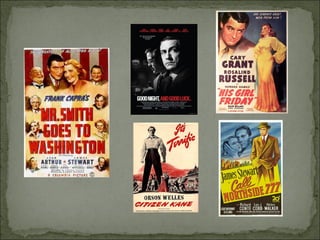
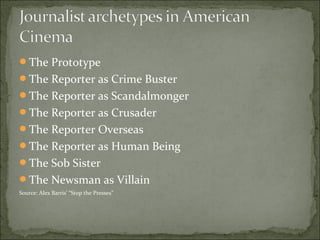
The Prototype
The Reporter as Crime Buster
The Reporter as Scandalmonger
The Reporter as Crusader
The Reporter Overseas
The Reporter as Human Being
The Sob Sister
The Newsman as Villain
Source: Alex Barris’ “Stop the Presses”

The journalist in cinema archetypes

  • 3.
    Simply put, anarchetype is a recurring pattern of character, symbol, or situation found in the mythology, religion, and stories of all cultures Jung defined his concept of the archetype as a formula that is the result of "countless experiences of our ancestors. They are, as it were, the psychic residue of numberless experiences of the same type."
  • 4.
    “The Hero Witha Thousand Faces” Truths disguised under the figures of religion and mythology Grammar of symbols Across cultures and history, parallels of truths are amazingly constant
  • 5.
    For the symbolsof mythology are not manufactured; the cannot be ordered, invented or permanently suppressed. They are spontaneous productions of the psyche, and each bears within it, undamaged the germ power of its source.
  • 6.
    Passover Christ’s parables Moses andthe Rod The Liahona Joseph’s Dream
  • 7.
    May include VirginBirth Departure Initiation Return Transformation of the Hero
  • 8.
    Heroes are constructions;they are not real. All societies have similar hero stories not because they coincidentally made them up on their own, but because heroes express a deep psychological aspect of human existence.
  • 9.
    In a sentence,heroes contribute to the society's necessary business of reproducing itself and its values. For most of history, religion has been the main force of reproducing the dominant society's traits by using mythical figures to illustrate moral and societal principles that help form a common social conception of such things as death and gender roles. Video clip from “The Power of Myth”
  • 10.
    List favorite storiesfrom scriptures or use one of the following: Nephi tied to the mast of the ship Moses on Mount Sinai Jonah and the Whale The sons of Lehi return to Jerusalem Work together in pairs and answer the question: How did the hero represent the “hero” cycle  Departure/separation  Initiation  Return  Transformation of the Hero Designate a spokesperson. Be ready to report.
  • 11.
    The Elements ofJournalism What news people should know and the public should expect Bill Kovach & Tom Rosenstiel
  • 12.
    Journalists’ must maintainan independence from those they cover The purpose of journalism is to provide citizens with the information they need to be free and self- governing. The journalists’ first obligation is to the truth. Journalists’ first loyalty is to citizens
  • 13.
    Journalists must maintainan independence from those they cover.  Journalists must serve as an independent monitor of power.  Journalists must offer a voice to the voiceless. Journalism must provide a forum for public criticism and comment.
  • 14.
    The essence ofjournalism is a discipline of verification. Journalists must make the significant relevant and interesting. Journalists should keep the news in proportion and make it comprehensive.  Journalists have an obligation to personal conscience.
  • 15.
    We believe thatgovernments were instituted of God for the benefit of man; and that he holds men accountable for their acts in relation to them, both in making laws and administering them. D&C 134:1 We believe that all governments necessarily require civil officers and magistrates to enforce the laws of the same that such as will administer the law in equity and justice should be sought for and upheld by the voice of the people if a republic, or the will of sovereign. D&C 134:3
  • 16.
    Constitutional journalism “Watchdog”local, state and national governmental activities Uncover “secret combinations” Involve the public in the political process  Create a civic dialogue – to build bridges Lift ethical standards Represent all of society
  • 17.
    The Prototype The Reporteras Crime Buster The Reporter as Scandalmonger The Reporter as Crusader The Reporter Overseas The Reporter as Human Being The Sob Sister The Newsman as Villain Source: Alex Barris’ “Stop the Presses”