WHY FREEDOM OF INFORMATION?
Joel Campbell
Freedom of Information Committee
Society of Professional Journalists
Associate Professor
Department of Communicatons
Brigham Young University
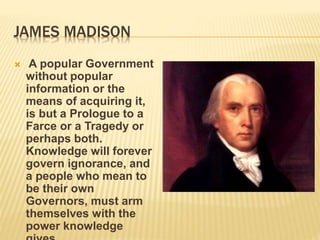
JAMES MADISON
 A popular Government
without popular
information or the
means of acquiring it,
is but a Prologue to a
Farce or a Tragedy or
perhaps both.
Knowledge will forever
govern ignorance, and
a people who mean to
be their own
Governors, must arm
themselves with the
power knowledge
IN THE WORDS OF PRESIDENTS
Liberty cannot be preserved without a general knowledge
among the people, who have a right and a desire to know.
-- John Adams
Let the people know the facts, and the country will be safe.
-- Abraham Lincoln
We must never forget that the free flow of information is
essential to a democratic society.
-- Bill Clinton
QUESTION: WHO SAID THIS?
“When information which properly belongs to the
public is systematically withheld by those in
power, the people soon become ignorant of their
own affairs, distrustful of those who manage
them, and -- eventually -- incapable of
determining their own destinies.”
a. Abraham Lincoln
b. Bill Clinton
c. Richard Nixon
d. John F. Kennedy
MOST SECRETIVE TIMES IN U.S. HISTORY?
 War of 1812
 World War I
 World War II
 Civil War
 Post 9/11
A HUMAN RIGHT
 Freedom of information is recognized in
international law. Article 19 of both the
Universal Declaration on Human Rights
and the International Covenant on Civil and
Political Rights provide that every person
shall have the right to seek and impart
information. An international court has
recognized the right to seek information
includes a right of freedom of information.
A U.S. RIGHT TO KNOW
“Democracy dies behind closed doors.”–
Judge Damon Keith
Detroit Free Press v. Ashcroft, 303 F.3d 681
(August 26, 2002)
Successful challenge of closed court
proceedings involving non-citizens following
9/11 terrorist attacks,
TWO RIGHTS IMPLIED
RIGHT TO KNOW RIGHT TO ASK
 Proactive
The positive obligation of
public bodies to provide, to
publish and to disseminate
information about their main
activities, budgets and
policies so that the public can
know what they are doing,
can participate in public
matters and can control how
public authorities are
behaving.
 Reactive
The right of all persons to ask
public officials for information
about what they are doing
and any documents they hold
and the right to receive an
answer. The majority of
information held by public
bodies should be available,
but there are some cases
where the information is
withheld in order to protect
privacy, national security or
commercial interests.
THE IMPACT OF FOI
 Some 86 countries around the world now have
some form of Freedom of Information (FOI)
legislation with many more considering or
developing it. This trend gained momentum
during the 1990s across the world.
 The UK implemented its 2000 FOIA in 2005.
 FOI legislation is pending in Brazil and
Philippines.
 Communist countries recognize basic
information access rights.
GENERAL GOALS OF FOI
 1. Increase transparency and openness
 2. Increase accountability and decrease
corruption
 3. Improve the quality of government decision-
making
 4. Improve public understanding of decision-
making
 5. Increase public participation
 6. Increase public trust
 7. Increase security
 Source; Stated goals of the UK FOIA 2000, National Security Archive
FREEDOM OF INFORMATION – “SUNSHINE
LAWS”
 U.S. Constitution – First Amendment right to attend
Court hearings and implied record access
(Some First Amendment theorists have argued for that the First Amendment
should extend to protect receiving and distributing information from
government, but that has never been recognized by a U.S. Supreme Court
majority)
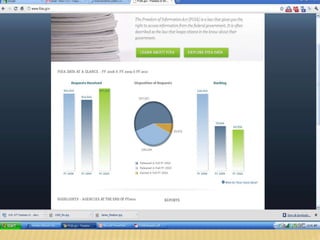
 U.S. Freedom of Information Act - FOIA (records)
 U.S. Government in the Sunshine Act (meetings)
 Utah Government Records Access and
Management Act - GRAMA
 Utah Open and Public Meetings Act
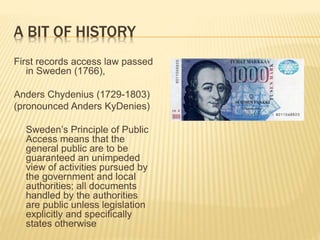
A BIT OF HISTORY
First records access law passed
in Sweden (1766),
Anders Chydenius (1729-1803)
(pronounced Anders KyDenies)
Sweden’s Principle of Public
Access means that the
general public are to be
guaranteed an unimpeded
view of activities pursued by
the government and local
authorities; all documents
handled by the authorities
are public unless legislation
explicitly and specifically
states otherwise
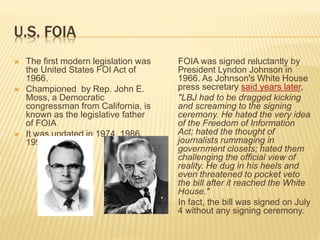
U.S. FOIA
 The first modern legislation was
the United States FOI Act of
1966.
 Championed by Rep. John E.
Moss, a Democratic
congressman from California, is
known as the legislative father
of FOIA
 It was updated in 1974, 1986,
1996, 2002.
FOIA was signed reluctantly by
President Lyndon Johnson in
1966. As Johnson's White House
press secretary said years later,
"LBJ had to be dragged kicking
and screaming to the signing
ceremony. He hated the very idea
of the Freedom of Information
Act; hated the thought of
journalists rummaging in
government closets; hated them
challenging the official view of
reality. He dug in his heels and
even threatened to pocket veto
the bill after it reached the White
House."
In fact, the bill was signed on July
4 without any signing ceremony.
UTAH’S GRAMA
 Enacted in 1991 Legislative session
 Update nearly every session since.
 2011 – HB477
 Costs
 Privacy
 Technology
 Balancing test
STORIES USING FOI LAWS
 Salaries of coaches and leading elected
officials
 Olympic bribery scandal investigation
 Campaign contributors to politicians
 Stories showing how soldiers were sprayed
with biological agents at Dugway Proving
Ground
 Effects on “downwinders” from above ground
nuclear tests
STORIES USING FOIA
 Radiation experimentation
 Increased health risks in work places
 Wasteful government spending
 Campaign finance
 Lobbyist expenditures
 Travel of members of Congress
 Homeland security expenditures
 Audits of military bases
 Biological and chemical exposures
 Safety in national parks
 501 c 3s – IRS Form 990 – Guidestar.org
PUBLIC RECORDS FOR EVERY DAY
 Police reports
 School teacher disciplinary records
 Voter registration records
 Professional licenses
 Audit reports
 Correspondence
 Incorporation records
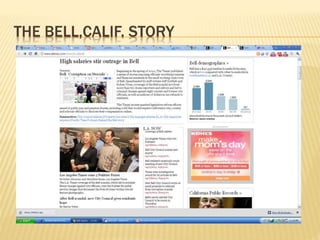
THE BELL,CALIF. STORY
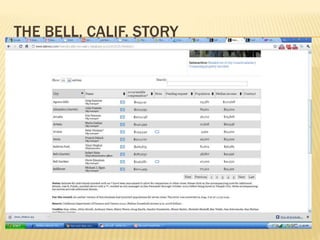
THE BELL, CALIF. STORY
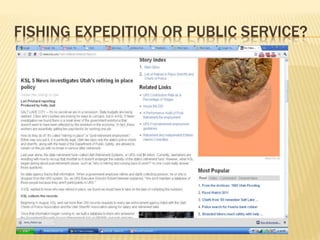
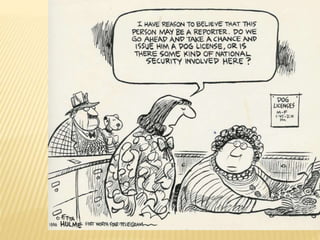
FISHING EXPEDITION OR PUBLIC SERVICE?
SANDY SALARIES - 2008
 "I'm sure the administrators are getting nearly all of the bonus money," wrote one
employee. "I've heard rumors that the chief receives up to $10,000,” wrote an
employee in an e-mail.
 After a three-year legal battle, the Salt Lake Tribune gained access to
information about an extensive bonus program at Sandy City. a bonus program
that disproportionately rewards top administrators from all city departments --
and even provides Sandy Mayor Tom Dolan with a $1,000+ "thank you" bonus,
each year.
Dolan's check pales in comparison to those received by city administrator Byron
Jorgenson and 11 other city leaders who help administer the program, each of
whom picks up the equivalent of about a month's salary in bonuses, year after
year.
 Meanwhile, most city employees who do get bonuses get the equivalent of a few
day's pay. And hundreds get nothing at all.
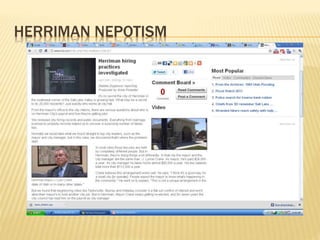
HERRIMAN NEPOTISM
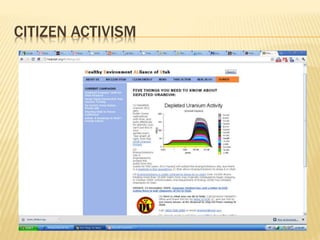
CITIZEN ACTIVISM
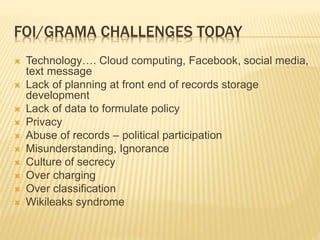
FOI/GRAMA CHALLENGES TODAY
 Technology…. Cloud computing, Facebook, social media,
text message
 Lack of planning at front end of records storage
development
 Lack of data to formulate policy
 Privacy
 Abuse of records – political participation
 Misunderstanding, Ignorance
 Culture of secrecy
 Over charging
 Over classification
 Wikileaks syndrome
THE POWER OF ACCESS
 At least a third of news stories are based in
part on open records, meetings or court
proceedings (SPJ 2001 study of 3,192
stories)
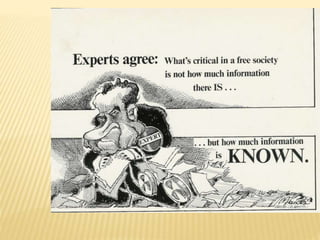
 Journalists increasingly having to fight for
records to circumvent growing walls of
secrecy and spin (despite what Nixon or
other officials would say)
 Documents help win Pulitzers
 Documents help change the world
UTAH GOVERNMENT RECORDS ACCESS AND
MANAGEMENT ACT (GRAMA)
 All records are considered public unless otherwise
specified
 If public interest outweighs private interest the
record may be disclosed
 Right to inspect records free of charge
 Government cannot use form of record to restrict
access.
 No use test
 No expertise test
GRAMA REQUEST PROCESS
 Find the record keeper
 Finesse a request
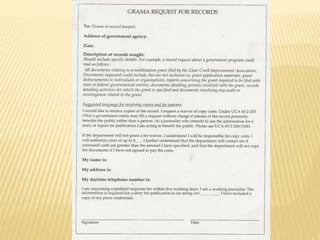
 Make a written request
 Wait for a response
 Appeal to the head of an agency
 State records committee or court
 Court
GRAMA REQUEST CONCEPTS
 Not held by state, check local ordinances
 10 days for normal response
 5 days for expedited response involving
“public interest”
 Request for fee waiver for “public interest”
 Journalists preparing a story for air or
publication considered acting in “public
interest”
FIVE CATEGORIES OF RECORDS
 Public – Salaries of public officials
-Public Tier II – police records
 Private – Medical and welfare records
 Controlled – Adoption records
 Protected – Trade secrets
 Limited – Catch-all exemption
ACCESS STRATEGY: HANDLING DENIALS
If they say…
 “Your description is inadequate.”
 “The requested material does not exist.”
 “We don’t trust how you might use the information.”
 “We don’t have time or resources to handle your
request.”
 “Parts of the records are exempt, so you can’t have
anything.”
 “We don’t have to give you nothin’!” (actual quote
from a sheriff)
 “OK. That will be $450,000, please.”
 “Just sign here on this contract line.”
GRAMA
 All records are considered public unless otherwise
specified
 If public interest outweighs private interest the
record may be disclosed
 Right to inspect records free of charge
 Government cannot use form of record to restrict
access.
 No use test
 No expertise test
FOIA
 Who is covered?
 Executive Branch departments, agencies, and
offices; federal regulatory agencies; and federal
corporations.
 Who is not covered?
 Congress, the federal courts, and parts of the
Executive Office of the President that function
solely to advise and assist the President, are not
subject to the FOIA
Source: National Security Archive
U.S. FREEDOM OF INFORMATION ACT (FOIA)
EXEMPTIONS
1. National security
2. Internal agency personnel rules
3. Information exempted by dozens of federal laws
already on the books – “Catch-all exemption”
4. Trade secrets and confidential commercial
information
5. Internal agency memoranda and policy decisions
6. Personal privacy – The Privacy Act
7. Law enforcement investigations
8. Federally regulated banks
9. Oil and gas wells
FEE WAIVERS
 For all non-commercial requesters the first two
hours of search time and 100 pages of copying
free of charge.
 If you are a representative of the news media, you
are entitled to waiver of all search and review
fees.
 In addition, all fees, including copying, must be
waived by the agency if the material requested "is
likely to contribute significantly to public
understanding of the operations or activities of
government and is not primarily in the commercial
interest of the requester."
FOR MORE INFORMATION
Reporters Committee for Freedom of the
Press. Online manual.
http://www.rcfp.org/foiact/index.html
UTAH OPEN MEETINGS ACT KEYS
 A quorum must be present
 Notice must be made 24 hours in advance
 Meetings must be closed by 2/3 vote
 Agenda must be posted or mailed
 Minutes must be taken and are public
documents
OPEN MEETINGS ACT KEYS
 Recordings of open sessions
 Detailed written minutes and recordings must
be kept of closed sessions except
discussions of character and security
 Sworn statement needed after character and
security discussions
 Misdemeanor penalty
EIGHT REASONS TO CLOSE A MEETING
 Discussion of character, professional
competence or physical or mental health of an
individual
 Strategy sessions for collective bargaining
 Strategy sessions for “imminent” litigation
 Strategy sessions to discuss the purchase,
exchange, or lease of real property when public
discussion of the transaction would disclose the
appraisal or estimated value of the property under
consideration or prevent the public body from
completing the transaction on the best possible
terms.
EIGHT REASONS TO CLOSE A MEETING
 Strategy sessions to discuss the sale of real
property when: value would be disclosed,
notice of sale had been given, terms of sale
are disclosed
 Security discussions
 Investigations of criminal misconduct
 Discussion of “commercial information” for
property tax appeals
TOP 10 MEETINGS TIPS
 Diffuse the open meetings bomb.
 “Retreats” should raise a red flag.
 Be careful of attorney-client privilege.
 Challenge “stealth agendas
 Question boilerplate closures.
 Beware or “electronic meetings”
 No votes for “executive sessions”
 Beware of “work meetings” or “committee of the whole”
meetings
 Get the meeting documents
 Beware of executive sessions for non-specific times and
locations

Why Freedom of Information

  • 1.
    WHY FREEDOM OFINFORMATION? Joel Campbell Freedom of Information Committee Society of Professional Journalists Associate Professor Department of Communicatons Brigham Young University
  • 2.
    JAMES MADISON  Apopular Government without popular information or the means of acquiring it, is but a Prologue to a Farce or a Tragedy or perhaps both. Knowledge will forever govern ignorance, and a people who mean to be their own Governors, must arm themselves with the power knowledge
  • 3.
    IN THE WORDSOF PRESIDENTS Liberty cannot be preserved without a general knowledge among the people, who have a right and a desire to know. -- John Adams Let the people know the facts, and the country will be safe. -- Abraham Lincoln We must never forget that the free flow of information is essential to a democratic society. -- Bill Clinton
  • 4.
    QUESTION: WHO SAIDTHIS? “When information which properly belongs to the public is systematically withheld by those in power, the people soon become ignorant of their own affairs, distrustful of those who manage them, and -- eventually -- incapable of determining their own destinies.” a. Abraham Lincoln b. Bill Clinton c. Richard Nixon d. John F. Kennedy
  • 6.
    MOST SECRETIVE TIMESIN U.S. HISTORY?  War of 1812  World War I  World War II  Civil War  Post 9/11
  • 7.
    A HUMAN RIGHT Freedom of information is recognized in international law. Article 19 of both the Universal Declaration on Human Rights and the International Covenant on Civil and Political Rights provide that every person shall have the right to seek and impart information. An international court has recognized the right to seek information includes a right of freedom of information.
  • 8.
    A U.S. RIGHTTO KNOW “Democracy dies behind closed doors.”– Judge Damon Keith Detroit Free Press v. Ashcroft, 303 F.3d 681 (August 26, 2002) Successful challenge of closed court proceedings involving non-citizens following 9/11 terrorist attacks,
  • 9.
    TWO RIGHTS IMPLIED RIGHTTO KNOW RIGHT TO ASK  Proactive The positive obligation of public bodies to provide, to publish and to disseminate information about their main activities, budgets and policies so that the public can know what they are doing, can participate in public matters and can control how public authorities are behaving.  Reactive The right of all persons to ask public officials for information about what they are doing and any documents they hold and the right to receive an answer. The majority of information held by public bodies should be available, but there are some cases where the information is withheld in order to protect privacy, national security or commercial interests.
  • 10.
    THE IMPACT OFFOI  Some 86 countries around the world now have some form of Freedom of Information (FOI) legislation with many more considering or developing it. This trend gained momentum during the 1990s across the world.  The UK implemented its 2000 FOIA in 2005.  FOI legislation is pending in Brazil and Philippines.  Communist countries recognize basic information access rights.
  • 11.
    GENERAL GOALS OFFOI  1. Increase transparency and openness  2. Increase accountability and decrease corruption  3. Improve the quality of government decision- making  4. Improve public understanding of decision- making  5. Increase public participation  6. Increase public trust  7. Increase security  Source; Stated goals of the UK FOIA 2000, National Security Archive
  • 12.
    FREEDOM OF INFORMATION– “SUNSHINE LAWS”  U.S. Constitution – First Amendment right to attend Court hearings and implied record access (Some First Amendment theorists have argued for that the First Amendment should extend to protect receiving and distributing information from government, but that has never been recognized by a U.S. Supreme Court majority)  U.S. Freedom of Information Act - FOIA (records)  U.S. Government in the Sunshine Act (meetings)  Utah Government Records Access and Management Act - GRAMA  Utah Open and Public Meetings Act
  • 13.
    A BIT OFHISTORY First records access law passed in Sweden (1766), Anders Chydenius (1729-1803) (pronounced Anders KyDenies) Sweden’s Principle of Public Access means that the general public are to be guaranteed an unimpeded view of activities pursued by the government and local authorities; all documents handled by the authorities are public unless legislation explicitly and specifically states otherwise
  • 14.
    U.S. FOIA  Thefirst modern legislation was the United States FOI Act of 1966.  Championed by Rep. John E. Moss, a Democratic congressman from California, is known as the legislative father of FOIA  It was updated in 1974, 1986, 1996, 2002. FOIA was signed reluctantly by President Lyndon Johnson in 1966. As Johnson's White House press secretary said years later, "LBJ had to be dragged kicking and screaming to the signing ceremony. He hated the very idea of the Freedom of Information Act; hated the thought of journalists rummaging in government closets; hated them challenging the official view of reality. He dug in his heels and even threatened to pocket veto the bill after it reached the White House." In fact, the bill was signed on July 4 without any signing ceremony.
  • 16.
    UTAH’S GRAMA  Enactedin 1991 Legislative session  Update nearly every session since.  2011 – HB477  Costs  Privacy  Technology  Balancing test
  • 17.
    STORIES USING FOILAWS  Salaries of coaches and leading elected officials  Olympic bribery scandal investigation  Campaign contributors to politicians  Stories showing how soldiers were sprayed with biological agents at Dugway Proving Ground  Effects on “downwinders” from above ground nuclear tests
  • 18.
    STORIES USING FOIA Radiation experimentation  Increased health risks in work places  Wasteful government spending  Campaign finance  Lobbyist expenditures  Travel of members of Congress  Homeland security expenditures  Audits of military bases  Biological and chemical exposures  Safety in national parks  501 c 3s – IRS Form 990 – Guidestar.org
  • 19.
    PUBLIC RECORDS FOREVERY DAY  Police reports  School teacher disciplinary records  Voter registration records  Professional licenses  Audit reports  Correspondence  Incorporation records
  • 20.
  • 21.
  • 22.
    FISHING EXPEDITION ORPUBLIC SERVICE?
  • 23.
    SANDY SALARIES -2008  "I'm sure the administrators are getting nearly all of the bonus money," wrote one employee. "I've heard rumors that the chief receives up to $10,000,” wrote an employee in an e-mail.  After a three-year legal battle, the Salt Lake Tribune gained access to information about an extensive bonus program at Sandy City. a bonus program that disproportionately rewards top administrators from all city departments -- and even provides Sandy Mayor Tom Dolan with a $1,000+ "thank you" bonus, each year. Dolan's check pales in comparison to those received by city administrator Byron Jorgenson and 11 other city leaders who help administer the program, each of whom picks up the equivalent of about a month's salary in bonuses, year after year.  Meanwhile, most city employees who do get bonuses get the equivalent of a few day's pay. And hundreds get nothing at all.
  • 24.
  • 25.
  • 27.
    FOI/GRAMA CHALLENGES TODAY Technology…. Cloud computing, Facebook, social media, text message  Lack of planning at front end of records storage development  Lack of data to formulate policy  Privacy  Abuse of records – political participation  Misunderstanding, Ignorance  Culture of secrecy  Over charging  Over classification  Wikileaks syndrome
  • 28.
    THE POWER OFACCESS  At least a third of news stories are based in part on open records, meetings or court proceedings (SPJ 2001 study of 3,192 stories)  Journalists increasingly having to fight for records to circumvent growing walls of secrecy and spin (despite what Nixon or other officials would say)  Documents help win Pulitzers  Documents help change the world
  • 29.
    UTAH GOVERNMENT RECORDSACCESS AND MANAGEMENT ACT (GRAMA)  All records are considered public unless otherwise specified  If public interest outweighs private interest the record may be disclosed  Right to inspect records free of charge  Government cannot use form of record to restrict access.  No use test  No expertise test
  • 30.
    GRAMA REQUEST PROCESS Find the record keeper  Finesse a request  Make a written request  Wait for a response  Appeal to the head of an agency  State records committee or court  Court
  • 32.
    GRAMA REQUEST CONCEPTS Not held by state, check local ordinances  10 days for normal response  5 days for expedited response involving “public interest”  Request for fee waiver for “public interest”  Journalists preparing a story for air or publication considered acting in “public interest”
  • 34.
    FIVE CATEGORIES OFRECORDS  Public – Salaries of public officials -Public Tier II – police records  Private – Medical and welfare records  Controlled – Adoption records  Protected – Trade secrets  Limited – Catch-all exemption
  • 35.
    ACCESS STRATEGY: HANDLINGDENIALS If they say…  “Your description is inadequate.”  “The requested material does not exist.”  “We don’t trust how you might use the information.”  “We don’t have time or resources to handle your request.”  “Parts of the records are exempt, so you can’t have anything.”  “We don’t have to give you nothin’!” (actual quote from a sheriff)  “OK. That will be $450,000, please.”  “Just sign here on this contract line.”
  • 36.
    GRAMA  All recordsare considered public unless otherwise specified  If public interest outweighs private interest the record may be disclosed  Right to inspect records free of charge  Government cannot use form of record to restrict access.  No use test  No expertise test
  • 37.
    FOIA  Who iscovered?  Executive Branch departments, agencies, and offices; federal regulatory agencies; and federal corporations.  Who is not covered?  Congress, the federal courts, and parts of the Executive Office of the President that function solely to advise and assist the President, are not subject to the FOIA Source: National Security Archive
  • 38.
    U.S. FREEDOM OFINFORMATION ACT (FOIA) EXEMPTIONS 1. National security 2. Internal agency personnel rules 3. Information exempted by dozens of federal laws already on the books – “Catch-all exemption” 4. Trade secrets and confidential commercial information 5. Internal agency memoranda and policy decisions 6. Personal privacy – The Privacy Act 7. Law enforcement investigations 8. Federally regulated banks 9. Oil and gas wells
  • 39.
    FEE WAIVERS  Forall non-commercial requesters the first two hours of search time and 100 pages of copying free of charge.  If you are a representative of the news media, you are entitled to waiver of all search and review fees.  In addition, all fees, including copying, must be waived by the agency if the material requested "is likely to contribute significantly to public understanding of the operations or activities of government and is not primarily in the commercial interest of the requester."
  • 40.
    FOR MORE INFORMATION ReportersCommittee for Freedom of the Press. Online manual. http://www.rcfp.org/foiact/index.html
  • 41.
    UTAH OPEN MEETINGSACT KEYS  A quorum must be present  Notice must be made 24 hours in advance  Meetings must be closed by 2/3 vote  Agenda must be posted or mailed  Minutes must be taken and are public documents
  • 42.
    OPEN MEETINGS ACTKEYS  Recordings of open sessions  Detailed written minutes and recordings must be kept of closed sessions except discussions of character and security  Sworn statement needed after character and security discussions  Misdemeanor penalty
  • 43.
    EIGHT REASONS TOCLOSE A MEETING  Discussion of character, professional competence or physical or mental health of an individual  Strategy sessions for collective bargaining  Strategy sessions for “imminent” litigation  Strategy sessions to discuss the purchase, exchange, or lease of real property when public discussion of the transaction would disclose the appraisal or estimated value of the property under consideration or prevent the public body from completing the transaction on the best possible terms.
  • 44.
    EIGHT REASONS TOCLOSE A MEETING  Strategy sessions to discuss the sale of real property when: value would be disclosed, notice of sale had been given, terms of sale are disclosed  Security discussions  Investigations of criminal misconduct  Discussion of “commercial information” for property tax appeals
  • 45.
    TOP 10 MEETINGSTIPS  Diffuse the open meetings bomb.  “Retreats” should raise a red flag.  Be careful of attorney-client privilege.  Challenge “stealth agendas  Question boilerplate closures.  Beware or “electronic meetings”  No votes for “executive sessions”  Beware of “work meetings” or “committee of the whole” meetings  Get the meeting documents  Beware of executive sessions for non-specific times and locations