
CAMPAIGN
COMMUNICATIONS 101
  IBEW Membership Development
           Conference
  Las Vegas, NV – Sept. 19, 2012

     Alex Hogan – Communications
            Specialist, IBEW
  alexander_hogan@ibew.org - @alexmhogan
Why is the IBEW
important to you
and your family?
In just one word
Approval ratings for unions are the
lowest they’ve been in 50 years: 52%
A good communications
strategy is a balance of
earned and direct media
involving multiple tools
Direct Media: We communicate
directly with target audience –
flyers, newsletters, Web sites, social
media


Earned Media: Someone else
reports our story –
newspapers, TV, radio, bloggers
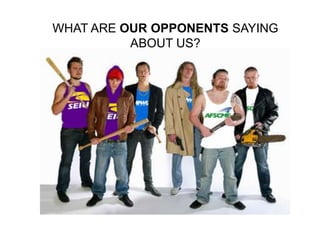
WHAT ARE OUR OPPONENTS SAYING
          ABOUT US?
No one should be forced
to pay union dues
against their will

Project Labor
Agreements are anti-
competitive giveaways to
unions

Big union bosses are
greedy special interests
that are in it for
themselves – they kill
jobs and hurt business
What Are We Saying About
       Ourselves?
The Four C’s

Clear
Concise
Compelling
Connect
Famous Messages

    Right to Work
“It’s the Economy Stupid”

“Morning in America”

“Change”

“Bin Laden is Dead, GM is Alive”

“No Child Left Behind”
How Not to Message

    1. Use your opponent’s
    framework
2. Rely on numbers and facts

  3. Try to convince your
  opponent, not the people in the
  middle
Some Hints

- Know your audience
- Talk about workers, not unions
- Make it personal. Use real people
- Keep the community in mind
- Don’t ignore facts but win people
 on values
- Be positive
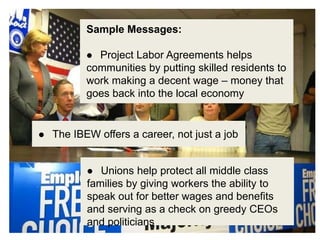
Sample Messages:

           l Project Labor Agreements helps
           communities by putting skilled residents to
           work making a decent wage – money that
           goes back into the local economy


l   The IBEW offers a career, not just a job


           l  Unions help protect all middle class
           families by giving workers the ability to
           speak out for better wages and benefits
           and serving as a check on greedy CEOs
           and politicians
“Does anyone have
any questions for
my answers?”
-Henry Kissinger
Sticking to Your
Message

l   Practice, practice, practice
l   Everyone on the same
page
l   Learn the art of the pivot
How to Pivot

1. Block the premise and follow up with your
message
l “That’s not my area of expertise, but what I
can tell you..”
l “I think real issue is…”
l “What working families really want to know…”

2. Step back and invite the audience on your
side.
Dealing with the Media
It isn’t an option…
l  What you are doing is of interest
to the public
l   If the press wants do a story bad
enough, it will do it whether or not
you cooperate
l   Your opponents aren’t shy
l   If you’re not talking to the
press, who is?
A proactive media strategy
means:

l More positive stories that tell
our side

l   Clear up miscommunications

lFrame the issue from a pro-
worker angle
10 Do’s and Don’ts Dealing with the
Press

                    Do Know
                    Your
                    Message

                     Don’t Be
                     Afraid to Say
                     “I don’t know”
10 Do’s and Don’ts Dealing with the
Press
                     Do ask
                     “What’s your
                     deadline?”

                     Don’t Say “No
                     comment”
10 Do’s and Don’ts Dealing with the
Press
                      Do use
                      spokespeople


                      Don’t rely
                      on a press
                      release to
                      get attention
10 Do’s and Don’ts Dealing with the
Press

                      Do be
                      accessible


                      Don’t use
                      shop talk
10 Do’s and Don’ts Dealing with the
Press

                        Do share the
                        good things
                        you do

                        Don’t say
                        more than
                        you need
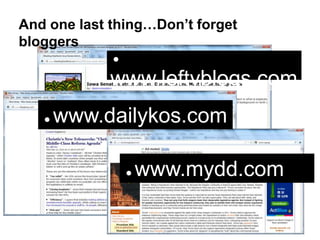
And one last thing…Don’t forget
bloggers
             l

            www.leftyblogs.com
   l   www.dailykos.com

                 l   www.mydd.com
Getting the
   Media’s
 Attention
l  Get to the know the
press beforehand.

l  Are you interesting?
Timely? Fresh?

l Make the press’s job
easier

l  What the press likes:
conflict, academic
reports, VIPs, experts.
And the funny and/or
unexpected
Letters to the Editor/Op-Eds
 l   Make it topical
 l   Know the word
 count
 l   Keep it local
 l   Have someone
 read it over
Social Media is any Website
that allows online
communication and interaction
with other users
Since the Chicago Teachers Strike
Began:


l   More than 16,000 new Facebook
fans


l More than 81,000 Facebook users
    talking about the CTU


l   Hashtags #CTUStrike and
#FairContractNow top two trending
tags on Twitter
Social Media
is a
relationship –
not a speech
Social media is an important
commitment – you are either
in or you’re out

Make it part of your daily
routine
At least one to two posts a
day – Facebook, Twitter

 l Share others work
 (ibew.org, afl-cio etc.)
 l Do polls, ask questions

 l Upload photos
Three Tips on Using Facebook to
Organize


1. Build your local’s/campaign’s page


l   Tell your members about it

l   Post frequently – and make it engaging

l   A good page name
Union Friends on Facebook
IBEW: www.facebook.com/ibewfb

AFL-CIO: www.facebook.com/aflcio

Economic Policy Institute:
www.facebook.com/pages/Economic-Policy-Institute

Union Plus: www.facebook.com/unionplus

American Rights at Work:
www.facebook.com/americanrightsatwork

Working America:
www.facebook.com/WorkingAmerica

Rick Smith Show:
Three Tips on Using Facebook to
Organize

2. Facebook Ads
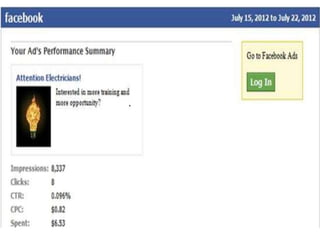
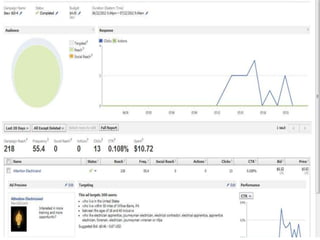
This ads targets 300
users:
l   who live in the United States
l   who live within 50 miles of Wilkes-
Barre, PA
l   between the ages of 18 and 60 inclusive
l   who like electrician
apprentice, journeyman
electricians, electrical
construction, foreman, electrician, journeyma
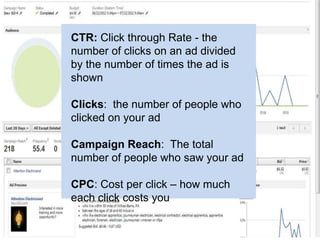
CTR: Click through Rate - the
number of clicks on an ad divided
by the number of times the ad is
shown

Clicks: the number of people who
clicked on your ad

Campaign Reach: The total
number of people who saw your ad

CPC: Cost per click – how much
each click costs you
Ad Tips

l Experiment with different ad
copy
l Close up face photos get good
responses
l Don’t mention unions
l Microtarget
Three Tips on Using Facebook to
Organize

3. Put Pressure on a Company (or Politician)
Some Tips
l Activate your members/supporters
online
l Use it to amplify real world activity
l Target the company’s page
l For influencers, not the
masses

l Authenticity counts

l Listen, rather than talk

l Sharing is caring -RT
RT: retweet

MT: modified retweet

@: the @ sign is used to call out usernames in Tweets, like this: Hello @Twitter!
When a username is preceded by the @ sign, it becomes a link to a Twitter profile

D: put a d and username before your message and it becomes a private message
between you and the recipient

FF: #FF stands for "Follow Friday." Twitter users often suggest who others should
follow on Fridays by tweeting with the hashtag #FF

Follower: A follower is another Twitter user who has followed you.

Following: Your following number reflects the quantity of other Twitter users you
have chosen to follow on the site

Lists: Curated groups of other Twitter users

Top Tweets: Tweets determined by a Twitter algorithm to be the most popular or
resonant on Twitter at any given time.
l Use hashtags
(#verigreedy, #1u, #ibew)

l Live tweet events

l Follow people you want following
you – press, elected officials, allies

l Press releases

l Use the tools –
      hootsuite.com, TweetDeck.com

l Act.ly petition
Three Ways YouTube Can
          Boost Organizing
l Provide useful information

l Create a person-to-person
connection

l Be the media
Some Tips

l  Don’t make it longer
than three to four minutes

l   Tag it

l   Share it
QUESTIONS?
COMMENTS? WANT A
  COPY OF THE
 PRESENTATION?
  Send me a tweet at
    @alexmhogan

Union Campaign Communications 101

  • 1.
    CAMPAIGN COMMUNICATIONS 101 IBEW Membership Development Conference Las Vegas, NV – Sept. 19, 2012 Alex Hogan – Communications Specialist, IBEW alexander_hogan@ibew.org - @alexmhogan
  • 2.
    Why is theIBEW important to you and your family? In just one word
  • 3.
    Approval ratings forunions are the lowest they’ve been in 50 years: 52%
  • 4.
    A good communications strategyis a balance of earned and direct media involving multiple tools
  • 5.
    Direct Media: Wecommunicate directly with target audience – flyers, newsletters, Web sites, social media Earned Media: Someone else reports our story – newspapers, TV, radio, bloggers
  • 6.
    WHAT ARE OUROPPONENTS SAYING ABOUT US?
  • 7.
    No one shouldbe forced to pay union dues against their will Project Labor Agreements are anti- competitive giveaways to unions Big union bosses are greedy special interests that are in it for themselves – they kill jobs and hurt business
  • 8.
    What Are WeSaying About Ourselves?
  • 9.
  • 10.
    Famous Messages Right to Work “It’s the Economy Stupid” “Morning in America” “Change” “Bin Laden is Dead, GM is Alive” “No Child Left Behind”
  • 11.
    How Not toMessage 1. Use your opponent’s framework 2. Rely on numbers and facts 3. Try to convince your opponent, not the people in the middle
  • 12.
    Some Hints - Knowyour audience - Talk about workers, not unions - Make it personal. Use real people - Keep the community in mind - Don’t ignore facts but win people on values - Be positive
  • 13.
    Sample Messages: l Project Labor Agreements helps communities by putting skilled residents to work making a decent wage – money that goes back into the local economy l The IBEW offers a career, not just a job l Unions help protect all middle class families by giving workers the ability to speak out for better wages and benefits and serving as a check on greedy CEOs and politicians
  • 14.
    “Does anyone have anyquestions for my answers?” -Henry Kissinger
  • 15.
    Sticking to Your Message l Practice, practice, practice l Everyone on the same page l Learn the art of the pivot
  • 17.
    How to Pivot 1.Block the premise and follow up with your message l “That’s not my area of expertise, but what I can tell you..” l “I think real issue is…” l “What working families really want to know…” 2. Step back and invite the audience on your side.
  • 18.
  • 19.
    It isn’t anoption… l What you are doing is of interest to the public l If the press wants do a story bad enough, it will do it whether or not you cooperate l Your opponents aren’t shy l If you’re not talking to the press, who is?
  • 20.
    A proactive mediastrategy means: l More positive stories that tell our side l Clear up miscommunications lFrame the issue from a pro- worker angle
  • 21.
    10 Do’s andDon’ts Dealing with the Press Do Know Your Message Don’t Be Afraid to Say “I don’t know”
  • 22.
    10 Do’s andDon’ts Dealing with the Press Do ask “What’s your deadline?” Don’t Say “No comment”
  • 23.
    10 Do’s andDon’ts Dealing with the Press Do use spokespeople Don’t rely on a press release to get attention
  • 24.
    10 Do’s andDon’ts Dealing with the Press Do be accessible Don’t use shop talk
  • 25.
    10 Do’s andDon’ts Dealing with the Press Do share the good things you do Don’t say more than you need
  • 26.
    And one lastthing…Don’t forget bloggers l www.leftyblogs.com l www.dailykos.com l www.mydd.com
  • 27.
    Getting the Media’s Attention
  • 28.
    l Getto the know the press beforehand. l Are you interesting? Timely? Fresh? l Make the press’s job easier l What the press likes: conflict, academic reports, VIPs, experts. And the funny and/or unexpected
  • 29.
    Letters to theEditor/Op-Eds l Make it topical l Know the word count l Keep it local l Have someone read it over
  • 31.
    Social Media isany Website that allows online communication and interaction with other users
  • 32.
    Since the ChicagoTeachers Strike Began: l More than 16,000 new Facebook fans l More than 81,000 Facebook users talking about the CTU l Hashtags #CTUStrike and #FairContractNow top two trending tags on Twitter
  • 33.
  • 34.
    Social media isan important commitment – you are either in or you’re out Make it part of your daily routine
  • 35.
    At least oneto two posts a day – Facebook, Twitter l Share others work (ibew.org, afl-cio etc.) l Do polls, ask questions l Upload photos
  • 36.
    Three Tips onUsing Facebook to Organize 1. Build your local’s/campaign’s page l Tell your members about it l Post frequently – and make it engaging l A good page name
  • 37.
    Union Friends onFacebook IBEW: www.facebook.com/ibewfb AFL-CIO: www.facebook.com/aflcio Economic Policy Institute: www.facebook.com/pages/Economic-Policy-Institute Union Plus: www.facebook.com/unionplus American Rights at Work: www.facebook.com/americanrightsatwork Working America: www.facebook.com/WorkingAmerica Rick Smith Show:
  • 38.
    Three Tips onUsing Facebook to Organize 2. Facebook Ads
  • 40.
    This ads targets300 users: l who live in the United States l who live within 50 miles of Wilkes- Barre, PA l between the ages of 18 and 60 inclusive l who like electrician apprentice, journeyman electricians, electrical construction, foreman, electrician, journeyma
  • 42.
    CTR: Click throughRate - the number of clicks on an ad divided by the number of times the ad is shown Clicks: the number of people who clicked on your ad Campaign Reach: The total number of people who saw your ad CPC: Cost per click – how much each click costs you
  • 43.
    Ad Tips l Experimentwith different ad copy l Close up face photos get good responses l Don’t mention unions l Microtarget
  • 44.
    Three Tips onUsing Facebook to Organize 3. Put Pressure on a Company (or Politician)
  • 45.
    Some Tips l Activateyour members/supporters online l Use it to amplify real world activity l Target the company’s page
  • 47.
    l For influencers,not the masses l Authenticity counts l Listen, rather than talk l Sharing is caring -RT
  • 48.
    RT: retweet MT: modifiedretweet @: the @ sign is used to call out usernames in Tweets, like this: Hello @Twitter! When a username is preceded by the @ sign, it becomes a link to a Twitter profile D: put a d and username before your message and it becomes a private message between you and the recipient FF: #FF stands for "Follow Friday." Twitter users often suggest who others should follow on Fridays by tweeting with the hashtag #FF Follower: A follower is another Twitter user who has followed you. Following: Your following number reflects the quantity of other Twitter users you have chosen to follow on the site Lists: Curated groups of other Twitter users Top Tweets: Tweets determined by a Twitter algorithm to be the most popular or resonant on Twitter at any given time.
  • 49.
    l Use hashtags (#verigreedy,#1u, #ibew) l Live tweet events l Follow people you want following you – press, elected officials, allies l Press releases l Use the tools – hootsuite.com, TweetDeck.com l Act.ly petition
  • 51.
    Three Ways YouTubeCan Boost Organizing l Provide useful information l Create a person-to-person connection l Be the media
  • 52.
    Some Tips l Don’t make it longer than three to four minutes l Tag it l Share it
  • 53.
    QUESTIONS? COMMENTS? WANT A COPY OF THE PRESENTATION? Send me a tweet at @alexmhogan

Editor's Notes

  • #11 Politicians do this all the time. They need to communicate why Americans should vote for him/her in one sentence – or one word. What was Obama’s slog in 2008. Kerry’s?
  • #14 ll
  • #23 If really can’t comment, than say why.