Socialization
1
QUESTION: Just how did you learn
to be who you are right now?
3 Min Write
REV 10-2015
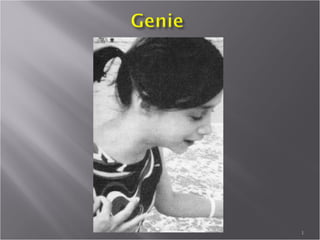
Genie
2
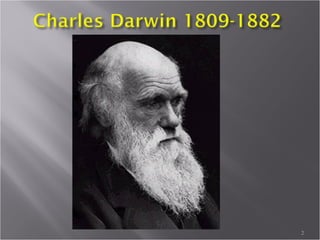
Charles Darwin 1809-1882
3
Darwin’s Study:
Charles Darwin’s
observations on
the development
of his children,
began the research
that culminated in
his book The
Expression of the
emotions in man
and Animals,
published in 1872
Wikipedia
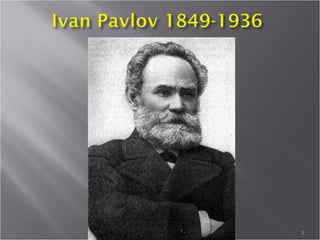
Ivan Pavlov 1849-1936
5
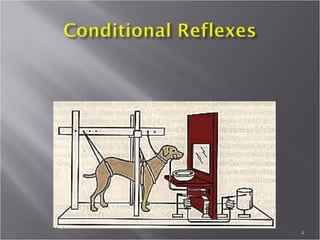
Conditional Reflexes
6
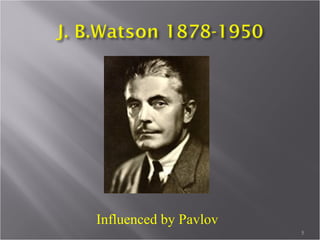
J. B.Watson 1878-1950
7
Influenced by Pavlov
(From Wikipedea)
 His first assumption was Evolutionary
Continuism. This implied that laws of behavior
applied to both humans and animals. Because of
this we can study animals as simple models of
complex human responses.
8
 The second assumption was called
reductionism. This said that all behaviors can be
linked to physiology. This means that we are
biological organisms responding to outside
influences.
9
 The third assumption is Determinism. This
states that we don't act freely but rather we
respond in a programmed way to outside
stimuli.
10
 Fourth is Empiricism. This states that
psychology should involve the study of
observable (overt) behavior and not
introspection or self analysis.
 [No more psychoanalysis]
11
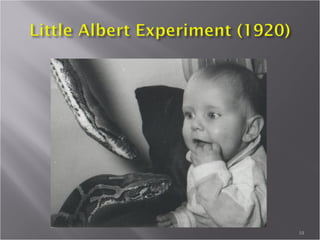
Little Albert Experiment (1920)
12
9 month old
Association with white rat, rabbit, dog, monkey,
masks, cotton wool, burning newspapers etc.
Showed no fear.
Stimulated with loud noise.
Predictable outcome. 3 min video:
https://www.youtube.com/watch?v=FMnhyGoz
LyE
13
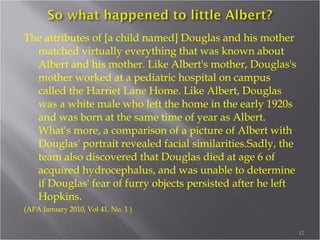
So what happened to little Albert?
The attributes of [a child named] Douglas and his mother
matched virtually everything that was known about
Albert and his mother. Like Albert's mother, Douglas's
mother worked at a pediatric hospital on campus called
the Harriet Lane Home. Like Albert, Douglas was a white
male who left the home in the early 1920s and was born
at the same time of year as Albert. What's more, a
comparison of a picture of Albert with Douglas' portrait
revealed facial similarities.Sadly, the team also
discovered that Douglas died at age 6 of acquired
hydrocephalus, and was unable to determine if Douglas'
fear of furry objects persisted after he left Hopkins.
(APA January 2010, Vol 41, No. 1 )
14
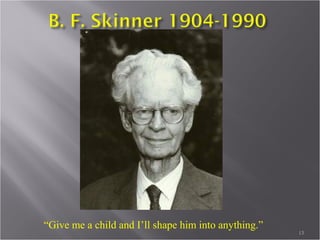
B. F. Skinner 1904-1990
15
“Give me a child and I’ll shape him into anything.”
16
Skinner focused on the concept of
conditioning through the use of
reinforcements and punishments.
“Socialization occurs when a person’s
behavior is shaped by the reinforcing
and punishing activities of other people
and groups.” (Hughes and Kroehler)
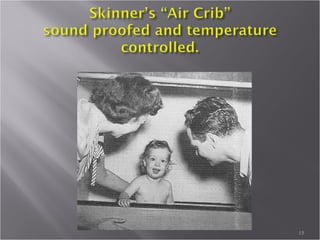
Skinner’s “Air Crib”
sound proofed and temperature controlled.
17
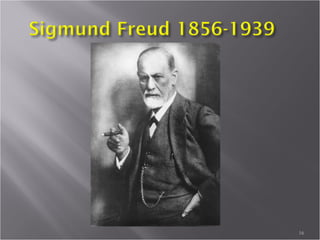
Sigmund Freud 1856-1939
18
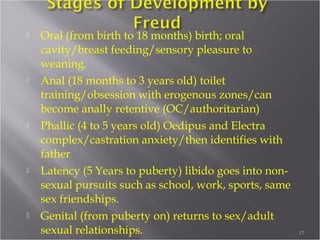
Stages of Development by Freud
 Oral (from birth to 18 months) birth; oral
cavity/breast feeding/sensory pleasure to weaning.
 Anal (18 months to 3 years old) toilet
training/obsession with erogenous zones/can
become anally retentive (OC/authoritarian)
 Phallic (4 to 5 years old) Oedipus and Electra
complex/castration anxiety/then identifies with
father
 Latency (5 Years to puberty) libido goes into non-
sexual pursuits such as school, work, sports, same
sex friendships.
 Genital (from puberty on) returns to sex/adult
sexual relationships.
19
Personality Stages per Freud
Components of the personality
 Id
 Ego
 Superego
22
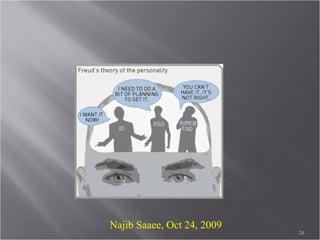
Id: Primitive, asocial pleasure
principle of gratification. Think
of babies and young kids.
23
Ego: The reality principle;
understands other’s needs;
meets need and the demands
of the id and the superego.
24
Superego: The moral part of our
existence. Ethical restraints;
having a conscience. Guilt and
anxiety.
25
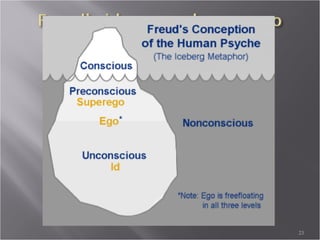
The ego resides in the conscious
mind and the id and superego are
in our unconscious.
26
Freud’s id, ego and superego model
27
28
Posted by Najib Saaee, Oct 24, 2009
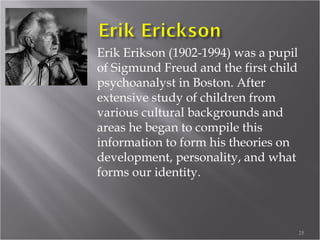
Erik Erickson
Erik Erikson (1902-1994) was a pupil
of Sigmund Freud and the first child
psychoanalyst in Boston. After
extensive study of children from
various cultural backgrounds and
areas he began to compile this
information to form his theories on
development, personality, and what
forms our identity.
29
Infancy (Birth-18 months)
 At this stage, we as human beings are
completely dependant, helpless. We rely on an
external source for everything, from food to
affection. The conflict of this stage is Trust vs.
Mistrust. Obviously, if we as infants are not getting
our needs met, we will become unsure of our
environment and fearful of our caregivers. For
healthy development and movement into the next
stage, we require our physical and emotional needs to
be consistently met.
30
Early Childhood (18 months-3 years)
 When we have overcome our Infancy crisis, we
begin to move into Early Childhood. In this
stage of development, we begin to do things for
ourselves, such as communicate with others
verbally, walk without assistance, and become
potty trained. Our crisis shifts to Autonomy vs.
Shame. This can be a fragile stage, particularly due to
our attempt to master skills (such as feeding oneself,
using a toilet instead of a diaper, etc)
31
Play Age (3-6 years
 When we have resolved our Early Childhood
crisis, we begin to move into Play Age. In this
stage of development, we begin to mirror or
mimic behavior around us. This is demonstrated
in our playtime activity. We become fascinated
with adult behaviors like driving, talking on the
phone, performing household chores like
cleaning and cooking, etc. It is through our play
that we explore and learn more skills.
32
School Age (6-12 years
 This stage of life is all about expansion of one’s
social circle and beginning school. Students are
influenced by their new surroundings as well as
their peers. Teachers begin to take on an
important role as well, considering a student’s
teacher spends more time with them than their
parents at this stage of life. Cognitively, we are
growing and learning new skills and we are
making things which is why this stage’s crisis is
considered Industry vs. Inferiority
33
Adolescence (12-18 years)
 According to Erikson, this is the first stage in our
development that is determined directly by
what we do as opposed to what we have had
done to us. It is a phase of exploration in which
we endeavor to determine our identity (ego
identity) and what we want our lives to look like
(career, education, etc). We are increasingly
more independent, withdrawing from our peers
and parents.
34
Young Adulthood (18-35 years)
 At this stage of psychosocial development, a
person begins to search for a partner. It becomes
the main focus or new struggle once a person
has resolved their adolescent identity crisis. The
most important event in this stage is a romantic
attachment or relationship. This is also the stage
in which most start a family, though this has
been pushed back somewhat in societal norms
today. The struggle of this stage is Intimacy vs.
Isolation.
35
Middle Adulthood (35-55 years)
 Erikson believed that much of our lives are
spent preparing for this stage. Once we have
successfully resolved the conflict of young
adulthood, we approach a new conflict in
middle adulthood. At this stage, work is most
crucial to our lives and we tend to be concerned
with productivity as well as personal growth.
The biggest fear of this stage is feeling
meaningless or inactive. Also the stage of the
“mid-life crisis,” we tend to struggle to find our
purpose or greater meaning in life. This struggle
is known as Generativity vs. Self-absorption
36
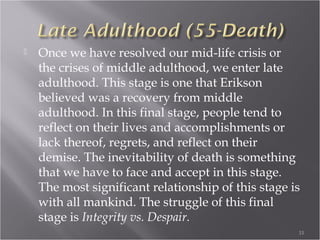
Late Adulthood (55-Death)
 Once we have resolved our mid-life crisis or the
crises of middle adulthood, we enter late
adulthood. This stage is one that Erikson believed
was a recovery from middle adulthood. In this
final stage, people tend to reflect on their lives
and accomplishments or lack thereof, regrets, and
reflect on their demise. The inevitability of death
is something that we have to face and accept in
this stage. The most significant relationship of this
stage is with all mankind. The struggle of this
final stage is Integrity vs. Despair.
37
Erikson’s Typology
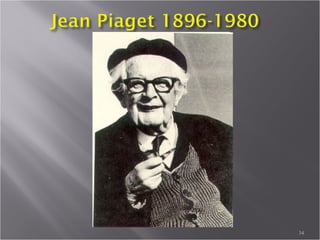
Jean Piaget 1896-1980
39
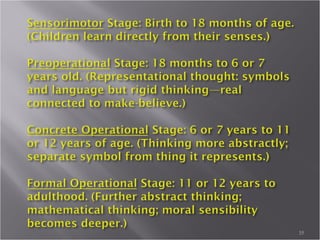
Sensorimotor Stage: Birth to 18 months of age.
(Children learn directly from their senses.)
Preoperational Stage: 18 months to 6 or 7 years
old. (Representational thought: symbols and
language but rigid thinking—real connected to
make-believe.)
Concrete Operational Stage: 6 or 7 years to 11 or
12 years of age. (Thinking more abstractly;
separate symbol from thing it represents.)
Formal Operational Stage: 11 or 12 years to
adulthood. (Further abstract thinking;
mathematical thinking; moral sensibility becomes
deeper.)
40
41
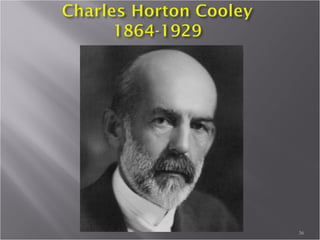
Charles Horton Cooley
1864-1929
42
Reacting to the biological
determinism of the early 20th
Century (Skinner), he
emphasized the element of
“nurture” over “nature.”
That is, we develop through
social interaction.
43
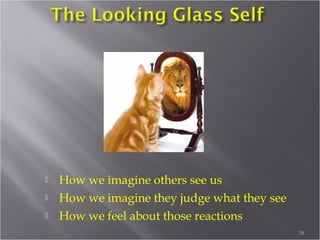
The Looking Glass Self
 How we imagine others see us
 How we imagine they judge what they see
 How we feel about those reactions
44
Professor Christine Monnier – date unknown
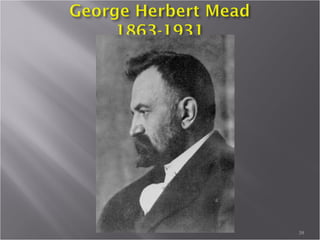
George Herbert Mead 1863-1931
46
The Self:
The “I” and the “Me”
47
The "Me" is the social self and the "I" is the
response to the “Me."
In other words, the "I" is the response of an
individual to the attitudes of others, while the "me" is
the organized set of attitudes of others which an
individual assumes.
The Self:
The “I” and the “Me”
49
The "me" is the accumulated understanding of
"the generalized other" i.e. how one thinks one's
group perceives oneself etc. The "I" is the
individual's impulses. The "I" is self as subject; the
"me" is self as object. The "I" is the knower, the
"me" is the known.
(Wikipedia, updated October 14, 2014)
Describe the “I” you are?
That is, Who are you?
And What are you?
Let’s see what the Zen perspective
is, per Alan Watts.
Developmental Stages
 Play Stage
 Game Stage
 Generalized Other
51
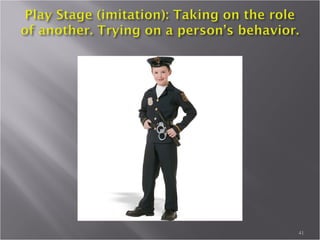
Play Stage (imitation): Taking on the role of another. Trying
on a person’s behavior.
52
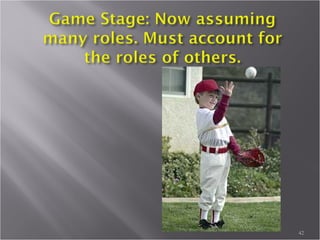
Game Stage: Now assuming many
roles. Must account for the roles of
others.
53
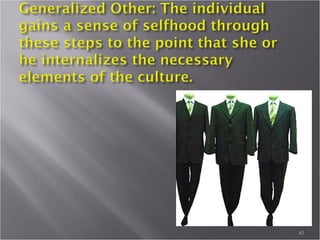
Generalized Other: The individual gains a
sense of selfhood through these steps to the
point that she or he internalizes the necessary
elements of the culture.
54
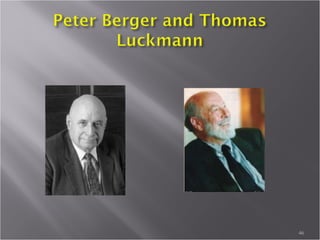
Peter Berger and Thomas Luckmann
55
Yes, it is back to the social construction of reality.
For Berger and Luckmann point out in their
seminal book the importance of the “generalized
other.” They explain that the socialization
process for the child is one in which a reality is
socially created already.
56
Indeed, the whole process is a fabrication.
Note their comment on the process:
“Primary socialization thus accomplishes
what (in hindsight, of course) may be seen as
the most important confidence trick that
society plays on the individual—to make
appear as necessity what in fact is a bundle of
contingencies, and thus to make meaningful
the accident of his birth.” (TSCoR, 1966)
57
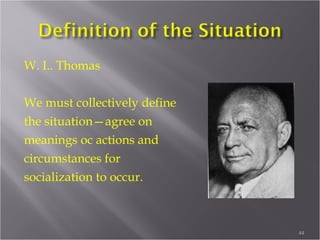
Definition of the Situation
W. I.. Thomas
We must collectively define
the situation—agree on
meanings oc actions and
circumstances for
socialization to occur.
58
Addendum:
 Rhesus monkeys: OpenStax etc re needing
physical contact – love as it were.
 Add twin studies
59

Socialization

  • 1.
    Socialization 1 QUESTION: Just howdid you learn to be who you are right now? 3 Min Write REV 10-2015
  • 2.
  • 3.
  • 4.
    Darwin’s Study: Charles Darwin’s observationson the development of his children, began the research that culminated in his book The Expression of the emotions in man and Animals, published in 1872 Wikipedia
  • 5.
  • 6.
  • 7.
  • 8.
    (From Wikipedea)  Hisfirst assumption was Evolutionary Continuism. This implied that laws of behavior applied to both humans and animals. Because of this we can study animals as simple models of complex human responses. 8
  • 9.
     The secondassumption was called reductionism. This said that all behaviors can be linked to physiology. This means that we are biological organisms responding to outside influences. 9
  • 10.
     The thirdassumption is Determinism. This states that we don't act freely but rather we respond in a programmed way to outside stimuli. 10
  • 11.
     Fourth isEmpiricism. This states that psychology should involve the study of observable (overt) behavior and not introspection or self analysis.  [No more psychoanalysis] 11
  • 12.
  • 13.
    9 month old Associationwith white rat, rabbit, dog, monkey, masks, cotton wool, burning newspapers etc. Showed no fear. Stimulated with loud noise. Predictable outcome. 3 min video: https://www.youtube.com/watch?v=FMnhyGoz LyE 13
  • 14.
    So what happenedto little Albert? The attributes of [a child named] Douglas and his mother matched virtually everything that was known about Albert and his mother. Like Albert's mother, Douglas's mother worked at a pediatric hospital on campus called the Harriet Lane Home. Like Albert, Douglas was a white male who left the home in the early 1920s and was born at the same time of year as Albert. What's more, a comparison of a picture of Albert with Douglas' portrait revealed facial similarities.Sadly, the team also discovered that Douglas died at age 6 of acquired hydrocephalus, and was unable to determine if Douglas' fear of furry objects persisted after he left Hopkins. (APA January 2010, Vol 41, No. 1 ) 14
  • 15.
    B. F. Skinner1904-1990 15 “Give me a child and I’ll shape him into anything.”
  • 16.
    16 Skinner focused onthe concept of conditioning through the use of reinforcements and punishments. “Socialization occurs when a person’s behavior is shaped by the reinforcing and punishing activities of other people and groups.” (Hughes and Kroehler)
  • 17.
    Skinner’s “Air Crib” soundproofed and temperature controlled. 17
  • 18.
  • 19.
    Stages of Developmentby Freud  Oral (from birth to 18 months) birth; oral cavity/breast feeding/sensory pleasure to weaning.  Anal (18 months to 3 years old) toilet training/obsession with erogenous zones/can become anally retentive (OC/authoritarian)  Phallic (4 to 5 years old) Oedipus and Electra complex/castration anxiety/then identifies with father  Latency (5 Years to puberty) libido goes into non- sexual pursuits such as school, work, sports, same sex friendships.  Genital (from puberty on) returns to sex/adult sexual relationships. 19
  • 21.
  • 22.
    Components of thepersonality  Id  Ego  Superego 22
  • 23.
    Id: Primitive, asocialpleasure principle of gratification. Think of babies and young kids. 23
  • 24.
    Ego: The realityprinciple; understands other’s needs; meets need and the demands of the id and the superego. 24
  • 25.
    Superego: The moralpart of our existence. Ethical restraints; having a conscience. Guilt and anxiety. 25
  • 26.
    The ego residesin the conscious mind and the id and superego are in our unconscious. 26
  • 27.
    Freud’s id, egoand superego model 27
  • 28.
    28 Posted by NajibSaaee, Oct 24, 2009
  • 29.
    Erik Erickson Erik Erikson(1902-1994) was a pupil of Sigmund Freud and the first child psychoanalyst in Boston. After extensive study of children from various cultural backgrounds and areas he began to compile this information to form his theories on development, personality, and what forms our identity. 29
  • 30.
    Infancy (Birth-18 months) At this stage, we as human beings are completely dependant, helpless. We rely on an external source for everything, from food to affection. The conflict of this stage is Trust vs. Mistrust. Obviously, if we as infants are not getting our needs met, we will become unsure of our environment and fearful of our caregivers. For healthy development and movement into the next stage, we require our physical and emotional needs to be consistently met. 30
  • 31.
    Early Childhood (18months-3 years)  When we have overcome our Infancy crisis, we begin to move into Early Childhood. In this stage of development, we begin to do things for ourselves, such as communicate with others verbally, walk without assistance, and become potty trained. Our crisis shifts to Autonomy vs. Shame. This can be a fragile stage, particularly due to our attempt to master skills (such as feeding oneself, using a toilet instead of a diaper, etc) 31
  • 32.
    Play Age (3-6years  When we have resolved our Early Childhood crisis, we begin to move into Play Age. In this stage of development, we begin to mirror or mimic behavior around us. This is demonstrated in our playtime activity. We become fascinated with adult behaviors like driving, talking on the phone, performing household chores like cleaning and cooking, etc. It is through our play that we explore and learn more skills. 32
  • 33.
    School Age (6-12years  This stage of life is all about expansion of one’s social circle and beginning school. Students are influenced by their new surroundings as well as their peers. Teachers begin to take on an important role as well, considering a student’s teacher spends more time with them than their parents at this stage of life. Cognitively, we are growing and learning new skills and we are making things which is why this stage’s crisis is considered Industry vs. Inferiority 33
  • 34.
    Adolescence (12-18 years) According to Erikson, this is the first stage in our development that is determined directly by what we do as opposed to what we have had done to us. It is a phase of exploration in which we endeavor to determine our identity (ego identity) and what we want our lives to look like (career, education, etc). We are increasingly more independent, withdrawing from our peers and parents. 34
  • 35.
    Young Adulthood (18-35years)  At this stage of psychosocial development, a person begins to search for a partner. It becomes the main focus or new struggle once a person has resolved their adolescent identity crisis. The most important event in this stage is a romantic attachment or relationship. This is also the stage in which most start a family, though this has been pushed back somewhat in societal norms today. The struggle of this stage is Intimacy vs. Isolation. 35
  • 36.
    Middle Adulthood (35-55years)  Erikson believed that much of our lives are spent preparing for this stage. Once we have successfully resolved the conflict of young adulthood, we approach a new conflict in middle adulthood. At this stage, work is most crucial to our lives and we tend to be concerned with productivity as well as personal growth. The biggest fear of this stage is feeling meaningless or inactive. Also the stage of the “mid-life crisis,” we tend to struggle to find our purpose or greater meaning in life. This struggle is known as Generativity vs. Self-absorption 36
  • 37.
    Late Adulthood (55-Death) Once we have resolved our mid-life crisis or the crises of middle adulthood, we enter late adulthood. This stage is one that Erikson believed was a recovery from middle adulthood. In this final stage, people tend to reflect on their lives and accomplishments or lack thereof, regrets, and reflect on their demise. The inevitability of death is something that we have to face and accept in this stage. The most significant relationship of this stage is with all mankind. The struggle of this final stage is Integrity vs. Despair. 37
  • 38.
  • 39.
  • 40.
    Sensorimotor Stage: Birthto 18 months of age. (Children learn directly from their senses.) Preoperational Stage: 18 months to 6 or 7 years old. (Representational thought: symbols and language but rigid thinking—real connected to make-believe.) Concrete Operational Stage: 6 or 7 years to 11 or 12 years of age. (Thinking more abstractly; separate symbol from thing it represents.) Formal Operational Stage: 11 or 12 years to adulthood. (Further abstract thinking; mathematical thinking; moral sensibility becomes deeper.) 40
  • 41.
  • 42.
  • 43.
    Reacting to thebiological determinism of the early 20th Century (Skinner), he emphasized the element of “nurture” over “nature.” That is, we develop through social interaction. 43
  • 44.
    The Looking GlassSelf  How we imagine others see us  How we imagine they judge what they see  How we feel about those reactions 44
  • 45.
    Professor Christine Monnier– date unknown
  • 46.
    George Herbert Mead1863-1931 46
  • 47.
    The Self: The “I”and the “Me” 47 The "Me" is the social self and the "I" is the response to the “Me." In other words, the "I" is the response of an individual to the attitudes of others, while the "me" is the organized set of attitudes of others which an individual assumes.
  • 49.
    The Self: The “I”and the “Me” 49 The "me" is the accumulated understanding of "the generalized other" i.e. how one thinks one's group perceives oneself etc. The "I" is the individual's impulses. The "I" is self as subject; the "me" is self as object. The "I" is the knower, the "me" is the known. (Wikipedia, updated October 14, 2014)
  • 50.
    Describe the “I”you are? That is, Who are you? And What are you? Let’s see what the Zen perspective is, per Alan Watts.
  • 51.
    Developmental Stages  PlayStage  Game Stage  Generalized Other 51
  • 52.
    Play Stage (imitation):Taking on the role of another. Trying on a person’s behavior. 52
  • 53.
    Game Stage: Nowassuming many roles. Must account for the roles of others. 53
  • 54.
    Generalized Other: Theindividual gains a sense of selfhood through these steps to the point that she or he internalizes the necessary elements of the culture. 54
  • 55.
    Peter Berger andThomas Luckmann 55
  • 56.
    Yes, it isback to the social construction of reality. For Berger and Luckmann point out in their seminal book the importance of the “generalized other.” They explain that the socialization process for the child is one in which a reality is socially created already. 56
  • 57.
    Indeed, the wholeprocess is a fabrication. Note their comment on the process: “Primary socialization thus accomplishes what (in hindsight, of course) may be seen as the most important confidence trick that society plays on the individual—to make appear as necessity what in fact is a bundle of contingencies, and thus to make meaningful the accident of his birth.” (TSCoR, 1966) 57
  • 58.
    Definition of theSituation W. I.. Thomas We must collectively define the situation—agree on meanings oc actions and circumstances for socialization to occur. 58
  • 59.
    Addendum:  Rhesus monkeys:OpenStax etc re needing physical contact – love as it were.  Add twin studies 59