Marshall McLuhan 1964
The Media is the Message
Now what doesTHIS mean?
Media themselves, not the
content they carry, should be
the focus of study.
For instance, a light bulb has no
content, yet it creates space;
that is, a light bulb enables
people to create spaces
during nighttime that would
otherwise be enveloped by
darkness.They can read at
night.
McLuhan wrote about this term in his book The Gutenberg
Galaxy:The Making ofTypographic Man (1962). His book
describes how electronic mass media collapse space and
time barriers in human communication, enabling people
to interact and live on a global scale. In this sense, the
globe has been turned into a village by the electronic
mass media.
Today, the global village is mostly used as a metaphor to
describe the Internet and WorldWideWeb.The Internet
globalizes communication by allowing users from around
the world to connect with each other. Similarly, web-
connected computers enable people to link their web
sites together.This new reality has implications for
forming new sociological structures within the context of
culture.
The Frankfurt School
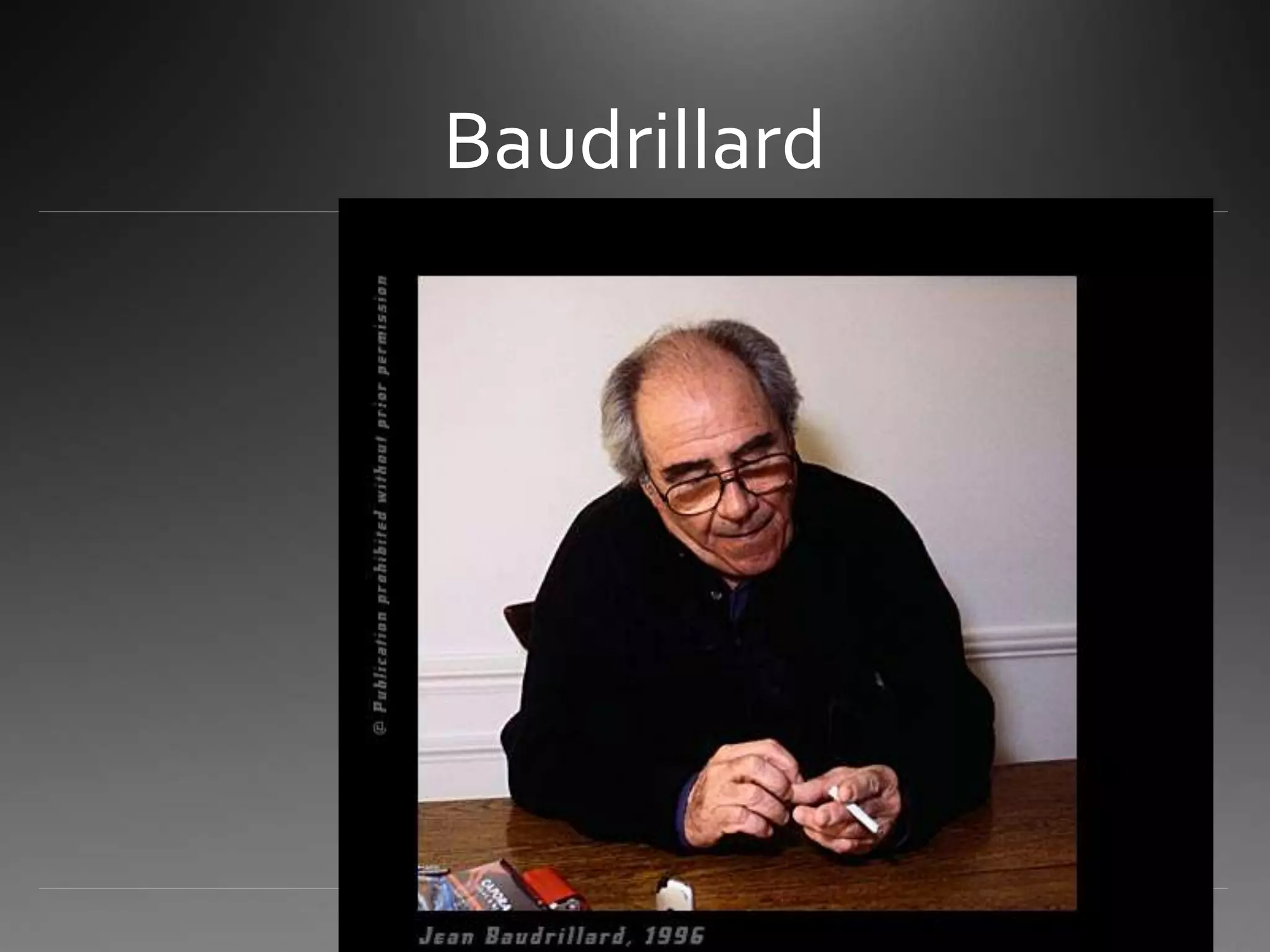
Baudrillard
Television does not just
“represent” the world to us, it
increasingly defines what the
world in which we live actually is.
(From Giddens et al, 2005
The O.J. SimpsonTrial
 It became a spectacle. It
did not happen in the
courthouse so much as
it did on the television.
 Baudrillard calls this
hyperreality—the reality
that is only seen onTV.
He stated that the GulfWar
cannot happen.
Then, after the war, he stated
that the GulfWar did not
happen.
And of course it all happens again!
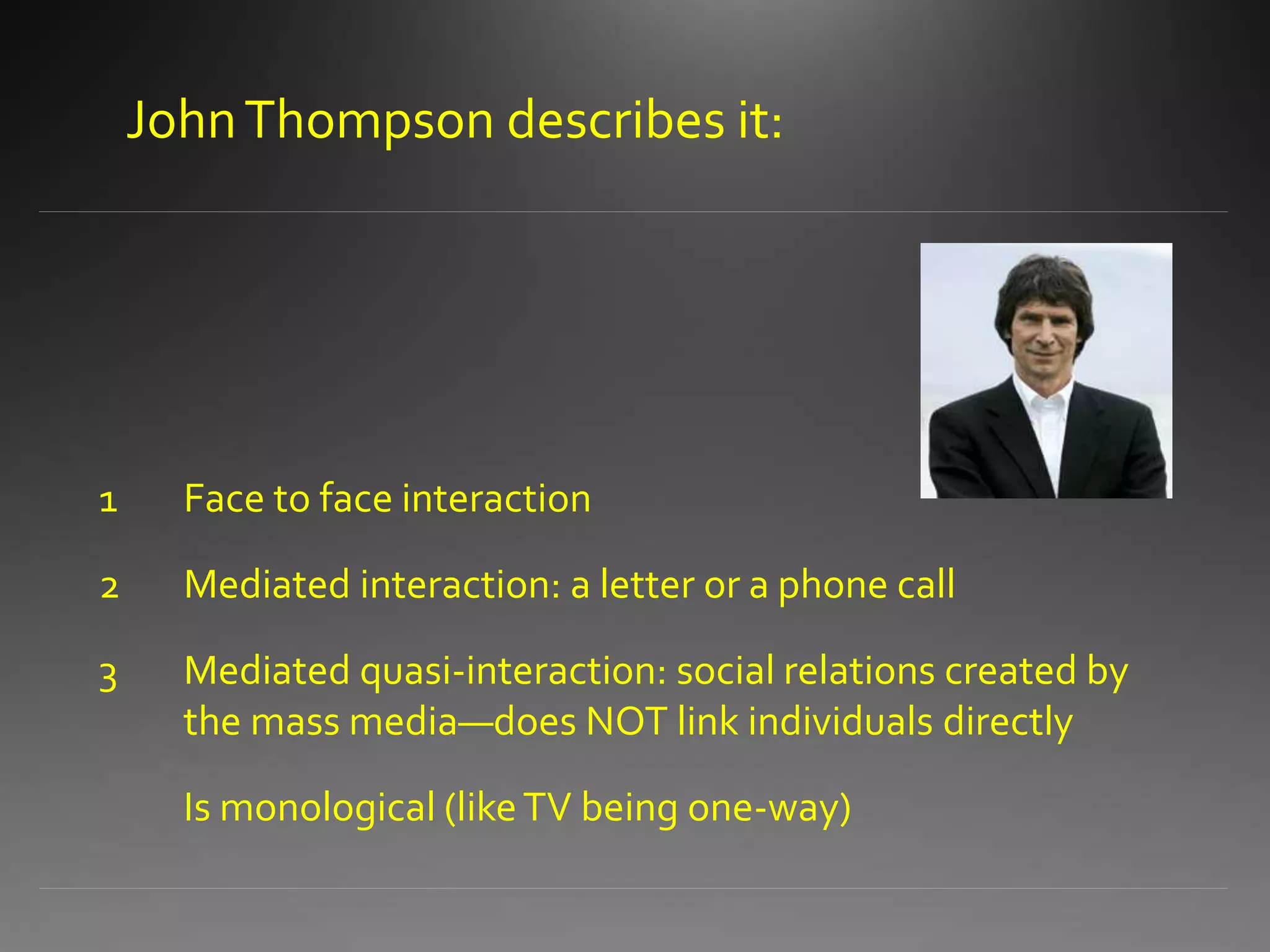
JohnThompson describes it:
1 Face to face interaction
2 Mediated interaction: a letter or a phone call
3 Mediated quasi-interaction: social relations created by
the mass media—does NOT link individuals directly
Is monological (likeTV being one-way)
Mass media changes the balance between the
PUBLIC
And the
PRIVATE
 Facebook
 Twitter
 Blogs
 Wikis
 MassTexting
 YouTube
 Vimeo
 Slideshare
The Culture Industry
discussion

Media 01 2015 incomplete

  • 1.
  • 2.
    The Media isthe Message Now what doesTHIS mean?
  • 3.
    Media themselves, notthe content they carry, should be the focus of study.
  • 4.
    For instance, alight bulb has no content, yet it creates space; that is, a light bulb enables people to create spaces during nighttime that would otherwise be enveloped by darkness.They can read at night.
  • 5.
    McLuhan wrote aboutthis term in his book The Gutenberg Galaxy:The Making ofTypographic Man (1962). His book describes how electronic mass media collapse space and time barriers in human communication, enabling people to interact and live on a global scale. In this sense, the globe has been turned into a village by the electronic mass media.
  • 6.
    Today, the globalvillage is mostly used as a metaphor to describe the Internet and WorldWideWeb.The Internet globalizes communication by allowing users from around the world to connect with each other. Similarly, web- connected computers enable people to link their web sites together.This new reality has implications for forming new sociological structures within the context of culture.
  • 7.
  • 9.
  • 10.
    Television does notjust “represent” the world to us, it increasingly defines what the world in which we live actually is. (From Giddens et al, 2005
  • 11.
    The O.J. SimpsonTrial It became a spectacle. It did not happen in the courthouse so much as it did on the television.  Baudrillard calls this hyperreality—the reality that is only seen onTV.
  • 12.
    He stated thatthe GulfWar cannot happen. Then, after the war, he stated that the GulfWar did not happen.
  • 13.
    And of courseit all happens again!
  • 14.
    JohnThompson describes it: 1Face to face interaction 2 Mediated interaction: a letter or a phone call 3 Mediated quasi-interaction: social relations created by the mass media—does NOT link individuals directly Is monological (likeTV being one-way)
  • 15.
    Mass media changesthe balance between the PUBLIC And the PRIVATE
  • 16.
     Facebook  Twitter Blogs  Wikis  MassTexting  YouTube  Vimeo  Slideshare
  • 17.