ERIKSON’S
PSYCHO-
SOCIAL
THEORY OF
DEVELOPMENT
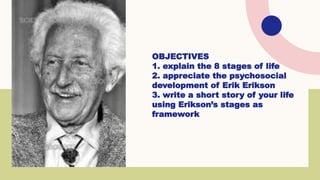
OBJECTIVES
1. explain the 8 stages of life
2. appreciate the psychosocial
development of Erik Erikson
3. write a short story of your life
using Erikson’s stages as
framework
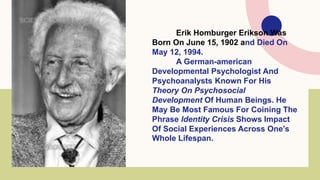
Erik Homburger Erikson Was
Born On June 15, 1902 and Died On
May 12, 1994.
A German-american
Developmental Psychologist And
Psychoanalysts Known For His
Theory On Psychosocial
Development Of Human Beings. He
May Be Most Famous For Coining The
Phrase Identity Crisis Shows Impact
Of Social Experiences Across One’s
Whole Lifespan.
INTRODUCTION
Erikson’s ‘psychosocial’ term is derived from the two source
words-psychological (root word ‘psycho’ relating to the mind, brain,
personality, etc.) and social (external relationships and
environment), both at the heart of Erikson’s theory. This theory was
largely influenced by Sigmund Freud. But Erikson extended the
theory and incorporated cultural and social aspects into Freud’s
biological and sexually-oriented theory.
Like other influential theories, Erikson’s model is simple and
well-designed. This theory is the basis for broad or complex
discussion and analysis of personality and behavior, and also for
understanding and for facilitating personal development- of self and
others. It can help the teacher in becoming more knowledgeable and
at the same time understanding of the various environmental factors
that affect his own and his students’ personality and behavior.
4
INTRODUCTION
Erikson’s eight stages theory is tremendously powerful
model. It is very accessible and obviously relevant to modern
life, from several different perspectives for understanding and
explaining how personality and behavior develop in people. As
such, his theory is useful for teaching, parenting, self-
awareness, managing and coaching, dealing with conflict and
generally for understanding self and others.
Various terms are used to describe Erikson’s model, for
example, Erikson’s biopsychosocial theory (bio means life);
Erikson’s human development cycle or life cycle, and variations
of these. All refer to the same eight stages of psychosocial
theory, which is Erkson’s most distinct work and remarkable
model.
5
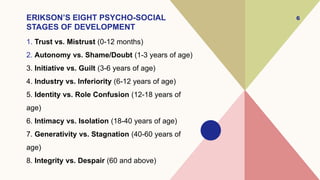
ERIKSON’S EIGHT PSYCHO-SOCIAL
STAGES OF DEVELOPMENT
1. Trust vs. Mistrust (0-12 months)
2. Autonomy vs. Shame/Doubt (1-3 years of age)
3. Initiative vs. Guilt (3-6 years of age)
4. Industry vs. Inferiority (6-12 years of age)
5. Identity vs. Role Confusion (12-18 years of
age)
6. Intimacy vs. Isolation (18-40 years of age)
7. Generativity vs. Stagnation (40-60 years of
age)
8. Integrity vs. Despair (60 and above)
6
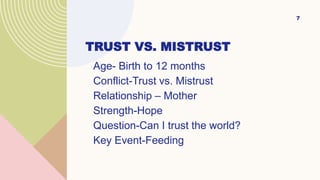
TRUST VS. MISTRUST
Age- Birth to 12 months
Conflict-Trust vs. Mistrust
Relationship – Mother
Strength-Hope
Question-Can I trust the world?
Key Event-Feeding
7
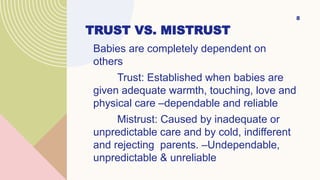
TRUST VS. MISTRUST
Babies are completely dependent on
others
Trust: Established when babies are
given adequate warmth, touching, love and
physical care –dependable and reliable
Mistrust: Caused by inadequate or
unpredictable care and by cold, indifferent
and rejecting parents. –Undependable,
unpredictable & unreliable
8
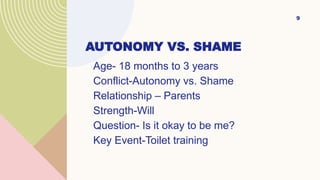
AUTONOMY VS. SHAME
Age- 18 months to 3 years
Conflict-Autonomy vs. Shame
Relationship – Parents
Strength-Will
Question- Is it okay to be me?
Key Event-Toilet training
9
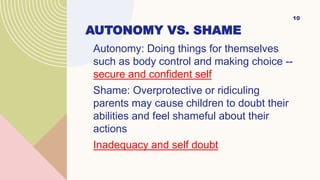
AUTONOMY VS. SHAME
Autonomy: Doing things for themselves
such as body control and making choice --
secure and confident self
Shame: Overprotective or ridiculing
parents may cause children to doubt their
abilities and feel shameful about their
actions
Inadequacy and self doubt
10
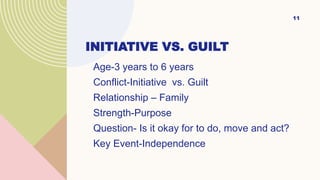
INITIATIVE VS. GUILT
Age-3 years to 6 years
Conflict-Initiative vs. Guilt
Relationship – Family
Strength-Purpose
Question- Is it okay for to do, move and act?
Key Event-Independence
11
INITIATIVE VS. GUILT
Initiative: Parents reinforce by giving
children freedom to play, use imagination
and ask questions
creative and constructive
Guilt: May occur if parents criticize, prevent
play or discourage a child’s questions
Always being wrong and failed to explore
the world
12
INDUSTRY VS. INFERIORITY
Age- 6 to 12 years old
Conflict-Industry vs. Inferiority
Relationship – Neighbors, school
Strength-Competence
Question- Can I make it in the world of people
and things?
Key Event-School
13
INDUSTRY VS. INFERIORITY
Children have to cope with new social and
academic demands
Industry:Occurs when a child is praised for
productive activities such as painting and
building
Sense of competence
Inferiority: Occurs if child’s efforts are
regarded as messy and inadequate
Weak sense of self, incapable to take
14
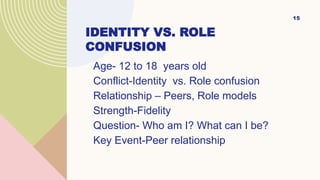
IDENTITY VS. ROLE
CONFUSION
Age- 12 to 18 years old
Conflict-Identity vs. Role confusion
Relationship – Peers, Role models
Strength-Fidelity
Question- Who am I? What can I be?
Key Event-Peer relationship
15
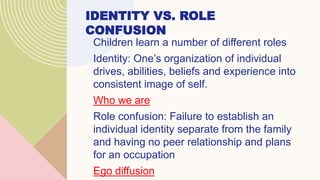
IDENTITY VS. ROLE
CONFUSION
Children learn a number of different roles
Identity: One’s organization of individual
drives, abilities, beliefs and experience into
consistent image of self.
Who we are
Role confusion: Failure to establish an
individual identity separate from the family
and having no peer relationship and plans
for an occupation
Ego diffusion
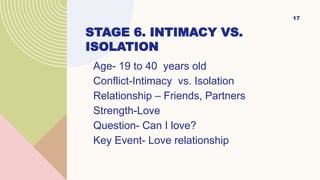
STAGE 6. INTIMACY VS.
ISOLATION
Age- 19 to 40 years old
Conflict-Intimacy vs. Isolation
Relationship – Friends, Partners
Strength-Love
Question- Can I love?
Key Event- Love relationship
17
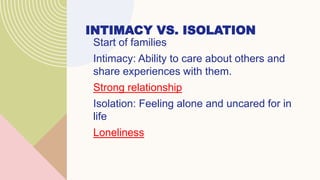
INTIMACY VS. ISOLATION
Start of families
Intimacy: Ability to care about others and
share experiences with them.
Strong relationship
Isolation: Feeling alone and uncared for in
life
Loneliness
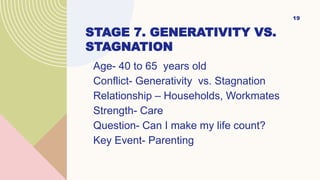
STAGE 7. GENERATIVITY VS.
STAGNATION
Age- 40 to 65 years old
Conflict- Generativity vs. Stagnation
Relationship – Households, Workmates
Strength- Care
Question- Can I make my life count?
Key Event- Parenting
19
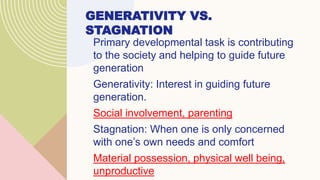
GENERATIVITY VS.
STAGNATION
Primary developmental task is contributing
to the society and helping to guide future
generation
Generativity: Interest in guiding future
generation.
Social involvement, parenting
Stagnation: When one is only concerned
with one’s own needs and comfort
Material possession, physical well being,
unproductive
GENERATIVITY VS.
STAGNATION
Primary developmental task is contributing
to the society and helping to guide future
generation
Generativity:Interest in guiding future
generation.
Social involvement, parenting
Stagnation: When one is only concerned
with one’s own needs and comfort
Material possession, physical well being,
unproductive
STAGE 8. INTEGRITY VS.
DESPAIR
Age- 65 years old to death
Conflict- Integrity vs. Despair
Relationship – Mankind, My kind
Strength- Wisdom
Question- Is it okay to have been me?
Key Event- Reflecting on and accepting of
one’s life
22
INTEGRITY VS. DESPAIR
In the last stage of life, individuals look
back over their lives and judge them
Integrity: Self-respect; developed when
people have lived richly and responsibly
Feeling of wisdom, meaning
Despair: Occurs when previous life events
are viewed with regret; experiences
heartache and remorse
Regret and bitterness
ACTIVITY. DO THIS
Write a short story of your life using Erikson’s stages
as framework

3-Module-7-ERIKSONS-PSYCHO-Social-theory-of-development-1.pptx

  • 1.
  • 2.
    OBJECTIVES 1. explain the8 stages of life 2. appreciate the psychosocial development of Erik Erikson 3. write a short story of your life using Erikson’s stages as framework
  • 3.
    Erik Homburger EriksonWas Born On June 15, 1902 and Died On May 12, 1994. A German-american Developmental Psychologist And Psychoanalysts Known For His Theory On Psychosocial Development Of Human Beings. He May Be Most Famous For Coining The Phrase Identity Crisis Shows Impact Of Social Experiences Across One’s Whole Lifespan.
  • 4.
    INTRODUCTION Erikson’s ‘psychosocial’ termis derived from the two source words-psychological (root word ‘psycho’ relating to the mind, brain, personality, etc.) and social (external relationships and environment), both at the heart of Erikson’s theory. This theory was largely influenced by Sigmund Freud. But Erikson extended the theory and incorporated cultural and social aspects into Freud’s biological and sexually-oriented theory. Like other influential theories, Erikson’s model is simple and well-designed. This theory is the basis for broad or complex discussion and analysis of personality and behavior, and also for understanding and for facilitating personal development- of self and others. It can help the teacher in becoming more knowledgeable and at the same time understanding of the various environmental factors that affect his own and his students’ personality and behavior. 4
  • 5.
    INTRODUCTION Erikson’s eight stagestheory is tremendously powerful model. It is very accessible and obviously relevant to modern life, from several different perspectives for understanding and explaining how personality and behavior develop in people. As such, his theory is useful for teaching, parenting, self- awareness, managing and coaching, dealing with conflict and generally for understanding self and others. Various terms are used to describe Erikson’s model, for example, Erikson’s biopsychosocial theory (bio means life); Erikson’s human development cycle or life cycle, and variations of these. All refer to the same eight stages of psychosocial theory, which is Erkson’s most distinct work and remarkable model. 5
  • 6.
    ERIKSON’S EIGHT PSYCHO-SOCIAL STAGESOF DEVELOPMENT 1. Trust vs. Mistrust (0-12 months) 2. Autonomy vs. Shame/Doubt (1-3 years of age) 3. Initiative vs. Guilt (3-6 years of age) 4. Industry vs. Inferiority (6-12 years of age) 5. Identity vs. Role Confusion (12-18 years of age) 6. Intimacy vs. Isolation (18-40 years of age) 7. Generativity vs. Stagnation (40-60 years of age) 8. Integrity vs. Despair (60 and above) 6
  • 7.
    TRUST VS. MISTRUST Age-Birth to 12 months Conflict-Trust vs. Mistrust Relationship – Mother Strength-Hope Question-Can I trust the world? Key Event-Feeding 7
  • 8.
    TRUST VS. MISTRUST Babiesare completely dependent on others Trust: Established when babies are given adequate warmth, touching, love and physical care –dependable and reliable Mistrust: Caused by inadequate or unpredictable care and by cold, indifferent and rejecting parents. –Undependable, unpredictable & unreliable 8
  • 9.
    AUTONOMY VS. SHAME Age-18 months to 3 years Conflict-Autonomy vs. Shame Relationship – Parents Strength-Will Question- Is it okay to be me? Key Event-Toilet training 9
  • 10.
    AUTONOMY VS. SHAME Autonomy:Doing things for themselves such as body control and making choice -- secure and confident self Shame: Overprotective or ridiculing parents may cause children to doubt their abilities and feel shameful about their actions Inadequacy and self doubt 10
  • 11.
    INITIATIVE VS. GUILT Age-3years to 6 years Conflict-Initiative vs. Guilt Relationship – Family Strength-Purpose Question- Is it okay for to do, move and act? Key Event-Independence 11
  • 12.
    INITIATIVE VS. GUILT Initiative:Parents reinforce by giving children freedom to play, use imagination and ask questions creative and constructive Guilt: May occur if parents criticize, prevent play or discourage a child’s questions Always being wrong and failed to explore the world 12
  • 13.
    INDUSTRY VS. INFERIORITY Age-6 to 12 years old Conflict-Industry vs. Inferiority Relationship – Neighbors, school Strength-Competence Question- Can I make it in the world of people and things? Key Event-School 13
  • 14.
    INDUSTRY VS. INFERIORITY Childrenhave to cope with new social and academic demands Industry:Occurs when a child is praised for productive activities such as painting and building Sense of competence Inferiority: Occurs if child’s efforts are regarded as messy and inadequate Weak sense of self, incapable to take 14
  • 15.
    IDENTITY VS. ROLE CONFUSION Age-12 to 18 years old Conflict-Identity vs. Role confusion Relationship – Peers, Role models Strength-Fidelity Question- Who am I? What can I be? Key Event-Peer relationship 15
  • 16.
    IDENTITY VS. ROLE CONFUSION Childrenlearn a number of different roles Identity: One’s organization of individual drives, abilities, beliefs and experience into consistent image of self. Who we are Role confusion: Failure to establish an individual identity separate from the family and having no peer relationship and plans for an occupation Ego diffusion
  • 17.
    STAGE 6. INTIMACYVS. ISOLATION Age- 19 to 40 years old Conflict-Intimacy vs. Isolation Relationship – Friends, Partners Strength-Love Question- Can I love? Key Event- Love relationship 17
  • 18.
    INTIMACY VS. ISOLATION Startof families Intimacy: Ability to care about others and share experiences with them. Strong relationship Isolation: Feeling alone and uncared for in life Loneliness
  • 19.
    STAGE 7. GENERATIVITYVS. STAGNATION Age- 40 to 65 years old Conflict- Generativity vs. Stagnation Relationship – Households, Workmates Strength- Care Question- Can I make my life count? Key Event- Parenting 19
  • 20.
    GENERATIVITY VS. STAGNATION Primary developmentaltask is contributing to the society and helping to guide future generation Generativity: Interest in guiding future generation. Social involvement, parenting Stagnation: When one is only concerned with one’s own needs and comfort Material possession, physical well being, unproductive
  • 21.
    GENERATIVITY VS. STAGNATION Primary developmentaltask is contributing to the society and helping to guide future generation Generativity:Interest in guiding future generation. Social involvement, parenting Stagnation: When one is only concerned with one’s own needs and comfort Material possession, physical well being, unproductive
  • 22.
    STAGE 8. INTEGRITYVS. DESPAIR Age- 65 years old to death Conflict- Integrity vs. Despair Relationship – Mankind, My kind Strength- Wisdom Question- Is it okay to have been me? Key Event- Reflecting on and accepting of one’s life 22
  • 23.
    INTEGRITY VS. DESPAIR Inthe last stage of life, individuals look back over their lives and judge them Integrity: Self-respect; developed when people have lived richly and responsibly Feeling of wisdom, meaning Despair: Occurs when previous life events are viewed with regret; experiences heartache and remorse Regret and bitterness
  • 24.
    ACTIVITY. DO THIS Writea short story of your life using Erikson’s stages as framework