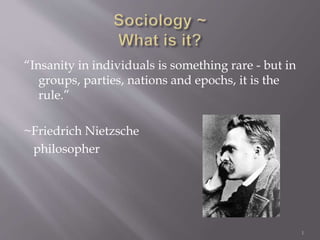
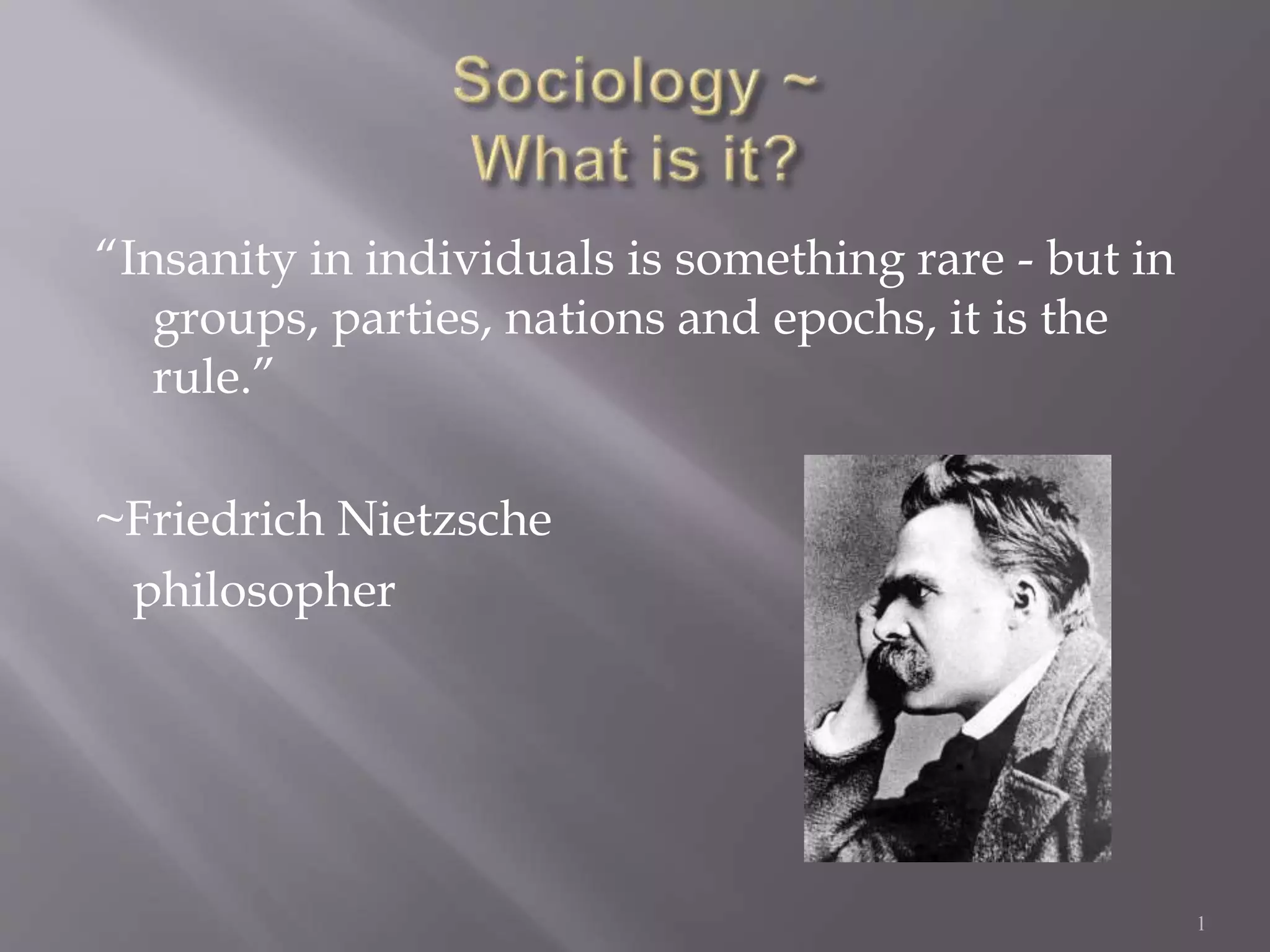














“Insanity in individuals is something rare - but in
groups, parties, nations and epochs, it is the
rule.”
~Friedrich Nietzsche
philosopher
1
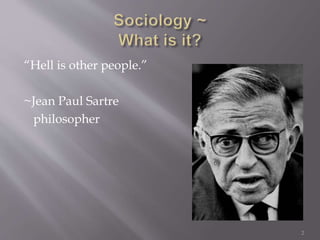
“Hell is other people.”
~Jean Paul Sartre
philosopher
2
It can be said that the first wisdom of sociology is
this: things are not what they seem.
~Peter L. Berger
(1929 -)
Sociology … is a science which attempts the
interpretive understanding of social action in
order thereby to arrive at a causal explanation
of its course and effects.
~Max Weber (1864 - 1920)
3
States one sociologist:
What makes sociology deceptively subtle
and powerful is that a sustained
examination of the seemingly obvious
usually requires that honest or thoughtful
people reexamine the assumptions that
sustain their identity.
Rousseau (not Jean Jacques). 2013
4
C. Wright Mills
and the
Sociological Imagination
5
6
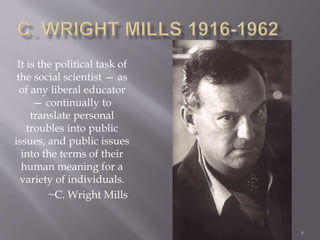
It is the political task of
the social scientist — as
of any liberal educator
— continually to
translate personal
troubles into public
issues, and public issues
into the terms of their
human meaning for a
variety of individuals.
~C. Wright Mills
 Biography and history
 Personal troubles versus public issues
 The social versus the individual
7
Sociology is where biography and history meet. It
is where you, as a person, interact with those
larger forces around you – what Durkheim
called social facts.
What is your history, your epoch or social
environment like? What does it contain?
8
 Civil Rights movement
 Assassination of Martin Luther King
 Assassination of President Kennedy
 Assassination of Robert Kennedy
 Charlie Manson
 The (second) feminist movement
 LSD
 The American Indian movement (AIM)
 The Vietnam War and the ant-war movement
9
 The draft
 Students for a Democratic Society (SDS)
 The Weathermen revolutionary group
 Nixon and the Watergate scandal
 The Pentagon Papers
 Hippies
 Assassination of John Lenon
 Bay of Pigs
 Cuban Missile Crisis
10
 Smart phones, tablets, twitter, Facebook…
 9/11 Trade Towers attacked
 First black president
 Iraq and Afghanistan
 Abu Ghraib and Guantanamo
 Water boarding
 Wikipedia
 WikiLeaks
 Bradley Manning and Edward Snowden
11
 Banking and mortgage crash
 Growing educational costs
 Tea Party and Occupy Wall Street
 Reversal of Voting Rights Act
 Cyber war, hacking, “Anonymous”
 Drones
 Globalization and corporate “personhood”
 Same sex marriage (some states)
 Legalization of marijuana (some states)
 Massive increases in prison populations
 Race 12
Your history helps shape you just as you
participate in the shaping of history.
History cannot exist, per se, without people
both living it and making it. You live in an
historically specific moment that was
constructed out of a series of such moments.
As well, you are making history now.
13
Mills was
concerned with
class issues. The
working class
had changed
after WWII.
There was now
a “new middle
class” of white
collar workers.
14
Contrary to Marx’s reasoning, for Mills, the
next revolution would not come from a blue-
collar, so-called, working class. (The
proletariat)
Perhaps necessary change would come from
this “new middle class.”
15
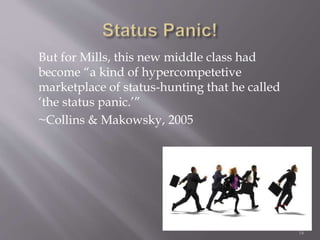
But for Mills, this new middle class had
become “a kind of hypercompetetive
marketplace of status-hunting that he called
‘the status panic.’”
~Collins & Makowsky, 2005
16
 Work is an anonymous “great salesroom”
 The trades are no longer independent but
merely “tools of the establishment.”
 People have become “cheerful robots.”
17
“The new middle class is superficially
satisfied, but inwardly anxious, and
dishonest about admitting it to
themselves …
They have no independent source of
power.” (ibid.)
18
In the power elite world organizations
converge causing the collective biographies of
the individuals within them to come to
resemble one another.
Does this sound like now?
Does this sound like your epoch?
19
20
Mills saw social problems as social ills that
arise from contradictions.
What are some social contradictions? (Also
called antagonisms)
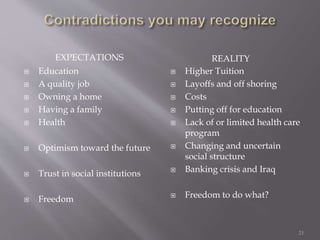
EXPECTATIONS REALITY
 Education
 A quality job
 Owning a home
 Having a family
 Health
 Optimism toward the future
 Trust in social institutions
 Freedom
 Higher Tuition
 Layoffs and off shoring
 Costs
 Putting off for education
 Lack of or limited health care
program
 Changing and uncertain
social structure
 Banking crisis and Iraq
 Freedom to do what?
21
22
General enlightenment – the ways in
which social arrangements shape
our lives; sociology affects public
understanding. (I’m just plain
curious. And you?)
23
The possibility for designing solutions –
sociologists can function as advisors, and
can recommend solutions to social
problems as a way of influencing public
policy. To wit:
24
From ASA Footnotes, July/August 2002, by Lee
Herring, ASA Director of Communications
“Sociology’s presence on Capitol Hill has increased
this spring, as ASA has collaborated with sister social
science organizations to co-sponsor or participate on
speaker panels conducting four high-visibility
congressional briefings.”
Sociology is an empirical discipline
 It relies on evidence
 Is systematic observation and experimentation
 Is verifiable through independent observation
 There is a demand for proof (hunches are for
direction only)
25
It is a public venture
Results are public for other’s verification
(peer review)
Open discussion and examination of
research
Conclusions are never final or absolute-
they are open to question
26
Questioning public assumptions – Peter
Berger’s “debunking motif” comes to
mind, or the notion of urban legends.
(Alligators in the sewer, California falling
off the continent Nostradamus and the
apocalypse.)
27
 Identifying social problems – calling
attention to hidden, ignored, or
misunderstood social problems;
Example: family violence. The first
national survey on family violence was
done in 1976 and surprised the public in
that it showed family violence as a
pervasive phenomena.
28
29
 Gender
 Education
 Race
 Sexuality
 Media and technology
 Family and marriage
 Ethnicity
 Social stratification
30
• Crime and deviance
• Drugs
• Environment
• Sexism
• Globalization
• Work and the economy
• Health and medicine
• …and on and on
31
 Interests you
 Worries you
 Frightens you
 Makes you angry
 Makes you want to help
 Makes you happy
 Gives you hope
 Makes you despair
32
GO FOR IT!
33
34
 to understand that we are more similar to each
other than different.
 the struggle of the sociologist is in having to
face more problems than solutions.
 a politician who has not taken a rigorous
course in sociology should not be allowed to
run for office.
 things are not what they seem.
35
 the ability of the Bourgeoisie to lay down their
arms
 the ultimate "power to the people”
 the ruthless criticism of all that exists
 to consider the possiblity of the existence of a
middle class
36
 how we all want essentially the same things in
life.
 the concept of the functionalist view of society
as an organism.
 that each of us has at least one personal
trouble
 how history and biography meet.
37
 how psychology is more useful than sociology
in looking at people's behavior
 that the larger the group the more powerful the
dynamics of their behavior
 discovering the difference between personal
troubles to public issues
 how behaviorism as a science best explains our
behavior
38
 why doesn't this person simply clean up and
get a job
 I'm certainly glad that I have never stooped so
low as to beg
 Is that person is a drug addict or an alcoholic
 what social events may have caused or
contributed to his or her condition
39
 Conflict theory
 Symbolic Interactionism
 Structural Functionalism
 Constructionism
40
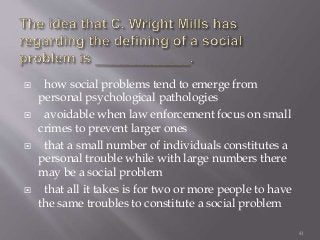
 how social problems tend to emerge from
personal psychological pathologies
 avoidable when law enforcement focus on small
crimes to prevent larger ones
 that a small number of individuals constitutes a
personal trouble while with large numbers there
may be a social problem
 that all it takes is for two or more people to have
the same troubles to constitute a social problem
41
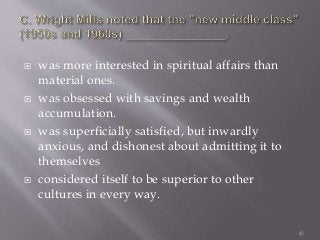
 was more interested in spiritual affairs than
material ones.
 was obsessed with savings and wealth
accumulation.
 was superficially satisfied, but inwardly
anxious, and dishonest about admitting it to
themselves
 considered itself to be superior to other
cultures in every way.
42
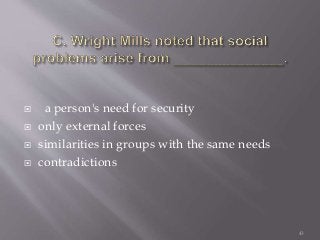
 a person's need for security
 only external forces
 similarities in groups with the same needs
 contradictions
43
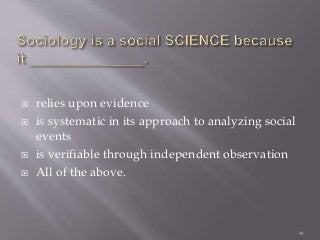
 relies upon evidence
 is systematic in its approach to analyzing social
events
 is verifiable through independent observation
 All of the above.
44
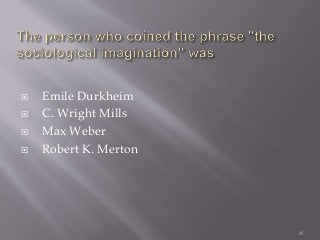
 Emile Durkheim
 C. Wright Mills
 Max Weber
 Robert K. Merton
45
46

An Introduction to the introduction of sociology

  • 1.
    “Insanity in individualsis something rare - but in groups, parties, nations and epochs, it is the rule.” ~Friedrich Nietzsche philosopher 1
  • 2.
    “Hell is otherpeople.” ~Jean Paul Sartre philosopher 2
  • 3.
    It can besaid that the first wisdom of sociology is this: things are not what they seem. ~Peter L. Berger (1929 -) Sociology … is a science which attempts the interpretive understanding of social action in order thereby to arrive at a causal explanation of its course and effects. ~Max Weber (1864 - 1920) 3
  • 4.
    States one sociologist: Whatmakes sociology deceptively subtle and powerful is that a sustained examination of the seemingly obvious usually requires that honest or thoughtful people reexamine the assumptions that sustain their identity. Rousseau (not Jean Jacques). 2013 4
  • 5.
    C. Wright Mills andthe Sociological Imagination 5
  • 6.
    6 It is thepolitical task of the social scientist — as of any liberal educator — continually to translate personal troubles into public issues, and public issues into the terms of their human meaning for a variety of individuals. ~C. Wright Mills
  • 7.
     Biography andhistory  Personal troubles versus public issues  The social versus the individual 7
  • 8.
    Sociology is wherebiography and history meet. It is where you, as a person, interact with those larger forces around you – what Durkheim called social facts. What is your history, your epoch or social environment like? What does it contain? 8
  • 9.
     Civil Rightsmovement  Assassination of Martin Luther King  Assassination of President Kennedy  Assassination of Robert Kennedy  Charlie Manson  The (second) feminist movement  LSD  The American Indian movement (AIM)  The Vietnam War and the ant-war movement 9
  • 10.
     The draft Students for a Democratic Society (SDS)  The Weathermen revolutionary group  Nixon and the Watergate scandal  The Pentagon Papers  Hippies  Assassination of John Lenon  Bay of Pigs  Cuban Missile Crisis 10
  • 11.
     Smart phones,tablets, twitter, Facebook…  9/11 Trade Towers attacked  First black president  Iraq and Afghanistan  Abu Ghraib and Guantanamo  Water boarding  Wikipedia  WikiLeaks  Bradley Manning and Edward Snowden 11
  • 12.
     Banking andmortgage crash  Growing educational costs  Tea Party and Occupy Wall Street  Reversal of Voting Rights Act  Cyber war, hacking, “Anonymous”  Drones  Globalization and corporate “personhood”  Same sex marriage (some states)  Legalization of marijuana (some states)  Massive increases in prison populations  Race 12
  • 13.
    Your history helpsshape you just as you participate in the shaping of history. History cannot exist, per se, without people both living it and making it. You live in an historically specific moment that was constructed out of a series of such moments. As well, you are making history now. 13
  • 14.
    Mills was concerned with classissues. The working class had changed after WWII. There was now a “new middle class” of white collar workers. 14
  • 15.
    Contrary to Marx’sreasoning, for Mills, the next revolution would not come from a blue- collar, so-called, working class. (The proletariat) Perhaps necessary change would come from this “new middle class.” 15
  • 16.
    But for Mills,this new middle class had become “a kind of hypercompetetive marketplace of status-hunting that he called ‘the status panic.’” ~Collins & Makowsky, 2005 16
  • 17.
     Work isan anonymous “great salesroom”  The trades are no longer independent but merely “tools of the establishment.”  People have become “cheerful robots.” 17
  • 18.
    “The new middleclass is superficially satisfied, but inwardly anxious, and dishonest about admitting it to themselves … They have no independent source of power.” (ibid.) 18
  • 19.
    In the powerelite world organizations converge causing the collective biographies of the individuals within them to come to resemble one another. Does this sound like now? Does this sound like your epoch? 19
  • 20.
    20 Mills saw socialproblems as social ills that arise from contradictions. What are some social contradictions? (Also called antagonisms)
  • 21.
    EXPECTATIONS REALITY  Education A quality job  Owning a home  Having a family  Health  Optimism toward the future  Trust in social institutions  Freedom  Higher Tuition  Layoffs and off shoring  Costs  Putting off for education  Lack of or limited health care program  Changing and uncertain social structure  Banking crisis and Iraq  Freedom to do what? 21
  • 22.
  • 23.
    General enlightenment –the ways in which social arrangements shape our lives; sociology affects public understanding. (I’m just plain curious. And you?) 23
  • 24.
    The possibility fordesigning solutions – sociologists can function as advisors, and can recommend solutions to social problems as a way of influencing public policy. To wit: 24 From ASA Footnotes, July/August 2002, by Lee Herring, ASA Director of Communications “Sociology’s presence on Capitol Hill has increased this spring, as ASA has collaborated with sister social science organizations to co-sponsor or participate on speaker panels conducting four high-visibility congressional briefings.”
  • 25.
    Sociology is anempirical discipline  It relies on evidence  Is systematic observation and experimentation  Is verifiable through independent observation  There is a demand for proof (hunches are for direction only) 25
  • 26.
    It is apublic venture Results are public for other’s verification (peer review) Open discussion and examination of research Conclusions are never final or absolute- they are open to question 26
  • 27.
    Questioning public assumptions– Peter Berger’s “debunking motif” comes to mind, or the notion of urban legends. (Alligators in the sewer, California falling off the continent Nostradamus and the apocalypse.) 27
  • 28.
     Identifying socialproblems – calling attention to hidden, ignored, or misunderstood social problems; Example: family violence. The first national survey on family violence was done in 1976 and surprised the public in that it showed family violence as a pervasive phenomena. 28
  • 29.
  • 30.
     Gender  Education Race  Sexuality  Media and technology  Family and marriage  Ethnicity  Social stratification 30
  • 31.
    • Crime anddeviance • Drugs • Environment • Sexism • Globalization • Work and the economy • Health and medicine • …and on and on 31
  • 32.
     Interests you Worries you  Frightens you  Makes you angry  Makes you want to help  Makes you happy  Gives you hope  Makes you despair 32
  • 33.
  • 34.
  • 35.
     to understandthat we are more similar to each other than different.  the struggle of the sociologist is in having to face more problems than solutions.  a politician who has not taken a rigorous course in sociology should not be allowed to run for office.  things are not what they seem. 35
  • 36.
     the abilityof the Bourgeoisie to lay down their arms  the ultimate "power to the people”  the ruthless criticism of all that exists  to consider the possiblity of the existence of a middle class 36
  • 37.
     how weall want essentially the same things in life.  the concept of the functionalist view of society as an organism.  that each of us has at least one personal trouble  how history and biography meet. 37
  • 38.
     how psychologyis more useful than sociology in looking at people's behavior  that the larger the group the more powerful the dynamics of their behavior  discovering the difference between personal troubles to public issues  how behaviorism as a science best explains our behavior 38
  • 39.
     why doesn'tthis person simply clean up and get a job  I'm certainly glad that I have never stooped so low as to beg  Is that person is a drug addict or an alcoholic  what social events may have caused or contributed to his or her condition 39
  • 40.
     Conflict theory Symbolic Interactionism  Structural Functionalism  Constructionism 40
  • 41.
     how socialproblems tend to emerge from personal psychological pathologies  avoidable when law enforcement focus on small crimes to prevent larger ones  that a small number of individuals constitutes a personal trouble while with large numbers there may be a social problem  that all it takes is for two or more people to have the same troubles to constitute a social problem 41
  • 42.
     was moreinterested in spiritual affairs than material ones.  was obsessed with savings and wealth accumulation.  was superficially satisfied, but inwardly anxious, and dishonest about admitting it to themselves  considered itself to be superior to other cultures in every way. 42
  • 43.
     a person'sneed for security  only external forces  similarities in groups with the same needs  contradictions 43
  • 44.
     relies uponevidence  is systematic in its approach to analyzing social events  is verifiable through independent observation  All of the above. 44
  • 45.
     Emile Durkheim C. Wright Mills  Max Weber  Robert K. Merton 45
  • 46.