



In Psychology
is a process that results in the
transformation of social structures to
improve the capacity of a society in
order to fulfill its objectives. It aims
specifically in developing power to
elevate expansion of human activity.
 means acquisition of the ability to
behave in accordance with social
expectations.
 the process by which a child learns
to live with others human beings and by
which he acquires behavior and
thought patterns characteristic of his
culture is called socialization.
 at birth , the baby is none gregarious.
Social behavior begins when the baby
first distinguishes between people and
objects and responds to them. the baby's
first social responses are to adults,
because they are normally his first
contacts.
 by the end of the third month he turns
his head in response to human voice.
he expresses pleasure in the presence
of others by kicking, smiling, and
waving his hand. he cries when left
alone but stops crying when he is
talked to.
 by the fourth month, he looks in the
directions of the person who leaves him,
smiles at the person who speaks to him,
and laughs when being played with.
by the fifth and sixth months, he
recognizes familiar persons with a
smile and shows fear in the presence
strangers.
 from the age 15 months, the baby
shows an increasing interest in
people and strong desire to be with
them and imitate them.
 from 2 to 6 years of age , the child
learns to make social contacts and
gets along with people outside of
home ,especially children of
his own age.
Atkinson et al. (1996) enumerate the
following characteristics as foundation
of social behavior:
1.Imition --the baby becomes a part of
the social group by imitating others.
2.Shyness-- by the third or fourth
month , the baby can distinguish
between familiar people and strangers.
3.Dependency---the more the baby is
cared for by one person, the more
dependent he becomes on that
person.
4.Acceptance of Authorities--whether
the baby will learn to conform to the
requests of those who are in authority
will depend on how insistent the person
in authority are.
5.Rivalry--rivalry depends on
associations with other babies or
children.
6.Attention seeking---during the second
year, the baby tries to get the attention
of adults by crying ,gabbing, or hitting
them and doing forbidden things.
7.Social cooperation
8.Resistant behavior-- Unless the baby
is given opportunities to be dependent,
resistant behavior will lead to
negativism.
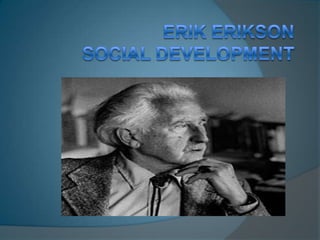
Erik Erikson (1902-1994) was a pupil of Sigmund
Freud and the first child psychoanalyst in Boston.
After extensive study of children from various
cultural backgrounds and areas he began to
compile this information to form his theories on
development, personality, and what forms our
identity.
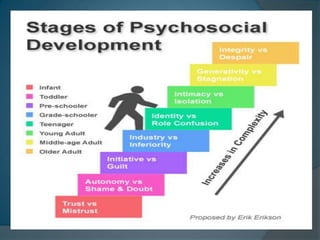
Erikson’s theory breaks down psychosocial
development into eight (and eventually a final
ninth) stages. These stages are delineated by
age and characterized by a struggle or crisis that
must be overcome in order to adapt and continue
to develop. Here is a breakdown of the stages:
Infancy (Birth-18 months) - At this stage,
we as human beings are completely
dependant, helpless. We rely on an external
source for everything, from food to affection.
The conflict of this stage is Trust vs.
Mistrust. Obviously, if we as infants are not
getting our needs met, we will become
unsure of our environment and fearful of our
caregivers. For healthy development and
movement into the next stage, we require
our physical and emotional needs to be
consistently met.
Early Childhood (18 months-3 years) - When
we have overcome our Infancy crisis, we begin to
move into Early Childhood. In this stage of
development, we begin to do things for ourselves,
such as communicate with others verbally, walk
without assistance, and become potty-trained.
Our crisis shifts to Autonomy vs. Shame. This can
be a fragile stage, particularly due to our attempt
to master skills (such as feeding oneself, using a
toilet instead of a diaper, etc). If we are shamed
or embarrassed at our inability to master more
adult tasks, it may affect our self-esteem. To
move into the next stage, we need
encouragement and support.
Play Age (3-6 years) - When we have resolved our
Early Childhood crisis, we begin to move into Play Age.
In this stage of development, we begin to mirror or
mimic behavior around us. This is demonstrated in our
playtime activity. We become fascinated with adult
behaviors like driving, talking on the phone, performing
household chores like cleaning and cooking, etc. It is
through our play that we explore and learn more skills.
Our crisis therefore shifts to Initiative vs. Guilt. While we
develop creatively, we also develop cognitively and
begin to develop reasoning and morality. When we
misbehave, we can anticipate punishment and therefore
begin to feel guilt. Our struggle then becomes balancing
our curiosity and initiative without feeling too much guilt
to progress.
School Age (6-12 years)
This stage of life is all about expansion of one’s
social circle and beginning school. Students are
influenced by their new surroundings as well as
their peers. Teachers begin to take on an important
role as well, considering a student’s teacher spends
more time with them than their parents at this stage
of life. Cognitively, we are growing and learning new
skills and we are making things which is why this
stage’s crisis is considered Industry vs. Inferiority. If
we are rejected socially or feel inadequate, we may
struggle to move past this phase of development
and have self-esteem issues through other stages.
Adolescence (12-18 years)
According to Erikson, this is the first stage in our
development that is determined directly by what
we do as opposed to what we have had done to
us. It is a phase of exploration in which we
endeavor to determine our identity (ego identity)
and what we want our lives to look like (career,
education, etc). We are increasingly more
independent, withdrawing from our peers and
parents. Erikson made the point that ego identity is
not simply the sum of prior identification, but
instead is a reassembly of the basic ego with
knowledge gained through previous crises (Slavin
56).
The arrival of puberty brings about a sexual
awareness and desire to experiment. The crisis in
this phase is Identity vs. Role Confusion. If we
cannot successfully resolve our identity question,
we are likely to experience role confusion and
experience identity crisis, which can lead to
negative behaviors. It is important to note this as a
middle or high school instructor because students
will experience a period of withdrawal from their
responsibilities and have a lack of motivation. It is
necessary to help adolescents through this phase
of their development in order to help them achieve
in the classroom.
Young Adulthood (18-35 years)
At this stage of psychosocial development, a
person begins to search for a partner. It becomes
the main focus or new struggle once a person has
resolved their adolescent identity crisis. The most
important event in this stage is a romantic
attachment or relationship. This is also the stage in
which most start a family, though this has been
pushed back somewhat in societal norms today.
The struggle of this stage is Intimacy vs. Isolation. If
we are successful at this stage we find intimacy on
a profound level. If we do not resolve this struggle,
we may experience isolation from others. Our most
significant relationships are with partners and
friends in this stage.
Middle Adulthood (35-55 years)
Erikson believed that much of our lives are spent
preparing for this stage. Once we have successfully
resolved the conflict of young adulthood, we approach
a new conflict in middle adulthood. At this stage, work
is most crucial to our lives and we tend to be
concerned with productivity as well as personal
growth. The biggest fear of this stage is feeling
meaningless or inactive. Also the stage of the “mid-life
crisis,” we tend to struggle to find our purpose or
greater meaning in life. This struggle is known
as Generatively vs. Self-absorption. If we become
stagnant and fail to grow or resolve our mid-life crisis,
it generally leads to self-absorption or self-indulgence.
Late Adulthood (55-Death)
Once we have resolved our mid-life crisis or the crises of
middle adulthood, we enter late adulthood. This stage is
one that Erikson believed was a recovery from middle
adulthood. In this final stage, people tend to reflect on
their lives and accomplishments or lack thereof, regrets,
and reflect on their demise. The inevitability of death is
something that we have to face and accept in this stage.
The most significant relationship of this stage is with all
mankind. The struggle of this final stage is Integrity vs.
Despair. Generally, a person who can reflect on their life
with satisfaction and contentedness will feel integrity,
where a person who does not feel accomplished or feel
that they have not contributed will feel despair at their
own failure.
Social development

Social development

  • 1.
  • 2.
    is a processthat results in the transformation of social structures to improve the capacity of a society in order to fulfill its objectives. It aims specifically in developing power to elevate expansion of human activity.
  • 3.
     means acquisitionof the ability to behave in accordance with social expectations.  the process by which a child learns to live with others human beings and by which he acquires behavior and thought patterns characteristic of his culture is called socialization.
  • 4.
     at birth, the baby is none gregarious. Social behavior begins when the baby first distinguishes between people and objects and responds to them. the baby's first social responses are to adults, because they are normally his first contacts.
  • 6.
     by theend of the third month he turns his head in response to human voice. he expresses pleasure in the presence of others by kicking, smiling, and waving his hand. he cries when left alone but stops crying when he is talked to.
  • 7.
     by thefourth month, he looks in the directions of the person who leaves him, smiles at the person who speaks to him, and laughs when being played with.
  • 8.
    by the fifthand sixth months, he recognizes familiar persons with a smile and shows fear in the presence strangers.  from the age 15 months, the baby shows an increasing interest in people and strong desire to be with them and imitate them.
  • 9.
     from 2to 6 years of age , the child learns to make social contacts and gets along with people outside of home ,especially children of his own age.
  • 11.
    Atkinson et al.(1996) enumerate the following characteristics as foundation of social behavior:
  • 12.
    1.Imition --the babybecomes a part of the social group by imitating others. 2.Shyness-- by the third or fourth month , the baby can distinguish between familiar people and strangers. 3.Dependency---the more the baby is cared for by one person, the more dependent he becomes on that person.
  • 13.
    4.Acceptance of Authorities--whether thebaby will learn to conform to the requests of those who are in authority will depend on how insistent the person in authority are. 5.Rivalry--rivalry depends on associations with other babies or children.
  • 14.
    6.Attention seeking---during thesecond year, the baby tries to get the attention of adults by crying ,gabbing, or hitting them and doing forbidden things. 7.Social cooperation 8.Resistant behavior-- Unless the baby is given opportunities to be dependent, resistant behavior will lead to negativism.
  • 16.
    Erik Erikson (1902-1994)was a pupil of Sigmund Freud and the first child psychoanalyst in Boston. After extensive study of children from various cultural backgrounds and areas he began to compile this information to form his theories on development, personality, and what forms our identity. Erikson’s theory breaks down psychosocial development into eight (and eventually a final ninth) stages. These stages are delineated by age and characterized by a struggle or crisis that must be overcome in order to adapt and continue to develop. Here is a breakdown of the stages:
  • 17.
    Infancy (Birth-18 months)- At this stage, we as human beings are completely dependant, helpless. We rely on an external source for everything, from food to affection. The conflict of this stage is Trust vs. Mistrust. Obviously, if we as infants are not getting our needs met, we will become unsure of our environment and fearful of our caregivers. For healthy development and movement into the next stage, we require our physical and emotional needs to be consistently met.
  • 18.
    Early Childhood (18months-3 years) - When we have overcome our Infancy crisis, we begin to move into Early Childhood. In this stage of development, we begin to do things for ourselves, such as communicate with others verbally, walk without assistance, and become potty-trained. Our crisis shifts to Autonomy vs. Shame. This can be a fragile stage, particularly due to our attempt to master skills (such as feeding oneself, using a toilet instead of a diaper, etc). If we are shamed or embarrassed at our inability to master more adult tasks, it may affect our self-esteem. To move into the next stage, we need encouragement and support.
  • 19.
    Play Age (3-6years) - When we have resolved our Early Childhood crisis, we begin to move into Play Age. In this stage of development, we begin to mirror or mimic behavior around us. This is demonstrated in our playtime activity. We become fascinated with adult behaviors like driving, talking on the phone, performing household chores like cleaning and cooking, etc. It is through our play that we explore and learn more skills. Our crisis therefore shifts to Initiative vs. Guilt. While we develop creatively, we also develop cognitively and begin to develop reasoning and morality. When we misbehave, we can anticipate punishment and therefore begin to feel guilt. Our struggle then becomes balancing our curiosity and initiative without feeling too much guilt to progress.
  • 20.
    School Age (6-12years) This stage of life is all about expansion of one’s social circle and beginning school. Students are influenced by their new surroundings as well as their peers. Teachers begin to take on an important role as well, considering a student’s teacher spends more time with them than their parents at this stage of life. Cognitively, we are growing and learning new skills and we are making things which is why this stage’s crisis is considered Industry vs. Inferiority. If we are rejected socially or feel inadequate, we may struggle to move past this phase of development and have self-esteem issues through other stages.
  • 21.
    Adolescence (12-18 years) Accordingto Erikson, this is the first stage in our development that is determined directly by what we do as opposed to what we have had done to us. It is a phase of exploration in which we endeavor to determine our identity (ego identity) and what we want our lives to look like (career, education, etc). We are increasingly more independent, withdrawing from our peers and parents. Erikson made the point that ego identity is not simply the sum of prior identification, but instead is a reassembly of the basic ego with knowledge gained through previous crises (Slavin 56).
  • 22.
    The arrival ofpuberty brings about a sexual awareness and desire to experiment. The crisis in this phase is Identity vs. Role Confusion. If we cannot successfully resolve our identity question, we are likely to experience role confusion and experience identity crisis, which can lead to negative behaviors. It is important to note this as a middle or high school instructor because students will experience a period of withdrawal from their responsibilities and have a lack of motivation. It is necessary to help adolescents through this phase of their development in order to help them achieve in the classroom.
  • 23.
    Young Adulthood (18-35years) At this stage of psychosocial development, a person begins to search for a partner. It becomes the main focus or new struggle once a person has resolved their adolescent identity crisis. The most important event in this stage is a romantic attachment or relationship. This is also the stage in which most start a family, though this has been pushed back somewhat in societal norms today. The struggle of this stage is Intimacy vs. Isolation. If we are successful at this stage we find intimacy on a profound level. If we do not resolve this struggle, we may experience isolation from others. Our most significant relationships are with partners and friends in this stage.
  • 24.
    Middle Adulthood (35-55years) Erikson believed that much of our lives are spent preparing for this stage. Once we have successfully resolved the conflict of young adulthood, we approach a new conflict in middle adulthood. At this stage, work is most crucial to our lives and we tend to be concerned with productivity as well as personal growth. The biggest fear of this stage is feeling meaningless or inactive. Also the stage of the “mid-life crisis,” we tend to struggle to find our purpose or greater meaning in life. This struggle is known as Generatively vs. Self-absorption. If we become stagnant and fail to grow or resolve our mid-life crisis, it generally leads to self-absorption or self-indulgence.
  • 25.
    Late Adulthood (55-Death) Oncewe have resolved our mid-life crisis or the crises of middle adulthood, we enter late adulthood. This stage is one that Erikson believed was a recovery from middle adulthood. In this final stage, people tend to reflect on their lives and accomplishments or lack thereof, regrets, and reflect on their demise. The inevitability of death is something that we have to face and accept in this stage. The most significant relationship of this stage is with all mankind. The struggle of this final stage is Integrity vs. Despair. Generally, a person who can reflect on their life with satisfaction and contentedness will feel integrity, where a person who does not feel accomplished or feel that they have not contributed will feel despair at their own failure.