Prepared By :
Dr. Mohammed Gamal
Supervisor of Cairo
Social Style
•Managers who consistently accomplish a
lot are notably inconsistent in their
manner of attacking problems and
approaching situations. They continually
change their focus, priorities, behavior
patterns and their own leadership styles
based on with whom they interact.
• — Harvard Business Review, 2008
Social Style
• Are predictable patterns of actions that
others can observe and agree upon for
describing one’s behavior
• All styles are successful and get results
• We all have style range and the ability
to situationally flex or adapt
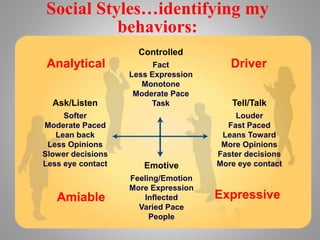
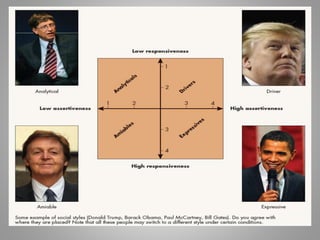
Social Styles…identifying my
behaviors:
Ask/Listen
Softer
Moderate Paced
Lean back
Less Opinions
Slower decisions
Less eye contact
Tell/Talk
Louder
Fast Paced
Leans Toward
More Opinions
Faster decisions
More eye contactEmotive
Feeling/Emotion
More Expression
Inflected
Varied Pace
People
Controlled
Fact
Less Expression
Monotone
Moderate Pace
Task
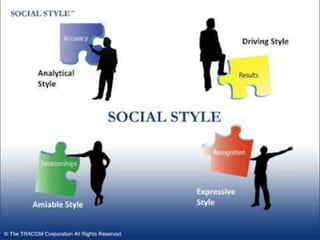
Analytical Driver
ExpressiveAmiable
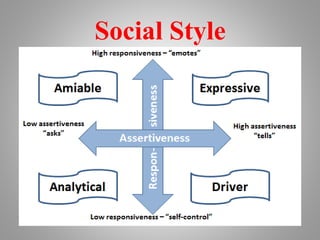
Social Style
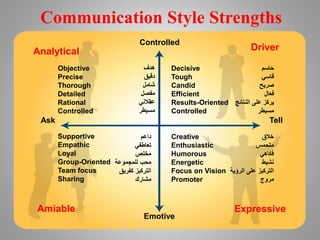
Communication Style Strengths
Analytical
Amiable Expressive
Driver
Controlled
Emotive
TellAsk
Objective
Precise
Thorough
Detailed
Rational
Controlled
Supportive
Empathic
Loyal
Group-Oriented
Team focus
Sharing
Decisive
Tough
Candid
Efficient
Results-Oriented
Controlled
Creative
Enthusiastic
Humorous
Energetic
Focus on Vision
Promoter
‫هدف‬
‫دقيق‬
‫شامل‬
‫مفصل‬
‫عقالني‬
‫مسيطر‬
‫حاسم‬
‫قاسي‬
‫صريح‬
‫فعال‬
‫النتائج‬ ‫على‬ ‫يركز‬
‫مسيطر‬
‫داعم‬
‫تعاطفي‬
‫مخلص‬
‫للمجموعة‬ ‫محب‬
‫كفريق‬ ‫التركيز‬
‫مشارك‬
‫خالق‬
‫متحمس‬
‫فكاهي‬
‫نشيط‬
‫الرؤي‬ ‫على‬ ‫التركيز‬‫ة‬
‫مروج‬
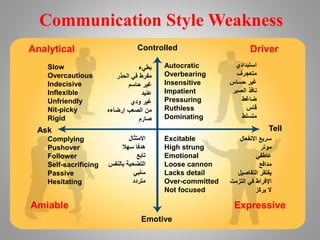
Communication Style Weakness
Analytical
Amiable Expressive
DriverControlled
Emotive
TellAsk
Slow
Overcautious
Indecisive
Inflexible
Unfriendly
Nit-picky
Rigid
Complying
Pushover
Follower
Self-sacrificing
Passive
Hesitating
Autocratic
Overbearing
Insensitive
Impatient
Pressuring
Ruthless
Dominating
Excitable
High strung
Emotional
Loose cannon
Lacks detail
Over-committed
Not focused
‫بطيء‬
‫الحذر‬ ‫في‬ ‫مفرط‬
‫حاسم‬ ‫غير‬
‫عنيد‬
‫ودي‬ ‫غير‬
‫إرضاءه‬ ‫الصعب‬ ‫من‬
‫صارم‬
‫استبدادي‬
‫متعجرف‬
‫حساس‬ ‫غير‬
‫الصبر‬ ‫نافذ‬
‫ضاغط‬
‫قاس‬
‫متسلط‬
‫االمتثال‬
‫سهال‬ ‫هدفا‬
‫تابع‬
‫بالنف‬ ‫التضحية‬‫س‬
‫سلبي‬
‫متردد‬
‫االنفعال‬ ‫سريع‬
‫موتر‬
‫عاطفي‬
‫مدافع‬
‫التفاصيل‬ ‫يفتقر‬
‫التزمت‬ ‫في‬ ‫اإلفراط‬
‫يركز‬ ‫ال‬
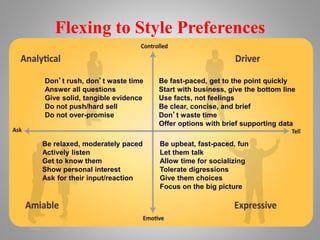
Flexing to Style Preferences
Don’t rush, don’t waste time
Answer all questions
Give solid, tangible evidence
Do not push/hard sell
Do not over-promise
Be fast-paced, get to the point quickly
Start with business, give the bottom line
Use facts, not feelings
Be clear, concise, and brief
Don’t waste time
Offer options with brief supporting data
Be relaxed, moderately paced
Actively listen
Get to know them
Show personal interest
Ask for their input/reaction
Be upbeat, fast-paced, fun
Let them talk
Allow time for socializing
Tolerate digressions
Give them choices
Focus on the big picture
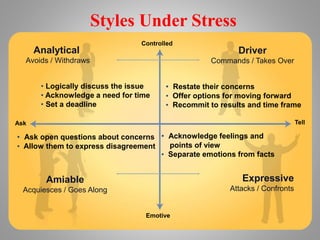
Styles Under Stress
Driver
Commands / Takes Over
Analytical
Avoids / Withdraws
Amiable
Acquiesces / Goes Along
• Logically discuss the issue
• Acknowledge a need for time
• Set a deadline
• Restate their concerns
• Offer options for moving forward
• Recommit to results and time frame
Controlled
Emotive
TellAsk
• Ask open questions about concerns
• Allow them to express disagreement
• Acknowledge feelings and
points of view
• Separate emotions from facts
Expressive
Attacks / Confronts
Three Universal Human Modeling Processes
*NLP has found that any human modeling activity (e.g., the way we create our model of the
world, how we represent our inner experience linguistically, etc.) is based on the same three
universal human modeling processes, i.e., Deletion, Generalization and Distortion.
 One of the three universal human modeling processes is Deletion.
No Time → No Effective Call " Don't Assume “
 The second of the three universal human modeling processes is Generalization.
Your fingers do not resemble each
 The last of the three universal human modeling processes is Distortion. when
someone says "The doctor makes me angry", this sentence may be regarded as
semantically ill-formed, because it is to be supposed that nobody can cause directly in
another person a specific state of mind. (The statement "I make myself angry, because the
doctor doesn't care about me" may be regarded as rather well formed.)
*NLP (Neuro-linguistic Programming)
was born initially as an alternative school of psychotherapy in California, USA, during the mid-seventies. It was initiated by John Grinder,
a linguistic professor, and Richard Bandler, a mathematician, at the University of California at Santa Cruz (UCSC).
Dr. Mohammed Gamal
Mohammed.gl@gmail.com
01097778595
Thank
You

Social styles en

  • 1.
    Prepared By : Dr.Mohammed Gamal Supervisor of Cairo
  • 3.
    Social Style •Managers whoconsistently accomplish a lot are notably inconsistent in their manner of attacking problems and approaching situations. They continually change their focus, priorities, behavior patterns and their own leadership styles based on with whom they interact. • — Harvard Business Review, 2008
  • 4.
    Social Style • Arepredictable patterns of actions that others can observe and agree upon for describing one’s behavior • All styles are successful and get results • We all have style range and the ability to situationally flex or adapt
  • 6.
    Social Styles…identifying my behaviors: Ask/Listen Softer ModeratePaced Lean back Less Opinions Slower decisions Less eye contact Tell/Talk Louder Fast Paced Leans Toward More Opinions Faster decisions More eye contactEmotive Feeling/Emotion More Expression Inflected Varied Pace People Controlled Fact Less Expression Monotone Moderate Pace Task Analytical Driver ExpressiveAmiable
  • 7.
  • 8.
    Communication Style Strengths Analytical AmiableExpressive Driver Controlled Emotive TellAsk Objective Precise Thorough Detailed Rational Controlled Supportive Empathic Loyal Group-Oriented Team focus Sharing Decisive Tough Candid Efficient Results-Oriented Controlled Creative Enthusiastic Humorous Energetic Focus on Vision Promoter ‫هدف‬ ‫دقيق‬ ‫شامل‬ ‫مفصل‬ ‫عقالني‬ ‫مسيطر‬ ‫حاسم‬ ‫قاسي‬ ‫صريح‬ ‫فعال‬ ‫النتائج‬ ‫على‬ ‫يركز‬ ‫مسيطر‬ ‫داعم‬ ‫تعاطفي‬ ‫مخلص‬ ‫للمجموعة‬ ‫محب‬ ‫كفريق‬ ‫التركيز‬ ‫مشارك‬ ‫خالق‬ ‫متحمس‬ ‫فكاهي‬ ‫نشيط‬ ‫الرؤي‬ ‫على‬ ‫التركيز‬‫ة‬ ‫مروج‬
  • 9.
    Communication Style Weakness Analytical AmiableExpressive DriverControlled Emotive TellAsk Slow Overcautious Indecisive Inflexible Unfriendly Nit-picky Rigid Complying Pushover Follower Self-sacrificing Passive Hesitating Autocratic Overbearing Insensitive Impatient Pressuring Ruthless Dominating Excitable High strung Emotional Loose cannon Lacks detail Over-committed Not focused ‫بطيء‬ ‫الحذر‬ ‫في‬ ‫مفرط‬ ‫حاسم‬ ‫غير‬ ‫عنيد‬ ‫ودي‬ ‫غير‬ ‫إرضاءه‬ ‫الصعب‬ ‫من‬ ‫صارم‬ ‫استبدادي‬ ‫متعجرف‬ ‫حساس‬ ‫غير‬ ‫الصبر‬ ‫نافذ‬ ‫ضاغط‬ ‫قاس‬ ‫متسلط‬ ‫االمتثال‬ ‫سهال‬ ‫هدفا‬ ‫تابع‬ ‫بالنف‬ ‫التضحية‬‫س‬ ‫سلبي‬ ‫متردد‬ ‫االنفعال‬ ‫سريع‬ ‫موتر‬ ‫عاطفي‬ ‫مدافع‬ ‫التفاصيل‬ ‫يفتقر‬ ‫التزمت‬ ‫في‬ ‫اإلفراط‬ ‫يركز‬ ‫ال‬
  • 11.
    Flexing to StylePreferences Don’t rush, don’t waste time Answer all questions Give solid, tangible evidence Do not push/hard sell Do not over-promise Be fast-paced, get to the point quickly Start with business, give the bottom line Use facts, not feelings Be clear, concise, and brief Don’t waste time Offer options with brief supporting data Be relaxed, moderately paced Actively listen Get to know them Show personal interest Ask for their input/reaction Be upbeat, fast-paced, fun Let them talk Allow time for socializing Tolerate digressions Give them choices Focus on the big picture
  • 12.
    Styles Under Stress Driver Commands/ Takes Over Analytical Avoids / Withdraws Amiable Acquiesces / Goes Along • Logically discuss the issue • Acknowledge a need for time • Set a deadline • Restate their concerns • Offer options for moving forward • Recommit to results and time frame Controlled Emotive TellAsk • Ask open questions about concerns • Allow them to express disagreement • Acknowledge feelings and points of view • Separate emotions from facts Expressive Attacks / Confronts
  • 13.
    Three Universal HumanModeling Processes *NLP has found that any human modeling activity (e.g., the way we create our model of the world, how we represent our inner experience linguistically, etc.) is based on the same three universal human modeling processes, i.e., Deletion, Generalization and Distortion.  One of the three universal human modeling processes is Deletion. No Time → No Effective Call " Don't Assume “  The second of the three universal human modeling processes is Generalization. Your fingers do not resemble each  The last of the three universal human modeling processes is Distortion. when someone says "The doctor makes me angry", this sentence may be regarded as semantically ill-formed, because it is to be supposed that nobody can cause directly in another person a specific state of mind. (The statement "I make myself angry, because the doctor doesn't care about me" may be regarded as rather well formed.) *NLP (Neuro-linguistic Programming) was born initially as an alternative school of psychotherapy in California, USA, during the mid-seventies. It was initiated by John Grinder, a linguistic professor, and Richard Bandler, a mathematician, at the University of California at Santa Cruz (UCSC).
  • 15.