People buy from people that they like,
be loved, use S4.
ADAPTING YOUR SELLING STYLE TO
THE FOUR SOCIAL STYLES
S4
www.maat.net
1
 Every individual is totally unique and the best sales
people are able to adapt their approach to enhance
their communication and consequently their leverage
based on the prospect or the customer they are
interacting with. Sometimes, it can take several visits
to really appreciate and recognize what makes a
person ‘tick’ yet there is a Behavioral Styles Model
that can circumnavigate this lengthy process making
it easy to identify the ideal behaviors to adopt in the
face of a variety of different people.
Why S4?
2
To establish rapport, do not use the golden rule:
“Do unto others as you would have them do unto you.”
Platinum rule:
“Do unto others as they would have you do unto them.”
“People like people like themselves.”
PLATINUM RULE IN SELLING
3
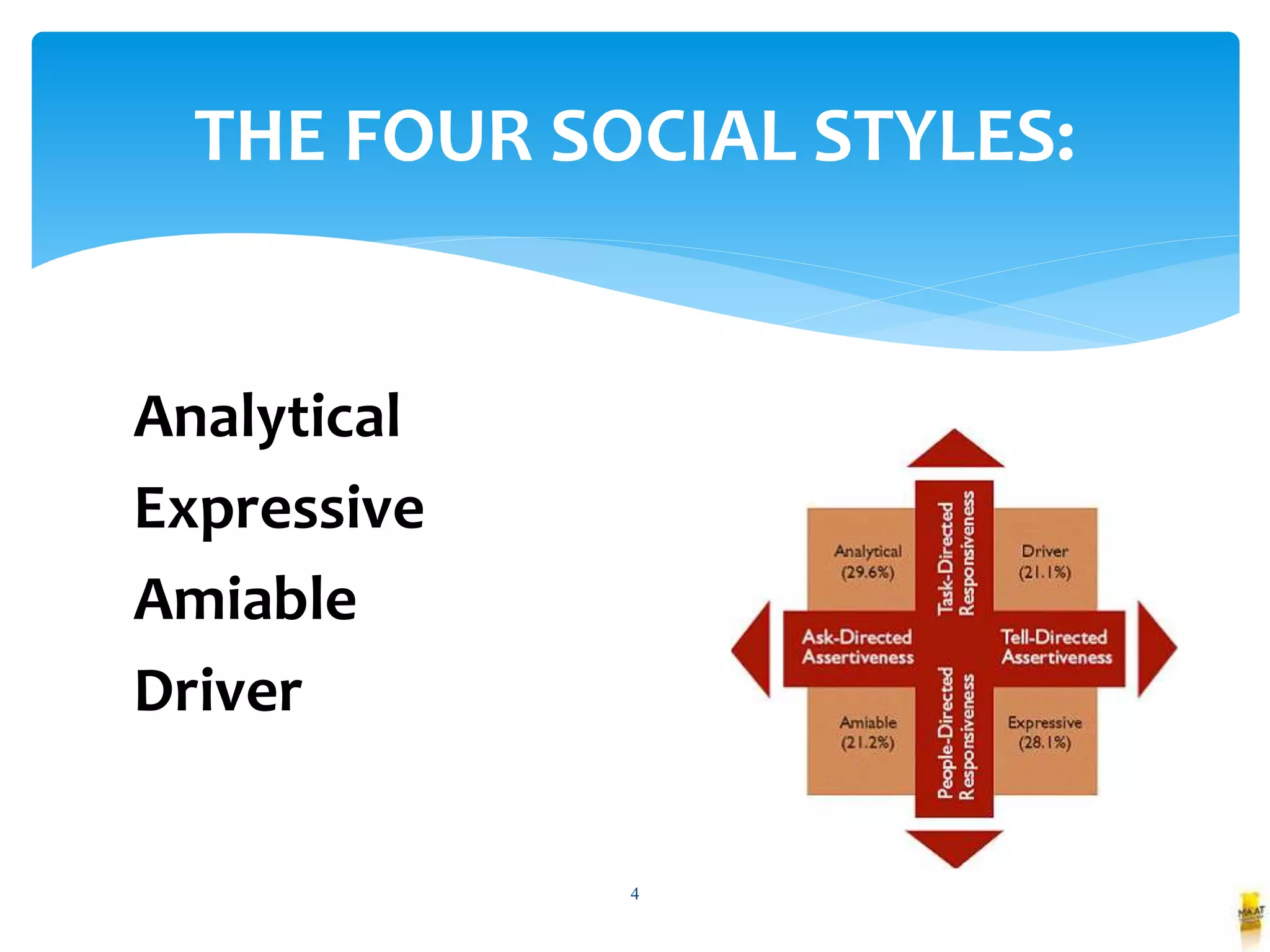
Analytical
Expressive
Amiable
Driver
THE FOUR SOCIAL STYLES:
4
5
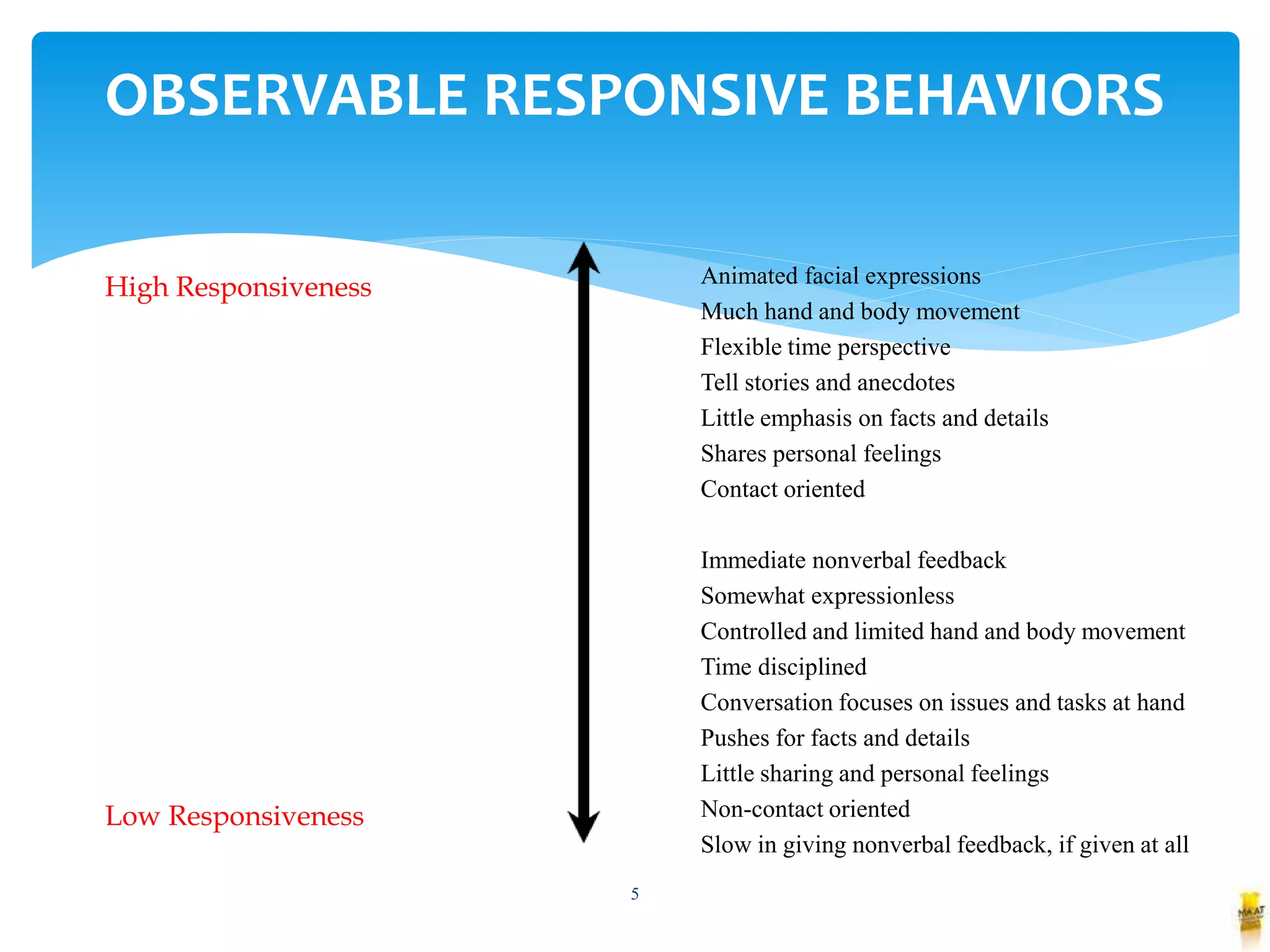
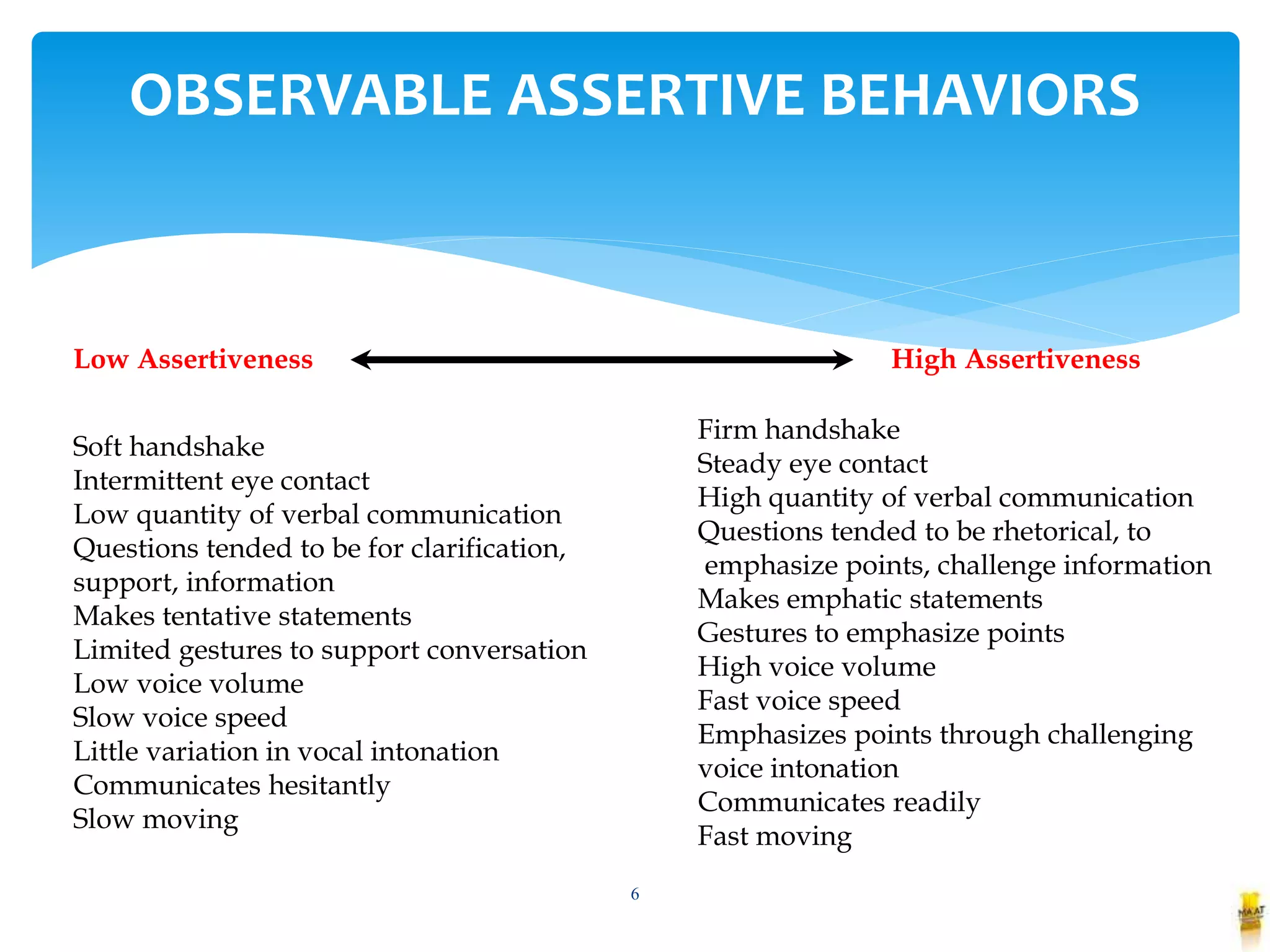
OBSERVABLE RESPONSIVE BEHAVIORS
Animated facial expressions
Much hand and body movement
Flexible time perspective
Tell stories and anecdotes
Little emphasis on facts and details
Shares personal feelings
Contact oriented
Immediate nonverbal feedback
Somewhat expressionless
Controlled and limited hand and body movement
Time disciplined
Conversation focuses on issues and tasks at hand
Pushes for facts and details
Little sharing and personal feelings
Non-contact oriented
Slow in giving nonverbal feedback, if given at all
High Responsiveness
Low Responsiveness
6
OBSERVABLE ASSERTIVE BEHAVIORS
Soft handshake
Intermittent eye contact
Low quantity of verbal communication
Questions tended to be for clarification,
support, information
Makes tentative statements
Limited gestures to support conversation
Low voice volume
Slow voice speed
Little variation in vocal intonation
Communicates hesitantly
Slow moving
Firm handshake
Steady eye contact
High quantity of verbal communication
Questions tended to be rhetorical, to
emphasize points, challenge information
Makes emphatic statements
Gestures to emphasize points
High voice volume
Fast voice speed
Emphasizes points through challenging
voice intonation
Communicates readily
Fast moving
Low Assertiveness High Assertiveness
Pros and Cons
High Responsiveness
Low Responsiveness
Amiable Style
Analytical Style Driving Style
Expressive Style
Positive
Supportive
Reliable
Pleasant
Negative
Complying
Retiring
Soft-hearted
Positive
Diligent
Persevering
Systematic
Negative
Picky
Righteous
Stiff
Positive
Invigorating
Optimistic
Animated
Negative
Excitable
Impatient
Manipulative
Positive
Firm
Comprehensive
Productive
Negative
Uncompromising
Overbearing
Pressuring
Low Assertiveness High Assertiveness
7
8
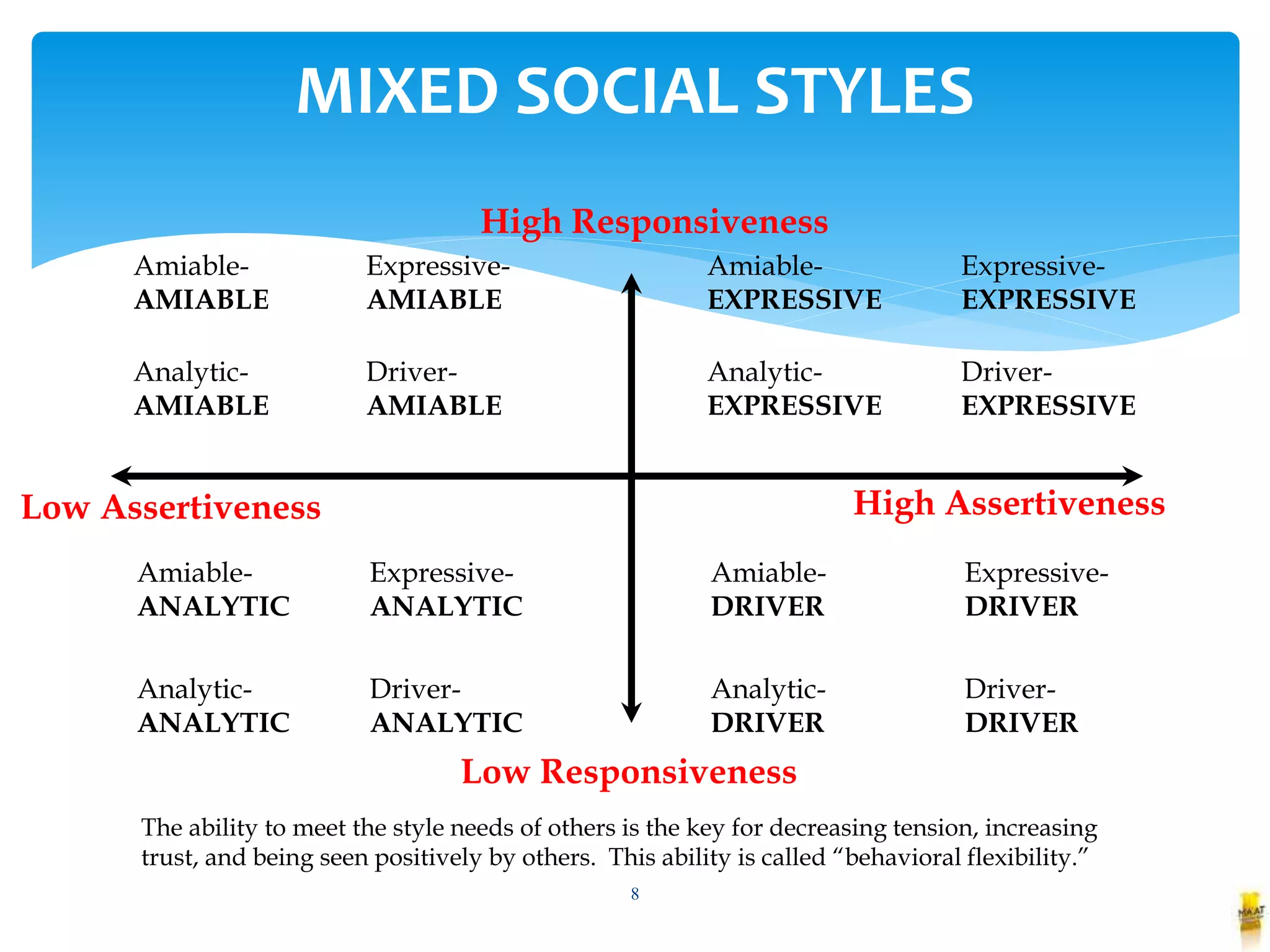
MIXED SOCIAL STYLES
The ability to meet the style needs of others is the key for decreasing tension, increasing
trust, and being seen positively by others. This ability is called “behavioral flexibility.”
Amiable-
AMIABLE
Expressive-
AMIABLE
Analytic-
AMIABLE
Driver-
AMIABLE
Amiable-
ANALYTIC
Analytic-
ANALYTIC
Driver-
ANALYTIC
Expressive-
ANALYTIC
Low Assertiveness High Assertiveness
Amiable-
DRIVER
Analytic-
DRIVER
Driver-
DRIVER
Expressive-
DRIVER
Analytic-
EXPRESSIVE
Amiable-
EXPRESSIVE
Expressive-
EXPRESSIVE
Driver-
EXPRESSIVE
High Responsiveness
Low Responsiveness
Characteristics of Social Styles
High Responsiveness
Low Responsiveness
Amiable Style
Analytical Style Driving Style
Expressive Style
Slow at taking action and making decisions
Likes close, personal relationships
Dislikes interpersonal conflict
Supports and “actively listens to others
Weak at goal-setting and self-direction
Has excellent ability to gain support from others
Works slowly and cohesively with others
Seeks security and belonging
Good counseling skills
Cautious actions and decisions
Likes organization and structure
Dislikes involvement
Asks many questions about specific details
Prefers objective, task-oriented, intellectual
work environment
Wants to be right and therefore, over-relies
on data collection
Works slowly and precisely alone
Seeks security and self-actualization
Good problem-solving skills
Spontaneous actions and decisions
Likes involvement
Dislikes being alone
Exaggerates and generalizes
Tends to dream and get others caught up
in his/her dreams
Jumps from one activity to another
Works quickly and excitingly with others
Seeks esteem and belongingness
Good persuasive skills
Decisive actions and decisions
Likes control
Dislikes inaction
Prefers maximum freedom to manage himself
and others
Cool, independent and competitive with others
Low tolerance for feelings, attitudes and
advice of others
Works quickly and impressively alone
Seeks esteem and self-actualization
Good administrative skills
Low Assertiveness High Assertiveness
9
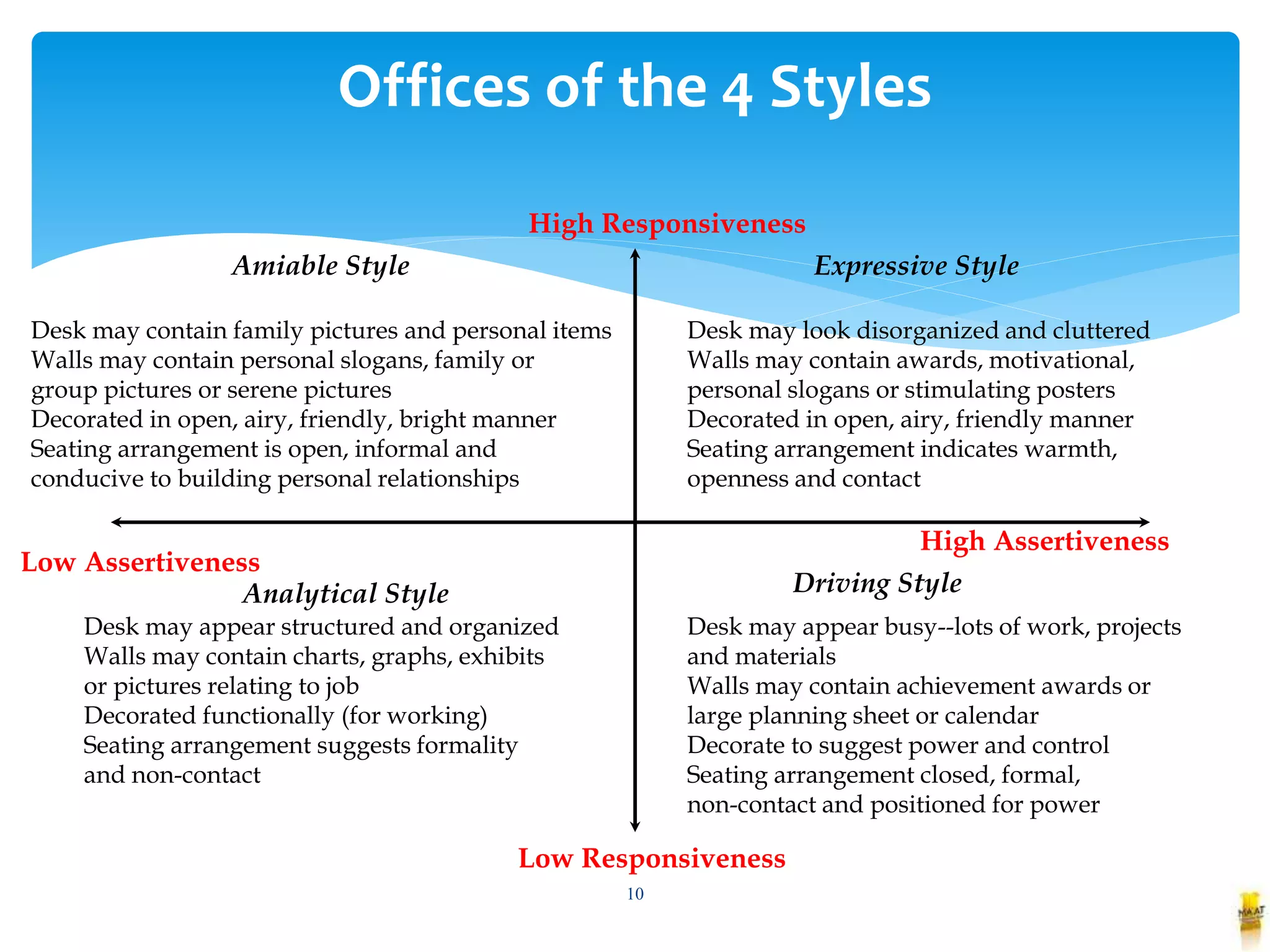
Offices of the 4 Styles
High Responsiveness
Low Responsiveness
Amiable Style
Analytical Style Driving Style
Expressive Style
Desk may contain family pictures and personal items
Walls may contain personal slogans, family or
group pictures or serene pictures
Decorated in open, airy, friendly, bright manner
Seating arrangement is open, informal and
conducive to building personal relationships
Desk may appear structured and organized
Walls may contain charts, graphs, exhibits
or pictures relating to job
Decorated functionally (for working)
Seating arrangement suggests formality
and non-contact
Desk may look disorganized and cluttered
Walls may contain awards, motivational,
personal slogans or stimulating posters
Decorated in open, airy, friendly manner
Seating arrangement indicates warmth,
openness and contact
Desk may appear busy--lots of work, projects
and materials
Walls may contain achievement awards or
large planning sheet or calendar
Decorate to suggest power and control
Seating arrangement closed, formal,
non-contact and positioned for power
Low Assertiveness
High Assertiveness
10
Analytical, Expressive, Amiable or Driver?
11
 Want fast, to the point information
 So be prepared and be brief
 Like summaries (usually on back page of visual aid)
 Or, prepare a 1 page summary with supporting material
 Are not interested in detailed graphs that need lengthy
interpretations.
 Stay focused on the specifics of the business call
 Hates Power Point
ADAPTING TO DRIVERS:
12
 Your presentation should be forceful and
dynamic
 Always talk in terms of results, high efficacy, it
will make them look good.
 Communicate urgency and you can ask for a
decision
 Emphasize only what is truly important
 Be businesslike and professional at all times
ADAPTING TO DRIVERS
13
 Likes to be in control. So offer options instead of
simple yes or no. You control the appointment by
making them think they do.
 Highlight benefits for the users and his prestige
 You can ask for a decision in the first visits.
 But if he says no, he is not likely to change his mind
 Explain features you know that will match their
business; compatibility with other products
 Likes advantages like high efficacy and easy to use
ADAPTING TO DRIVERS
ef·fi·ca·cy: noun, plural ef·fi·ca·cies. capacity for producing a desired result or effect;
effectiveness: a remedy of great efficacy. 14
Analytical, Expressive, Amiable or Driver?
15
 Receptive to presentations with visual aids
 Start with establishing rapport and personalized
amenities
 Inquire sincerely about personal well being and ¨how´s
the family¨
 Likes to hear of product advantages in terms of User
Benefits
 Likes to hear about references.
 Needs many people to agree with them
 Decision by committee
ADAPTING TO AMIABLES:
16
 Needs assurance!!! They are afraid to make a
decision.
 Is a late adopter: Does not like to be pressured
into making a rapid decision or sudden changes
 Likes to talk about personal details
 Be a good listener and offer personalized
attention
 Have empathy and understanding.
 Never say “Beta”.
ADAPTING TO AMIABLES
17
 Be consistent in your visits
 Like to be presented points from visual aid in
very personal terms such as “your employees...”
 Like to hear others rave about the product.
 Are more easily guided into the business
discussion with the use of a visual aid.
 Are better focused on product facts via a visual
aid.
ADAPTING TO AMIABLES
18
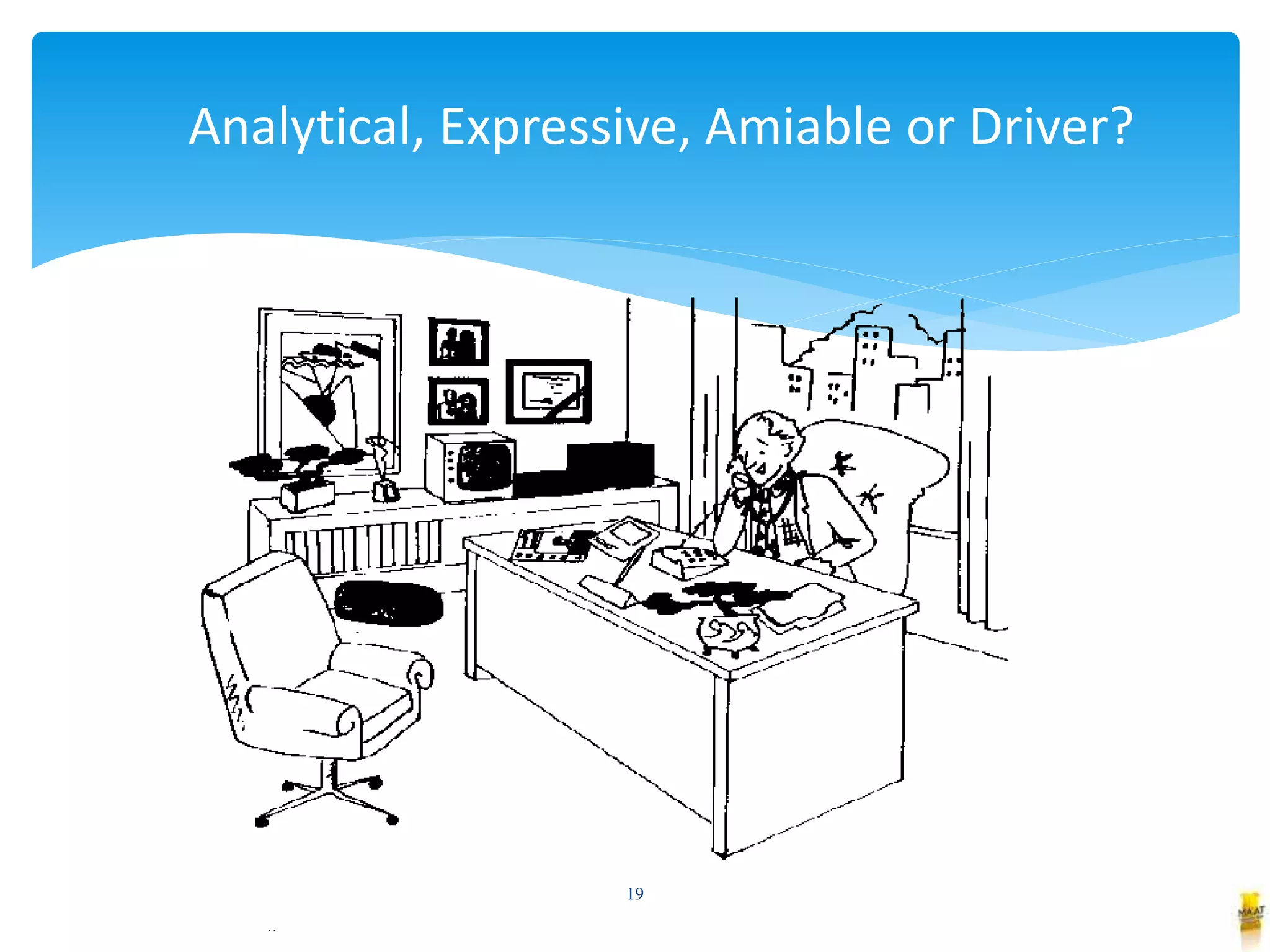
Analytical, Expressive, Amiable or Driver?
19
 Like lively, stimulating and enthusiastic
presentations.
 Present new ideas, concepts, developments or
events.
 They love, ¨what´s new¨. Heat Seekers.
 Are reassured about the product via visual aids.
 Likes to participate or get involved
 Use personalized non routine questions
ADAPTING TO EXPRESSIVES:
20
 Likes ¨user benefits¨. “You will love this!”
 Likes personalized presentations
 Give examples and references
 Likes to be known as an innovator( early
adopter) and opinion leader
 Can make a decision in the first visit
 Loves Beta
ADAPTING TO EXPRESSIVES:
21
 Be sure to confirm commitments in writing
 Emphasize new technology as a way of
differentiating your product
 Invite to participate in ¨focus groups¨.
 Or to attend symposiums
 Or to speak to other users
 Always follow up on their past commitments
ADAPTING TO EXPRESSIVES:
22
 Constantly recognize and reinforce other users
good experience if applicable
 Keep on track with the use of a visual aid.
 Very short attention spans
 Like details in writing.
 Enjoy the “story” or anecdotal approach.
 Totally wants to be entertained, get them out of
the office.
 They love to play.
ADAPTING TO EXPRESSIVES:
23
Analytical, Expressive, Amiable or Driver?
24
 Want detailed sequence of product claims.
 Like to see graphs and charts (but usually
want them backed up with real life examples
or stats).
 Like to rely on the written work.
 Likes a logical, organized presentation
 Be specific, detailed exact and precise
ADAPTING TO ANALYTICALS:
25
 Speak slowly
 Be accurate and be ready to support your
presentation with proof
 Be ready to respond to questions on specific
details
 Likes to be logical, reasonable and factual
 Cautious: Does not like to be pressured into
making a decision
ADAPTING TO ANALYTICALS:
26
 Do not be domineering
 Does not like to participate. Do not press with
open questions
 Likes to know both sides of the issue. The Good
and the Bad.
 Needs complete and balanced information
 Needs to be assured in writing.
 Tends to trust written versus oral claims
ADAPTING TO ANALYTICALS:
27
 May discourage the use of advertising-type
“showpieces” but still need the impact of visual
stimulation.
 If visual aids are used, highlight stats not commercial
points
 (Make sure to choose pieces carefully before the call
to address the above points).
 Be formal. Dress conservatively. Don´t be too friendly
ADAPTING TO ANALYTICALS:
28
Close more business!
29
Utilize the principals in S4 and be loved.
I have taught these principles to
many companies and sales people
face to face and their close ratios
improved. I will teach your sales
people and provide on going
coaching. Contact me. A lead is a
terrible thing to waste!
Contact:
Steve Hirst
www.maat.net
215-313-5360
shirst@maat.net
…Happy Selling

Social Style Selling Skills

  • 1.
    People buy frompeople that they like, be loved, use S4. ADAPTING YOUR SELLING STYLE TO THE FOUR SOCIAL STYLES S4 www.maat.net 1
  • 2.
     Every individualis totally unique and the best sales people are able to adapt their approach to enhance their communication and consequently their leverage based on the prospect or the customer they are interacting with. Sometimes, it can take several visits to really appreciate and recognize what makes a person ‘tick’ yet there is a Behavioral Styles Model that can circumnavigate this lengthy process making it easy to identify the ideal behaviors to adopt in the face of a variety of different people. Why S4? 2
  • 3.
    To establish rapport,do not use the golden rule: “Do unto others as you would have them do unto you.” Platinum rule: “Do unto others as they would have you do unto them.” “People like people like themselves.” PLATINUM RULE IN SELLING 3
  • 4.
  • 5.
    5 OBSERVABLE RESPONSIVE BEHAVIORS Animatedfacial expressions Much hand and body movement Flexible time perspective Tell stories and anecdotes Little emphasis on facts and details Shares personal feelings Contact oriented Immediate nonverbal feedback Somewhat expressionless Controlled and limited hand and body movement Time disciplined Conversation focuses on issues and tasks at hand Pushes for facts and details Little sharing and personal feelings Non-contact oriented Slow in giving nonverbal feedback, if given at all High Responsiveness Low Responsiveness
  • 6.
    6 OBSERVABLE ASSERTIVE BEHAVIORS Softhandshake Intermittent eye contact Low quantity of verbal communication Questions tended to be for clarification, support, information Makes tentative statements Limited gestures to support conversation Low voice volume Slow voice speed Little variation in vocal intonation Communicates hesitantly Slow moving Firm handshake Steady eye contact High quantity of verbal communication Questions tended to be rhetorical, to emphasize points, challenge information Makes emphatic statements Gestures to emphasize points High voice volume Fast voice speed Emphasizes points through challenging voice intonation Communicates readily Fast moving Low Assertiveness High Assertiveness
  • 7.
    Pros and Cons HighResponsiveness Low Responsiveness Amiable Style Analytical Style Driving Style Expressive Style Positive Supportive Reliable Pleasant Negative Complying Retiring Soft-hearted Positive Diligent Persevering Systematic Negative Picky Righteous Stiff Positive Invigorating Optimistic Animated Negative Excitable Impatient Manipulative Positive Firm Comprehensive Productive Negative Uncompromising Overbearing Pressuring Low Assertiveness High Assertiveness 7
  • 8.
    8 MIXED SOCIAL STYLES Theability to meet the style needs of others is the key for decreasing tension, increasing trust, and being seen positively by others. This ability is called “behavioral flexibility.” Amiable- AMIABLE Expressive- AMIABLE Analytic- AMIABLE Driver- AMIABLE Amiable- ANALYTIC Analytic- ANALYTIC Driver- ANALYTIC Expressive- ANALYTIC Low Assertiveness High Assertiveness Amiable- DRIVER Analytic- DRIVER Driver- DRIVER Expressive- DRIVER Analytic- EXPRESSIVE Amiable- EXPRESSIVE Expressive- EXPRESSIVE Driver- EXPRESSIVE High Responsiveness Low Responsiveness
  • 9.
    Characteristics of SocialStyles High Responsiveness Low Responsiveness Amiable Style Analytical Style Driving Style Expressive Style Slow at taking action and making decisions Likes close, personal relationships Dislikes interpersonal conflict Supports and “actively listens to others Weak at goal-setting and self-direction Has excellent ability to gain support from others Works slowly and cohesively with others Seeks security and belonging Good counseling skills Cautious actions and decisions Likes organization and structure Dislikes involvement Asks many questions about specific details Prefers objective, task-oriented, intellectual work environment Wants to be right and therefore, over-relies on data collection Works slowly and precisely alone Seeks security and self-actualization Good problem-solving skills Spontaneous actions and decisions Likes involvement Dislikes being alone Exaggerates and generalizes Tends to dream and get others caught up in his/her dreams Jumps from one activity to another Works quickly and excitingly with others Seeks esteem and belongingness Good persuasive skills Decisive actions and decisions Likes control Dislikes inaction Prefers maximum freedom to manage himself and others Cool, independent and competitive with others Low tolerance for feelings, attitudes and advice of others Works quickly and impressively alone Seeks esteem and self-actualization Good administrative skills Low Assertiveness High Assertiveness 9
  • 10.
    Offices of the4 Styles High Responsiveness Low Responsiveness Amiable Style Analytical Style Driving Style Expressive Style Desk may contain family pictures and personal items Walls may contain personal slogans, family or group pictures or serene pictures Decorated in open, airy, friendly, bright manner Seating arrangement is open, informal and conducive to building personal relationships Desk may appear structured and organized Walls may contain charts, graphs, exhibits or pictures relating to job Decorated functionally (for working) Seating arrangement suggests formality and non-contact Desk may look disorganized and cluttered Walls may contain awards, motivational, personal slogans or stimulating posters Decorated in open, airy, friendly manner Seating arrangement indicates warmth, openness and contact Desk may appear busy--lots of work, projects and materials Walls may contain achievement awards or large planning sheet or calendar Decorate to suggest power and control Seating arrangement closed, formal, non-contact and positioned for power Low Assertiveness High Assertiveness 10
  • 11.
  • 12.
     Want fast,to the point information  So be prepared and be brief  Like summaries (usually on back page of visual aid)  Or, prepare a 1 page summary with supporting material  Are not interested in detailed graphs that need lengthy interpretations.  Stay focused on the specifics of the business call  Hates Power Point ADAPTING TO DRIVERS: 12
  • 13.
     Your presentationshould be forceful and dynamic  Always talk in terms of results, high efficacy, it will make them look good.  Communicate urgency and you can ask for a decision  Emphasize only what is truly important  Be businesslike and professional at all times ADAPTING TO DRIVERS 13
  • 14.
     Likes tobe in control. So offer options instead of simple yes or no. You control the appointment by making them think they do.  Highlight benefits for the users and his prestige  You can ask for a decision in the first visits.  But if he says no, he is not likely to change his mind  Explain features you know that will match their business; compatibility with other products  Likes advantages like high efficacy and easy to use ADAPTING TO DRIVERS ef·fi·ca·cy: noun, plural ef·fi·ca·cies. capacity for producing a desired result or effect; effectiveness: a remedy of great efficacy. 14
  • 15.
  • 16.
     Receptive topresentations with visual aids  Start with establishing rapport and personalized amenities  Inquire sincerely about personal well being and ¨how´s the family¨  Likes to hear of product advantages in terms of User Benefits  Likes to hear about references.  Needs many people to agree with them  Decision by committee ADAPTING TO AMIABLES: 16
  • 17.
     Needs assurance!!!They are afraid to make a decision.  Is a late adopter: Does not like to be pressured into making a rapid decision or sudden changes  Likes to talk about personal details  Be a good listener and offer personalized attention  Have empathy and understanding.  Never say “Beta”. ADAPTING TO AMIABLES 17
  • 18.
     Be consistentin your visits  Like to be presented points from visual aid in very personal terms such as “your employees...”  Like to hear others rave about the product.  Are more easily guided into the business discussion with the use of a visual aid.  Are better focused on product facts via a visual aid. ADAPTING TO AMIABLES 18
  • 19.
  • 20.
     Like lively,stimulating and enthusiastic presentations.  Present new ideas, concepts, developments or events.  They love, ¨what´s new¨. Heat Seekers.  Are reassured about the product via visual aids.  Likes to participate or get involved  Use personalized non routine questions ADAPTING TO EXPRESSIVES: 20
  • 21.
     Likes ¨userbenefits¨. “You will love this!”  Likes personalized presentations  Give examples and references  Likes to be known as an innovator( early adopter) and opinion leader  Can make a decision in the first visit  Loves Beta ADAPTING TO EXPRESSIVES: 21
  • 22.
     Be sureto confirm commitments in writing  Emphasize new technology as a way of differentiating your product  Invite to participate in ¨focus groups¨.  Or to attend symposiums  Or to speak to other users  Always follow up on their past commitments ADAPTING TO EXPRESSIVES: 22
  • 23.
     Constantly recognizeand reinforce other users good experience if applicable  Keep on track with the use of a visual aid.  Very short attention spans  Like details in writing.  Enjoy the “story” or anecdotal approach.  Totally wants to be entertained, get them out of the office.  They love to play. ADAPTING TO EXPRESSIVES: 23
  • 24.
  • 25.
     Want detailedsequence of product claims.  Like to see graphs and charts (but usually want them backed up with real life examples or stats).  Like to rely on the written work.  Likes a logical, organized presentation  Be specific, detailed exact and precise ADAPTING TO ANALYTICALS: 25
  • 26.
     Speak slowly Be accurate and be ready to support your presentation with proof  Be ready to respond to questions on specific details  Likes to be logical, reasonable and factual  Cautious: Does not like to be pressured into making a decision ADAPTING TO ANALYTICALS: 26
  • 27.
     Do notbe domineering  Does not like to participate. Do not press with open questions  Likes to know both sides of the issue. The Good and the Bad.  Needs complete and balanced information  Needs to be assured in writing.  Tends to trust written versus oral claims ADAPTING TO ANALYTICALS: 27
  • 28.
     May discouragethe use of advertising-type “showpieces” but still need the impact of visual stimulation.  If visual aids are used, highlight stats not commercial points  (Make sure to choose pieces carefully before the call to address the above points).  Be formal. Dress conservatively. Don´t be too friendly ADAPTING TO ANALYTICALS: 28
  • 29.
    Close more business! 29 Utilizethe principals in S4 and be loved. I have taught these principles to many companies and sales people face to face and their close ratios improved. I will teach your sales people and provide on going coaching. Contact me. A lead is a terrible thing to waste! Contact: Steve Hirst www.maat.net 215-313-5360 shirst@maat.net …Happy Selling