


Understanding Learning Styles A guide for new managers
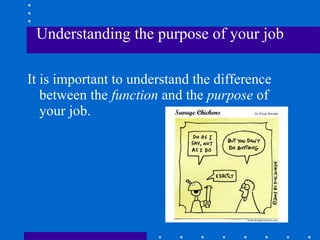
Understanding the purpose of your job It is important to understand the difference between the  function  and the  purpose  of your job.
Understanding the purpose of your job The function is what you do, the purpose is why you do it. Understanding your purpose requires that you be very specific about the benefits you create for others.
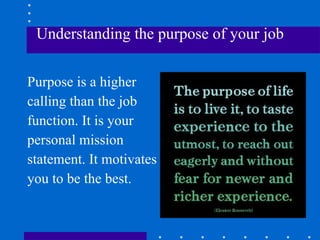
Understanding the purpose of your job Purpose is a higher calling than the job function. It is your  personal mission  statement. It motivates  you to be the best.
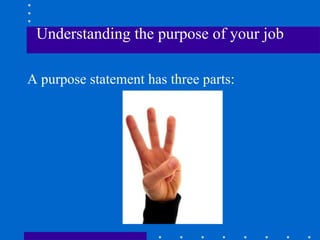
Understanding the purpose of your job A purpose statement has three parts:
Understanding the purpose of your job A purpose statement has three parts: What  you do
Understanding the purpose of your job A purpose statement has three parts: What  you do Who  you serve
Understanding the purpose of your job A purpose statement has three parts: What  you do Who  you serve and the  benefits  you create
What comes next?
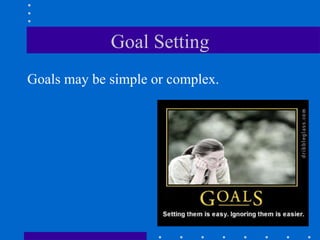
Goal Setting Goals may be simple or complex.
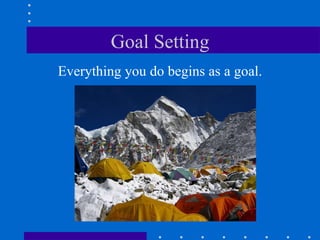
Goal Setting Everything you do begins as a goal.
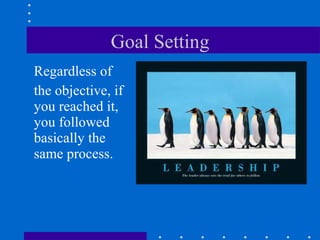
Goal Setting Regardless of  the objective, if you reached it, you followed basically the same process.
Goal setting strategy Goals Should Be Statements of the Desired End Result. I want… I need… We must…
Goal setting strategy First, find what you really want, what you really need. Dream big. Dare to fail.  – Norman Vaughn, member of Admiral Byrd’s South Pole exploration.
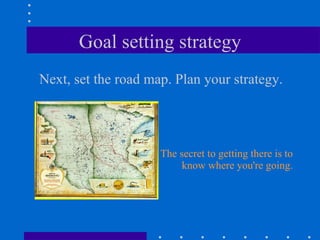
Goal setting strategy Next, set the road map. Plan your strategy. The secret to getting there is to know where you're going.
Goal setting strategy Third, believe in the plan. Thinking about what you can’t do is worry.  Thinking about what you can do is planning.
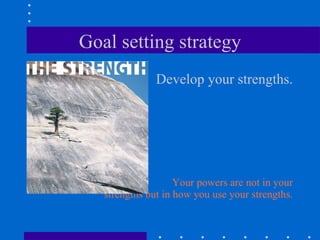
Goal setting strategy Develop your strengths. Your powers are not in your strengths but in how you use your strengths.
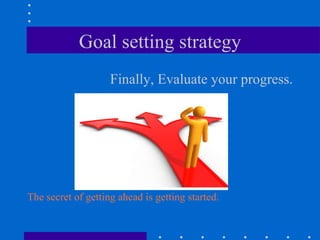
Goal setting strategy Finally, Evaluate your progress. The secret of getting ahead is getting started.
Communicating Good communication skills are vital to interpersonal relations. Effective communication is more than talking and listening, it includes both skills and emotions. Skills can be making eye contact or adjusting body position. Emotions include empathy and valuing people.
Communicating Dr. Albert Mehrabian of UCLA found that effective communication depends on:  the words people say (7%) the tone of voice (38%) body language (55%) Mehrabian, A. Silent messages: Implicit communication of emotions and attitudes. Belmont, CA: Wadsworth 1981
Communicating Keys to becoming a better listener: Maintain strong eye contact Remember names Listen for emotions Ask questions Focus on what is being said, not what you are going to say
Communicating Keys to becoming a better listener: Do not interrupt Avoid being defensive Be aware of body language and other nonverbal communication Show openness Tune out the environment
Modeling Behavior
Modeling Behavior One of the biggest complaints from staff is that their managers don’t model good behaviors and attitudes in leader-follower interactions. When followers observe managers practicing good customer relations, they are more likely to do the same.
Modeling Behavior The most efficient way to produce results and communicate an organization’s commitment to customer service is to demonstrate it through positive behavior and attitudes.
Modeling Behavior If managers want productive employees and organization-wide commitment to customer service, they must first set a good example by practicing what they preach.
Psychological Reciprocity What you give out to people comes back to you. People are instinctively impelled to return the same feelings and attitudes they perceive from others. To establish trust and loyalty, show it to the customers.   The language of complaint starts with they.  The language of solutions starts with I.
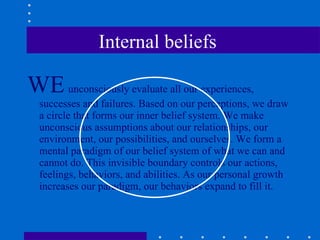
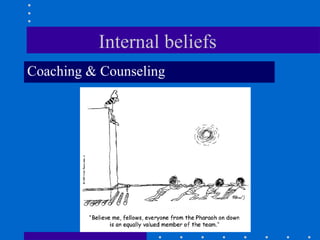
Internal beliefs  WE   unconsciously evaluate all our experiences, successes and failures. Based on our perceptions, we draw a circle that forms our inner belief system. We make unconscious assumptions about our relationships, our environment, our possibilities, and ourselves. We form a mental paradigm of our belief system of what we can and cannot do. This invisible boundary controls our actions, feelings, behaviors, and abilities. As our personal growth increases our paradigm, our behaviors expand to fill it.
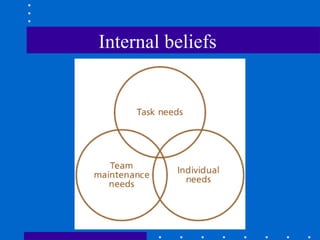
Internal beliefs
Internal beliefs  Any attempts to change a persons behavior without first changing the  mental paradigm  will likely to fail. A leader’s role is to expand the follower’s  belief system . Find the  potential  in subordinates and express a belief in the subordinate’s  abilities .
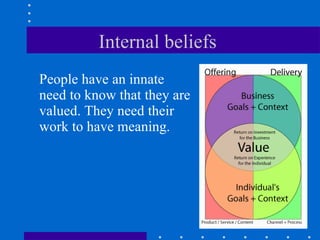
Internal beliefs  People have an innate need to know that they are valued. They need their work to have meaning.
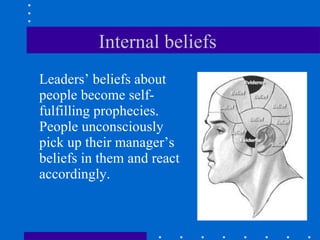
Internal beliefs  Leaders’ beliefs about people become self-fulfilling prophecies. People unconsciously pick up their manager’s beliefs in them and react accordingly.
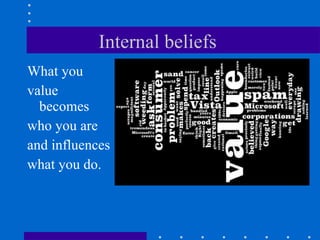
Internal beliefs  What you  value becomes  who you are  and influences  what you do.
Internal beliefs  Coaching & Counseling: Ask  about their goals or objectives . Listen  without distractions or interruptions Coach  knowledge, skills, or actions as needed . Praise  specific behaviors . Challenge  them to become their best .
Internal beliefs  Coaching & Counseling
Don’t get discouraged The early bird gets the worm. But the second mouse gets the cheese
Behavior Styles
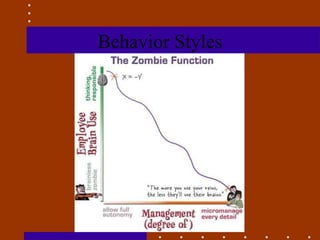
Behavior Styles Everyone has a learning and communicating style based on patterns of thinking, feeling, and acting that are learned from the social environment and life experience. These behavioral differences have the potential to create great misunderstandings that can be avoided if people learn to see themselves from each other’s viewpoint.
Behavior Styles What one person might consider as straightforward and instructive may be seen as detached by a second person, or as pushy and intrusive by a third. The different perceptions stem from differences in values, attitudes, and communication styles.
Behavior Styles We can improve communication by understanding how each of us relate to our environment. Managers must enlarge the set of situations in which they are comfortable and confident.
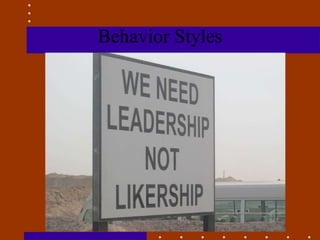
Behavior Styles
Behavior Styles By examining our own values and beliefs, work styles, communication patterns, and the personality differences between others and ourselves we can discover how to succeed in a diverse workplace.
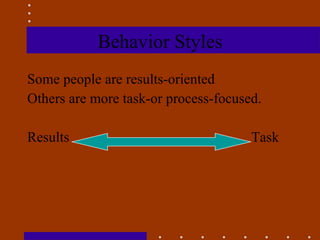
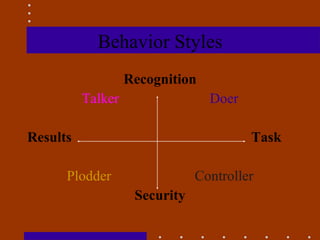
Behavior Styles Some people are results-oriented Others are more task-or process-focused. Results  Task
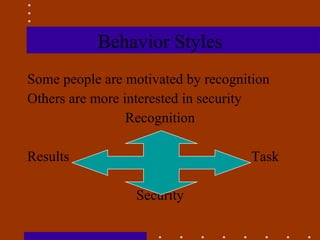
Behavior Styles Some people are motivated by recognition Others are more interested in security Recognition Results  Task Security
Behavior Styles
Behavior Styles Talkers  are outgoing, friendly, and affable. They like parties and gatherings, are comfortable in groups, and like photos and  recognition . Talkers may become emotional under pressure.
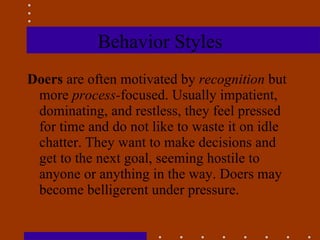
Behavior Styles Doers  are often motivated by  recognition  but more  process- focused. Usually impatient, dominating, and restless, they feel pressed for time and do not like to waste it on idle chatter. They want to make decisions and get to the next goal, seeming hostile to anyone or anything in the way. Doers may become belligerent under pressure.
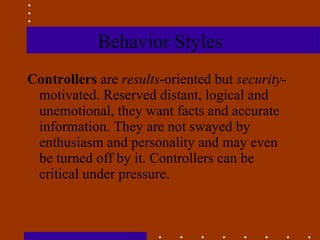
Behavior Styles Controllers  are  results -oriented but  security- motivated. Reserved distant, logical and unemotional, they want facts and accurate information. They are not swayed by enthusiasm and personality and may even be turned off by it. Controllers can be critical under pressure.
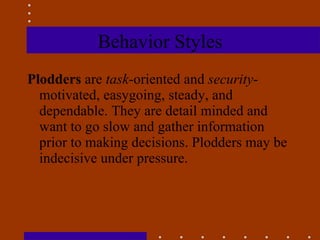
Behavior Styles Plodders  are  task -oriented and  security -motivated, easygoing, steady, and dependable. They are detail minded and want to go slow and gather information prior to making decisions. Plodders may be indecisive under pressure.
Behavior Styles Recognition Talker   Doer Results   Task Plodder   Controller Security
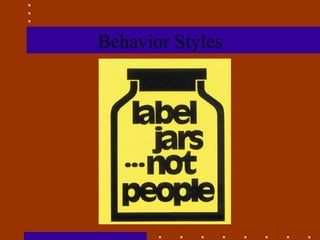
Behavior Styles Most everyone is a combination of all four styles so remember... It’s very  hard to peal  off a label.
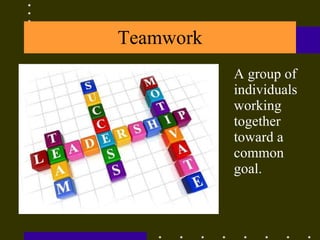
Teamwork A group of individuals working together toward a common goal.

New Managers Workshop

  • 1.
    Understanding Learning StylesA guide for new managers
  • 2.
    Understanding the purposeof your job It is important to understand the difference between the function and the purpose of your job.
  • 3.
    Understanding the purposeof your job The function is what you do, the purpose is why you do it. Understanding your purpose requires that you be very specific about the benefits you create for others.
  • 4.
    Understanding the purposeof your job Purpose is a higher calling than the job function. It is your personal mission statement. It motivates you to be the best.
  • 5.
    Understanding the purposeof your job A purpose statement has three parts:
  • 6.
    Understanding the purposeof your job A purpose statement has three parts: What you do
  • 7.
    Understanding the purposeof your job A purpose statement has three parts: What you do Who you serve
  • 8.
    Understanding the purposeof your job A purpose statement has three parts: What you do Who you serve and the benefits you create
  • 9.
  • 10.
    Goal Setting Goalsmay be simple or complex.
  • 11.
    Goal Setting Everythingyou do begins as a goal.
  • 12.
    Goal Setting Regardlessof the objective, if you reached it, you followed basically the same process.
  • 13.
    Goal setting strategyGoals Should Be Statements of the Desired End Result. I want… I need… We must…
  • 14.
    Goal setting strategyFirst, find what you really want, what you really need. Dream big. Dare to fail. – Norman Vaughn, member of Admiral Byrd’s South Pole exploration.
  • 15.
    Goal setting strategyNext, set the road map. Plan your strategy. The secret to getting there is to know where you're going.
  • 16.
    Goal setting strategyThird, believe in the plan. Thinking about what you can’t do is worry. Thinking about what you can do is planning.
  • 17.
    Goal setting strategyDevelop your strengths. Your powers are not in your strengths but in how you use your strengths.
  • 18.
    Goal setting strategyFinally, Evaluate your progress. The secret of getting ahead is getting started.
  • 19.
    Communicating Good communicationskills are vital to interpersonal relations. Effective communication is more than talking and listening, it includes both skills and emotions. Skills can be making eye contact or adjusting body position. Emotions include empathy and valuing people.
  • 20.
    Communicating Dr. AlbertMehrabian of UCLA found that effective communication depends on: the words people say (7%) the tone of voice (38%) body language (55%) Mehrabian, A. Silent messages: Implicit communication of emotions and attitudes. Belmont, CA: Wadsworth 1981
  • 21.
    Communicating Keys tobecoming a better listener: Maintain strong eye contact Remember names Listen for emotions Ask questions Focus on what is being said, not what you are going to say
  • 22.
    Communicating Keys tobecoming a better listener: Do not interrupt Avoid being defensive Be aware of body language and other nonverbal communication Show openness Tune out the environment
  • 23.
  • 24.
    Modeling Behavior Oneof the biggest complaints from staff is that their managers don’t model good behaviors and attitudes in leader-follower interactions. When followers observe managers practicing good customer relations, they are more likely to do the same.
  • 25.
    Modeling Behavior Themost efficient way to produce results and communicate an organization’s commitment to customer service is to demonstrate it through positive behavior and attitudes.
  • 26.
    Modeling Behavior Ifmanagers want productive employees and organization-wide commitment to customer service, they must first set a good example by practicing what they preach.
  • 27.
    Psychological Reciprocity Whatyou give out to people comes back to you. People are instinctively impelled to return the same feelings and attitudes they perceive from others. To establish trust and loyalty, show it to the customers. The language of complaint starts with they. The language of solutions starts with I.
  • 28.
    Internal beliefs WE unconsciously evaluate all our experiences, successes and failures. Based on our perceptions, we draw a circle that forms our inner belief system. We make unconscious assumptions about our relationships, our environment, our possibilities, and ourselves. We form a mental paradigm of our belief system of what we can and cannot do. This invisible boundary controls our actions, feelings, behaviors, and abilities. As our personal growth increases our paradigm, our behaviors expand to fill it.
  • 29.
  • 30.
    Internal beliefs Any attempts to change a persons behavior without first changing the mental paradigm will likely to fail. A leader’s role is to expand the follower’s belief system . Find the potential in subordinates and express a belief in the subordinate’s abilities .
  • 31.
    Internal beliefs People have an innate need to know that they are valued. They need their work to have meaning.
  • 32.
    Internal beliefs Leaders’ beliefs about people become self-fulfilling prophecies. People unconsciously pick up their manager’s beliefs in them and react accordingly.
  • 33.
    Internal beliefs What you value becomes who you are and influences what you do.
  • 34.
    Internal beliefs Coaching & Counseling: Ask about their goals or objectives . Listen without distractions or interruptions Coach knowledge, skills, or actions as needed . Praise specific behaviors . Challenge them to become their best .
  • 35.
    Internal beliefs Coaching & Counseling
  • 36.
    Don’t get discouragedThe early bird gets the worm. But the second mouse gets the cheese
  • 37.
  • 38.
    Behavior Styles Everyonehas a learning and communicating style based on patterns of thinking, feeling, and acting that are learned from the social environment and life experience. These behavioral differences have the potential to create great misunderstandings that can be avoided if people learn to see themselves from each other’s viewpoint.
  • 39.
    Behavior Styles Whatone person might consider as straightforward and instructive may be seen as detached by a second person, or as pushy and intrusive by a third. The different perceptions stem from differences in values, attitudes, and communication styles.
  • 40.
    Behavior Styles Wecan improve communication by understanding how each of us relate to our environment. Managers must enlarge the set of situations in which they are comfortable and confident.
  • 41.
  • 42.
    Behavior Styles Byexamining our own values and beliefs, work styles, communication patterns, and the personality differences between others and ourselves we can discover how to succeed in a diverse workplace.
  • 43.
    Behavior Styles Somepeople are results-oriented Others are more task-or process-focused. Results Task
  • 44.
    Behavior Styles Somepeople are motivated by recognition Others are more interested in security Recognition Results Task Security
  • 45.
  • 46.
    Behavior Styles Talkers are outgoing, friendly, and affable. They like parties and gatherings, are comfortable in groups, and like photos and recognition . Talkers may become emotional under pressure.
  • 47.
    Behavior Styles Doers are often motivated by recognition but more process- focused. Usually impatient, dominating, and restless, they feel pressed for time and do not like to waste it on idle chatter. They want to make decisions and get to the next goal, seeming hostile to anyone or anything in the way. Doers may become belligerent under pressure.
  • 48.
    Behavior Styles Controllers are results -oriented but security- motivated. Reserved distant, logical and unemotional, they want facts and accurate information. They are not swayed by enthusiasm and personality and may even be turned off by it. Controllers can be critical under pressure.
  • 49.
    Behavior Styles Plodders are task -oriented and security -motivated, easygoing, steady, and dependable. They are detail minded and want to go slow and gather information prior to making decisions. Plodders may be indecisive under pressure.
  • 50.
    Behavior Styles RecognitionTalker Doer Results Task Plodder Controller Security
  • 51.
    Behavior Styles Mosteveryone is a combination of all four styles so remember... It’s very hard to peal off a label.
  • 52.
    Teamwork A groupof individuals working together toward a common goal.