http://mlearning.muohio.edu/mlc
               Twitter: @miami_mlearning


   A Characterization of Social
      Networks for Effective
Communication and Collaboration in
      Computing Education
Introduction
• Social networks (SN) are extremely
  popular
  – Twitter, Facebook, G+ boast millions of users
    http://ex.pn/LExZsy
• Gaining use in the workplace
  – P&G, Best Buy, Deloitte, Dow Chemical, IBM,
    SAP, Accenture, Microsoft, IBM, HP, Eli Lilly…

                          2
Contributions
• Identify common modes of communication
  in social networks
• Characterize how these modes can be
  used in an education setting
• Suggest how different genres of
  communication can be aided by social
  networks
                     3
Social Networks
• In the workplace                • In education
  – DiMicco et al. indicate         – Junco et al. found an
    that SN used to                   increase in
    strengthen “weak ties”            engagement when
    at IBM                            Twitter used for
  – Asunda argues SN                  discussions, etc.
    improve networking,             – Ellison et al. found
    collaboration,                    students used SN to
    information sharing,              maintain “bridging”
    etc.                              social capital (e.g.,
                                      strengthening weak
                              4       ties)
Our Experience
• Goals
  – Increase engagement between stakeholders
    of the course
     • Student/Faculty, Student/Student,
       Student/Customer
  – Decrease e-mail usage  Decrease
    repetition
  – Support inverted (i.e., flipped) classroom
• Google Plus used for this work
  – Used Twitter and Facebook in the past
                       5
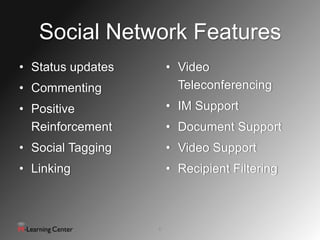
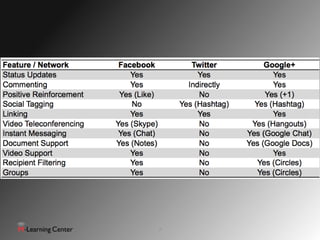
Social Network Features
• Status updates       • Video
• Commenting             Teleconferencing
• Positive             • IM Support
  Reinforcement        • Document Support
• Social Tagging       • Video Support
• Linking              • Recipient Filtering


                   6
7
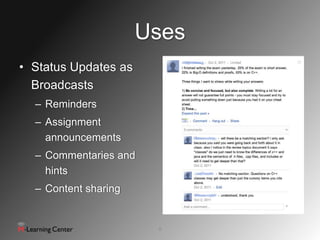
Uses
• Status Updates as
  Broadcasts
  – Reminders
  – Assignment
    announcements
  – Commentaries and
    hints
  – Content sharing


                       8
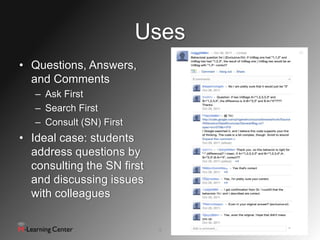
Uses
• Questions, Answers,
  and Comments
   – Ask First
   – Search First
   – Consult (SN) First
• Ideal case: students
  address questions by
  consulting the SN first
  and discussing issues
  with colleagues

                            9
Social Networks and Communication
                  Genres
• Situational Learning          • Several modes of
  • Effective                     communication in SN
    communication occurs          fall within workplace
    within context                scenarios
• Carter et al. – genres
  of software
  engineering
  – Workplace scenarios


                           10
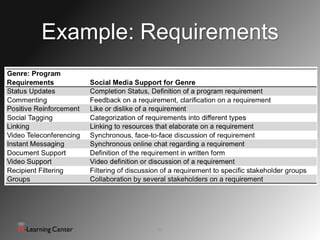
Example: Requirements


          11
Observations
• Students familiar with the technology
• Potential for cheating
• Students adept at writing short, well-
  articulated messages benefitted the most
• Engaged participants derived more utility
  than disengaged


                      12
Recommendations
• If you plan on using social media
  – Establish guidelines for using social media
     • In what ways are the different modes going to be
       used?
  – Define an acceptable use policy
     • What are is allowed and what is not allowed
  – Model desired behavior and usage
     • Be an active participant within the social network

                            13
Future Work
• Formally study engagement and
  achievement
  – Ask, Search, Consult behaviors and
    performance
• Weak ties/Social capital versus
  Engagement when social network is
  integrated into course activities

                       14

A Characterization of Social Networks for Effective Communication and Collaboration in Computing Education

  • 1.
    http://mlearning.muohio.edu/mlc Twitter: @miami_mlearning A Characterization of Social Networks for Effective Communication and Collaboration in Computing Education
  • 2.
    Introduction • Social networks(SN) are extremely popular – Twitter, Facebook, G+ boast millions of users http://ex.pn/LExZsy • Gaining use in the workplace – P&G, Best Buy, Deloitte, Dow Chemical, IBM, SAP, Accenture, Microsoft, IBM, HP, Eli Lilly… 2
  • 3.
    Contributions • Identify commonmodes of communication in social networks • Characterize how these modes can be used in an education setting • Suggest how different genres of communication can be aided by social networks 3
  • 4.
    Social Networks • Inthe workplace • In education – DiMicco et al. indicate – Junco et al. found an that SN used to increase in strengthen “weak ties” engagement when at IBM Twitter used for – Asunda argues SN discussions, etc. improve networking, – Ellison et al. found collaboration, students used SN to information sharing, maintain “bridging” etc. social capital (e.g., strengthening weak 4 ties)
  • 5.
    Our Experience • Goals – Increase engagement between stakeholders of the course • Student/Faculty, Student/Student, Student/Customer – Decrease e-mail usage  Decrease repetition – Support inverted (i.e., flipped) classroom • Google Plus used for this work – Used Twitter and Facebook in the past 5
  • 6.
    Social Network Features •Status updates • Video • Commenting Teleconferencing • Positive • IM Support Reinforcement • Document Support • Social Tagging • Video Support • Linking • Recipient Filtering 6
  • 7.
  • 8.
    Uses • Status Updatesas Broadcasts – Reminders – Assignment announcements – Commentaries and hints – Content sharing 8
  • 9.
    Uses • Questions, Answers, and Comments – Ask First – Search First – Consult (SN) First • Ideal case: students address questions by consulting the SN first and discussing issues with colleagues 9
  • 10.
    Social Networks andCommunication Genres • Situational Learning • Several modes of • Effective communication in SN communication occurs fall within workplace within context scenarios • Carter et al. – genres of software engineering – Workplace scenarios 10
  • 11.
  • 12.
    Observations • Students familiarwith the technology • Potential for cheating • Students adept at writing short, well- articulated messages benefitted the most • Engaged participants derived more utility than disengaged 12
  • 13.
    Recommendations • If youplan on using social media – Establish guidelines for using social media • In what ways are the different modes going to be used? – Define an acceptable use policy • What are is allowed and what is not allowed – Model desired behavior and usage • Be an active participant within the social network 13
  • 14.
    Future Work • Formallystudy engagement and achievement – Ask, Search, Consult behaviors and performance • Weak ties/Social capital versus Engagement when social network is integrated into course activities 14