
Social Media 101: Social
Media Tools for Research

KMb Learning Session
January 11, 2012

Krista Jensen
Knowledge Mobilization Officer
Agenda
1. What is Social Media or Web 2.0?

2. An Overview of Select Tools

3. Developing a Social Media Strategy

4. “Gone Phishing” and Other Dangers

5. Top tips for Using Social Media

6. Resources

7. Q and A

                                        2
Social Media- Some Definitions
•    “A group of Internet based applications that build on the ideological and
     technological foundations of Web 2.0, and that allow the creation and exchange
     of user-generated content”

•    “Includes web-based and mobile technologies used to turn communication into
     interactive dialogue”

•    “Online communications in which individuals shift fluidly and flexibly between
     the role of audience and author. To do this, they use social software that
     enables anyone without knowledge of coding, to post, comment on, share or
     mash up content and to form communities around shared interests.”


Kaplan, A. M., & Haenlein, M. (2010).Users of the world, unite! The challenges and opportunities of social media. Business
Horizons,53(1), 59-68

Social media. (n.d.). In Wikipedia. Retrieved January 10, 2012, from http://en.wikipedia.org/wiki/Social_media

Thornley, J. (2008, April 8). What is “social media?”. Retrieved January 10, 2012 from ProPR blog http://propr.ca/2008/what-is-
social-media/
                                                                                                                              3
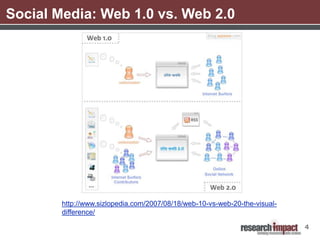
Social Media: Web 1.0 vs. Web 2.0


        http://www.sizlopedia.com/2007/08/18/web-10-vs-web-20-the-visual-
        difference/

                                                                            4
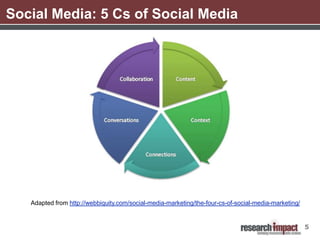
Social Media: 5 Cs of Social Media


   Adapted from http://webbiquity.com/social-media-marketing/the-four-cs-of-social-media-marketing/


                                                                                                      5
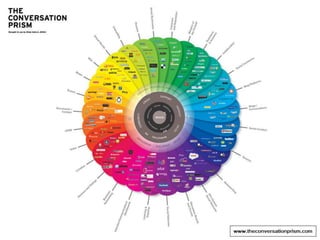
Social Media Landscape


                         6
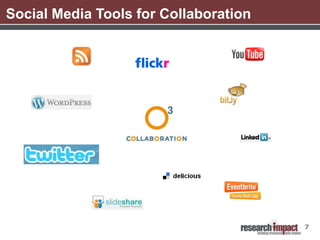
Social Media Tools for Collaboration


                                       7
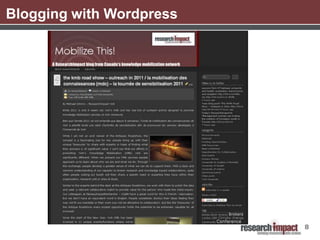
Blogging with Wordpress


                          8
Blogging with Wordpress
Highlights
• Allows you to share stories and information with
  wider audience
• Way to promote your services, events and activities
• Wordpress.com is free, web accessible and easy to
  use

Tips:
• Information you would put into a newsletter can go
  into a blog
• Aim for at least one post a week
                                                        9
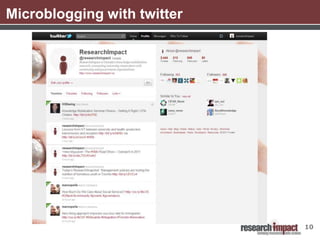
Microblogging with twitter


                             10
Microblogging with twitter
Highlights
• Send out short (140 character) messages called tweets
• Allows you to share updates, opinions, resources and
  information with followers
• Good way to connect with other people with shared interests
  and build communities of practice


Tips:
• Use a URL shorten like http://bit.ly/ to save on characters in
  your tweets and track who clicks on your links
• Back up your tweets regularly with TweetBackup
  http://tweetbackup.com
• Aim for at least one tweet a day
                                                                   11
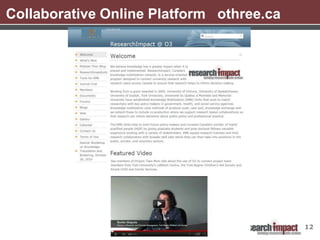
Collaborative Online Platform othree.ca


                                          12
Collaborative Online Platform othree.ca
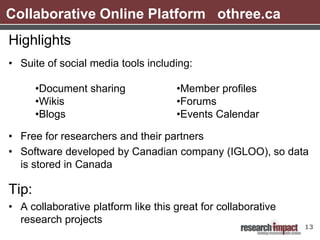
Highlights
• Suite of social media tools including:

       •Document sharing             •Member profiles
       •Wikis                        •Forums
       •Blogs                        •Events Calendar

• Free for researchers and their partners
• Software developed by Canadian company (IGLOO), so data
  is stored in Canada

Tip:
• A collaborative platform like this great for collaborative
  research projects
                                                               13
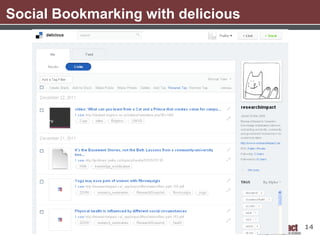
Social Bookmarking with delicious


                                    14
Social Bookmarking with delicious
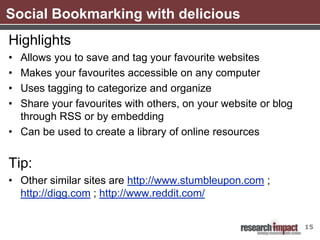
Highlights
• Allows you to save and tag your favourite websites
• Makes your favourites accessible on any computer
• Uses tagging to categorize and organize
• Share your favourites with others, on your website or blog
  through RSS or by embedding
• Can be used to create a library of online resources


Tip:
• Other similar sites are http://www.stumbleupon.com ;
  http://digg.com ; http://www.reddit.com/


                                                               15
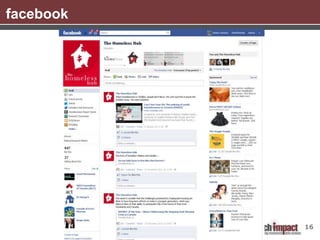
facebook


           16
facebook
Highlights
• A fan page allows you to share updates, links, resources and
  have discussions
• People can follow your updates and activities and post
  questions or comments on your wall
• Includes facebook Insights which gives you some analytics
  so you can see who is visiting your page


Tips:
• Once you have 25 fans you can set up a vanity URL
  www.facebook.com/projectnamehere
• Set up a fan page and post updates there to keep it separate
  from your personal facebook page
                                                             17
Developing a Social Media Strategy

• Develop a social media strategy to help guide you and avoid
  “shiny object” syndrome

• Think about which tools you will use for various purposes, eg.
  Wordpress for blogging, delicious for sharing
  resources, eventbrite to manage events, linkedin to connect
  with professionals

• Don’t feel that you have to use every tool, especially at the
  beginning. Start by picking a few tools that suit your goals and
  use them well


                                                                18
Social Media Strategy Worksheet
•   Team: Identify the person or persons who will have primary responsibility for
    populating, maintaining and monitoring your site. Ensure they have the time and
    enthusiasm to devote to this project. List the team members.

•   Primary Goals: Are you trying to communicate a campaign, generally promote
    your department, communicate with alumni? Define your goal for your social media
    presence.

•   Measuring Success: Determine how you will measure the success, or lack of
    success, of your site. Increased traffic to your Web site? Better communication with
    prospective students? A new network of colleagues? List how you plan to measure
    the site’s success, and the tools you’ll use to track that success.

•   Audiences: Identifying your audiences will help you tailor your content and also
    choose the right tool. List your primary audiences.

•   Current Conversation: This is when the listening begins. Survey the social media
    landscape for the “thought leaders” in your field. What are people already saying?
    What are people saying about you? Who is saying it? List the topics, people and
    sites that are leading the conversations that are relevant to you.

                                                                                       19
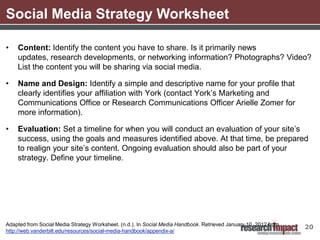
Social Media Strategy Worksheet

•   Content: Identify the content you have to share. Is it primarily news
    updates, research developments, or networking information? Photographs? Video?
    List the content you will be sharing via social media.

•   Name and Design: Identify a simple and descriptive name for your profile that
    clearly identifies your affiliation with York (contact York’s Marketing and
    Communications Office or Research Communications Officer Arielle Zomer for
    more information).

•   Evaluation: Set a timeline for when you will conduct an evaluation of your site’s
    success, using the goals and measures identified above. At that time, be prepared
    to realign your site’s content. Ongoing evaluation should also be part of your
    strategy. Define your timeline.


Adapted from Social Media Strategy Worksheet. (n.d.). In Social Media Handbook. Retrieved January 10, 2012 from
                                                                                                                  20
http://web.vanderbilt.edu/resources/social-media-handbook/appendix-a/
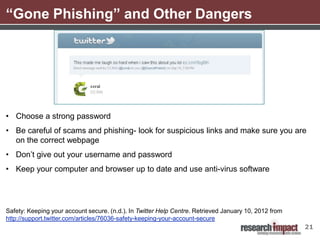
“Gone Phishing” and Other Dangers


• Choose a strong password
• Be careful of scams and phishing- look for suspicious links and make sure you are
  on the correct webpage
• Don’t give out your username and password
• Keep your computer and browser up to date and use anti-virus software


Safety: Keeping your account secure. (n.d.). In Twitter Help Centre. Retrieved January 10, 2012 from
http://support.twitter.com/articles/76036-safety-keeping-your-account-secure
                                                                                                       21
Top tips for Using Social Media

• Develop a social media strategy

• Try to use the same username across various tools and sites
  and develop a common look and feel

• Think about how you are going to measure and evaluate
  success before you start

• Remember that this does take time and resources

• Have fun with it!


                                                            22
Resources
Bit.ly http://bit.ly
    • URL shortener that lets you track who clicked on your links and creates a
      QR code for your shortened link that you can add to print materials

Cambridge Community Television www.slideshare.net/cctvcambridge
  • Good presentations on how to develop a social media strategy

The Conversation Prism www.theconversationprism.com
  • Visual of many social media tools for various purposes

HOW TO: Set up a facebook Page http://mashable.com/2011/05/22/how-to-
  facebook-page/
  • Includes step by step instructions to set up a fan page

NameChk http://namechk.com/
  • Let’s you see if your username is available on social networking sites

                                                                             23
Resources
Online Database of Social Media Policies
    http://socialmediagovernance.com/policies.php
  • Links to over 175 social media policies and guidelines in use by various
    organizations, including many universities

SlideShare www.slideshare.net
   • Post your presentations online and allows you to embed them on your
     website

TweetBackup http://tweetbackup.com
  • Twitter doesn’t archive tweets but you can backup your tweets and export
    them to Excel with this tool

TweetChat http://tweetchat.com/
  • Allows you to have a tweetup, a kind of twitter “conference call”, using
    hashtags. This tool with show only conversations with your chosen
    hashtag
                                                                               24
Resources
TweetStats http://tweetstats.com
  • Show some statistics and analytics on your tweets. Also can create a
    word cloud of all the words you tweet

Twuffer http://twuffer.com/
  • Allows to you schedule in tweets for a later time. Good to use if you are
    going to be away or plan to tweet daily about a resource, eg.
    ResearchSnapshots

Twitter Help Center http://support.twitter.com/
  • Articles to get you started, as well as information about solving common
     problems and how to report a violation

Vanderbilt University Social Media Handbook
    http://web.vanderbilt.edu/resources/social-media-handbook/
  • Very good resources on how to create a social media strategy and how
    to start using various tools
                                                                            25
Resources
YorkU’s Graphic Standards Manual
    http://www.yorku.ca/yorkweb/standards/graphicstandards.htm
  • Follow this to ensure you following York’s visual identity standards and
    are using the York logo correctly

YorkU’s Social Media Guidelines
    http://www.yorku.ca/ycom/socialmedia/SocialMediaGuidelines2010_R5.
    pdf
  • Guidelines for setting up YorkU affiliated social media sites such as
    facebook and twitter

YorkU Web Publishing Services
    http://www.yorku.ca/computing/facultystaff/webpages/publishing.html
    • Can help you set up a Wordpress.org blog


                                                                               26
Questions?


             27
Krista Jensen
 kejensen@yorku.ca

 Website
 http://www.researchimpact.ca
 O3 Space
 http://researchimpact.othree.ca
 Mobilize This! Blog
 http://researchimpact.wordpress.com
 twitter
 http://twitter.com/researchimpact
 delicious
http://delicious.com/researchimpact

Social Media Tools for Research

  • 1.
    Social Media 101:Social Media Tools for Research KMb Learning Session January 11, 2012 Krista Jensen Knowledge Mobilization Officer
  • 2.
    Agenda 1. What isSocial Media or Web 2.0? 2. An Overview of Select Tools 3. Developing a Social Media Strategy 4. “Gone Phishing” and Other Dangers 5. Top tips for Using Social Media 6. Resources 7. Q and A 2
  • 3.
    Social Media- SomeDefinitions • “A group of Internet based applications that build on the ideological and technological foundations of Web 2.0, and that allow the creation and exchange of user-generated content” • “Includes web-based and mobile technologies used to turn communication into interactive dialogue” • “Online communications in which individuals shift fluidly and flexibly between the role of audience and author. To do this, they use social software that enables anyone without knowledge of coding, to post, comment on, share or mash up content and to form communities around shared interests.” Kaplan, A. M., & Haenlein, M. (2010).Users of the world, unite! The challenges and opportunities of social media. Business Horizons,53(1), 59-68 Social media. (n.d.). In Wikipedia. Retrieved January 10, 2012, from http://en.wikipedia.org/wiki/Social_media Thornley, J. (2008, April 8). What is “social media?”. Retrieved January 10, 2012 from ProPR blog http://propr.ca/2008/what-is- social-media/ 3
  • 4.
    Social Media: Web1.0 vs. Web 2.0 http://www.sizlopedia.com/2007/08/18/web-10-vs-web-20-the-visual- difference/ 4
  • 5.
    Social Media: 5Cs of Social Media Adapted from http://webbiquity.com/social-media-marketing/the-four-cs-of-social-media-marketing/ 5
  • 6.
  • 7.
    Social Media Toolsfor Collaboration 7
  • 8.
  • 9.
    Blogging with Wordpress Highlights •Allows you to share stories and information with wider audience • Way to promote your services, events and activities • Wordpress.com is free, web accessible and easy to use Tips: • Information you would put into a newsletter can go into a blog • Aim for at least one post a week 9
  • 10.
  • 11.
    Microblogging with twitter Highlights •Send out short (140 character) messages called tweets • Allows you to share updates, opinions, resources and information with followers • Good way to connect with other people with shared interests and build communities of practice Tips: • Use a URL shorten like http://bit.ly/ to save on characters in your tweets and track who clicks on your links • Back up your tweets regularly with TweetBackup http://tweetbackup.com • Aim for at least one tweet a day 11
  • 12.
  • 13.
    Collaborative Online Platformothree.ca Highlights • Suite of social media tools including: •Document sharing •Member profiles •Wikis •Forums •Blogs •Events Calendar • Free for researchers and their partners • Software developed by Canadian company (IGLOO), so data is stored in Canada Tip: • A collaborative platform like this great for collaborative research projects 13
  • 14.
  • 15.
    Social Bookmarking withdelicious Highlights • Allows you to save and tag your favourite websites • Makes your favourites accessible on any computer • Uses tagging to categorize and organize • Share your favourites with others, on your website or blog through RSS or by embedding • Can be used to create a library of online resources Tip: • Other similar sites are http://www.stumbleupon.com ; http://digg.com ; http://www.reddit.com/ 15
  • 16.
  • 17.
    facebook Highlights • A fanpage allows you to share updates, links, resources and have discussions • People can follow your updates and activities and post questions or comments on your wall • Includes facebook Insights which gives you some analytics so you can see who is visiting your page Tips: • Once you have 25 fans you can set up a vanity URL www.facebook.com/projectnamehere • Set up a fan page and post updates there to keep it separate from your personal facebook page 17
  • 18.
    Developing a SocialMedia Strategy • Develop a social media strategy to help guide you and avoid “shiny object” syndrome • Think about which tools you will use for various purposes, eg. Wordpress for blogging, delicious for sharing resources, eventbrite to manage events, linkedin to connect with professionals • Don’t feel that you have to use every tool, especially at the beginning. Start by picking a few tools that suit your goals and use them well 18
  • 19.
    Social Media StrategyWorksheet • Team: Identify the person or persons who will have primary responsibility for populating, maintaining and monitoring your site. Ensure they have the time and enthusiasm to devote to this project. List the team members. • Primary Goals: Are you trying to communicate a campaign, generally promote your department, communicate with alumni? Define your goal for your social media presence. • Measuring Success: Determine how you will measure the success, or lack of success, of your site. Increased traffic to your Web site? Better communication with prospective students? A new network of colleagues? List how you plan to measure the site’s success, and the tools you’ll use to track that success. • Audiences: Identifying your audiences will help you tailor your content and also choose the right tool. List your primary audiences. • Current Conversation: This is when the listening begins. Survey the social media landscape for the “thought leaders” in your field. What are people already saying? What are people saying about you? Who is saying it? List the topics, people and sites that are leading the conversations that are relevant to you. 19
  • 20.
    Social Media StrategyWorksheet • Content: Identify the content you have to share. Is it primarily news updates, research developments, or networking information? Photographs? Video? List the content you will be sharing via social media. • Name and Design: Identify a simple and descriptive name for your profile that clearly identifies your affiliation with York (contact York’s Marketing and Communications Office or Research Communications Officer Arielle Zomer for more information). • Evaluation: Set a timeline for when you will conduct an evaluation of your site’s success, using the goals and measures identified above. At that time, be prepared to realign your site’s content. Ongoing evaluation should also be part of your strategy. Define your timeline. Adapted from Social Media Strategy Worksheet. (n.d.). In Social Media Handbook. Retrieved January 10, 2012 from 20 http://web.vanderbilt.edu/resources/social-media-handbook/appendix-a/
  • 21.
    “Gone Phishing” andOther Dangers • Choose a strong password • Be careful of scams and phishing- look for suspicious links and make sure you are on the correct webpage • Don’t give out your username and password • Keep your computer and browser up to date and use anti-virus software Safety: Keeping your account secure. (n.d.). In Twitter Help Centre. Retrieved January 10, 2012 from http://support.twitter.com/articles/76036-safety-keeping-your-account-secure 21
  • 22.
    Top tips forUsing Social Media • Develop a social media strategy • Try to use the same username across various tools and sites and develop a common look and feel • Think about how you are going to measure and evaluate success before you start • Remember that this does take time and resources • Have fun with it! 22
  • 23.
    Resources Bit.ly http://bit.ly • URL shortener that lets you track who clicked on your links and creates a QR code for your shortened link that you can add to print materials Cambridge Community Television www.slideshare.net/cctvcambridge • Good presentations on how to develop a social media strategy The Conversation Prism www.theconversationprism.com • Visual of many social media tools for various purposes HOW TO: Set up a facebook Page http://mashable.com/2011/05/22/how-to- facebook-page/ • Includes step by step instructions to set up a fan page NameChk http://namechk.com/ • Let’s you see if your username is available on social networking sites 23
  • 24.
    Resources Online Database ofSocial Media Policies http://socialmediagovernance.com/policies.php • Links to over 175 social media policies and guidelines in use by various organizations, including many universities SlideShare www.slideshare.net • Post your presentations online and allows you to embed them on your website TweetBackup http://tweetbackup.com • Twitter doesn’t archive tweets but you can backup your tweets and export them to Excel with this tool TweetChat http://tweetchat.com/ • Allows you to have a tweetup, a kind of twitter “conference call”, using hashtags. This tool with show only conversations with your chosen hashtag 24
  • 25.
    Resources TweetStats http://tweetstats.com • Show some statistics and analytics on your tweets. Also can create a word cloud of all the words you tweet Twuffer http://twuffer.com/ • Allows to you schedule in tweets for a later time. Good to use if you are going to be away or plan to tweet daily about a resource, eg. ResearchSnapshots Twitter Help Center http://support.twitter.com/ • Articles to get you started, as well as information about solving common problems and how to report a violation Vanderbilt University Social Media Handbook http://web.vanderbilt.edu/resources/social-media-handbook/ • Very good resources on how to create a social media strategy and how to start using various tools 25
  • 26.
    Resources YorkU’s Graphic StandardsManual http://www.yorku.ca/yorkweb/standards/graphicstandards.htm • Follow this to ensure you following York’s visual identity standards and are using the York logo correctly YorkU’s Social Media Guidelines http://www.yorku.ca/ycom/socialmedia/SocialMediaGuidelines2010_R5. pdf • Guidelines for setting up YorkU affiliated social media sites such as facebook and twitter YorkU Web Publishing Services http://www.yorku.ca/computing/facultystaff/webpages/publishing.html • Can help you set up a Wordpress.org blog 26
  • 27.
  • 28.
    Krista Jensen kejensen@yorku.ca Website http://www.researchimpact.ca O3 Space http://researchimpact.othree.ca Mobilize This! Blog http://researchimpact.wordpress.com twitter http://twitter.com/researchimpact delicious http://delicious.com/researchimpact