Seniors and Aging
KM in the AM January, 2018
Getting old isn’t what
it used to be
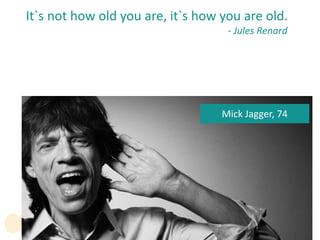
Mick Jagger, 74
It`s not how old you are, it`s how you are old.
- Jules Renard
I may be a senior, but so what? I’m still hot.
- Betty White
Betty White, 96
People are living longer
That’s good news!
• Life expectancy in York
Region is 84.1 years,
compared to 81.5 years
in Ontario and 81.1 years
in Canada.
.
The proportion of women will
remain higher than men but…
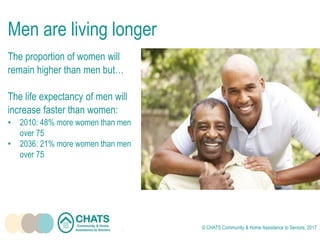
The life expectancy of men will
increase faster than women:
• 2010: 48% more women than men
over 75
• 2036: 21% more women than men
over 75
Men are living longer
© CHATS Community & Home Assistance to Seniors, 2017
The “Senior Tsunami” in York Region
• Population of seniors in YR will almost double by 2031: 1 in 5
over 65 y/o
• YR has a higher % of new permanent resident seniors
representing the fastest growing age group
• In 2016, 18.1% (28,360) of all seniors in York Region did not
speak either official language: 72% arriving between 2010
and 2014
• Seniors make up 12.8% of York Region’s population living in
low income households
• Seniors are more likely to live alone. Of all people living alone
in York Region in 2016, 40.8% or 21,400 were seniors.
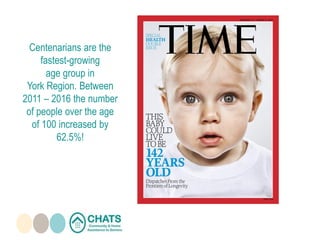
Centenarians are the
fastest-growing
age group in
York Region. Between
2011 – 2016 the number
of people over the age
of 100 increased by
62.5%!
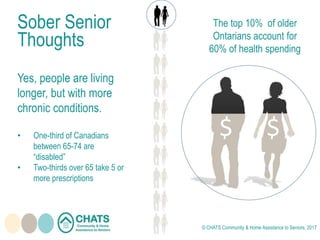
Sober Senior
Thoughts
Yes, people are living
longer, but with more
chronic conditions.
• One-third of Canadians
between 65-74 are
“disabled”
• Two-thirds over 65 take 5 or
more prescriptions
The top 10% of older
Ontarians account for
60% of health spending
$ $
© CHATS Community & Home Assistance to Seniors, 2017
Sober Senior
Thoughts
In 2011, over 500,000
Canadians had dementia
(60% Alzheimer's)
By 2038 that number
Is projected to increase
to 1,100,000
Sober Senior
Thoughts
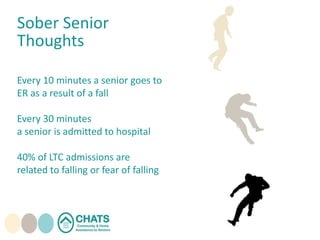
Every 10 minutes a senior goes to
ER as a result of a fall
Every 30 minutes
a senior is admitted to hospital
40% of LTC admissions are
related to falling or fear of falling
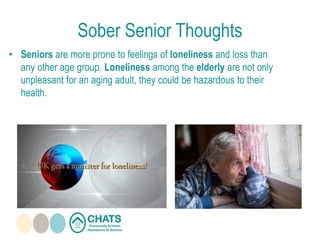
Sober Senior Thoughts
• Seniors are more prone to feelings of loneliness and loss than
any other age group. Loneliness among the elderly are not only
unpleasant for an aging adult, they could be hazardous to their
health.
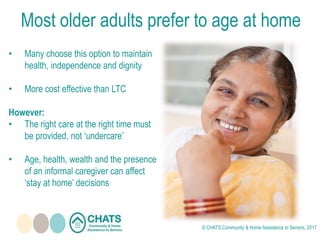
Most older adults prefer to age at home
• Many choose this option to maintain
health, independence and dignity
• More cost effective than LTC
However:
• The right care at the right time must
be provided, not ‘undercare’
• Age, health, wealth and the presence
of an informal caregiver can affect
‘stay at home’ decisions
© CHATS Community & Home Assistance to Seniors, 2017
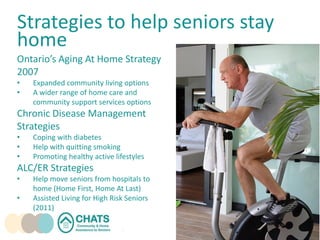
Strategies to help seniors stay
home
Ontario’s Aging At Home Strategy
2007
• Expanded community living options
• A wider range of home care and
community support services options
Chronic Disease Management
Strategies
• Coping with diabetes
• Help with quitting smoking
• Promoting healthy active lifestyles
ALC/ER Strategies
• Help move seniors from hospitals to
home (Home First, Home At Last)
• Assisted Living for High Risk Seniors
(2011)
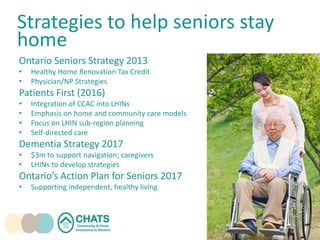
Strategies to help seniors stay
home
Ontario Seniors Strategy 2013
• Healthy Home Renovation Tax Credit
• Physician/NP Strategies
Patients First (2016)
• Integration of CCAC into LHINs
• Emphasis on home and community care models
• Focus on LHIN sub-region planning
• Self-directed care
Dementia Strategy 2017
• $3m to support navigation; caregivers
• LHINs to develop strategies
Ontario’s Action Plan for Seniors 2017
• Supporting independent, healthy living
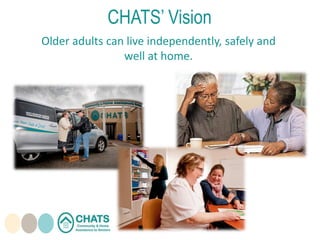
CHATS’ Vision
Older adults can live independently, safely and
well at home.
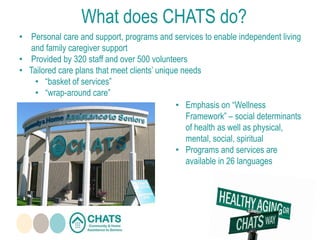
• Personal care and support, programs and services to enable independent living
and family caregiver support
• Provided by 320 staff and over 500 volunteers
• Tailored care plans that meet clients’ unique needs
• “basket of services”
• “wrap-around care”
• Emphasis on “Wellness
Framework” – social determinants
of health as well as physical,
mental, social, spiritual
• Programs and services are
available in 26 languages
What does CHATS do?
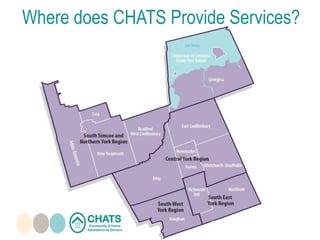
Where does CHATS Provide Services?
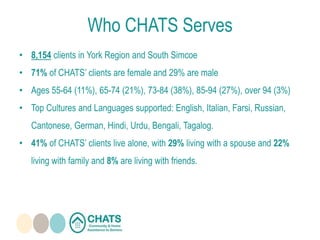
• 8,154 clients in York Region and South Simcoe
• 71% of CHATS’ clients are female and 29% are male
• Ages 55-64 (11%), 65-74 (21%), 73-84 (38%), 85-94 (27%), over 94 (3%)
• Top Cultures and Languages supported: English, Italian, Farsi, Russian,
Cantonese, German, Hindi, Urdu, Bengali, Tagalog.
• 41% of CHATS’ clients live alone, with 29% living with a spouse and 22%
living with family and 8% are living with friends.
Who CHATS Serves
How CHATS Helps
Programs and Services
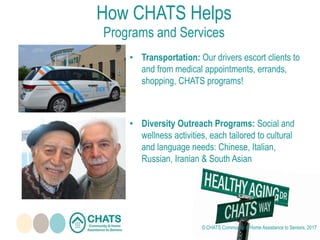
• Transportation: Our drivers escort clients to
and from medical appointments, errands,
shopping, CHATS programs!
• Diversity Outreach Programs: Social and
wellness activities, each tailored to cultural
and language needs: Chinese, Italian,
Russian, Iranian & South Asian
© CHATS Community & Home Assistance to Seniors, 2017
How CHATS Helps
Programs and Services
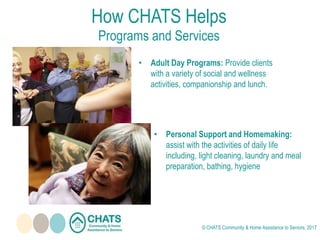
• Adult Day Programs: Provide clients
with a variety of social and wellness
activities, companionship and lunch.
• Personal Support and Homemaking:
assist with the activities of daily life
including, light cleaning, laundry and meal
preparation, bathing, hygiene
© CHATS Community & Home Assistance to Seniors, 2017
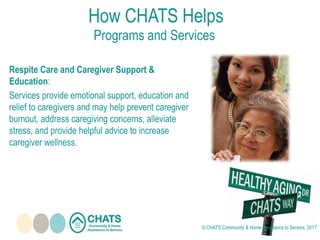
Respite Care and Caregiver Support &
Education:
Services provide emotional support, education and
relief to caregivers and may help prevent caregiver
burnout, address caregiving concerns, alleviate
stress, and provide helpful advice to increase
caregiver wellness.
How CHATS Helps
Programs and Services
© CHATS Community & Home Assistance to Seniors, 2017
What’s Next for CHATS?
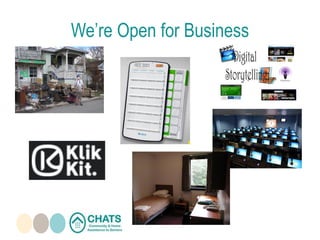
We’re Open for Business
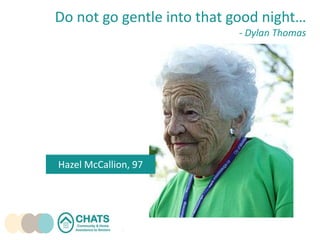
Do not go gentle into that good night…
- Dylan Thomas
Hazel McCallion, 97
For more information,
905-713-6596
1-877-452-4287
www.chats.on.ca

CHATS - Seniors and Aging

  • 1.
    Seniors and Aging KMin the AM January, 2018
  • 2.
    Getting old isn’twhat it used to be
  • 3.
    Mick Jagger, 74 It`snot how old you are, it`s how you are old. - Jules Renard
  • 4.
    I may bea senior, but so what? I’m still hot. - Betty White Betty White, 96
  • 5.
    People are livinglonger That’s good news! • Life expectancy in York Region is 84.1 years, compared to 81.5 years in Ontario and 81.1 years in Canada. .
  • 6.
    The proportion ofwomen will remain higher than men but… The life expectancy of men will increase faster than women: • 2010: 48% more women than men over 75 • 2036: 21% more women than men over 75 Men are living longer © CHATS Community & Home Assistance to Seniors, 2017
  • 7.
    The “Senior Tsunami”in York Region • Population of seniors in YR will almost double by 2031: 1 in 5 over 65 y/o • YR has a higher % of new permanent resident seniors representing the fastest growing age group • In 2016, 18.1% (28,360) of all seniors in York Region did not speak either official language: 72% arriving between 2010 and 2014 • Seniors make up 12.8% of York Region’s population living in low income households • Seniors are more likely to live alone. Of all people living alone in York Region in 2016, 40.8% or 21,400 were seniors.
  • 8.
    Centenarians are the fastest-growing agegroup in York Region. Between 2011 – 2016 the number of people over the age of 100 increased by 62.5%!
  • 9.
    Sober Senior Thoughts Yes, peopleare living longer, but with more chronic conditions. • One-third of Canadians between 65-74 are “disabled” • Two-thirds over 65 take 5 or more prescriptions The top 10% of older Ontarians account for 60% of health spending $ $ © CHATS Community & Home Assistance to Seniors, 2017
  • 10.
    Sober Senior Thoughts In 2011,over 500,000 Canadians had dementia (60% Alzheimer's) By 2038 that number Is projected to increase to 1,100,000
  • 11.
    Sober Senior Thoughts Every 10minutes a senior goes to ER as a result of a fall Every 30 minutes a senior is admitted to hospital 40% of LTC admissions are related to falling or fear of falling
  • 12.
    Sober Senior Thoughts •Seniors are more prone to feelings of loneliness and loss than any other age group. Loneliness among the elderly are not only unpleasant for an aging adult, they could be hazardous to their health.
  • 13.
    Most older adultsprefer to age at home • Many choose this option to maintain health, independence and dignity • More cost effective than LTC However: • The right care at the right time must be provided, not ‘undercare’ • Age, health, wealth and the presence of an informal caregiver can affect ‘stay at home’ decisions © CHATS Community & Home Assistance to Seniors, 2017
  • 14.
    Strategies to helpseniors stay home Ontario’s Aging At Home Strategy 2007 • Expanded community living options • A wider range of home care and community support services options Chronic Disease Management Strategies • Coping with diabetes • Help with quitting smoking • Promoting healthy active lifestyles ALC/ER Strategies • Help move seniors from hospitals to home (Home First, Home At Last) • Assisted Living for High Risk Seniors (2011)
  • 15.
    Strategies to helpseniors stay home Ontario Seniors Strategy 2013 • Healthy Home Renovation Tax Credit • Physician/NP Strategies Patients First (2016) • Integration of CCAC into LHINs • Emphasis on home and community care models • Focus on LHIN sub-region planning • Self-directed care Dementia Strategy 2017 • $3m to support navigation; caregivers • LHINs to develop strategies Ontario’s Action Plan for Seniors 2017 • Supporting independent, healthy living
  • 16.
    CHATS’ Vision Older adultscan live independently, safely and well at home.
  • 17.
    • Personal careand support, programs and services to enable independent living and family caregiver support • Provided by 320 staff and over 500 volunteers • Tailored care plans that meet clients’ unique needs • “basket of services” • “wrap-around care” • Emphasis on “Wellness Framework” – social determinants of health as well as physical, mental, social, spiritual • Programs and services are available in 26 languages What does CHATS do?
  • 18.
    Where does CHATSProvide Services?
  • 19.
    • 8,154 clientsin York Region and South Simcoe • 71% of CHATS’ clients are female and 29% are male • Ages 55-64 (11%), 65-74 (21%), 73-84 (38%), 85-94 (27%), over 94 (3%) • Top Cultures and Languages supported: English, Italian, Farsi, Russian, Cantonese, German, Hindi, Urdu, Bengali, Tagalog. • 41% of CHATS’ clients live alone, with 29% living with a spouse and 22% living with family and 8% are living with friends. Who CHATS Serves
  • 20.
    How CHATS Helps Programsand Services • Transportation: Our drivers escort clients to and from medical appointments, errands, shopping, CHATS programs! • Diversity Outreach Programs: Social and wellness activities, each tailored to cultural and language needs: Chinese, Italian, Russian, Iranian & South Asian © CHATS Community & Home Assistance to Seniors, 2017
  • 21.
    How CHATS Helps Programsand Services • Adult Day Programs: Provide clients with a variety of social and wellness activities, companionship and lunch. • Personal Support and Homemaking: assist with the activities of daily life including, light cleaning, laundry and meal preparation, bathing, hygiene © CHATS Community & Home Assistance to Seniors, 2017
  • 22.
    Respite Care andCaregiver Support & Education: Services provide emotional support, education and relief to caregivers and may help prevent caregiver burnout, address caregiving concerns, alleviate stress, and provide helpful advice to increase caregiver wellness. How CHATS Helps Programs and Services © CHATS Community & Home Assistance to Seniors, 2017
  • 23.
  • 24.
  • 25.
    Do not gogentle into that good night… - Dylan Thomas Hazel McCallion, 97
  • 26.