JoeOlson
DataArchitect
SmartChicagoCollaborative
27Mar2014
joe.olson@cct.org
(All the cool buzzwords in one place!)
Social Media,
Cloud Computing,
Machine Learning,
Open Source, and
Big Data Analytics
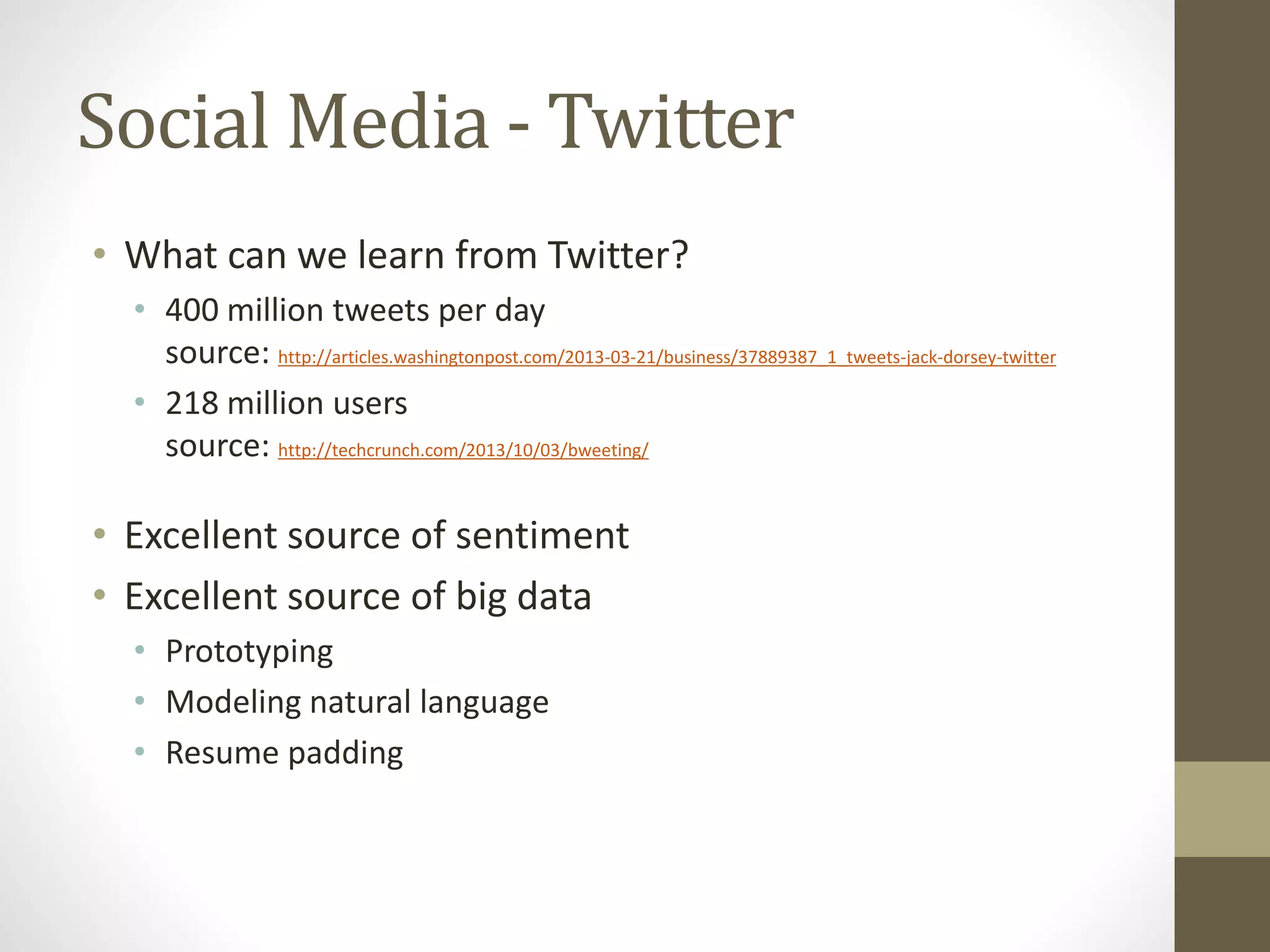
Social Media - Twitter
• What can we learn from Twitter?
• 400 million tweets per day
source: http://articles.washingtonpost.com/2013-03-21/business/37889387_1_tweets-jack-dorsey-twitter
• 218 million users
source: http://techcrunch.com/2013/10/03/bweeting/
• Excellent source of sentiment
• Excellent source of big data
• Prototyping
• Modeling natural language
• Resume padding
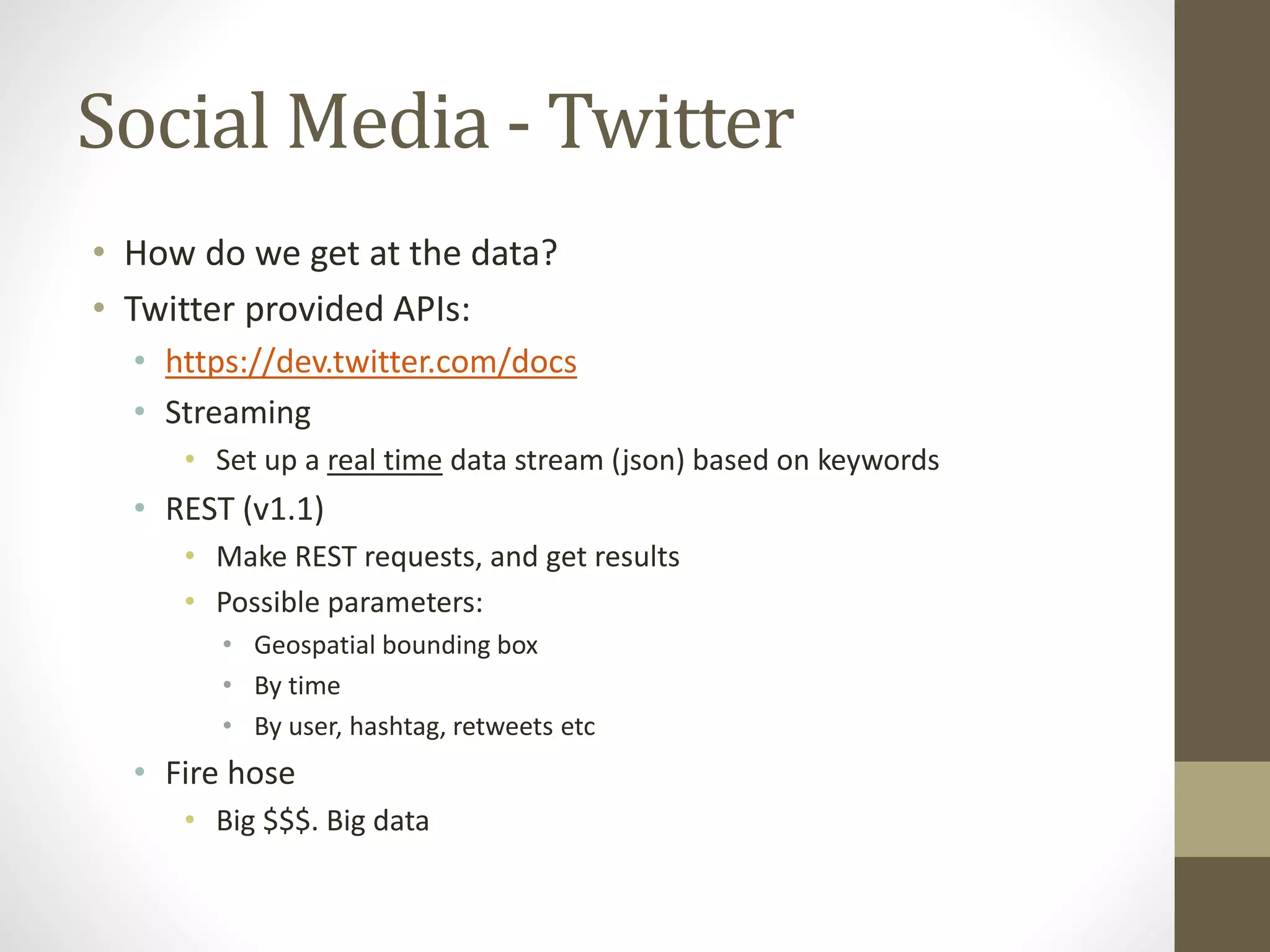
Social Media - Twitter
• How do we get at the data?
• Twitter provided APIs:
• https://dev.twitter.com/docs
• Streaming
• Set up a real time data stream (json) based on keywords
• REST (v1.1)
• Make REST requests, and get results
• Possible parameters:
• Geospatial bounding box
• By time
• By user, hashtag, retweets etc
• Fire hose
• Big $$$. Big data
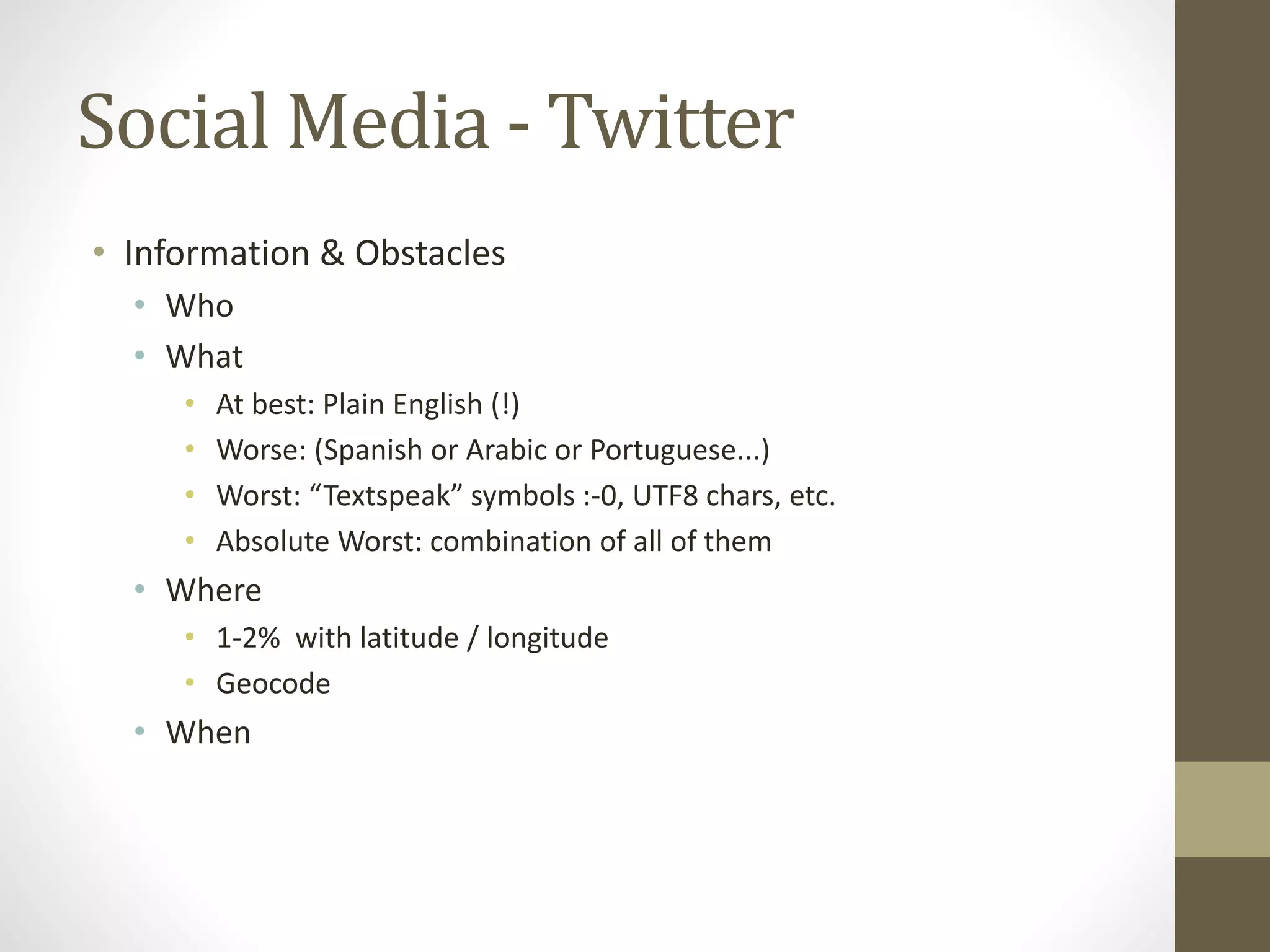
Social Media - Twitter
• Information & Obstacles
• Who
• What
• At best: Plain English (!)
• Worse: (Spanish or Arabic or Portuguese...)
• Worst: “Textspeak” symbols :-0, UTF8 chars, etc.
• Absolute Worst: combination of all of them
• Where
• 1-2% with latitude / longitude
• Geocode
• When
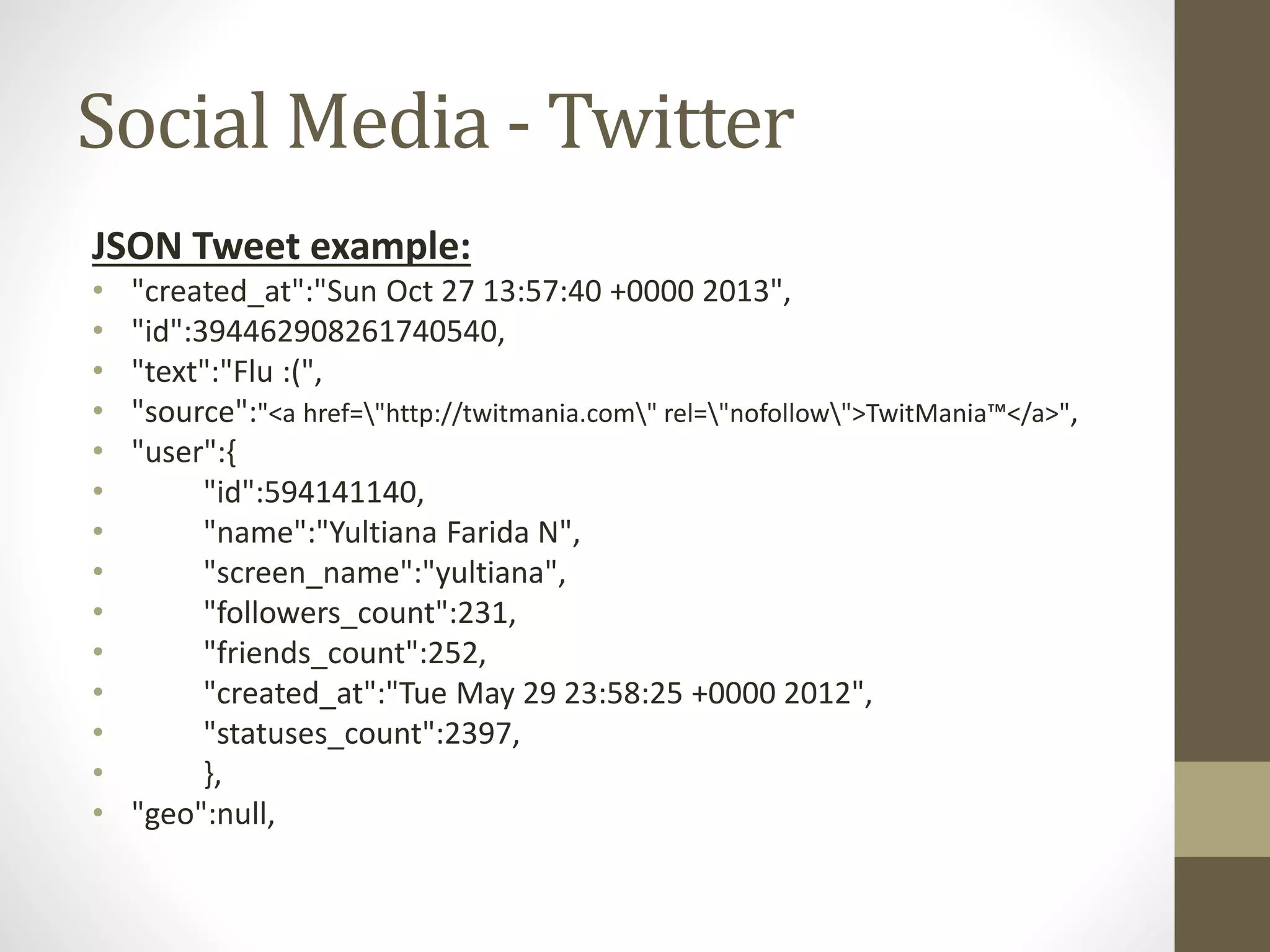
Social Media - Twitter
JSON Tweet example:
• "created_at":"Sun Oct 27 13:57:40 +0000 2013",
• "id":394462908261740540,
• "text":"Flu :(",
• "source":"<a href="http://twitmania.com" rel="nofollow">TwitMania™</a>",
• "user":{
• "id":594141140,
• "name":"Yultiana Farida N",
• "screen_name":"yultiana",
• "followers_count":231,
• "friends_count":252,
• "created_at":"Tue May 29 23:58:25 +0000 2012",
• "statuses_count":2397,
• },
• "geo":null,
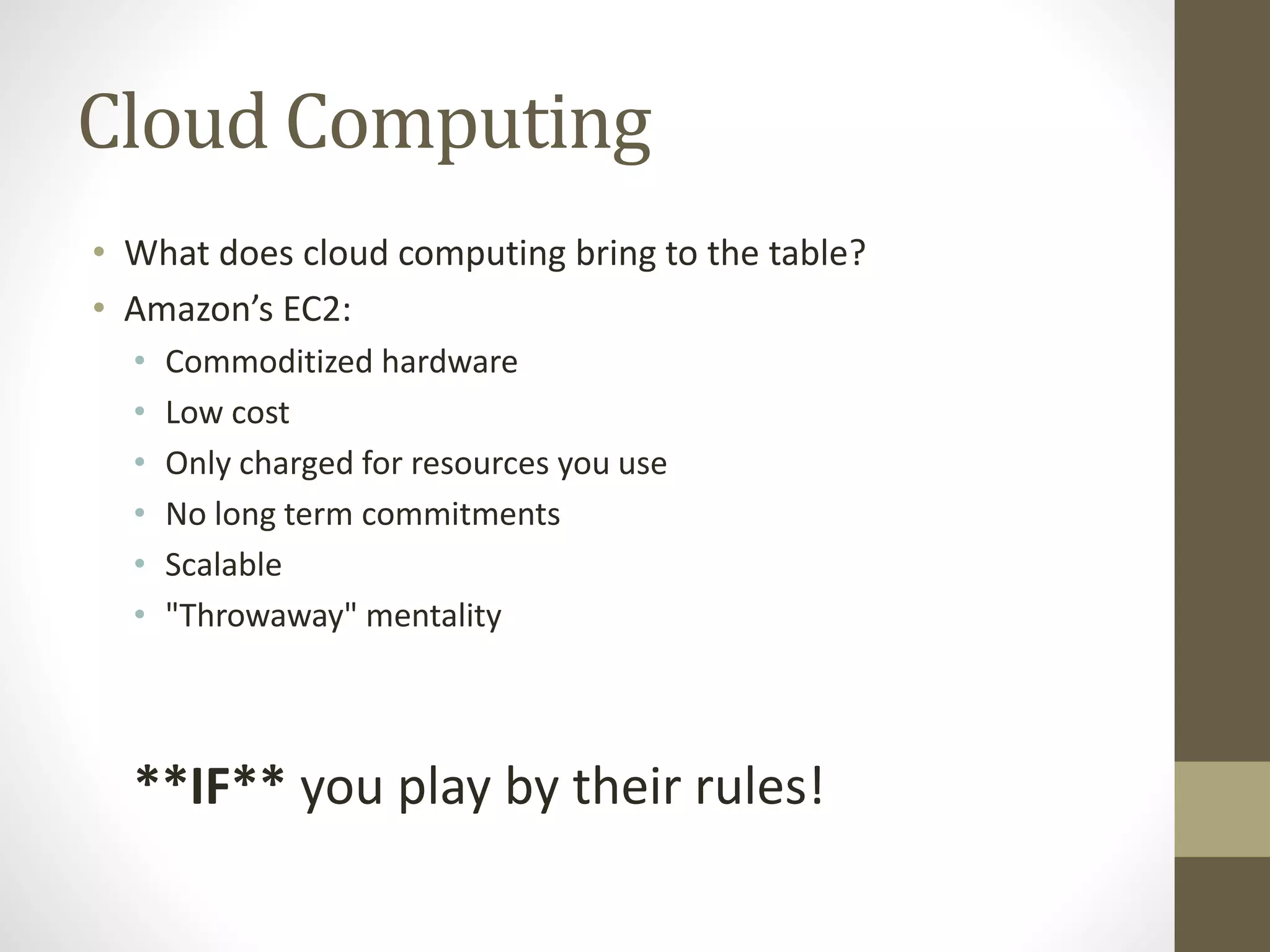
Cloud Computing
• What does cloud computing bring to the table?
• Amazon’s EC2:
• Commoditized hardware
• Low cost
• Only charged for resources you use
• No long term commitments
• Scalable
• "Throwaway" mentality
**IF** you play by their rules!
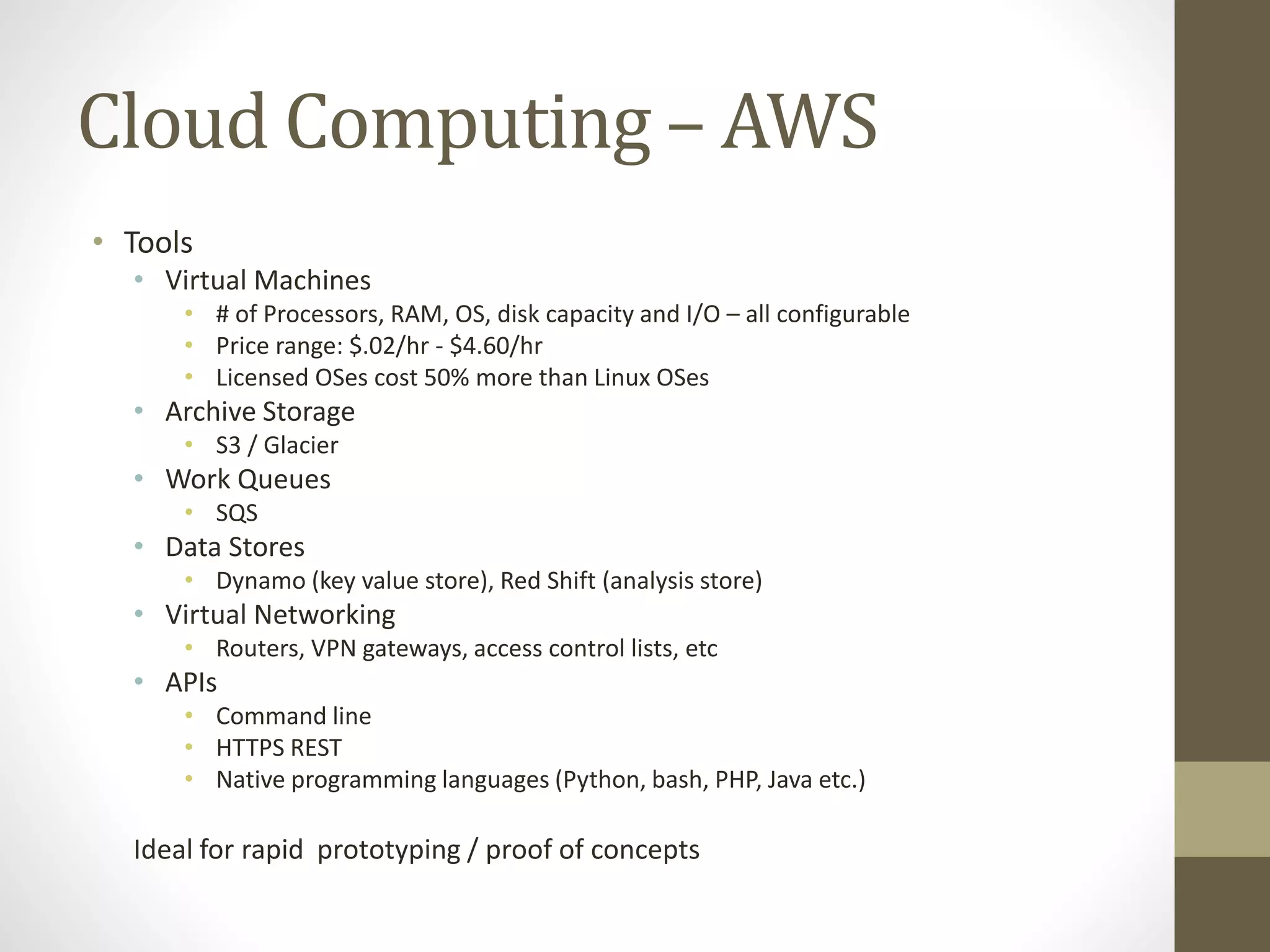
Cloud Computing – AWS
• Tools
• Virtual Machines
• # of Processors, RAM, OS, disk capacity and I/O – all configurable
• Price range: $.02/hr - $4.60/hr
• Licensed OSes cost 50% more than Linux OSes
• Archive Storage
• S3 / Glacier
• Work Queues
• SQS
• Data Stores
• Dynamo (key value store), Red Shift (analysis store)
• Virtual Networking
• Routers, VPN gateways, access control lists, etc
• APIs
• Command line
• HTTPS REST
• Native programming languages (Python, bash, PHP, Java etc.)
Ideal for rapid prototyping / proof of concepts
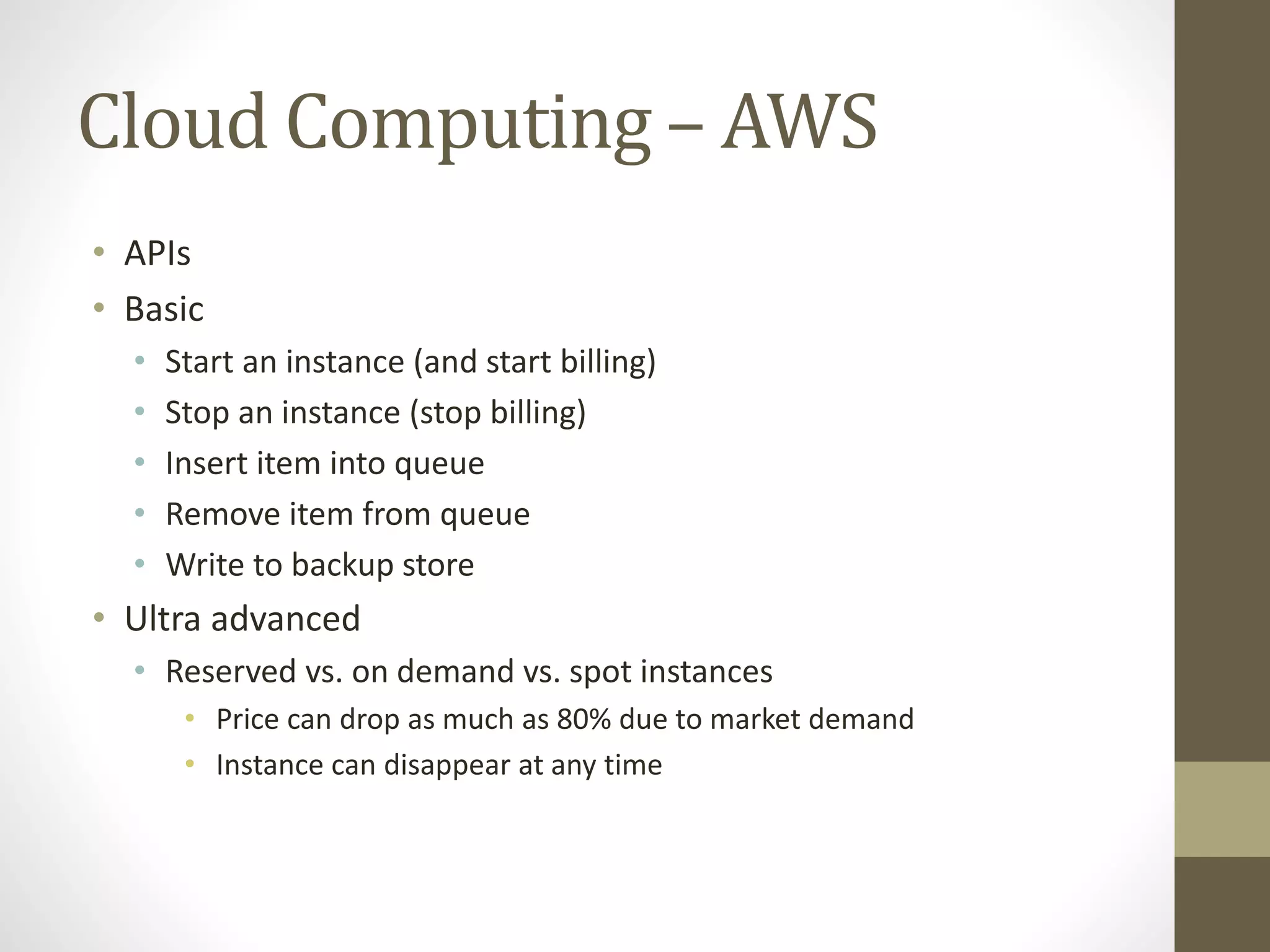
Cloud Computing – AWS
• APIs
• Basic
• Start an instance (and start billing)
• Stop an instance (stop billing)
• Insert item into queue
• Remove item from queue
• Write to backup store
• Ultra advanced
• Reserved vs. on demand vs. spot instances
• Price can drop as much as 80% due to market demand
• Instance can disappear at any time
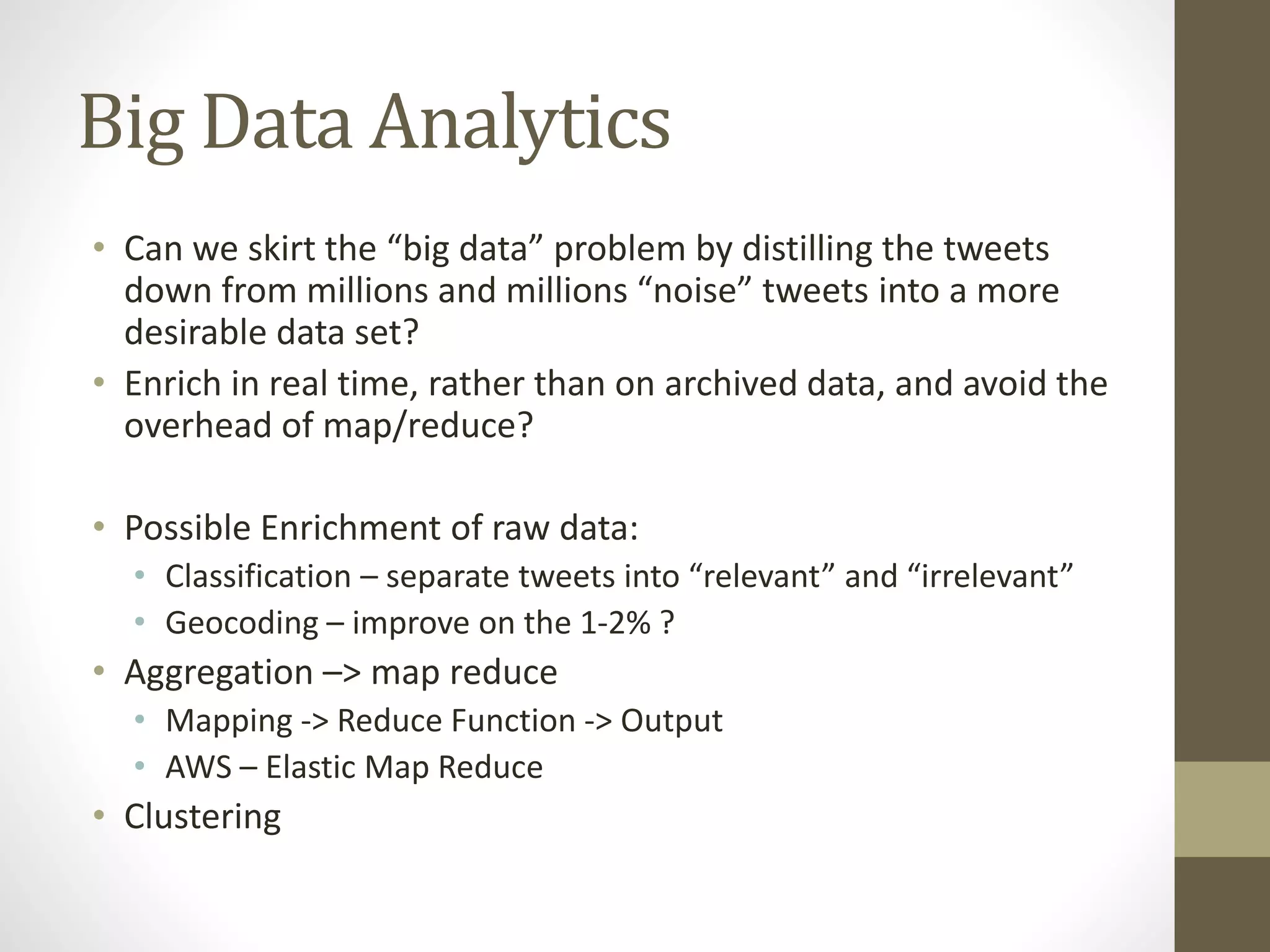
Big Data Analytics
• Can we skirt the “big data” problem by distilling the tweets
down from millions and millions “noise” tweets into a more
desirable data set?
• Enrich in real time, rather than on archived data, and avoid the
overhead of map/reduce?
• Possible Enrichment of raw data:
• Classification – separate tweets into “relevant” and “irrelevant”
• Geocoding – improve on the 1-2% ?
• Aggregation –> map reduce
• Mapping -> Reduce Function -> Output
• AWS – Elastic Map Reduce
• Clustering
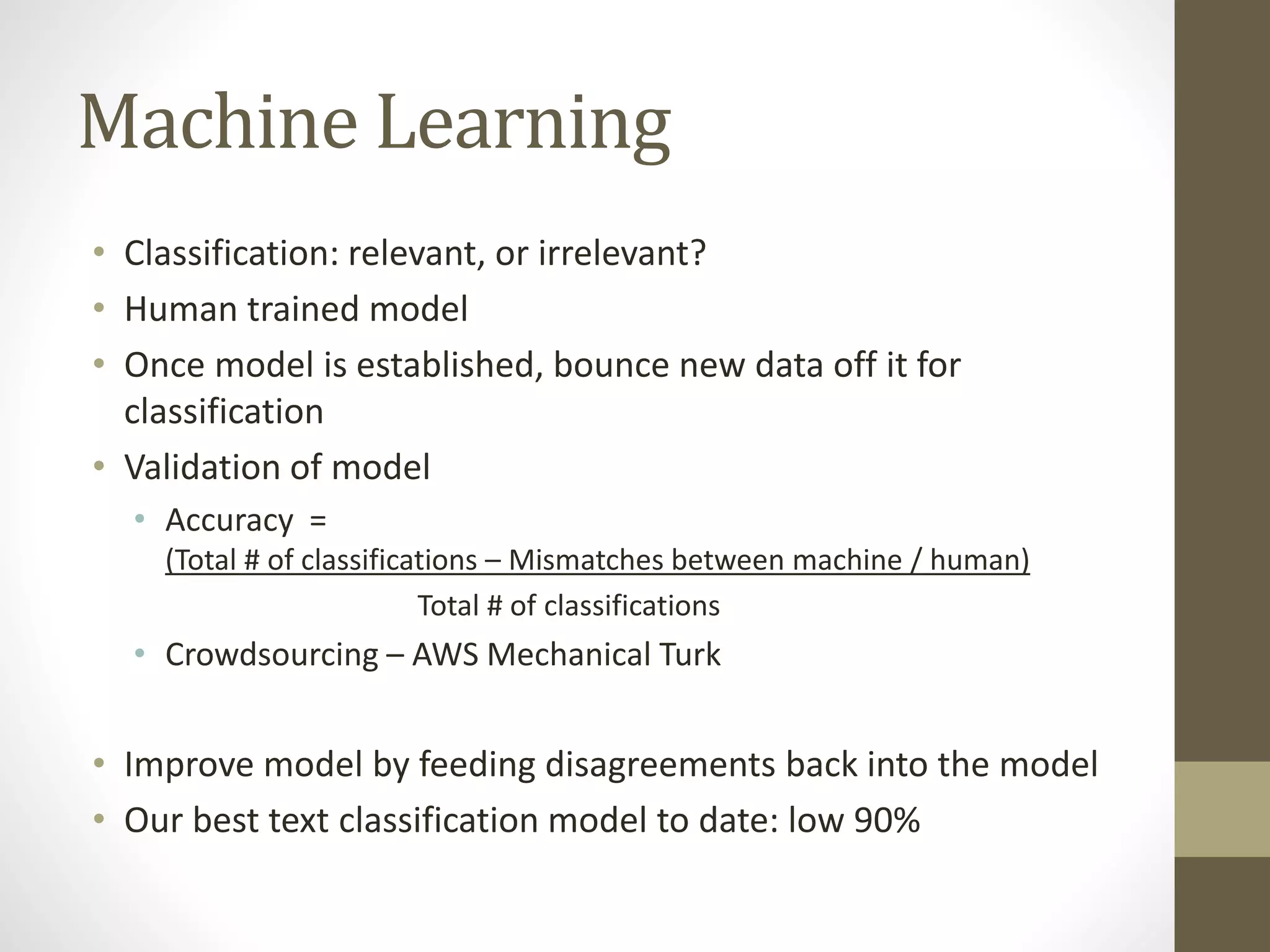
Machine Learning
• Classification: relevant, or irrelevant?
• Human trained model
• Once model is established, bounce new data off it for
classification
• Validation of model
• Accuracy =
(Total # of classifications – Mismatches between machine / human)
Total # of classifications
• Crowdsourcing – AWS Mechanical Turk
• Improve model by feeding disagreements back into the model
• Our best text classification model to date: low 90%
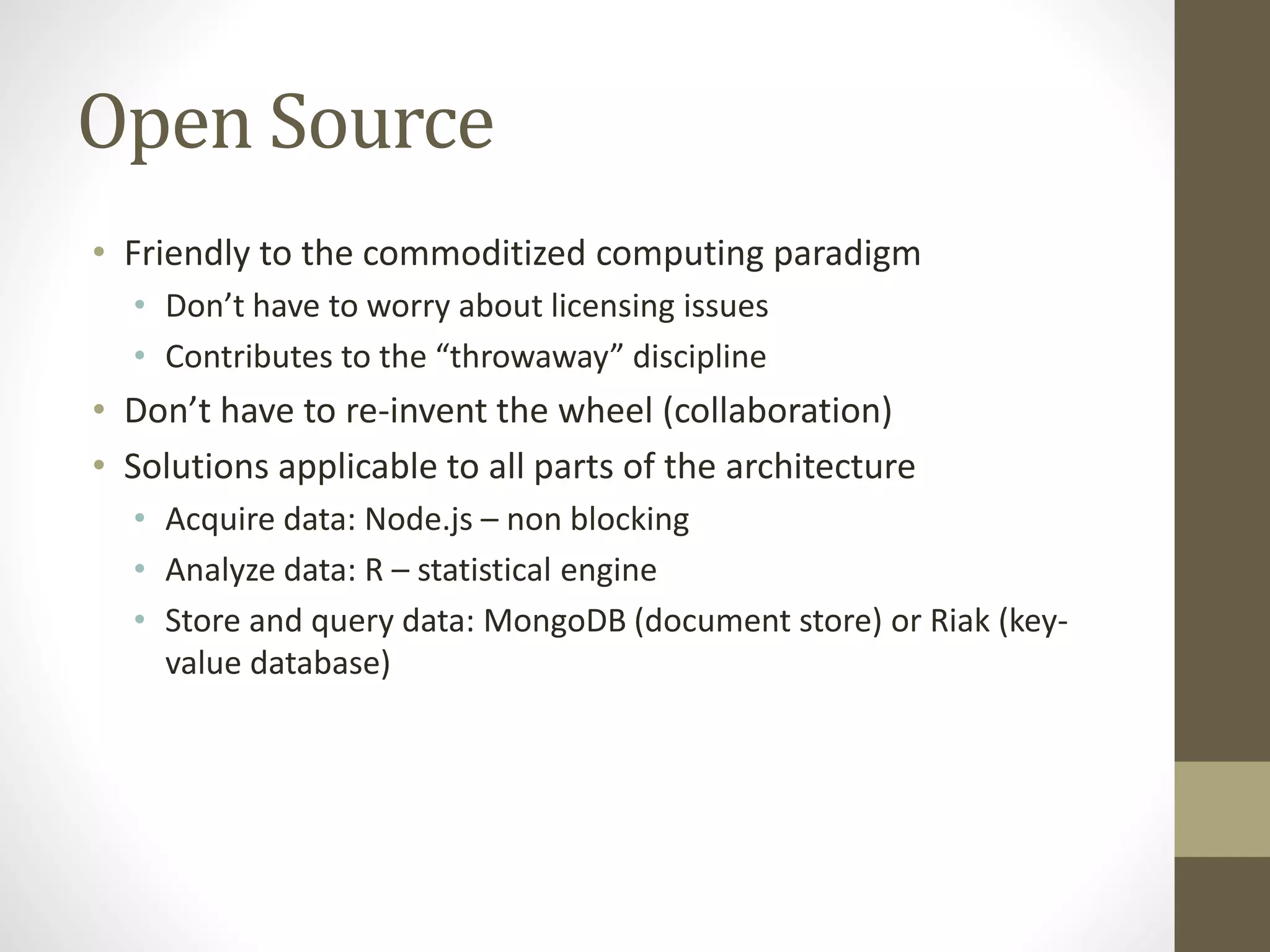
Open Source
• Friendly to the commoditized computing paradigm
• Don’t have to worry about licensing issues
• Contributes to the “throwaway” discipline
• Don’t have to re-invent the wheel (collaboration)
• Solutions applicable to all parts of the architecture
• Acquire data: Node.js – non blocking
• Analyze data: R – statistical engine
• Store and query data: MongoDB (document store) or Riak (key-
value database)
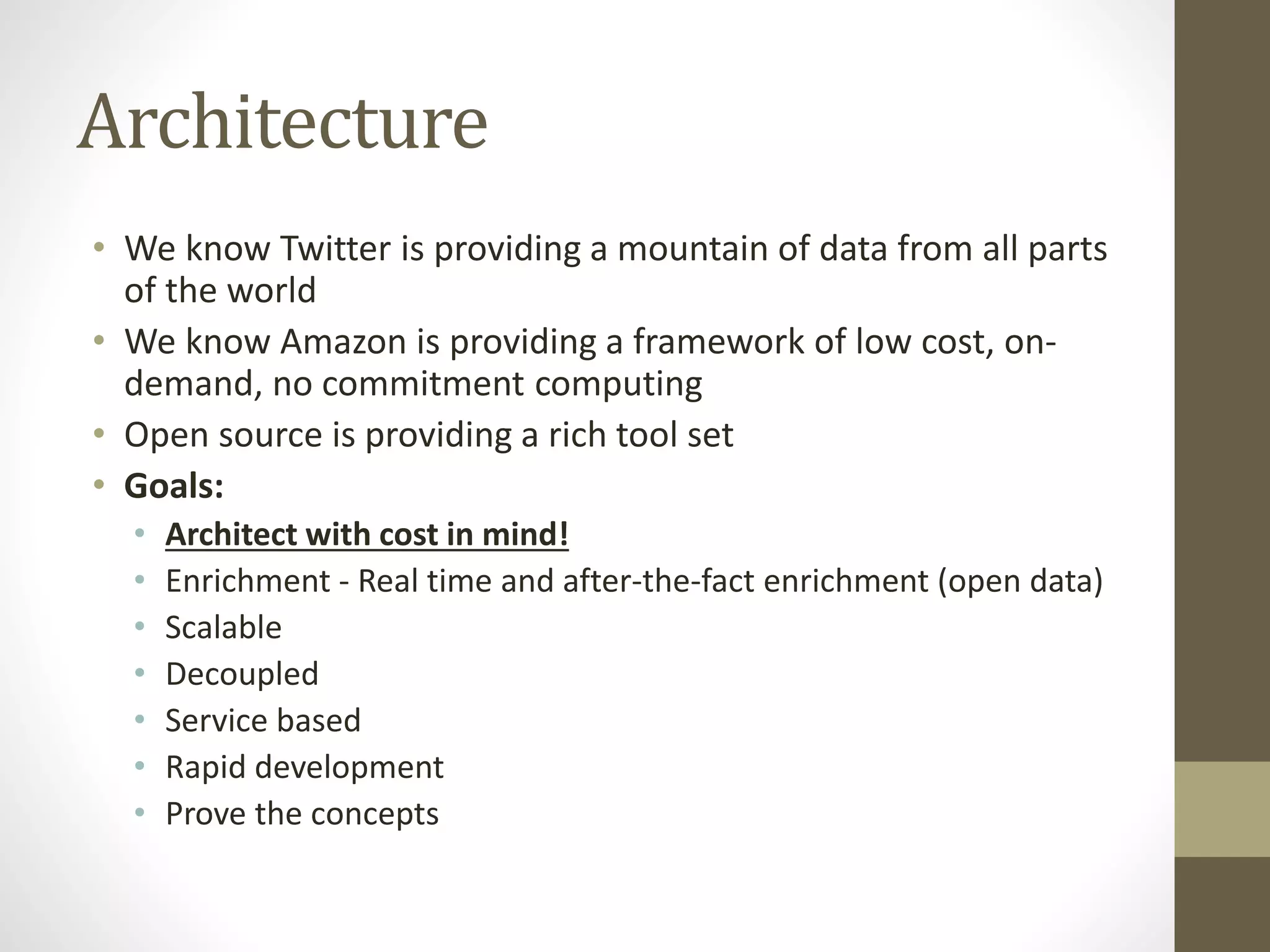
Architecture
• We know Twitter is providing a mountain of data from all parts
of the world
• We know Amazon is providing a framework of low cost, on-
demand, no commitment computing
• Open source is providing a rich tool set
• Goals:
• Architect with cost in mind!
• Enrichment - Real time and after-the-fact enrichment (open data)
• Scalable
• Decoupled
• Service based
• Rapid development
• Prove the concepts
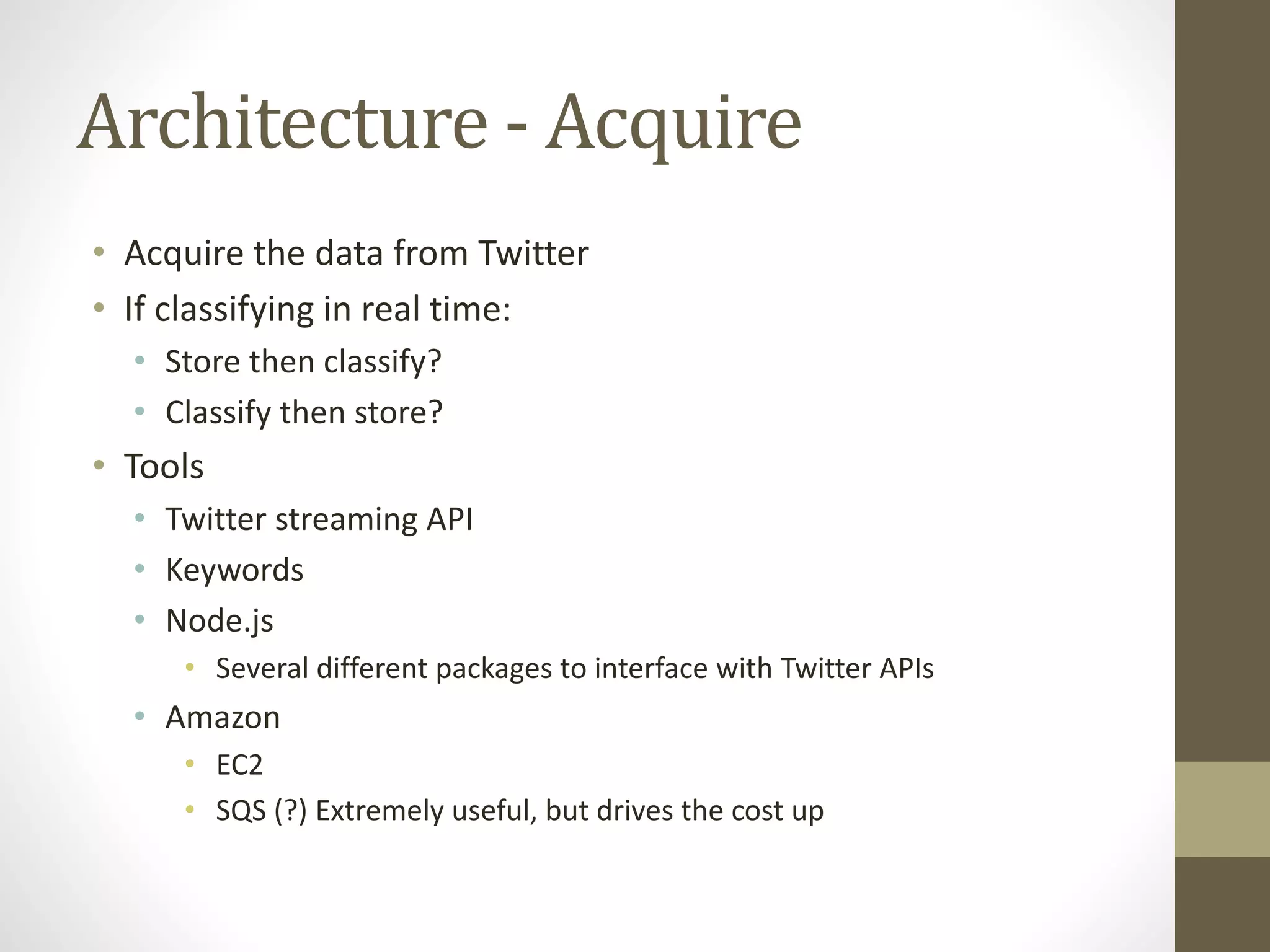
Architecture - Acquire
• Acquire the data from Twitter
• If classifying in real time:
• Store then classify?
• Classify then store?
• Tools
• Twitter streaming API
• Keywords
• Node.js
• Several different packages to interface with Twitter APIs
• Amazon
• EC2
• SQS (?) Extremely useful, but drives the cost up
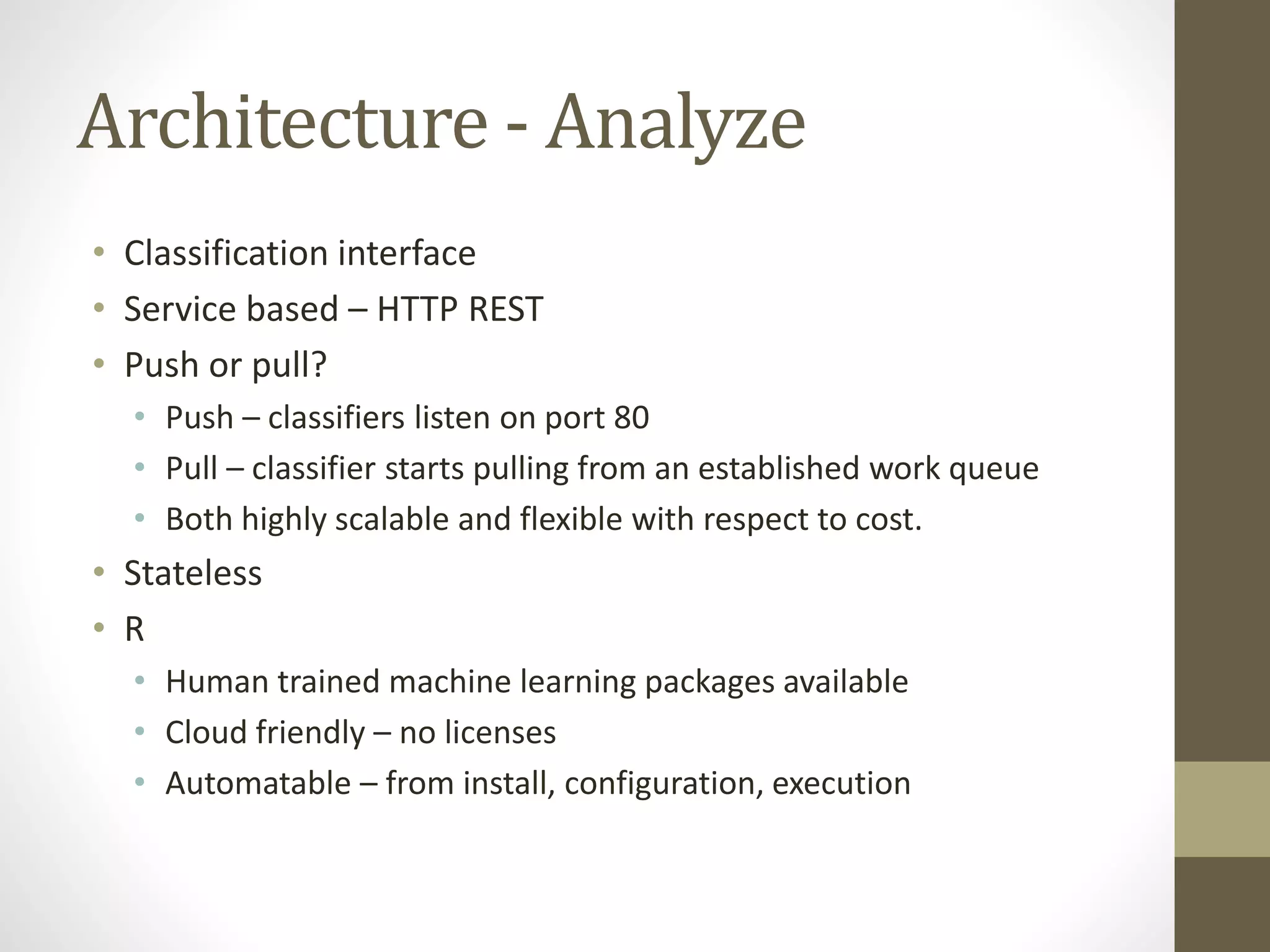
Architecture - Analyze
• Classification interface
• Service based – HTTP REST
• Push or pull?
• Push – classifiers listen on port 80
• Pull – classifier starts pulling from an established work queue
• Both highly scalable and flexible with respect to cost.
• Stateless
• R
• Human trained machine learning packages available
• Cloud friendly – no licenses
• Automatable – from install, configuration, execution
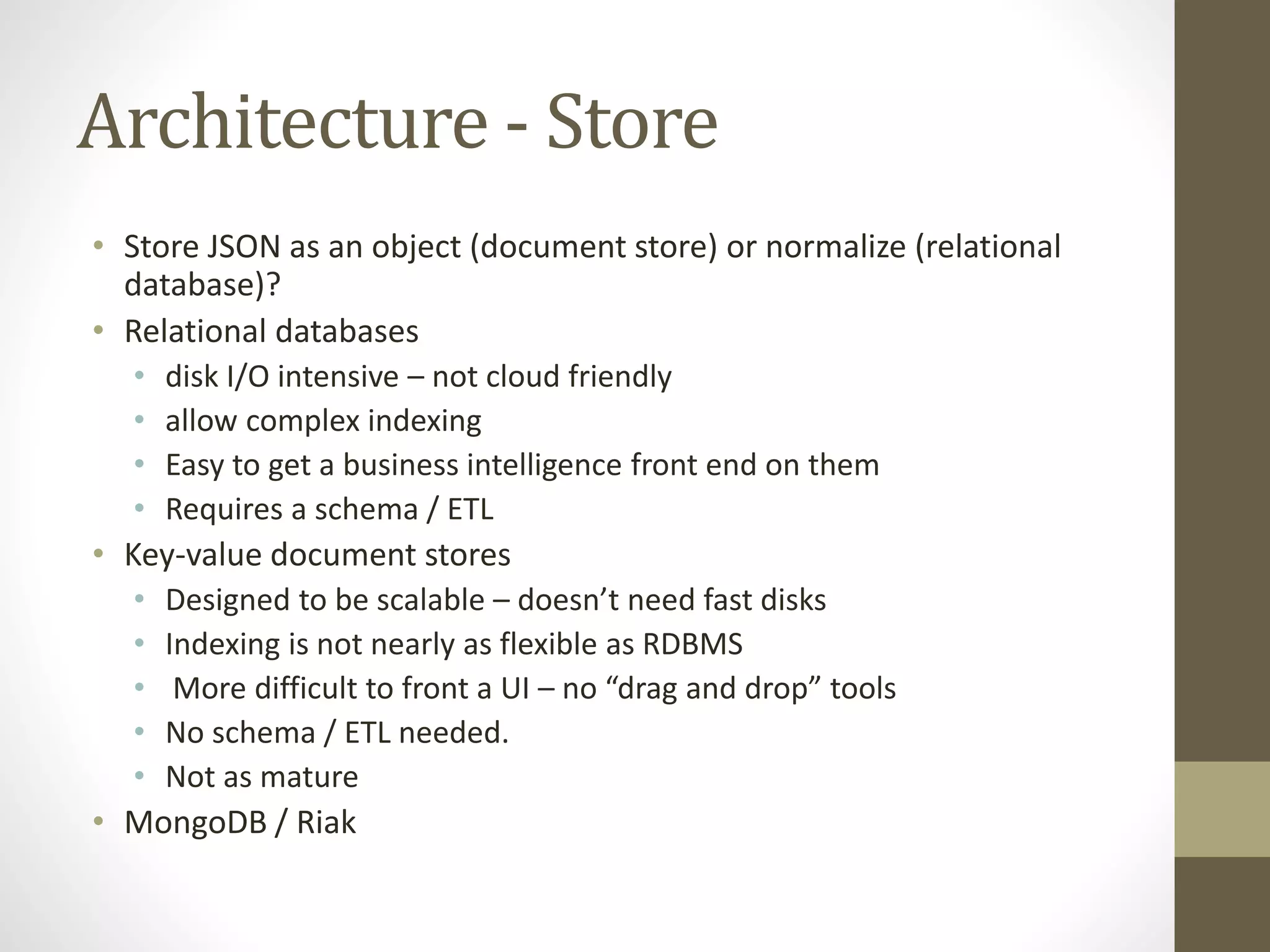
Architecture - Store
• Store JSON as an object (document store) or normalize (relational
database)?
• Relational databases
• disk I/O intensive – not cloud friendly
• allow complex indexing
• Easy to get a business intelligence front end on them
• Requires a schema / ETL
• Key-value document stores
• Designed to be scalable – doesn’t need fast disks
• Indexing is not nearly as flexible as RDBMS
• More difficult to front a UI – no “drag and drop” tools
• No schema / ETL needed.
• Not as mature
• MongoDB / Riak
Architecture – Presentation
• Least need for cloud friendly scalability here?
• Options
• Licensed BI software – Tableau, Endeca, Jaspersoft, Pentaho
• Open source BI software – SpagoBI
• Roll your own - PHP, Ruby, Visual Basic, Javascript, etc
• Connect to an existing system instead?
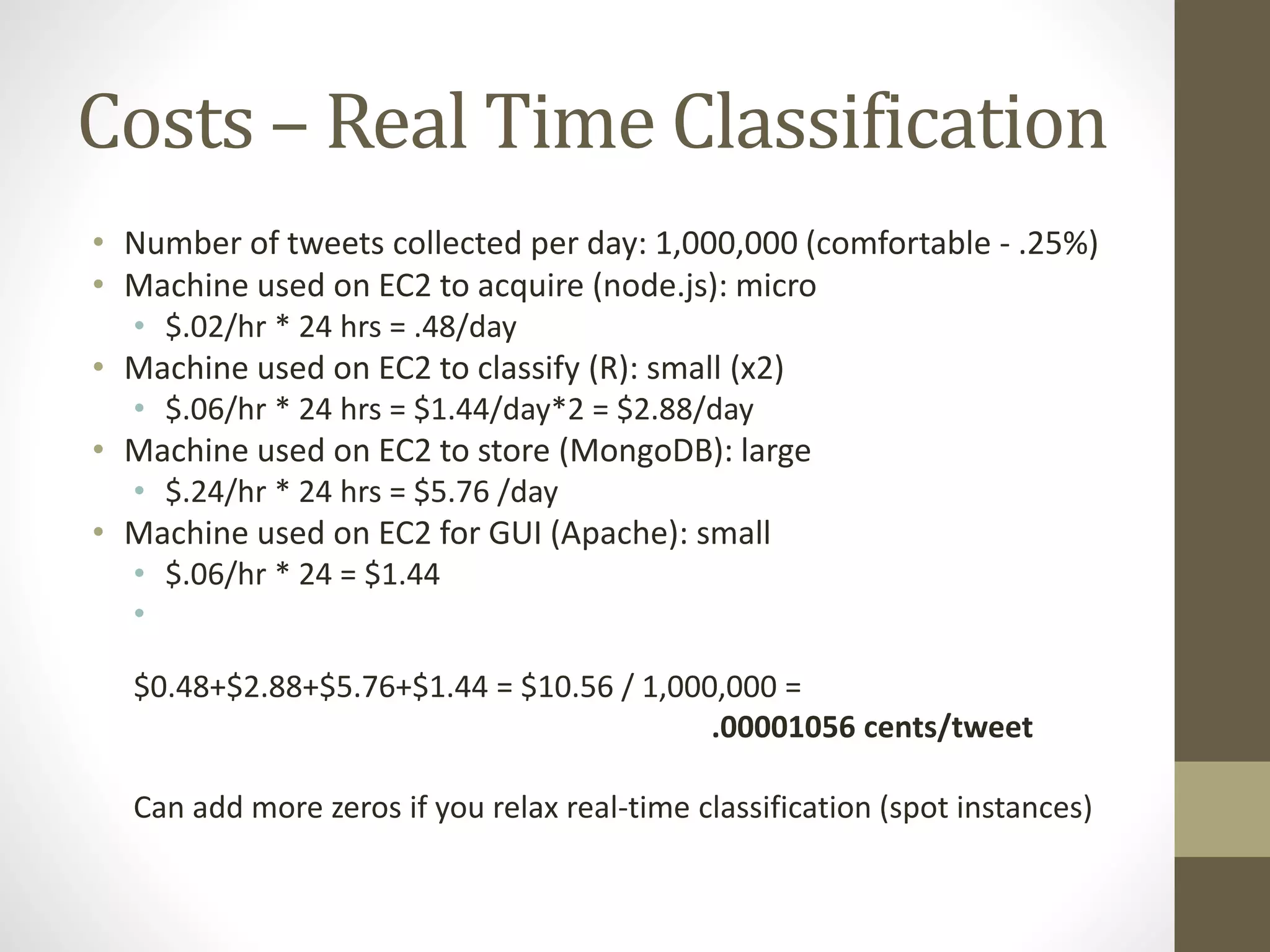
Costs – Real Time Classification
• Number of tweets collected per day: 1,000,000 (comfortable - .25%)
• Machine used on EC2 to acquire (node.js): micro
• $.02/hr * 24 hrs = .48/day
• Machine used on EC2 to classify (R): small (x2)
• $.06/hr * 24 hrs = $1.44/day*2 = $2.88/day
• Machine used on EC2 to store (MongoDB): large
• $.24/hr * 24 hrs = $5.76 /day
• Machine used on EC2 for GUI (Apache): small
• $.06/hr * 24 = $1.44
•
$0.48+$2.88+$5.76+$1.44 = $10.56 / 1,000,000 =
.00001056 cents/tweet
Can add more zeros if you relax real-time classification (spot instances)
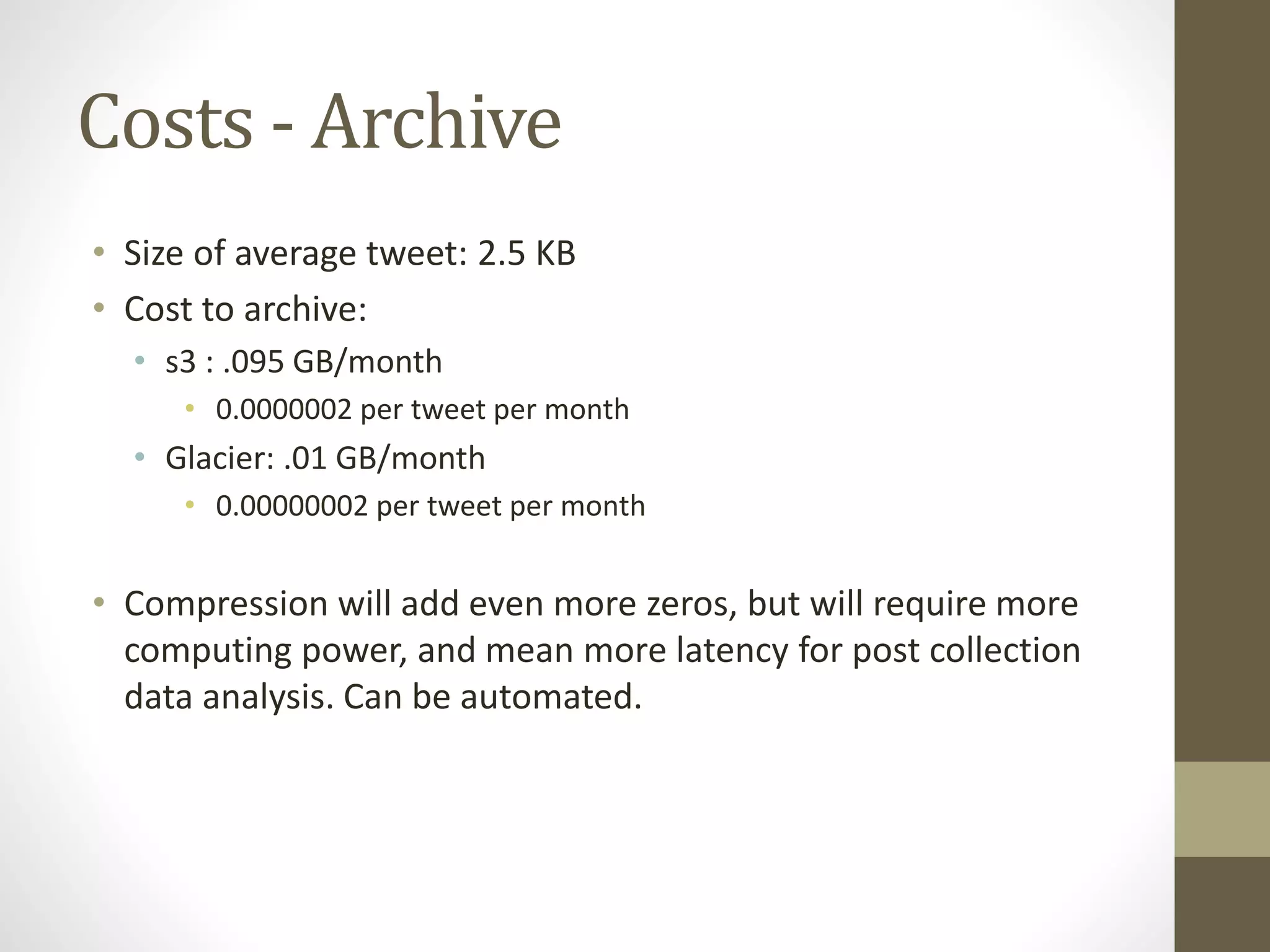
Costs - Archive
• Size of average tweet: 2.5 KB
• Cost to archive:
• s3 : .095 GB/month
• 0.0000002 per tweet per month
• Glacier: .01 GB/month
• 0.00000002 per tweet per month
• Compression will add even more zeros, but will require more
computing power, and mean more latency for post collection
data analysis. Can be automated.
Use Cases
• Foodborne Chicago (http://foodborne.smartchicagoapps.org/)
• Public-private partnership with City of Chicago Dept. of Public Health
and Smart Chicago Collaborative
• Reach out to city residents on Twitter tweeting about food poisoning
symptoms, in an attempt to get them to log information in the City’s
311 database (via the Open311 API)
• Once in the 311 database, it follows established City workflows, and
becomes actionable
• Numbers (1 year):
• 2,390 tweets classified as related to food poisoning
• 282 tweets responded to
• 205 reports submitted
• 145 inspections
• Real time classification examples:
• “Ugh! I got food poisoning from the McDonalds’s on Halstead!”
http://184.73.52.31/cgi-bin/R/fp_classifier?text=Ugh!%20I%20got%20food%20poisoning%20from%20McDonalds%20on%20Halstead
• “U of Chicago releases a new paper on the effects of food poisoning”
http://184.73.52.31/cgi-bin/R/fp_classifier?text=U%20of%20Chicago%20releases%20new%20paper%20on%20the%20effects%20of%20food%20poisoning
• Video:http://www.youtube.com/watch?v=RNf9XQ_25Yw&feature=youtu.be
Use Cases
• Disease Tracker
• Large scale attempt to track disease occurrences in the United
States.
• Sponsored by the Dept. of HHS
• Approximately 1 million tweets a day (cold, flu) classified in real
time
• EC2 scalable instances
• Geolocation
• Cost to run for 6 months: $850
Future Directions
• Turnkey service
• Can all this functionality be abstracted down to a pushbutton
service?
• Open data
• Can you advertise the data collected, how you enriched it, and
allow others to come along an enrich it as well?
• General purpose bridge between Twitter and issue tracking
databases
• Big industry problem
Github Sources
• Tweet Collector
• https://github.com/smartchicago/TweetCollector
• Classifier Code
• https://github.com/corynissen/foodborne_classifier

Social Media, Cloud Computing, Machine Learning, Open Source, and Big Data Analytics (Chicago Summit)

  • 1.
    JoeOlson DataArchitect SmartChicagoCollaborative 27Mar2014 joe.olson@cct.org (All the coolbuzzwords in one place!) Social Media, Cloud Computing, Machine Learning, Open Source, and Big Data Analytics
  • 2.
    Social Media -Twitter • What can we learn from Twitter? • 400 million tweets per day source: http://articles.washingtonpost.com/2013-03-21/business/37889387_1_tweets-jack-dorsey-twitter • 218 million users source: http://techcrunch.com/2013/10/03/bweeting/ • Excellent source of sentiment • Excellent source of big data • Prototyping • Modeling natural language • Resume padding
  • 3.
    Social Media -Twitter • How do we get at the data? • Twitter provided APIs: • https://dev.twitter.com/docs • Streaming • Set up a real time data stream (json) based on keywords • REST (v1.1) • Make REST requests, and get results • Possible parameters: • Geospatial bounding box • By time • By user, hashtag, retweets etc • Fire hose • Big $$$. Big data
  • 4.
    Social Media -Twitter • Information & Obstacles • Who • What • At best: Plain English (!) • Worse: (Spanish or Arabic or Portuguese...) • Worst: “Textspeak” symbols :-0, UTF8 chars, etc. • Absolute Worst: combination of all of them • Where • 1-2% with latitude / longitude • Geocode • When
  • 5.
    Social Media -Twitter JSON Tweet example: • "created_at":"Sun Oct 27 13:57:40 +0000 2013", • "id":394462908261740540, • "text":"Flu :(", • "source":"<a href="http://twitmania.com" rel="nofollow">TwitMania™</a>", • "user":{ • "id":594141140, • "name":"Yultiana Farida N", • "screen_name":"yultiana", • "followers_count":231, • "friends_count":252, • "created_at":"Tue May 29 23:58:25 +0000 2012", • "statuses_count":2397, • }, • "geo":null,
  • 6.
    Cloud Computing • Whatdoes cloud computing bring to the table? • Amazon’s EC2: • Commoditized hardware • Low cost • Only charged for resources you use • No long term commitments • Scalable • "Throwaway" mentality **IF** you play by their rules!
  • 7.
    Cloud Computing –AWS • Tools • Virtual Machines • # of Processors, RAM, OS, disk capacity and I/O – all configurable • Price range: $.02/hr - $4.60/hr • Licensed OSes cost 50% more than Linux OSes • Archive Storage • S3 / Glacier • Work Queues • SQS • Data Stores • Dynamo (key value store), Red Shift (analysis store) • Virtual Networking • Routers, VPN gateways, access control lists, etc • APIs • Command line • HTTPS REST • Native programming languages (Python, bash, PHP, Java etc.) Ideal for rapid prototyping / proof of concepts
  • 8.
    Cloud Computing –AWS • APIs • Basic • Start an instance (and start billing) • Stop an instance (stop billing) • Insert item into queue • Remove item from queue • Write to backup store • Ultra advanced • Reserved vs. on demand vs. spot instances • Price can drop as much as 80% due to market demand • Instance can disappear at any time
  • 9.
    Big Data Analytics •Can we skirt the “big data” problem by distilling the tweets down from millions and millions “noise” tweets into a more desirable data set? • Enrich in real time, rather than on archived data, and avoid the overhead of map/reduce? • Possible Enrichment of raw data: • Classification – separate tweets into “relevant” and “irrelevant” • Geocoding – improve on the 1-2% ? • Aggregation –> map reduce • Mapping -> Reduce Function -> Output • AWS – Elastic Map Reduce • Clustering
  • 10.
    Machine Learning • Classification:relevant, or irrelevant? • Human trained model • Once model is established, bounce new data off it for classification • Validation of model • Accuracy = (Total # of classifications – Mismatches between machine / human) Total # of classifications • Crowdsourcing – AWS Mechanical Turk • Improve model by feeding disagreements back into the model • Our best text classification model to date: low 90%
  • 11.
    Open Source • Friendlyto the commoditized computing paradigm • Don’t have to worry about licensing issues • Contributes to the “throwaway” discipline • Don’t have to re-invent the wheel (collaboration) • Solutions applicable to all parts of the architecture • Acquire data: Node.js – non blocking • Analyze data: R – statistical engine • Store and query data: MongoDB (document store) or Riak (key- value database)
  • 12.
    Architecture • We knowTwitter is providing a mountain of data from all parts of the world • We know Amazon is providing a framework of low cost, on- demand, no commitment computing • Open source is providing a rich tool set • Goals: • Architect with cost in mind! • Enrichment - Real time and after-the-fact enrichment (open data) • Scalable • Decoupled • Service based • Rapid development • Prove the concepts
  • 13.
    Architecture - Acquire •Acquire the data from Twitter • If classifying in real time: • Store then classify? • Classify then store? • Tools • Twitter streaming API • Keywords • Node.js • Several different packages to interface with Twitter APIs • Amazon • EC2 • SQS (?) Extremely useful, but drives the cost up
  • 14.
    Architecture - Analyze •Classification interface • Service based – HTTP REST • Push or pull? • Push – classifiers listen on port 80 • Pull – classifier starts pulling from an established work queue • Both highly scalable and flexible with respect to cost. • Stateless • R • Human trained machine learning packages available • Cloud friendly – no licenses • Automatable – from install, configuration, execution
  • 15.
    Architecture - Store •Store JSON as an object (document store) or normalize (relational database)? • Relational databases • disk I/O intensive – not cloud friendly • allow complex indexing • Easy to get a business intelligence front end on them • Requires a schema / ETL • Key-value document stores • Designed to be scalable – doesn’t need fast disks • Indexing is not nearly as flexible as RDBMS • More difficult to front a UI – no “drag and drop” tools • No schema / ETL needed. • Not as mature • MongoDB / Riak
  • 16.
    Architecture – Presentation •Least need for cloud friendly scalability here? • Options • Licensed BI software – Tableau, Endeca, Jaspersoft, Pentaho • Open source BI software – SpagoBI • Roll your own - PHP, Ruby, Visual Basic, Javascript, etc • Connect to an existing system instead?
  • 17.
    Costs – RealTime Classification • Number of tweets collected per day: 1,000,000 (comfortable - .25%) • Machine used on EC2 to acquire (node.js): micro • $.02/hr * 24 hrs = .48/day • Machine used on EC2 to classify (R): small (x2) • $.06/hr * 24 hrs = $1.44/day*2 = $2.88/day • Machine used on EC2 to store (MongoDB): large • $.24/hr * 24 hrs = $5.76 /day • Machine used on EC2 for GUI (Apache): small • $.06/hr * 24 = $1.44 • $0.48+$2.88+$5.76+$1.44 = $10.56 / 1,000,000 = .00001056 cents/tweet Can add more zeros if you relax real-time classification (spot instances)
  • 18.
    Costs - Archive •Size of average tweet: 2.5 KB • Cost to archive: • s3 : .095 GB/month • 0.0000002 per tweet per month • Glacier: .01 GB/month • 0.00000002 per tweet per month • Compression will add even more zeros, but will require more computing power, and mean more latency for post collection data analysis. Can be automated.
  • 19.
    Use Cases • FoodborneChicago (http://foodborne.smartchicagoapps.org/) • Public-private partnership with City of Chicago Dept. of Public Health and Smart Chicago Collaborative • Reach out to city residents on Twitter tweeting about food poisoning symptoms, in an attempt to get them to log information in the City’s 311 database (via the Open311 API) • Once in the 311 database, it follows established City workflows, and becomes actionable • Numbers (1 year): • 2,390 tweets classified as related to food poisoning • 282 tweets responded to • 205 reports submitted • 145 inspections • Real time classification examples: • “Ugh! I got food poisoning from the McDonalds’s on Halstead!” http://184.73.52.31/cgi-bin/R/fp_classifier?text=Ugh!%20I%20got%20food%20poisoning%20from%20McDonalds%20on%20Halstead • “U of Chicago releases a new paper on the effects of food poisoning” http://184.73.52.31/cgi-bin/R/fp_classifier?text=U%20of%20Chicago%20releases%20new%20paper%20on%20the%20effects%20of%20food%20poisoning • Video:http://www.youtube.com/watch?v=RNf9XQ_25Yw&feature=youtu.be
  • 20.
    Use Cases • DiseaseTracker • Large scale attempt to track disease occurrences in the United States. • Sponsored by the Dept. of HHS • Approximately 1 million tweets a day (cold, flu) classified in real time • EC2 scalable instances • Geolocation • Cost to run for 6 months: $850
  • 21.
    Future Directions • Turnkeyservice • Can all this functionality be abstracted down to a pushbutton service? • Open data • Can you advertise the data collected, how you enriched it, and allow others to come along an enrich it as well? • General purpose bridge between Twitter and issue tracking databases • Big industry problem
  • 22.
    Github Sources • TweetCollector • https://github.com/smartchicago/TweetCollector • Classifier Code • https://github.com/corynissen/foodborne_classifier