Are you having an impact on impact?
Julie Bayley (Coventry University) &
David Phipps (York University, Canada)
@researchimpact
2
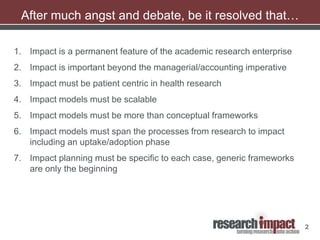
After much angst and debate, be it resolved that…
1. Impact is a permanent feature of the academic research enterprise
2. Impact is important beyond the managerial/accounting imperative
3. Impact must be patient centric in health research
4. Impact models must be scalable
5. Impact models must be more than conceptual frameworks
6. Impact models must span the processes from research to impact
including an uptake/adoption phase
7. Impact planning must be specific to each case, generic frameworks
are only the beginning
3
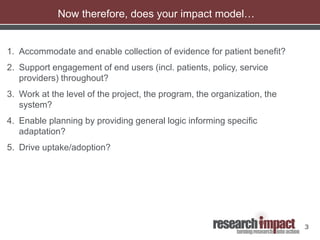
Now therefore, does your impact model…
1. Accommodate and enable collection of evidence for patient benefit?
2. Support engagement of end users (incl. patients, policy, service
providers) throughout?
3. Work at the level of the project, the program, the organization, the
system?
4. Enable planning by providing general logic informing specific
adaptation?
5. Drive uptake/adoption?
4
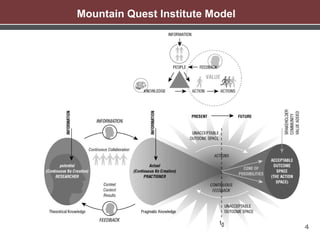
Mountain Quest Institute Model
5
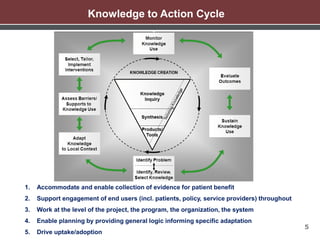
Knowledge to Action Cycle
1. Accommodate and enable collection of evidence for patient benefit
2. Support engagement of end users (incl. patients, policy, service providers) throughout
3. Work at the level of the project, the program, the organization, the system
4. Enable planning by providing general logic informing specific adaptation
5. Drive uptake/adoption
6
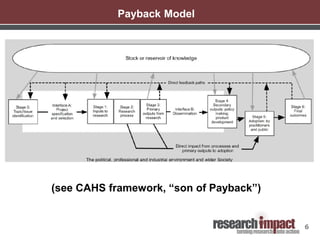
Payback Model
(see CAHS framework, “son of Payback”)
7
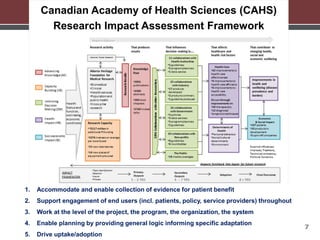
Canadian Academy of Health Sciences (CAHS)
Research Impact Assessment Framework
1. Accommodate and enable collection of evidence for patient benefit
2. Support engagement of end users (incl. patients, policy, service providers) throughout
3. Work at the level of the project, the program, the organization, the system
4. Enable planning by providing general logic informing specific adaptation
5. Drive uptake/adoption
8
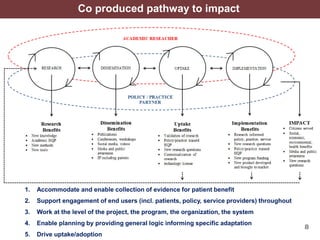
Co produced pathway to impact
1. Accommodate and enable collection of evidence for patient benefit
2. Support engagement of end users (incl. patients, policy, service providers) throughout
3. Work at the level of the project, the program, the organization, the system
4. Enable planning by providing general logic informing specific adaptation
5. Drive uptake/adoption
9
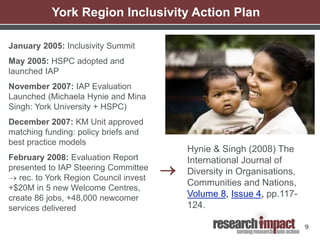
January 2005: Inclusivity Summit
May 2005: HSPC adopted and
launched IAP
November 2007: IAP Evaluation
Launched (Michaela Hynie and Mina
Singh: York University + HSPC)
December 2007: KM Unit approved
matching funding: policy briefs and
best practice models
February 2008: Evaluation Report
presented to IAP Steering Committee
→ rec. to York Region Council invest
+$20M in 5 new Welcome Centres,
create 86 jobs, +48,000 newcomer
services delivered
York Region Inclusivity Action Plan
Hynie & Singh (2008) The
International Journal of
Diversity in Organisations,
Communities and Nations,
Volume 8, Issue 4, pp.117-
124.
→
10
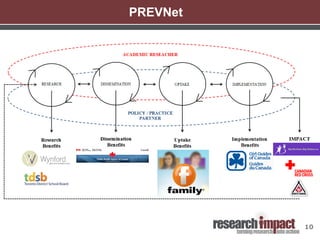
PREVNet
11
1. Accommodate and enable collection of evidence for patient benefit
2. Support engagement of end users (incl. patients, policy, service providers) throughout
3. Work at the level of the project, the program, the organization, the system
4. Enable planning by providing general logic informing specific adaptation
5. Drive uptake/adoption
12
Thank you

NIHR 160427 final

  • 1.
    Are you havingan impact on impact? Julie Bayley (Coventry University) & David Phipps (York University, Canada) @researchimpact
  • 2.
    2 After much angstand debate, be it resolved that… 1. Impact is a permanent feature of the academic research enterprise 2. Impact is important beyond the managerial/accounting imperative 3. Impact must be patient centric in health research 4. Impact models must be scalable 5. Impact models must be more than conceptual frameworks 6. Impact models must span the processes from research to impact including an uptake/adoption phase 7. Impact planning must be specific to each case, generic frameworks are only the beginning
  • 3.
    3 Now therefore, doesyour impact model… 1. Accommodate and enable collection of evidence for patient benefit? 2. Support engagement of end users (incl. patients, policy, service providers) throughout? 3. Work at the level of the project, the program, the organization, the system? 4. Enable planning by providing general logic informing specific adaptation? 5. Drive uptake/adoption?
  • 4.
  • 5.
    5 Knowledge to ActionCycle 1. Accommodate and enable collection of evidence for patient benefit 2. Support engagement of end users (incl. patients, policy, service providers) throughout 3. Work at the level of the project, the program, the organization, the system 4. Enable planning by providing general logic informing specific adaptation 5. Drive uptake/adoption
  • 6.
    6 Payback Model (see CAHSframework, “son of Payback”)
  • 7.
    7 Canadian Academy ofHealth Sciences (CAHS) Research Impact Assessment Framework 1. Accommodate and enable collection of evidence for patient benefit 2. Support engagement of end users (incl. patients, policy, service providers) throughout 3. Work at the level of the project, the program, the organization, the system 4. Enable planning by providing general logic informing specific adaptation 5. Drive uptake/adoption
  • 8.
    8 Co produced pathwayto impact 1. Accommodate and enable collection of evidence for patient benefit 2. Support engagement of end users (incl. patients, policy, service providers) throughout 3. Work at the level of the project, the program, the organization, the system 4. Enable planning by providing general logic informing specific adaptation 5. Drive uptake/adoption
  • 9.
    9 January 2005: InclusivitySummit May 2005: HSPC adopted and launched IAP November 2007: IAP Evaluation Launched (Michaela Hynie and Mina Singh: York University + HSPC) December 2007: KM Unit approved matching funding: policy briefs and best practice models February 2008: Evaluation Report presented to IAP Steering Committee → rec. to York Region Council invest +$20M in 5 new Welcome Centres, create 86 jobs, +48,000 newcomer services delivered York Region Inclusivity Action Plan Hynie & Singh (2008) The International Journal of Diversity in Organisations, Communities and Nations, Volume 8, Issue 4, pp.117- 124. →
  • 10.
  • 11.
    11 1. Accommodate andenable collection of evidence for patient benefit 2. Support engagement of end users (incl. patients, policy, service providers) throughout 3. Work at the level of the project, the program, the organization, the system 4. Enable planning by providing general logic informing specific adaptation 5. Drive uptake/adoption
  • 12.