




8th event of Better Future Better Myanmar 2015 Free Seminar Series
“ONE in ALL”
5th July, 2015 (Sunday), 9:00 AM – 3:30 PM
Mandalay
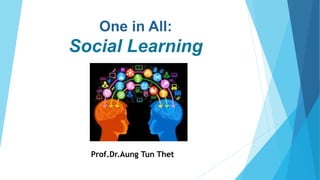
One in All:
Social Learning
Prof.Dr.Aung Tun Thet
Expectations
 We will:
 LEARN
 Let OTHERS Learn
 Always try our BEST
 Show RESPECT with our words and actions
 Be RESPONSIBLE for our words and actions
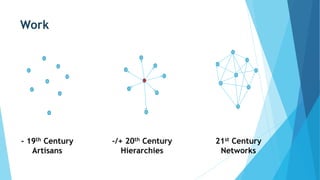
Work
- 19th Century
Artisans
-/+ 20th Century
Hierarchies
21st Century
Networks
Social Learning Revolution
 Value of:
Knowledge sharing
Teamwork
Informal learning
Joint problem solving
 Investing in collaboration technology
 Reaping rewards
Importance of Social Learning
 Connect
 Social exchanges
 Business and technological changes
Importance of Social Learning
 Knowing right people
 Asking right questions
 More important than internally-held
knowledge and skills
Importance of Social Learning
 Social experience adaptive
 Social learning mindset better feedback on
changes
Importance of Social Learning
 Internet fundamentally changed how we
communicate
 From
 Focus on knowledge transfer and
acquisition (Plato)
 To
 Dialogue and guidance (Sons of Socrates)
Importance of Social Learning
 Find information
 Turn into knowledge at point-of-need
 Key competitive advantage
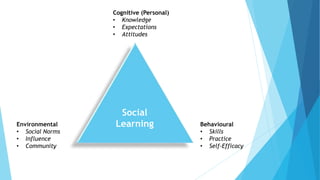
Social
Learning
Cognitive (Personal)
• Knowledge
• Expectations
• Attitudes
Behavioural
• Skills
• Practice
• Self-Efficacy
Environmental
• Social Norms
• Influence
• Community
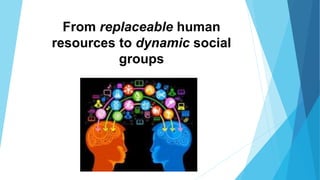
From replaceable human
resources to dynamic social
groups
Preparing people for work
 Taylor
 Only one way to do a job
 Person doing work conform to job
requirements
Individual Training
 Core of Learning and Development
 Jobs constant
 People interchangeable
Modern Organizations
 Change
 Preparing for jobs that don’t even exist
 Stable work environment no longer present
Collective Social Learning approach
 Learning and work as groups
 Group connected (network) more important
than individual node
Knowledge
 Capacity for action
 “Know how”
 Practitioner: accountable for producing
results
Learning
 Remains within - no value to organization
 Acting on knowledge as practitioner (work
performance)
Learning
 Individuals direct own learning
 Organizations focus on results
Individual Learning
 Irrelevant
 Work not done by one person
Social Networks
 Learning spreads
 Conduit for effective organizational
performance
 Blocking or circumventing slows learning
and reduce effectiveness
Social Learning
 Groups work
 Share knowledge
 Cooperating in networks increase adaptive
ability
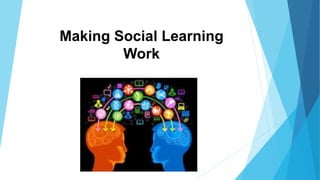
Making Social Learning
Work
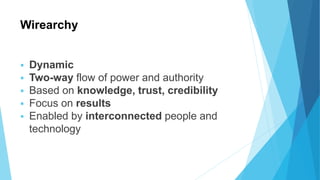
Wirearchy
 Dynamic
 Two-way flow of power and authority
 Based on knowledge, trust, credibility
 Focus on results
 Enabled by interconnected people and
technology
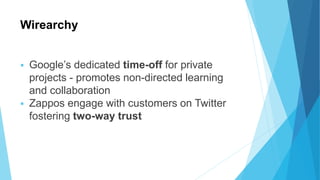
Wirearchy
 Google’s dedicated time-off for private
projects - promotes non-directed learning
and collaboration
 Zappos engage with customers on Twitter
fostering two-way trust
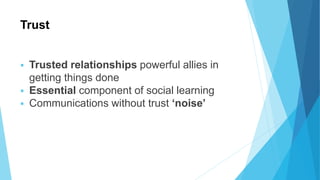
Trust
 Trusted relationships powerful allies in
getting things done
 Essential component of social learning
 Communications without trust ‘noise’
Social Learning
 Think and act at macro level (what to do)
 Leave micro (how to do it) to each worker
or team
 Social media make work easier or more
effective
 Make traditional management obsolete
 “Teach people how to fish or teach them how
to learn to fish themselves”
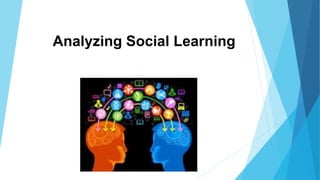
Analyzing Social Learning
Learning
 Two types:
1. Formal learning through training
2. Informal learning - accident or result of
observation, conversation and time in job
 Formal training for skills and knowledge
missed out social nature
Five Types of Organizational Learning
1. Intra-Organizational Learning (IOL) – keeping
organization up to date and up to speed
2. Group Directed Learning (GDL) – working in
teams, projects, study groups, etc.
3. Personal Directed Learning (PDL) –
individuals organizing and managing own
personal or professional learning
Five Types of Organizational Learning
4. Accidental & Serendipitous Learning
(ASL) – individuals learning without
consciously realizing it (incidental or
random learning)
5. Formal Structured Learning (FSL) –
formal education and training - classes,
courses, workshops, etc.
Five Types of Organizational Learning
 Traditional training (FSL) only one of five
types
 Three (IOL, GDL, PDL) require self-
direction - essence of social learning
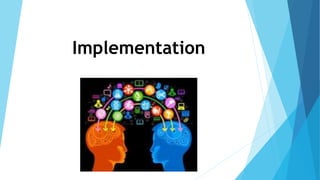
Implementation
Getting Started
 Social learning take place when people:
 Clarify intention – learning rather
than browsing
 Ground learning – defining question or
problem
 Focused conversations
Social Learning
 Knowledge created, internalized and shared
 Listen & Create: open to self-education
 Converse: sharing knowledge
 Co-create: collaborative work, customer
experience
 Formalize & Share: new structured
knowledge
Social Learning
 Learning from social interactions
 Key to innovation
 Official channels competing with informal
communications
Collaborative Enterprise
 Optimal organization for networked
economy
 Collaborate internally
Enterprise Social Learning
 Company blog
 Web-based social learning platform
 Micro-blogging platform similar to Twitter
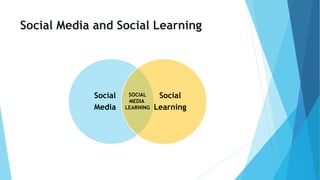
Social Media and Social Learning
Social
Media
Social
Learning
SOCIAL
MEDIA
LEARNING
70:20:10
Framework for High Performance
Development Practices
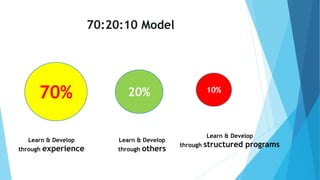
70:20:10 Model
70% 20% 10%
Learn & Develop
through experience
Learn & Develop
through others
Learn & Develop
through structured programs
70:20:10
 Reference model
 Not recipe
 Not rigid formula
70:20:10
 Build capabilities through:
 Experience
 Practice
 Utilising network of support
 Not only through structured training and
development away from workplace
70:20:10
 Easily-understood
 Readily adapted to re-focus development
70:20:10
 Learning outside of formal classes and
courses
 More frequent
 More effective
 Than structured and ‘managed’
counterpart
70:20:10
 Integrate disparate development activities
 Leadership programmes
 Informal coaching and mentoring
 Learning from work through conversations,
communities, sharing, reflective practice
70:20:10
 Coherent framework to strategise
 Workplace
 Social and structured
 Learning activities
People learn their jobs by doing
their jobs
 Effective managers make stretch
assignments
 Coach team members
 Experience the teacher
 Managers shape experiences
People learn their jobs by doing
their jobs
 Learning from experience and
conversation
 Systematic and enlightened management
 Organization working smarter
 Potential great
Coherent Organization
 Co-learning with customers and
stakeholders
 Everyone stay current
 Workers know what another doing
 Aligned to achieve common purpose
 Harmonious companies
Old Days
 Work mechanical
 Workers learned skills and knowledge from
training sessions
 Did what they were told
 Achieving coherence easy
21st Century
 Complex, unpredictable work
 Learn on the fly
 Collaborate with other people
Social Networks
 In-person
 Online
 Democratizing workplace
 Workers in charge of own development
Social Networks
 Have information at fingertips
 Homework in collaboration with friends
 Work in collaboration with colleagues
Social Learning
 To stay ahead and create more value
 Learn
 Faster
 Better
 Smarter!
Thank you!
09 797367944 & 09 797367955
Contact us for more information

BFBM(8-2015) One in all (social learning)

  • 1.
    8th event ofBetter Future Better Myanmar 2015 Free Seminar Series “ONE in ALL” 5th July, 2015 (Sunday), 9:00 AM – 3:30 PM Mandalay
  • 2.
    One in All: SocialLearning Prof.Dr.Aung Tun Thet
  • 3.
    Expectations  We will: LEARN  Let OTHERS Learn  Always try our BEST  Show RESPECT with our words and actions  Be RESPONSIBLE for our words and actions
  • 5.
    Work - 19th Century Artisans -/+20th Century Hierarchies 21st Century Networks
  • 6.
    Social Learning Revolution Value of: Knowledge sharing Teamwork Informal learning Joint problem solving  Investing in collaboration technology  Reaping rewards
  • 7.
    Importance of SocialLearning  Connect  Social exchanges  Business and technological changes
  • 8.
    Importance of SocialLearning  Knowing right people  Asking right questions  More important than internally-held knowledge and skills
  • 9.
    Importance of SocialLearning  Social experience adaptive  Social learning mindset better feedback on changes
  • 10.
    Importance of SocialLearning  Internet fundamentally changed how we communicate  From  Focus on knowledge transfer and acquisition (Plato)  To  Dialogue and guidance (Sons of Socrates)
  • 11.
    Importance of SocialLearning  Find information  Turn into knowledge at point-of-need  Key competitive advantage
  • 12.
    Social Learning Cognitive (Personal) • Knowledge •Expectations • Attitudes Behavioural • Skills • Practice • Self-Efficacy Environmental • Social Norms • Influence • Community
  • 13.
    From replaceable human resourcesto dynamic social groups
  • 15.
    Preparing people forwork  Taylor  Only one way to do a job  Person doing work conform to job requirements
  • 16.
    Individual Training  Coreof Learning and Development  Jobs constant  People interchangeable
  • 17.
    Modern Organizations  Change Preparing for jobs that don’t even exist  Stable work environment no longer present
  • 18.
    Collective Social Learningapproach  Learning and work as groups  Group connected (network) more important than individual node
  • 19.
    Knowledge  Capacity foraction  “Know how”  Practitioner: accountable for producing results
  • 20.
    Learning  Remains within- no value to organization  Acting on knowledge as practitioner (work performance)
  • 21.
    Learning  Individuals directown learning  Organizations focus on results
  • 22.
    Individual Learning  Irrelevant Work not done by one person
  • 23.
    Social Networks  Learningspreads  Conduit for effective organizational performance  Blocking or circumventing slows learning and reduce effectiveness
  • 24.
    Social Learning  Groupswork  Share knowledge  Cooperating in networks increase adaptive ability
  • 25.
  • 27.
    Wirearchy  Dynamic  Two-wayflow of power and authority  Based on knowledge, trust, credibility  Focus on results  Enabled by interconnected people and technology
  • 28.
    Wirearchy  Google’s dedicatedtime-off for private projects - promotes non-directed learning and collaboration  Zappos engage with customers on Twitter fostering two-way trust
  • 29.
    Trust  Trusted relationshipspowerful allies in getting things done  Essential component of social learning  Communications without trust ‘noise’
  • 30.
    Social Learning  Thinkand act at macro level (what to do)  Leave micro (how to do it) to each worker or team  Social media make work easier or more effective  Make traditional management obsolete  “Teach people how to fish or teach them how to learn to fish themselves”
  • 31.
  • 33.
    Learning  Two types: 1.Formal learning through training 2. Informal learning - accident or result of observation, conversation and time in job  Formal training for skills and knowledge missed out social nature
  • 34.
    Five Types ofOrganizational Learning 1. Intra-Organizational Learning (IOL) – keeping organization up to date and up to speed 2. Group Directed Learning (GDL) – working in teams, projects, study groups, etc. 3. Personal Directed Learning (PDL) – individuals organizing and managing own personal or professional learning
  • 35.
    Five Types ofOrganizational Learning 4. Accidental & Serendipitous Learning (ASL) – individuals learning without consciously realizing it (incidental or random learning) 5. Formal Structured Learning (FSL) – formal education and training - classes, courses, workshops, etc.
  • 36.
    Five Types ofOrganizational Learning  Traditional training (FSL) only one of five types  Three (IOL, GDL, PDL) require self- direction - essence of social learning
  • 37.
  • 39.
    Getting Started  Sociallearning take place when people:  Clarify intention – learning rather than browsing  Ground learning – defining question or problem  Focused conversations
  • 40.
    Social Learning  Knowledgecreated, internalized and shared  Listen & Create: open to self-education  Converse: sharing knowledge  Co-create: collaborative work, customer experience  Formalize & Share: new structured knowledge
  • 41.
    Social Learning  Learningfrom social interactions  Key to innovation  Official channels competing with informal communications
  • 42.
    Collaborative Enterprise  Optimalorganization for networked economy  Collaborate internally
  • 43.
    Enterprise Social Learning Company blog  Web-based social learning platform  Micro-blogging platform similar to Twitter
  • 45.
    Social Media andSocial Learning Social Media Social Learning SOCIAL MEDIA LEARNING
  • 46.
    70:20:10 Framework for HighPerformance Development Practices
  • 48.
    70:20:10 Model 70% 20%10% Learn & Develop through experience Learn & Develop through others Learn & Develop through structured programs
  • 49.
    70:20:10  Reference model Not recipe  Not rigid formula
  • 50.
    70:20:10  Build capabilitiesthrough:  Experience  Practice  Utilising network of support  Not only through structured training and development away from workplace
  • 51.
    70:20:10  Easily-understood  Readilyadapted to re-focus development
  • 52.
    70:20:10  Learning outsideof formal classes and courses  More frequent  More effective  Than structured and ‘managed’ counterpart
  • 53.
    70:20:10  Integrate disparatedevelopment activities  Leadership programmes  Informal coaching and mentoring  Learning from work through conversations, communities, sharing, reflective practice
  • 54.
    70:20:10  Coherent frameworkto strategise  Workplace  Social and structured  Learning activities
  • 55.
    People learn theirjobs by doing their jobs  Effective managers make stretch assignments  Coach team members  Experience the teacher  Managers shape experiences
  • 56.
    People learn theirjobs by doing their jobs  Learning from experience and conversation  Systematic and enlightened management  Organization working smarter  Potential great
  • 57.
    Coherent Organization  Co-learningwith customers and stakeholders  Everyone stay current  Workers know what another doing  Aligned to achieve common purpose  Harmonious companies
  • 58.
    Old Days  Workmechanical  Workers learned skills and knowledge from training sessions  Did what they were told  Achieving coherence easy
  • 59.
    21st Century  Complex,unpredictable work  Learn on the fly  Collaborate with other people
  • 60.
    Social Networks  In-person Online  Democratizing workplace  Workers in charge of own development
  • 61.
    Social Networks  Haveinformation at fingertips  Homework in collaboration with friends  Work in collaboration with colleagues
  • 62.
    Social Learning  Tostay ahead and create more value  Learn  Faster  Better  Smarter!
  • 65.
    Thank you! 09 797367944& 09 797367955 Contact us for more information