SOCIAL
GROUPS
Prepared by : Ms. Leena Ghag.
Nursing Tutor
INTRODUCTION
• An individual cannot live alone as he is a social animal.
• His activities starts as a participating member of group such as family.
• Individual meets several people and share common ideas and feelings
which means man lives in social groups.
• Groups helps individual in shaping personality.
• Social groups consists of two or more people who interact with one
another and who recognize themselves as a distinct social unit. The
interaction within the social group causes them to identify with one
another.
• Groups carry out many activities which are necessary in a society.
DEFINITION
According to Horton and Hunt, “Groups are aggregates or categories
of people who have consciousness of membership and of interaction.”
According to Ogburn and Nimkoff, “Whenever two Or more individuals
came together and influence one another, they may be said to
constitute social group.”
GROUP STRUCTURE
• The term group may apply to social units varying in size from two
persons to a large organizations or major political party.
• These may be essential subcultures or categories, which describe the
members of a society or may involve close face to face interaction
directed at common goal.
1. Status
• Status within the group,
which determine the rank
or hierarchical position
which an individual occupy
in the group.
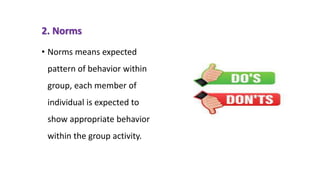
2. Norms
• Norms means expected
pattern of behavior within
group, each member of
individual is expected to
show appropriate behavior
within the group activity.
3. Role
• The people have status in
the group, on the basis of
this, they perform the
activities.
• 4. Communication
• Communication is the
basis of interaction.
• People communicate with
each other in group using
different communication
pattern.
5. Interaction within group
• The group structure may be
change itself as a result of the
events occupying in interaction.
• Past interactions have an effect
upon future interactions and this
process will change in structure.
6. Physical arrangement
• The way people are arranged or arrange themselves indicate
something about their relationship.
• E.g., mother-daughter relation.
7. Reciprocal relations
• The individuals in a group are inter related to each other. The
reciprocal relation form an essential features of a group.
(Reciprocal relation : the situation which two variables can mutually
influence one another.)
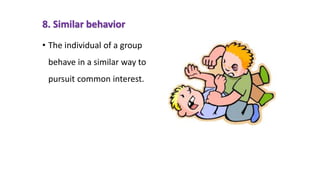
8. Similar behavior
• The individual of a group
behave in a similar way to
pursuit common interest.
IMPORTANCE
1. Motivation
2. Task motivation
3. Satisfaction
4. We feeling
5. Affects the attitude
6. Provides social identity, social reality and social support
1. Motivation
• The members within social
group influence and enhance
one another.
• For e.g. in family parents
motivate children for higher
education and status etc.
2. Task motivation
• The individuals gather together to achieve the goal of
mutual activity.
• In case of disaster management program, nurses gather to
participate to manage the case of disaster victims and
provide efficient care.
3. Satisfaction
• Combined activities of social
group brigs rewards of achieving
goal, which provides net
satisfaction and grater
identification within the group.
4. Affects the attitude
• Social group through influential and motivational behavior
change the attitude of group members, who don’t behave
according to expected one.
5. Provides social identity, social reality and social support
• Social identity means individual become involved with one another and aware
of each other as member of the same social unit.
• In hospitals orientation program are being organized by nursing group to
orient the new members and to provide identity to them in nursing field.
• They are introduced with seniors and about the help. Which hey can seek
during the problem while on job from them, there by acting as social support.
CLASSIFICATION OF
GROUPS
1. According to Cooley
Primary group
Secondary group
2. According to Summer
In groups
Out groups
3. According to F. H. Giddings
Genetic
Congregate
4. According to Miller
Horizontal group
Vertical group
5. According to Leopold
Crowds
Groups
Abstract collection
6. Group have been classified as
Class
Tribe
caste
1. According to Cooley
• Primary group
• Secondary group
PRIMARY GROUPS
• In primary groups, the contact between members of group is intimate.
• The interaction is face of among members.
• Primary group is a small group and is the nucleus of all social organizations
e.g. family.
• Primary groups form the social nature and ideals of the individual.
• Primary groups bring a sense of we feeling.
• It creates sympathy and mutual understanding among members.
Characteristics of primary group
• Close contact
• The people of primary group are closely related and have face to face
interaction.
• The close contact provides an opportunity to the members to express their
views, ideas, opinions and even it is possible to visualize the facial
expressions and gestures while having communication.
• Stability
• Stability is required for primary group, which will promote the intimacy
of relationship among the member of group.
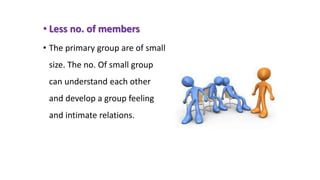
• Less no. of members
• The primary group are of small
size. The no. Of small group
can understand each other
and develop a group feeling
and intimate relations.
• Cooperation
• All members of primary group
gather together in a spirit to
participate cooperatively to study a
common project or to remove the
grievances.
• This common feeling provides
satisfaction among members of the
group.
• Common interest
• The common interest is shared by
every member because of devotion
and energy of all the member of
group in achieving goal.
• It not only sustain the common
interest but sustain the interest of
living itself.
• Similar background
• The member of primary group should have equal experience and
should be almost equal in intelligent level.
Importance
For individual
• An individual learns about culture.
• Shapes the personality of individual.
• Associates the individual together.
• Let the members express their aspirations and resentment.
• Provides stimulus to each of its members in the pursuit of interest.
• Encourages its member towards the achievement of objective.
• Boosts the morale of its members.
• Creates we feeling and brings cooperation among members and also unity for
achievement of objective.
For society
• Maintain social control over it members.
• Helps in process of socialization.
• Teaches its members to work according to rules in society.
• Develop the basic attitude towards social institutions.
• Provide cementing force to social structure and prevent social
integration.
SECONDARY GROUP
• According to Mazumdar H.T. “When face to face contacts are not present in
the relation of members, we have secondary group.”
• Secondary groups are large and human contacts are superficial.
• In secondary group, the influence of one member over another is indirect.
• These group lacks I intimacy and do not have face to face contact in the
relationship in these groups rules are sets and clear cut division of labor
among its members.
Main Characteristics of secondary group
• Formal, impersonal and secondary relations
• Largeness of the size
• Option of membership - voluntary
• No physical basis
• Active and Inactive members
• Relations – no face to face (indirect communication)
• Formal rules – law, legislation, police, court etc.
• Individuals status- limited influence on personality
• Goal orientation
• Group structure – formal structure
• Cooperation is indirect.
Importance of secondary group
• The primary group have an important place in a simple and small society. But in
modern era the trend is towards secondary groups.
• These groups are goal directed
• The changing trends of modern society man now depends for his needs more on
secondary groups then primary groups.
• Efficiency (the emphasis is on getting the job done).
• Open Channels of Opportunity.
• Wider Outlook.
• Provide opportunity to develop individual talent.
1. According to Summer
• In groups
• Out groups
IN GROUPS
• The groups to which an individual belong is in group. The members of in
group have respect for one another right and show cooperation. e.g. family,
college, institution, hospital etc.
• It means the in group is an association which can be primary (family) or
secondary (hospital) group towards which a person has friendliness and a
sense of solidarity.
Characteristics of in groups
• Similar attitudes and behavior.
• Create sense of belongingness.
• Sympathy is present among member.
• Cooperative relationships and respect towards each other.
• Feeling of brotherhood.
• Pleasure on one member gives pleasure to all of its member.
• Members are ready to sacrifice themselves for the sake of group.
• Members use the word we which shows their unity within the group.
OUT GROUP
• Out group is defined as the group to which an individual does not belong or
the group in relation to outside the boundaries of his in group.
• It consists of person towards whom, the individuals feel a sense of disgust or
indifference.
• The embers of in group use the term they for out group.
• The attitude of individuals out group ranges from mild negative attitude to
intense negative or a feeling of heartedness.
SOCIAL GROUPS

SOCIAL GROUPS

  • 1.
    SOCIAL GROUPS Prepared by :Ms. Leena Ghag. Nursing Tutor
  • 2.
    INTRODUCTION • An individualcannot live alone as he is a social animal. • His activities starts as a participating member of group such as family. • Individual meets several people and share common ideas and feelings which means man lives in social groups. • Groups helps individual in shaping personality.
  • 3.
    • Social groupsconsists of two or more people who interact with one another and who recognize themselves as a distinct social unit. The interaction within the social group causes them to identify with one another. • Groups carry out many activities which are necessary in a society.
  • 4.
    DEFINITION According to Hortonand Hunt, “Groups are aggregates or categories of people who have consciousness of membership and of interaction.” According to Ogburn and Nimkoff, “Whenever two Or more individuals came together and influence one another, they may be said to constitute social group.”
  • 5.
    GROUP STRUCTURE • Theterm group may apply to social units varying in size from two persons to a large organizations or major political party. • These may be essential subcultures or categories, which describe the members of a society or may involve close face to face interaction directed at common goal.
  • 6.
    1. Status • Statuswithin the group, which determine the rank or hierarchical position which an individual occupy in the group.
  • 7.
    2. Norms • Normsmeans expected pattern of behavior within group, each member of individual is expected to show appropriate behavior within the group activity.
  • 8.
    3. Role • Thepeople have status in the group, on the basis of this, they perform the activities.
  • 9.
    • 4. Communication •Communication is the basis of interaction. • People communicate with each other in group using different communication pattern.
  • 10.
    5. Interaction withingroup • The group structure may be change itself as a result of the events occupying in interaction. • Past interactions have an effect upon future interactions and this process will change in structure.
  • 11.
    6. Physical arrangement •The way people are arranged or arrange themselves indicate something about their relationship. • E.g., mother-daughter relation.
  • 12.
    7. Reciprocal relations •The individuals in a group are inter related to each other. The reciprocal relation form an essential features of a group. (Reciprocal relation : the situation which two variables can mutually influence one another.)
  • 13.
    8. Similar behavior •The individual of a group behave in a similar way to pursuit common interest.
  • 14.
    IMPORTANCE 1. Motivation 2. Taskmotivation 3. Satisfaction 4. We feeling 5. Affects the attitude 6. Provides social identity, social reality and social support
  • 15.
    1. Motivation • Themembers within social group influence and enhance one another. • For e.g. in family parents motivate children for higher education and status etc.
  • 16.
    2. Task motivation •The individuals gather together to achieve the goal of mutual activity. • In case of disaster management program, nurses gather to participate to manage the case of disaster victims and provide efficient care.
  • 17.
    3. Satisfaction • Combinedactivities of social group brigs rewards of achieving goal, which provides net satisfaction and grater identification within the group.
  • 18.
    4. Affects theattitude • Social group through influential and motivational behavior change the attitude of group members, who don’t behave according to expected one.
  • 19.
    5. Provides socialidentity, social reality and social support • Social identity means individual become involved with one another and aware of each other as member of the same social unit. • In hospitals orientation program are being organized by nursing group to orient the new members and to provide identity to them in nursing field. • They are introduced with seniors and about the help. Which hey can seek during the problem while on job from them, there by acting as social support.
  • 20.
    CLASSIFICATION OF GROUPS 1. Accordingto Cooley Primary group Secondary group 2. According to Summer In groups Out groups
  • 21.
    3. According toF. H. Giddings Genetic Congregate 4. According to Miller Horizontal group Vertical group 5. According to Leopold Crowds Groups Abstract collection
  • 22.
    6. Group havebeen classified as Class Tribe caste
  • 23.
    1. According toCooley • Primary group • Secondary group
  • 24.
    PRIMARY GROUPS • Inprimary groups, the contact between members of group is intimate. • The interaction is face of among members. • Primary group is a small group and is the nucleus of all social organizations e.g. family. • Primary groups form the social nature and ideals of the individual. • Primary groups bring a sense of we feeling. • It creates sympathy and mutual understanding among members.
  • 25.
    Characteristics of primarygroup • Close contact • The people of primary group are closely related and have face to face interaction. • The close contact provides an opportunity to the members to express their views, ideas, opinions and even it is possible to visualize the facial expressions and gestures while having communication.
  • 26.
    • Stability • Stabilityis required for primary group, which will promote the intimacy of relationship among the member of group.
  • 27.
    • Less no.of members • The primary group are of small size. The no. Of small group can understand each other and develop a group feeling and intimate relations.
  • 28.
    • Cooperation • Allmembers of primary group gather together in a spirit to participate cooperatively to study a common project or to remove the grievances. • This common feeling provides satisfaction among members of the group.
  • 29.
    • Common interest •The common interest is shared by every member because of devotion and energy of all the member of group in achieving goal. • It not only sustain the common interest but sustain the interest of living itself.
  • 30.
    • Similar background •The member of primary group should have equal experience and should be almost equal in intelligent level.
  • 31.
    Importance For individual • Anindividual learns about culture. • Shapes the personality of individual. • Associates the individual together. • Let the members express their aspirations and resentment. • Provides stimulus to each of its members in the pursuit of interest. • Encourages its member towards the achievement of objective. • Boosts the morale of its members. • Creates we feeling and brings cooperation among members and also unity for achievement of objective.
  • 32.
    For society • Maintainsocial control over it members. • Helps in process of socialization. • Teaches its members to work according to rules in society. • Develop the basic attitude towards social institutions. • Provide cementing force to social structure and prevent social integration.
  • 33.
    SECONDARY GROUP • Accordingto Mazumdar H.T. “When face to face contacts are not present in the relation of members, we have secondary group.” • Secondary groups are large and human contacts are superficial. • In secondary group, the influence of one member over another is indirect. • These group lacks I intimacy and do not have face to face contact in the relationship in these groups rules are sets and clear cut division of labor among its members.
  • 34.
    Main Characteristics ofsecondary group • Formal, impersonal and secondary relations • Largeness of the size • Option of membership - voluntary • No physical basis • Active and Inactive members • Relations – no face to face (indirect communication) • Formal rules – law, legislation, police, court etc. • Individuals status- limited influence on personality
  • 35.
    • Goal orientation •Group structure – formal structure • Cooperation is indirect.
  • 36.
    Importance of secondarygroup • The primary group have an important place in a simple and small society. But in modern era the trend is towards secondary groups. • These groups are goal directed • The changing trends of modern society man now depends for his needs more on secondary groups then primary groups. • Efficiency (the emphasis is on getting the job done). • Open Channels of Opportunity. • Wider Outlook. • Provide opportunity to develop individual talent.
  • 37.
    1. According toSummer • In groups • Out groups
  • 38.
    IN GROUPS • Thegroups to which an individual belong is in group. The members of in group have respect for one another right and show cooperation. e.g. family, college, institution, hospital etc. • It means the in group is an association which can be primary (family) or secondary (hospital) group towards which a person has friendliness and a sense of solidarity.
  • 39.
    Characteristics of ingroups • Similar attitudes and behavior. • Create sense of belongingness. • Sympathy is present among member. • Cooperative relationships and respect towards each other. • Feeling of brotherhood. • Pleasure on one member gives pleasure to all of its member. • Members are ready to sacrifice themselves for the sake of group. • Members use the word we which shows their unity within the group.
  • 40.
    OUT GROUP • Outgroup is defined as the group to which an individual does not belong or the group in relation to outside the boundaries of his in group. • It consists of person towards whom, the individuals feel a sense of disgust or indifference. • The embers of in group use the term they for out group. • The attitude of individuals out group ranges from mild negative attitude to intense negative or a feeling of heartedness.