Information on
Pharmacovigilance
Dr. M. Immanuel Jebastine,
M. Pharm., (Hon.D)Hum., (Ph.D).,
Assistant Professor,
VISTAS
• Drug and disease classification
• Drug dictionaries and coding in
pharmacovigilance
• Information resources in pharmacovigilance
• Establishing pharmacovigilance programme
Drug and disease classification
• Anatomical, Therapeutic and Chemical
Classification of Drugs (ATC)
 In the ATC system the active substance
is divided into different groups according
to the organ or system on which they act
and their therapeutic, Pharmacological and
chemical properties.
 ATC / DDD Methodology
Drug utilization research uses the Anatomical
Therapeutic Chemical (ATC) as the classification system
and Defined Daily Dose (DDD) as a unit of measure.
DDD is the assumed average maintenance dose per day
for a drug used for its main indication in adults.
The methodology is endorsed by WHO and is
recommended as the international standard for drug
utilisation monitoring and research.
Why ATC/DDD ?
ATC/DDD methodology facilitates the presentation and
comparison of drug consumption statistics at international,
national and regional levels despite differences in
nomenclature (both branded & generic), packing sizes,
pricing and customary dosages.
This methodology is useful for valid presentation &
comparison of
• drug utilization within and across countries to support
better outcomes & quality use of medicines.
General Principles for ATC
Classification
Drugs are classified based on their main therapeutic
use
Only one ATC code for each ROA (route of
administration).
Several ATC code: if clearly different therapeutic uses
reflected in different
 Routes of administration (e.g. topical, systemic)
 Strengths
ATC Groups
• In the Anatomical Therapeutic Chemical
(ATC) classification system, the active
substances are divided into different groups
according to the organ or system on which
they act and their therapeutic, pharmacological
and chemical properties.
Drugs are classified in groups at five
different levels.
1. ATC 1st level
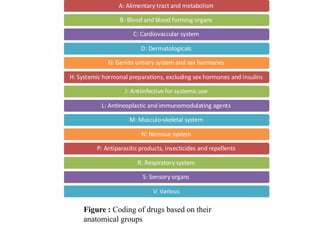
 The system has fourteen main anatomical or
pharmacological groups
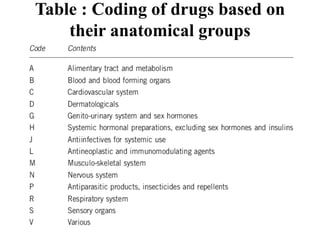
(1st level). The ATC 1st levels are shown in the figure.
2. ATC 2nd level
 Pharmacological or Therapeutic subgroup
3. ATC 3rd & 4th levels
 Chemical, Pharmacological or Therapeutic subgroup
4. ATC 5th level
 Chemical substance
• The 2nd, 3rd and 4th levels are often used to
identify pharmacological subgroups when
that is considered more appropriate than
therapeutic or chemical subgroups.
Figure : Coding of drugs based on their
anatomical groups
Table : Coding of drugs based on
their anatomical groups
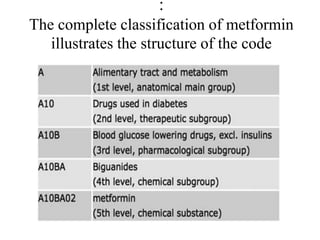
:
The complete classification of metformin
illustrates the structure of the code
Thus, in the ATC system all plain metformin
preparations are given the code A10BA02. For
the chemical substance, the International
Nonproprietary Name (INN) is preferred. If INN
names are not assigned, USAN (United States
Adopted Name) or BAN (British Approved
Name) names are usually chosen. The coding is
important for obtaining accurate information in
epidemiological studies. The five different levels
allow comparisons to be made at various levels
according to the purpose of the study.
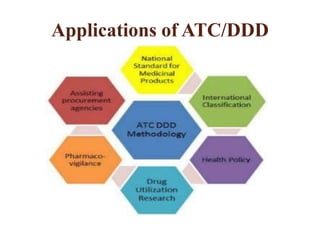
Applications of ATC/DDD
International Classification of
Diseases
The ICD is originally designed as a health
care classification system, providing a system
of diagnostic codes for classifying diseases,
including nuanced classifications of a wide
variety of signs, symptoms, abnormal findings,
complaints, social circumstances, and external
causes of injury or disease.
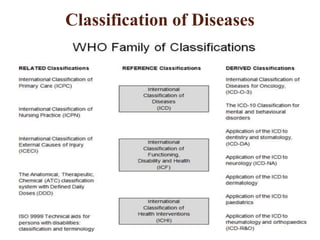
Classification of Diseases
Importance of ICD
The ICD is important because it provides a
common language for reporting and
monitoring diseases. This allows the world
to compare and share data in a consistent
and standard way- between hospitals,
regions and countries and over periods of time.
History of ICD
In 1860, Floresence Nightingale, made 1st
model of systemic collection of hospital
data.
In 1893, French Physician Jacques Bertillon
introduced bertillon classification of cause of
death.
In 1898, American public health association
recommended revision of ICD system every
10 years
The revision followed minor changes untill
6th version of ICD, morbidity & mortality
conditions and section on mental disorders
WHO has responsibility of preparing &
publishing the ICD revision every 10 years
Who uses ICD ?
1.Users include physicians, nurses, other
providers, researchers, health information
managers and coders, health information
technology workers, policy-makers, insurers
and patient organizations.
Who uses ICD ?
2. ICD has been translated into 43 languages and
it is being used by all member States. Most
countries (117) use the system to report
mortality data, a primary indicator of health
status.
Who uses ICD ?
3. All Member States are expected to use the
most current version of the ICD for reporting
death and disease statistics (according to the
WHO Nomenclature Regulations adopted by
the World Health Assembly in 1967).
International Non Proprietary
Names for Drugs (INN)
• INN facilitates the identification of pharmaceutical
substances or active pharmaceutical ingredient. Each INN
is a unique name that is globally recognized & is public
property. A nonproprietary name is also called generic
name.
• It provides clear identification, safe prescription and
dispensing of medicines to patients. It is also important
for the communication and exchange of information
among health professionals worldwide.
History of INN
The system was established in 1950 by World Health
Assembly and the first list of International
Nonproprietary Names for pharmaceutical substances
was published in 1953.
The cumulative list of INN now stands at some 7000
names designated since that time, and thus number
is growing every year by 120-150 new INN.
Uses of INN
• Nonproprietary names are intended for use in
pharmacopoeias, labeling, product information, advertising
and other promotional material, drug regulation and
scientific literature and as a basis for product names.
Drug dictionaries and coding in
pharmacovigilance
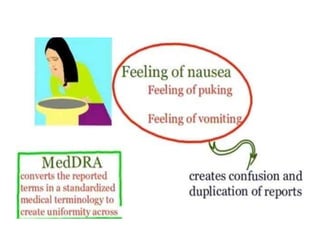
What is MedDRA?
• Med=Medical
• D=Dictionary
• R=Regulatory
• A=Activities
Definition:
The MedDRA is a medical terminology used to
classify adverse event information associated with
the use of biopharmaceuticals and other medical
products (e.g. medical devices and vaccines).
It is used to classify the adverse drug events (ADEs)
data from clinical trials, spontaneous adverse event
reports by healthcare professionals, patients and others;
and from other sources of the ADEs.
MedDRA has been developed by an
ICH Working Group to provide:
An international, multi-lingual, medical terminology ‰
Medical personnel can code ADR data in their native
language
Safer – less likely to miscode data
Standardized communication between regulators and
industry/spponsors of clinical trials‰
Within regions and between regions
A single terminology for use through
all phases of development cycle
(both pre- and post-marketing)
Clinical Trials (medical information, adverse
events)
Registration (study reports, analyses,
summary of product characteristics/labeling –
undesirable effects section)
Post-authorization (adverse events)
Support for electronic submissions
 Each MedDRA term is assigned a unique 8-digit
numeric code
Codes can fill certain data fields in e-submission types
(E2B: ICSR- Individual Case Safety Reports, eCTD:
e-Common Technical Document)
Codes easier to transmit as no language boundaries
Who develop MedDRA?
It is developed by the International Council for
Harmonization (ICH) of Technical Requirements for
Pharmaceuticals for Human use.
ICH has created a governance structure to nature and
protects the integrity of MedDRA.
ICH Med DRA committee oversees all the activities of
the MedDRA maintenance and support services
organization.
The Maintenance and Support
Service Organization (MSSO)
MSSO is the management Board appointed by ICH
steering committee.
Maintain and upgrades MedDRA.
Releases updated MedDRA versions twice a year (in
March and September).
MedDRA MSSO
MedDRA is actively developed and maintained
– Two releases per year
– Evolves to meet needs of regulators, industry,
other users
– Success depends on these activities
ICH contracted MSSO for this purpose
MSSO activities are governed by ICH MedDRA
Management Board
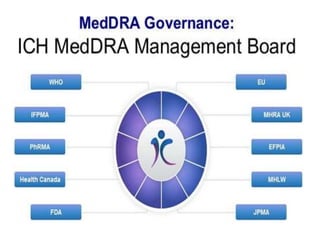
ICH MedDRA Management Board
• Six Parties: EU, EFPIA, FDA, MHLW, JPMA, PhRMA,
• Three Observers: WHO, EFTA, Canada European
1.Commission - European Union (EU)
2.European Federation of Pharmaceutical Industries and
Associations (EFPIA)
3.US Food and Drug Administration (FDA)
4.Pharmaceutical Research and Manufacturers of America
(PhRMA)
5.Ministry of Health, Labor and Welfare, Japan (MHLW)
6.Japan Pharmaceutical Manufacturers Association (JPMA)
Objectives of MedDRA’s
Development
• International multi-lingual terminology
– Used in 60 countries
– Available in 11 languages
• Standardised communication between industry and
regulators Application throughout all phases of
development Classification of a wide range of
clinical information
• Support multiple medical product areas
Support electronic submissions
– Unique 8-digits codes for all terms
– For data fields in e- submission types (e.g. E2B)
MED-DRA CODE
Unique number assigned to each
term in the dictionary
8 digit number
Starts with 10000001, initially started
alphabetically
As term added, codes assigned
sequentially.
WHO Drug Dictionary
The WHO Drug Dictionary is an international classification of the
medicines created by the WHO Programme for International Drug
Monitoring (IDM) and managed by Uppsala Monitoring Centre (UMC).
A database with information about medical products from all over the
world.
It contains medicinal products and information related to the mina
relational database system.
Information is provided in a consistent and structured way
It provides useful groupings of data useful for both data input and out put.
It is continuously updated.
Eudravigilance medicinal product
dictionary
• EudraVigilance: European Union Drug Regulating Authority
Pharmacovigilance
 ATC: Anatomical Therapeutic Chemical
 CIOMS: Council for International Organisations of Medical Sciences
 EEA: European Economic Area
 EMA: European Medicines Agency
 ESTRI: Elecronic Strandards for the Transfer of Regulatory
Information
 EVDAS: Eudravigilance Data Analysis System
 EVCTM: Eudravigilance Eudravigilance Clinical Trial Module
 EVPM: Eudravigilance Post-Authorisation Modole
 ICH: International Conference of Harmonisation
Eudravigilance medicinal product
dictionary (EVMPD):
• The EudraVigilance Medicinal Product Dictionary
(EVMPD) has been designed to support in a standardised
and structured way the collection, reporting, coding and
evaluation of data on authorised medicinal products and
investigational medicinal products.
Information resources in
pharmacovigilance
DEFINTION:- The branch of science who`s activities
relating to the detection, assessment, understanding, and
prevention of adverse effects or any other drug related
problem.
• OBJECTIVE:
1 To know what are the various sources of drug
information.
2 To select the appropriate source depending on the
information.
BASIC DRUG INFORMATION
RESOURCES-
Drug information is current, critically examined,
relevant data about drugs and drug use in a given
patient or situation.
Current information uses the most recent, up-to-
date sources possible.
Critically examined information.
Relevant information must be presented in a
manner that applies directly to the circumstances
under consideration (e.g. patient parameters,
therapeutic objectives, alternative approaches).
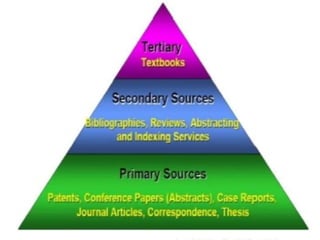
TYPES OF RESOURCES:-
(I)Primary resources
(II)Secondary resources
(III)Tertiary resources
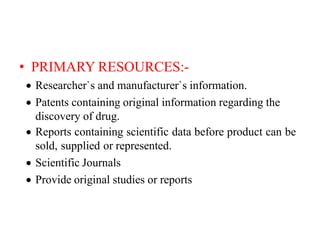
• PRIMARY RESOURCES:-
 Researcher`s and manufacturer`s information.
 Patents containing original information regarding the
discovery of drug.
 Reports containing scientific data before product can be
sold, supplied or represented.
 Scientific Journals
 Provide original studies or reports
ADVANTAGES
 Most current evidences.
 Provide data on new drugs.
 Original document that was created at the time of the actual
events.
DISADVANTAGES
 Data can be controversial.
 Every study has limitation
 Complicated
 Time consuming.
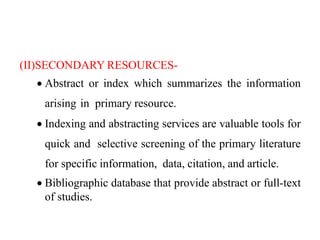
(II)SECONDARY RESOURCES-
 Abstract or index which summarizes the information
arising in primary resource.
 Indexing and abstracting services are valuable tools for
quick and selective screening of the primary literature
for specific information, data, citation, and article.
 Bibliographic database that provide abstract or full-text
of studies.
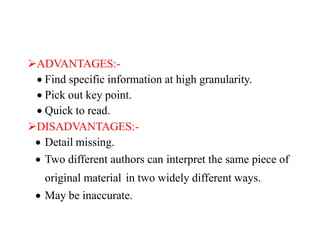
ADVANTAGES:-
 Find specific information at high granularity.
 Pick out key point.
 Quick to read.
DISADVANTAGES:-
 Detail missing.
 Two different authors can interpret the same piece of
original material in two widely different ways.
 May be inaccurate.
(III)TERTIARY RESOURCES-
 Compilation of knowledge in the field. e.g. Textbooks, handbook, online
drug compendia.
 ADVANTAGES-
 Provide comprehensive information.
 Information reflects views of multiple experts in field.
 Fast, easy to use, and may be good for patients.
 DISADVANTAGES-
 Information may be dated due to gap between when resources is written and
published.
 Chances of distorting a topic.
OTHER SOURCES-
Libraries
Research association
Government bodies
Information center in industries
Establishing pharmacovigilance
programme
• Established pharmacovigilanace program in a hospital and
national programme
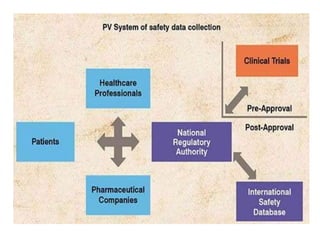
 PV is a major post-marketing tool to ensure the safety of a
medicinal product. Apart from the respective drug regulating
authorities in each country, International Conference on
Harmonization (ICH) of Technical Requirements for
Registration of Pharmaceuticals for Human Use,
Pharmacovigilance Planning- ICH E2E and World Health
Organization-Uppsala Monitoring Centre (WHO- UMC) also
play key roles towards developing, enhancing and monitoring
global PV system. A PV system is defined as a system used by
an organization to fulfill its legal tasks and responsibilities in
relation to PV that monitors authorised medicinal products’
safety and detect if any change to risk benefit balance.
After the thalidomide disaster in the year 1961,
WHO worked along with its Collaborating Centre
to establish a programme for International Drug
Monitoring and through this programme, WHO
promoted PV at the country level. At the end of
2010, 134 countries were part of the WHO-PV
Programme. To give it a further impetus and
fortify the drug regulatory framework in the
country, the Drug Controller General of India
(DCGI) has announced the CDSCO's “VISION
2020”
which proposes to create a PV center in every
medical college in the country which is an
ambitious task keeping in view the fact that it is
still at low ebb in many government medical
colleges and the condition is the same or may be
worse in the private institutes. Therefore, it is
likely that the proposal may have to negotiate
many bottlenecks to pay some dividends. In this
backdrop, the article discusses the essentials of
setting up a PV center and getting it operational
Essential for a Pharmacovigilance
program:-
Pharmacovigilance is all about drug
regulations and is based on thorough
collaborative ties, coordination,
communications, and public relations. The most
suitable location for setting up a PV centre is
dictated by the political governance and its
healthcare priorities, including willingness to
do, law enactment, its enforcement, funding,
organisation, staffing, training, and development.
To Ensure a Good PV System, Certain
Operational Requirements must be met, which
include:-
 A properly structured drug safety management team to intensify the
communication among the PV network. This will assure an
organised structure and smooth functioning. Meetings among the
PV physicians, managers, and technical agencies need to be held
from time to time
 A countrywide database which provides provision for collating and
managing ADR reports
 A national PV advisory committee
 A clear approach, to be communicated in detail, in regular
situations as well as situations of crisis
 Funding to run different grounds of a system.
Minimum requirements for a functional national
pharmacovigilance system
The following are the minimum requirements that WHO
and partners agree should be met in any national
pharmacovigilance system.
1. A national pharmacovigilance centre with designated
staff (at least one fulltime), stable basic funding, clear
mandates, well-defined structures and roles, and
collaborating with the WHO Programme for International
Drug Monitoring;
2. A national spontaneous reporting system with a national
individual case safety report (ICSR) form, i.e. an ADR
reporting form;
3. A national database or system for collating and managing
ADR reports;
4. A national ADR or pharmacovigilance advisory
committee able to provide technical assistance on causality
assessment, risk assessment, risk management, case
investigation and, where necessary, crisis management,
including crisis communication;
5. A clear communication strategy for routine
communication and communication during crises.
. The Manpower and the machinery
a) Adequate qualified and experienced man power to run
the system - PV staff should have complete knowledge
regarding data collection and verification, coding of drugs
and adverse events, causality assessment, signal detection,
risk management, interpreting the data obtained etc.
 Staff
The expertise desirable in the routines of a
pharmacovigilance centreincludes: Clinical medicine,
pharmacology, toxicology, epidemiology. However, a new
pharmacovigilance centre often starts with only a part-time
expert
 usually a physician or a pharmacist
 and some secretarial support.
 Planning the basics
A blueprint should be drawn up to establish and get a PV
system to work. Care needs to be taken to establish the
following:
a) Advisory Committees
A multi-disciplinaryadvisory committee is
desirable, to support the pharmacovigilance
centre with regard to the quality of the procedures in:
1.Data collection and assessment
2.Data Interpretation
3.Information publication
A network of experienced advisors in various
specializations is helpful
 b) Communication process
 Getting in conversation with health authorities and local,
regional, national bodies and groups engaged in
clinical medicine, pharmacology,toxicology, epidemiology,
briefing them about the importance of the project and its
applicability in modern therapeutics. A bulletin or newsletter
distributed to all healthcare professionals or a
regular column in reputed (medical and
pharmaceutical) journals are good means for the dissemination
of information. Prompt data-sheet amendments are important, but
data-sheets may be printed infrequently and their educational
impact may not be large. In urgent cases of sufficient
importance ‘Dear Doctor’ letters may alert the profession
c)Data acquisition
Designing a template for ADR reporting and making
available ADR reporting forms at all times, to hospital
departments and general practitioners, on which they can
furnish relevant information to the data bank of the center.
d)Dissemination
Producing printed handouts as well as conducting
meetings or workshops in hospitals and academia to
acquaint health care professionals about the definitions,
goals, scope, and methodology of the PV system to
create awareness about its relevance in present times.
e)Establishment
Hiring the right qualified and interested staff,
getting suitable place for accommodating them as well
as the center, making arrangements for telephones,
computers, printers, word processors, database
management, bibliography support services and an
internet.
f) Internal education
 Ensuring proper education and frequent updating of the staff
belonging to the PV centers by training them in data collection,
filtration, mining, verification, interpretation and coding of ADRs,
medicines coding, causality assessment, signal detection, risk
management, and action in case of serious/fatal adverse drug events
(ADE). Data mining is a relatively nascent interdisciplinary area
which involves finding correlations and patterns among many fields
in large databases with the aim of categorizing the data and
summarizing identified relationships.
g)Database and information serivce
Creating a safely stored, classified database which is
retrievable and guarded by required degrees of
confidentiality. The provision of a high quality
information service to healthcare professionals is a
basic task of a pharmacovigilance centre and a major
instrument in the stimulation of reporting. For this
purpose and for the assessment of case reports the
centre should have access to a comprehensive and up-
to-date literature source and information database.
h) Promotion
To inculcate and promote the habit of reporting ADRs to
the higher center, medical journals, health bulletins and
other professional healthcare publications.
I)Networking
To encourage healthcare professionals to contact
institutions working on a global scale in PV e.g. Uppsala
Monitoring Centre (UMC) WHO department of Essential
Medicines and Medicines Policy, Geneva, and net groups
like International Network for the Rational Use of Drugs
(INRUD), E-drug, and Network for Rational Use of
Medicines (NetRUM)
 Data
Pharmacovigilance at present thrives heavily on a
regional/country wide reporting of suspected ADRs
through spontaneous reporting system from
motivated reporters. It usually picks up signals of
rare, serious, unprecedented ADRs. Reports of
suspected ADRs are taken in case report forms
(CRF) which in PV is defined as a notification
relating to a patient with an ADE (or laboratory test
abnormality) suspected to be induced by a medicine.
• The CRF should be distributed to health care
professionals across the area covered by a
particular PV center regularly, and a suitable
system has to be developed to ensure that the
filled forms are either collected or could be
posted free, or sent by e mail/FAX to the
center, so that there is an uninterrupted and
free flow of data.
 A CRF should contain minimum following information
 Patient: Age, gender, medical history in brief, ethnic origin (in some
countries)
 ADE monitoring: Detailed description (nature, localization,
severity, characteristics), reports of investigations and tests, date of
appearance, course, outcome
 Suspected medicines: Name (brand, formulation, ingredient,
concentration, manufacturer), dose, route of administration, date of
initiation of therapy/date of withdrawal of therapy, indications for use,
and rechallenge in case of non serious ADEs
 Other medicines: All other medicines used by the patient
(including self medication) including their name, dose,
route, date of initiation and withdrawal
 Risk factors: e.g. impaired renal function, past exposure to
suspected medicines, history of allergy, and social drug use
 Reporter: Name and address of the reporter (confidential
and to be used for data completion, verification, and follow
up)
• Health care professionals e.g. practicing
physicians, pharmacists, nurses, dentists, and
midwives are reliable sources of information.
Pharmacists and nurses can illuminate on
concomitant medication and history of
medicine usage. It is imperative for
pharmaceutical companies to report any ADRs
of their products to regulatory authorities. In
the event of patients directly reporting ADRs,
 It is always better to communicate with their physicians
for better understanding and verification of data. The
reporting can be done from peripheral to the regional PV
centers, which sweep a particular region, which in turn
pool into the zonal database, the analysis of which
reflects a gross national overview. The entire national
data should be reported to UMC.
 Bringing a reporting culture
Reporting of ADR is a continuous process and important
to cultivate and sustain the attention and interest of
healthcare workers so that it gets incorporated as a
routine procedure in healthcare. The following measures
may be adopted to give a fillip to reporting:
 Easy and free availability of prepaid reporting forms and
other modes of reporting
 Duly acknowledging the receipt of ADR reports
telephonically or through personal communication
 Providing journal articles, ADR bulletins, newsletters to
reporters
 Actively involving the PV center staff in scientific meetings, undergraduate
and postgraduate education
 Collaborating with other PV committees, It is always ideal to look out for
other organizations that may be able to collaborate with your PV Centre to
reduce the financial and logistic burden. For example, poison control and
drug information centres share similar PV interests. It may be useful to
develop a PV system in conjunction with these centres.
 Collaborating with professional associations
 Utilizing PV data for development of clinical pharmacy and clinical
pharmacology
Tasks for pharmacovigilance
a)Information service
One of the primary responsibilities of a center is to make
high quality credible and latest medicine information
available to health care professionals. For this, the center
should have access to up-to-date and comprehensive
literature database. The national centers should preferably
have an online access to UMC database and be on the
mailing list of ADR bulletins of WHO.
b)Reaching out
Newsletters, medicine bulletins, columns from reputed
medical or pharmaceutical journals may be chosen as routes
of effective propagation of latest developments in medicine
research and therapy to the healthcare professionals.
c)Appraisal
 The ADR case reports obtained are evaluated by the center
staff, employing the collective know-how of clinical medicine,
pharmacology, toxicology, and epidemiology.
d)Secondary prevention of ADRs
 Secondary prevention of ADRs can be attempted by
distribution of “patient alert cards” which are pocket size cards
and could be carried around by patients. They provide relevant
information about the medicines including ADRs and go a long
way in preventing ADRs.
e)Data processing
Data is best managed electronically by computer,
wherein, data is entered in a hierarchical format according
to product name, medicine name or therapeutic category.
This facilitates recording detailed case information and
easy retrieval Internationally accepted terminologies
regarding classification of medicines (Anatomical
Therapeutic Chemical [ATC], International Nonproprietary
Names [INN]) and ADRs e.g. WHO Adverse Reaction
Terminology (WHO ART), Medical Dictionary for
Regulatory Activity (MedDRA) should be used, so that the
data can be globally shared.
f) Hypothesizing
This is one of the chief goals of PV center. Based on the
case reports, the center should be able to generate
hypothesis or detect a signal with regard to probable
ADRs.
g) Medicine regulation
It is PV center's duty to keep a close eye on the new
medicines launched in the market and follow them up to
look for newer ADEs, issue warnings, unmask newer
indications or changes or to advocate withdrawal of
medicines in extreme cases. A center should actively take
up activities towards furthering the role of PV with periodic
safety update reports (PSURs), registries, risk
management- minimization plans, and improved
communication with changes in label of medicines.
The PV system needs to deal with large population
and the rate of reporting governs the estimation of the
money needed to run the complete system. Huge
investment is required in terms of collection of data
from the actual source to transforming it into a
Regulatory reportable format. Funding can be obtained
from various parties, such as drug Regulatory authority,
university departments, health insurance companies,
and professional associations.
Establishment & operation of drug
safety department in industry
 Introduction:-
 Pharmacovigilance has grown as a discipline over the past
10 to 15 year.
 An educational survey in 1994 revealed that more than 320
people currently worked in company pharmacovigilance
function in the UK alone.
 Pharmaceutical companies are international, hence the
number of staff working in this field within the
industry,particularly in other European countries and USA.
 A major pharmaceutical company such as Astra has over 100
permanent, experienced staff in pharmacovigilance within its
research and development organisation in Sweden and the UK
and US similar number in local operating companies worldwide
 The number of individual reports of possible adverse drug
reaction can be considerable, for key marketed products often
more than 1000 case reports a year are received worldwide
from healthcare professionals and other sources.
Aim of pharmacovigilance within the
industry
 Protect patients from unnecessary harmby
identifying previously unrecognised drug hazards.
 Refuting false safety signals and quantifying risk in
relation to benefit.
 Scientific characteristics:-
Pharmacovigilance is related to a number of scientific
disciplines
i.Clinical medicine
ii.Clinical and preclinical pharmacology
iii.Immunology
iv.Toxicology
v.Epidemiology ,
Identification and analysis of the safety
characteristics of medicine .
In two distinct stage:-
1. Before Marketing
2. After Marketing
1.Before marketing:- The main methodology is
experimental with clinical trial comparing the
new treatment to existing alternative treatment.
2.After marketing:- Introduction of a new
medicine into you generally use, the main safety
methodology is observational i.e. uses data from
observation of patients treated in clinical practice
rather than from experimental situations.
Pre-marketing clinical trials:-
 Safety monitoring in clinical trials involves collecting adverse
event, laboratory investigation and details of the clinical
examination of patients.
 Pharmacovigilance may be involved to varying degrees all phases
of clinical trials including planning, execution, data analysis,
reporting of safety information.
 Safety issues from animal pharmacology and toxicology studies,
finding in phase-1 studies, ADR with similar drugs, signals from
other studies and special patient group (eg. elderly).
• The practice of collecting all adverse events rather than
suspected ADR arose from the failure of clinical trials
to detect serious reaction with protocol and after
several years experience this is now the approach
adopted by company in most studies.
• The involvement of pharmacovigilance staff in clinical
trials also includes an important responsibility for the
expedited reporting of individual cases and safety
update required by the UK medicine control agency and
other regulatory authorities.
• Safety analysis and clinical expert report in the
marketing authorisation application submitted
by the company and will be the basis of ADR,
warning and precaution include in the
prescribing information i.e data sheet.
Methods of post marketing surveillance
(PMS) used by the pharmaceutical industry:-
• First step in signal generation:- Processes that can identify
possible new ADR.
 Signal generated through four different methods
Spontaneous reporting
o Recording and reporting clinical observation of a suspected
ADR with a marketed drug is known as spontaneous
reporting.
o The National system in the UK is the yellow card.
o Where doctors, dentists and recently
hospital pharmacist are encouraged to report all
suspected reactions to new medicines and serious
suspected reactions to established medicines.
Published case reports
 Publishing case reports of suspected ADR in medical
journals is an establish a way of alerting other to
possible drug hazards.
 A more recent development is report of possible ADR
appearing on the internet and money companies are
still determining how they should best handle them.
Cohort studies
Companies may set up or sponsor prospective, non
interventional cohort type studies to answer safety
question rose after marketing or general hypothesis
generating and testing tool to be used as need arises.
Post marketing clinical trials
Large randomised clinical trials with wide entry
criteria can be valuable in assessing the safety of
marketed products as well as confirming efficacy.
2. Second step in signal generation:- Signals are
subjected to hypothesis testing i.e. processes that
determine whether the single-dose indeed indicate a
new ADR or whether it is false.
The hypothesis testing process:-A
typical situation in company pharmacovigilance
is that a small number of reports have been
received, showing that the patients have developed
a serious medical condition e.g.-liver function
disturbance, convulsion.
Using spontaneous reporting data for hypothesis testing:-
It is common place in clinical practice to make decisions
and take actions based on assessment of causality between
an event and a certain drug in individual cases.
Epidemiological studies:- during the last decade
pharmacoepidemiology, the study of the use and effect of
drugs in large populations e.g- NSAID treatment and
gastrointestinal ulceration and bleeding.
Information on Pharmacovigilance.pptx

Information on Pharmacovigilance.pptx

  • 1.
    Information on Pharmacovigilance Dr. M.Immanuel Jebastine, M. Pharm., (Hon.D)Hum., (Ph.D)., Assistant Professor, VISTAS
  • 2.
    • Drug anddisease classification • Drug dictionaries and coding in pharmacovigilance • Information resources in pharmacovigilance • Establishing pharmacovigilance programme
  • 3.
    Drug and diseaseclassification • Anatomical, Therapeutic and Chemical Classification of Drugs (ATC)  In the ATC system the active substance is divided into different groups according to the organ or system on which they act and their therapeutic, Pharmacological and chemical properties.
  • 4.
     ATC /DDD Methodology Drug utilization research uses the Anatomical Therapeutic Chemical (ATC) as the classification system and Defined Daily Dose (DDD) as a unit of measure. DDD is the assumed average maintenance dose per day for a drug used for its main indication in adults. The methodology is endorsed by WHO and is recommended as the international standard for drug utilisation monitoring and research.
  • 5.
    Why ATC/DDD ? ATC/DDDmethodology facilitates the presentation and comparison of drug consumption statistics at international, national and regional levels despite differences in nomenclature (both branded & generic), packing sizes, pricing and customary dosages. This methodology is useful for valid presentation & comparison of • drug utilization within and across countries to support better outcomes & quality use of medicines.
  • 6.
    General Principles forATC Classification Drugs are classified based on their main therapeutic use Only one ATC code for each ROA (route of administration). Several ATC code: if clearly different therapeutic uses reflected in different  Routes of administration (e.g. topical, systemic)  Strengths
  • 7.
    ATC Groups • Inthe Anatomical Therapeutic Chemical (ATC) classification system, the active substances are divided into different groups according to the organ or system on which they act and their therapeutic, pharmacological and chemical properties.
  • 8.
    Drugs are classifiedin groups at five different levels. 1. ATC 1st level  The system has fourteen main anatomical or pharmacological groups (1st level). The ATC 1st levels are shown in the figure. 2. ATC 2nd level  Pharmacological or Therapeutic subgroup 3. ATC 3rd & 4th levels  Chemical, Pharmacological or Therapeutic subgroup 4. ATC 5th level  Chemical substance
  • 9.
    • The 2nd,3rd and 4th levels are often used to identify pharmacological subgroups when that is considered more appropriate than therapeutic or chemical subgroups.
  • 10.
    Figure : Codingof drugs based on their anatomical groups
  • 11.
    Table : Codingof drugs based on their anatomical groups
  • 12.
    : The complete classificationof metformin illustrates the structure of the code
  • 13.
    Thus, in theATC system all plain metformin preparations are given the code A10BA02. For the chemical substance, the International Nonproprietary Name (INN) is preferred. If INN names are not assigned, USAN (United States Adopted Name) or BAN (British Approved Name) names are usually chosen. The coding is important for obtaining accurate information in epidemiological studies. The five different levels allow comparisons to be made at various levels according to the purpose of the study.
  • 14.
  • 15.
    International Classification of Diseases TheICD is originally designed as a health care classification system, providing a system of diagnostic codes for classifying diseases, including nuanced classifications of a wide variety of signs, symptoms, abnormal findings, complaints, social circumstances, and external causes of injury or disease.
  • 16.
  • 17.
    Importance of ICD TheICD is important because it provides a common language for reporting and monitoring diseases. This allows the world to compare and share data in a consistent and standard way- between hospitals, regions and countries and over periods of time.
  • 18.
    History of ICD In1860, Floresence Nightingale, made 1st model of systemic collection of hospital data. In 1893, French Physician Jacques Bertillon introduced bertillon classification of cause of death. In 1898, American public health association recommended revision of ICD system every 10 years The revision followed minor changes untill 6th version of ICD, morbidity & mortality conditions and section on mental disorders WHO has responsibility of preparing & publishing the ICD revision every 10 years
  • 19.
    Who uses ICD? 1.Users include physicians, nurses, other providers, researchers, health information managers and coders, health information technology workers, policy-makers, insurers and patient organizations.
  • 20.
    Who uses ICD? 2. ICD has been translated into 43 languages and it is being used by all member States. Most countries (117) use the system to report mortality data, a primary indicator of health status.
  • 21.
    Who uses ICD? 3. All Member States are expected to use the most current version of the ICD for reporting death and disease statistics (according to the WHO Nomenclature Regulations adopted by the World Health Assembly in 1967).
  • 22.
    International Non Proprietary Namesfor Drugs (INN) • INN facilitates the identification of pharmaceutical substances or active pharmaceutical ingredient. Each INN is a unique name that is globally recognized & is public property. A nonproprietary name is also called generic name. • It provides clear identification, safe prescription and dispensing of medicines to patients. It is also important for the communication and exchange of information among health professionals worldwide.
  • 23.
    History of INN Thesystem was established in 1950 by World Health Assembly and the first list of International Nonproprietary Names for pharmaceutical substances was published in 1953. The cumulative list of INN now stands at some 7000 names designated since that time, and thus number is growing every year by 120-150 new INN.
  • 24.
    Uses of INN •Nonproprietary names are intended for use in pharmacopoeias, labeling, product information, advertising and other promotional material, drug regulation and scientific literature and as a basis for product names.
  • 25.
    Drug dictionaries andcoding in pharmacovigilance What is MedDRA? • Med=Medical • D=Dictionary • R=Regulatory • A=Activities
  • 26.
    Definition: The MedDRA isa medical terminology used to classify adverse event information associated with the use of biopharmaceuticals and other medical products (e.g. medical devices and vaccines). It is used to classify the adverse drug events (ADEs) data from clinical trials, spontaneous adverse event reports by healthcare professionals, patients and others; and from other sources of the ADEs.
  • 27.
    MedDRA has beendeveloped by an ICH Working Group to provide: An international, multi-lingual, medical terminology ‰ Medical personnel can code ADR data in their native language Safer – less likely to miscode data Standardized communication between regulators and industry/spponsors of clinical trials‰ Within regions and between regions
  • 28.
    A single terminologyfor use through all phases of development cycle (both pre- and post-marketing) Clinical Trials (medical information, adverse events) Registration (study reports, analyses, summary of product characteristics/labeling – undesirable effects section) Post-authorization (adverse events)
  • 29.
    Support for electronicsubmissions  Each MedDRA term is assigned a unique 8-digit numeric code Codes can fill certain data fields in e-submission types (E2B: ICSR- Individual Case Safety Reports, eCTD: e-Common Technical Document) Codes easier to transmit as no language boundaries
  • 32.
    Who develop MedDRA? Itis developed by the International Council for Harmonization (ICH) of Technical Requirements for Pharmaceuticals for Human use. ICH has created a governance structure to nature and protects the integrity of MedDRA. ICH Med DRA committee oversees all the activities of the MedDRA maintenance and support services organization.
  • 33.
    The Maintenance andSupport Service Organization (MSSO) MSSO is the management Board appointed by ICH steering committee. Maintain and upgrades MedDRA. Releases updated MedDRA versions twice a year (in March and September).
  • 34.
    MedDRA MSSO MedDRA isactively developed and maintained – Two releases per year – Evolves to meet needs of regulators, industry, other users – Success depends on these activities ICH contracted MSSO for this purpose MSSO activities are governed by ICH MedDRA Management Board
  • 35.
    ICH MedDRA ManagementBoard • Six Parties: EU, EFPIA, FDA, MHLW, JPMA, PhRMA, • Three Observers: WHO, EFTA, Canada European 1.Commission - European Union (EU) 2.European Federation of Pharmaceutical Industries and Associations (EFPIA) 3.US Food and Drug Administration (FDA) 4.Pharmaceutical Research and Manufacturers of America (PhRMA) 5.Ministry of Health, Labor and Welfare, Japan (MHLW) 6.Japan Pharmaceutical Manufacturers Association (JPMA)
  • 37.
    Objectives of MedDRA’s Development •International multi-lingual terminology – Used in 60 countries – Available in 11 languages • Standardised communication between industry and regulators Application throughout all phases of development Classification of a wide range of clinical information • Support multiple medical product areas Support electronic submissions – Unique 8-digits codes for all terms – For data fields in e- submission types (e.g. E2B)
  • 38.
    MED-DRA CODE Unique numberassigned to each term in the dictionary 8 digit number Starts with 10000001, initially started alphabetically As term added, codes assigned sequentially.
  • 39.
    WHO Drug Dictionary TheWHO Drug Dictionary is an international classification of the medicines created by the WHO Programme for International Drug Monitoring (IDM) and managed by Uppsala Monitoring Centre (UMC). A database with information about medical products from all over the world. It contains medicinal products and information related to the mina relational database system. Information is provided in a consistent and structured way It provides useful groupings of data useful for both data input and out put. It is continuously updated.
  • 40.
    Eudravigilance medicinal product dictionary •EudraVigilance: European Union Drug Regulating Authority Pharmacovigilance  ATC: Anatomical Therapeutic Chemical  CIOMS: Council for International Organisations of Medical Sciences  EEA: European Economic Area  EMA: European Medicines Agency  ESTRI: Elecronic Strandards for the Transfer of Regulatory Information  EVDAS: Eudravigilance Data Analysis System  EVCTM: Eudravigilance Eudravigilance Clinical Trial Module  EVPM: Eudravigilance Post-Authorisation Modole  ICH: International Conference of Harmonisation
  • 41.
    Eudravigilance medicinal product dictionary(EVMPD): • The EudraVigilance Medicinal Product Dictionary (EVMPD) has been designed to support in a standardised and structured way the collection, reporting, coding and evaluation of data on authorised medicinal products and investigational medicinal products.
  • 42.
    Information resources in pharmacovigilance DEFINTION:-The branch of science who`s activities relating to the detection, assessment, understanding, and prevention of adverse effects or any other drug related problem.
  • 43.
    • OBJECTIVE: 1 Toknow what are the various sources of drug information. 2 To select the appropriate source depending on the information.
  • 44.
    BASIC DRUG INFORMATION RESOURCES- Druginformation is current, critically examined, relevant data about drugs and drug use in a given patient or situation. Current information uses the most recent, up-to- date sources possible. Critically examined information. Relevant information must be presented in a manner that applies directly to the circumstances under consideration (e.g. patient parameters, therapeutic objectives, alternative approaches).
  • 45.
    TYPES OF RESOURCES:- (I)Primaryresources (II)Secondary resources (III)Tertiary resources
  • 47.
    • PRIMARY RESOURCES:- Researcher`s and manufacturer`s information.  Patents containing original information regarding the discovery of drug.  Reports containing scientific data before product can be sold, supplied or represented.  Scientific Journals  Provide original studies or reports
  • 48.
    ADVANTAGES  Most currentevidences.  Provide data on new drugs.  Original document that was created at the time of the actual events. DISADVANTAGES  Data can be controversial.  Every study has limitation  Complicated  Time consuming.
  • 49.
    (II)SECONDARY RESOURCES-  Abstractor index which summarizes the information arising in primary resource.  Indexing and abstracting services are valuable tools for quick and selective screening of the primary literature for specific information, data, citation, and article.  Bibliographic database that provide abstract or full-text of studies.
  • 50.
    ADVANTAGES:-  Find specificinformation at high granularity.  Pick out key point.  Quick to read. DISADVANTAGES:-  Detail missing.  Two different authors can interpret the same piece of original material in two widely different ways.  May be inaccurate.
  • 51.
    (III)TERTIARY RESOURCES-  Compilationof knowledge in the field. e.g. Textbooks, handbook, online drug compendia.  ADVANTAGES-  Provide comprehensive information.  Information reflects views of multiple experts in field.  Fast, easy to use, and may be good for patients.  DISADVANTAGES-  Information may be dated due to gap between when resources is written and published.  Chances of distorting a topic.
  • 52.
  • 53.
    Establishing pharmacovigilance programme • Establishedpharmacovigilanace program in a hospital and national programme  PV is a major post-marketing tool to ensure the safety of a medicinal product. Apart from the respective drug regulating authorities in each country, International Conference on Harmonization (ICH) of Technical Requirements for Registration of Pharmaceuticals for Human Use, Pharmacovigilance Planning- ICH E2E and World Health Organization-Uppsala Monitoring Centre (WHO- UMC) also play key roles towards developing, enhancing and monitoring global PV system. A PV system is defined as a system used by an organization to fulfill its legal tasks and responsibilities in relation to PV that monitors authorised medicinal products’ safety and detect if any change to risk benefit balance.
  • 54.
    After the thalidomidedisaster in the year 1961, WHO worked along with its Collaborating Centre to establish a programme for International Drug Monitoring and through this programme, WHO promoted PV at the country level. At the end of 2010, 134 countries were part of the WHO-PV Programme. To give it a further impetus and fortify the drug regulatory framework in the country, the Drug Controller General of India (DCGI) has announced the CDSCO's “VISION 2020”
  • 55.
    which proposes tocreate a PV center in every medical college in the country which is an ambitious task keeping in view the fact that it is still at low ebb in many government medical colleges and the condition is the same or may be worse in the private institutes. Therefore, it is likely that the proposal may have to negotiate many bottlenecks to pay some dividends. In this backdrop, the article discusses the essentials of setting up a PV center and getting it operational
  • 56.
    Essential for aPharmacovigilance program:- Pharmacovigilance is all about drug regulations and is based on thorough collaborative ties, coordination, communications, and public relations. The most suitable location for setting up a PV centre is dictated by the political governance and its healthcare priorities, including willingness to do, law enactment, its enforcement, funding, organisation, staffing, training, and development.
  • 57.
    To Ensure aGood PV System, Certain Operational Requirements must be met, which include:-  A properly structured drug safety management team to intensify the communication among the PV network. This will assure an organised structure and smooth functioning. Meetings among the PV physicians, managers, and technical agencies need to be held from time to time  A countrywide database which provides provision for collating and managing ADR reports  A national PV advisory committee  A clear approach, to be communicated in detail, in regular situations as well as situations of crisis  Funding to run different grounds of a system.
  • 59.
    Minimum requirements fora functional national pharmacovigilance system The following are the minimum requirements that WHO and partners agree should be met in any national pharmacovigilance system. 1. A national pharmacovigilance centre with designated staff (at least one fulltime), stable basic funding, clear mandates, well-defined structures and roles, and collaborating with the WHO Programme for International Drug Monitoring; 2. A national spontaneous reporting system with a national individual case safety report (ICSR) form, i.e. an ADR reporting form;
  • 60.
    3. A nationaldatabase or system for collating and managing ADR reports; 4. A national ADR or pharmacovigilance advisory committee able to provide technical assistance on causality assessment, risk assessment, risk management, case investigation and, where necessary, crisis management, including crisis communication; 5. A clear communication strategy for routine communication and communication during crises.
  • 61.
    . The Manpowerand the machinery a) Adequate qualified and experienced man power to run the system - PV staff should have complete knowledge regarding data collection and verification, coding of drugs and adverse events, causality assessment, signal detection, risk management, interpreting the data obtained etc.
  • 62.
     Staff The expertisedesirable in the routines of a pharmacovigilance centreincludes: Clinical medicine, pharmacology, toxicology, epidemiology. However, a new pharmacovigilance centre often starts with only a part-time expert  usually a physician or a pharmacist  and some secretarial support.
  • 63.
     Planning thebasics A blueprint should be drawn up to establish and get a PV system to work. Care needs to be taken to establish the following: a) Advisory Committees A multi-disciplinaryadvisory committee is desirable, to support the pharmacovigilance centre with regard to the quality of the procedures in: 1.Data collection and assessment 2.Data Interpretation 3.Information publication A network of experienced advisors in various specializations is helpful
  • 64.
     b) Communicationprocess  Getting in conversation with health authorities and local, regional, national bodies and groups engaged in clinical medicine, pharmacology,toxicology, epidemiology, briefing them about the importance of the project and its applicability in modern therapeutics. A bulletin or newsletter distributed to all healthcare professionals or a regular column in reputed (medical and pharmaceutical) journals are good means for the dissemination of information. Prompt data-sheet amendments are important, but data-sheets may be printed infrequently and their educational impact may not be large. In urgent cases of sufficient importance ‘Dear Doctor’ letters may alert the profession
  • 65.
    c)Data acquisition Designing atemplate for ADR reporting and making available ADR reporting forms at all times, to hospital departments and general practitioners, on which they can furnish relevant information to the data bank of the center.
  • 66.
    d)Dissemination Producing printed handoutsas well as conducting meetings or workshops in hospitals and academia to acquaint health care professionals about the definitions, goals, scope, and methodology of the PV system to create awareness about its relevance in present times.
  • 67.
    e)Establishment Hiring the rightqualified and interested staff, getting suitable place for accommodating them as well as the center, making arrangements for telephones, computers, printers, word processors, database management, bibliography support services and an internet.
  • 68.
    f) Internal education Ensuring proper education and frequent updating of the staff belonging to the PV centers by training them in data collection, filtration, mining, verification, interpretation and coding of ADRs, medicines coding, causality assessment, signal detection, risk management, and action in case of serious/fatal adverse drug events (ADE). Data mining is a relatively nascent interdisciplinary area which involves finding correlations and patterns among many fields in large databases with the aim of categorizing the data and summarizing identified relationships.
  • 69.
    g)Database and informationserivce Creating a safely stored, classified database which is retrievable and guarded by required degrees of confidentiality. The provision of a high quality information service to healthcare professionals is a basic task of a pharmacovigilance centre and a major instrument in the stimulation of reporting. For this purpose and for the assessment of case reports the centre should have access to a comprehensive and up- to-date literature source and information database.
  • 70.
    h) Promotion To inculcateand promote the habit of reporting ADRs to the higher center, medical journals, health bulletins and other professional healthcare publications.
  • 71.
    I)Networking To encourage healthcareprofessionals to contact institutions working on a global scale in PV e.g. Uppsala Monitoring Centre (UMC) WHO department of Essential Medicines and Medicines Policy, Geneva, and net groups like International Network for the Rational Use of Drugs (INRUD), E-drug, and Network for Rational Use of Medicines (NetRUM)
  • 72.
     Data Pharmacovigilance atpresent thrives heavily on a regional/country wide reporting of suspected ADRs through spontaneous reporting system from motivated reporters. It usually picks up signals of rare, serious, unprecedented ADRs. Reports of suspected ADRs are taken in case report forms (CRF) which in PV is defined as a notification relating to a patient with an ADE (or laboratory test abnormality) suspected to be induced by a medicine.
  • 73.
    • The CRFshould be distributed to health care professionals across the area covered by a particular PV center regularly, and a suitable system has to be developed to ensure that the filled forms are either collected or could be posted free, or sent by e mail/FAX to the center, so that there is an uninterrupted and free flow of data.
  • 74.
     A CRFshould contain minimum following information  Patient: Age, gender, medical history in brief, ethnic origin (in some countries)  ADE monitoring: Detailed description (nature, localization, severity, characteristics), reports of investigations and tests, date of appearance, course, outcome  Suspected medicines: Name (brand, formulation, ingredient, concentration, manufacturer), dose, route of administration, date of initiation of therapy/date of withdrawal of therapy, indications for use, and rechallenge in case of non serious ADEs
  • 75.
     Other medicines:All other medicines used by the patient (including self medication) including their name, dose, route, date of initiation and withdrawal  Risk factors: e.g. impaired renal function, past exposure to suspected medicines, history of allergy, and social drug use  Reporter: Name and address of the reporter (confidential and to be used for data completion, verification, and follow up)
  • 76.
    • Health careprofessionals e.g. practicing physicians, pharmacists, nurses, dentists, and midwives are reliable sources of information. Pharmacists and nurses can illuminate on concomitant medication and history of medicine usage. It is imperative for pharmaceutical companies to report any ADRs of their products to regulatory authorities. In the event of patients directly reporting ADRs,
  • 77.
     It isalways better to communicate with their physicians for better understanding and verification of data. The reporting can be done from peripheral to the regional PV centers, which sweep a particular region, which in turn pool into the zonal database, the analysis of which reflects a gross national overview. The entire national data should be reported to UMC.
  • 78.
     Bringing areporting culture Reporting of ADR is a continuous process and important to cultivate and sustain the attention and interest of healthcare workers so that it gets incorporated as a routine procedure in healthcare. The following measures may be adopted to give a fillip to reporting:  Easy and free availability of prepaid reporting forms and other modes of reporting  Duly acknowledging the receipt of ADR reports telephonically or through personal communication  Providing journal articles, ADR bulletins, newsletters to reporters
  • 79.
     Actively involvingthe PV center staff in scientific meetings, undergraduate and postgraduate education  Collaborating with other PV committees, It is always ideal to look out for other organizations that may be able to collaborate with your PV Centre to reduce the financial and logistic burden. For example, poison control and drug information centres share similar PV interests. It may be useful to develop a PV system in conjunction with these centres.  Collaborating with professional associations  Utilizing PV data for development of clinical pharmacy and clinical pharmacology
  • 80.
    Tasks for pharmacovigilance a)Informationservice One of the primary responsibilities of a center is to make high quality credible and latest medicine information available to health care professionals. For this, the center should have access to up-to-date and comprehensive literature database. The national centers should preferably have an online access to UMC database and be on the mailing list of ADR bulletins of WHO.
  • 81.
    b)Reaching out Newsletters, medicinebulletins, columns from reputed medical or pharmaceutical journals may be chosen as routes of effective propagation of latest developments in medicine research and therapy to the healthcare professionals.
  • 82.
    c)Appraisal  The ADRcase reports obtained are evaluated by the center staff, employing the collective know-how of clinical medicine, pharmacology, toxicology, and epidemiology. d)Secondary prevention of ADRs  Secondary prevention of ADRs can be attempted by distribution of “patient alert cards” which are pocket size cards and could be carried around by patients. They provide relevant information about the medicines including ADRs and go a long way in preventing ADRs.
  • 83.
    e)Data processing Data isbest managed electronically by computer, wherein, data is entered in a hierarchical format according to product name, medicine name or therapeutic category. This facilitates recording detailed case information and easy retrieval Internationally accepted terminologies regarding classification of medicines (Anatomical Therapeutic Chemical [ATC], International Nonproprietary Names [INN]) and ADRs e.g. WHO Adverse Reaction Terminology (WHO ART), Medical Dictionary for Regulatory Activity (MedDRA) should be used, so that the data can be globally shared.
  • 84.
    f) Hypothesizing This isone of the chief goals of PV center. Based on the case reports, the center should be able to generate hypothesis or detect a signal with regard to probable ADRs.
  • 85.
    g) Medicine regulation Itis PV center's duty to keep a close eye on the new medicines launched in the market and follow them up to look for newer ADEs, issue warnings, unmask newer indications or changes or to advocate withdrawal of medicines in extreme cases. A center should actively take up activities towards furthering the role of PV with periodic safety update reports (PSURs), registries, risk management- minimization plans, and improved communication with changes in label of medicines.
  • 86.
    The PV systemneeds to deal with large population and the rate of reporting governs the estimation of the money needed to run the complete system. Huge investment is required in terms of collection of data from the actual source to transforming it into a Regulatory reportable format. Funding can be obtained from various parties, such as drug Regulatory authority, university departments, health insurance companies, and professional associations.
  • 88.
    Establishment & operationof drug safety department in industry  Introduction:-  Pharmacovigilance has grown as a discipline over the past 10 to 15 year.  An educational survey in 1994 revealed that more than 320 people currently worked in company pharmacovigilance function in the UK alone.  Pharmaceutical companies are international, hence the number of staff working in this field within the industry,particularly in other European countries and USA.
  • 89.
     A majorpharmaceutical company such as Astra has over 100 permanent, experienced staff in pharmacovigilance within its research and development organisation in Sweden and the UK and US similar number in local operating companies worldwide  The number of individual reports of possible adverse drug reaction can be considerable, for key marketed products often more than 1000 case reports a year are received worldwide from healthcare professionals and other sources.
  • 90.
    Aim of pharmacovigilancewithin the industry  Protect patients from unnecessary harmby identifying previously unrecognised drug hazards.  Refuting false safety signals and quantifying risk in relation to benefit.
  • 91.
     Scientific characteristics:- Pharmacovigilanceis related to a number of scientific disciplines i.Clinical medicine ii.Clinical and preclinical pharmacology iii.Immunology iv.Toxicology v.Epidemiology ,
  • 92.
    Identification and analysisof the safety characteristics of medicine . In two distinct stage:- 1. Before Marketing 2. After Marketing
  • 93.
    1.Before marketing:- Themain methodology is experimental with clinical trial comparing the new treatment to existing alternative treatment. 2.After marketing:- Introduction of a new medicine into you generally use, the main safety methodology is observational i.e. uses data from observation of patients treated in clinical practice rather than from experimental situations.
  • 94.
    Pre-marketing clinical trials:- Safety monitoring in clinical trials involves collecting adverse event, laboratory investigation and details of the clinical examination of patients.  Pharmacovigilance may be involved to varying degrees all phases of clinical trials including planning, execution, data analysis, reporting of safety information.  Safety issues from animal pharmacology and toxicology studies, finding in phase-1 studies, ADR with similar drugs, signals from other studies and special patient group (eg. elderly).
  • 95.
    • The practiceof collecting all adverse events rather than suspected ADR arose from the failure of clinical trials to detect serious reaction with protocol and after several years experience this is now the approach adopted by company in most studies. • The involvement of pharmacovigilance staff in clinical trials also includes an important responsibility for the expedited reporting of individual cases and safety update required by the UK medicine control agency and other regulatory authorities.
  • 96.
    • Safety analysisand clinical expert report in the marketing authorisation application submitted by the company and will be the basis of ADR, warning and precaution include in the prescribing information i.e data sheet.
  • 97.
    Methods of postmarketing surveillance (PMS) used by the pharmaceutical industry:- • First step in signal generation:- Processes that can identify possible new ADR.  Signal generated through four different methods Spontaneous reporting o Recording and reporting clinical observation of a suspected ADR with a marketed drug is known as spontaneous reporting. o The National system in the UK is the yellow card. o Where doctors, dentists and recently hospital pharmacist are encouraged to report all suspected reactions to new medicines and serious suspected reactions to established medicines.
  • 98.
    Published case reports Publishing case reports of suspected ADR in medical journals is an establish a way of alerting other to possible drug hazards.  A more recent development is report of possible ADR appearing on the internet and money companies are still determining how they should best handle them.
  • 99.
    Cohort studies Companies mayset up or sponsor prospective, non interventional cohort type studies to answer safety question rose after marketing or general hypothesis generating and testing tool to be used as need arises. Post marketing clinical trials Large randomised clinical trials with wide entry criteria can be valuable in assessing the safety of marketed products as well as confirming efficacy.
  • 100.
    2. Second stepin signal generation:- Signals are subjected to hypothesis testing i.e. processes that determine whether the single-dose indeed indicate a new ADR or whether it is false. The hypothesis testing process:-A typical situation in company pharmacovigilance is that a small number of reports have been received, showing that the patients have developed a serious medical condition e.g.-liver function disturbance, convulsion.
  • 101.
    Using spontaneous reportingdata for hypothesis testing:- It is common place in clinical practice to make decisions and take actions based on assessment of causality between an event and a certain drug in individual cases. Epidemiological studies:- during the last decade pharmacoepidemiology, the study of the use and effect of drugs in large populations e.g- NSAID treatment and gastrointestinal ulceration and bleeding.