
Safety Data Generation
Dr. Ramesh Bhandari
Asst. Professor
Department of Pharmacy Practice
KLE College of Pharmacy, Belagavi
Safety data generation
Drug
Discovery
Pre-
Clinical
Developm
ent
Clinical
Developm
ent
Regulatory
approval
Drug
Marketed
IND
Application
Developed
Compound
NDA
Submission
Drug Approved
for marketing
Pre-Clinical
Phase
Post
Approval
Phase
Clinical
Phase
1 2 3
Safety data generation
• In-vitro, In-vivo
• Safety pharmacology
Pre-Clinical
Phase
• AEs/SAEs
• Subject Follow-ups
Clinical
Phase
• PSURs
• Marketing authorization
holders (MAH) AEs
Post
Approval
Phase
Pre-Clinical Phase
4
Pre-Clinical Phase Data Generation
◎ Exploratory toxicology:
◎ Regulatory toxicology
Pre-Clinical Phase Data Generation
◎ Exploratory toxicology:
 Provide a rough quantitative estimate of
toxicity (acute or repeated dose)
 Provides main organs and systems
involved
Pre-Clinical Phase Data Generation
◎ Regulatory toxicology:
 Performed to GLP standards and
comprise regulatory requirement by
authorities
 Performed to support an application
for marketing approval
Pre-Clinical Phase Data Generation
◎ Exploratory toxicology: In-vitro and in-
vivo studies:
 Mutagenicity
 Cytotoxicity
 Immunotoxicity
 Hepatotoxicity
 Embryotoxicity
Pre-Clinical Phase Data Generation
◎ Regulatory Toxicology:
 Safety pharmacology
 GLP guidelines
 Acute toxicity
 Chronic toxicity
 Reproductive toxicity
Pre-Clinical Phase Data Generation
 Safety pharmacology:
 Pharmacological testing to check that the
drug does not produce any obviously
hazardous acute effects known as safety
pharmacology.
Pre-Clinical Phase Data Generation
 Safety pharmacology:
 System wise tests
 Follow up tests
 Supplementary tests
Pre-Clinical Phase Data Generation
 Safety pharmacology:
 System wise tests
• CVS: BP, Heart rate, ECG changes
• Respiratory: RR, Tidal volume
• CNS: Behavioural Changes, motor
activity, Body temperature
Pre-Clinical Phase Data Generation
 Safety pharmacology:
 Follow up tests
 CVS: Cardiac output, ventricular
contractility
 Respiratory: pulmonary arterial
pressure, blood gases
Pre-Clinical Phase Data Generation
 Safety pharmacology:
 Supplementary tests:
• Renal function: Urinary volume, pH,
proteinuria, blood urea
• GIT: gastric secretion, pH, GI motility, GI
transit time
Pre-Clinical Phase Data Generation
 Acute toxicity:
o28 days repeat dose toxicity and
recovery in 2 species
 Chronic toxicity:
o3-12 months chronic toxicity in 2
species
Pre-Clinical Phase Data Generation
 Reproductive toxicity:
oReproductive toxicity in 1 species
 Carcinogenicity:
o24 months carcinogenicity in 2 species
Clinical Trial Safety
Data Generation
17
Clinical Trial Safety Data Generation
• 20–100 People
• Usually 1-2 Years
Phase I (Safety)
• 100-300 People
• 1-2 Years
Phase II (Efficacy
and Safety)
• 1000-3000 Peoples
• 2-3 Years
Phase III
(Efficacy and
Safety)
Clinical Trial Safety Data Generation
 Serious adverse events reporting
 Conducting Subjects follow up
 Ensuring subject compliance
 Continue communication
Clinical Trial Safety Data Generation
Adverse
Events
Unexpected
adverse
events
Any
laboratory
abnormalities
Serious
Adverse
events
Adverse
events of
special
interest
Adverse drug
reactions
Clinical Trial Safety Data Generation
 Adverse Event:
Any untoward medical occurrence observed during treatment while a
pharmaceutical product which does not necessarily have a causal
relationship with the treatment.
• Adverse outcomes after use of the drug
• Any new clinical experience may or may not be linked to the use of
drug
• Eg: any laboratory abnormality or new symptoms after the use of the
drug
Clinical Trial Safety Data Generation
 Sources:
Clinical Information sources
Non Clinical Information Sources
Clinical Trial Safety Data Generation
 Sources:
Clinical Information sources:
Data from clinical and epidemiological studies
Data from pharmaceutical companies
Safety profile of the drugs of similar class or type
Data from clinical studies
Clinical Trial Safety Data Generation
 Sources:
Non Clinical Information Sources:
Chemical structure, class indication, adverse effects, actions
In-vitro studies report
Data from toxicology studies in animals (Cardiotoxicity,
hepatotoxicity, renal toxicity, carcinogenicity, mutagenicity)
Clinical Trial Safety Data Generation
 Serious adverse event
 Adverse drug reaction
 Unexpected adverse event:
Nature and severity of which is not consistent
with the risk information described in general
investigational plan of investigator’s brochure
Clinical Trial Safety Data Generation
 Reporting timelines:
Any Serious, unexpected or life threatening adverse
events must be reported within 7 days
Any other unexpected AEs that are neither fatal not
life threatening should be reported within 15 days
Post Marketing
Safety Data
Generation
27
Post Marketing Safety Data Generation
 Periodic safety update reports
 PSUR Process
 Intake of ADR information
 Data Retrieval
 Data analysis
 PSURs should be submitted every months for first two
years and annually for subsequent 2 years. (India)
Post Marketing Safety Data Generation
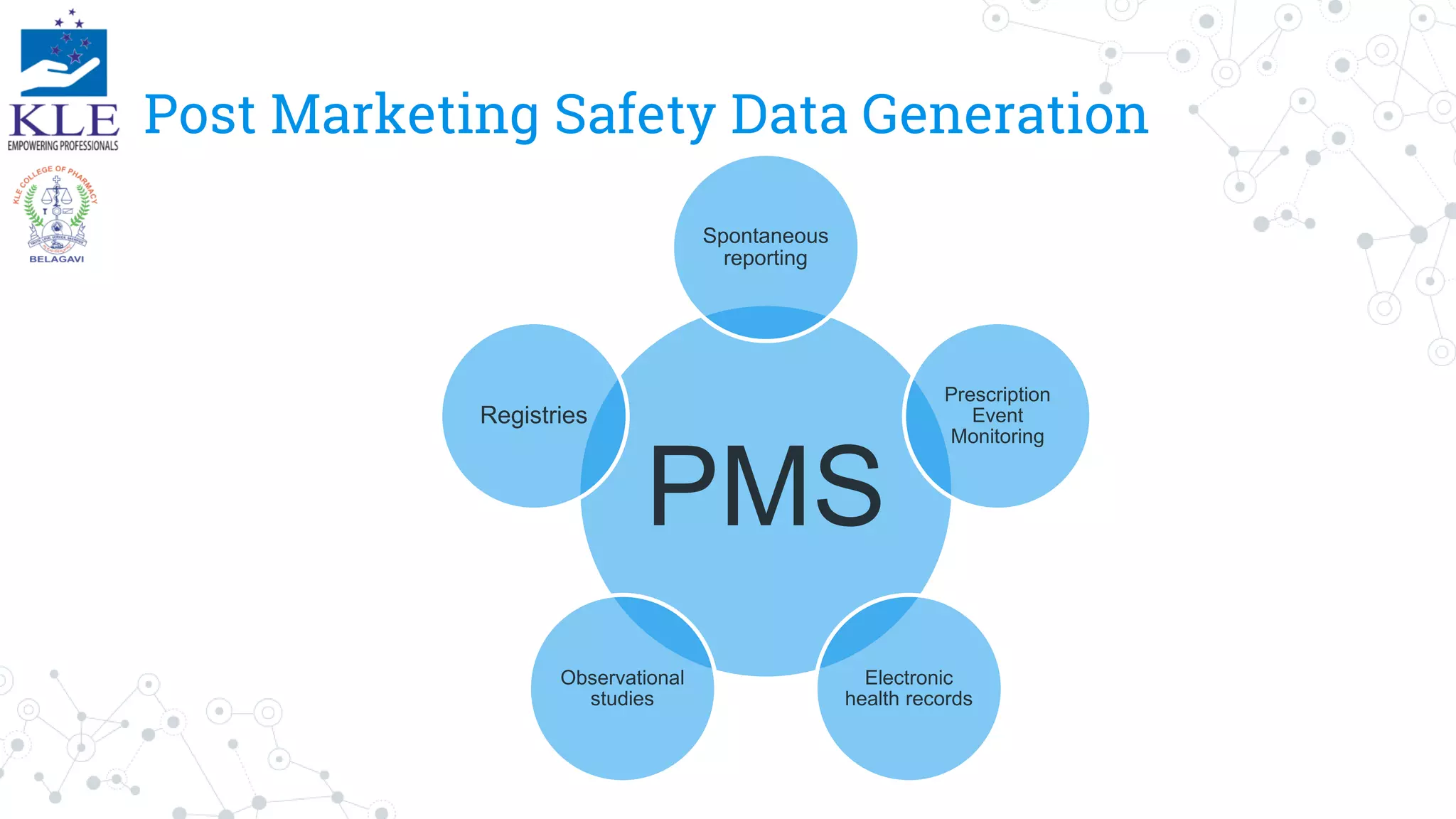
PMS
Spontaneous
reporting
Prescription
Event
Monitoring
Electronic
health records
Observational
studies
Registries
Post Marketing Safety Data Generation
 Post marketing safety evaluation data source:
Product’s preapproval safety profile
Current FDA approved label
FDA adverse event reports (FAERS)
Reports of vaccine adverse event reporting system
(VAERS)
Periodic submission of safety reports
Post Marketing Safety Data Generation
 Post marketing reports timeline:
Serious and unexpected AEs: FDA recommends
report to be submitted within 15 days
Follow up - Up to 15 days alert reports should be
submitted within 15 days
32

Safety Data Generation

  • 1.
    Safety Data Generation Dr.Ramesh Bhandari Asst. Professor Department of Pharmacy Practice KLE College of Pharmacy, Belagavi
  • 2.
  • 3.
    Safety data generation •In-vitro, In-vivo • Safety pharmacology Pre-Clinical Phase • AEs/SAEs • Subject Follow-ups Clinical Phase • PSURs • Marketing authorization holders (MAH) AEs Post Approval Phase
  • 4.
  • 5.
    Pre-Clinical Phase DataGeneration ◎ Exploratory toxicology: ◎ Regulatory toxicology
  • 6.
    Pre-Clinical Phase DataGeneration ◎ Exploratory toxicology:  Provide a rough quantitative estimate of toxicity (acute or repeated dose)  Provides main organs and systems involved
  • 7.
    Pre-Clinical Phase DataGeneration ◎ Regulatory toxicology:  Performed to GLP standards and comprise regulatory requirement by authorities  Performed to support an application for marketing approval
  • 8.
    Pre-Clinical Phase DataGeneration ◎ Exploratory toxicology: In-vitro and in- vivo studies:  Mutagenicity  Cytotoxicity  Immunotoxicity  Hepatotoxicity  Embryotoxicity
  • 9.
    Pre-Clinical Phase DataGeneration ◎ Regulatory Toxicology:  Safety pharmacology  GLP guidelines  Acute toxicity  Chronic toxicity  Reproductive toxicity
  • 10.
    Pre-Clinical Phase DataGeneration  Safety pharmacology:  Pharmacological testing to check that the drug does not produce any obviously hazardous acute effects known as safety pharmacology.
  • 11.
    Pre-Clinical Phase DataGeneration  Safety pharmacology:  System wise tests  Follow up tests  Supplementary tests
  • 12.
    Pre-Clinical Phase DataGeneration  Safety pharmacology:  System wise tests • CVS: BP, Heart rate, ECG changes • Respiratory: RR, Tidal volume • CNS: Behavioural Changes, motor activity, Body temperature
  • 13.
    Pre-Clinical Phase DataGeneration  Safety pharmacology:  Follow up tests  CVS: Cardiac output, ventricular contractility  Respiratory: pulmonary arterial pressure, blood gases
  • 14.
    Pre-Clinical Phase DataGeneration  Safety pharmacology:  Supplementary tests: • Renal function: Urinary volume, pH, proteinuria, blood urea • GIT: gastric secretion, pH, GI motility, GI transit time
  • 15.
    Pre-Clinical Phase DataGeneration  Acute toxicity: o28 days repeat dose toxicity and recovery in 2 species  Chronic toxicity: o3-12 months chronic toxicity in 2 species
  • 16.
    Pre-Clinical Phase DataGeneration  Reproductive toxicity: oReproductive toxicity in 1 species  Carcinogenicity: o24 months carcinogenicity in 2 species
  • 17.
  • 18.
    Clinical Trial SafetyData Generation • 20–100 People • Usually 1-2 Years Phase I (Safety) • 100-300 People • 1-2 Years Phase II (Efficacy and Safety) • 1000-3000 Peoples • 2-3 Years Phase III (Efficacy and Safety)
  • 19.
    Clinical Trial SafetyData Generation  Serious adverse events reporting  Conducting Subjects follow up  Ensuring subject compliance  Continue communication
  • 20.
    Clinical Trial SafetyData Generation Adverse Events Unexpected adverse events Any laboratory abnormalities Serious Adverse events Adverse events of special interest Adverse drug reactions
  • 21.
    Clinical Trial SafetyData Generation  Adverse Event: Any untoward medical occurrence observed during treatment while a pharmaceutical product which does not necessarily have a causal relationship with the treatment. • Adverse outcomes after use of the drug • Any new clinical experience may or may not be linked to the use of drug • Eg: any laboratory abnormality or new symptoms after the use of the drug
  • 22.
    Clinical Trial SafetyData Generation  Sources: Clinical Information sources Non Clinical Information Sources
  • 23.
    Clinical Trial SafetyData Generation  Sources: Clinical Information sources: Data from clinical and epidemiological studies Data from pharmaceutical companies Safety profile of the drugs of similar class or type Data from clinical studies
  • 24.
    Clinical Trial SafetyData Generation  Sources: Non Clinical Information Sources: Chemical structure, class indication, adverse effects, actions In-vitro studies report Data from toxicology studies in animals (Cardiotoxicity, hepatotoxicity, renal toxicity, carcinogenicity, mutagenicity)
  • 25.
    Clinical Trial SafetyData Generation  Serious adverse event  Adverse drug reaction  Unexpected adverse event: Nature and severity of which is not consistent with the risk information described in general investigational plan of investigator’s brochure
  • 26.
    Clinical Trial SafetyData Generation  Reporting timelines: Any Serious, unexpected or life threatening adverse events must be reported within 7 days Any other unexpected AEs that are neither fatal not life threatening should be reported within 15 days
  • 27.
  • 28.
    Post Marketing SafetyData Generation  Periodic safety update reports  PSUR Process  Intake of ADR information  Data Retrieval  Data analysis  PSURs should be submitted every months for first two years and annually for subsequent 2 years. (India)
  • 29.
    Post Marketing SafetyData Generation PMS Spontaneous reporting Prescription Event Monitoring Electronic health records Observational studies Registries
  • 30.
    Post Marketing SafetyData Generation  Post marketing safety evaluation data source: Product’s preapproval safety profile Current FDA approved label FDA adverse event reports (FAERS) Reports of vaccine adverse event reporting system (VAERS) Periodic submission of safety reports
  • 31.
    Post Marketing SafetyData Generation  Post marketing reports timeline: Serious and unexpected AEs: FDA recommends report to be submitted within 15 days Follow up - Up to 15 days alert reports should be submitted within 15 days
  • 32.