SOCIOLOGY
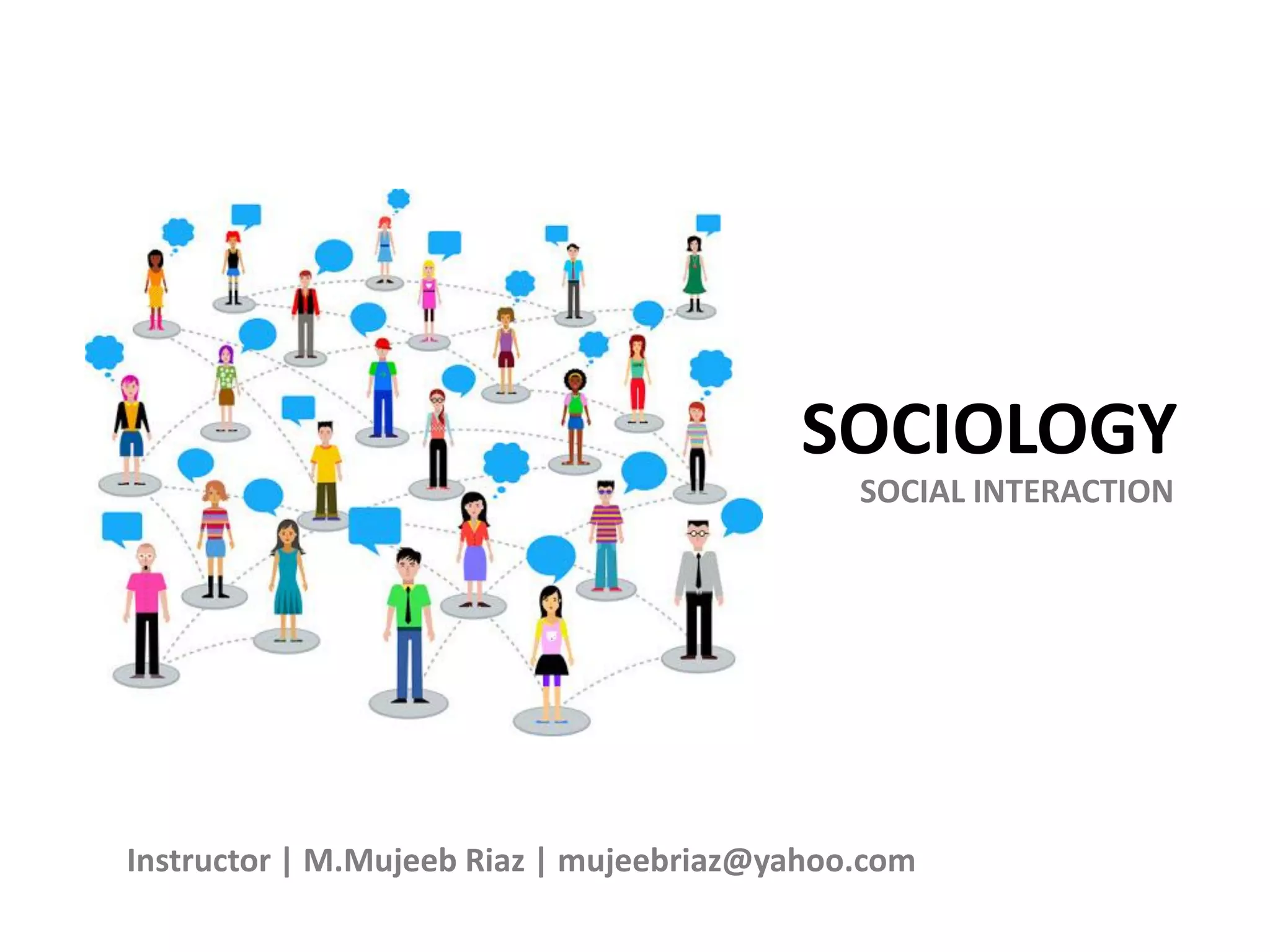
SOCIAL INTERACTION
Instructor | M.Mujeeb Riaz | mujeebriaz@yahoo.com
• The Process by which people act and react in
relation to each other.
Person
/Indiviual
Action
Influence/Direct
Others
To do Reaction
Social Interaction
SOCIAL INTERACTION
• Social interaction is the reciprocal influencing of
the acts of persons and groups.
• Reciprocal social relationship is that situation in
which the actual or expected behavior of one
person affects the behavior of others.
• As a result there is an exchange of acts between
or among individuals.
• “In this way social interaction is the process by
which people act and react in relation to each
other. Through interaction we create the reality”.
COMPONENTS OF SOCIAL
INTERACTION
• Components of Social Interaction
– Social Status
– Role
– The Social Construction of Reality
– Communication
SOCIAL STATUS
• Social status is a recognized social position that
an individual occupies in a social situation.
• In common usage status might indicate the
power, prestige and privileges associated with
one’s position.
• Sociological meaning of social status is different
from every day meanings that are usually
associated with ‘prestige’.
• STATUS IS WHO WE ARE AND WHAT WE ARE IN
RELATION TO OTHERS.
Master Status
Achieved Status
Ascribed Status
• Ascribed Status :
A social position that someone receives at
birth or someone assumes involuntarily later
in life is an ascribed status.i.e
Nationality |Caste |Color
• Achieved Status
Concept developed by anthropologist Ralph
Linton.
Achieved status refers to a social position
that some assumes voluntarily.
It reflects personal ability, skills and effort. It is
acquired on the basis of merit.
• Master Status
• Master status is a status that has an
exceptional importance for social identity
,often shaping a person’s entire life.
• Once occupation is an example.
ROLE
• Role is a behavior expected of someone who
holds a particular status. Role is the dynamic
aspect of one’s status: an individual holds a
status and performs a role.
• There are a number of other aspects of role
like:
Different Aspects of Role
Role Set
Role
Conflict
Role
Strain
Role Exit
Role Set
• Since we occupy many statuses simultaneously therefore we perform multiple roles. The
performance of such multiple roles related to a status is referred to as role set. Role set refers to a
number of roles attached to a single status. You have a status of student, think of how many roles do
you have to perform.
Role Conflict
• Role conflict is incompatibility among roles corresponding to two or more statuses. Roles of a woman
being a mother and an employee in an office may conflict with each other.
Role Strain
Roles connected with a single status may make competing demands on an individual, therefore may
create strain in the performance of those roles simultaneously. Hence role strain refers to
incompatibility among roles corresponding to a single status. A teacher being friendly with the
students as well as the maintainer of discipline in the class could be an example.
Role Exit
• A person begins the process of role exit by reflecting on his life and coming to doubt his ability to
continue in a certain role. He may imagine alternative role and may go for it. It may be linked status
exit, which may be voluntary or involuntary. A person decides to leave a job voluntarily and has a role
exit. A person retires and again has a role exit. “Process of becoming ex”, an ex- chairman, an ex-
director are the examples.
THE SOCIAL CONSTRUCTION OF
REALITY
• Adopting situation from different formal and informal institutions
consciously or unconsciously.
• The process by which people shape reality
through social interaction.
• The whole of this process of construction of one’s self/reality is based on
learning through social interaction.
• Social construction of reality is the process by which people creatively
shape reality through interaction.
• Through social interaction we negotiate the reality i.e. some agreement
about what is going on, though people may have different perceptions of
the event.
• Social construction of the life span of people into childhood, adulthood, and
old age can be the examples. Situations that we define as real become real
in their consequences or in their being functional. Reality as perceived by
the people as they have constructed. What is the reality of a commonly
used phrase: How are you? Do we mean physically? Mentally? Spiritually?
Financially?
COMMUNICATION
• Communication is another important component of
interaction for which we need to have a language –
verbal as well as non-verbal.
• Human beings develop symbols, signs, and codes that
they associate with the realities of life. These signs,
symbols, and codes stand for the reality or
phenomenon (material/non material), they are not the
phenomenon itself.
• Meanings are attached to the symbols and there is
some agreement on the meanings. Meanings can be
situation specific and may vary by different cultures.
Thanks

Social interaction by Mujeeb Riaz_ Sociology

  • 1.
    SOCIOLOGY SOCIAL INTERACTION Instructor |M.Mujeeb Riaz | mujeebriaz@yahoo.com
  • 2.
    • The Processby which people act and react in relation to each other. Person /Indiviual Action Influence/Direct Others To do Reaction Social Interaction
  • 3.
    SOCIAL INTERACTION • Socialinteraction is the reciprocal influencing of the acts of persons and groups. • Reciprocal social relationship is that situation in which the actual or expected behavior of one person affects the behavior of others. • As a result there is an exchange of acts between or among individuals. • “In this way social interaction is the process by which people act and react in relation to each other. Through interaction we create the reality”.
  • 4.
    COMPONENTS OF SOCIAL INTERACTION •Components of Social Interaction – Social Status – Role – The Social Construction of Reality – Communication
  • 5.
    SOCIAL STATUS • Socialstatus is a recognized social position that an individual occupies in a social situation. • In common usage status might indicate the power, prestige and privileges associated with one’s position. • Sociological meaning of social status is different from every day meanings that are usually associated with ‘prestige’. • STATUS IS WHO WE ARE AND WHAT WE ARE IN RELATION TO OTHERS.
  • 6.
  • 7.
    • Ascribed Status: A social position that someone receives at birth or someone assumes involuntarily later in life is an ascribed status.i.e Nationality |Caste |Color
  • 8.
    • Achieved Status Conceptdeveloped by anthropologist Ralph Linton. Achieved status refers to a social position that some assumes voluntarily. It reflects personal ability, skills and effort. It is acquired on the basis of merit.
  • 9.
    • Master Status •Master status is a status that has an exceptional importance for social identity ,often shaping a person’s entire life. • Once occupation is an example.
  • 11.
    ROLE • Role isa behavior expected of someone who holds a particular status. Role is the dynamic aspect of one’s status: an individual holds a status and performs a role. • There are a number of other aspects of role like:
  • 12.
    Different Aspects ofRole Role Set Role Conflict Role Strain Role Exit
  • 13.
    Role Set • Sincewe occupy many statuses simultaneously therefore we perform multiple roles. The performance of such multiple roles related to a status is referred to as role set. Role set refers to a number of roles attached to a single status. You have a status of student, think of how many roles do you have to perform. Role Conflict • Role conflict is incompatibility among roles corresponding to two or more statuses. Roles of a woman being a mother and an employee in an office may conflict with each other. Role Strain Roles connected with a single status may make competing demands on an individual, therefore may create strain in the performance of those roles simultaneously. Hence role strain refers to incompatibility among roles corresponding to a single status. A teacher being friendly with the students as well as the maintainer of discipline in the class could be an example. Role Exit • A person begins the process of role exit by reflecting on his life and coming to doubt his ability to continue in a certain role. He may imagine alternative role and may go for it. It may be linked status exit, which may be voluntary or involuntary. A person decides to leave a job voluntarily and has a role exit. A person retires and again has a role exit. “Process of becoming ex”, an ex- chairman, an ex- director are the examples.
  • 14.
    THE SOCIAL CONSTRUCTIONOF REALITY • Adopting situation from different formal and informal institutions consciously or unconsciously. • The process by which people shape reality through social interaction. • The whole of this process of construction of one’s self/reality is based on learning through social interaction.
  • 15.
    • Social constructionof reality is the process by which people creatively shape reality through interaction. • Through social interaction we negotiate the reality i.e. some agreement about what is going on, though people may have different perceptions of the event. • Social construction of the life span of people into childhood, adulthood, and old age can be the examples. Situations that we define as real become real in their consequences or in their being functional. Reality as perceived by the people as they have constructed. What is the reality of a commonly used phrase: How are you? Do we mean physically? Mentally? Spiritually? Financially?
  • 16.
    COMMUNICATION • Communication isanother important component of interaction for which we need to have a language – verbal as well as non-verbal. • Human beings develop symbols, signs, and codes that they associate with the realities of life. These signs, symbols, and codes stand for the reality or phenomenon (material/non material), they are not the phenomenon itself. • Meanings are attached to the symbols and there is some agreement on the meanings. Meanings can be situation specific and may vary by different cultures.
  • 17.