1
2
Learning Outcomes
1. State what soap is
2. State what detergent is
3. Describe soap preparation process
4. Describe detergent preparation process
5. Describe the cleansing action of soap
6. Describe the cleansing action of detergent
7. Compare and contrast the effectiveness
of cleansing action of soap and detergent
8. Identify the additives in detergent and
their respective functions
3
What is soap?
 Soaps are sodium or potassium salts of
long-chain fatty acids.
 General formula of a soap can be written
as:
RCOONa+ or RCOOK+
 R is an alkyl group that usually containing
12 to 18 carbon atoms.
 It can be saturated or unsaturated
4
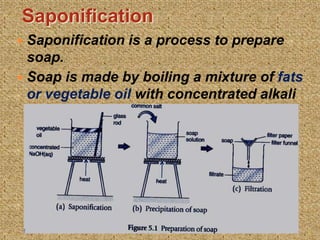
Saponification
 Saponification is a process to prepare
soap.
 Soap is made by boiling a mixture of fats
or vegetable oil with concentrated alkali
(NaOH or KOH)
5
What is detergent?
 Detergent is non-soap cleansing agent.
 It is divided into natural detergent and
synthetic detergent
 Detergent is the sodium salt of sulphonic
acid
 Natural detergent is made from animal or
vegetable oil while synthetic detergent is
normally made from petroleum
 Commercialized detergent are usually
sodium alkyl sulphate and sodium alkyl
benzene sulphonate 6
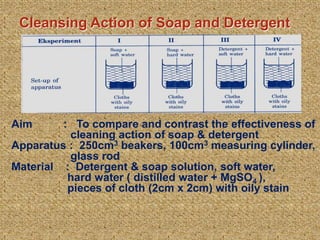
Cleansing Action of Soap and Detergent
Aim : To compare and contrast the effectiveness of
cleaning action of soap & detergent
Apparatus : 250cm3 beakers, 100cm3 measuring cylinder,
glass rod
Material : Detergent & soap solution, soft water,
hard water ( distilled water + MgSO4 ),
pieces of cloth (2cm x 2cm) with oily stain
7
Procedures:
1. Prepare 4 beakers with the content below:
2. Stir the solution in each beaker using a glass rod until no
changes can be observed
3. Record all changes that occurred
4. Place a piece of cloth with oily stain into each beaker.
5. Wash the oily stain on each piece using the solution in
each beaker and stirred
6. Observe and record whether the oily stain on each piece of
cloth dissapear.
Experiment Content
I 100cm3 of soap solution
II 50cm3 of soap solution + 50cm3 MgSO4
III 100cm3 of detergent solution
IV 50cm3 of detergent solution + 50cm3 MgSO4
8
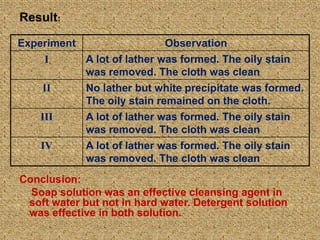
Result:
Conclusion:
Soap solution was an effective cleansing agent in
soft water but not in hard water. Detergent solution
was effective in both solution.
Experiment Observation
I A lot of lather was formed. The oily stain
was removed. The cloth was clean
II No lather but white precipitate was formed.
The oily stain remained on the cloth.
III A lot of lather was formed. The oily stain
was removed. The cloth was clean
IV A lot of lather was formed. The oily stain
was removed. The cloth was clean
9
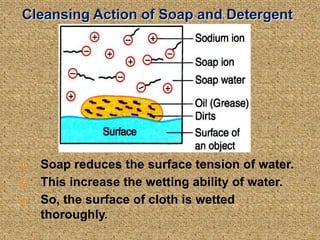
Cleansing Action of Soap and Detergent
1. Soap reduces the surface tension of water.
2. This increase the wetting ability of water.
3. So, the surface of cloth is wetted
thoroughly.
10
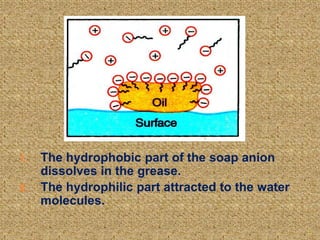
1. The hydrophobic part of the soap anion
dissolves in the grease.
2. The hydrophilic part attracted to the water
molecules.
11
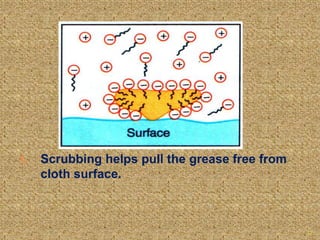
1. Scrubbing helps pull the grease free from
cloth surface.
12
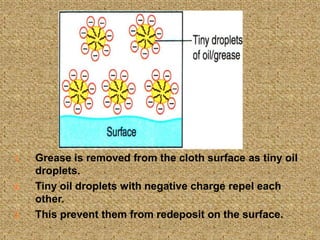
1. Grease is removed from the cloth surface as tiny oil
droplets.
2. Tiny oil droplets with negative charge repel each
other.
3. This prevent them from redeposit on the surface.
13
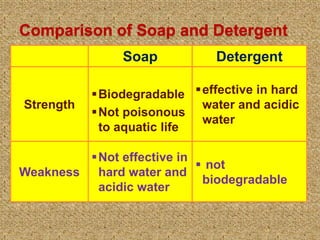
Comparison of Soap and Detergent
Soap Detergent
Strength
Biodegradable
Not poisonous
to aquatic life
effective in hard
water and acidic
water
Weakness
Not effective in
hard water and
acidic water
 not
biodegradable
14
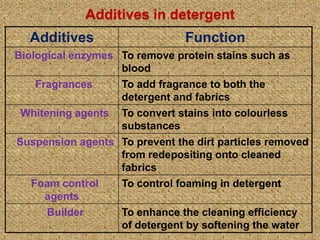
Additives in detergent
Additives Function
Biological enzymes To remove protein stains such as
blood
Fragrances To add fragrance to both the
detergent and fabrics
Whitening agents To convert stains into colourless
substances
Suspension agents To prevent the dirt particles removed
from redepositing onto cleaned
fabrics
Foam control
agents
To control foaming in detergent
Builder To enhance the cleaning efficiency
of detergent by softening the water15

Soap and detergent

  • 1.
  • 2.
  • 3.
    Learning Outcomes 1. Statewhat soap is 2. State what detergent is 3. Describe soap preparation process 4. Describe detergent preparation process 5. Describe the cleansing action of soap 6. Describe the cleansing action of detergent 7. Compare and contrast the effectiveness of cleansing action of soap and detergent 8. Identify the additives in detergent and their respective functions 3
  • 4.
    What is soap? Soaps are sodium or potassium salts of long-chain fatty acids.  General formula of a soap can be written as: RCOONa+ or RCOOK+  R is an alkyl group that usually containing 12 to 18 carbon atoms.  It can be saturated or unsaturated 4
  • 5.
    Saponification  Saponification isa process to prepare soap.  Soap is made by boiling a mixture of fats or vegetable oil with concentrated alkali (NaOH or KOH) 5
  • 6.
    What is detergent? Detergent is non-soap cleansing agent.  It is divided into natural detergent and synthetic detergent  Detergent is the sodium salt of sulphonic acid  Natural detergent is made from animal or vegetable oil while synthetic detergent is normally made from petroleum  Commercialized detergent are usually sodium alkyl sulphate and sodium alkyl benzene sulphonate 6
  • 7.
    Cleansing Action ofSoap and Detergent Aim : To compare and contrast the effectiveness of cleaning action of soap & detergent Apparatus : 250cm3 beakers, 100cm3 measuring cylinder, glass rod Material : Detergent & soap solution, soft water, hard water ( distilled water + MgSO4 ), pieces of cloth (2cm x 2cm) with oily stain 7
  • 8.
    Procedures: 1. Prepare 4beakers with the content below: 2. Stir the solution in each beaker using a glass rod until no changes can be observed 3. Record all changes that occurred 4. Place a piece of cloth with oily stain into each beaker. 5. Wash the oily stain on each piece using the solution in each beaker and stirred 6. Observe and record whether the oily stain on each piece of cloth dissapear. Experiment Content I 100cm3 of soap solution II 50cm3 of soap solution + 50cm3 MgSO4 III 100cm3 of detergent solution IV 50cm3 of detergent solution + 50cm3 MgSO4 8
  • 9.
    Result: Conclusion: Soap solution wasan effective cleansing agent in soft water but not in hard water. Detergent solution was effective in both solution. Experiment Observation I A lot of lather was formed. The oily stain was removed. The cloth was clean II No lather but white precipitate was formed. The oily stain remained on the cloth. III A lot of lather was formed. The oily stain was removed. The cloth was clean IV A lot of lather was formed. The oily stain was removed. The cloth was clean 9
  • 10.
    Cleansing Action ofSoap and Detergent 1. Soap reduces the surface tension of water. 2. This increase the wetting ability of water. 3. So, the surface of cloth is wetted thoroughly. 10
  • 11.
    1. The hydrophobicpart of the soap anion dissolves in the grease. 2. The hydrophilic part attracted to the water molecules. 11
  • 12.
    1. Scrubbing helpspull the grease free from cloth surface. 12
  • 13.
    1. Grease isremoved from the cloth surface as tiny oil droplets. 2. Tiny oil droplets with negative charge repel each other. 3. This prevent them from redeposit on the surface. 13
  • 14.
    Comparison of Soapand Detergent Soap Detergent Strength Biodegradable Not poisonous to aquatic life effective in hard water and acidic water Weakness Not effective in hard water and acidic water  not biodegradable 14
  • 15.
    Additives in detergent AdditivesFunction Biological enzymes To remove protein stains such as blood Fragrances To add fragrance to both the detergent and fabrics Whitening agents To convert stains into colourless substances Suspension agents To prevent the dirt particles removed from redepositing onto cleaned fabrics Foam control agents To control foaming in detergent Builder To enhance the cleaning efficiency of detergent by softening the water15