DEPARTMENT OF CHEMICAL ENGINEERING
EGE UNIVERSITY
ChE 116 TECHNICAL COMMUNICATION
OUTLINE
*History
*Types
*Properties
*Uses
*Manufacturing Processes
*Economic Analysis
*Environmental Impacts
*Benefits
*Detergents vs Soaps
*Future
*Alternate Sources
*Most Expensive Soap
HISTORY OF SOAP
• In the biblical period, soaps were made from
plant derivatives.
• The origin of word “soap” is unclear, but some
legends are documented.
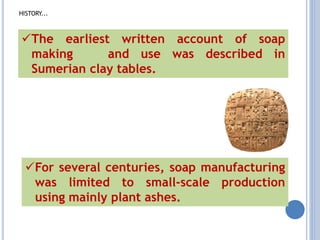
The earliest written account of soap
making and use was described in
Sumerian clay tables.
For several centuries, soap manufacturing
was limited to small-scale production
using mainly plant ashes.
HISTORY...
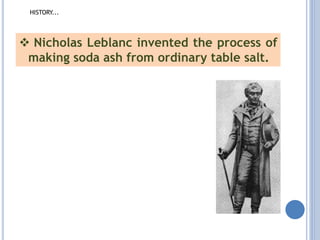
 Nicholas Leblanc invented the process of
making soda ash from ordinary table salt.
HISTORY...
 Fritz Gunther developed the first
synthetic detergent.
HISTORY...
Liquid Soaps
Toilet Soaps
TYPES...
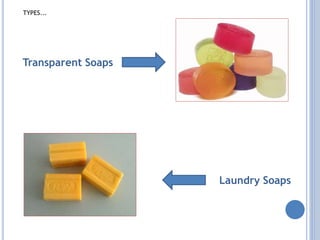
Transparent Soaps
Laundry Soaps
TYPES...
Antibacterial Soaps
Shaving Soaps
TYPES...
Soaps for cleansing are obtained by treating
vegetable or animal oils and fats with a strongly
alkaline solution.
Figure 1 Formation of Triglyceride
PROPERTIES...
 A long hydrophobic hydrocarbon “tail”
 A hydrophilic anionic “head”
Figure 2 General Structure of Soap
PROPERTIES...
USES
Personal hygiene
Laundry
Textile
Polymerization(Plastic and rubber industry)
Cosmetics
 Leather
RAW MATERIALS
Fats and oils
Tallow
Lard
 Lye (caustic soda)
Natural fatty acids
Non-fatty soap stocks
Alkalines
Smaller-scale production involves the traditional batch
processes. The three variations are:
 Cold Process
 Hot Process
 Fully-boiled Process
BATCH PROCESS
Continuous processes are preferred today because of their
flexibility, speed and economics.
CONTINUOUS PROCESS
Figure 3 Flow sheet of manufacture of soaps, fatty acids
and glycerin
THE LEVEL AND DEVELOPMENT OF TURKEY
In the soap industry,
Turkey has a very big
production capacity,
which is greater than
demand.
RATE OF EXPORTS OF SOAP
Soap exports in Turkey have
declined significantly in
1991 compared to 1990.
In 1992 and 1993 a
significant increase took
place.
RATE OF EXPORTS OF SOAP...
Table 1 Turkey's Various Types of Soap Exports
Products
1992 1993 1994
Quantify Value Quantify Value Quantify Value
Medical and
disinfectant
soaps
1.340t* $1.228 249t $258 420t $314
Toilet soaps 37.879t $34.493 38.609t $37.689 58.592t $58.816
Other soaps 28.528t $17.387 24.890t $13.671 18.892t $10.683
Total(soaps) 69.807t $53.107 63.749t $51.617 78.264t $69.813
*t: tones
The main countries that exported the soap are
Bulgaria, Rumania, Iraq, Egypt, Polish, Kazakhstan,
Albania and Jordan .
RATE OF EXPORTS OF SOAP...
Countries 1992 1993 1994
Russian
Federation
7.049.096t* 6.676.132t 13.406.385t
Bulgaria 62.826t 3.643.935t 6.607.495t
Rumania 2.285.709t 3.022.940t 5.985.360t
Iraq 16.739.286t 4.703.930t 4.549.156t
Polish 3.303.579t 4.584.737t 4.185.550t
Egypt 3.385.884t 4.151.455t 4.055.668t
Kazakhstan 452.403t 323.377t 3.584.622t
Albania 2.285.709t 3.022.940t 3.401.572t
Jordan 5.894.580t 4.951.581t 1.488.274t
Others 11.647.805t 16.536.248t 22.548.599t
Total 53.106.877t 51.617.275t 69.812.681t
Table 2 Turkey's Exports of Soap Comparison According to Countries
*t: tones
ENVIRONMENTAL IMPACTS...
TRICLOSAN TRICLOCARBAN
Hygiene
Reduce the spread of germs
Fresh, clean and smelling hands
Reduce the risk of diarrhea
BENEFITS...
General Properties of Soap General Properties of Detergents
They are obtained from vegetable or
animal oils.
They are derived synthetically from
petroleum.
They are natural so they have no
effect on human body.
They affect the human body.
They are easily broken down by
natural means.
They can’t easily decompose.
They do not cause water pollution. They cause water pollution.
They have no damage to the
environment.
They cause environmental pollution.
They lose their cleaning power over
time.
They have special formulas for
different purposes.
They form a precipitate with metal
ions present in hard water.
They are less affected by the ions in
hard water.
They can damage clothes. They don’t damage clothes too much.
They clean more effective in hot
water.
They clean well even in cold water.
They are used for thousands of
years.
They are widely used in the last 50-60
years.
FUTURE...
DEMOGRAPHICS ENVIRONMENT
GLOBALIZATION ECONOMY
Environment-friendly products
More money for testing
FUTURE...
Cheapest and harmless raw materials
Alternatives to caustic soda
ALTERNATE SOURCES...
 Plantain peel ash
 Cassava peel ash
ALTERNATE SOURCES...
MOST EXPENSIVE SOAP
• Silver, a known antibacterial agent, is what makes Cor
the most expensive soap in the world.
• Cor retails for $125 for a 120 gram bar.
Soap

Soap

  • 1.
    DEPARTMENT OF CHEMICALENGINEERING EGE UNIVERSITY ChE 116 TECHNICAL COMMUNICATION
  • 2.
    OUTLINE *History *Types *Properties *Uses *Manufacturing Processes *Economic Analysis *EnvironmentalImpacts *Benefits *Detergents vs Soaps *Future *Alternate Sources *Most Expensive Soap
  • 5.
    HISTORY OF SOAP •In the biblical period, soaps were made from plant derivatives. • The origin of word “soap” is unclear, but some legends are documented.
  • 6.
    The earliest writtenaccount of soap making and use was described in Sumerian clay tables. For several centuries, soap manufacturing was limited to small-scale production using mainly plant ashes. HISTORY...
  • 7.
     Nicholas Leblancinvented the process of making soda ash from ordinary table salt. HISTORY...
  • 8.
     Fritz Guntherdeveloped the first synthetic detergent. HISTORY...
  • 10.
  • 11.
  • 12.
  • 14.
    Soaps for cleansingare obtained by treating vegetable or animal oils and fats with a strongly alkaline solution. Figure 1 Formation of Triglyceride PROPERTIES...
  • 15.
     A longhydrophobic hydrocarbon “tail”  A hydrophilic anionic “head” Figure 2 General Structure of Soap PROPERTIES...
  • 17.
  • 19.
    RAW MATERIALS Fats andoils Tallow Lard  Lye (caustic soda) Natural fatty acids Non-fatty soap stocks Alkalines
  • 20.
    Smaller-scale production involvesthe traditional batch processes. The three variations are:  Cold Process  Hot Process  Fully-boiled Process BATCH PROCESS
  • 21.
    Continuous processes arepreferred today because of their flexibility, speed and economics. CONTINUOUS PROCESS
  • 22.
    Figure 3 Flowsheet of manufacture of soaps, fatty acids and glycerin
  • 24.
    THE LEVEL ANDDEVELOPMENT OF TURKEY In the soap industry, Turkey has a very big production capacity, which is greater than demand.
  • 25.
    RATE OF EXPORTSOF SOAP Soap exports in Turkey have declined significantly in 1991 compared to 1990.
  • 26.
    In 1992 and1993 a significant increase took place. RATE OF EXPORTS OF SOAP...
  • 27.
    Table 1 Turkey'sVarious Types of Soap Exports Products 1992 1993 1994 Quantify Value Quantify Value Quantify Value Medical and disinfectant soaps 1.340t* $1.228 249t $258 420t $314 Toilet soaps 37.879t $34.493 38.609t $37.689 58.592t $58.816 Other soaps 28.528t $17.387 24.890t $13.671 18.892t $10.683 Total(soaps) 69.807t $53.107 63.749t $51.617 78.264t $69.813 *t: tones
  • 28.
    The main countriesthat exported the soap are Bulgaria, Rumania, Iraq, Egypt, Polish, Kazakhstan, Albania and Jordan . RATE OF EXPORTS OF SOAP...
  • 29.
    Countries 1992 19931994 Russian Federation 7.049.096t* 6.676.132t 13.406.385t Bulgaria 62.826t 3.643.935t 6.607.495t Rumania 2.285.709t 3.022.940t 5.985.360t Iraq 16.739.286t 4.703.930t 4.549.156t Polish 3.303.579t 4.584.737t 4.185.550t Egypt 3.385.884t 4.151.455t 4.055.668t Kazakhstan 452.403t 323.377t 3.584.622t Albania 2.285.709t 3.022.940t 3.401.572t Jordan 5.894.580t 4.951.581t 1.488.274t Others 11.647.805t 16.536.248t 22.548.599t Total 53.106.877t 51.617.275t 69.812.681t Table 2 Turkey's Exports of Soap Comparison According to Countries *t: tones
  • 31.
  • 34.
    Hygiene Reduce the spreadof germs Fresh, clean and smelling hands Reduce the risk of diarrhea BENEFITS...
  • 35.
    General Properties ofSoap General Properties of Detergents They are obtained from vegetable or animal oils. They are derived synthetically from petroleum. They are natural so they have no effect on human body. They affect the human body. They are easily broken down by natural means. They can’t easily decompose. They do not cause water pollution. They cause water pollution. They have no damage to the environment. They cause environmental pollution. They lose their cleaning power over time. They have special formulas for different purposes. They form a precipitate with metal ions present in hard water. They are less affected by the ions in hard water. They can damage clothes. They don’t damage clothes too much. They clean more effective in hot water. They clean well even in cold water. They are used for thousands of years. They are widely used in the last 50-60 years.
  • 37.
  • 38.
  • 40.
    Cheapest and harmlessraw materials Alternatives to caustic soda ALTERNATE SOURCES...
  • 41.
     Plantain peelash  Cassava peel ash ALTERNATE SOURCES...
  • 42.
    MOST EXPENSIVE SOAP •Silver, a known antibacterial agent, is what makes Cor the most expensive soap in the world. • Cor retails for $125 for a 120 gram bar.